Posts Tagged ‘Australian Motor Racing History’

lex balcombe

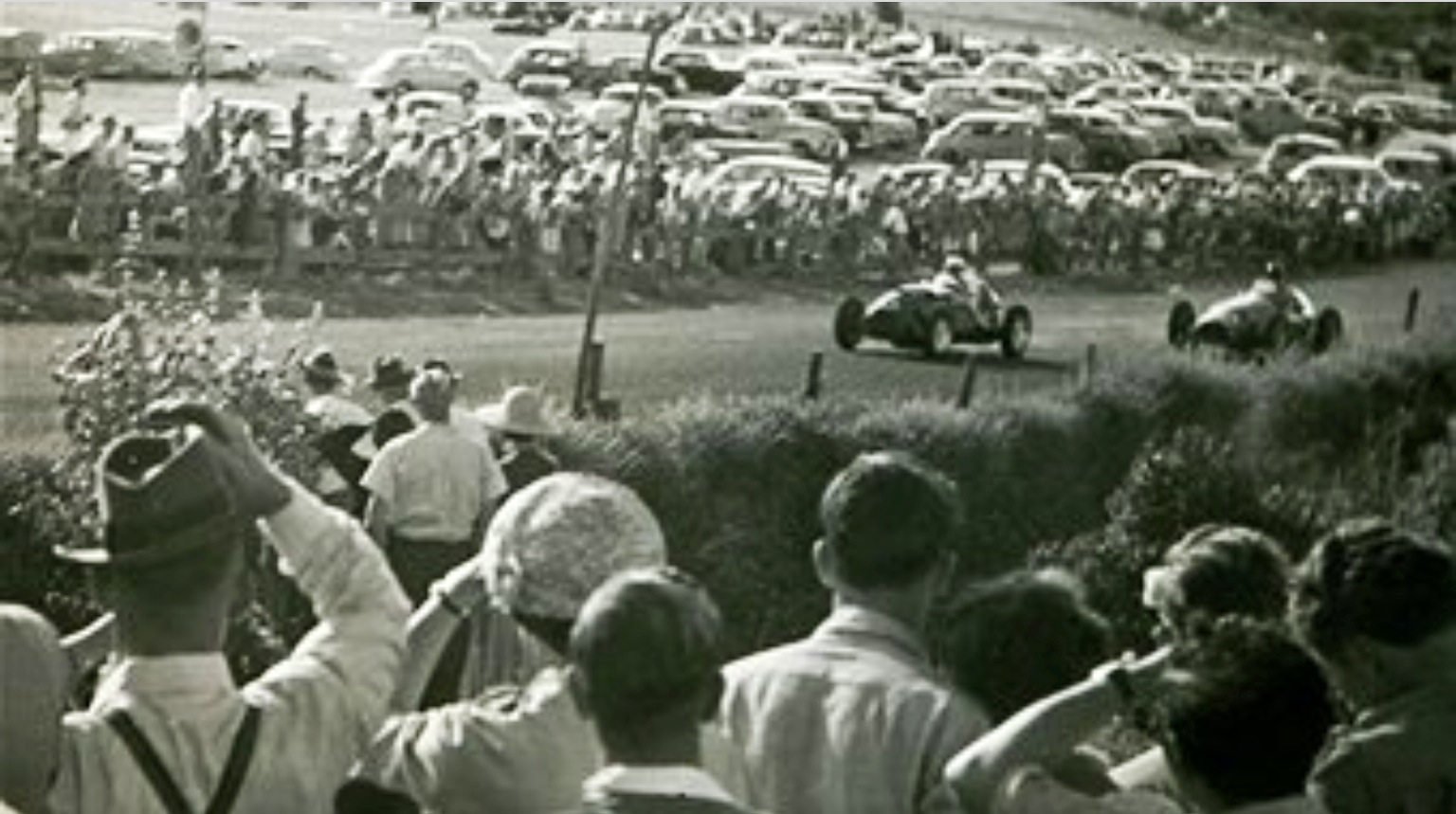
Lex Davison’s ‘Little Alfa’ leads Lyndon Duckett’s Bugatti Type 35 Anzani, the brand new body of the Alfa gleaming in the winter sun, Balcombe Army Camp, Victoria, Australia 12 June 1950…

The ‘race meeting’ at Balcombe was a small but historically significant part of Australian Motor Racing history, this wonderful shot is from the Dacre Stubbs Collection.

Balcombe paddock with Lyndon Duckett’s Bugatti T35 Anzani and the Davison Little Alfa in foreground (G McKaige)

It goes something like this, as reported in Barry Greens fine book ‘Glory Days’ which records the history of Albert Park in the 1950’s.

The army were keen to raise money for their canteen fund and asked the Light Car Club of Australia (LCCA) to run a race meeting using the grounds of their camp. The race meeting was a financial success, but key to the creation of a circuit was closure and use of a section of the Nepean Highway, the main road between Melbourne and the Mornington Peninsula- permission was not forthcoming from the relevant authority

So the Balcombe meeting occurred as more of a sprint event given track limitations with two cars on the track at a time, and a series of eliminations on the day to determine the winners of the various classes.

Charlie Dean in Maybach 1- handsome and fast beast that it was, sold to Stan Jones a year or so later but maintained and developed by Charlie and his boys at Repco Research in Brunswick in the years which followed. Winner of the 1954 New Zealand GP in Jones’ hands. Recreated by John Sheppard in the eighties (G McKaige)

‘The Royal Australian Signals Corp Sprint’ for under 1500cc, ‘The Survey Corps Sports Sprint’ for over 1500cc and ‘Balcombe Apprentice School Trophy’ for outright cars were catchy names indeed!

Doug Whiteford won the outright final in his 1950 Australian Grand Prix Winning Ford V8 Spl, ‘Black Bess’, from Bill Patterson’s supercharged MG TC and Stan Jones HRG. All three were subsequently Australian champions and AGP winners.

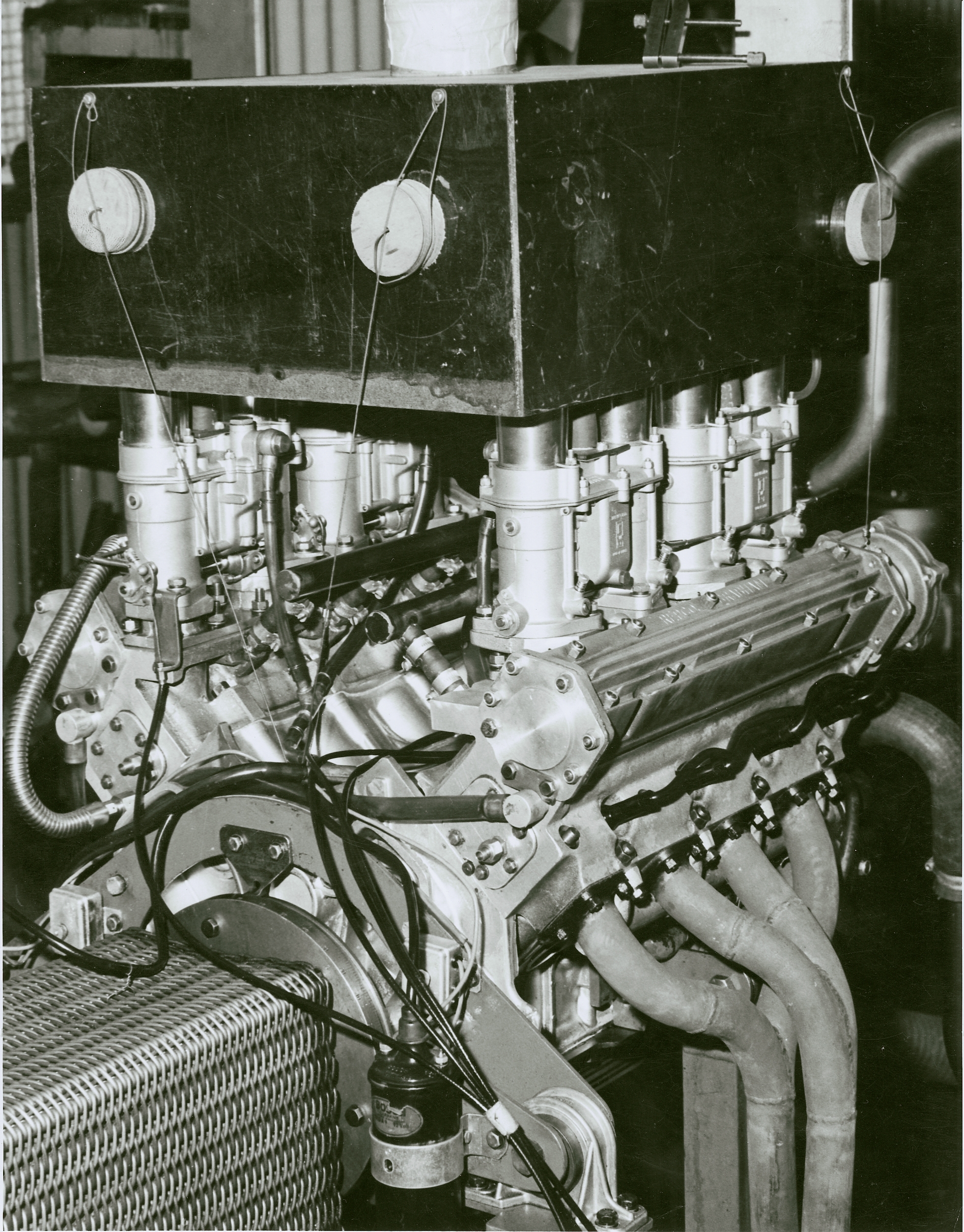
Reg Hunt’s Hunt JAP ‘Flying Bedstead’ Spl, it’s engine installation pictured below. By 1955 he had raced 500’s for a year in the UK and was one of the fastest combinations back in Australia aboard a Maserati A6GCM- stiff not to win the AGP that year at Port Wakefield (G McKaige)


(G McKaige)

The historically significant bit is that when Bill Leech, lifelong competitor, car collector and LCCA President at the time discussed the meeting and its shortcomings as a circuit sans Nepean Highway with the Commander of Army Southern Command, he was asked ‘what can we use as an alternative’? Whereupon Leech replied ‘what about here?’. Here being Albert Park where Southern Command were based, and the rest as they say is history and covered a while ago in another post.

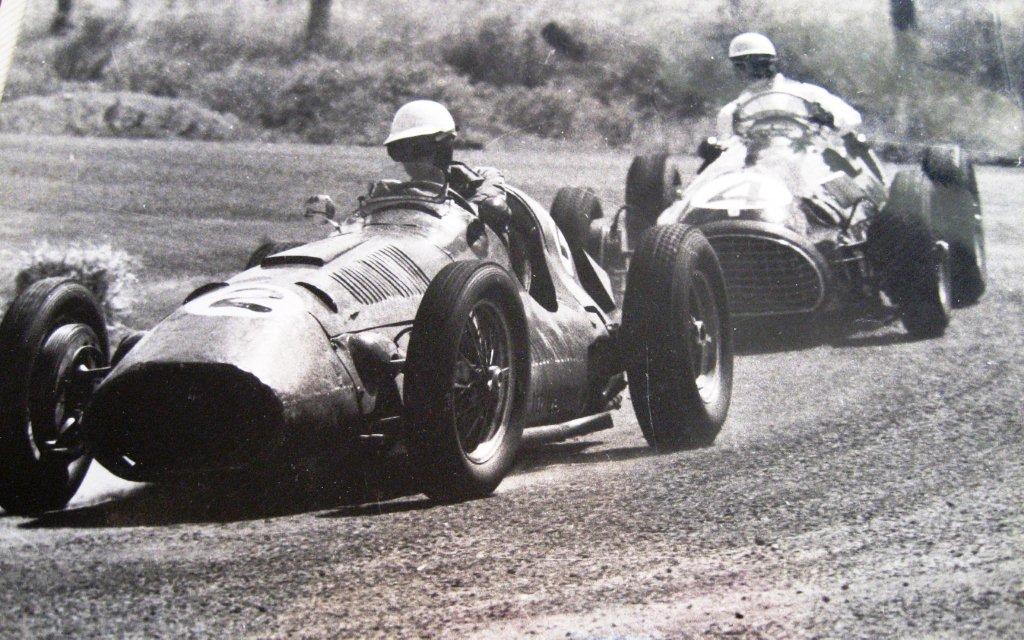
1956 ‘Argus Trophy’ Albert Park: Reg Hunt and Lex Davison: Maserati 250F and A6GCM: Ferrari Tipo 500…

Hobart Mercury 14 June 1950

In an amusing end to the weekend the Hobart ‘Mercury’ reported that the Melbourne Traffic Police Chief described many motorists returning from Balcombe as ‘reckless road-hogs’- harsh language indeed.

‘Many of them drove like whirlwinds’ in attempts to emulate the skilled drivers with several booked for speeding at 75 miles an hour. The racers themselves were spared the blame- perhaps the ‘need for speed’ stretch was the straight road from Mornington along past Sunnyside to Mount Eliza? I guess Pt Nepean Road is what we now know as the Nepean Highway.

Little Alfa aroca concourse

‘Little Alfa’ engine bay at AROCA Spettacolo, 2014. (M Bisset)

Balcombe will be well known to Melburnians of a certain age…

It was towards the top of the hill on the Nepean Highway as you leave Mornington and enter Mount Martha and these days is the site of a school, Balcombe Grammar and housing. The last army training units left the area in 1983.

For international readers Mount Martha, of which Balcombe is a part are on the shore of Port Phillip Bay, the vast expanse of water one can see in the distance on the AGP telecasts from Albert Park. The Mornington Peninsula, both it’s beaches and wineries are worthy additions to your tourist agenda when you visit!

The US Marines also played a part in construction of the circuit being credited with building both Uralla Road through the camp and Range Road locally to access a rifle range.

As World War 2 approached countries globally prepared for the inevitable, the 4th Division of the Australian Army were located at a camp in Balcombe on 209 acres of land compulsorily acquired from local landowners to defend Port Phillip and the Morninton Peninsula.

Tony Gaze, Alta Sports (G McKaige)


Derek Jolly, Austin 7 Spl over from Adelaide- road registered, I wonder if he drove his racer across? (G McKaige)

The army presence had a huge local impact, at the time their were 104 houses in Mt Martha- by mid 1940 over 3000 militia soldiers of the 4th division- trainees were located at four temporary campsites between the Nepean Highway and the coast just south of Bay Road.

Press reports at the time the camp was built said it was the most pleasant site for an army camp in the country, a point not lost on the ‘Army Brass’ one suspects, the Peninsula then as now is a popular summer playground.

The 1st US Marine Division, relieved from the strategically critical Coral Sea campaign at Guadalcanal, arrived in 1942 and used Balcombe Camp as a rehabilitation centre.

It became headquarters for the 1st Division of the USMC in 1942, the corp trained in the area including carrying out beach landing exercises using the ship ‘HMAS Manoora’.

Post war the Army Apprentices School was located there until 1983, and once, just once, it was used as a race track!

Davison ‘Little Alfa’…

duckett and davison rob roy 1946

Lyndon Duckett and Lex Davison, right, with their collections of cars at Rob Roy Hillclimb, Christmas Hills, Melbourne 1946. L>R. Ducketts’ 1908 Isotta Fraschini, Bug T35 powered by an R1 Anzani DOHC engine and Davisons’ ‘Little Alfa’ in 2 seater form as first modified by Barney Dentry, Mercedes SSK (Culture Victoria)

Lex Davison was one of Australia’s greatest drivers, the winner of four Australian Grands’ Prix and father and grandfather of two generations of racing drivers- grandsons Will and Alex are V8 Supercar Drivers and James an Indycar racer competing currently in Australia and the US respectively.

In 1950 Lex was still four years away from his first AGP win, he competed in everything everywhere and had just acquired an Alfa P3 in a progression which would take him to be a consistent front runner in the decade to come.

‘Little Alfa’ started life as a Tipo 6C 1500 ‘Normale’- chassis #0111522 was imported by Lex’ father in 1928 in chassis form as a road car. The original fabric body by Martin and King was replaced with a steel body built by Terdichs’ in 1945, both Melbourne firms.

Lex took over the car after the death of his father, Barney Dentry, a top driver of the day himself, stripped it and Kellow Falkiner built a two-seater body.

lex davo little alfa 11 th rob roy

Always an exciting driver, Davo contests the 11th Rob Roy 1946. This wonderful shot by George Thomas shows the lines of the car to good effect after its first evolution from Tourer to Racer (George Thomas)


lex cape schanck

Lex slightly! sideways at the second hairpin, Cape Schanck Hillclimb on Victoria’s Mornington Peninsula in 1946. ‘Little Alfa’ here in ‘evolution 2’ not its final spec (Cars and Drivers #1)


Little Alfa, Balcombe 1950 (G McKaige)

John Blanden records that the car became well known over the following years and was set aside when Davison acquired a Mercedes SSK. Dentry again ministered to the car and before it was completed the P3 arrived from the UK…as a consequence the 6C1500  became henceforth the ‘Little Alfa’.

Dentry shortened the chassis, lightened the brakes, replaced the rear axle with one from a 1750 SS Alfa, fitted a Rootes cabin mounted blower and moved the engine back 6 inches.

The chassis was then taken to renowned race body-builder Bob Baker who constructed a derivative but distinctive aluminium single-seater body with a pointed tail.

The cars first outing was at Balcombe as recorded above, coming second in its semi-final. The Alfa didn’t race much, the P3 was the front line car until the AGP winning HWM Jag was acquired/built later.

The Little Alfa was retained by the Davison family and moved from property to property before finally being restored by Nick Langford’s restoration business in Castlemaine. It made its debut in December 1979.

little alfa amaroo

Lex’ son Chris driving in the car, with daughter Claire, post restoration, Amaroo Park Historics 1986. (Gordon Graham)

Little Alfa’ was run in historic events by Diana Davison, Lex’ widow and quite a driver in her own right, son Chris and WW2 Spitfire Ace and post war racer Tony Gaze, who married Diana in 1977. Chris, a very quick Formula Ford racer in period and historic competitor now, recalls with great fondness the car…

‘It was a massive honour for me to drive ‘Little Alfa’. The car was purchased by my grandfather in 1928 and used as the family car until his death in 1942. It was only then that Lex got hold of it and started racing it. Of course this is the same car that Lex and Di drove to Bathurst for their honeymoon and also became one of his first racing cars. But he only did a handful of races in it. I am not sure that it was going to be competitive and he got the opportunity to purchase the P3, or ‘Big Alfa’ as it was known in our house. This is why the cars were known as the ‘Little Alfa’ and the ‘Big Alfa’.

‘In terms of actually driving it, i am taller and broader than average so it was a real squeeze to fit in. We took out the seat and I sat on the floor on an old sheep skin. The first thing you notice is that it has an accelerator pedal in between the brake and the clutch, and this does take some time to get used to. With no actual fuel pump, you must ‘pump up’ the air pressure in the fuel tank with a dash mounted pump and if you get busy around the circuit its easy to forget to do this and next thing the engine starts to die from lack of fuel. The alcohol fuel used to cause problems with the supercharger freezing up, so it was very important to get the fuel mixture right’.

‘Being a tight fit in the car, I used to feel the chassis rails flex whenever I went around a corner or hit a bump.With no seat belts or roll bar, driving the car flat out up the back straight at Sandown was one of the most dangerous things I have done in motorsport, especially as I was virtually held in the car by a low piece of bodywork and hanging onto the steering wheel for grim life’.

‘The term ‘brakes’ could be described as an overstatement, ‘restrainers’ more accurate. The car weighed 1500kgs and with a blown 1500cc engine on alcohol, you picked up quite a bit of pace down the long straights. I did give the fence a whack at Sandown once when I arrived at the end of the old pit straight and had ZERO brakes. The mechanic had forgotten to adjust the length of the brake cable and the shoes were barely even touching the brake drums’.

‘The best the car ever drove was at the 1986 Amaroo Historic Meeting, i could actually get some attitude and drift going. Frank Gardner spoke to me after one of the races, he had been standing right on the start of the pit apron, where you would aim the car at the turn in point for the corner onto the straight. He commented that seeing the car in a full drift coming straight toward where he was standing sure got his attention!’

‘The biggest problem I had at that meeting was once I really got the car going well, the speed up the straight and through the kink was such that both front wheels vibrated very badly, which was a real concern when you were so close to the old quarry wall. In the wet the car was a nightmare with levels of understeer that could only be described MASSIVE. With very old tyres and little adjustment on the car, I used to use the handbrake on turn in to try and get the rear end to generate some changes of direction. But I walked a fine line and really had to get the timing right, requiring a flick into the corner, quick pull on the handbrake to get the rear to slide and power on to keep up some attitude. If you got it slightly wrong it was back to uncontrollable understeer and all I could see from the cockpit was a VERY long red bonnet and two front tyres wasting their time with massive levels of lock’.

‘It was fabulous to see Mum and Tony on the circuit in the ‘Little Alfa’ but Mum did find it difficult to drive. So we ‘retired’ the car after the 1986 Amaroo meeting satisfied that we had actually seen the car fire a shot in anger’.

davo amaroo 86 little alfa

Chris and Claire Davison in the ‘Little Alfa’ at the 1986 Amaroo Park meeting Chris speaks about in the text. These days Claire is a mum, she, husband Johnny and Chris race a team of 3 Reynard FF’s in Australian Historic Racing. Lex’ ‘Ecurie Australie’ races on…(Chris Davison)

http://www.theweeklyreview.com.au/geelong/well-read/cover-story/7082-motorsport-bloodline/?nav=Y2F0X2lkLzIyNg==

‘Little Alfa’ remained in the Davison family until sold some years ago but thankfully remains in Australia in the hands of a caring Alfista, the car has an entirely Australian history since it’s departure from Italy in 1928.

Chris Davison…’I know that all of our family are delighted to see Trevor Montgomery now driving the car at most of the historic race meetings in the south. I feel that he understands and respects our family’s connection to this unique car and unique piece of Australian motorsport history’.

gaze nd davisons rob roy

Paddock scene from gentler more relaxed times, Tony Gaze, Diana Davison and Lex, Rob Roy Hillclimb 1950. (Dacre Stubbs Collection)


little alfa sandown 2009

‘Little Alfa’ current custodian Trevor Montgomery and Chris Davison at Sandown Historics November 2009…looking as pristine as it did in 1950. (Chris Davison)

Etcetera- Balcombe…

(G McKaige)

Derek Jolly’s Austin 7 Spl, he later won the 1960 Australian Tourist Trophy- a decade hence aboard an ex-works Lotus 15 Climax. I wrote about he and his cars a while back.


(G McKaige)


(G McKaige)

Love these these two shots above of Lyndon Duckett and George McKaige preparing the Anzani Bugatti before the event on a frosty Melbourne day in ‘Duckett’s Lane’- Towers Lane behind Duckett’s Towers Road, Toorak home. Road car is a Rover P3.

(G McKaige)


(G McKaige)

MG K3 and Engine above- here unsupercharged.


(T Johns)

Race Program courtesy of the Tony Johns Collection…


(T Johns)


(T Johns)


(T Johns)


(T Johns)


(T Johns)


(T Johns)


(T Johns)


(T Johns)


(T Johns)


(T Johns)


(T Johns)

Credits…

Chris Davison, many thanks for the recollections of driving the car and photos from the family collection

John Blanden ‘Historic Racing Cars in Australia’, Barry Green ‘Glory Days’, ‘Cars and Drivers’ magazine, Dacre Stubbs Collection, Culture Victoria, George Thomas, Gordon Graham, Hobart Mercury 14 June 1950, George McKaige via his son Chester, Tony Johns Collection

(G McKaige)

Tailpiece: The New and the Old…

The Keith Martin (John Medley thinks) Cooper Mk IV JAP 1000- which must have looked ‘other worldly’ to the good citizens of the Peninsula in 1950.

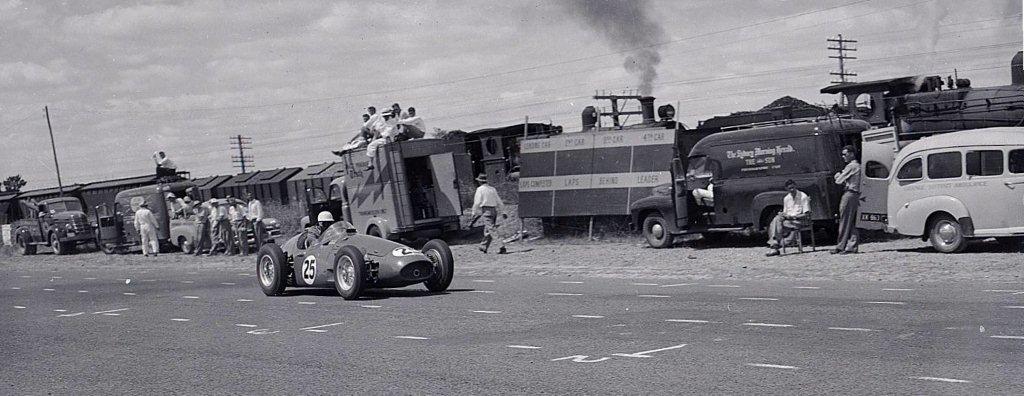
The modern as tomorrow Cooper is nicely juxtaposed with Doug Whiteford’s self-built #4 pre-war ‘Black Bess’ Ford V8 Special which won that years AGP at Lobethal six months before- and on the day at Balcombe. There were no Coopers at Lobethal but two made the long trip to Narrogin, down south of Perth for the 1951 AGP, Martin’s car and a later MkV driven by John Crouch.

#1 is Tony Gaze’s Alta and to its right Maybach with the bonnet covered- there was plenty of life in the front-engined cars at that stage of course, but the mid-engined era was underway from that little factory in Surbiton.

Finito…

image

Jack Brabham dipping under brakes as he approaches ‘Pub Corner’ in his Cooper T51 Climax on the first lap of the ‘Longford Trophy’ in  March 1960, wonderful Ellis French shot…

Jack retuned to our Australian summer as the reigning World Champion, he didn’t disappoint the Tasmanian crowd winning the race from the similar MkIV T51s of Alec Mildren and Bib Stillwell.

In those pre-Tasman 2.5 formula days Australian National Formula 1 was run to Formula Libre rules, but 1960 Coopers of various models and capacities were the dominant marque. There were still sportscars amongst the single-seaters including Doug Whitford’s ex-works Maserati 300S, sold to Doug after the 1956 Australian Grand Prix at Albert Park when Officine Maserati brought five Maseratis to Melbourne- thee F1 250F’s and two 300S.

The ‘Australian Motor Sports Annual Review 1960/61’ has a report of the 1960 Longford Trophy and notes with superb understatement that ‘Possibly no circuit in Australia offers so many scenic attractions and quite so large a variety of racing hazards as that at Longford in Northern Tasmania.’

The article continues ‘Although racing has been carried out at Longford for several years, it was only after the selection of the circuit for a Gold Star race in 1958 that Longford became known to Australians outside Tasmania…One of the advantages Longford holds over any other mainland circuit is full government and community support. Unlike other states where motor racing is viewed with concern for safety or as a noise disturbing nuisance and a Sabbath breaker, Tasmania views motor racing as a vital tourist attraction and as such, gives it the fullest support’.

Improvements to the track since the 1959 meeting resulted in a faster, more even surface with a softened approach to the railway crossing in Longford township.

Longford 1960 grid shot

John Ellacott shot of the front 2 rows gridded up: Brabham #4, Stillwell #6, Miller in yellow, all Cooper T51 Climaxes and Arnold Glass in the Maserati 250F, evocative!

Australian Tourist Trophy contenders with the J Wright Aston Martin DB3S and Doug Whiteford’s Maserati 300S up front with Harry Cape’s MGA Coupe and the #18 Gorringe/Watt MG Holden on grid 2 (J Barnes)

The 1960 meeting was a double-header with both the Formula Libre Longford Trophy and Australian Tourist Trophy for sportscars, won by Derek Jolly’s ex-works Lotus 15 Climax FPF 2 litre, the ATT was a great race with a big field, check out this photo heavy feature; https://primotipo.com/2018/05/17/1960-australian-tourist-trophy/

Jack Brabham’s Cooper T51 Climax FPF 2.5 had been secured by the promoters and was the same chassis with which he had won the NZ GP at Ardmore in January from Bruce McLaren’s Cooper T45 and Stillwell’s T51- click here for that NZ7 GP; https://primotipo.com/2019/09/16/chief-mechanic/

Brabham had a good summer also winning The Lady Wigram Trophy, Light Car Club of Tasmania Trophy at Longford, the Repco Trophy at Phillip Island in mid-March before heading back to Europe.

Jack’s practice time of 2:38 was a second clear of Bib’s 2.2 litre T5, a welcome addition to the grid was Alec Mildren’s new Cooper T51 Maserati, the frame of the car was adapted by Mildren and mechanic Glenn Abbey to fit a four cylinder, DOHC Maser 250S sportscar engine running on methanol- the soon to be 1960 Australian Gold Star champion did 2:46. An article about this car is here; https://primotipo.com/2018/06/08/mildrens-unfair-advantage/

Longford Trophy 1960 start

Stillwell gets the jump off the line, Glass at rear, Brabham on this side (John Ellacott)

Stillwell got the jump from the start and led for the first three-quarters of a lap before Brabham passed him in his more powerful Cooper. On lap 3 Jack did a 2:34, an average of 105.19 mph and on the following tour recorded a top speed on the Flying Eighth of 157.9 mph. Brabham reduced his pace and led comfortably from Stillwell, Mildren and Arnold Glass’s ex-Hunt/Stillwell Maserati 250F.

The punch of Mildren’s Maserati engine was demonstrated when he sailed past Stillwell’s Coventry Climax engined T51 on the Flying Mile, at about the same time Bill Patterson’s 2 litre T51 passed Glass with Jon Leighton’s Cooper T45 Climax being challenged by Glynn Scott’s similar ex-Mildren machine- both of these cars were powered by 2 litre Climaxes. Towards the end of the 17 lap 45 minute 40 second race Brabham allowed Mildren to close up to within 100 yards of his car, magneto failure spoiling Patterson’s good run.

Brabham won from Mildren, Stillwell, Glass, Leighton and Scott, the Glass Maserati was the only front-engined interloper amongst the dominant mid-engined Coopers.

Glynn Scott, Cooper T43 Climax 1.7 with Jon Leighton’s Cooper T45 2 litre behind him- the red car is Ern Tadgell’s Lotus 12 Climax aka Sabakat (J Barnes)

Allen Brown’s wonderful archive ‘oldracigcars.com’ states that the car Jack drove at Longford was probably the first of two cars he used during his successful 1959 F1 season, chassis ‘F2-4-59′- he drove it in the early part of the year, it then became a spare when ’27-59’ appeared at Zandvoort.

When Jack’s Australian season ended the car was sold to Bib Stillwell who then had two Cooper T51’s to choose from, his Gold Star campaigns had started to become more serious and ultimately were very successful from 1962 to 1965- four titles on the trot in Cooper and Brabham chassis.

Brabham returned to Europe to successfully defend his world title whilst the Gold Star championship was won by Alec Mildren’s Maserati engined T51.

Brabham Cooper T51 Longford 1960

Brabham in his Cooper T51 Climax at Longford in 1960. I think the gent in braces at the rear is Jacks’ father, this chassis 1 of 2 he used in his successful 1959 GP season (oldracephotos)

Allen Brown’s wonderful archive ‘oldracingcars.com’ states that the car Jack drove at Longford was probably the first of two cars he used during his successful 1959 F1 season, chassis ‘F2-4-59′- he drove it in the early part of the year, it then became a spare when ’27-59’ appeared at Zandvoort.

When Jack’s Australian season ended the car was sold to Bib Stillwell who then had two Cooper T51’s to choose from, his Gold Star campaigns had started to become more serious and ultimately were very successful from 1962 to 1965- four titles on the trot in Cooper and Brabham chassis.

Brabham returned to Europe to successfully defend his world title whilst the Gold Star championship was won by Alec Mildren’s Maserati engined T51.

Longford scene 1960

Kevin Drages’ panoramic view of part of the Longford paddock in March 1960, looking across to Mountford corner with the Pit Straight on the right. Cars are green Derek Jollys’ Lotus XV Climax and the ‘Kenley Vincent Spl’.

Etcetera…

Brabham Longford media interview 1960

(Kevin Drage)

‘Modern media scrum’, Jack tells the press how it was post race.

JB’s British Racing Drivers Club badge proudly worn on his overalls, the car is a Humber ‘Super Snipe’, in those days British prestige cars were very popular in Australia, the Germans steadily whittled them back by the early seventies.

Bill Patterson Cooper T51 Longford 1960

(Ellis French)

Bill Patterson’s Coopers T51 by two.

Patterson went on to win the Gold Star in 1961 and soon after retired from driving but supported others for decades via his Ringwood, Melbourne, Holden dealership, click here for a feature on Patto and his many Coopers; https://primotipo.com/2017/02/02/patto-and-his-coopers/

Jack Brabham and BIb Stillwell, Longford 1960

(Kevin Drage)

Jack Brabham and Bib Stillwell swapping Cooper set-up notes…or Bib is buying Jacks car!?

Stillwell was a good Brabham customer over the years acquiring many Coopers including the car Jack drove at Longford that weekend and, later, Brabhams, both men very successful drivers and businessmen. Bib feature article here; https://primotipo.com/2018/07/20/matich-stillwell-brabhams-warwick-farm-sydney-december-1963/

Bib Stillwell Cooper T51 Climax Longford paddock 1960

(Ellis French)

Bib Stillwell’s Climax engine being fettled in the Longford paddock.

(J Barnes)

Tornado 2 Chev won the 1958 Gold Star round at Longford with Ted Gray at the wheel, but by 1960 the marvellous 283 cid Chev engined beastie was an also-ran amongst the hordes of Coopers typified by Stillwell’s T51 at right- Ted didn’t start in the Longford Trophy feature and was unclassified in the LCCT Trophy a couple of days later. The D Type Jaguar without a rear wheel is David Finch’s car- note to the left Doug Whiteford’s Maser 300S ‘Rice’ trailer.

(J Barnes)

All the fun of the fair- who can help with the bike/rider identifications?

(J Barnes)

Ron Hodgson and David McKay in their Jaguars before the touring car race- who won this encounter?

(J Barnes)

Alan Jack cruises through the Longford paddock in his ex-Patterson Cooper T39 Climax whilst in the distance you can see Doug Whiteford’s Maserati 300S and trailer and further still Arnold Glass’ 250F.

Sticking with the T39 theme, the Jack and Lynn Archer cars sandwich Ron Phillips’ ex-Whitehead/Jones Cooper T38 Jaguar which raced so well in the Australian Tourist Trophy.

(J Ellacott)

(J Barnes)

Its a pity John Barnes got the shakes because this Light Car Club of Tasmania Trophy start shot really would have been a cracker but I still like it for its atmospherics.

Red #13 is Ern Tadgell’s Sabakat or more correctly Lotus 12 Climax ‘351’ about which I have written a lot. #9 and #20 are the Patterson and Scott Coopers Types 51 and 43- the Cooper in front of Scott’s is Mildren’s Maserati engined machine. The front engined car at left is the Glass Maser 250F and yellow machine to its right is Austin Miller’s distinctive Cooper T51.

Meanwhile in the simply superb panorama below we can take in the starters stand and beach umbrella, anxious mechanics, the old tram which served as race HQ, the flags and wonderful casual, bucolic air of this wonderful part of the world.

The cars- Sabakat at left, then Gray’s Tornado and one of the Coopers at right.

(J Barnes)

(J Barnes)

What a great shot, probably the grid of one of the Tasmanians only events perhaps, Ellis French identifies the cars as the #12 Gerald Tattersall, Buchanan, #14 R Ward, MGA Twin-Cam and #30 on row 2 the Mel McEwin in the Melmac Healey Spl, green car alongside the Hines #11 MG Special, red #18 is Mick Watt MG Holden Spl and #101 a Triumph TR not listed in the program.

(J Barnes)

She looks unbelievable!

I wonder what, or who it is which has captured the attention of Brabham’s crew. Who are they BTW?

Brabham Senior- Tom, and Esso’s Reg Thompson watch proceedings from the far left- look at those monster 58 DCO Webers, circa 235bhp from a 2.5 FPF tops at the time.

(J Barnes)

Photo and Reference Credits…

Ellis French, John Ellacott, oldracephotos.com, Kevin Drage, ‘Australian Motor Sports Annual 1960/61’, John Barnes

oldracingcars.com

Jack Brabham Cooper T51 Climax on the approach to Pub Corner Longford 1960

Tailpiece…

Lets finish on the same note as we started, an Ellis French shot of Brabham, this time ‘panned’ into the braking area on the entry to ‘Pub Corner’, Longford 1960…

For international readers Tasmania is a wonderful place to visit.

The scenery is stunning on all of its coasts, the mountains in the middle worth climbing, the ‘Overland Trail’ in the Cradle Mountain- Lake St Clair National Park worth walking. Hobart, a centre of culture and ‘Foodie Stuff’ is worth a stop for ‘Mona’ alone, a gallery of contemporary art and you can still see a lot of the Longford circuit, not far from Launceston, including the ‘Country Club Hotel’ with heaps of racing memorabilia.

Finito…

Jack Brabham Oulton Park Gold Cup 1966, Brabham BT19 Repco

Jack Brabham wins the Oulton Park ‘Spring Cup’ 1966. Brabham BT19 Repco (Brian Watson)

The second episode covered the design and building of the 1966 ‘RB620’ V8, the engine which would contest and win the World Constructors and Drivers Championships in 1966, this is a summary of that season…

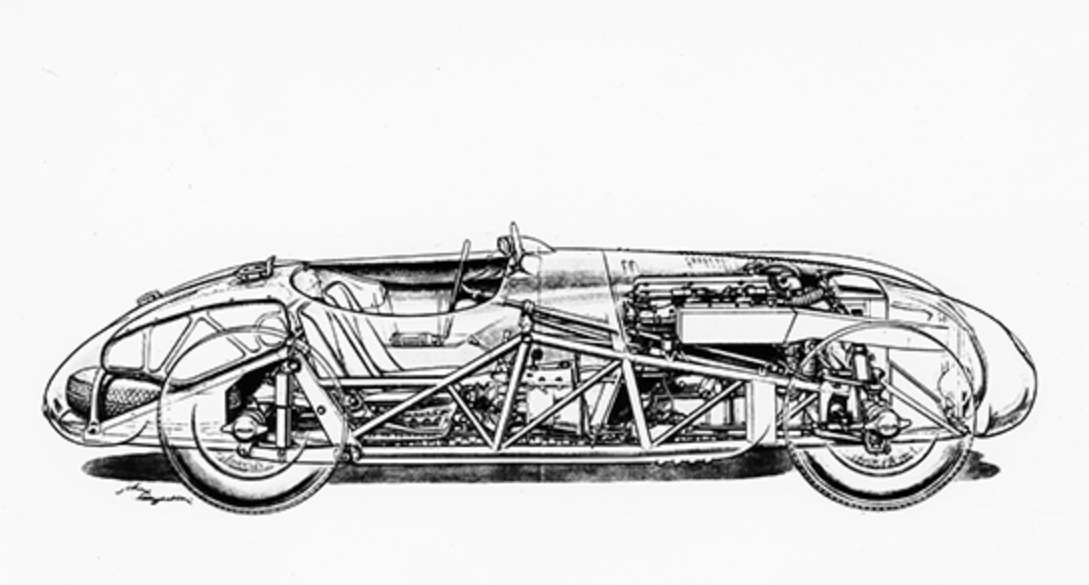
Brabham BT19 cutaway

Cutaway drawing of Brabham BT19 # ‘F1-1-65’, JB’s 1966 Championship Winning mount. Produced in 1965 for the stillborn Coventry Climax Flat 16 cylinder 1.5 litre F1 engine and modified by Ron Tauranac to fit the ‘RB620’ engine, which was designed by Phil Irving with Brabham/Tauranacs direct input in terms of ancilliaries etc to fit this chassis. A conventional light, agile, driver friendly and ‘chuckable’ spaceframe chassis Brabham of the period. Front suspension independent by upper and lower wishbones and coil spring/ damper units. Rear by upper top link, inverted lower wishbone, twin radius rods and coil spring/ damper units. Adjustable sway bars front and rear. Hewland HD500, and later DG300 ‘box. Much raced and winning chassis…still in Australia in Repco’s ownership (Motoring News)

The 1966 South African Grand Prix…whilst not that year a Championship round was the first race of the new 3 litre F1 on 1 January.

In December 1965 the first 3 Litre RB620 ‘E3’ was assembled and with slightly larger inlet valves, ports and throttle bodies than the ‘2.5’ produced 280bhp @ 7500rpm. After six hours testing it was rebuilt, shipped to the UK and fitted to Jacks ‘BT19’, a chassis built during 1965 for the stillborn Coventry Climax 16 cylinder engine, the rear frame modified to suit ‘RB620’.

Brabham started from pole and lead until the Lucas injection metering unit drive coupling failed. He achieved fastest lap but was the only 3 litre present.

Straight after the race the car was flown to Melbourne and fitted  with  Repco 2.5 engine ‘E2’ for the Sandown Tasman round on February 27, Repco’s backyard or home event…

BT19 on the factory floor in Melbourne

Roy Billington prepares BT19 for fitment of the’RB620′ 2.5 Tasman engine in place of the 3 litre used in South Africa on 1 January 1966 (Wolfe/Repco)


Brabham and Frank Hallam, Sandown 1966

Jack Brabham with RB Engines GM Frank Hallam at Sandown 1966. Publicity shot with BT19, long inlet trumpets give the engine away as a ‘Tasman 2.5’. Car sans RH side ‘Lukey Mufflers’ exhaust tailpipe in this shot ‘, sitting across the drivers seat. Rear suspension as described in cutaway drawing above, twin coils, fuel metering unit, HD500 Hewland, battery and ‘expensive’ Tudor oil breather mounted either side of ‘box (Brabhams World Championship Year’ magazine)

During a preliminary race the car set a lap record- the race won by Stewart’s BRM. But in the main race but an oil flow relief valve failed, causing engine damage, Stewart won from Clark Lotus 39 Climax and Graham Hill in the other BRM P261.

Upon dissasembly, it was found a sintered gear in the pressure pump had broken. The engine was then rebuilt for the final Tasman round at Longford Tasmania.

In a close race, with the engine overheating, the car ran short of fuel and was beaten by the two 2 litre BRM P261’s (bored out 1.5 litre F1 cars) of Stewart and Hill, Jackie Stewart easily winning the 1966 Tasman Championship for the Bourne team.

Brabham BT 19 refuelling, Longford 1966

BTT19 being filled with the sponsors product, Longford paddock 1966 (Ellis French)

In early January 1966 the engine operation was transferred from Repco’s experimental labs in Richmond to the Maidstone address and factory covered in episode 2 where the operations were ‘productionised’ to build engines for both BRO (Brabham Racing Organisation) and customers.

So far the engine had not covered itself in glory but invaluable testing was being carried out and problems solved.

Meanwhile back in Europe other teams were developing their cars for 1966…

All teams faced the same challenge of a new formula, remember that Coventry Climax, the ‘Cosworth Engineering’ of the day were not building engines forcing the ‘English Garagistes’ as Enzo Ferrari disparagingly described the teams, to find alternatives, as Jack had done with Repco.

Ferrari were expected to do well, as they had done with the introduction of the 1.5 litre Formula in 1961, they had a new chassis and an engine ‘in stock’, which was essentially a 3 litre variant of their 3.3 litre P2 Sports Car engine, the ‘box derived from that car as well. The gorgeous bolide looked the goods but was heavy and not as powerful as was claimed or perhaps Repco’s horses were stallions and the Italian’s geldings!

Ferrari 312 1966 cutaway

Hubris or too little focus on F1 in 1966…on paper the Ferrari 312 shoulda’ won in ’66…when Surtees left so did their title hopes, Ferraris’ decline in the season was matched by Brabhams’ lift…

Cooper also used a V12, a 3 litre, updated variant of the 2.5 litre engine Maserati developed at the end of the 250F program in 1957 when it was tested but unraced.

Cooper T81 Maserati engine 1966

Coopers’ 1966 T81 was an aluminium monocoque chassis carrying a development of Masers’ 10 year old ‘Tipo 10’ 60 degree V12. DOHC, 2 valves per cylinder, Lucas injected, and a claimed 360bhp @ 9500rpm. The cars were heavy, reasonably reliable. Surtees and Rindt extracted all from them (Bernard Cahier)

Dan Gurney had left Brabham and built a superb car designed by ex-Lotus designer Len Terry. The T1G Eagle was to use Coventry Climax 2.7 litre FPF power until Dans’ own Gurney-Weslake V12 was ready. Again, the car was heavy as it was designed for both Grand Prix and Indianapolis Racing where regulation compliance added weight.

Denny Hulme stepped up to fulltime F1 to support Jack in the other Brabham.

The dominant marque of the 1.5 litre formula , Lotus were caught without an engine and contracted with BRM for their complex ‘H16’ and were relying also on a 2 litre variant of the Coventry Climax FWMV 1.5 V8…simultaneously Keith Duckworth was designing and building the Ford funded Cosworth DFV, but its debut was not until the Dutch Grand Prix in 1967.

BRM, having failed to learn the lessons of complexity with their supercharged V16 1.5 litre engine of the early 50’s, and then reaping the benefits of simplicity with the P25/P48/P57, designed the P83 ‘H16’, essentially two of their 1.5 litre V8’s at 180 degrees, one atop the other with the crankshafts geared together. They, like Lotus were also using 2 litre variants of their very fast, compact, light and simple 1965 F1 cars, the P261 whilst developing their ‘H16′ contender.

Honda won the last race of the 1.5 litre formula in Mexico 1965 and were busy on a 3 litre V12 engined car, the RA273 appeared later in the season in Richie Ginthers’ hands.

Ginther Honda RA273 , Monza 1966

Richie Ginthers’ powerful but corpulent, make that mobidly obese Honda RA 273 at Monza, the heaviest but most powerful car of 1966…it appeared too late in the season to have an impact but was competitive in Richies’ hands, a winner in ’67 at Monza…(unattributed)

Bruce Mclaren produced his first GP cars, the Mclaren M2A and M2B, technically advanced monocoque chassis of Mallite construction, a composite of balsa wood bonded between sheets of  aluminium on each side.

His engine solution was the Ford ‘Indy’ quad cam 4.2 litre V8, reduced to 3 litres, despite a lot of work by Traco, the engine whose dimensions were vast and heavy, developed way too little power, the engine and gearbox weighing not much less than BT19 in total…He also tried an Italian Serenissima engine without success.

Bruce McLaren, McLaren M2A Ford Indy, Riverside 1966

Bruce testing M2A Ford at Riverside, California during a Firestone tyre test in early 1966. M2A entirely Mallite, M2B used Mallite inner, and aluminium outer skins. Note the wing mount…wing first tested at Zandvoort 1965. L>R: Bruce McLaren, Gary Knutson, Howden Ganley and Wally Willmott (Tyler Alexander)

So, at the seasons outset Brabham were in a pretty good position with a thoroughly tested engine, but light on power and on weight in relation to Ferrari who looked handily placed…

Variety is the spice- 1966 MotorSport magazine visual of the different F1 engine solutions pursued by the different makers

Brabham contested two further non-championship races…with the original engine in Syracuse where fuel injection problems caused a DNF and at Silverstone on May 14 where the car and engine achieved their first wins, Brabham also setting the fastest lap of the ‘International Trophy’.

Brabham , Silverstone Trophy 1966, BT19 Repco

First win for BT19 and the Repco ‘RB620’ engine, Silverstone International trophy 1966 (unattributed)

Monaco was the first round of the 1966 F1 Championship on May 22…

Clark qualified his small, light Lotus 33 on pole with John Surtees in the new Ferrari alongside. Jack was feeling unwell, and the cars were late arriving after a British seamens strike, Jack recorded a DNF, his Hewland HD 500 gearbox jammed in gear.

Mike Hewland was working on a stronger gearbox for the new formula, Jack used the new ‘DG300′ transaxle for the first time at Spa. Clarks’ ‘bullet-proof’ Lotus 33 broke an upright, then Surtees’ Ferrari should have won but the ‘slippery diff’ failed leaving victory to Jackie Stewarts’ 2 litre BRM P261.

Richie Ginther Monaco 1966

Richie Ginther going the wrong way at Monaco whilst Jack and Bandini find a way past. Cooper T81 Maser, BT19 and Ferrari 246 respectively. Nice ‘atmo’ shot (unattributed)

Off to Spa, and whilst Brabham was only fourth on the grid…he was quietly confident but a deluge on the first lap caused eight cars to spin, the biggest accident of Jackie Stewarts’ career causing a change in his personal attitude to driver, car and circuit safety which was to positively reverberate around the sport for a decade.

image

The rooted monocoque of Jackie Stewarts’ BRM P261, Spa 1966. He was trapped within the tub until released by Graham Hill and Bob Bondurant who borrowed tools from spectators to remove the steering wheel…all the while a full tank of fuel being released…(unattributed)

Surtees won the race from Jochen Rindt in a display of enormous bravery in a car not the calibre of the Ferrari or Brabham, Jack finished fourth behind the other Ferrari of Lorenzo Bandini. Denny Hulme still driving a Climax engined Brabham.

At this stage of the season, the ‘bookies pick’, Ferrari, were looking pretty handy.

BRM P83, Stewart, Oulton Park 1966

Another major new car of 1966 was the BRM P83 ‘H16’…love this shot of Jackie Stewart trying to grab hold of the big, unruly beast at the Oulton Park ‘Spring Cup’ 1966. The car got better as 1966 became 1967 but then so too did the opposition, the message of Brabham simplicity well and truly rammed home when the Lotus 49 Ford appeared at Zandvoort in May 1967…free-loading spectators having a wonderful view! (Brian Watson)

Goodyear…

Dunlops’ dominance of Grand Prix racing started with Engleberts’ final victory when Peter Collins won the British Grand Prix for Ferrari in 1958.

Essentially Dunlops’ racing tyres were developed for relatively heavy sports prototypes, as a consequence the light 1.5 litre cars could compete on the same set of tyres for up to four GP’s Jimmy Clark doing so in his Lotus 25 in 1963!

Goodyear provided tyres for Lance Reventlows’ Scarab team in 1959, returned to Indianapolis in 1963, to Europe in Frank Gardners’ Willment entered Lotus 27 F2 at Pau in 1964 and finally Grand Prix racing with Honda in 1964.

In a typically shrewd deal, Brabham signed with Goodyear in 1965, it’s first tyres for the Tasman series in 1965 were completely unsuitable but within days a new compound had been developed for Australian conditions, this was indicative of the American giants commitment to win.

By 1966 Goodyear was ready for its attack on the world championship, we should not forget the contribution Goodyears’ tyre technology made to Brabhams’ wins in both the F1 World Championship and Brabham Honda victory in the F2 Championship that same year.

Equally Goodyear acknowledged Brabhams’ supreme testing ability in developing its product which was readily sought by other competitors at a time when Dunlop and Firestone were also competing…a ‘tyre war’ unlike the one supplier nonsense which prevails in most categories these days.

Dan Gurney Eagle T1G Climax, Spa 1966

Dan Gurney, Eagla T1G Climax, Spa 1966. In my top 3 ‘GP car beauties list’…Len Terry’s masterful bit of work hit its straps 12 months later when the car, by then V12 Eagle-Weslake powered won Spa, but in ’66 the car was too heavy and the 2.7/8 Climax lacked the necessary ‘puff’…Goodyear clad cameraman exceptionally brave!, shot on exit of Eau Rouge (unattributed)

The French Grand Prix was the turning point of the season…

Brabham arrived with three cars- Hulmes’ Climax engined car as a spare and finally an ‘RB620’ engined car for the Kiwi. Perhaps even more critically for Brabham, John Surtees had left Ferrari in one of the ‘Palace Upheavals’ which occurred at Maranello from time to time, fundamentally around Surtees’ view on the lack of F1 emphasis, the team still very much focussed on LeMans and the World Sports Car Championship, where the marques decade long dominance was being challenged by Ford.

Surtees was also, he felt, being ‘back-doored’ as team-leader by team-manager Eugenio Dragoni in choices involving his protege, Lorenzo Bandini. The net effect, whatever the exact circumstances was that Surtees, the only Ferrari driver capable of winning the ’66 title moved to Cooper, Bandini and Mike Parkes whilst good drivers were not an ace of 1964 World Champ, Surtees calibre…

Reims was the ultimate power circuit so it was not a surprise when four V12’s were in front of Brabham on the grid, the Surtees and Rindt Coopers and the two Ferraris. Surtees Cooper failed, and Jack hung on, but was losing ground to Bandini, until his throttle cable broke with Brabham leading and then winning the race.

It was Jacks’ first Championship GP win since 1960, and the first win for a driver in a car of his own manufacture, a feat only, so far matched by Dan Gurney at Spa in 1967.

It was, and is a stunning achievement, but there was still a championship to be won.

Jack Brabham French GP 1966 Brabham BT19 Repco

Brabham wins the French GP 1966, the first man to ever win a GP in a car of his own construction. Brabham BT19 Repco (umattributed)


image

Brabham’s BT19 leads out of Druids at Brands Hatch, ’66 British GP. Gurney Eagle T1G Climax, Hulme’s Brabham BT20 Repco, Clark’s Lotus 33 Climax and the two Cooper T81 Masers of Surtees inside and Rindt, then Stewart’s BRM P261 and McLaren’s white McLaren M2B Serenissima and the rest (unattributed)

At Brands Hatch Ferrari did not appear…

They were victims of an industrial dispute in Italy. Cooper were still sorting their Maser V12, the H16 BRM’s did not race nor did the Lotus 43, designed for the BRM engine. BRM and Lotus were still relying on 2 litre cars. Brabham and Hulme were on pole and second on the grid, finishing in that order, a lap ahead of Hill and Clark.

At Zandvoort, in the Dutch sand-dunes

Brabham with beard Dutch GP 1966

Jack was tough but had a sense of humor…he had just turned 40 a month or so before, there was a lot in the press about his age so JB donned a beard, and with a jack-handle as walking stick approached BT19…much to the amusement of the Dutch crowd and press (Eric Koch)

Brabham and Hulme again qualified one-two but Jim Clark drove a stunning race in his 2 litre Lotus leading Jack for many laps, the crafty Brabham, just turned forty playing a waiting game and picking up the win after Clarks’ Climax broke its dynamic balancer, the Scot pitting for water and still being in second place when he returned, such was his pace. Clark fell back to third, Hill finishing second, the Ferraris and Coopers off the pace.

Brabham in BT19 Repco, Dutch GP 1966

Bernard Cahiers’ famous shot of Brabham ‘playing with his Goodyears’ in the Dutch sand-dunes is still reproduced by Repco today and used as a ‘promo’ handout whenever this famous car, Jacks’ mount for the whole of his ’66 Championship campaign, still owned by Repco, is displayed in Australia


German GP grid 1966

German GP grid, Nurburgring 1966. I like this shot as it says a lot about the size of 1966 F1 cars and the relative performance of the ‘bored-out 1.5 litre cars vs. the new 3 litres at this stage of the formula. The only 3 litre on the front row, is Ferrari recent departee John Surtees Cooper Maserati #7, Clark is on pole #1 Lotus 33 Climax, #6 Stewart BRM P261, # 11 Scarfiotti Ferrari Dino, all ‘bored 1.5’s. Row 2 is Jack in BT19, and #9 and #10 Bandini and Parkes in Ferrari 312’s, all ‘3 litres’. The physical difference in size between the big, heavy Ferraris, and the little, light BT19 ‘born and built’ as a 1965 1.5 litre car for the stillborn Coventry Climax Flat 16 engine, is marked (unattributed)

The Nurburgring is the ultimate test of man and machine…

Brabham qualified poorly in fifth after setup and gearbox dramas. Clark, Surtees, Stewart and Bandini were all ahead of Jack with only Surtees, of those drivers in a 3 litre car!

The race started in wet conditions, Jack slipped into second place after a great start by the end of lap one and past Surtees by the time the pack passed the pits, Surtees suffered clutch failure widening the gap between he and Brabham, Rindt in the other Cooper finishing third. Hulme was as high as fifth but lack of ignition ended his race.

Hill and Surtees were still slim championship chances as the circus moved on to Monza.

Jack Brabham and Denny Hulme, German GP 1966

Denny and Jack ponder the setup of Hulmes BT20, practice conditions far better than raceday when Jack would triumph (unattributed)

Ferrari traditionally perform well at home…and so it was, Ludovico Scarfiotti winning the race on September 4.

Another power circuit, Brabham was outqualifed by five ‘multis’ the V12’s, the Ferraris of Parkes (pole) Scarfiotti and Bandini, the Cooper of Surtees and the H16 Lotus 43 BRM of Clark in third.

The Ferraris lead from the start from Surtees, but Brabham sensing a slow pace took the lead only losing it when an inspection plate loosened at the front of the engine, burning oil, the lubricant not allowed to be topped up under FIA rules. Hulme moved into second as Jack retired. The lead changed many times but Surtees retirement handed the titles to Brabham, Scarfiotti winning the race from Parkes and Hulme.

The cars were scrutineered and weighed at Monza.

The weights of the cars was published by ‘Road and Track’ magazine. BT19 was ‘Twiggy’ at 1219Lb, the Cooper T81 1353Lb, BRM 1529Lb, similarly powered Lotus 43 1540Lb and Honda RA273 1635Lb. Lets say the Repcos’ horses were real at 310bhp, Ferrari and Cooper (Maserati) optimistic at 360 and BRM and Honda 400’ish also a tad optimistic…as to power to weight you do the calculations!

Jim Clark Lotus 43 BRM Monza 1966

Jim Clark jumps aboard his big, beefy 1540Lb Lotus 43 BRM whilst Jacks light 1219Lb BT19 is pushed past, ’66 Monza grid. Love the whole BRM ‘H16’ engine as a technical challenge…(unattributed)


Scarfiotti and Clark Italian GP 1966

2 of the ‘heavyweights’ of 1966, Ludovico Scarfiottis’ Ferrari 312 leading Jim Clarks’ Lotus 43 BRM at Monza, Scarfiottis’ only championship GP win (unattributed)

Jim Clarks’ Lotus 43 BRM achieved the ‘H16’s only victory at Watkins Glen…the Scot using BRM’s spare engine after his own ‘popped’ at the end of US Grand Prix practice. Jack’s engine broke a cam follower in the race, Denny also retiring with low oil pressure.

jack us

Front row of the Watkins Glen grid. #5 Brabham’s BT20 on pole DNF, Bandini’s Ferrari 312 DNF and Surtees Cooper T81 Maser 3rd (Alvis Upitis)

The final round of the 1966 was in Mexico City on October 23…

The race won by John Surtees from pole, in a year when he had been very competitive, and perhaps unlucky. Having said that, had he stayed at Ferrari perhaps he would have won the title, the Ferrari competitive in the right hands. Brabham was fourth on the grid, best of the non-V12’s with Richie Ginther again practicing well in the new, big, incredibly heavy V12 Honda RA273. Surtees’ development skills would be applied to this car in 1967.

Surtees finished ahead of Brabham and Hulme, despite strong pressure from both, whilst Clark was on the front row with the Lotus 43, the similarly engined BRM’s mid-grid, it was to be a long winter for the teams the postion of many not that much changed from the seasons commencement…

Mexican GP 1966, Surtees, Brabham and Rindt

John Surtees, Jack and Jochen Rindt, Coopers T81 Maserati X2 and BT19. Mexican GP 1966. Ferrari missed Surtees intense competitiveness when he left them, the Cooper perhaps batting above its (very considerable!) weight as a consequence, Rindt no slouch mind you. The Coopers’ competitive despite the tough altitude and heat of Mexico City. (unattributed)

Malcolm Prestons’ book ‘Maybach to Holden’ records that 3 litre engines ‘E5, E6, E7 and E8’…were used by BRO in 1966, in addition to E3, all having at least one replacement block.

Some engines were returned to Melbourne for re-building and at least three were sold in cars by Brabham to South Africa and Switzerland, whether Repco actually consented to the sale of these engines, ‘on loan’ to BRO is a moot point!, but parts sales were certainly generated as a consequence.

Detail development of the ‘RB620’ during the season resulted in the engines producing 310 bhp @ 7500rpm with loads of torque and over 260bhp from 6000-8000rpm.

Brabham team with BT19 1966

Back In Australia…

The Tasman ‘620’ 2.5 litre engine was not made available to Australasian customers in 1966, they were in 1967, a Repco prepared Coventry Climax FPF won the ‘Gold Star’, the Australian Drivers Championship in 1966, Spencer Martin winning the title in Bob Janes’ Brabham BT11A.

4.4 litre ‘RB620′ engines were built for Sports Cars, notably Bob Janes’ Elfin 400, we will cover those in a separate chapter.

Development of the F1 engine continued further in early 1966 in Maidstone, whilst production and re-building of the ‘RB620’ for BRO continued, we will cover the design and testing of what became the 1967 ‘RB740′ Series engine in the next episode…

Meanwhile Brabhams’, Tauranacs’, Irvings’ and Repcos’ achievements were being rightly celebrated in Australia where ingenuity, practicality and brilliant execution and development of a simple chassis and engine had triumphed over the best of the established automotive, racing and engineering giants of Europe…

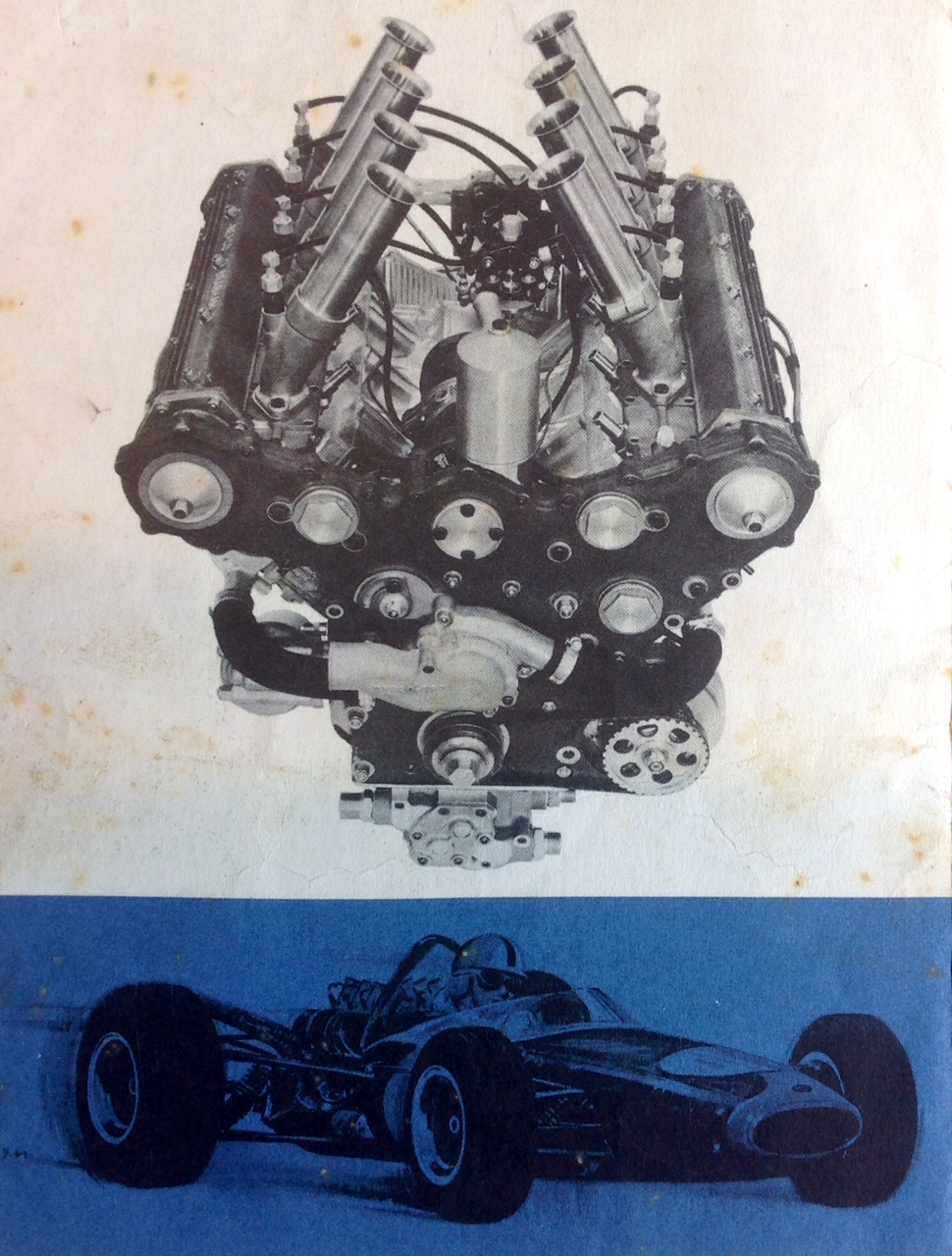
Repco 'RB620' 3 Litre F1 V8

‘RB620’ 3 litre V8 in Brabham BT19, 1966 F1 World Champions (Bernard Cahier)

Etcetera…

Jack Brabham and Denny Hulme , Mexican GP 1966

Jack Brabham and Denny Hulme, 1st and 4th in the World Drivers Championship 1966. Mexican GP 1966, lovely Bernard Cahier portrait of 2 good friends. Graham Hills’ BRM P83 ‘H16’ at rear.


Brabham 'Championship Year' magazine

BT19 cutaway

BT19 Repco cutaway (unattributed)


london Racing Car Show 1967

Brabham BT19 Repco on ‘centre stage’ at the 1967 London Racing Car Show (unattributed)


RB Nose

Brabham after Rheims victory 1966

A fitting photo to end the article…the joy of victory and achievement after his Rheims, French GP victory. The first man ever to win a GP in a car of his own manufacture, Brabham BT19 Repco (unattributed)

Bibliography…

Rodway Wolfe Collection, ‘Jack Brabhams World Championship Year’ magazine, Motoring News magazine, The Nostalgia Forum, oldracingcars.com, Nigel Tait Collection

‘Maybach to Holden’ Malcolm Preston, ‘History of The Grand Prix Car’ Doug Nye

Photo Credits…

The Cahier Archive, Brian Watson, Tyler Alexander, Ellis French, Eric Koch, Alvis Upitis, Rodway Wolfe Collection

Tailpiece: The Repco hierachy at Sandown upon the RB620’s Australian debut, 27 February 1966. Phil Irving leaning over BT19 and trying to grab another fag from Frank Hallam’s packet. Norman Wilson with head forward leaning on the rear Goodyear, Kevin Davies and Nigel Tait in the white dust coat…and Jack wishing they would bugger ‘orf so he could test the thing. Nigel Tait recalls that the car probably had 2.5 engine #E2, had no starter motor and he the job of push-starting the beastie…

sandown

(Tait/Repco)


post

Jack Brabham, Repco engineer Nigel Tait, and Brabham BT19 Repco. Sandown Park Melbourne for its Tasman Series debut, January 1966. RB620 ‘E2’ engine in 2.5 litre capacity. (Australian Post magazine)


rb 620

Repco Brabham ‘RB 620 Series’ 3 litre SOHC V8 engine. The ’66 World Championship winning engine. Circa 310 bhp @ 8000 rpm. Weight 160 Kg, the ‘600 series’ block was F85 Oldsmobile based, ’20 series’ heads early crossflow type (Repco)

In this Repco article we start with a summary of the events leading to Repco’s involvement in Grand Prix Racing, then identify key team members, the equipment used to build the engines and finally have a detailed account of the 1966 championship winning engines construction…

records

RBE factory records ’60’s style (Wolfe)

Why did Repco Commit to Grand Prix Racing?…

Younger readers may not know the background to Australian automotive company, Repco’s involvement in Grand Prix racing in the mid-sixties.

Coventry Climax, the Cosworth Engineering of their day caused chaos for British GP teams when they announced they would not build an engine for the new 3 litre F1 commencing in 1966.

Repco had serviced the 2.5 litre Coventry Climax FPF four cylinder engines, the engine ‘de jour’ in local Tasman races, but were looking for an alternative to protect their competitive position, Jack Brabham suggested a production based V8 to them.

Brabham identified an alloy, linerless V8 GM Oldsmobile engine, a project which had been abandoned by  them due to production costs. Jack pitched the notion of racing engines of 2.5 litre and 3 litre displacements using simple, chain driven SOHC, two valve heads to Repco’s CEO Charles McGrath.

GM developed a family of engines comprising the F85 Oldsmobile and Buick 215. They were almost identical except that the F85 variant had six head studs per cylinder rather than the five of the 215 and was therefore Brabham’s preferred competition option.

Jack had first seen the engines potential racing against Chuck Daigh’s Scarab Buick RE Intercontinental Formula mid-engined single seater in a one off appearance by Lance Reventlow’s outfit at Sandown, Australia, in early 1962.

The engine’s competition credentials were further established at Indianapolis that year when Indy debutant Dan Gurney qualified Mickey Thomson’s 215 engined car eighth, the car failing with transmission problems after 92 laps. It was the first appearance of a stock block engined car at Indy since 1945.

scarab

Jack Brabham looking carefully at the Buick 3.9 litre engine in the mid-engined Scarab RE at Sandown Park, Melbourne in 1962, filing the information away for future reference! (Doug Nye with Jack Brabham)

Whilst the engine choice was not a ‘sure thing’ its competition potential was clear to Brabham, as astute as he was practical.

At the time the engine was the lightest mass production V8 in the world with a dry weight of 144 kg and compact external dimensions to boot. Its future at GM ended in 1963 due to high production costs and wastage rates on imperfectly cast blocks, about 400,000 engines had been built by that time.

New Kid on the Block…

‘Having talked my way into the Repco Brabham Engine Co with a promise of hard work and a 3 weeks trial I was very happy’ recalls Rodway Wolfe.

I was given a nice grey dustcoat with a lovely Repco Brabham insignia on the pocket and shown around the factory and introduced to everyone- I was the seventh employee. Repco had picked the cream of their machinists from throughout the empire to work at RBE, they were great guys to work with and willing to share all their skills.

The three-week trial period was a gimmick, after a few days I had settled in as one of the team. After the trial my wage was increased to slightly higher than my previous job in the Repco merchandising company.’

People: Key Team Members…

dyno

L>R: Phil Irving, Bob Brown, Frank Hallam and Peter Holinger dyno testing the first 2.5 litre Tasman RB620 engine at Russell Manufacturing’s engine test lab in Richmond in March 1965. Weber carbs borrowed from Bib Stillwell, the engine did not race in this form. The engine initially produced 235 bhp @ 8200 rpm, equivalent to a 2.5 Coventry Climax engine. ‘Ciggies a wonderful period touch (Repco)

The first prototype RB engine was built at the Repco Engine Laboratory in Richmond, Victoria, an inner Melbourne suburb, then a hub of manufacturing now a desirable inner city place to live, 1.5 km from the CBD.

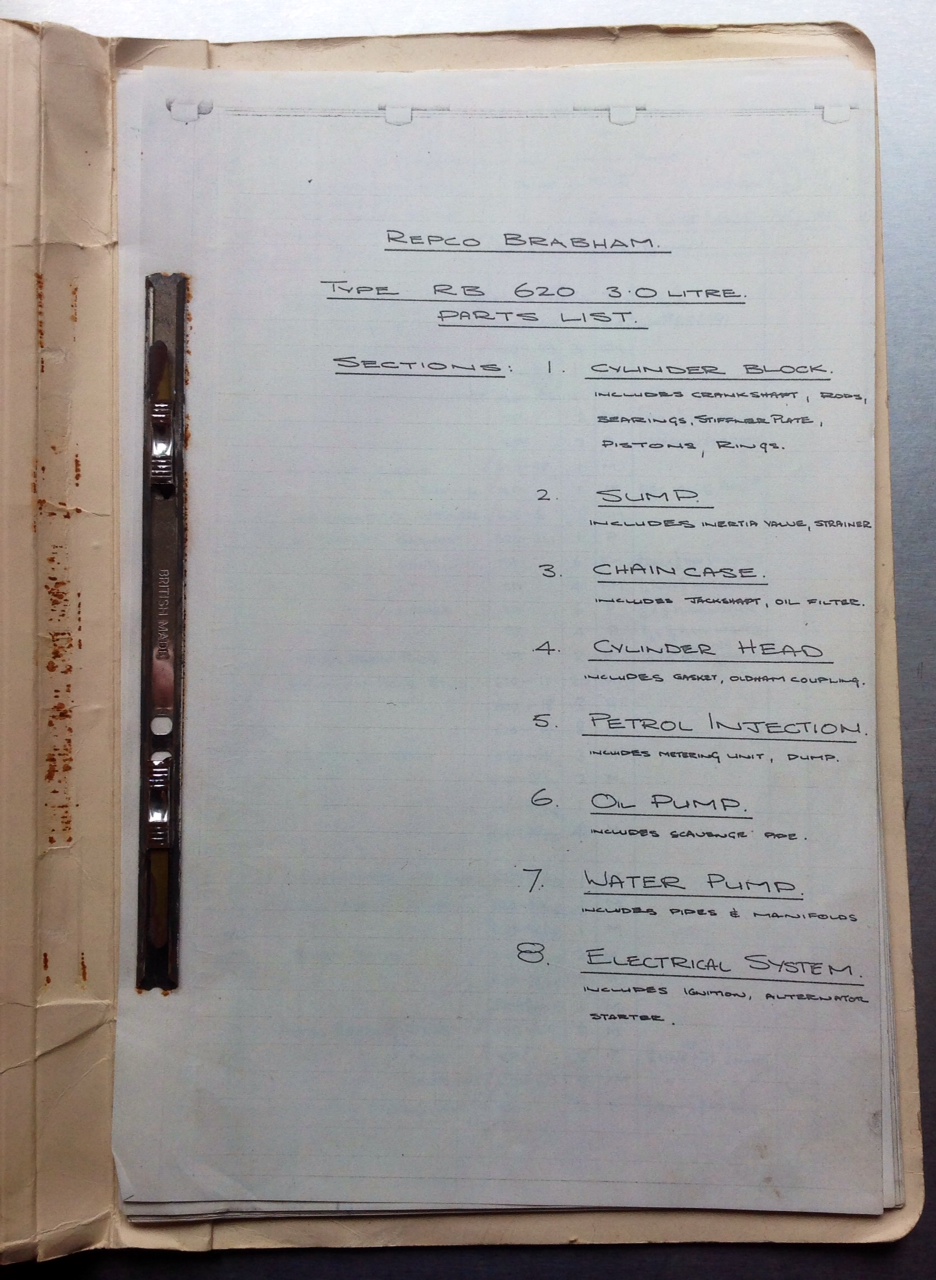
It was designated the type ‘RB620’, which was the nex file number of the various laboratory, research and development projects in process at the time.

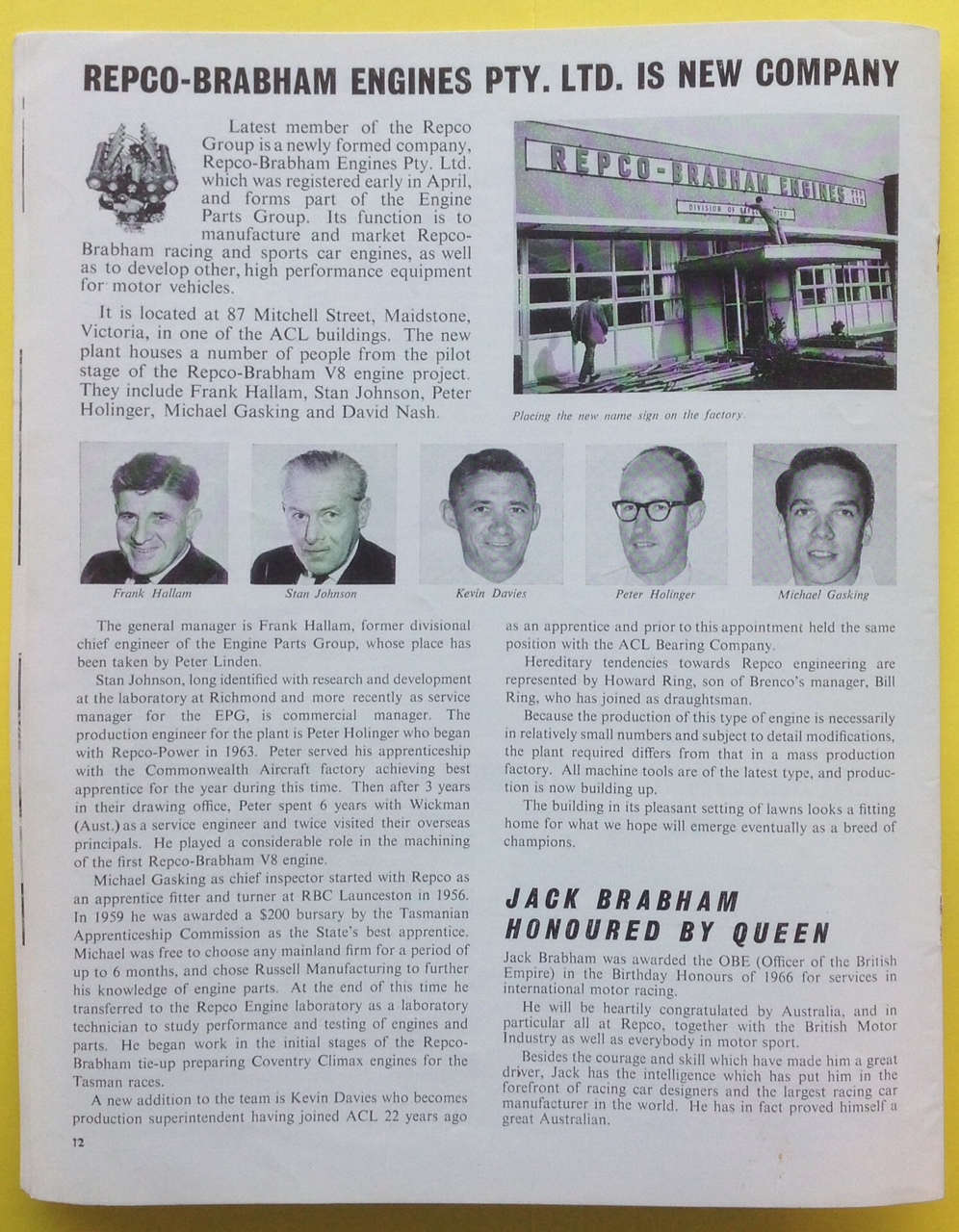
‘Frank Hallam was General Manager and Phil Irving was Project Engineer together with Nigel Tait and others. Peter Holinger made the components and Michael Gasking tested the engines. There were others involved before my time, those mentioned were involved at Richmond’.

As an industrial site using steel garages in Richmond the RB project received comment in various overseas publications as the ‘World Championship Fl engine built in a tin shed in Australia’.

When I joined in late 1965 the project had just arrived at the Maidstone, Melbourne factory. (87 Mitchell Street, Maidstone, then an industrial Melbourne western suburb, 10 km from the CBD) The Manager was Frank Hallam. In the drawing office, the Chief Engineer was Phil Irving, the Production Manager Peter Holinger, Production Superintendent Kevin Davies and the machine shop leading hand was David Nash. We also had a Commercial Manager, Stan Johnson who came and went’.

hallam

Frank Hallam and Jack Brabham discuss the turning of camshaft blanks on the Tovaglieri lathe (Repco)

‘Around this time Michael Gasking also transferred from the Richmond Laboratory- he was Chief of Engine Assembly and Testing.  Also on the machine tools was John Mepstead who was a great all rounder and later appointed to help Michael with engine assembly. He eventually joined Frank Matich to ‘spanner’ the 1969 Australian Sports Car Championship winning Matich SR4 Repco.

Frank Hallam arranged for me to attend RMIT night school, Repco picked up the bill. Those Tuesday and Thursday nights for 4 years helped me immensely, over the period I obtained a certificate in ‘Capstan and Turret and Automatic Screw Machines’ operation and a certificate in ‘Product Drafting’. My status was as a First Class Machinist in the Repco Brabham factory.

If I had any queries I would also ask Phil Irving who loved a yarn and was a huge bank of knowledge. I felt so honoured to to work for him, and learned so much’.

RBE formation

‘Repco Record’, the internal Repco staff magazine announces the formation of Repco Brabham Engines Pty. Ltd. (Repco)

Machine Tools…

‘Frank Hallam was a machine tool enthusiast.

It was a big help, he made sure we worshipped our machines, blowing away the swarf with an air hose. I learned respect and cleanliness of all machine tools. Few machine shops were as clean or free of swarf and mess everywhere with the exception of Holinger Engineering, Peter was also fastidious.

We were lucky to have top machines in the workshop. Our biggest was an Ikegai horizontal boring machine. RBE had two lathes- a Dean Smith & Grace English machine and also a Tovaglieri Italian unit.

We had a small Deckel horizontal borer and a couple of mills- a Bridgeport and a French Vernier. The older machine was a Herbert capstan lathe, I used this to make every stud for all the future Repco Brabham engines- main bearing and cylinder head studs, a very big variety in different steel types, it was repetitive stuff that would normally be boring but I didn’t care, we were winning the World Championship’…

‘When he drew a new design of stud, Phil Irving would come out and check my thoughts on being able to make it with what we had and other various things. We would do a yield point test in a vice where we measured the length of the new stud after I made a sample and then tension it to a nominated foot pound tension and we would keep increasing the tension until the stud refused to return to the original length. That tension was known as the yield point so Phil would pick a tension somewhere in a safe range under that yield point’.

RB620 Series Engine: Machining and Modification of the Oldsmobile F85 block…

olds

Not the sharpest of shots but a rare one showing the ‘production’ Olds and RB620 engines. RB620 on the right. The engine was the lightest production V8 in the world at the time (unattributed)

‘When I arrived there were a lot of aluminum cylinder blocks along one factory wall. Repco acquired twenty-six Oldsmobile cylinder blocks from General Motors in the US. (2 of the 26 were prototype engines E1 and E2 which were built up in Richmond)

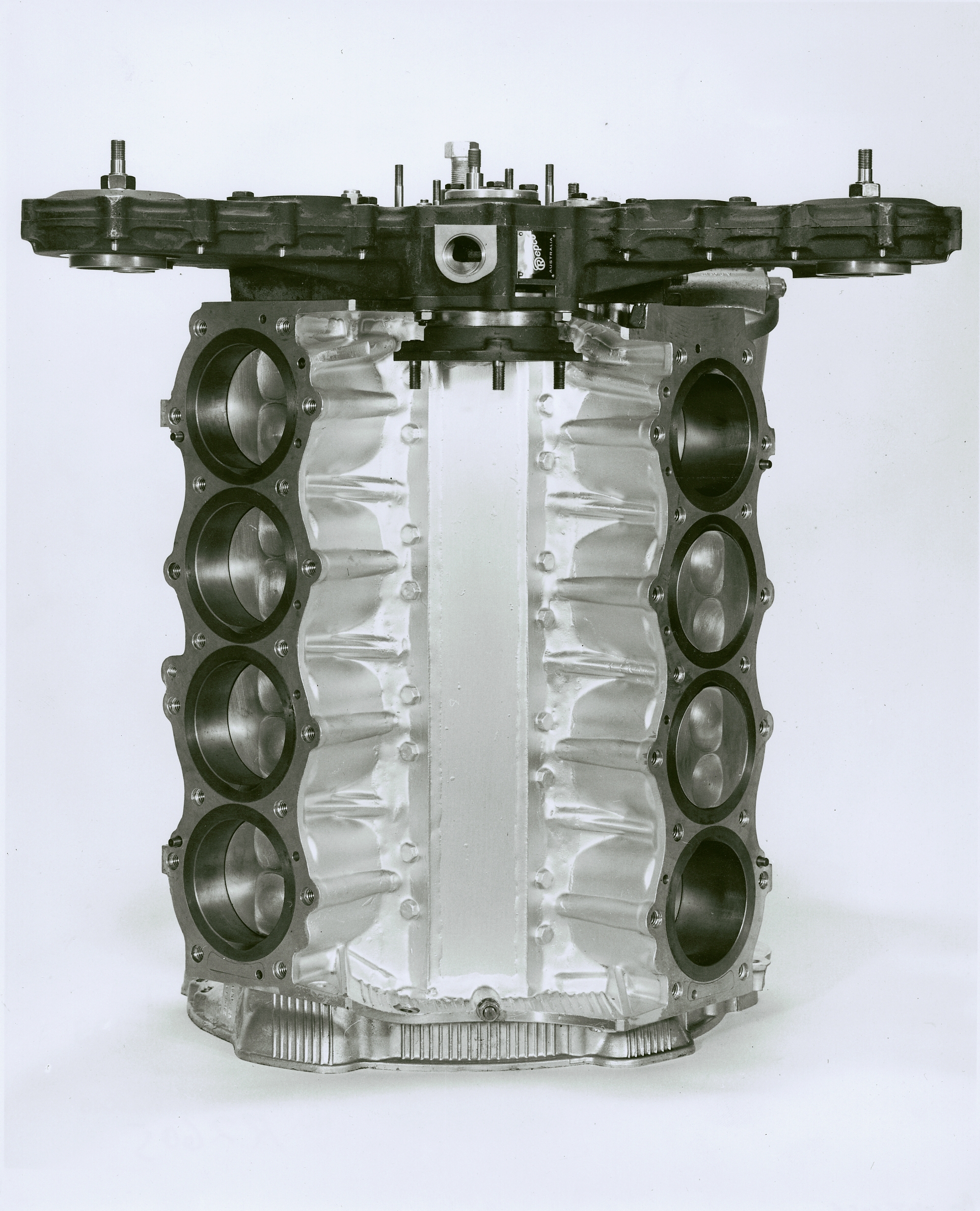
One of my first jobs was to remove all the piston assemblies from those twenty-four blocks. They were not short blocks as known in Australia (here they are complete without sump or cylinder heads) but these were not complete to that stage. They had crank bearings in place, all main bearing caps and the 3.5 inch liners were cast into the block. We didn’t use the cast iron main bearing caps or bolts, replacing them with steel caps and high strength studs.

The RB 620 used the original 3.5 inch cast in sleeves but practically everything else was changed.

All surfaces were re-machined for accuracy, all bolt thread holes re-tapped and recessed to accept studs of superior material. The camshaft bearings were in the valley of the block of course but we pressed them out and rotated them 45 degrees and pressed them back in place to cut off the original oil galleries as our engine ran twin overhead camshafts, one per cylinder bank.

The front original camshaft bearing was left intact and the second camshaft bearing was removed and fitted was a sleeve with an INA roller bearing.

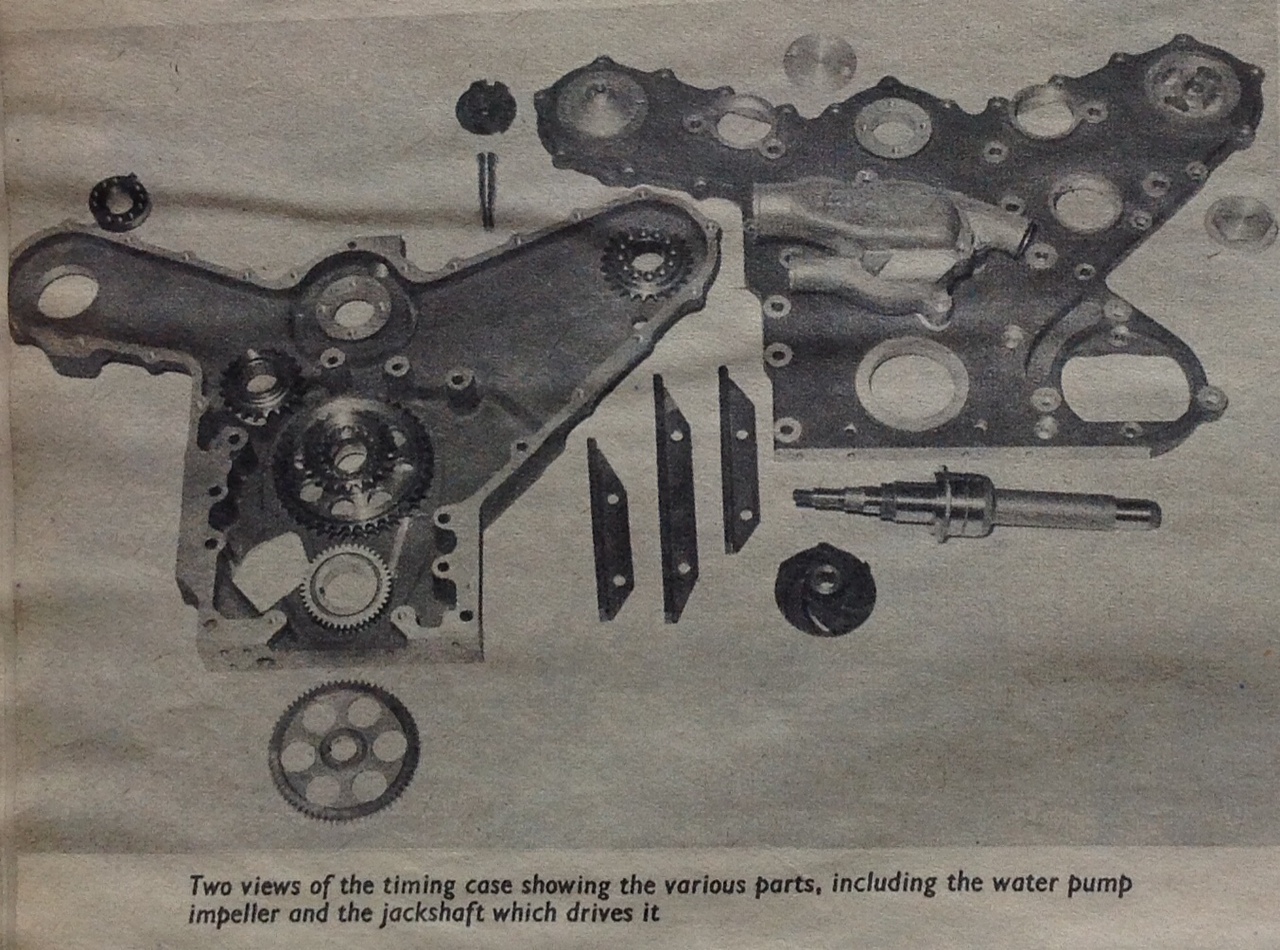
We made up little jackshafts which were driven from the crankshaft by a duplex chain, which also drove the single row chain driving the overhead camshafts. These jackshafts used the first original Oldsmobile slipper bearing and a small roller type bearing in the second original cam bearing location. The chains etc, were all enclosed inside the RB chain-case.

rb 620 chain case

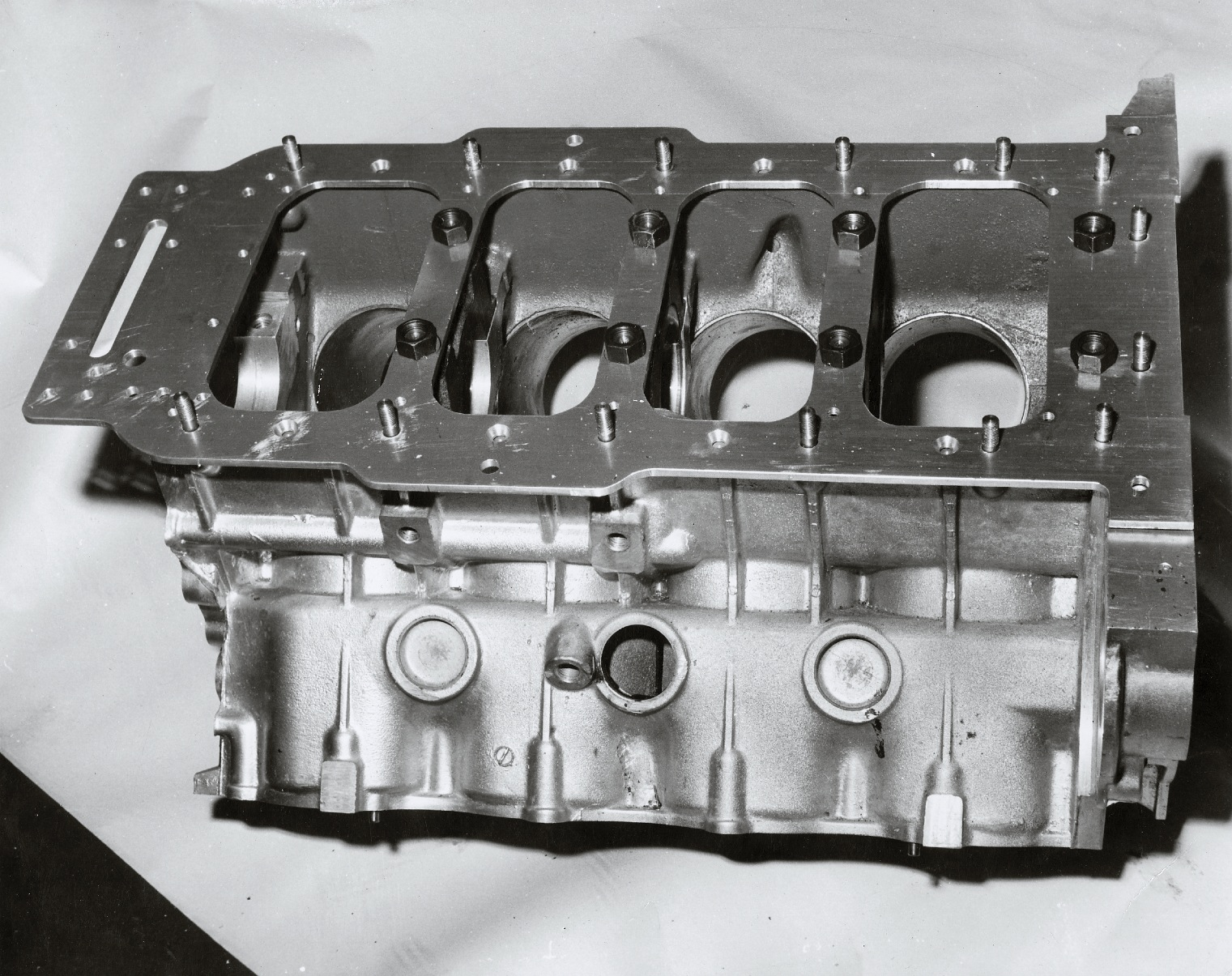
RB600 F85 Olds block from above. Note the valley cover of aluminium sealed ‘with a sea of Araldite then painted over with Silverfros- those blocks which are still in service today still retain the Araldited plate and still do not leak’ comments ex RBE engineer Nigel Tait. Phil Irving’s design had lots of clever bits including the timing chain arrangement which allowed the heads to be removed in the field without disturbing the engine timing- and was also clever in that the same head could be used on either side of the engine (Tait/Repco)


block & timing case

600 block and timing case, ‘Purolator oil filter housing, timing chain single row (Repco)

‘A lot of people in 1966, including the international motoring writers, did not realise the extent of the machining required to the F85 Oldsmobile cylinder block to use as our race engine base. It was more work and and involved to adapt the F85 than in machining our new Repco cast blocks (700 and 800 Series) used later in the project.

It used to annoy all of us when our engine was referred to as ‘based on a Buick’ in various world motoring magazines. It also added insult to injury by them adding ‘Built in a tin shed in Australia’!

We then had to close up the large cavity in the valley where there used to be a cover plate, pushrods and cam followers in the original engine.

We spent many hours fettling aluminum plates by hand and fitting them into the valleys to cover the original cam followers and holes etc. When we had a very good fit of these plates we mixed two pot resin (Araldite) with additional aluminum powder and filled up the valley seams around the plate.

Then with some elaborate heating systems we invented, we dried the Araldite in place. This also gained us the reputation of the ‘The Grand Prix engine held together with Araldite’ in various magazine articles!’

rb 20 block

RB600 block on the left, Olds’ F85 unmodified block on the right. The 600 block has the pushrod holes covered with the Araldited aluminium plate. ‘The 1/4 inch thick block stiffener plate protrudes from the top of the modified block. This gives the effect of cross bolting…note also the Repco designed magnesium sump’ notes Tait (Tait/Repco)

‘I finished the job of dismantling the blocks, we only worked on two or three at a time during the early months of 1966. Unless the parts were an easy item or required substantial machine set up we only made a few of each component as design changes were ongoing. Not critical large changes but small subtle ones’.

‘We didn’t have any problems with the Oldsmobile block by there was one race in 1966 when a cylinder liner failed. As explained, we used the cast in liners and retained the 3.5 inch bore.

BRO, (Brabham Racing Organisation) sent back the failed engine block and we bored out the remains of the cylinder liner. There was a casting cavity behind the liner which caused the weakness and failure. This was a problem that could not be dealt with without boring out all the liners and fitting sleeves. Otherwise there could be more failures due to bad castings. From that date we used dry liners and eradicated the risk of it occurring again.’

block

Jack and Phil specified this aluminium plate to add stiffness to the production F85 Olds block, big holes to provide rod clearance obviously. ‘This block would have had dry sleeves which led to considerable blowby problems due to distortion and eventually wet sleeves were specified by Phil Irving’ notes Nigel Tait (Tait/Repco)

UK Components: Crankshaft etc…

Phil Irving completed most of the design of the engine in England, he rented a flat in Clapham in January 1964 close to BRO and together with Jack they settled on a relatively simple single overhead camshaft configuration compatible with the block and fitment into the unused Brabham BT19 spaceframe chassis. This simplen specificaton is what Jack pitched to the Repco board at the projects outlet.

The BT19 frame had remained unused throughout 1965 when the engine for which it was designed, the Flat-16 Coventry Climax FWMW, was not released to Brabham, Lotus and Cooper as planned.

To expedite things in the UK, whilst simultaneously mailing drawings to Australia, Phil  commissioned Sterling Metals to cast the heads. Prior to his return to Australia in September 1964, HRG machined an initial batch of six heads, fitting valves and seats to Irving’s specifications.

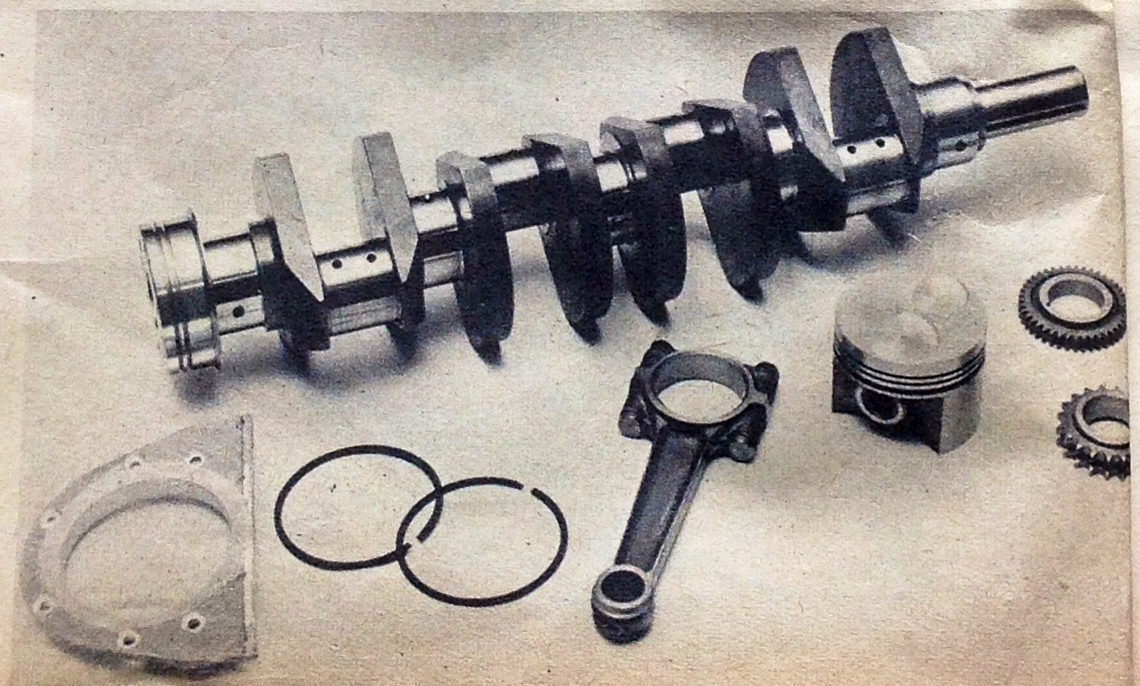
‘Laystall in the UK also made the crankshaft. Constructed from a single steel billet the ‘flat’ nitrided crankshaft was a wonderful Irving design. I don’t recall any updates or changes to the design of the crankshaft over the years the RB engines were built. It was supplied in 2.5, 3 litre and 4.2 litres for the Indy engines- also 4.4, 4.8 and 5 litre sportscar versions. All crankshafts were of the same bearing dimensions etc’.

‘The term ‘flat-crank’ refers to the connecting rod journals being opposite each other and not in multi-plane configuration as is usual in production V8’s. It meant the engine was not such a well balanced unit at low revolutions but it actually converted the engine to virtually two four cylinder units and either cylinder bank would run quite smoothly on its own. The layout also enabled the superior use of exhaust configuration eliminating the need for crossover exhaust pipes to obtain full extraction effect’.

crank

Crankshaft was made by Laystall to Phil Irving’s design, pistons and rings by Repco subsidiaries. (Repco)

Pistons…

‘Repco is a piston ring manufacturer and very experienced in ring design which meant that we were well ahead in that regard.

The famous SS55 oil rings were well known already around the world. The pistons were Repco Products.

No other F1 engine constructor of the sixties made their own pistons. The experience we gained with the supply of Coventry Climax pistons and rings contributed to this success.’

Bearings: Vandervell Interlopers and ‘Racing Improves the Breed’…

‘Repco was already supplying engine bearings to various manufacturers globally from the Tasmanian based Repco Bearing Company, we obtained these components as required.

During 1966 an advert appeared in a British motoring magazine, ‘French Grand Prix won on Vandervell bearings’. Vandervell are of course a British bearing company, Repco were furious and telex messages to and from BRO (Brabham Racing Organization) revealed that Jack Brabham was not happy with the depth of the lead overlay on our copper/lead crankshaft bearings.

Our bearings had a lead overlay of .001 inch and the Vandervell bearings an overlay of .0005. So I was instructed to pack away all our existing bearings and mark them not for use, our bearing company came up with the improved design bearings with the lesser overlay in time for the next GP. Racing certainly improves the product!

Before I transferred to the RB project, i worked in Repco merchandising and received brochures and information about a new Repco alumina/tin bearing known as the ‘Alutin’ and advertised by Repco as a new high performance product. Repco were promoting them as a breakthrough design.

I learned these new bearings had been unsatisfactory under test in the F1 engine and within a short period no more was said about the new product ‘Alutin’. They were inclined to ‘pick up’ on the journals at high rpm – another example of how racing  improves the product. This problem had not been evident in the engine testing of the product by Repco to that date.’

ad

‘Racing Improves the Breed’…Repco Ad 1966

Outsourced Items…

‘There were some components we did source outside the Repco Group.

There were cam followers, Alfa Romeo cam buckets, valve springs from W&S, valves manufactured by local company Dreadnaught. The ignition system was sourced from Bosch by Brabham.

The collets were from the UK and were a production car or motorcycle collet, the name escapes me. We made the valve spring retainers and collet retaining caps. Over the project we made  changes to the collet retainer material from aluminum to heat treated aluminium bar and later titanium. Not a lot was gained as titanium fatigues as well, as we found out.’

Lucas Fuel Injection…

‘The fuel injectors and fuel distributor were Lucas items, the system was in early stages of development. It consisted of an injector for each cylinder, in our case installed in the inlet trumpet a short distance from the inlet port in the cylinder head.

The system is timed with a fuel distributor in the engine valley driven from the chaincase by the distributor drive gear. The fuel is supplied at 100psi from an electric pump. The fuel pressure supplies and operates small shuttles which are constantly metering supply according to the length of shuttle travel. The amount of fuel supplied to the injectors is controlled by a variable small steel cam which is profiled to suit the particular engine size etc. The steel cam therefore controls the actual fuel mixture and is linked to the throttle inlet slides’.

‘It is interesting to note that although the fuel distributor can be timed to any position in the engine cycle, injecting at the point of the inlet valve opening or with it closed or wherever, it does not make any important difference in engine performance but as Phil Irving explained to me there is a point of injection that lowers engine performance so therefore the fuel distributor is timed in each installation to avoid the undesirable point of injection. The air inlet trumpets were cut to length spun and profiled.

The chaincase was a magnesium casting and the ‘620’ 1966 World Championship engine used a single row handmade chain imported from Morse in the US. We cut all the sprockets and manufactured all the camshaft couplings etc. We used an SCD hydraulic chain adjuster, a standard BMC component.

The cam chain was driven by a small jackshaft which was fitted in the front two original camshaft bearing spaces of the original Olds block. The jackshaft was driven by a Morse duplex chain from the crankshaft sprocket, also Repco made. The crankshaft had a small gear driving the oil pump mounted underneath the chain case.’

chain case

Assembly of chain in the magnesium timing case of an RB620 engine (Repco)

Oil Pump…

‘The oil pump was a wonderful Irving design, simple to service but a small work of art. It featured flexible supply hoses with snap fittings and was a combination of oil supply pump which supplied the engine with oil up through a gallery in the chaincase and also a slightly larger scavenge pump connected to each end of the engine sump- it was also a magnesium casting. The pump assemblies, sump and all components were made by Repco.

The system consisted of a sump with an inertia valve located in its lowest point. If the car was braking the inertia moved the valve forward which opened a cavity in the front of the sump causing oil to be drawn from the front. Under acceleration the inertia valve moved backwards and the forward cavity closed and the rear cavity opened. This meant a minimum of blowby and air to be pumped by the scavenge system. I don’t recall any failure of this system apart from the  Sandown debut race of our ‘620’ Series 2.5 litre engine in January 1966′.

‘The ‘Tasman’ cars were held on the grid for rather a long time and as a result the oil had cooled in the Repco Brabham. Jack left the line with plenty of revs, the cold oil and resulting oil pressure split the pressure pump gears. The first engines used cast Fordson Major tractor pressure pump gears and one gear had split due to the extreme pressure. Jack Brabham did  3 or 4 laps from memory.

I arrived at work on Monday morning and in typical Irving style found a drawing  for the supervisor for the construction of new steel gears and a ‘Do Not Use’ request for all the Fordson gears in stock. Phil had arrived at the drawing office on Sunday evening after the Sandown meeting and made the modifications straight away’.

‘The chaincase featured a couple of inspection caps which were removed to allow for chain tension adjustment etc. We made these caps and when it came to cutting the retaining threads in the chaincase we could not obtain the required thread tap anywhere. Phil had specified similar threads to the Vincent Motorcycle chain adjuster cap threads so that’s exactly what we used. Irving brought in the original Vincent motorcycle thread tap and we used that to thread all the chaincases under manufacture at the time, actually going back to valve spring collet retainer caps.

I recall that the first engines used BSA motorcycle collet retainers. One of the things I enjoyed so much working with Phil was that he did not waste time on risk taking design, he used tried and tested systems from his past. He once said “There is really nothing new, it is just changed around in some way”- well he sure proved that with the first RB620 engine!’

chaincase componentry

Cylinder Heads…

‘The cylinder heads were cast aluminum of crossflow design, the cam covers cast magnesium. All our cast magnesium and aluminum components were supplied by CAC in Fishermans Bend, Melbourne, with the exception of the first batch of six heads cast in the UK. (Commonwealth Aircraft Corporation).

Phil was remarkable with his engine design skill in that he could see the item in reverse or three dimensions and could design all the sand boxes etc and patterns required to arrive at the finished item.

The engine used no bolts as the original Olds did. Cylinder heads, cam covers, main bearing caps, sump, oil pump and chaincase were fitted with, or retained by high tensile studs.That was my department and apart from the first couple of prototypes I made all the studs for the 1966/67 RB engines. Some were quite a challenge, the thread specification and tolerances were exacting.

The crankshaft rear bearing seal was a slipper ring design with a bolted on ring retaining flange. The slipper rings were supplied by our Russell Manufacturing Co, we made the outer flange in the factory. The steel flywheel was also turned and made by Repco’.

Conncting Rods and Ease of Servicing…

rod

RBE conrod drawing (Repco)

‘We used modified Daimler connecting rods and competition Chevrolet and Repco rods. In later engines we occasionally used Warren rods from the US. In the valley of the engine a small drive housing held the vertical ignition distributor and also the fuel distributor. Sometimes in the larger engines we also fitted a mechanical fuel pump to this housing.’

‘The type 620 engine engine had throttle slides running on small grooves with 1/8 inch steel rollers to prevent lock ups which would be a disaster. The slide covers were  fastened directly to the cylinder head and in later engines were changed to fully assembled units and fastened directly to the cylinder heads for ease of changing if required. They were then complete units with studs bolting them to the inlet flanges’.

A big feature of servicing the RB620 engine was that either cylinder head could be removed without disturbing camshaft timing or the camshaft from the cylinder head, a great time saver. (See the photos in the block section above which clearly shows this)

The oil pump can be removed in one small unit and replaced with no other dismantling. Or the two cylinder heads can be removed without disturbing the timing of the camshafts or the chain case. All very important design features for use ‘in the field’.

engine assembly

RB620 engine assembly early 1966, Maidstone (Repco)

First Test…

The first engine, a 2.5 litre Tasman engine designated ‘E1’ was fired up on March 26 1965, almost twelve months to the day Phil Irving commenced its design.

It was initially run with Weber 32mm IDM carbs and after a checkover fitted with 40mm Webers. The engine produced 235BHP @ 8200RPM, equivalent to a good Coventry Climax 2.5 FPF at the time.

Repco committed to build 6 engines for the 1966 Tasman Series, later changed to three 2.5 litre Tasman engines and two 3 litre F1 engines, the first race for the new engine was the non-championship South African Grand Prix on January 1 1966, the next part in the Repco story is the 1966 race program for the new engine.

rb 20 dyno long shot

‘2.5 litre 620 V8 E1 on the Heenan and Froude GB4 dynamometer in Cell 4 at Richmond, 1965. The exhausts lead straight out through a hole in the wall. Also there was minimal noise insulation in the tin shed that served as a test cell. Vickers Ruwolt across the road blamed us for the large crack that developed in their brick wall on the other side of Doonside Street!’ recalls Nigel Tait (Tait/Repco)

Photo & Other Credits…

Autocar, ‘Jack Brabhams World Championship Year’, Repco Record, ‘Doug Nye with Jack Brabham’, Australian Post, ‘From Maybach to Repco’ Malcolm Preston, Rodway Wolfe Collection, Nigel Tait recollections and his Collection, Repco Ltd photo archive

Etcetera…

letterhead

Original RBE Pty.Ltd. Letterhead. Jack Brabham had no financial (equity) or directorship involvement in this company, it was entirely a Repco subsidiary.


wade

‘E1’ was the RB620 prototype Tasman 2.5 litre engine. Most of the entries in this exercise book are dated, this one is not, but its mid 1965, the book records the use of cams with the ‘Wade 185’ grind and the valve timing, no dyno sheets sadly! (Wolfe/Repco)


repco 1

Have a look at this Repco film produced in mid-1965…

It covers some interesting background on the relationship between Brabham and Repco, footage of Jack at home in the UK, the Brabham factory in New Haw, some on circuit footage at Goodwood and then some sensational coverage of the 1965 Tasman Series in both NZ and Oz. The latter segues nicely into footage of the first ‘RB620’ 2.5 Tasman V8 engine ‘E1’ on the dyno at the Repco Engine Laboratory, at Russell Manufacturing, Richmond in ’65…

Tailpiece: #1-RBE620 2.5 litre ‘E1’, the prototype Tasman 2.5 V8, fitted with Webers on the GB4 dyno- Repco Engine Lab at Russells, Richmond 1965. The box over the Webers is for airflow measurement notes Nigel Tait…

rb 620 on dyno

(Tait/Repco)


dalton
Superb, evocative Gnoo Blas shot. Ross Dalton, C-Type Jag, February 1960 (John Ellacott)

Gnoo Blas actually! Ross Dalton and his Jaguar C-Type, February 1960…

Gnoo Blas was a circuit around the public roads of Bloomfield Hospital in Orange, in the Central West region of New South Wales, 250km west of Sydney. Gnoo Blas is the aboriginal name of Mount Canoblas nearby.

The superb opening photo, taken by John Ellacott, is one of those ‘ the more you look the more you see shots’. Note the ‘fag’ between the driver’s fingers, plastic raincoat, overloaded control tower, Kombi with ‘tarp drying on top, official with ‘cuppa. All are about as far from Bernie’s ‘manicured paddocks and corporate scene’ as it’s possible to be. And thank the good Lord above for that.

As the Australian economy recovered from World War 2 and disposable incomes increased, together with the availability of consumer credit, motor racing and racing circuits were opportunities for individuals and communities alike. Circuits popped up all over the place. Oranges’ ‘Cherry Blossom Committee’ saw an opportunity to establish a circuit as the promoters of the Easter Bathurst meeting ‘up the road’, the Australian Sporting Car Club were in dispute with local Bathurst authorities and were looking for an alternative venue.

The 6.03km, triangular shaped circuit opened in January 1953, the South Pacific Road Racing Championship attracted 12,500 spectators.

All of the stars of the period raced there including Prince Bira, Peter Whitehead, Tony Gaze, Ted Gray, Doug Whiteford and Jack Brabham who made his road racing debut there in 1952 in a Cooper Mk IV and held the lap record until the circuits’ final meeting.

John Boorman on the way to a win in XKC037, Gnoo Blas 1955 (J Psaros)
orange
(Orange & District Historical Society)

The shot of above shows the atmosphere of the place and time. John Medley IDs the shot as lap 1 of the 1955 South Pacific Championship, ‘Brabham leading Whitehead- a remarkable performance.’ F2 Cooper T23 Bristol from Formula Libre Ferrari 500/625.

Dwindling crowds, debts owed to the original investors and difficulties in renewing the track licence with the NSW police led to the circuits closure in October 1961, the lap record was then held by Jon Leighton’s Cooper Climax at 105.2 mph. One era and circuit closed with Warwick Farm shortly to open in Western Sydney, another era commenced.

gnoo-blas-reg-hunt-Jan-29-1956-2
Reg Hunt on the way to victory in the South Pacific Championship on 30 January 1956. Maserati 250F. Check out the ‘steaming train’, Sydney Morning Herald van, the general oh-so-casual scene. Road racing at its best (Gnoo Blas Classic Car Club)

South Pacific Road Racing Championships 1956…

One of the best promoted meetings was the ‘South Pacific Road Racing Championship’ contested on 30 January 1956.

20,000 spectators crowded into Orange on race day to see a quality field of cars and drives; Reg Hunt in his new Maserati 250F, Jack Brabham and Ken Neal in Cooper Bristols, Curley Brydon Ferrari 125, Stan Jones in Maybach 3 and Alf Harvey in the ex-Bira Oscar V12.

Hunt dominated, he lapped the field, took the fastest lap and set the highest top speed at160mph over the Flying Quarter. Jones withdrew with a ‘leg out of bed’, a rod poking outside the block of the precious six-cylinder engine. Brabham and Neal were second and third in their Cooper Bristols.

gnoo-blas-alf-harvey-january-1956
Gnoo Blas European Exotica. Alf Harvey’s ex-Bira OSCA V12 ahead of Curley Brydon’s Ferrari 125, South Pacific Championship, January 1956 (Gnoo Blas Classic Car Club)
gardner boorman c type tomago
pwoooaaah! Boys will be boys. XKC037 during John Boorman’s ownership at a meeting at Tomago Airstrip, near Newcastle NSW, 1955 (Dick Willis)

Ex-works- Frank Gardner/Frank Matich Jaguar XKC037…

The ‘happy chappy’ in the Jaguar in the first photo at the top is Ross Dalton who acquired the car from Frank Matich. XKC037 started life as a works car. It was built as a standard specification reserve 1953 Le Mans entry in case the advanced lightweight cars under development failed in testing (XKC038 and XKC039 were built for the same purpose).

Stirling Moss raced it at Silverstone in May 1953 and rolled it. XKC037 was then rebodied and sold to the Kenyan Coca Cola bottler John Marussis who entered it at Reims but wrecked it at Dundrod.

Rebuilt again, it was then sold via 1951 Le Mans winner, Peter Whitehead to Cessnock, New South Wales doctor, John Boorman.

Frank Gardner bought the car as an insurance write-off after it was involved in a fatal accident. Gardner recalled in a ‘Motorsport’ interview ‘…Boorman hit a Ford Customline, killed the (two) occupants and ended up down a ravine (near Tamworth NSW)…I wrote to Jaguar asking for information so i could rebuild it… a few weeks later a package arrived with all the drawings so I knew which way to go to get it sorted’.

‘I did it right because even then a proper C-Type meant something and I thought if I bastardise this thing it will look like cleaning up a bloody Rembrandt with aftershave lotion! But I couldn’t get it to run cool so I altered the radiator grille a bit…’

Former Cessnock resident Michael Hickey identifies this shot as Allandale Road, Cessnock. Equipe Boorman- C Type and Mk7 Jags, is on the way to Mount Panorama in 1955- he raced in both the Easter and October meetings (Jaguar Magazine)
Boorman at Mount Panorama, Bathurst date uncertain (unattributed)
FG in XKC037 when first rebuilt and fitted with one of Frank’s XK120 grilles and fibreglass bonnet, circuit unknown (unattributed)

The C Type replaced FG’s lightweight XK120 Jaguar and was an important stepping stone in the careers of both he and Matich, both progressed to D=Types after the C.

Years later XKC037 was acquired by Sydney Jaguar identity, Ian Cummins who completed its restoration in the mid 1970s. It left our shores in 1984 for a sum considerably greater than the £2000 Ross Dalton paid in 1960!

C-Type Jags won Le Mans upon debut in 1951 and again in ’53.

fm c type leatons servo
Frank Matich in XKC037 out the front of the cars owners, Leatons Motors workshop, 351 Stony Creek Road, Kingsgrove, Sydney in October 1958. What a shot! Love the Energol ‘The Oiliest Oil’ sign (John Ellacott)

Etcetera: XKC037….

boorman tomago
(Dick Willis)

Dr John Boorman, XKC037 at Tomago Airstrip, NSW 9 April 1955.

(J Psaros)

Frank Gardner at Mount Panorama in 1957.

image
(John Ellacott)

Tom Sulman’s Aston Martin DB3S chases Frank Gardner’s Jag XKC037 at Mount Druitt, November 1957.

(unattributed)

FG ascending Silverdale Hillclimb during the 1957 NSW Hillclimb Championships, he won his class and was quicker than Arnold Glass in the ex-Lex Davison Australian Grand Prix winning HWM Jaguar.

fm mount druitt
(John Ellacott)

Frank Matich Jag C during private practice at Mt Druitt, Sydney in 1959.

fm c bathurst
(Kevin Drage)

The engine of XKC037 as raced by Frank Matich for Leaton Motors at the October 1958 Bathurst meeting.

The car contested the Australian Tourist Trophy, FM finished fourth, David McKay won the race in his second, ex-works Aston Martin DB3S.

scw
Advertorial 1950s style! The Leaton Motors Team on the cover of Australia’s Sports Car World magazine; the Austin Lancer dvr Brian Foley, AH Sprite dvr Doug Chivas and XKC037 dvr Frank Matich (Sports Car World)

The current owner of this wonderful car, John Corrie, recently (March 2015) got in touch and sent these shots of the C Type, great to see it still being raced, Messrs Gardner, Matich and Dalton would be pleased!

xkc oodwood 2
David Brazell in John Corries’, ‘XKC037’, Goodwood Track day practising for the 2013 Revival meeting (Chris Perrett)
xkc good wood
Superb shot in the English Summer…’Goodwood Revival 2013 during the Freddie March Trophy which was stopped after an hour the weather turned really bad’. David Brazell in John Corries car (Chris Perrett)
xkc home
XKC037 looking rather more immaculate than in its days as a workhorse for Frank Gardner and Frank Matich in Australia (John Corrie)
jag c cutaway
C-Type cutaway drawing (Jaguar Heritage)
jaaggs
(Unattributed)

Etcetera: Gnoo Blas 1960 Australian Touring Car Championship meeting…

Start of the one race, ‘the first’, Australian Touring Car Championship at Gnoo Blas on 1 February 1960.

Left to right are the Jag Mk1s of Ron Hodgson, Bill Pitt and David McKay from pole who won the race.

Hodgson led early, the three Jags pulled away from the rest of the field, he ran wide and the other two spun at Windsock on lap 1 then he did the same on lap 2 letting McKay and Pitt through. Max Volkers was fourth in his Holden FJ and Pete Geoghegan fifth in his Holden 48-215 until head gasket failure intervened.

By lap 14 McKay had a 26 second lead over Pitt, then rain fell catching Ron Sawyer’s Holden FJ out. He spun on the crest of Connaghans Corner hitting the inside bank and rolling, help was at hand when Des West stopped to assist the hapless driver from the car. McKay’s path was blocked by a Ford Zephyr which had also stopped (driver unknown) ‘McKay used his car to move the Zephyr out of the way’.

Further excitement occurred on the following lap when McKay spun yielding the lead to Pitt but the overdrive mechanism on that car began to fail allowing David McKay to regain the lead two laps from the end. He won the race six seconds ahead of Pitt with Ron Hodgson a minute in arrears then came Max Volkers a lap down in fourth.

(Ian Lord Collection)
finch d type
David Finch, Jag XKD Type ,Windsock Corner, Gnoo Blas 1960 (Don Read Collection)


gnoo blas

Bibliography…

‘Historic Racing Cars in Australia’ John Blanden, John Medley, Michael Hickey

Photo Credits…

John Ellacott, Jaguar Heritage, Orange & District Historical Society, Paul Cross, Don Read Collection, Dick Willis, Chris Perrett, John Corrie, Frank Gardner ‘Motorsport’ magazine interview March 2008, Gnoo Blas Classic Car Club, Jock Psaros, Jaguar Magazine, Ian Lord Collection

Finito…

bluebird rain

Campbell, Bluebird and team depart from the salt of Lake Eyre in May 1963 on the causeway from saltpan to road and on to Muloorina Station, rain soon covered the Lake to a depth of 3 inches…surreal shot (Pinterest unattributed)

50 Years Ago Today, 17 July 1964 , Donald Campbell Broke the World Land Speed Record, in Bluebird Proteus CN7, at Lake Eyre , South Australia achieving a speed of 403.10 MPH…

Donald Campbell was to achieve a unique double, the only man to ever break Land and Water Speed Records in the same year, when at Lake Dumbleyung outside Perth he set a record of 276.33 MPH in Bluebird K7 on December 31 1964.

His fathers son…
father & son

Sir Malcolm & Donald Campbell, Daytona Beach , January 1933. Bluebird Campbell Railton

Donald was the son of Sir Malcolm Campbell, a Grand Prix winner and Brooklands racer who turned his hand to record breaking achieving 146.16 mph at Pendine Sands , Wales , 1924 in a Sunbeam V12 .He broke 9 LSR records in all, his final at Bonneville, Utah, on 3 Sept 1935 at an average of 301.337 mph, the first person to exceed 300mph.

He set 4 Water Speed Records , the final in 1939 on Coniston Water in Bluebird K4 . He was Knighted in 1931 and died after a series of strokes in 1948 aged 63.

daytona 1933

Malcolm Campbell, Bluebird , Daytona Beach , Florida. 272.46MPH , February 1933 (Pinterest)

Water Speed Records & The Norris Brothers…

k4

Donald Campbell, Leo Villa (right) in Bluebird K4 ,Coniston Water, Lakes District, Lancashire, August 1949 (Pinterest)

Like many sons of famous fathers Donald set out to both emulate and surpass the achievements of his father.

At the outbreak of World War 2 he volunteered  for the RAF but was unable to serve as a result of childhood rheumatic fever. He became a maintenance engineer and subsequently a Shareholder/Director of a small engineering company named Kine Engineering, the business producing machine tools..

His record breaking efforts commenced after his father died, having purchased the boat ‘Bluebird K4’ from Sir Malcolms Estate. It was gradually coaxed to 170MPH and had circuit racing success.Lew Norris was a mechanical engineer and the workshop manager at Kine Engineering who provided advice on the development of K4.

In early 1953 Campbell began developing his own advanced all metal jet powered Bluebird K7 hydroplane. He approached Ken & Lew Norris to design and build the boat , the brothers collaborating with Australian aerodynamicist Tom Fink.

Norris Bros Ltd became a very successful design consultancy working and manufacturing in diverse fields, amongst their designs was the automatic tensioning device for seatbelts.

Campbell set 7 WSR’s in K7 between July 1955 and December 1964, the first at 202.33MPH, the last at  276.33 He was awarded a CBE for his water speed record breaking in January 1957.

k7 66

Bluebird K7 Coniston Water 1966

From the Waters of Lake Coniston to the Salt of Bonneville, Utah…LSR & Bluebird CN7…

drawing

Bluebird CN7 : Air for the turbine was drawn in thru the cars nose, ducted around the driver , the cockpit positioned forward of the front wheels. Wheelbase identical to John Cobb’s Railton (Pinterest)

After Campbells record attempt at Lake Mead in Nevada in 1955 it was put to him that he should ‘go for the double’, to achieve a Land & Water Speed record in the same year .

Campbell had no credentials on land, but undeterred approached the Norris Brothers to build a car capable of 500 mph. The task was enormous with Campbell then in his late ’30’s being described as a ‘financier , impresario, sportsman, adventurer, as well as courageous enough to take on the elements’.

Campbell was a patriot and wanted the car to be the best of British ,it took over 80 companies, in excess of one million pounds to build the car and an equivalent amount to run the operation…enormous sums by the standard of the day.

Having put in place the funding and  corporate support to deliver the project technically Norris Brothers designed a car capable of 500mph. the design concept was simple ; a jet engine, run drive shafts out of each end to the front and rear axles, and build a steel frame to house the engine, driver, and wheels. The driver sat forward of the front wheels, air was  ingested through a front intake and ducted around the driver into the turbines and then the engine.

The technical specifications of the CN7 are outlined below, but in essence the car was of advanced aluminium monocoque construction  ,had 4 driven wheels, was 30 feet long, weighed 9600 pounds and was powered by a Bristol Siddeley free turbine , or what would  be described today as a ‘turbo prop’ engine, developing 4450 shaft horse power or 4000 BHP at 11-11800RPM.

The aerodynamics were similar to John Cobbs Mobil Railton Special which almost achieved 400MPH using petrol engines.

Bonneville 1960…

bonneville sept

Campbell testing CN7 at Bonneville , September 1960, days before the accident

Bluebird was completed in Spring 1960 and after testing at Goodwood circuit was shipped to Bonneville , Utah, the scene of Malcolms last LSR triumph in September 1935.

Initial testing went well but on his sixth run Campbell crashed at 360 mph , writing off the car and hospitalising himself with a fractured skull, burst eardrum and extensive cuts and abrasions.

Campbells confidence was badly shaken, he suffered mild panic attacks and for some time doubted he could go back to record breaking. He learnt to fly light aircraft as part of his convalescence but by 1961 he was feeling better and planning the rebuild of CN7.

bonneville

Bluebird was rooted, destroyed in Campbells near fatal accident, the cars structural integrity saving him. Campbell did not have a background in motor racing, unlike his father, the challenge of driving and controlling the immense car without that is almost beyond comprehension…bravery in the extreme, and self belief despite the self-doubt it is said Campbell also had

CN7 Rebuilt…

team

Some of the team at Lake Eyre…scale of the operation in this remote location clear…

Sir Alfred Owen of BRM Trust, and later the owner of BRM outright, fame stepped forward and offered to rebuild the car, various of his Rubery Holdings Group companies having constructed the car initially.

Campbell thought that Bonneville was too short, the salt having a total length of 11 miles and after researching various alternatives identified Lake Eyre, 700 Km north of Adelaide as a more appropriate location.It had 450 square miles of dried salt lake and rain had not fallen for over 20 years.The surface of the 20 mile long ‘track’ was rock hard, which allowed a very long ‘run in’ to the measured mile and importantly plenty of space to stop the massive car, not easy despite the sophisticted braking system, their being little or no ‘engine braking’ from such engines.

image

Sussing the Lake Eyre salt in 1962 (National Geographic)


By Summer 1962 CN7 was rebuilt , 9 months later than planned , it was the same car albeit with the important addition of a stabilising fin and reinforced fibreglass cockpit cover , it was shipped to Australia in late 1962.

unloading

Unloading Bluebird at Lake Eyre 1963 (John Kennedy)

Lake Eyre, South Australia…1963 and Craig Breedlove , Bonneville ’63…

bogged

The task of getting Bluebird to Lake Eyre, and then onto the surface was immense. 100Km of road were constructed by the government and then a 400 metre long causeway from road onto the lake Surface far enough in to clear the soft outside of the Lake. 1963 (John Kennedy)

The Australian and South Australian Governments saw the attempt as a means by which to promote both the country and the state.

Lake Eyre is remote, to say the least, the South Australian Government creating a gravel road 100 Km long from Marree to Muloorina Station and from there to the shore of the Lake. Then the difficult bit started…the crust of salt lakes is hardest in the middle, underlying the crust is water saturated blue mud. It was necessary to build a causeway 400 metres long  to allow transport vehicles to access the salt from the road itself .

The initial runway selected was abandoned after trucks grading it sank through the surface, another being chosen and graded after government equipment returned having worked on public, impassable roads which had not seen water for years…

refuelling

Shortly after Easter, in addition to Bluebird there were 5 Fordson tractors, 2 Commer 5 ton trucks, a Humber Super Snipe car an Elfin Catalina single seater for tyre adhesion tests, several Commer vans for refuelling etc, multiple Land Rovers, and other assorted cars belonging to reporters and photographers.

There were around 80 men at Lake Eyre either in houses or caravans, then a mechanised unit of the army and police arrived swelling numbers to 150-200 depending on the day, making food and other supplies difficult when roads were impassable. It was a military operation, supported by the Australian Army to provide the logistical support to move around 200 people into the remote location to support the record attempt.

army

A new course was marked out , several test strips being prepared so that Ted Townsend, the Dunlop technician, could work out their relative effectiveness. This was done by driving the Elfin Catalina, a small single seater powered by a Ford Cosworth 1.5 litre engine, and doing deceleration runs using a recording ‘Tapley ‘ meter. The object was to find a course with a high coefficient of friction to aid the momentum of the car, to aid the cars grip of the surface. The tyres used on the Elfin were the same Dunlops fitted to Bluebird, albeit scaled down from 52 inches…

elfin

Dunlop Engineer Ted Townsend at the wheel of the Elfin ‘Catalina’ Ford used for surface testing, the car mounted with 13 inch scale replicas of Bluebirds 52 inch tyres. Car was used with testing equipment to find salt with the optimum coefficient of friction (Pinterest)

The task of making the strips was huge as Ken Norris wanted a tolerance of o.25 inches variation in height of the salt surface over 100 feet.

test

Bluebird Lake Eyre test run 1963 (John Kennedy)

Campbell arrived in late March, low speed attempts at around 240MPH being carried out, this also allowed the team to do their ‘turn around drill’, the return record timing run  needing to be made within an hour of the first.

Then the rain came…By May 1963 Lake Eyre was flooded to a depth of 3 inches, the first rain in years and the attempt was abandoned. Campbell had to move the car off the lake in the middle of the night to avoid it being submerged. He was criticised at the time for this but the good citizens of Great Britain did not understand the ‘on ground’ realities of Outback Australia howver large the entourage.

Meanwhile, at Bonneville Craig Breedlove had driven his pure thrust jet car, the ‘Spirit of America’ to 407.45 mph in July 1963 . The ‘car’ didn’t comply with FIA regulations about the ‘cars’ having a ‘minimum of 4 driven wheels’, but in the eyes of the world he was the fastest ‘man on wheels’, it was not the first time the regulators lagged behind the technology being deployed.

Campbell was bitterly diappointed but had to push on knowing Bluebird was capable of going much faster if circumstances smiled upon him.

mascot

Campbell hands has mascot, ‘Mr Whoppit’ , who rode in the car together with several other items, he was highly superstitious, to wife Tonya, Lake Eyre 1964

Lake Eyre 1964…

loads up

Campbell returned to Australia in Spring 1964 but the course could not be used after yet more rain.

BP pulled out as his main sponsor, Australian Oil Company Ampol stepping in. Campbell was still being criticised heavily in the press in the UK because of his administration of the project, in many ways unfairly, he hardly had control over the weather.

The course was never fully dry, but under pressure, Campbell was forced to make the best of it. In July he put in some speeds which approached the record. On 17 July, taking advantage of a break in the weather , he made 2 courageous attempts on a shortened, damp course, posting 403.10 mph.

CN7 covered the final third of the measured mile at an average of 429 mph peaking at 440 as it left the measured distance …the car would have gone faster then 450MPH had he been able to make the long run into the ‘measured mile’, he had gone to Lake Eyre for in the first place…

But it was the record all the same.

record

Civic Reception at Adelaide Town Hall…

adealiade

Civic Reception in Adelaide, King William Street had not seen anything quite like it! 200,000 people turned up, an enormous percentage of the local population at the time (Pinterest)

Campbell drove CN7 through the streets of South Australia’s capital with a crowd of more than 200,000 in attendance. CN7 then toured the country and throughout the UK after its return in November 1964. Bluebird was eventually restored in 1969, having been damaged in a demonstation run by a stand-in driver at Goodwood,but  has never run again.

The Double…

lake d

Campbell achieved his seventh WSR at Lake Dunbleyung near Perth Western Australia on 31 December 1964 at an average speed of 276.33 mph, just getting his second record within the same year as he had planned.

k7 1967

Short But Sweet..

Campbell’s LSR was short as the FIA admitted jet powered cars from October 1964.

Campbell’s 429mph on Lake Eyre remained the highest speed achieved by a wheel driven car until 2001. CN7 is now on display at the National Motor Museum in Hampshire, England.

Bluebird Rocket Car and another WSR attempt…

Norris Bros were requested by Campbell to undertake design studies to achieve Mach1.1 , using a rocket car to do so.

To increase publicity for the program to get the necessary community and business support Campbell sought to break the WSR again, this program commenced in Spring 1964.K7 was fitted with a lighter & more powerful Bristol Orpheus engine from a Folland Gnat aircraft developing about 4500 pounds of thrust.

The modified boat was taken to Coniston Water in November 1966, the boat failing when the engine ingested debris from collapsed air intakes.

Some runs at 250 mph were made but the boat had fuel feed problems limiting maximum engine power, this problem was fixed by the engineers, better weather was then required.

4 January 1967…

The weather at dawn that cold, gloomy day was was ok.

Campbell set of for his first run at 8.45 am, he went past the first marker at 285MPH, 7.525 seconds later leaving the measured mile at over 310 MPH. Instead of refuelling and waiting for the wash to subside, he made his return run, this was something he had done before.

His second run was faster , at a peak speed of 328MPH the boat was bouncing its starboard sponson with increasing ferocity, the most intense bounce dropping speed from 328 to 296MPH. Engine ‘flame out’ (failure) occurred , perhaps caused by fuel starvation, damage to a structural element , disturbance of the airstream or all 3 factors. Shorn of nose thrust, and resultant nose down momentum K7 glided before completely leaving the water. It somersaulted before plunging back into Coniston 230 metres short of the measured mile. K7 cartwheeled across the water before coming to rest.

The impact broke the craft in half, forward of the intakes where Campbell was sitting, killing him instantly. K7 then sank. The wreck of was found by Navy divers on 5 January, but Campbell’s body was not.

coniston

Coniston Water 4 January 1967

Postcript…

The wreckage of K7 was recovered between October 2000  and May 2001, Campbells body was recovered on 28 May 2001, he was  interred at Coniston Cemetery on 12 Sptember that year. None of this was without controversy the family split on the issue, Campbell himself having allegedly said in 1964 ‘skipper and boat stay together’.

As of 2008 K7 is being restored by ‘The Bluebird Project to full aerospace standards of working condition in North Shields, Tyne & Wear using as much of the original craft as possible.

Legacy…

Adrian Newey , doyen of Formula 1 designers in the last 20 years had this to say about Bluebird CN7 in the January 2013 issue of ‘Racecar Engineering’ magazine… ‘Motorsport as an industry is a user of technologies developed in other industries, aerospace in particular…..in terms of the biggest advances made, although not strictly speaking a racing car , Bluebird was the most advanced car of its time. …It was the first car to properly recognise and use ground effects. The installation of a jet engine is a nightmare, and it was constructed using a monocoque (chassis) working with a lot of lightweight structures. It was built in the way you build an aircraft , but at the time motor racing teams werent doing that..’

Campbell was a remarkable, extraordinarily driven man. He started his World Record Breaking late, after his fathers death, Sir Malcoms Estate passed to his grandsons partially to avoid Donald pursuing the path Sir Malcolm followed , the Estate having some of the old Bluebirds. But Donald did it anyway.

He sought the advice of his fathers mechanic, Leo Villa, and evolved K4, selling his share in his engineering business, and losing his second marriage in the process to fund the Norris Bros initial work on K7.

Other than the family background in record breaking he had no expereince of his own until his fathers death of controlling and racing boats or cars.

His family name was a huge start but the ability to create a team to fund, design, build, develop, and then compete is extraordinary. He was a ‘Racer’ to his core.

He was a deeply passionate, patriotic Brit with all of the best ‘derring do’ associated with adventurers of a past age, an inspiration to all around him and an iconic figure to a generation.

canpbell

Donald Campbell CBE, with Bluebird CN7, Lake Eyre 1964. an amazingly brave adventurer from a bygone age.

YouTube Footage of the Lake Eyre Record…

Specifications…Bluebird Proteus CN7

cutaway watts

Designer/Builders Norris Brothers

Engine : Bristol Siddeley Proteus 705 gas turbine. Compressor , 12 axial flow stages, 8 combustion chambers , 2 two stage turbines

4000 BHP @ 11-11800 rpm

Transmission : 2 David Brown single split gearboxes with differentials, no clutch. Spiral bevel drives front & rear

Chassis : ‘Aeroweb’ sandwich, 0.48 inch thick light alloy spaced 3/4 inch apart by resin bonded 1/4 inch mesh honeycomb of 0.002 inch thick light alloy . Body built by Motor Panels Ltd

Suspension :Independent by ball jointed wishbones. Girdling oleo pneumatic suspension struts with rubber rebound buffers

Steering : Burman recirculating ball

Brakes : Girling disc , inboard mounted, 16 3/4 inch external & 10 3/8 inch internal diameters

Wheels : Dunlop split rim disc wheels

Tyres : Dunlop 7.8 inch section , 52 inch external diameter

Dimensions :Length 13 ft 6 inches, Track F & R 5 ft 6

Weight 9600 pounds

Fuel Capacity 25 gallons of aviation turbine kerosene

instruments

CN7 instruments were complex , their images being reflected onto the windscreen where Campbell could read them ‘heads up display’

art


cockpit

References & Photo Credits…

Land Speed Racing History, Greg Strapling

Australian Broadcasting Commission

The Bluebird Project

Cutaway drawing, Laurie Watts

Photos…

John Kennedy, National Geograghic, Ted Townsend

Pinterest, various photos unattributed


British gp support
(Buzaglo Collection)

Many a driver’s career has been inspired by films. The most iconic of which is surely Grand Prix, the 1966 John Frankenheimer epic. Australian John ‘Buzz’ Buzaglo worked on Grand Prix and became a Formula Ford ace in the UK shortly thereafter…

The opening photograph was taken during the British GP Meeting, John Player British F3 Championship round in July 1973. Fired up in his heat, having been unable to fasten his Willans harness, Buzz’ March 733 Ford Novamotor passes John Sheldon’s Royale RP11A on the outside of Woodcote using all of the circuit and surrounds!

He failed to finish but made the final as one of the fastest non-finishers, coming seventh from the back of the grid against world class opposition including later F1 drivers Alan Jones, Brian Henton, Larry Perkins, Danny Sullivan and Roelof Wunderink. Tony Rouff won the race in a GRD 373 Ford from Russell Woods’ March 733 Ford and Jones’ GRD 373 Ford.

buzz
Brands Hatch 1971 paddock, Palliser WDF3, KVG Racing

 Billycarts with Jonesy…

Growing up in the Melbourne’s Balwyn, early ‘motoring’ exploits were shared with local lads including Alan Jones. They took on The Billycart challenge of the eastern suburbs, the formidable drop from Belmore Road down Balwyn Road to Hyslop Park. It was enough to test even the very best ‘gun suspension setup’ of pram wheels up-front and ball-bearings at the rear. How many of us developed a love of oversteer in such sophisticated machinery! Jones and Buzaglo were to meet again a couple of decades later in British F3.

gp

Kangaroo Valley and Grand Prix…

Bored with his job, Buzaglo set off  for Europe in 1965 to see the sights and soon set up digs in Earls Court, ‘Kangaroo Valley’. A succession of jobs followed including film extra work. While at Brands Hatch as an extra, Buzz befriended one of the producers and was offered a job as a Second Assistant Director on Grand Prix, at £150 per week. It was too good to resist, off to Clermont Ferrand and Monza Buzaglo and best mate, Jeff Morrow went.

Their task was to manage the cars into position to allow the shoot of the day to take place. In the process they got to know both the cast and drivers well including Jochen Rindt, Peter Revson, Bob Bondurant, Mike Spence, Chris Amon, Jackie Stewart and co-star James Garner.

Much fun was had driving the cars into position and into ‘parc-ferme’ in the evenings. James Garner asked the boys to take his Mustang GT350 from Clermont to Monza ‘which took a week, we did it ever so carefully’. The most dangerous part of Buzaglo’s job was an invitation by Frankenheimer’s bored wife to visit her hotel suite. It was immediately clear Scrabble wasn’t her game of choice, discretion was the better part of valour, after one drink, Buzz departed, job and hide intact!

mustang
Buzaglo in James Garner’s Mustang GT350 en-route from Clermont Ferrand to Monza in the Swiss Alps


garner
On the ‘set’ of Grand Prix at Monza. In front, James Garner, Bob Bondurant and Buzz. Mike Spence is holding the yellow helmet, beside him is Ken Costello (F3 driver), Peter Revson is wearing the white helmet with Director, John Frankenheimer behind Revson and looking sideways
merlyn
Buzz on the Brands grid, Merlyn Mk11, June 11 1970, the day of his first win

The Revolution Club and Merlyn FF…

Buzz’ competitive juices were fired by close proximity to the scene. He was soon saving hard for a car, working in two clubs, one of which, The Revolution Club was a haunt of racing people including Stewart, Rindt, Frank Williams, Bill Ivy, Mike Hailwood, Piers Courage, Emerson Fittipaldi and many others.

Eventually he chose a Merlyn Mk 11 Formula Ford which was promptly loaded up for a  test session at Brands Hatch. Tim Schenken happened to be watching proceedings, having a quiet ale by the fire in bar. He soon appeared in overalls lapping in the Merlyn and made various changes to the set up. Schenken had won the first British FF Championship in a similar car in 1968 and was running an F3 Brabham and other cars that year, 1969.

Buzaglo launched a campaign of club events commencing at Brands, finishing fifth, and Castle Combe, third in late ’69. He soon established a reputation as a young man to watch from Oz, having wound his actual age back by five years in the best traditions of the sport.

jochen
A couple of happy chappies- Jochen Rindt, Buzz and Bob Bondurant during the filming of ‘Grand Prix’, Monza 1966

 Winning in Jochen’s overalls…

Into 1970 the car was raced frequently, picking up several wins at Brands Hatch. His first, on June 11, was achieved wearing a pair of overalls given to him by Rindt. ‘Jochen came into the club one night and asked if I had bought a car yet, he immediately offered me a pair of overalls and delivered them the following week telling me to make sure I had some wins in them. They were beautiful plain light gold, triple-layer nomex, he had hardly worn them.’

‘Emerson Fittipaldi offered to help me by talking to my sponsor after an enormous lose from bank to bank in the Snetterton Esses on some oil dropped by motorbikes in the previous practice session.’

‘I was sitting there in the middle of the track thinking WTF!?, and he shouted down to see if I was alright. He was towing his F3 Lotus 59 back to the pits over the bridge and saw the whole thing. He walked me down to the track to show me the oil which was there in the earlier car session. It was a wonderful gesture, he and his wife Maria came into the Revolution Club for a meal on me a few nights later. An amazing, genuine and ever so friendly bloke.’

brands win
First win, Merlyn Mk11, Brands June 1970

At Oulton Park Buzz and another car touched, the Merlyn was rolled into oblivion. Fellow Aussie Brian McGuire extricated him from the wreck with Buzaglo finally waking up in Cheshire and District Hospital on the following Wednesday. Buzz was out for three months, no racing and no income.

Buzaglo saw Rindt ‘steal’ a lucky 1970 Brands Hatch British GP win from Jack Brabham when his BT33 famously ran out of fuel on the last lap. Very late for work in London, good mate Mike Hailwood gave Buzz the ride of his life making it back to London in record time, ‘the Honda 750/4 was a stunning bit of kit’, he recalls.

Another memorable Brands day involved Buzz and his girlfriend being picked up by Frank Williams in London and schmoozed in the plush Grovewood Suite in the belief the Revolution Club could assist in Williams’ future campaigns. FW was not too miffed to learn Buzz was the manager; such was his work ethic, Williams figured he owned the place!

brise

paliser
Palliser WDF2

Palliser in 1971…

Upon recovery from the shunt he and Richard Knight – winner of the first Australian FF Championship in a Bib Stillwell Racing Team Elfin 600 in 1970 – built up a pair of Palliser WDF3 Formula Fords to attack the 1971 season.

Buzz continued his run of success, a win in a championship round in front of Tony Brise, and a BARC Silverstone round over Richard Knight in identical cars, both setting lap records were highlights.

win 2
Victorious weekend in 1972 at Castle Combe, 2 wins and the lap record. Johnny Gerber between Buzz and the mechanics. Elden Mk10a
mallory
In the KVG Elden Mk10a, Mallory Park hairpin, before the Falconer wide-body was fitted

KVG Racing and 1972 success in an Elden Mk10a…

Strong 1971 results attracted KVG Racing sponsorship in 1972 to support a two car team: a new Palliser WDF2 for Buzaglo and Buzz’ WDF3 for Ian Grob.

Early in the season it was decided to replace the Pallisers with a pair of Elden Mk10a’s, the ducks-guts in FF equipment at the time. Buzz was having a strong season and tipped to win the BOC Championship before a bad accident at Croft in March hospitalised him again, this time with a broken leg and ribs.

Ken Grob, of KVG Racing, wanted to focus on sportscars for his son to drive, so Mexican driver Johnny Gerber bought Grob’s car, the other was given to Buzz. The cars were made more competitive by the purchase of two Dennis Falconer built very slippery – and contentious – bodies, ‘they good for an extra 250rpm over the standard Elden body down a decent straight and a tad more downforce depending upon how the bodywork was supported,’ according to Buzz. At this time British businessman, lawyer/shipbroker Tony Vlassopulos of Ippokampos Shipping, Johnny Gerber’s sponsor, provided financial support.

Johnny and Buzz won many races that year with Buzaglo taking the Castle Combe FF lap record which stood for eight years, and the BRSCC South Western FF Championship.

paper article

silverstone
Buzaglo in the Elden Mk10a leads Rob Cooper and the rest of the pack for a Silverstone win, 1972.

There was a strong Australian contingent at Snetterton for the inaugural Formula Ford Festival on November 5, then as now the launchpad of many a Grand Prix career.

Larry Perkins took the very first Elfin 620 to the UK, he had raced and pranged it at Amaroo Park before its shipment to England. John Leffler was in the Bowin P4A in which he finished second in the 1972 Australian Driver to Europe FF Championship and the winner of that title, Bob Skelton, took over the very latest, variable-rate suspension Bowin P6F. Peter Finlay entered the Palliser WDF2 in which he would finish third in the EFDA/European FF Championship in 1973 before shipping the car home and doing so well in 1974-75, second in the 1975 DTE.

Future F1 drivers in a field of great depth included Danny Sullivan, Patrick Neve, Tiff Needell and Hans Binder and Perkins.

perkins
Formula Ford Festival, Snetterton 1972. Doug Bassett goes straight on at the Hairpin, Larry Perkins, Elfin 620 leads Tiff Needell’s Lotus 69, Chris Smith’s Elden and Buzaglo in the Ippokampos Elden Mk10a and the rest

Buzz qualified well and finished second to Sullivan in his semi-final but back in the pack of the final having initially run third off the front of the grid and moving forwards, then distributor moved, causing a misfire which pushed him back down the field. The final was run over 25 laps, a long race by FF standards with the cars refuelled after the warm-up lap! Ian Taylor in a Dulon LD9 won from Derek Lawrence in a Titan Mk6.

The best placed of the Aussies was Perkins who was third, and at the start of what turned out to be a five year sojurn in Europe. Finlay was tenth in his Palliser, finishing one slot behind future GP driver Hans Binder’s Merlyn. They would have many a battle during the European Formula Ford Championship the following year, Binder won that title in his Merlyn Mk24 and the F3 prize car and drive for 1974 with Peter second in his Palliser. (Bengt Gilhorn who is usually listed as the winner in most references of the series was disqualified from the final Brands Hatch round ‘proof of the finishing positions of the 1973 Euro was that Binder won the F3 car…’Peter points out.

Finlay recalled ‘I was amazed that I was the best placed Aussie after Perkins…the car had been damaged in a prang (not my direct fault) at Oulton Park, when we assisted Leffo to run there, and it took a while to get it sorted at the Festival’. The visiting Aussies all did the Oulton meeting to have a run on the tyres used in the UK before Snetterton.

Leffler was third in his heat and Skelton fourth in his. Buzz recalls the guys as ‘great blokes with the cars creating huge interest and making a strong impression,’ in what was the global Formula Ford Grand Final for 1972.

festival

The FF year finished with a meeting at Zolder in Belgium. ‘It was a two race format, in the first race Patrick Neve won, I was third, I won the second race and set the lap record winning overall,’ recalled Buzz. 1972 had been a mixed year with the accident, but a successful one despite the ‘might-have-beens’ particularly at the FF Festival.

march
In the Peter Bloore owned March 733 Novamotor, British GP meeting 1973, an amazing weekend and ‘tigerish’ drive

 Lookin’ good, F3 in 1973…

Ippokampos were happy with the results of both drivers and provided some support to Buzz’ mount for the last year of the 1.6-litre F3, a March 733 Novamotor (Lotus-Ford Twin Cam) owned by Kiwi Peter Bloore. The car and engine were great choices in what would be a year of phenomenal F3 depth.

There were dozens of F3 races in England in 1973 with Alan Jones, Larry Perkins, Brian Henton, Richard Robarts, Tony Brise and Mike Wilds to name the future F1 drivers who ran in the three main championships. These fellows did the lot, Buzz did six selected rounds as funds permitted. Jacques Laffite, Lella Lombardi, Conny Andersson, Jean Ragnotti, and Michele Leclere ran occasional forays in the UK in the midst of their domestic European campaigns.

Buzz’ first F3 year was an impressive one particularly given he did no testing pre-season, and the self run, self prepared nature of the car. The first time he sat in the thing was at its first race meeting.

His best results in the BARC Championship were a seventh, eighth and second at Silverstone, Brands and Castle Combe. At the latter he set fastest lap and the lap record behind winner, Ian Taylor, at an average speed of 103mph; the lap record stands in perpetuity as the F3 1.6-litre record.

His best in the Northern Central Rounds was a ninth at Brands. Buzz memorably ‘save Perkins life in the tunnel under the circuit’ as Jones threatened to ‘fuckin knock those ice-cubes (glasses) off your nose’ if his Cowangie driving habits were not altered! It would have been amusing to see that exchange between the three Victorians!

sideways
Caught it! Sideways at Woodcote corner sans seatbelts in the heat. Scheckter lost his McLaren M23 in the British GP here at the end of the first lap the following day, taking out half the field

Contesting the British Grand Prix in the BRSCC F3 Championship round was a huge thrill with a strong seventh in a field which included six future F1 drivers, only two of them – in works cars – Jones and Henton finished in front of him in the leased March.

‘I started my heat on the second row behind Jones. Before the start, for the life of me I couldn’t get the belts done up. While trying to do them up, in a panic I missed the drop of the flag and just about the whole field passed me. I drove like the clappers and passed John Sheldon on the outside of Woodcote putting three wheels into the dirt. A stone went through the fuel filter a lap later so I DNF’d but I had one of the fastest non-qualifier laps so I made the final.

‘From the back row I worked myself up to seventh getting a European F3 Championship point. I remember AJ saying to me later you really had your eyes on this weekend.’

It had been a very promising first F3 season, his sponsor was happy, things were looking good and on the rise. Australia’s Sports Car World Magazine ran an article about Australian drivers doing well in Europe. Buzaglo was in the best of company being featured along with Tim Schenken, Alan Jones, Larry Perkins, Vern Schuppan, Dave Walker and the late Brian McGuire. Roll on 1974.

743
Buzaglo in the Ippokampos March 743, following Luis Correia Moraes GRD 374 at Bottom Bend , Brands Hatch in a test session

A year which seemed full of promise: March 743 Ford Holbay in 1974…

Ippokampos provided a £150,000 budget to run a two-car team in 1974. Unlike today, when control classes largely hold sway throughout the open-wheeler world, the choice of chassis and engine was critical.

1974 was the first year of the 2-litre F3. The March 743 was a good choice, the Holbay engine, based on the Ford Cortina/Pinto SOHC unit, was not. The good ‘ole Lotus Ford Twin-cam, suitably bored and stroked and prepped by Novamotor in Italy would have been the better choice and therein lay the problems of the season.

Buzz blames himself as the budget was adequate to purchase Novamotors. He knew them well and they offered their engines at a favourable price, but Holbay offered a works-deal with engines free, ‘it made sense at the time.’

Some good qualifying results were ruined in races where the engine lacked competitive power and torque. Poor car preparation also let the team down with a bad run of results for both drivers early in the season, Buzz’ best results was a sixth, seventh and eighth at Oulton Park, Silverstone and Snetterton respectively. The next race was the most prestigious of the season, the XVI Grand Prix de Monaco Formule 3.

743 2
Buzz’ Ippokampos March 743 Holbay Ford in the Oulton Park paddock, he finished 6th, April 1974.

Monaco, or not…

Buzz was excited, he was entered for Monaco, and picked up a special engine from Holbay’s John Reed. ‘We have given you a special engine you can rev to 9,000rpm, you have had so much bad luck’, which was fitted to the car the week before the event.

Whilst helping the mechanics fit the engine, Ron Dennis and Neil Trundle called into the workshop suggesting removal of the rear bodywork due to the expected heat in the principality and fitting a bigger rear wing. Great blokes Buzz thought!

On the Monday before the event Buzz was summoned to Tony Vlassopulos’ (Ippokampos) office to be told his seat was being taken by Tom Pryce, who duly won the race.

Rondel Racing (Ron Dennis and Neil Trundle) ran Pryce in their Motul M1 F2 car in 1973, the Token was to be their Motul F1 car for 1974. Motul’s (French oil company) withdrawal of funds meant the F1 project was sold by Rondel to Tony Vlassopulos and Ken Grob, they re-named it Token, an acronym of their names.

The car was a dog. Pryce’s Monaco F1 entry was refused as a consequence of poor results in preceding Grands Prix. The F3 ride was a calculated way of re-launching Tom’s career. Buzz, further down the team-totem-pole was pushed aside.

Pryce won his heat by 16 seconds from Tony Brise and the final by 20 seconds, again from Brise, unheard of margins at Monaco given the driver depth. Brise, another star of that generation was no slouch, to say the least. Buzz wishes he had been in the car such was its pace. Unbeknown to Buzaglo, the engine was a-cheater with a device which allowed air past the restrictor, then as now mandated by the class, allowing more revs and power.

He feels no ill will to Pryce, whom he knew and believes had no knowledge of the special engine either. As Buzz put it ‘it was the one and only 2-litre F3 race Pryce ever did, he had no point of reference to the performance of a ‘normal Holbay’. No other Holbay engined car was in the top 15 finishers. By the end of the year Holbay’s ruse was known and Novamotor were dominating with their variant of the Toyota 2TG DOHC, four-valve engine.

What was memorable was that Buzz and his girlfriend were flown from Luton to Nice in Ken Grob’s Learjet, living it up for the Monaco weekend. If only! For Buzz it was all over. Tony V was focussed on Grand Prix racing not on his Formula 3 team, no further 1974 F3 appearances were made.

chevron
John McDonald’s Chevron B19/23 Ford shared with Buzaglo, Brands 1000Km 1974

 Brands Hatch 1000 km…

For Buzz with no money, his career was over but for a one-off drive in fellow F3 driver John McDonald’s 2-litre Chevron B19/23 Ford 2-litre sports car in the 1974 Brands Hatch 1000 Km race.

McDonald was struggling with the car in practice but eventually gave the Australian a few laps, qualifying the car around fifteenth. ‘I was black flagged after 19 laps for dropping oil so that finished the race, I was really pissed off as I was in my element driving this great handling car, from memory I was up to seventeenth at the time I was stopped.’ Outright victors were the the two Jean-Pierres – Beltoise and Jarier in a Matra MS670C, its banshee like 3-litre V12 wail ‘was enough to blow smaller cars sideways’, Buzz recalls.

Not forgotten by March, who had a high regard for his skills, he test drove the prototype March 75S 2-litre sports car in late 1974, giving his feedback about a car which ‘was not much chop’. Subsequent results proved this analysis pretty correct.

chevron 2
John McDonald in the Chevron B19/23 he shared with Buzaglo, Brands Hatch 1000Km  1974

Post racing and home…

And that was it, Buzz had run out of money and ideas.

He had a reasonable run, partially supported by sponsors along the way but did not have the chance to hone his skills and put aside a bad trot and maintain enough support to go forward in the way Perkins and Jones did. It took them four and three years respectively to jump out of F3, incredibly competitive then as now, Buzaglo represents one of Australia’s might-have-beens.

He started his career late, won his first race within six months in a second hand, self run car and was beating future grand prix drivers with extensive karting experience by 1971. Buzz achieved fourteen FF wins at a time the category was at its most competitive anywhere in the world. He also set four lap records: three in FF, Silverstone in 1971, Castle Combe and Zolder in 1972 and the Castle Combe F3 lap record in 1973.

You wonder what he may have achieved with a little more luck, funds or a mentor/patron? Buzz never raced in Australia other than a few Grand Prix Rallies, these fun events were a contrast to the International races he contested a couple of decades before.

Wanting to stay in the UK, good friend and future F1 entrant/entrepreneur John (RAM Racing) McDonald organised a job at his Datsun outlet. From 1975 he worked for well known dealer/entrant The Chequered Flag selling Lancias helping to build the number one Lancia dealership in Europe. He then joined old mate, Richard Knight’s then fledgling Mazda dealership before finally returning to Australia in 1982-83. He joined Allan Johnstone’s Penfolds Dealership group selling Mazda’s in Melbourne’s Burwood before retiring to Albert Park and an wasy walk to the lake.

Buzz keeps in touch with many of his UK racing friends, meeting journalists Joe Saward and Mike Doodson each year at the AGP. Good friend Jo Ramirez, the well known ex-Eagle/McLaren Team manager gave Buzz his most prized possession, the empty Moet Magnum sprayed by Senna and personally signed and marked ‘Adelaide 1993’ by him, after his last GP win.

Sadly ‘those overalls’, along with many other items were lost in a container which never arrived home from the UK .

jo 2
Ramirez with the Moet Magnum sprayed by Ayrton Senna after his last Grand Prix victory in Adelaide in 1993..one of Buzz’ most prized possessions

So many Aussies have taken the European racing plunge over the years. Then, as now, success is difficult for even the well funded, ‘it was a blast, magic’ as Buzz puts it, and a great might-have-been at the same time all fired by Grand Prix and the enthusiasm of his Revolution Club racer mates.

Photo and other Credits…

Alan Cox, Mike Dixon, most from Buzz Buzaglo’s collection, Peter Finlay, F2 Index

Etcetera…

jo
Buzz with Jo Ramirez in recent years, a regular visitor to Australia for the AG Prix
druids
Buzz in the KVG Elden Mk10a, Druids’ Brands Hatch 1972
combe 3
Castle Combe 1972…last lap thrash to the flag, Buzz leading Roger Orgee, Gerber and Rob Cooper. Victory by 0.8 of a second and the lap record held for around 8 years. Buzz observed the Falconer wide-bodied Eldens pulled an extra 250 revs at places like the ‘Combe but were banned as contravening the FF regs in relation to aerodynamics the following year
leffler
FF Festival Snetterton 1972. Buzaglo’s Elden leads Aussie John Leffler’s Bowin P4a and Tiff Needell in his Lotus 69

Tailpiece…

fag

Nerve settling drag on the fag…11 June 1970…just before the off and a race win. Merlyn Mk 11.

Finito…