Posts Tagged ‘Cooper T51 Climax’

image

(Heritage Images)

I’m constantly in awe of the talents of the photographers whose work is displayed in this ‘masterpiece’ of mine…

Take a careful look at the composition and execution of this shot of Phil Hill’s Dino at Monaco in 1959-the use of light, the way the shadows of the palm tree and building architecture frame the shot of the snub-Monaco nosed Ferrari 246 and the expression on the American drivers face. The shadow of the photographer gives a sense of involvement.

image

(Klemantaski)

Things were pretty tough for the front engined brigade by 1959 of course.

Jack’s first Cooper title was bagged that year. In the process of trying to keep up, Enzo’s brigade created quite the most beautiful cars in these later Dino’s. The snub nosed car not so much but checkout Tony Brooks slinky, curvaceous chassis above during the BARC 200 at Aintree on 19 April ’59. Jean Behra took the win that day in a sister car, the Scuderia may have been lulled into a sense of false security by this non-championship event result.

The 1959 Dinos had more voluptuous bodywork by Medardo Fantuzzi, clothing big-tube frames with coil-sprung de Dion rear ends rather than the transverse-leaf setup used earlier. Dunlop disc brakes and tyres were used with Armstong telescopic shocks replacing the ‘unreliable’ lever-arm Houdailles- Doug Nye wrote that some Ferrari team members blamed the Houdailles as the cause of Peter Collins fatal 1958 German GP accident.

image

Brabham on the way to his first GP win at Monaco in 1959, Cooper T51 Climax (Cahier)

It was very much a Cooper T51 Climax year.

They won three of the five non-championship events (Moss took 2, Brabham 1) with Ferrari and BRM taking one apiece (Behra and Flockhart). Ignoring the Indy 500 which was part of the world championship back then, there were eight GP events. Cooper won five (Brabham-Monaco, British and Moss-Portugal and Italy two races each for the Aussie and the Brit and McLaren-US 1 win). Ferrari won two (Brooks-French, German) and BRM won one, the break-through first win for the Bourne marque and Jo Bonnier aboard a P25 at Zandvoort.

image

(unattributed)

Its front is a little ‘fugly’, the looks only a mother could love

‘Snub nosed’ Dino, Hill rounding the Gasworks Hairpin, Quay in the background. Oooh, la, la from the rear tho. All things Italian look great from the back!? Hill hustling his Dino, thru the Mirabeau right hander below.

image

(LAT)

Have a look at Phil’s car below in August on the hugely picturesque and dangerous Monsanto road course during the Portuguese GP.

DNF when Lotus 16 mounted Hill G spun in his path taking out both cars. Moss won in a T51 Cooper Climax from Masten Gregory similarly mounted, Gurney the best placed Ferrari in 3rd.

I guess by definition these Dino’s are the ultimate expression of the front engined GP car given Enzo persevered at least a year longer than he should have.

image

(LAT)

Credits…

Heritage Images, Klemantaski Collection, LAT, Cahier Archive, Ferrari Dino article by Doug Nye in Motorsport November 2007

Etcetera- Technical Specifications…

Two rare photographs of Dinos in the semi-nude.

The first, above, is a 156 F2 in the Nürburgring pits in August 1957, both are by Bernard Cahier. The second is of the Taffy Von Trips (DNF) car during the 1960 Belgian Grand Prix weekend at Spa.

Vittorio Jano’s new 65 degree 1.5 litre V6 gave about 180 bhp @ 9000 rpm on the Maranello test-bed, it burst into life about five months after Dino Ferrari’s untimely death due to renal failure on 30 June 1956.

The cars chassis was a scaled down variant of the Lancia Ferrari 801, its tubular frame comprised of two large diameter bottom tubes braced by a welded on superstructure of thinner tubes- not a true spaceframe in a definitional sense.

The engine was angled across the frame, as you can see, this allowed the prop-shaft to run past the drivers seat to the left. The front suspension, clearly shown, is by wishbones and coil springs with the rear suspension by de Dion tube and transverse leaf spring. Drum brakes and Houdaille lever arm shocks were fitted with Scaglietti providing the sexy aluminium body.

The 1957 German GP was a famous victory for Fangio’s Maserati 250F from the Hawthorn, Collins and Musso Lancia Ferrari 801’s. The Dino, if the photo is captioned correctly, was perhaps in the transporter. Whilst entered in the F2 section, the race results show Maurice Trintignant as a ‘no-show’, Denis Jenkinson’s race report also says the car did not arrive so perhaps the date on the caption is wrong and the shot is of a 1958 246.

The first F2 Ferrari Dino, chassis #’0011′ made its race debut at the Naples GP on 28 April 1957. Enlarged engines of 1983 cc, 2195 cc were built over the ensuing months and- then the 2417 cc variant was raced by Peter Collins during the non-championship 27 October Moroccan GP- the Dino 246 was born!

Stricken by flu, Peter spun off, the 85mm bore, 71mm stroke, 2417 cc engine at that stage gave 270 bhp @ 8300 rpm burning 130 octane AvGas, the 1958 mandated fuel.

The 1960 Dino 246/60 (above) were lightened with engines angled across the frame the opposite way to 1959, with the transaxle turned around to match- providing the drivers with the challenge of a reversed gearchange gate.

They also featured pannier fuel tanks without separate covering body panelling (look closely above) smaller fuel tanks and all-independent coil-spring and wishbone suspension.

At Spa Phil Hill used the Ferrari four-cam power advantage but was still overwhelmed by a Cooper Climax 1-3 finish. Jack Brabham led home Bruce McLaren in T53’s whilst Olivier Gendebien was third in an earlier T51.

Tailpiece: And what a tail. I’m cheating really, this is the butt of Phil’s ’58 Dino, this pictorial article is mainly about the 1959 cars…

image

’58 Moroccan GP; Moss won in a Vanwall VW57 from Mike Hawthorn and Phil, both Dino mounted, Mike won the ’58 World Title at this race (LAT)

The photo is another masterpiece of composition and high-speed shutter work during the Moroccan GP at Ain-Diab, Casablanca Morocco on 19 October 1958.

Check out the different tail treatment from the later cars earlier in the article and ‘three piece’ fabrication of the Ferrari’s rear tail section comprising from driver back- the fuel tank, then oil tank and finally small curvaceous endplate, Italian panel bashing at its best.

Finito…

image

(oldracephotos.com/Ellis)

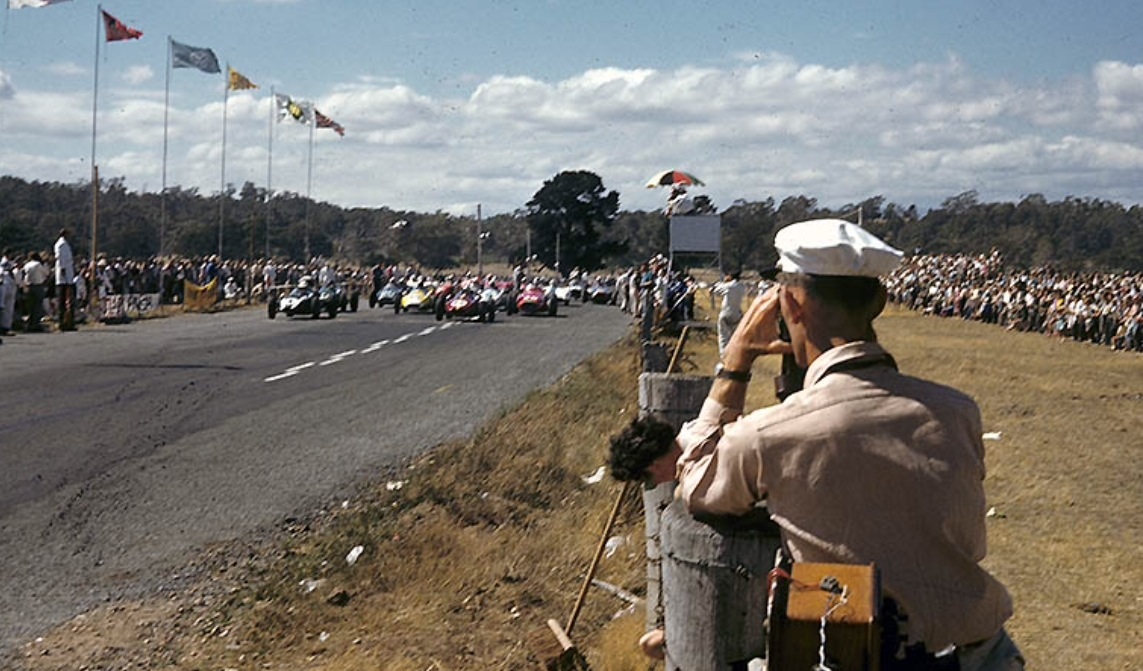
The ‘Longford Trophy’ race start in Tasmania, 5 March 1960 with Jack Brabham and Bib Stillwell in Cooper T51 Climaxes on the front row…

Jack is on the far left, in yellow is Austin Miller’s Cooper T51 Climax then Bib’s red Cooper and far right in red, Arnold Glass’ 4th placed Maser 250F, the beach umbrella atop the starters stand is a nice Oz summer touch, meanwhile the man in the white cap surveys it all and snaps away. Glorious!

I wrote an article about this event a while back, Lindsay Ross recently published the evocative photo above of  a wonderful summers day of a time and place so long ago, too good not to feature.

Jack Brabham, Cooper T51 Climax, Longford Trophy 1960…

Brabham won the 17 lap race from Alec Mildren’s Cooper T51 Maserati, Alec and his car were to be Australia’s Gold Star champions that year, and Stillwell 3rd.

image

Brabham with Stillwell alongside, then Aussie Miller in yellow beside the Glass Maser. Almost ready for the off (John Ellacott)

Here is publican, crop-duster pilot and racer Austin Miller’s immaculate Cooper T51, 2.2 litre Climax powered, in the Longford paddock amongst the sportscars, he retired on lap 3. How sweet it is. This car, chassis ‘F2-20-59’, driven by the intrepid Austin, later set an Australian Land Speed Record, which then Chevy 283cid V8 powered makes it Australia’s first ‘F5000’, and is a fascinating story for another time…

image

(John Ellacott)

Credit…

oldracephotos.com/Ellis, John Ellacott, oldracingcars.com

image

Bill Patterson getting all he can from the 1000cc JAP engine in his little, lithe, light and nimble Cooper MkV. He is on his way to Australian Hillclimb Championship glory on 19 April 1954 at Collingrove, Angaston in South Australia’s Barossa Valley…

Patterson was an immensely fast driver, look closely and you can see his left hand proud of the wheel as he gently corrects the powerful little cars slide on the testing, wonderful Collingrove Hill.

I wrote a short article about this Cooper, chassis # MkV/41/51 a while ago, that article was inspired by a photo, as is this one which covers the history of the car and of Bill Patterson, an Australian champion driver. Click here for the earlier article which provides information about air-cooled Coopers generally, and the MkV specifically.

Cooper Mk V JAP: Penguin Hillclimb, Tasmania, Australia 1958…

patta brands

(500race.org)

The car was bought by Melbourne’s Bill Patterson and Geelong’s Tom Hawkes in the UK and raced by them in 1951 before they brought it back to Australia…

The wealthy Victorians arrived in mid 1951 with the intention of having a racing holiday. Tom was to buy and prepare the car and Bill was to drive it. John Crouch, the Australian Cooper Distributor arranged for delivery of a newly released Cooper MkV to the duo but it was fitted with a JAP 500cc engine rather than the more reliable Norton ‘double knocker’ which was simply unobtainable. The car was specced with long range tanks with longer races in Australia in mind.

The 500 Club 500race.org has this to say about Patto’s performances in it ‘Patterson travelled to England in 1951 and bought a Cooper MkV JAP which he raced in England and Europe. Given the competitiveness of the British scene, and the dominance of the Manx Norton engine, Patterson achieved some creditable results including a 2nd in the Commander Yorke Trophy in August…In September he took a trip to Grenzlandring, Germany, 3rd to the Ecurie Richmond cars of Brown and Brandon…he managed a 2nd and 4th in heats at Brands but failed in the final.’

He arrived razor-sharp back in Australia after the intense competition of F3 in the UK and Europe first racing in Australia at Parramatta Park, Sydney in January 1952. Stan Jones then bought the Cooper in a deal in which Tom Hawkes acquired Stan’s Allard J2. But Patterson shared the racing with Stan before eventually buying the car in 1954.

dodge

Bill Patterson’s Cooper MkV chasing the big ex-Bill Wilcox Phil Harrison Metallurgique/Dodge Special at Port Wakefield, South Australia’s opening meeting, in January 1953. Classic battle of big and small/old and modern technology, the chassis of the Metallurgique/Dodge dating back to the 1920’s. Harrison won the race, the car based on a chassis found in a wreckers yard with a body built by Bob Baker in Melbourne. Patto retired with a broken throttle cable on lap 4 (State Library of SA)

A JAP 998cc engine was fitted, the car  first raced in this form at Rob Roy Hillclimb in outer Melbourne on 28 February 1954, Patto won the 1954 AHCC in it as detailed earlier, as well as the 1955 South Australian Hillclimb Championship, also at Collingrove.

The little car contested the 1955 AGP at Port Wakefield with Patterson at the wheel with a JAP 500 fitted, he retired. In fact the mates Jones (Maybach), Hawkes (Cooper T23 Bristol) and Patterson all retired from the AGP, won by Jack Brabham’s Cooper T40 Bristol, Jack having made his F1 Championship GP debut in that car at Aintree several months before.

stan

Stan Jones, Collingrove, Cooper MkV, Easter 1955  (State Library of SA)

paddock

Stan Jones, Cooper MkV in the Collingrove paddock, probably Easter Monday 1955. He set a new outright record of 38.02 seconds during this meeting (State Library of SA)

The car passed into Ken Wylie’s hands who raced it with both Norton 500 and JAP 1000 engines before crossing Bass Straight to Jock Walkem in Tasmania, he fitted a JAP 1000. The car came back to the mainland, Victorian John Hartnett raced it with both JAP 500 and 1000cc lumps. It then went back to Tassie, raced by both Dave Powell senior and junior powered by JAP 500, 1000 and 1100 motors as well as a BSA 500 engine. The car was then sold to Peter Dobson and passed to Brian ‘Brique’ Reed who restored it in the 1970’s. After many years of ownership it was bought by Peter Harburg.

patto race

#12 D Harvey MG TC s/c from #8 Bill Patterson or is it Stan Jones? Cooper MkV, #11 D Tillett MG TC, Port Wakefield, Easter 1955 perhaps (State Library of SA)

Bill Patterson…

Patterson, was born on 30 August 1923 into a family of considerable wealth. He was the son of Wimbledon tennis champ Gerald Patterson and a nephew of famous Australian opera singer, Dame Nellie Melba.

Gerald Patterson was the Wimbledon singles champion in 1919 and 1922. He represented Australia in the Davis Cup from 1919-1928 and in 1927 won the first Australian singles title at Kooyong until the modern era, the home of Australian tennis. Patterson fought in the Great War and was decorated for his bravery, being awarded the Military Cross as a member of the Royal Field Artillery at Messines in 1917.

By the time his tennis career was over he had embarked on a very successful business career initially with sporting goods manufacturer AG Spalding Bros, by 1935 he was its CEO and went on to become a director of some other well known companies of the time.

image

France’s Suzanne Lenglen and Gerald Patterson, mixed doubles champions at Wimbledon in 1920 (Bob Thomas)

Bill was born into a life of privilege, initially growing up at 15 Barry Street in Kew, the scene of many society parties and events including tennis matches on the home’s grass court. The family soon moved to nearby Toorak, Melbourne’s suburb of the ‘great and the good’.

He attended Scotch College in nearby Hawthorn, leaving in 1934 to attend Geelong Grammar, his sporting intent and prowess apparent as a member of the school’s rowing First VIII in 1938. Born into such circumstances is a double-edged sword of course, being the son of an elite sportsman-and businessman is seldom an easy thing given the expectations foisted upon the child.

patto-mg-rob-roy

Bill Patterson is his stripped MG TC, approaching The Spillway, at the 16th Rob Roy Hillclimb, 2 May 1948 (George Thomas)

I am intrigued to know what Bill did when he initially left school, he first came to motor racing prominence driving one of the first MG TC’s delivered to Melbourne post-war. His first event appears to be the 11th Rob Roy Hillclimb on 24 November 1946. This car was soon replaced by a second TC which was stripped and tuned.

He contested the 1948 Australian Grand Prix at Point Cook in outer Melbourne in this TC, which was fettled by Reg Nutt. The race is famous for the intense heat of the meeting which forced many of the top runners to retire from the impacts of the heat on either their mount or themselves. By lap 13 Patterson led the race, aided by a pretty good handicap. The car retired from the race, boiled dry on lap 24. The event was won by Frank Pratt’s BMW 328, which like Patterson, was aided and abetted by a good handicap.

Soon after the AGP Patterson and later Australian Grand Prix three times winner Doug Whiteford built a stripped, lightweight, two seater TC Special which had a curvaceous aluminium body made by Bob Baker in Melbourne. The engine was fitted with all the trick bits of the day and was supercharged, a Marshall blower was fed by a 1 3/8 inch SU carburettor at a boost of 10psi. The car was powerful, finned drum brakes were fitted as well as adjustable shock absorbers.

This famous little car, which still exists, first appeared at Rob Roy in January 1949, it’s first race was at Fishermans Bend in March. The car was fast from the start but Patto’s nemesis in under 1500cc events was Ken Wylie’s Austin A40 Spl. The MG first won at Nuriootpa in April 1949.

Back in the Barossa Valley, Patterson contested the 1950 AGP at Nuriootpa in South Australia and was on hand to see his friend Whiteford win in ‘Black Bess’ Doug’s Ford V8 Ute based, amazing, special. Patto’s TC blew a head gasket on lap 6 having had a torrid dice with Stan Jones HRG in a preliminary race, Stan did not start the race.

image

Patterson and his MG TC Spl at Hell Corner, Bathurst, Easter 1950. Pretty, fast, well driven car (George Reed)

At Bathurst in Easter 1950 he did a lap of  3:17 seconds, the fastest a 1500cc car had been around the demanding mountain circuit. John Medley observed in his ‘Bathurst Bible’ ‘The lightweight green car had an impressive collection of wins to its credit and was probably then Australias fastest MG…the driver was to become one of Australia’s fastest’.

Of great interest to Patterson was the appearance at Bathurst of the first two Coopers in Australia. The cars, MkIV’s, were raced by Keith Martin/Arthur Wylie and Jack Saywell. These ‘very light, 600lbs dry and with 82bhp 995cc JAP motors, all independently sprung MkIV Coopers, were, for their competitors, a taste of tomorrow’ said Medley.

Patterson had a very successful meeting with the TC at Balcombe on Victoria’s Mornington Peninsula in June 1950 with two wins and two seconds. Not long thereafter the car was sold to Sydney’s Curly Brydon who also did well with the car, developing it further.

For Bill Patterson though, the path was clear, he was off to the UK to race a Cooper in British 500cc F3, the toughest training ground of all at the time. Patto contested the Round Australia Trial in a Holden and a Peugeot, and other than a brief Ferrari flirtation which fell into his lap, he was pretty much a Cooper Man for the rest of his racing career.

After his 1951 season and the continuation of his career with the MkV in Australia covered above, he finally sold the little air-cooled bolide and bought his first Coventry Climax engined Cooper. This mid-fifties period coincided with the commencement of his Holden dealership, let’s spend a moment on that before picking up Patterson’s next Cooper.

The Australian economy boomed in the 1950’s buoyed by the pent up demand of wartime austerity, global demand for our products, wool, wheat and goods produced behind high tariff walls, high levels of migration from war-torn Europe and greater availability of consumer credit. The ‘great Australian dream’ of owning a home and a car were now within reach of larger numbers of people than ever before.

It was in this environment that Bill Patterson and his father (Gerald’s biographical notes make it clear he was a director of Bill Patterson Holden) chose Holden as the marque they would sell and Ringwood as the centre of their ‘Prime Market Area’ they secured from General Motors Holdens. It was an astute choice of location. No doubt Holden were well pleased to have Patterson as a dealer given his and his families profile. Fellow elite Melbourne racers Reg Hunt, Lex Davison, Stan Jones and Bib Stillwell also had, or would have Holden franchises

In 1955 (Bill Patterson Motors Ltd was incorporated on 3 October 1955) Ringwood was very much on the eastern urban fringe of Melbourne (30Km) as the city marched, for the reasons outlined above rapidly in every direction other than into Port Phillip Bay! Surrounding suburbs of Mitcham, Heathmont, Vermont and Croydon were served by better roads into Melbourne and train lines. The middle class were Holdens target market, Bill chose his location wisely. As the local populace and their incomes grew so too did Holdens range of cars, Patterson added BMW to the mix in the 1970’s, another great choice of a marque not well known in Oz, and on the rise.

patts-dship

Patterson’s dealership at 55 Maroondah Highway, Ringwood in 1959. Holdens are ‘FC’ models, Cooper is the T43 Climax. It might not look so special now but the architect designed showroom was schmick at the time (Wolfgang Seivers)

Patterson’s Ringwood premises were initially modest but by 1959 he had built a state of the art dealership at 55 Maroondah Highway, just at the bottom of the downhill drop below Heatherdale Road, designed by Hassell McConnell Architects, Hassells are still one of Australia’s best architectural outfits, a global one at that. I can well remember as a kid visiting my aunt in Mitcham ‘out in the sticks’ as my father described it, and the impact of Patterson’s big site whenever we were in the area.

The point here is that Patterson, did things well and thoroughly. It helped that he had access to, probably, family working capital but he invested wisely and ran a very strong operation for decades.

In a previous life I worked as a consulting accounting/financial advisor to motor dealers for 7 years or so and worked with over 20 dealers across many franchises, not Patto I hasten to add. They are complex businesses; effectively 5 enterprises under one roof-new cars, used cars, service, parts, plus finance and insurance. Add to that the property aspects.

Lots of people think dealerships are ‘money for jam’. They are not, the space is incredibly competitive and the profit margins thin. The investment in infrastructure is significant. They need to be very well run with great, ongoing vigilance around daily detail to make good money. Patterson was one of Holden’s best dealers for decades, consistently in their Top 15 nationally and the figures were distributed monthly by GM, the peer pressure relentless and ongoing! At the top of the GMH tree, by the way, was often fellow Victorian, former champion racer Reg Hunt, his huge site on the Nepean Highway in Elsternwick well known to many Australian race fans.

Back to the racing. In 1956 Patterson imported a Cooper T39 Climax, #CS/12/56 a sportscar powered by a Coventry Climax SOHC 1500cc engine. The car first raced at the Albert Park Olympic AGP Meeting in November 1956, he managed to roll it at the end of the straight during the Australian Tourist Trophy won by Moss’ works Maserati 300S! Damage was superficial. Quickly repaired the pretty little car won its class and was 3rd outright in the Argus Trophy in the second weekend of the two part meeting.

The car was pretty much unbeatable in its class, Bill took it to Caversham for the 1957 Australian Grand Prix held in WA, Caversham is 16 kilometres from Perth. He stripped a gear in the first heat and, unable to race the car, became relief driver for Lex Davison’s ex-Ascari/Gaze Ferrari 500/625  winning the race with Davo in searing heat. Bill did some laps whilst Davison was treated for the effects of heat before returning to the event.

The win was in somewhat controversial lap scoring circumstances from Stan Jones, who raced solo in his Maser 250F. Patterson was 10th in the 1957 Gold Star Championship, the first year in which this for many years prestigious championship was run. Davison won the award in his Ferrari.

patto

Patterson in his Cooper T53 Climax, Longford 2 March 1964. The car is painted in his usual subtle but distinctive livery of white with a light blue stripe. He only completed 13 laps of the race won by Graham Hill’s Scuderia Veloce Brabham BT4 Climax (oldracephotos.com)

Patterson raced a succession of Cooper single-seaters and was always regarded as one of the fastest local drivers…

The Cooper T39 sports was sold when Bill bought the ex-works Jack Brabham Cooper T43 Climax #F2/9/57 which Jack brought to Australia to race at Gnoo Blas, Orange in January 1958. Jack sold the car to Bib Stillwell, the first of many cars Jack sold to Bib! Bib sold the car shortly thereafter to fellow Melbourne motor trader Patterson after Stillwell repaired it; he rolled the car at its second meeting in his hands at Bathurst, Easter 1958.

image

Patterson’s Cooper T43 Climax chasing Arnold Glass’ Maserati 250F through the Longford Viaduct during the first heat of the 1959 AGP carnival. Whiteford’s Maser 300S won from Glass and Patto. Stan Jones won the GP in his 250F, Glass 3rd and Patto DNS the GP itself having lost a tooth off third gear in this heat (oldracingcars.com)

Bill first raced it at Lowood, Queensland in 1958, and later in the year at Bathurst in the Australian Grand Prix, a great race won by Davison’s evergreen Ferrari 500/625. Bill qualified the 1760cc Climax engined car well, on row 4 amongst much more powerful machinery. But he was out of luck again, this time not taking the start with a blown head gasket.

He retired again at the Melbourne Grand Prix at Albert Park in November 1958 and did not take the start of the Longford 1959 Australian Grand Prix, that race won by Stan Jones’ Maser 250F. Bill was 3rd in his heat but knocked a tooth off 3rd gear preventing a start in the GP itself. Again.

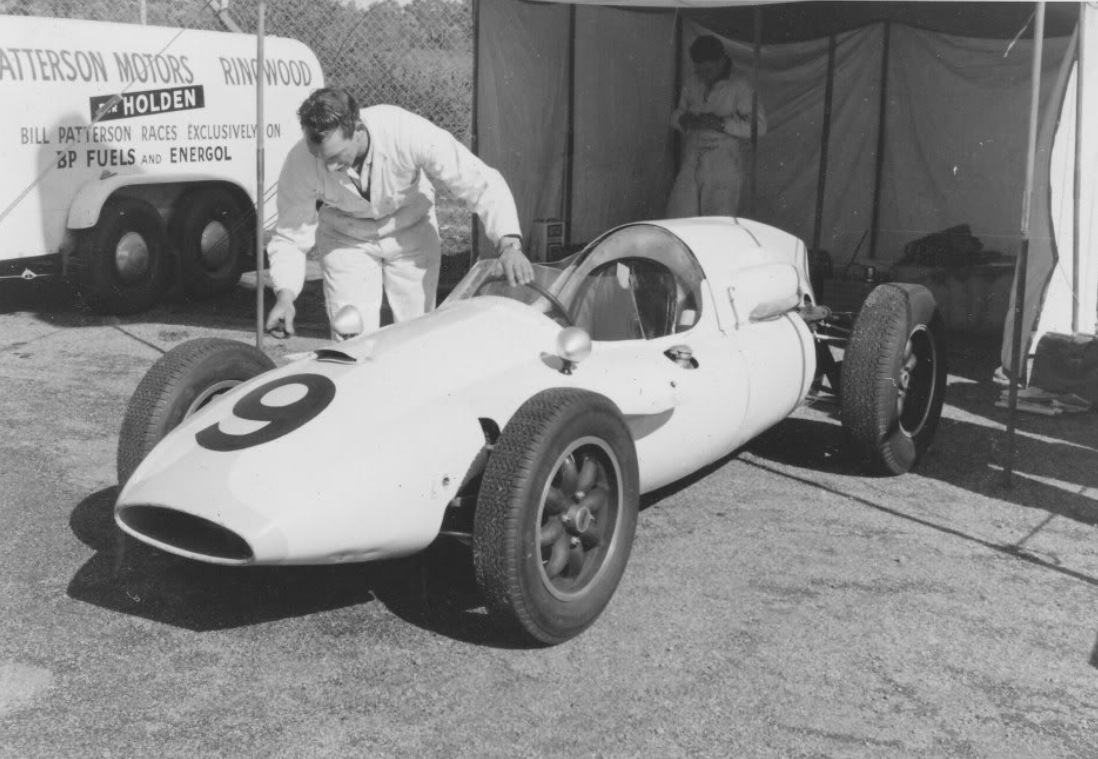
Bill put the car to one side and kept it as a spare which was occasionally raced by Doug Whiteford when he bought a T51 GP Cooper, #F2/15/59, a car supplied less engine in mid-1959. The car was built up in Patterson’s Ringwood dealership by his mechanic, Trevor Hill and made its debut at Port Wakefield in October 1959.

He was 4th in the 1959 Gold Star, using the T43 and new T51 which was fitted with a 2 litre Coventry Climax FPF DOHC engine winning 2 rounds at Port Wakefield and Phillip Island, both in the T51.

patto-p-island-60

Patterson leads Austin Miller’s Cooper T51 Climax during the 11 December 1960 ‘Lukey Trophy’ at Phillip Island, in his first T51 ‘F2-15-59’. Bill is diving into MG Corner during his winning run (AMS)

He went one better, 3rd in the 1960 Gold Star in the Cooper T51 Climax, the car at one stage won 9 times in a row, not at championship level mind you. The FPF’s capacity was increased to 2.4 litres by Doug Whiteford by the time of the October 1960 Bathurst International meeting. Despite greater consistency Patto won only the Lukey Trophy at Phillip Island in December. He took seconds at the Island in March, Bathurst in October and thirds at Fishermans Bend and Easter Bathurst.

The second place at Bathurst was behind Brabham’s current 2.5 litre T51, Patto was racing his earlier 2.4 litre engined, leaf sprung T51; the drive was talked about for years for its fighting brilliance on this most demanding of road circuits.

Into 1961 the car was fitted with a full, factory 2.5 litre FPF Patto acquired on a trip to the UK, in this spec he set lap records at all of his Gold Star races.

At Lakeside on 16 July 1961 Bill had a huge accident on this very fast circuit, rolling the car, having taken 4 seconds off the lap record earlier in the day and dicing with Stan Jones at the time of the crash. He was badly hurt, the car rooted, albeit the bits which were usable were retained as spares for the replacement, new, T51 Bill bought from Coopers. By then he was well and truly a long-standing ultra-loyal customer!

The replacement car, chassis #F2/5/57 (probably the plate of an old car attached to what was certainly a T51 of current specification) won the national title in 1961…

image

A bit less BP and a bit more Cooper would have enhanced this shot! Patto and his victorious 1961 Cooper T51 Climax at Caversham in 1961, a successful weekend with a win in the WA Road Racing Championship (unattributed)

Early in the season Patto was 3rd at Longford in March, a week later going one better with a 2nd to Jack Brabham in a T53 Cooper ‘Lowline’ at Hume Weir circuit at Albury/Wodonga on the NSW/Victorian border. At the following round at the Bathurst Easter meeting Patterson took a great win from Stan Jones, Bib Stillwell, Arnold Glass, Alec Mildren, David McKay and Noel Hall all in Cooper T51’s. The only other finisher, Queenslander Glynn Scott was 8th in a Cooper T43!

Patterson won again at Lowood in June, winning the Queensland Centenary Road Race Championship from Mildren and Jones.

patto-cav-profile

Aren’t these Cooper T51’s the prettiest of things. The F1 champion of 1959 is such a contrast with the champion car of 1958, the Ferrari Dino 246! Here Patterson is practising his car at Caversham in August 1959, he practised carrying his usual #9 and raced as #19 (Ken Devine)

Patterson’s boys towed the new Cooper across the continent to Caversham, Western Australia, the effort rewarded with a win in the 1961 WA Road Racing Championship on August 12. The victory also gave him the ’61 Gold Star.

Another long tow to South Australia for the October Australian Grand Prix, at the Mallala airfield circuit, 60Km from Adelaide.

Bib Stillwell had imported a T53 Lowline providing Bill with strong competition. Patterson won his heat in a good start to the weekend and started the race from pole, there was a good deal of ill-feeling amongst the drivers as to time-keeping. McKay got the jump at the start-too much so according to the officials! By the end of lap 1 Patto was in the lead from McKay, Davison, Youl and Stillwell.

Patto pulled away at a rate of 1.5 seconds per lap, McKay was penalised a minute on lap 20, 5 laps later Pattersons Cooper was misfiring. Patterson stopped twice, but returned after the problem, vapour lock, was solved. McKay led Davison on the road but was effectively 3rd with his penalty.

Patto rejoined the race a lap behind, finished 4th and set fastest lap…

Davison again took a contentious AGP win, in a Cooper T51 borrowed from Stillwell, this time the controversy over an alleged jump start by McKay, the resultant penalty cost him the race. The shame though was Bill’s retirement, it was a race which was ‘his’, by that stage Patto was also very much a master of his craft, a driver of great experience, speed, and ‘tiger’. He was a man who was ‘high born’ but boy he drove with hunger!

With his two wins at Bathurst and Lowood, Patto won the Gold Star title by 36 points from Lex Davison’s Cooper T51 and Bib Stillwell’s T51 and T53.

cooper-wa

Patterson and his boys after winning the WA Road Racing Championship at Caversham in August 1961, Cooper T51 ‘F2-2-57’ or ‘F2-5-57′(Ken Devine)

Into 1962 he raced on but the T51’s raced by Patto and others were becoming less competitive as chassis design rapidly advanced, the Brabham BT4 probably the pick of the ‘Intercontinental’ cars at the time. 3rd was therefore a good result in the Gold Star in a season in which he raced sporadically.

He was first Australian resident in the Sandown International, the circuits opening meeting in March 1962, was 3rd in the Bathurst 100 at Easter not racing again until the Victorian Road Race Championship, at Sandown his home circuit in September where he was 3rd behind Davison and Stillwell’s later Cooper T53’s.

Patterson contested the AGP at Caversham in November, 4th a good result behind the latest equipment but the T51 was three laps behind McLaren’s winning Cooper T62, the car Bruce used to good effect in the 1963 NZ and Australian Internationals.

Patterson was 6th in the Gold Star in 1963 but only raced his ‘Lowline’ Cooper T53 Climax sporadically. He bought this car from Bib Stillwell, #F1/5/61, the car probably a chassis used by Brabham and Surtees in Intercontinental events in the UK in mid 1961. Bib raced it in 1962, a win in the Mallala Gold Star round in October his best result.

Bill’s first race in the T53 was the Sandown International in March where he was a DNF with gearbox failure. He raced it again at Sandown in September, very close to home for Bill, the circuit was only 10 km from his Ringwood Holden Dealership, and retired again from the Victorian Road Racing Championships. The speed was still there though, he was 3rd in the Hordern Trophy at Warwick Farm in December.

patto-cav-form-up

Patterson in the Cooper T51 Climaxes, the double rear wishbone chassis. He is in the Caversham form up area in the August 1961 WA Road racing Championship weekend, a race he won. Syd Negus Cooper Repco Holden and Plymouth Spl in the background (Ken Devine)

Patterson raced on into 1964, he was 41 and dealing with a growing business and it’s attendant pressures. There was a credit squeeze in 1961 caused by the federal governments responses to the growth of inflation at the time; it knocked the socks out of the economy and many highly geared motor traders, not least his friend Stan Jones, so perhaps that was a factor. Mind you, the Patterson family wealth meant that Bill’s access to working capital would have been greater than most.

In any event, he contested the Sandown and Longford rounds of the inaugural Tasman Series in 1964, in fact Longford was his last championship drive. For one who had raced so long, his was a relatively quiet retirement.

I well remember one drive when Bill raced/demonstrated one of his Coopers in the ‘Tribute To Fangio’ meeting at Sandown in 1978, the YouTube footage of that ‘race’ between Brabham’s Brabham BT19, his 1966 championship winning chassis and Fangio in a Benz W196 well worth a look.

Longford was the end of a long career which commenced way back in ’46 at 23 years of age.

Patterson focused on his growing business starting a long period as the sponsor or supporter of other drivers by acquiring the ex-McLaren/Mayer Cooper T70 Climax which was raced by John McDonald for a couple of seasons before its sale to Don O’Sullivan in 1967. This is the car now owned by Adam Berryman in Melbourne, it’s history chronicled not so long ago in my article about Tim Mayer.

Cooper historian Stephen Dalton observes that Bill Patterson ‘had the longest run of anyone using Cooper chassis, starting in 1951 in England/Europe through to 1966 when he was running McDonald’. Patterson’s business interests centred around his large Ringwood, outer eastern Melbourne, car and truck dealerships ‘Patterson Holden’ / ‘Patterson Cheney’ and later ‘Bill Patterson BMW’, as covered earlier in this article.

image

Henk Woelders in the first of two Elfin 600 Ford F2 cars he raced with Patterson’s support. This is the first, a 600B at Calder in 1969 not too long before the ban which outlawed clever wings like this. Very much a movable aerodynamic device, the wing could be feathered on the straights to minimise unwanted drag (Bob Mills Collection)

Drivers Patterson supported included Henk Woelders who won an Australian F2 Championship in an Elfin 600E Ford and Peter Brock’s Holden and BMW Le Mans Touring Car campaigns. He also sponsored Alan Jones 1977 Rothmans F5000 Series assault in Teddy Yip’s Lola T332 Chev. Patterson was a mainstay of support for the Holden Dealer Team in its various incarnations, the performance of that team in production or production based touring car races important brand positioning for The General over the years.

Many elite drivers have also been motor traders across the globe, in Australia there are quite a few who put more back into the sport than they took out, Patto was one of those. Bob Jane, Alec Mildren, David McKay and Ron Hodgson are others who spring to mind, not the only ones mind you.

Even though his businesses had been highly profitable down the decades, in his later years his fortunes changed. He sold out of his dealerships and invested in an air transport business which serviced the islands in Bass Strait between the Victorian mainland and Tasmania. Unfortunately the business was unprofitable and sustained considerable losses.

Bill lived comfortably with his wife albeit on a different level than that to which he was accustomed, he died on 10 January 2010 at Karinya Grove aged care facility, in the well to do Melbourne bayside suburb of Sandringham aged 86.

image

Where Does Bill Patterson Fit in The Pantheon of Australian Champion Drivers?…

‘Australian Motor Racing Annual 1964’ rated the Top 20 as Frank Matich, Bib Stilwell, John Martin and Leo Geoghegan and then in no particular order Lex Davison, Bill Patterson, Bob Jane, Ian Geoghegan, John Youl, Greg Cusack, John French, Brian Muir, Norm Beechey, Peter Manton, Brian Foley, Harry Firth, Bruce McPhee, Keith Rilstone, Jack Hunnam and Glynn Scott. Depressing is that about 70% of this lot are Taxi Drivers, that is Touring Car racers.

patto

Bill Patterson, Cooper T39 Climax, Fishermans Bend, Victoria probably in February 1958. Car is registered and would have made a quick road car! (Bradbury West)

Of Patterson the annual said ‘Ah Patterson. Still the most spectacularly fast of all Australians, Bill Patterson races when he feels like it and always uses all the road and part of the verge. In the past he has been renowned for some fiery displays on the grid and past it; in a competitive car  he is on his day, always the man to beat’.

Lex Davison in his Australian Motorsports magazine column wrote of Patto in relation to the 1963 Hordern Trophy at Warwick Farm ‘…meanwhile our fastest driver, Bill Patterson, lacking recent activity, was rough and unpolished’.

David McKay, racer, team owner and journalist always described Bill in his columns as ‘The Hare’ to indicate his outright pace.

Patterson proved he could ‘cut it’ in his brief F3 stint in UK/Europe in 1951, in many ways it’s a pity, given his growing wealth that he didn’t acquire an outright contending car when he returned to Oz then. To have seen Patto go toe to toe in the mid-fifties in equivalent machinery to Davison, Jones, Hunt, Stillwell, Mildren, Whiteford, Gray, McKay and others would have been really something.

Whatever the considerations Patterson always got more than the best from his cars and without doubt was ‘Top 3’ in Australia for a season or three in an era, late fifties to early sixties, when there was increasing depth amongst the front rank drivers and greater equipment parity than had been the case in the decades before. And ran a very successful business whilst doing it…

Etcetera: London to Moscow tow…

cooper-and-rice-trailer

(Ken Devine)

I chucled when i saw this fine shot by Ken Devine of Bill’s Cooper T51 and its ‘Rice’ Trailer in the Caversham paddock, Western Australia in August 1961.

From Patterson’s Ringwood base to Caversham trip is about 3440 Km, from Australia’s East to West Coast, London to Moscow is only 2870Km. The road then was a shocker too, the Eyre Highway was not much more than a track in the 1940’s and 1950’s, the West Australian section was sealed in 1969 but the South Aussies didn’t do their bit until 1976.

It would have been a long, painful, difficult drive for the mechanics, the driver of course flew by Vickers Viscount or some such…

Bibliography…

Rob Saward The Nostalgia Forum, oldracephotos.com, State Library of South Australia, John Blanden ‘Historic Racing Cars in Australia’, John Medley ‘Bathurst: Cradle of Australian Motor Racing’, Graham Howard and Ors ‘History of The Australian Grand Prix’

Special thanks to ace researcher and Cooper historian Stephen Dalton for his assistance in identifying or confirming venues, dates of race meetings and which Cooper is which! Any errors are mine.

Photo Credits…

State Library of South Australia, Bob Thomas, George Thomas, Ken Devine, George Reed, oldracephotos.com, Bradbury West, Wolfgang Seivers, Bob Mills Collection, Australian Motorsports magazine

Tailpiece: Patterson’s Cooper T51 6th leads Bib Stillwell T53 3rd and Angus Hyslop T53 4th into Longford Corner during the South Pacific Championship at Longford won by John Surtees T53 in 1962…

image

(oldracephotos.com)


image


Tony Rudd and one of the BRM crew either sorting a problem or firing up Harry Schell’s P25 so the Bourne engineering chief can get back to his hotel, Monaco 1959…

image

Behra’s Ferrari Dino 246 you can just see on the left then Moss and Brabham, both Cooper T51, #48 Phil Hill Fazz Dino, #22 McLaren and #32 Trintignant Coopers T51. #16 and #18 Schell and Bonnier in BRM P25’s outside Brooks Dino. #20 Flockhart P25 BRM and behind him Graham Hill’s Lotus 16 Climax (unattributed)

In a sign of the times Jack Brabham won the race from Tony Brook’s front engined Ferrari Dino 246, Jack and third placed Maurice Trintignant in mid-engined Cooper T51 Climaxes. Jack of course took the first of his drivers titles that year and Cooper the constructors.

image

Jack on his own on the Monaco quayside in 1959, on his way to his first championship GP win, Cooper T51 Climax. His last the 1970 South African GP at Kyalami (Cahier)

It wasn’t a great weekend for the BRM boys; all three cars retired, Ron Flockhart, Jo Bonnier and Harry with a spin, brake’s and an accident and a split fuel tank the causes respectively.

mon butt

Stunning shot of Tony Brooks’ Dino chasing Harry Schell’s BRM into casino Square, Monaco 1959 (Heritage)

brm cutaway

BRM P25; spaceframe chassis, 2491cc DOHC, 2 valve, Weber fed 4 cylinder engine developing circa 275bhp@8000rpm, 4 speed ‘box. Suspension; upper and lower wishbones and coil spring/dampers and De Dion and coil spring/dampers at the rear. Front disc brakes, single disc on the transmission at the rear (C La Tourette)

The team broke through for its well deserved first win in 1959, Bonnier took the next race, the Dutch GP on 31 May, beating Jack and Masten Gregory in Cooper T51’s.

mon babes

BRM babes; hard for the mechanics to focus surrounded by this lot. The photo has done the rounds but i’ve never read the identity of said poppets if anyone can advise, BRM P25, Monaco 1959 (unattributed)

Credits…

Klemantaski Collection, Cahier Archive, Heritage Images, C La Tourette

Tailpiece: Harry Schell’s BRM P25 clips the inside of the kerb on entry to a corner in his pursuit of Cliff Allison’s Ferrari Dino 246 at Zandvoort in 1959, JoBo’s P25 took a famous win, Harry DNF, Allison 9th…

image


image

Harry Schell on the limit of adhesion in his ‘Yeoman Credit’ Cooper T51 Climax at Madgwick Corner, Goodwood…

Harry Schell was a press-on kinda driver wasn’t he? Here the Franco-American is delighting the ‘Glover Trophy’ spectators with some delicious Cooper T51 drifts…

The 1960 event was held on Easter Monday, 18 April. Harry was bang on the pace too, equal 2nd quickest in practice with Stirling Moss in a similar car. Chris Bristow demonstrated his undeniable pace though, he was on pole by a couple of tenths and finished 3rd in the race behind Moss, the winner Innes Ireland in his factory Lotus 18 Climax, the quickest of 1960’s GP grid. Harry’s engine popped on lap 20 of the 62 lap 162 Km race…

Credit…

GP Library, National Motor Museum

Tailpiece: Harry telling a naughty joke by the look of it, Crystal Place, July 1955…

Stirling Moss, Schell and Mike Hawthorn during the ‘London Trophy’ meeting which Mike won the feature race in a Maserati 250F from Harry’s Vanwall.

schell

(National Motor Museum)

Mike won his heat in the Moss’ family 250F chassis #2508, Harry his in Vanwall ‘VW2’ and Mike the final. Moss was contracted to Mercedes Benz that year, this non-championship 30 July event not one in which Benz entered their W196’s.

image

Austin Miller’s Cooper T51 Climax chases Bib Stillwell’s similar car at Reid Park gates, Mount Panorama, Bathurst on 2 October 1960, magic John Ellacott shot…

The two drivers are contesting the ‘Craven A International’ won by Jack Brabham from Bill Patterson, and Stillwell in 2.5/2.4 and 2.2 litre Cooper T51’s respectively. Miller retired his 2.2 litre engined car during the 26 lap race. Note the beautiful bucolic Bathurst surrounds of apple orchards and grazing paddocks, is a dangerous place, especially then, these cars mighty quick.

Jack was in the process of winning the 1960 GP championships for himself and Cooper, returning to Oz between the Italian GP at Monza on 4 September and season-ending USGP at Riverside on 20 November. He won the title with 5 wins from teammate Bruce McLaren and Stirling Moss (Lotus 18 Climax). Jack and Bruce drove ‘Lowline’ Cooper T53’s that season.

The tyre marks are from Doug Whiteford’s Maser 300S which had a component faiure earlier in the meeting.

The Gold Star title for Australia’s champion driver that year was won by Alec Mildren in another T51 but interestingly powered by a 2.5 litre Maser 250S ‘Birdcage’ engine.

I’ve already written an article or two about Stillwell.

Bib Stillwell: Cooper T49 ‘Monaco’: Warwick Farm, Sydney December 1961…

Aston Martin DB4GT Zagato ‘2 VEV’: Lex Davison and Bib Stillwell…

Businessman, crop-duster pilot, publican, racer and Australian Land Speed Record Holder ‘Aussie’ Miller is an intensely interesting character, article coming soon! I know his son Guy having raced against him in FF and his engineer Geoff Smedley has helped with another article, must call ’em!

The shot below is also at Bathurst, its Austin heading across the top of the ‘mount. ‘Superior Cars’ signage is one of Stan Jones Melbourne dealerships.

image

(John Ellacott)

Credits…

John Ellacott

surt

(Getty)

John Surtees smiles for the cameras with his Ken Tyrrell Racing Cooper T51 Climax in April 1960…

The much anticipated switch of the British multiple bike champion to four wheels took place when he contested the Formula Junior races at the ‘BARC Members Meeting’ at Goodwood on 19 March 1960.

Ken Tyrrell entered him in a Cooper T52 BMC, the ‘novice’ raced into second between the Team Lotus duo of Jim Clark and Trevor Taylor both mounted in Lotus 18 Fords, more competitive cars. The field also included other later GP drivers Peter Arundell and Mike Spence.

surt cooper

John Surtees, Cooper T52 BMC FJ, Goodwood, 19 March 1960 (Getty)

It was a great debut so why not jump into the deep end?

The Non-Championship F1 ‘Oulton Park Trophy’ took place at the Cheshire circuit on 2 April, with limited testing the talented Brit took on a field of some depth, starting the race from pole and again finishing second. Innes Ireland took the win in a Team Lotus 18 Climax with the very experienced Roy Salvadori third in another Cooper T51 Climax. The field also included Harry Schell and Chris Bristow.

Surtees had arrived in cars! He mixed racing two wheels and four in 1960 but focussed on cars from 1961…

Photo Credits…

Getty Images

Tailpiece…

surt mv

Surtees winning the Isle of Man Senior TT in 1956. MV Agusta 500 (Getty)

stan jones
(Pat Smith/oldracephotos.com)

Stan muscling his big Maserati 250F around Longford in 1959 en-route to his one and only Australian Grand Prix win…

The win was timely, he was monstered all the way by Len Lukey’s Cooper T43 2-litre, the way of the future of course. ‘Twas the last AGP win for a front engined car, mind you Lex Davison came within metres of winning in an Aston Martin DBR4 at Lowood, Queensland in 1960.

Stan’s was a well deserved victory, he and his team, led by Otto Stone had a car which was consistently and reliably fast. Perhaps his driving now had a more measured approach to match the fire and pace which was never in doubt. The Stan Jones story is an interesting one, click here to read it; https://primotipo.com/2014/12/26/stan-jones-australian-and-new-zealand-grand-prix-and-gold-star-winner/

stan
Jones at the wheel of his Maser, 1956 AGP Albert Park. Lovely portrait of the guy and looking quite the pro driver he was! (unattributed)

Jones gave his Gold Star defence a red hot go in 1959 having won the title in 1958, he raced four cars in his quest.

He didn’t race in the season opening event in Orange, NSW. Jack Brabham won in a Cooper T51, but he wheeled out his Maybach for Fishermans Bend’s Victoria Trophy on 22 February. He finished second to Alec Mildren’s Cooper T43.

Stan hadn’t raced the Maybach for years but had retained it. His friend and fellow racer Ern Seeliger evolved the car by replacing the Maybach engines which had been at the core of Maybach’s 1-3 with a Chev Corvette 283cid V8. The car also had a de Dion rear end and other clever modifications.

He swapped back into the Maser, winning the AGP at Longford on 2 March.

maybach
Stan in the big, now blue Maybach 4 Chev beside Alec Mildren’s Cooper T43 Climax at fairly desolate Port Wakefield, SA, March 1959 (Kevin Drage)

He switched back to the Maybach for the SA Trophy at Port Wakefield on March 28, winning the race. Crazily, the next round of the title was at Bathurst on 30 March, two days later. Very hard for contestants to make that trip from SA to Central NSW now, let alone with the road system of 1959!

Stan flew to Bathurst to drive the Maser. Whilst he won his heat he had engine dramas in the final and failed to finish, victory was taken by Kiwi Ross Jensen in another Maserati 250F.

He used the Maybach again at Lowood on June 14, he was third, then swapped back to the Maser for the next round, again at Lowood on 30 August, hitting a strawbale and failed to finish.

The reasons for the choice of car at each meeting would be interesting to know but are probably a function of vehicle availability and suitability. Which was the primary and which was the secondary factor meeting to meeting no doubt varies…

Mid-engined inevitability was clear though despite none of the Australian Cooper exponents being able to secure a full 2.5-litre FPF Coventry Climax engine…yet. The ‘mechanical mice’, as Lex Davison christened the Coopers, were only going to get quicker.

Whilst his fellow competitors were back at Port Wakefield for the 12 October meeting Stan was doing a deal with Bib Stillwell to buy his Cooper T51 2.2 FPF, chassis ‘F2-20-59’, the first of several T51’s Stan raced.

stan
Stan Jones, Cooper T51 Climax, Caversham, WA October 24, 1959 (Dave Sullivan Album)

He soon got the hang of the car, after all he had been an air-cooled Cooper exponent earlier in the decade, finishing second to Len Lukey’s Cooper at Caversham, WA.

jones and lukey
The Jones #3 Cooper T51 beside Len Lukey’s earlier model T43, Caversham August 1959. Lukey was the Gold Star winner in 1959 driving both Cooper T43 and T23 Bristol (Dave Sullivan Album)

The final rounds of Australia’s longest ever Gold Star series were Phillip Island’s Westernport Cup and Phillip Island Trophy races on 22 November and 13 December respectively.

Jones brought his ‘roster of cars’ to four for the year when he drove Ern Tadgell’s Sabakat (Lotus 12 Climax) after damaging his Cooper in a collision with Lukey. The Cooper was too badly damaged to start, as was Lukey’s, but Stan, very sportingly was lent the Sabakat by Tadgell.

Lukey won the 1959 title from Alec Mildren by two points with Jones a distant third. Mildren’s time would come in 1960 with fabulous AGP and Gold Star wins in a new Cooper T51 Maserati he and his team built over the summer.

Sadly it was the last full-blown Gold Star campaign for Jones, economic pressures from 1960 meant he did a few title rounds but was not a serious title contender, although still a tough competitor in any individual race he entered.

jones cooper
Stan settles into his Cooper T51 at Caversham (Dave Sullivan Album)

Photo Credits…

Pat Smith/Oldracephotos;  http://www.oldracephotos.com/content/home/, Dave Sullivan Album, Kevin Drage

Tailpiece…

equipe stan
Equipe Jones at Albert Park during the 1956 AGP won by Moss’ 250F. International truck and the Rice Trailer, were the ‘ducks guts’, still a few of these around and highly prized (unattributed)

Finito…

stillwell cooper monaco wf

Bib Stillwell leans his Cooper into Homestead Corner, you can see and feel the energy being expended in extracting all the performance the car has to offer in this John Ellacott shot…

Stillwell was four times Australian National ‘Gold Star’ Champion from 1962 to 1965, his early sixties battles with rival Frank Matich in both single-seaters and in sports cars, Matich in his Lotus 19 or 19B, were legendary.

Both were Australian champions in both types of car and fierce rivals- Stillwell the Melbourne motor dealer/semi-professional racer and Matich, the Sydney based, and perhaps first truly professional Australian driver.

stillwell monaco lakeside

Stillwell in the Monaco just ahead of Frank Matich, Lotus 19b Climax, Lakeside, Queensland, perhaps the 1963 Tasman Meeting. (Peter Mellor)

In Sportscars Stillwell won the ‘Australian Tourist Trophy’ aboard the Cooper Monaco in 1961 and 1962. Matich won it in 1964 in a Lotus 19B Climax and in 1966 racing his almost brand new Elfin 400 Olds (aka the ‘Traco Olds’), then in 1967 in his first self-built Matich SR3 Olds and again in 1968 in a Matich SR3 Repco.

The ATT was not contested in 1969 but Frank’s Matich SR4, powered by a 5 litre quad-cam Repco ‘760 Series’ V8 was the fastest car in Australia of any sort that year. It was built to contest the Can-Am Series in 1968 but was too late in completion to compete so Frank used it to destroy the opposition at home a year later instead.

Bib acquired this ex-Moss car in the UK. The chassis number is uncertain but Doug Nye believes it to be the car ordered by Moss in April 1959 as a kit of parts ex-factory which was then built up by Keele Engineering.

The Monaco was lightly raced by the great Brit, commencing with the British GP meeting at Aintree in 1959, DNF after qualifying on the front row. He took the car to Scandinavia in August winning races at both Karlskoga, Sweden and the Roskilde Ring, Copenhagen, Denmark and it was then put to one side as he focussed on a Lotus 19 to which the engine and ‘box from the Monaco were fitted.

Bib bought the car off Moss during a trip to the UK in 1961.

At Stillwell’s Kew, Melbourne Holden dealership workshops it was fitted by Gerry Brown with a 2.5 Litre Coventry Climax FPF four cylinder engine and gearbox out of one of Bib’s Cooper single-seaters upon arrival in Australia and was soon ready in time for the 19 September 1961 Warwick Farm meeting.

Starting a familiar pattern, the Stillwell transporter left its Cotham Road, Kew, Melbourne base to go to Adelaide with two cars- Bib raced both his Cooper T53 in the Australian Grand Prix at Mallala in October 1961 finishing second to Lex Davison- Lex in Bib’s older Cooper T51, and the Cooper Monaco that weekend.

The Monaco arrived in Australia with the standard leaf spring rear suspension configuration but Alf Francis had modified the rear chassis bracketry to also allow the use of a coil spring/damper set-up- both were used in Oz.

cooper monaco sandown rear end

Stillwell Cooper at Sandown 1963. Coil spring rear suspension in this shot (Kevin Drage)


cooper monaco ray bell

Cooper Monaco during the Warwick Farm International meeting in 1961. Transverse leaf spring rear suspension configuration in this shot. Look at all those curvy bits of tube, offensive to engineering purists but effective all the same! Coventry Climax 2.5 or 2.7 FPF engine. Citroen Ersa gearbox (Ray Bell)

In Australia the car also raced with a 2.7 ‘Indy’ Climax FPF with which it was timed at 160mph on Longford’s ‘Flying Mile’ in 1963. In a quest for still more speed, in October 1964 the car was fitted with an ex-Scarab RE/Arnold Glass BRM P48 Buick V8.

Lance Reventlow sold one of his engines to Arnold Glass after the one off appearance of his mid-engined Scarab RE Buick Intercontinental Formula car raced by Chuck Daigh at Sandown’s opening meeting in March 1962. Glass replaced the somewhat temperamental BRM 4 cylinder engine with the lightweight, 3.9 litre aluminium, pushrod V8.

In Stillwell’s hands the car won the 1961 and 1962 Australian TT, the Victorian Sports Car Championship in 1962 and 1963 and the South Pacific Sports Car Championship at Longford in 1962.

Stillwell at Warwick Farm in the Cooper in 1965, at this stage fitted wth the ex-Scarab/Glass Buick V8 (R Austin)


The Cooper Monaco with the ex-Scarab/Glass Buick V8 behind the car and ‘George, a mechanic at East Malvern Motors where we both worked for Ray Gibbs’ quipped Mike Kyval. This is during the period Tony Osbourne owned the car. Gibbs was one of the cars drivers in that period of ownership- and prepared the car (M Kyval)

Sold to ‘Pitstop Motors’ Dick Thurston, he first raced it at Calder in January 1966- shortly thereafter he was fifth in the 1966 Australian Tourist Trophy at Longford- a race won, as mentioned above by the Matich Elfin 400 Oldsmobile.

The car was was soon sold on, still in Melbourne, to South Yarra’s Tony Osbourne of ‘Argo Racing’- as in Argo Street South Yarra, who raced it at Calder in May 1966 and then contested the first Surfers Paradise 12 Hour race together with Murray Carter and Ray Gibbs- the beast completed 96 laps of the race won by the Scuderia Veloce Ferrari 250LM crewed by Jackie Stewart and Andy Buchanan.

The car subsequently passed through many owners hands including Fred Wheelhouse, Peter Nielson, Charles Dominelli before acquisition by Pat McLernon of Dandenong, Victoria who fitted a new body built by Ted Proctor in Sydney, by this stage a Ford 302 V8 was fitted. Stan Rumble owned it for a while before the wonderful machine fell into the loving hands of Paul Moxham who restored it to original Coventry Climax engined form.

In 2000 Frank Sytner and John Coombs acquired it, the car has raced in Europe since then.

scuderia stillwell

Mallala is a wonderful, challenging shorter circuit built on a former RAAF airfield 60 Km North of Adelaide. (Kevin Drage)

‘Scuderia Stillwell’ arriving and unloading the Monaco and Cooper T53 at Mallala- South Australia Gold Star meeting in October 1962 after the long haul from their Kew.

mallala map

Mallala is a fabulous little 1.6mile/2.6Km circuit 55Km north of Adelaide. It was built on the site of former ‘RAAF Base Mallala’, which was acquired by a group of enthusiasts in 1961..the opening meeting in August 1961 was won by Bib Stillwell in a Cooper…

Stillwell had a good start in life…

He attended Trinity Grammar and Scotch College in Hawthorn and at 22 had parental support for his original small MG dealership in 1949, but over the decades grew his business.

He was awarded a Holden franchise in 1953 operating from Cotham Road Kew, and later as a Ford, BMW and other prestige marques dealer building a large group with his own talent and entrepreneurial flair which prospers in his families hands today long after his death.

His management skills were world class, his interests included aviation. After success in that field from the mid-sixties in Australia- distributing Beechcraft and later Lerjets he was appointed President of the Lear Corporation in the US in 1982, a position he held for 3 years before returning to Australia to a ‘second motor dealing career’ in luxury franchises and historic racing, he died on June 12 1999.

bss in cooper monaco

Stillwell happy in victory, Cooper Monaco, Mallala October 1962. He took wins that day in this car and the Gold Star event in his Cooper T53 Kevin Drage)

I rather like this observation Michael Lynch made in his obituary of Bib published in the Melbourne ‘Age’ newspaper.

‘The links between business and sport, and the characteristics required to succeed in both, have often been drawn. Drive, determination, persistence, talent, luck, the ability to think outside the obvious and seize opportunities that others don’t see – and then make them work – are all characteristics shared variously by top sportsmen and the leading lights of the business world.’

’Stillwell, who died suddenly last weekend from a heart attack, had all of them in good measure, showcasing them in both his sporting career, which ran until the mid-1960s, and then his business career, which was still being developed at the time of his death’.

Cooper T49 ‘Monaco’ Specifications…

Cooper monaco cutaway

The Cooper Type number is 49- the car was given the ‘Monaco’ name in recognition of Jack Brabham’s victory in the 1959 Monaco Grand Prix, his first GP win on the way to his, and Coopers first World Championships as driver and constructor.

Of typical curved Cooper space frame construction, the car owes most of its hardware to its single-seater siblings. Front suspension is by upper and lower wishbones and coil spring/damper units with an adjustable roll bar. At the rear top location is provided by a transverse leaf spring, with a lower rear wishbone. Brakes are disc all around, steering rack and pinion and typical Cooper alloy wheels of the period were used.

Most of the cars were fitted with Coventry Climax FPF engines of varying capacities, Stillwell’s mainly with a 2.5 but it was raced with other engines as recorded above. Gearbox was the Citroen ERSA or Colotti units- the Moss/Stilwell car was first fitted with a Cooper CS5, 5 speed transaxle.

stillwell cooper monaco lakeside

Stillwell again at Lakeside. Cooper Monaco 1963. (Peter Mellor)

Etcetera…

(Sparks Family)

Another successful Mallala weekend for Stillwell, this time after winning the 19 August 1961 ‘Mallala Trophy’ Gold Star round.

Looking very natty in his BRDC badged blue blazer, it’s perhaps a posed BP publicity shot, whatever the case, a top shot.

(P Skelton)

Stephen Dalton reckons this shot of the Monaco is at Calder in January or February 1962.

Credits…

John Ellacott, Kevin Drage, Ray Bell, James Allington cutaway, Ken Devine Collection, Reg Sparks Collection via Craig Sparks, Phillip Skelton via Tony Johns Collection

The Nostalgia Forum, Richard Austin, John Blanden ‘Historic Racing Cars in Australia’, Mike Kyval

Tailpiece: Equipe Stillwell during the November 1962 Caversham AGP weekend…

(K Devine)

The open-wheeler is a Cooper T53 Climax- Bib was third in the AGP behind Bruce McLaren’s Cooper T62 and John Youl’s T55 at Caversham off the back of winning the Gold Star from Youl and Patterson- he took victories at Bathurst and Mallala on the way to the title.

Finito…


image

Jack Brabham dipping under brakes as he approaches ‘Pub Corner’ in his Cooper T51 Climax on the first lap of the ‘Longford Trophy’ in  March 1960, wonderful Ellis French shot…

Jack retuned to our Australian summer as the reigning World Champion, he didn’t disappoint the Tasmanian crowd winning the race from the similar MkIV T51s of Alec Mildren and Bib Stillwell.

In those pre-Tasman 2.5 formula days Australian National Formula 1 was run to Formula Libre rules, but 1960 Coopers of various models and capacities were the dominant marque. There were still sportscars amongst the single-seaters including Doug Whitford’s ex-works Maserati 300S, sold to Doug after the 1956 Australian Grand Prix at Albert Park when Officine Maserati brought five Maseratis to Melbourne- thee F1 250F’s and two 300S.

The ‘Australian Motor Sports Annual Review 1960/61’ has a report of the 1960 Longford Trophy and notes with superb understatement that ‘Possibly no circuit in Australia offers so many scenic attractions and quite so large a variety of racing hazards as that at Longford in Northern Tasmania.’

The article continues ‘Although racing has been carried out at Longford for several years, it was only after the selection of the circuit for a Gold Star race in 1958 that Longford became known to Australians outside Tasmania…One of the advantages Longford holds over any other mainland circuit is full government and community support. Unlike other states where motor racing is viewed with concern for safety or as a noise disturbing nuisance and a Sabbath breaker, Tasmania views motor racing as a vital tourist attraction and as such, gives it the fullest support’.

Improvements to the track since the 1959 meeting resulted in a faster, more even surface with a softened approach to the railway crossing in Longford township.

Longford 1960 grid shot

John Ellacott shot of the front 2 rows gridded up: Brabham #4, Stillwell #6, Miller in yellow, all Cooper T51 Climaxes and Arnold Glass in the Maserati 250F, evocative!

Australian Tourist Trophy contenders with the J Wright Aston Martin DB3S and Doug Whiteford’s Maserati 300S up front with Harry Cape’s MGA Coupe and the #18 Gorringe/Watt MG Holden on grid 2 (J Barnes)

The 1960 meeting was a double-header with both the Formula Libre Longford Trophy and Australian Tourist Trophy for sportscars, won by Derek Jolly’s ex-works Lotus 15 Climax FPF 2 litre, the ATT was a great race with a big field, check out this photo heavy feature; https://primotipo.com/2018/05/17/1960-australian-tourist-trophy/

Jack Brabham’s Cooper T51 Climax FPF 2.5 had been secured by the promoters and was the same chassis with which he had won the NZ GP at Ardmore in January from Bruce McLaren’s Cooper T45 and Stillwell’s T51- click here for that NZ7 GP; https://primotipo.com/2019/09/16/chief-mechanic/

Brabham had a good summer also winning The Lady Wigram Trophy, Light Car Club of Tasmania Trophy at Longford, the Repco Trophy at Phillip Island in mid-March before heading back to Europe.

Jack’s practice time of 2:38 was a second clear of Bib’s 2.2 litre T5, a welcome addition to the grid was Alec Mildren’s new Cooper T51 Maserati, the frame of the car was adapted by Mildren and mechanic Glenn Abbey to fit a four cylinder, DOHC Maser 250S sportscar engine running on methanol- the soon to be 1960 Australian Gold Star champion did 2:46. An article about this car is here; https://primotipo.com/2018/06/08/mildrens-unfair-advantage/

Longford Trophy 1960 start

Stillwell gets the jump off the line, Glass at rear, Brabham on this side (John Ellacott)

Stillwell got the jump from the start and led for the first three-quarters of a lap before Brabham passed him in his more powerful Cooper. On lap 3 Jack did a 2:34, an average of 105.19 mph and on the following tour recorded a top speed on the Flying Eighth of 157.9 mph. Brabham reduced his pace and led comfortably from Stillwell, Mildren and Arnold Glass’s ex-Hunt/Stillwell Maserati 250F.

The punch of Mildren’s Maserati engine was demonstrated when he sailed past Stillwell’s Coventry Climax engined T51 on the Flying Mile, at about the same time Bill Patterson’s 2 litre T51 passed Glass with Jon Leighton’s Cooper T45 Climax being challenged by Glynn Scott’s similar ex-Mildren machine- both of these cars were powered by 2 litre Climaxes. Towards the end of the 17 lap 45 minute 40 second race Brabham allowed Mildren to close up to within 100 yards of his car, magneto failure spoiling Patterson’s good run.

Brabham won from Mildren, Stillwell, Glass, Leighton and Scott, the Glass Maserati was the only front-engined interloper amongst the dominant mid-engined Coopers.

Glynn Scott, Cooper T43 Climax 1.7 with Jon Leighton’s Cooper T45 2 litre behind him- the red car is Ern Tadgell’s Lotus 12 Climax aka Sabakat (J Barnes)

Allen Brown’s wonderful archive ‘oldracigcars.com’ states that the car Jack drove at Longford was probably the first of two cars he used during his successful 1959 F1 season, chassis ‘F2-4-59′- he drove it in the early part of the year, it then became a spare when ’27-59’ appeared at Zandvoort.

When Jack’s Australian season ended the car was sold to Bib Stillwell who then had two Cooper T51’s to choose from, his Gold Star campaigns had started to become more serious and ultimately were very successful from 1962 to 1965- four titles on the trot in Cooper and Brabham chassis.

Brabham returned to Europe to successfully defend his world title whilst the Gold Star championship was won by Alec Mildren’s Maserati engined T51.

Brabham Cooper T51 Longford 1960

Brabham in his Cooper T51 Climax at Longford in 1960. I think the gent in braces at the rear is Jacks’ father, this chassis 1 of 2 he used in his successful 1959 GP season (oldracephotos)

Allen Brown’s wonderful archive ‘oldracingcars.com’ states that the car Jack drove at Longford was probably the first of two cars he used during his successful 1959 F1 season, chassis ‘F2-4-59′- he drove it in the early part of the year, it then became a spare when ’27-59’ appeared at Zandvoort.

When Jack’s Australian season ended the car was sold to Bib Stillwell who then had two Cooper T51’s to choose from, his Gold Star campaigns had started to become more serious and ultimately were very successful from 1962 to 1965- four titles on the trot in Cooper and Brabham chassis.

Brabham returned to Europe to successfully defend his world title whilst the Gold Star championship was won by Alec Mildren’s Maserati engined T51.

Longford scene 1960

Kevin Drages’ panoramic view of part of the Longford paddock in March 1960, looking across to Mountford corner with the Pit Straight on the right. Cars are green Derek Jollys’ Lotus XV Climax and the ‘Kenley Vincent Spl’.

Etcetera…

Brabham Longford media interview 1960

(Kevin Drage)

‘Modern media scrum’, Jack tells the press how it was post race.

JB’s British Racing Drivers Club badge proudly worn on his overalls, the car is a Humber ‘Super Snipe’, in those days British prestige cars were very popular in Australia, the Germans steadily whittled them back by the early seventies.

Bill Patterson Cooper T51 Longford 1960

(Ellis French)

Bill Patterson’s Coopers T51 by two.

Patterson went on to win the Gold Star in 1961 and soon after retired from driving but supported others for decades via his Ringwood, Melbourne, Holden dealership, click here for a feature on Patto and his many Coopers; https://primotipo.com/2017/02/02/patto-and-his-coopers/

Jack Brabham and BIb Stillwell, Longford 1960

(Kevin Drage)

Jack Brabham and Bib Stillwell swapping Cooper set-up notes…or Bib is buying Jacks car!?

Stillwell was a good Brabham customer over the years acquiring many Coopers including the car Jack drove at Longford that weekend and, later, Brabhams, both men very successful drivers and businessmen. Bib feature article here; https://primotipo.com/2018/07/20/matich-stillwell-brabhams-warwick-farm-sydney-december-1963/

Bib Stillwell Cooper T51 Climax Longford paddock 1960

(Ellis French)

Bib Stillwell’s Climax engine being fettled in the Longford paddock.

(J Barnes)

Tornado 2 Chev won the 1958 Gold Star round at Longford with Ted Gray at the wheel, but by 1960 the marvellous 283 cid Chev engined beastie was an also-ran amongst the hordes of Coopers typified by Stillwell’s T51 at right- Ted didn’t start in the Longford Trophy feature and was unclassified in the LCCT Trophy a couple of days later. The D Type Jaguar without a rear wheel is David Finch’s car- note to the left Doug Whiteford’s Maser 300S ‘Rice’ trailer.

(J Barnes)

All the fun of the fair- who can help with the bike/rider identifications?

(J Barnes)

Ron Hodgson and David McKay in their Jaguars before the touring car race- who won this encounter?

(J Barnes)

Alan Jack cruises through the Longford paddock in his ex-Patterson Cooper T39 Climax whilst in the distance you can see Doug Whiteford’s Maserati 300S and trailer and further still Arnold Glass’ 250F.

Sticking with the T39 theme, the Jack and Lynn Archer cars sandwich Ron Phillips’ ex-Whitehead/Jones Cooper T38 Jaguar which raced so well in the Australian Tourist Trophy.

(J Ellacott)

(J Barnes)

Its a pity John Barnes got the shakes because this Light Car Club of Tasmania Trophy start shot really would have been a cracker but I still like it for its atmospherics.

Red #13 is Ern Tadgell’s Sabakat or more correctly Lotus 12 Climax ‘351’ about which I have written a lot. #9 and #20 are the Patterson and Scott Coopers Types 51 and 43- the Cooper in front of Scott’s is Mildren’s Maserati engined machine. The front engined car at left is the Glass Maser 250F and yellow machine to its right is Austin Miller’s distinctive Cooper T51.

Meanwhile in the simply superb panorama below we can take in the starters stand and beach umbrella, anxious mechanics, the old tram which served as race HQ, the flags and wonderful casual, bucolic air of this wonderful part of the world.

The cars- Sabakat at left, then Gray’s Tornado and one of the Coopers at right.

(J Barnes)

(J Barnes)

What a great shot, probably the grid of one of the Tasmanians only events perhaps, Ellis French identifies the cars as the #12 Gerald Tattersall, Buchanan, #14 R Ward, MGA Twin-Cam and #30 on row 2 the Mel McEwin in the Melmac Healey Spl, green car alongside the Hines #11 MG Special, red #18 is Mick Watt MG Holden Spl and #101 a Triumph TR not listed in the program.

(J Barnes)

She looks unbelievable!

I wonder what, or who it is which has captured the attention of Brabham’s crew. Who are they BTW?

Brabham Senior- Tom, and Esso’s Reg Thompson watch proceedings from the far left- look at those monster 58 DCO Webers, circa 235bhp from a 2.5 FPF tops at the time.

(J Barnes)

Photo and Reference Credits…

Ellis French, John Ellacott, oldracephotos.com, Kevin Drage, ‘Australian Motor Sports Annual 1960/61’, John Barnes

oldracingcars.com

Jack Brabham Cooper T51 Climax on the approach to Pub Corner Longford 1960

Tailpiece…

Lets finish on the same note as we started, an Ellis French shot of Brabham, this time ‘panned’ into the braking area on the entry to ‘Pub Corner’, Longford 1960…

For international readers Tasmania is a wonderful place to visit.

The scenery is stunning on all of its coasts, the mountains in the middle worth climbing, the ‘Overland Trail’ in the Cradle Mountain- Lake St Clair National Park worth walking. Hobart, a centre of culture and ‘Foodie Stuff’ is worth a stop for ‘Mona’ alone, a gallery of contemporary art and you can still see a lot of the Longford circuit, not far from Launceston, including the ‘Country Club Hotel’ with heaps of racing memorabilia.

Finito…