Posts Tagged ‘Jack Brabham’

image
(LAT)

Stirling Moss leads the 1956 Australian Grand Prix at Albert Park in his works Maser 250F…

The dark, gloomy, wet weather shot could be in Europe. Stirling won the 80 lap, 250 mile race held on 2 December 1956 by a lap from teammate Jean Behra, Peter Whitehead’s Ferrari 555 Super Squalo, Reg Hunt’s Maserati 250F and Stan Jones’ similar car.

The excitement of this post Melbourne Olympic Games race meeting run over two weekends I covered in an article about the Australian Tourist Trophy which Moss also won the week before, in another works Maser, this time a 300S, click here to read it;

image
Moss during the 1958 Melbourne Grand Prix metting in Rob Walker’s Cooper T45 Climax. He raced sans the rear engine cover in the final, such was the heat, so this is a practice shot or heat (Fairfax)

This short article is pictorial in nature, I rather like the justaposition between his win in the conventional, state of the art 250F in 1956 and victory two years later in the 1958 Melbourne Grand Prix. On that occasion Stirling was in a paradigm shifting, mid-engined Cooper, a T45 Climax. He took the first modern era, mid-engined GP win on January 19, 1958 in a Cooper T43 Climax at the Buenos Aires circuit in Argentina.

Moss chills in the Albert Park paddock before the off in 1956 (S Landrigan)

Stirling won that 32 lap, 100 mile Albert Park, Melbourne GP race run in super hot conditions on 30 November 1958…

Behind him was Jack Brabham’s similar Cooper T45 Climax 2.2 FPF- Doug Whiteford’s Maser 300S and Bib Stillwell’s Maser 250F were third and fourth.

The race was a Formula Libre event attended by over 70,000 spectators. Brabham led away at the start but Moss soon passed him and moved steadily away keeping a strong lead despite easing in the final laps given his cars water temperature, which was off the Smiths clock!

(R Jones)

Melbourne GP start, Jack gets the jump in the centre from Moss on the left, both in Cooper T45’s and Stan Jones Maserati 250F.

Stirling’s car was fitted with an Alf Francis built Coventry Climax FPF, 4 cylinder DOHC, two valve, Weber carbed engine of 2051cc, it was a ‘screamer’ with trick cams and crank. Jack’s T45 toted a 2.2 litre FPF, revised Ersa five-speed ‘box and double wishbone rear suspension.

Jack Brabham ahead of Dick Cobden, Ferrari 125 Chev
image

The two new-fangled Cooper T45’s were the class of the field, Moss and Jack took a heat apiece. The natural order of things in Australia changed very rapidly, just like everywhere else, albeit the last Australian Grand Prix won by a front-engine car was Stan Jones’ win at Longford several months after the Albert Park meeting, on 2 March 1959.

image
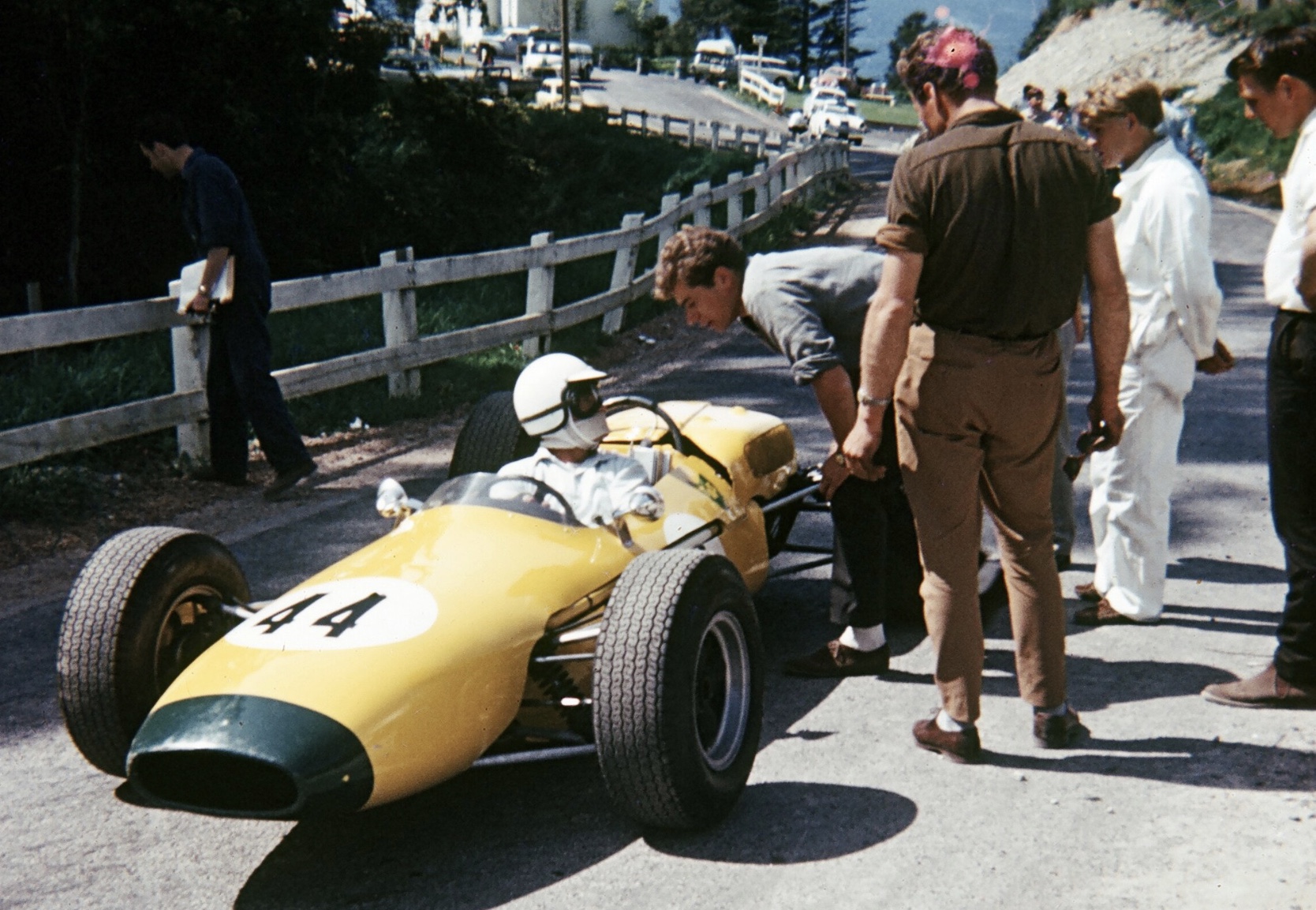
Jack’s Cooper being fettled in the Albert Park paddock in 1958, probably a practice day shot, T45 Climax (G Rhodes via KBY191)

Brabham was still on the rise as a driver, he raced in F2 in 1958 (and in the F2 class of some GP’s) but took fourth in the Monaco classic, sixth in the French, seventh in the Portuguese and eighth in the Dutch GP at Zandvoort-all in works F1 Cooper T45’s. His time was shortly to come of course, in 1959 and 1960.

image
Moss takes the chequered flag in his Cooper T45, Melbourne GP, November 1958 (LAT)

Sadly, the 30 November 1958 Albert Park race was the last race meeting until the modern Albert Park era

That commenced with the first of the F1 Grands Prix in 1996, or more precisely with some historic events in the years before which ‘softened up the public’ to the concept. The use of the park for motor racing became enmeshed in 1950s Victorian State politics, the net result was the end of racing for nearly forty years.

Barry Green observed in his book, ‘Glory Days’, ‘In many ways that final meeting represented a changing of the guard. The two nimble, little rear-engined cars had blitzed the field, underscoring the fact that the writing was on the wall for the big, front engined cars’.

‘So too, the days of the wealthy sporting amateur, of racing for a silver cup and the fun of it all. Professionalism had arrived- to see that, one had to look no further than the darkening sky over Albert Park; to a hovering helicopter, about to pluck Stirling Moss from the crowd and whisk him off to Essendon Airport and connections to the Bahamas for the Nassau Speed Week’.

Start of one of the heats won by Brabham’s Cooper T45 on this side. In the middle is Ted Gray’s big, booming Tornado Chev with Bill Patterson in the white Cooper T43 Climax (R Jones)
Same heat as above- Brabham, Cooper T45 Climax, Ted Gray, Tornado 2 Chev, Stan Jones, Maserati 250F, Tom Clark, Ferrari 555 Super Squalo, Derek Jolly, Lotus 15, Bill Patterson, Cooper T41 and the rest

Checkout this fantastic BP film, supporters of Moss’ attendance at the event, of the 1958 Melbourne GP meeting…

Etcetera: 1956 AGP/ATT weekends, November/December…

With Reg Hunt at left and Ken Wharton, right, before the start of the Australian Tourist Trophy- Moss’ winning Maserati 300S at right- and en-route to victory below.

Reg Hunt settles into his 250F before the off (JA Dennison)

Jean Behra grabs a quick drag whilst Moss deals with a fan.

And below corrects a delicate slide on the fast, demanding Albert Park road course- Maserati 250F.

A pity about that errant thumb- but still nice atmo and the Whitehead Talbot-Lago and it’s three big SU carbs (JA Dennison)
(J Russell)

Victory shot on soggy race day- wonderful, rare photograph.

Bibliography…

‘Glory Days-Albert Park 1953-8’ Barry Green

Credits…

stirlingmoss.com, LAT, Fairfax Media, Graham Rhodes, Simon Landrigan, Robert Jones, Australian Motor Heritage Foundation via Brian Caldersmith, Janet Russell Collection, JA Dennison

Tailpiece…

image
(unattributed)

And what a fine tail it is too. Moss, Maser 250F and mechanic in more recent times. “I won’t remember your number, text-me,” is the gist of the conversation.

Finito…

image

(Wolfe)

Looking at Jack in this shot i wondered who the most recent of the F1 driver/engineers was?

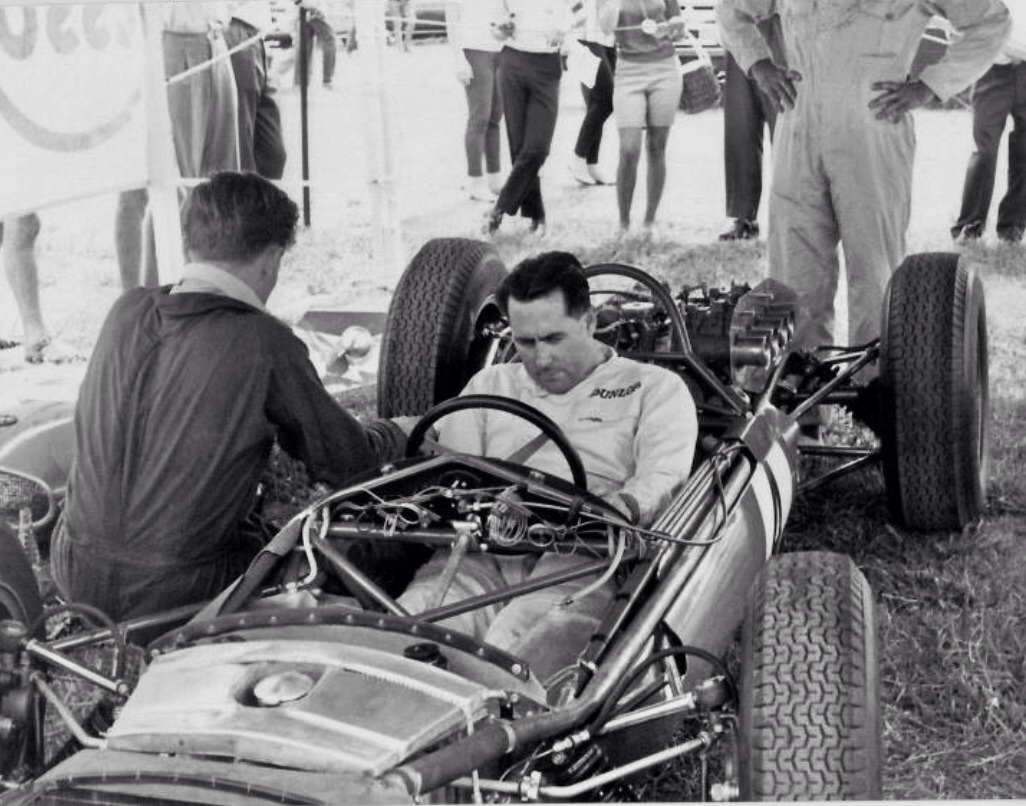
Brabham is helping the boys prepare his BT23E Repco before the Sandown Tasman round, the Australian Grand Prix, in early 1968. Jack, ever the practical, hands-on engineer.

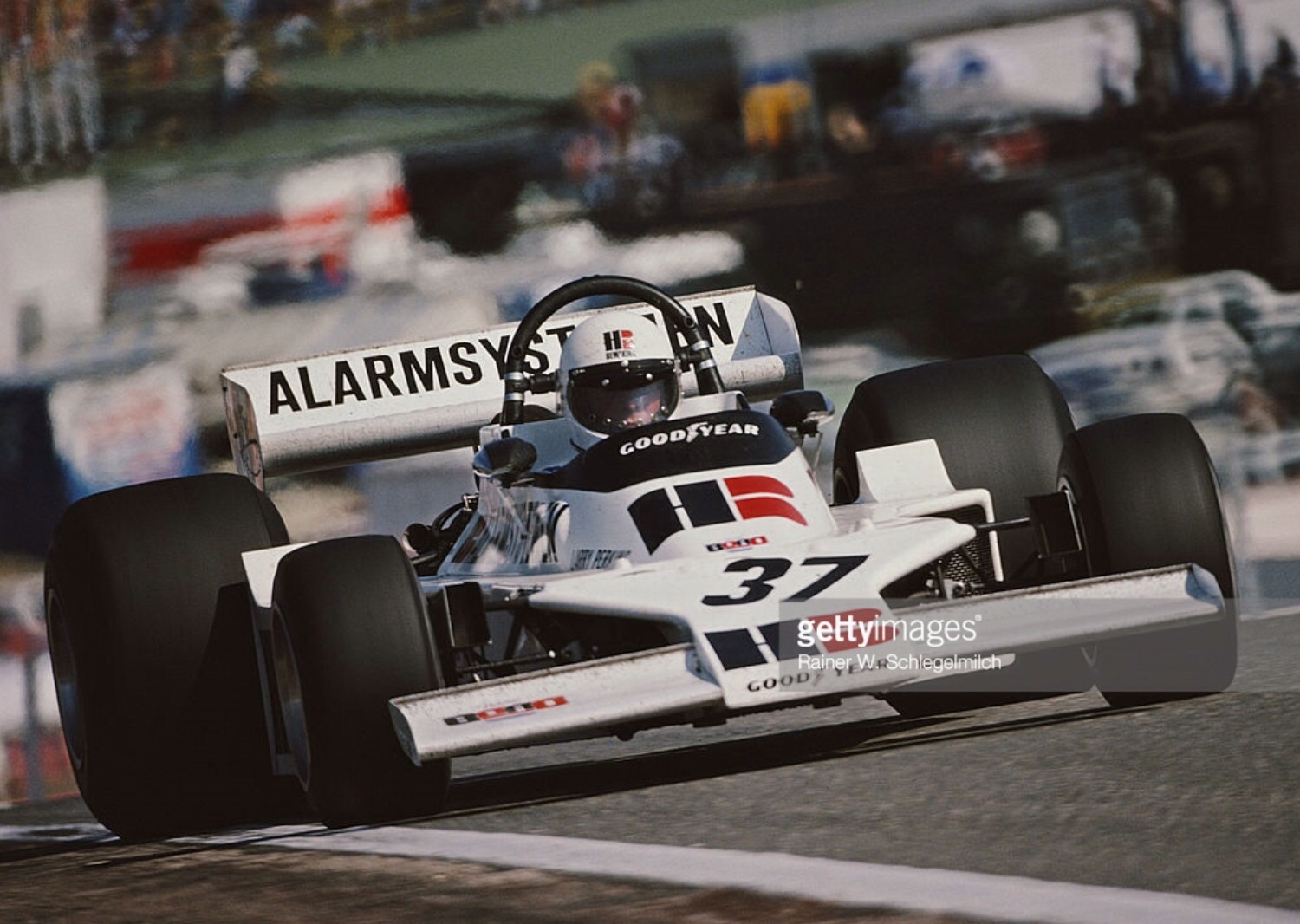
Larrikins, Larry Perkins perhaps? He raced and prepared an Ensign, nee Boro in 1976. Was he, perhaps, the last or most recent of the genre? The guys I am referring to are the blokes who could both drive the things and could and would put ‘em together themselves.
image

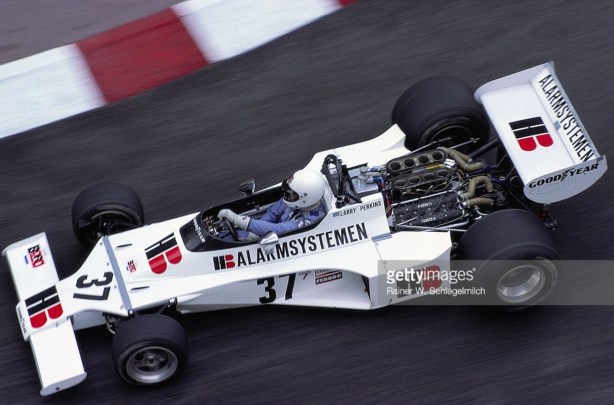
Nice overhead shot of Perkins Ensign ‘Boro’ N175 Ford at Monaco in 1976. He didn’t make the cut in the principality but raced the car in the Belgian, Spanish and Swedish Grands Prix for 8th, 13th and DNF in an operation which was very much smell of an oily rag and DIY…And did well enough to pick up a Brabham drive later in the season, one, sadly, he was not to keep. These cars of Mo Nunns were beautifully designed, quick jiggers. Chris Amon made ‘em fly too, tho their mechanical breakages sapped his confidence and bruised his body, ending his GP career (Schlegelmilch)

Qualifiers?…

Mercedes mechanic come driver ace Hermann Lang is the first who pops into my head but he can’t have been the only one pre-war? I wonder if the Renault brothers were ‘hands on’ maybe they qualify as the first way back in the Edwardian era? Vincenzo Lancia maybe?

image

Hermann Lang at Donington Park 1937. Apprenticed as a motor-cycle mechanic at 14, Lang was an ace on bikes by the time he joined Benz as a mechanic in 1934, by ’39 he was European (read World) Champion. He fettled Fagioli’s W25 initially. Aided and abetted by team manager Alfred Neubauer, and against the wishes of some of the drivers, he test drove the cars in 1935 and 1936 before being made a works driver for 1937 with the 5.6-litre W125. By 1939 he was the grids yardstick, winning 5 of the 8 major GP’s in the 3 litre W154. Having the momentum as the ace of the day was lost by the War years, after a few unsuccessful attempts in post-war GP’s, he won the ‘52 Le Mans in a 300SL Benz (Fox)

Fangio certainly built some of the ‘rockets’ he raced in Argentina early on in his career, whether he wielded a torch once he got to Europe is perhaps another thing.

The dudes i think of most readily are the fifties/sixties fellows; Jack and Bruce of course, Chapman qualifies altho he didn’t race in a GP, he did practice for the French GP in 1956 for Vanwall though.  He qualified 5th but boofed the car so did not race.

image

Here’s a few practical chaps, and all pretty handy steerers including Brabham designer Ron Tauranac (far right leaning) who was quick in his Ralts in Oz before he was enticed to the UK by Jack. From left Howden Ganley a picture of 70’s sartorial elegance in the flares, and a mechanic at McLarens in the early days as he progressed thru the junior formulae ranks in the UK. Tim Schenken, (these two later partners in Tiga Cars) Graham Hill waxing lyrical and RT at right. Car is the one of a kind ‘Lobster Claw’ Brabham BT34 Ford, driven by Hill, its British GP practice @ Silverstone in 1971. Tim drove last years BT33 and was consistently quicker than GH in his first full F1 season (Blackman)

Graham Hill, Phil Hill, Richie Ginther, Dan Gurney, Jim Hall, Bob Anderson, Frank Gardner, Denny Hulme, Howden Ganley and Graham McRae all qualify. The Kiwi F5000 ace did a Gee Pee or two in ‘73ish and his cars were great bits of kit.

image

In 1970-3 Graham McRae was one of the worlds best F5000 pilots at a time the category globally was mega-competitive, winning races and championships in Australasia, Europe and the US. His Len Terry designed Leda LT27/ McRae GM1 Chev’s were the ‘ducks guts’ as well, until the Lola T300 rained on his, and everybody else’s parades. Formula Lola from then on. Here he is in one of Frank Williams Iso IR Fords during ’73 British GP practice at Silverstone. He didn’t complete the first lap with throttle slide dramas at the start of the lap which ended with Jody Scheckter’s big Woodcote, McLaren M23 shunt which took out half the field (unattributed)

Thinking slightly more broadly Chevron’s Derek Bennett wasn’t an F1 driver but otherwise is absolutely of the driver/engineer fix it yerself mould. Make that design, build and drive it. And in Australia Garrie Cooper (Elfin) and Frank Matich spring to mind, Frank was ‘elite level’ as a driver and his sports and F5000’s cars were all winners. Both were not F1 drivers to be clear. ANF1 drivers, but not F1 drivers…

image

Larry at the press launch of the BRM P201 in early 1977. Mike Pilbeam’s chassis was good, if they had popped a DFV into it they would have had a good car? By then the BRM V12 was well past it’s use-by date and hadn’t had any development to speak of for years (Keystone)

Larry was later than all that lot so I reckon its him as ‘the last’? Unless some of you guys can think of someone more recent, and you may well do, the above is outta my head which does not fit into the category of thorough, diligent research.

image

Perkins had several drives of the Holden Dealer Team supercharged, Holden LC Torana GTR XU1 during 1972, here at Catalina Park in Sydney’s Blue Mountains (Rod MacKenzie)

Perkins spannered the very first Ralt RT1 Tauranac built to his ’75 Euro F3 Championship win then lent his talents to Chris Amon on his Amon and, as I say largely self prepared the Ensign/Boro Ford well enough to be plucked by BC Ecclestone into Brabham for a while. Until Carlos Pace rained on his parade. By the time Larry got to BRM they were shit-heaps, that episode a total wasta time. Mike Pilbeam’s chassis was in search of a good engine.

image

Here Larry is  trying to qualify the Amon AF101 Ford during German GP practice after Chris fell ill, Nurburgring 1974, DNQ. Clay Regazzoni won in a Ferrari 312B3 (Sutton)

Larry prepared all of his cars in the junior formulae in Australia before taking the same talents into European F3. I well remember seeing Larry rectifying his practice mishap transferring all the good bits of Robert Handfirds Ralt RT4 into a new chassis having had a territorial dispute with a slower car in practice, and rooted the cars tub, during the 1981 AGP weekend at Calder. Despite a lack of practice time the car was 4th on raceday, Roberto Moreno victorious in another RT4.

image

Teo Fabi and Perkins (near side) in March 782 and 77B during the 1979 F Pac NZ GP at Pukekohe.The 1979 NZ F Pac championship was won by Teo Fabi in a factory March 782. The 5 circuit, 5 weekend, 10 50-mile race series was tough. He dominated, the March 782 the best 1978 Euro F2 chassis, was fitted with the latest March 79B bodywork incorporating sliding skirts. Perkins was his toughest opponent driving the ex-works March 77B chassis raced by Danny Sullivan in NZ the year before. Perkins raced a Ralt Australia/Scuderia Veloce Ralt RT1 in the 1978 series finishing runner-up to Keke Rosberg. Larry was 29 then, it was still not too late to resuscitate his single-seater career, the result may well have been different had Perkins raced a car as quick as Fabi’s. Having said that, in early 1979 Fabi was an F3 graduate, Larry an ex-F1 driver so Larry should have been quicker. Perkins mixed single seaters and touring cars in the early eighties. He raced F Pac and F5000, winning the 1979 Rothmans International Series in an Elfin MR8 Chev. He then became a touring car specialist, winning the Bathurst 1000 6 times and a car constructor. He led the team which built the race cars at the Holden Dealer Team when it was owned by Peter Brock and formed Perkins Engineering to build and race Holdens from early 1986 to 2013.

Bob Janes All Australian, if you can call such an attempt in a German car!, attack on Le Mans in 1984 in a John Fitzpatrick Porsche 956 is a story in itself with the drive shared by Larry and Aussie Touring Car Legend, Pter Brock. The preparation of the car in Australia and France was in Larry’s tender, loving hands, the great run ended during the night whilst Larry was at the wheel.

image

Perkins at the wheel of the Porsche 956 he shared with Peter Brock in 1984. The car ran as high as 8th before crashing during the night (unattributed)

Larry was pushing hard and ran out of road passing two cars seeking to make up time, the car had slipped down to about 35th after losing 28 minutes repairing a front hub damaged when the car lost a front wheel whilst Brock was driving. He was sanguine about it saying later fatigue wasn’t the issue, the choice of passing a split second one of course, with hindsight backing off was the right one. Henri Pescarolo and Klaus Ludwig won in a 956B, Larry and Brock were out in the 18th hour having covered 145 laps

perkins-jag

Perkins at the wheel of the Jguar XJR9-LM he co-drove to 4th place at Le Mans in 1988 (unattributed)

Jaguar and Holden Special Vehicles…

Tom Walkinshaw was well aware of both Larry’s speed and car construction skills. The Brit owned Holden Special Vehicles in the post-Brock era but was making the same climb up the UK motor racing greasy pole as a driver, as Perkins in the early 1970’s.

Amusing was being a guest of HSV at Bathurst for the 1000Km event in 1988-the design and branding business of which I was a partner designed/created the HSV Logo and brand look and feel, and seeing the ‘in team competition’ between the two Holden VL Commodore HSV racers.

One was built by the Poms at TWR and one built by Larrikins and the lads in Melbourne! Larry’s qualified in the top 10 but neither finished, Walkinshaw’s car doing only 5 laps and Perkins 137. HSV was a very do it yerself operation then, MD John Crennan himself drove the courtesy vehicle to ferry we guests from the circuit to the airport after the race, a far cry of later years as the business of building heavily re-engineered performance Holdens grew.

Walkinshaw invited Larry to join his TWR Jaguar squad at Le Mans in 1988. The Aussie tested the car at Silverstone in preparation for the race, the car was very quick even compared to the Porsche 956, also a ground-effect car, of 4 years earlier. He finished 4th in the French classic co-driving a Jag XJR-9LM together with fellow ex-F1 driver Derek Daly and Kevin Cogan. The big 7 litre V12 was 11 laps behind the winning Jag of teammates Jan Lammers, Johnny Dumfries and Andy Wallace.

Perkins touring car exploits in Oz as both builder and driver are well known. Suffice it to say that the Perkins Engineering workshop at Moorabbin Airport in Melbourne’s southern suburbs built amongst the best Holden Group A and V8 Supercars for a couple of decades both for his own team and customers.

This made him a prosperous businessman, in so doing he applied the self taught engineering, business skills and resilience which made him such a formidable driver. Make that driver/engineer, to pick up where we started!

image

Drivers meeting during the 1979 NZ F Pacific series. Larry is talking to Teo Fabi, who won the title that year, Jeff Wood is the tall dude and the blondie, Oz F Pac Ace John Smith (Cammick)


image

Jack Brabham explaining why front stiffness is critical to performance, Tasman Series, Australia 1968 (unattributed)

Back to the Brabham BT23E race-prep picture at this articles outset…

Whenever you see pictures of Jack he is always fiddling with something, he is rarely looking on at the mechanics doing stuff or checkin’ out the babes.

This (opening article) shot was in a general interest magazine in Rodway Wolfe’s suitcase of Repco Goodies which is in my care. I was certain ‘twas Jack’s 1968 Tasman mount, his BT23E, to which is being fitted an RB740 275bhp Repco V8.

Rodway believes the place is probably a workshop on the South side of the Princes Highway near the Warrigal Road corner close to Sandown in Melbourne. Jack’s Australian manager, Reg Thompson (ex-Redex) used to organise these locales close to the circuit, rather than the team operate from Repco Brabham Engines HQ in Maidstone, which in those pre-Westgate Bridge days was a ‘cut lunch and camel ride’ from Sandown in Springvale.

Jack is at left of course, hidden behind him is Graeme Bartels to the right is Norman Wilson, RBE’s Senior Design Engineer post Phil Irving. He is fettling the Lucas metering unit which is beneath the exhausts, I wonder if he is cursing his packaging as he works! Bevan Weston is facing the camera in the middle, all these fellas are RBE Maidstone crew. The other blokes are BRO. (Brabham Racing Organisation)

One of the many hints its Oz rather than Europe are the cans of Australian oil company ‘Ampol’ fuel and lubricant on the floor of the workshop. In F1 Jack was sponsored by Esso then Gulf from 1968. Ampol didn’t make competition fuel or lubricants, Nigel Tait says that RBE used Shell Super M lubricants at Maidstone whilst assembling and testing the engines, I wonder if its Shell oil and fuel in those Ampol cans!

image

Front rows of the ’68 Australian GP grid, Sandown Park, Melbourne. Clark #6 then Amon and Jack on the front row-Lotus 49 DFW, Ferrari Dino 246T and Brabham BT23E Repco. On row 2 Hill in the other 49 and Leo Geoghegan Lotus 39 Repco, well up in this 1965 chassis. You can just see Frank Gardner’s Brabham BT23D Alfa on the inside of the circuit (Howard)

Sandown 1968 Tasman Race: The Australian GP…

This account is a truncated version of that found on the excellent sergent.com website.

The conditions that weekend at Sandown Park were absolutely scorching, Melbourne had been in drought for the previous months. I can still remember water restrictions at the time, the race was held over 55 laps of the 3 and a bit Km, very fast circuit laid out around a horse racing course.

‘The first official practice was held in temperatures of up to 106 degrees, Brabham was quickest in the Brabham-Repco V8 fitted with the older 630 type heads which brought the exhausts up from the lower part of the engine. It was obviously a powerful arrangement, as Brabham had little effort getting down to 1:6.7 secs during his 10 laps’.

Its interesting but not quite right, in fact the engine was a brand new ‘830 Series’ Tasman V8, a combination of the ‘short’ 800 block to be used in the 1968 RB860 F1 engine, and crossflow 30 Series heads. These were more powerful than the 40 Series used in F1 in ’67 and more widely on various Repco engines of capacities from 2.5 to 5 litres.

image

The brand new, prototype or first RB830 V8 nestled in the back of Jack’s Brabham BT23E chassis at Sandown during the AGP weekend in 1968. That it was developmental is indicated by the tack on oil cooler and weird aluminium ‘fuel pot’ as Rod Wolfe describes it (Rod MacKenzie)

Clearly though the engine being popped into the chassis in the opening shot is a 740 not an 830, so exactly when this engine is being put in-or pulled out is an interesting, if arcane one!

Jack only did the Warwick Farm and Sandown Tasman rounds in 1968, the car clearly raced a 740 that weekend in Sydney their is plenty of photographic evidence to support that. Equally, if you look closely at the grid at the start of the Sandown race the engine fitted to Jack’s car is not a 740 ‘between the Vee’ exhaust engine but a ‘crossflow’ 830 engine.

Perhaps the car practiced initially at Sandown with a 740, the 830 fitted later in the meeting or perhaps the photo at the articles outset is in a Sydney workshop prior to WF, for sure it isn’t RB HQ at Maidstone in Victoria.

To add to the confusion there is a photo in the report of the AGP in the bible (History of The Australian Grand Prix by Graham Howard and others) which shows the car at Sandown fitted with a 740, but the photo caption I don’t think is right, I suspect it’s at WF not Sandown, they are both circuits built around horse racing  tracks and the car carried #2 at both meetings. All contributions welcome on this arcane Repco topic of what engine where!

Clearly the 830 developed plenty of mumbo as Jack popped it on pole from Amon in the four valve Ferrari and Clark on the outside. Then came a brilliant Leo Geoghegan in his ex-Clark 1966 Tasman Series Lotus 39 but fitted with a Repco ‘740’ rather than the Coventry Climax FPF four which the car was built.

In fact it was built for the still-born Coventry Climax V16, but modified to suit the CC FPF. In any event Leo had the old car ‘dancin amongst this compoany in the latest and greatest from Europe and Graham Hill on the second row respectively.

Then was Gardner (Brabham BT23D Alfa Romeo T33 V8) and Cusack (Brabham BT23A Repco 740) Rodriguez (BRM P126 V12) then Piers Courage in the little 1.6 McLaren M4A Ford FVA, John Harvey’s old Brabham BT11 Repco V8 740 Attwood (BRM), Hulme and Bartlett (Brabham completed the grid with no ANF2 1.5’s allowed.

image

Jack in BT23E in the Warwick Farm pits the week before the Sandown AGP, car clearly fitted with a 740 Series ‘exhaust between the Vee’ engine. Car in front is one of the P261 BRM’s, behind is Piers Courage McLaren M4A FVA F2 car (Brian McInerney)

Race day was still scorching, the drivers avoided the usual pre-race sports car ride. Jim Clark led from Amon, with Jack making a poor start and getting away in 5th place as the field lined up Shell corner.

Coming under Dunlop Bridge for the first time the order was Clark, Amon, Hill, Gardner, Brabham, Geoghegan (already sounding off tune), Rodriguez, Cusack, Courage, Bartlett, Attwood, Hulme and Harvey.

Brabham took Gardner on lap 3 while Cusack slipped under Rodriguez. Hill fell to Brabham on lap 5. Cusack again poured it on to get by Geoghegan (only running on seven cylinders with a broken plug insulator) and Courage got by Rodriguez on the following lap.

The race was an absolute beauty by lap eight, the order was Clark and Amon with Brabham closing fast. Then came Hill, Gardner, a gap to Courage, Cusack, Geoghegan, Rodriguez, Attwood and Bartlett.

On lap 10 Rodriguez blew the V12 BRM. Brabham, by then was catching Amon and Clark at the rate of 0.5 sec a lap, the chase was sending the crowd wild. Three laps later Brabham had closed right up on Amon.

The three leaders lapped Hulme on BP Straight as they flashed past on lap 19, while Gardner got past Hill again and Bartlett somehow blew off Cusack in the Coventry Climax engined old Brabham BT11A. Next time round, Brabham had again lost ground to Amon and Gardner was one second ahead of Hill. Then, as the leaders came from under Dunlop Bridge onto the main straight, there were only two. Brabham came into view a little later coasting towards the pits with a seized engine.

image

Clark and Amon during their epic dice into turn 1 or Shell Corner for the quick blast past the old pits on the left, Sandown 1968 (Rod MacKenzie)

With Brabham out of the race, the crowd focused on the furious dice between Clark and Amon, and then back further to Graham Hill and Frank Gardner.

‘Amon desperately needed the win to make up points on Clark and he was driving superbly to hang on to the tail of the more powerful Lotus-Ford. He started a series of maneuvres which were to last throughout the race of slipstreaming the Lotus, then switching to the side and trying to forge past on the straights. However, Clark had enough steam to just hold the Ferrari leaving his braking slightly later than Amon on Shell and Lukey corners’.

Amon lost some ground lapping slower cars but by lap 43 he was looking into Clark’s ZF ‘box. Temperatures had tumbled during the race to a moderate 90 degrees (!) which made things a shade easier all round’.

‘With seven laps left in the 33rd Australian Grand Prix, Frank Gardner got the GO signal from the Mildren crew and roared after Hill. Amon had his nose over the finish line twice in the closing laps in a massive bid to snatch the lead from Clark, but he was out-braked each time into Shell. Gardner took Hill briefly at Lukey corner on lap 52 but Hill was in front again as they came under Dunlop Bridge.

image

Clark under brakes in the winning Lotus 49 DFW, AGP Sandown 1968 (Rod MacKenzie)

And that’s how they finished. It was probably the most exciting GP since the 1960 event at Lowood when Alec Mildren won by a mere one 26th second from Lex Davison. Clark credited Amon with a wonderful drive, and it was obvious both men were as near to the limit as anyone for the whole 55 laps. Courage came home a lap down in fifth place while Attwood, Geoghegan and Bartlett all completed 53 laps in that order. Geoghegan received the honour of first Australian home for the second time and Bartlett was fuming because he had received no pit signal as to how close he was to Geoghegan’.

F1 ‘830 Series’ Repco V8?…

An interesting historic sidebar is this engines prospects as an F1 engine, had it been raced in 1968.

The 860 Series, DOHC, 4 valve circa 390bhp engine bombed bigtime in F1 in 1968. Jack and Jochen Rindt had a torrid time, the engine was way behind with its build and testing compared to the simpler, championship winning 620 and 740 Series 1966 and 1967 engines-a story for another time.

Jack was later to reflect, including in a conversation with Repco’s Rodway Wolfe that another F1 title could have been won by Repco  in 1968. His theory was that had they taken the simple SOHC, 2 valve approach which yielded championships in 1966 and 1967 by using the 830 V8 in ’68 another title beckoned. In 2.5 litre Tasman form the 830 gave circa 295 bhp, even if it gave 350 bhp in 3 litre form, which is 20bhp more than the 740 F1 engine gave in 1967, Jack was drawing a long bow about its ’68 prospects, i think.

By 1968 the Ford Cosworth DFV, which first raced in the ’67 Dutch GP was giving a reliable 405bhp and was in the hands of Lotus, McLaren and Matra; 5 or 6 cars raced the engine in every GP depending upon whether Ken Tyrrell’s Matra International fielded one or two cars. Every 1968 GP bar the French (won by Ickx, Ferrari) was won by the DFV…Yep, an 830 engined Brabham BT26 would have finished in the points had it been reliable, Rindt was pedalling it remember. But a title? I really don’t think so Jack, the game had moved on.

The great tantalising Repco ‘what if’ is how the 860 quad cam would have gone in 1969 with its bugs sorted and having a reliable, torquey Repco (real horses, not ponies) 400bhp. A title in 1969?! Maybe…

Credits…

Rodway Wolfe Collection, Rod MacKenzie Collection, Fox Photos, Keystone, Ross Cammick, The Roaring Season, Getty Images, Brian McInerney, Victor Blackman

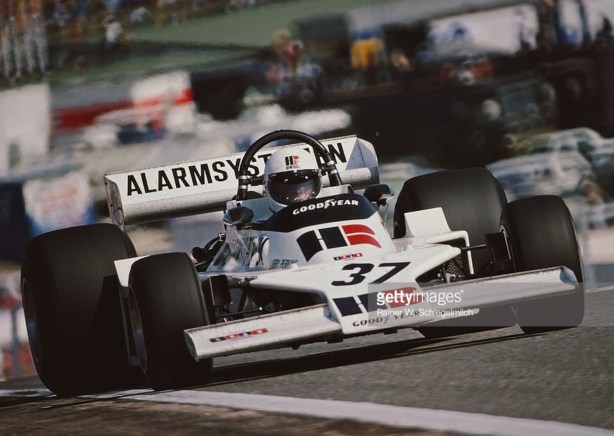
Tailpiece: Larry on his way to 13th in the Ensign N175 Ford during the 1976 Spanish Grand Prix at Jarama, Hunt won in a McLaren M23 Ford…
image

Finito…


image

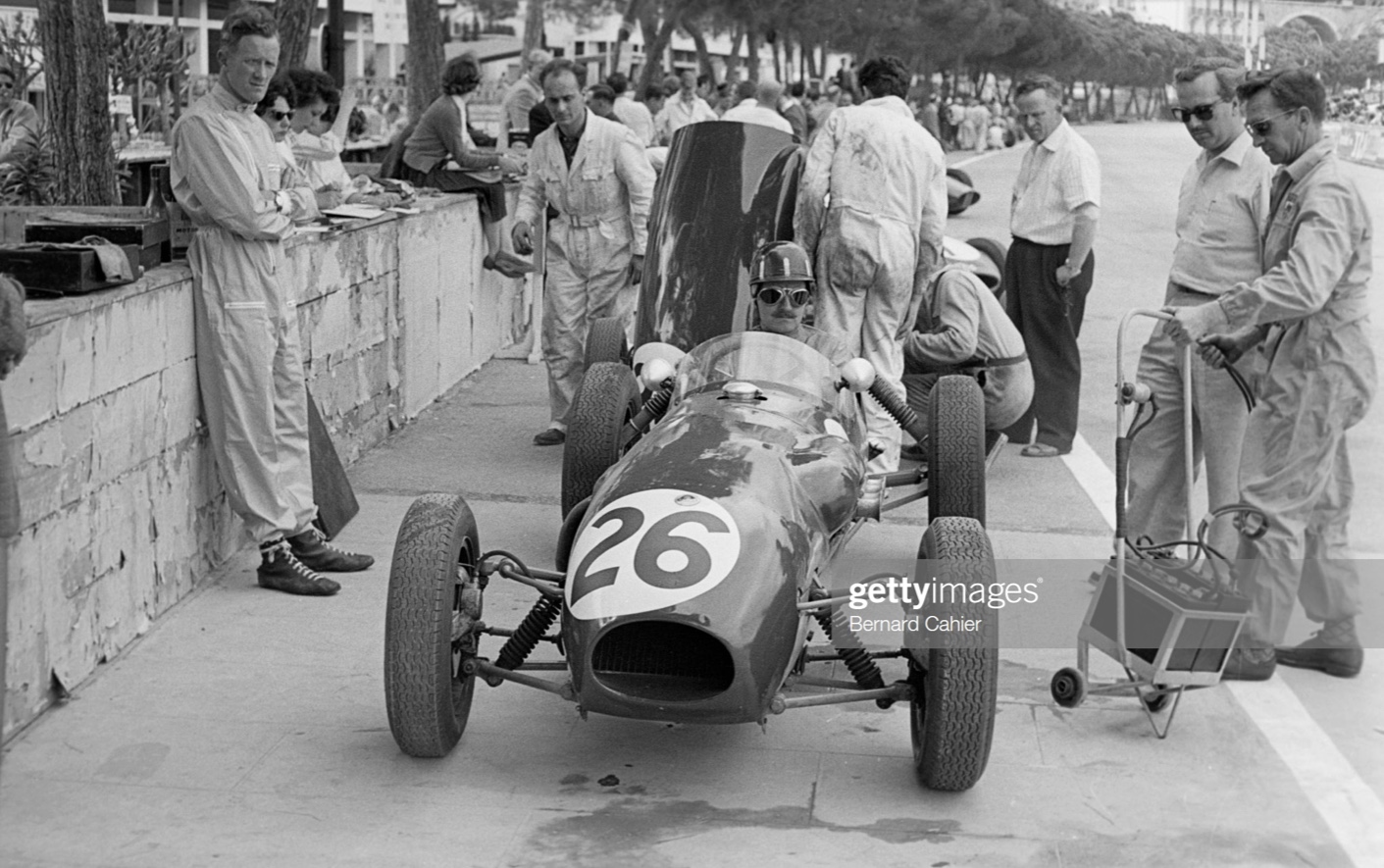
Cliff Allison releases his Lotus 12 Climax from the Monaco haybales on 18 May 1958, whilst teammate Graham Hill passes in the sister car…

It was a significant race for Lotus, their debut as Championship Grand Prix competitors, Allison was classified sixth and Hill’s race ended on lap 15 with engine dramas.

Coventry Climax had still not built a 2.5 litre version of their FPF 4 cylinder engine, so Lotus, like Cooper, were competing with engines of 1960cc, well below the 2.5 litre F1 capacity limit.

image

Jesse Alexander’s shot captures the atmosphere of Monaco ’58, shot taken from the ‘Milk Bar’

Times of change in racing are of immense interest to those of us with an historic bent. 1958/1959 is one of those eras with the growing influence of the ‘Green Cars’ a portent of the British dominance to come. And of course Cooper showing the mid-engined path still with us today.

allison

Cliff Allison at Monza in 1959 (Cahier)


lot 12

Lotus 12 in all its naked glory at Zandvoort in 1958. It was about as small as a front engined GP car could get, ignoring the fact it was designed as an F2 car! In 1958 ’twas as modern as tomorrow and as passe as yesterday simultaneously (Cahier)


Note the twin dual-throat SU carbs and front roll bar double-tasking as a means of locating the upper suspension top link

Indicative of  mid-engined growing superiority was the failure of all the Maserati 250F’s entered to qualify- driven by Godia-Sales, Kavanagh, Taramazzo, Gerini, de Fillipis, Testut, Gould and the great, but ageing Monegasque Louis Chiron. Lets not forget that only the year before, 1957, Juan Manuel Fangio won the race in a factory ‘Piccolo’ 250F. And Moss also won aboard a 250F in 1956 for that matter too.

Successful British motor-cycle dealer BC Ecclestone had acquired the GP Connaughts but Bernie, Paul Emery and Bruce Kessler all failed to qualify the cars too.

image

Bernie Ecclestone trying hard to qualify his Connaught Type B Alta, to no avail as was the case for his 2 teammates (unattributed)

Things were better for the Green Cars at the front of the grid with Brooks, Behra and Brabham in Vanwall VW57, BRM P25 and Cooper Climax T45 respectively. Salvadori and Trintignant were next up in Coopers, the quickest Ferrari, Mike Hawthorn, was sixth in his Dino.

image

# 18 Savadori Cooper T45 Climax, # 6 Behra BRM P25, #16 Brabham Cooper T45 Climax, # 30 Brooks Vanwall VW57, winner Trintignant partially obscured behind Brabham Cooper T45 Climax, # 32 Lewis-Evans Vanwall VW57…and the rest, turn one, lap1 (unattributed)

In a race of changing fortunes Behra, Hawthorn and Moss all led but suffered mechanical failures.

Trintignant won the race in Rob Walker’s Cooper T45 Climax from Musso and Collins in Dinos. Moss’ Argentina Cooper T43 win was no ‘flash in the pan’ by any stretch…

image

Moss, Hawthorn, Brabham and Trintignant. Ferrari Dino 246, Vanwall VW57 with Monaco ‘snub nose’ and Coopers T45 Climax x 2 (unattributed)


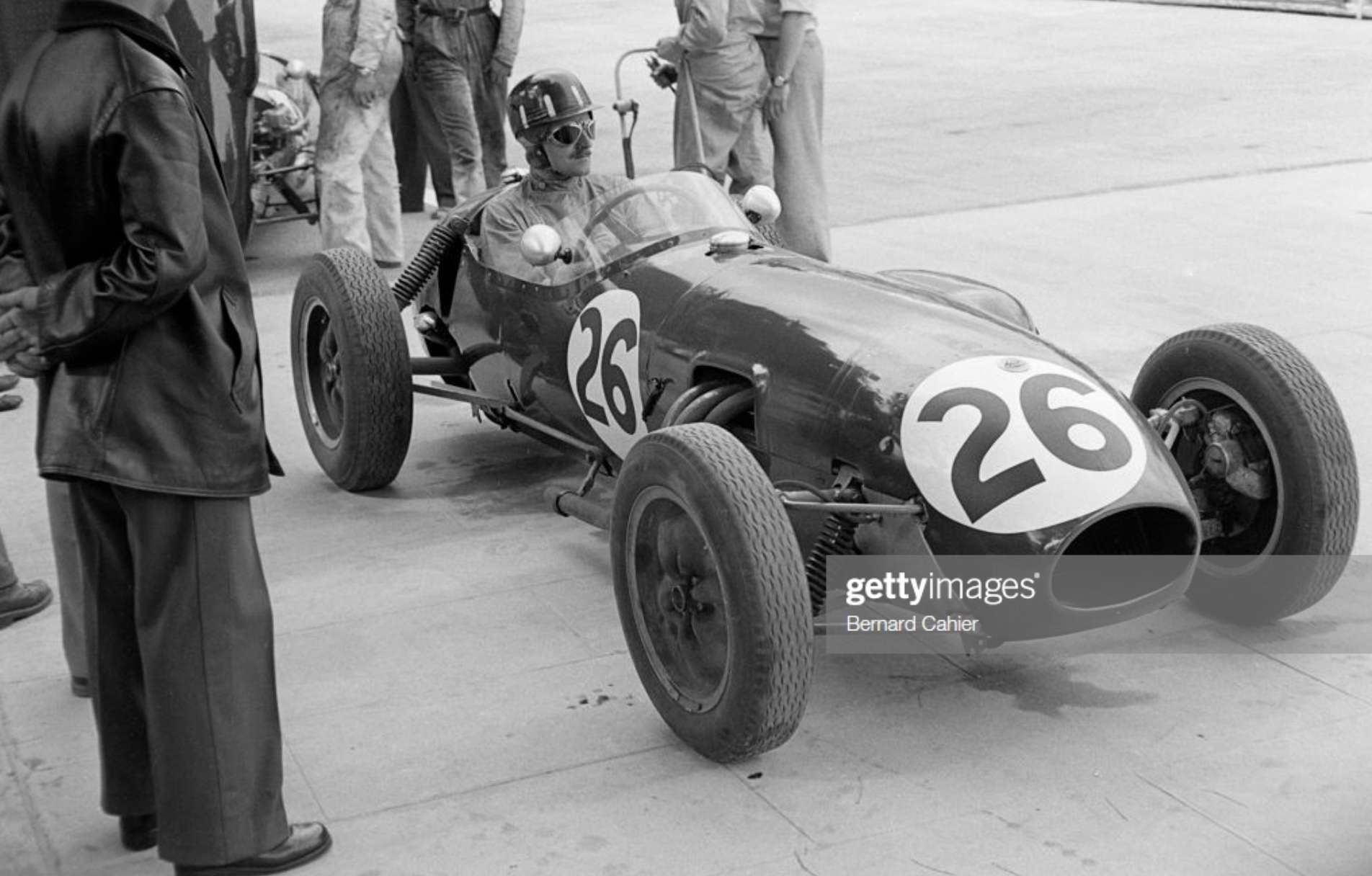
Graham Hill prepares for another practice lap whilst Cliff Allison looks on at left and Colin Chapman in the sunglasses at right.

The Lotus 12 was Chapman’s 1957 F2 contender powered by a Coventry Climax 1.5 litre FPF engine.

Whilst competitive the lithe, nimble, light front-engined cars took no F2 race wins that year, Allison’s second late in the season at the Oulton Park International Cup was the best result.

Fitted with 2 litre FPF’s, ‘F1’ 12’s contested the Non-Championship 1957 Glover Trophy and Lavant Cup at Goodwood and BRDC International Trophy, Silverstone as well as the 1958 Glover Trophy, BARC 200 at Aintree and the BRDC International Trophy before their Monaco Championship debut. Allison’s fourth in the 1958 Glover Trophy aboard chassis ‘357’- the same car he raced in Monaco was the best result. Graham Hill’s car was ‘353’ which has resided, beautifully restored, with Mike Bennett in Adelaide for many years.

Beautiful shots above and below by Bernard Cahier shows the minimalist nature of the Hill Lotus 12 to great effect. Greatness was to come later with Lotus of course- a championship in 1968 after a remarkable stint with BRM.

In some ways its surprising that Chapman, the great innovator, didn’t go the mid-engined route with the Lotus 16, the 12’s successor but he got the hang of the mid-engined thing rather well with the 18 which followed- a machine which was rather successful in FJ, F2 and F1 in 1960.

Lotus 12 Climax cutaway


Etcetera…

image

Photo and other Credits…

Jesse Alexander, The Cahier Archive, John Ross Motor Racing Archive, John Marsden

Tailpiece: Allison made the Lotus 12 sing…

alli italy

(John Ross)

As here at Monza 1958.

He put the car fifth on the British GP grid, well in front of Hill in the new Lotus 16, finished sixth at Zandvoort, fourth in the Belgian GP at Spa and seventh at Monza. Such were his performances he was off to Ferrari in 1959 at Enzo’s invitation

Finito…

image

(Gasking)

Repco workshop customer point of sale ‘take-away’ from 1962/3…

Given the sophistication of todays online marketing, driven as it is by complex algorithms using the reams of data we all hand over, unknowingly in our daily routines, it’s interesting to look at how it was once done, and still is to an extent I guess.

This quite eye-catching piece, with its complex die cut is sophisticated for its day and was no doubt scooped up in large numbers by the trade customers who frequented the various outlets of Repco’s burgeoning global empire. Repco’s retail outlets, well known to Aussies as a weekend DIY supply destination came later.

Former Repco engineer Michael Gasking has given me access to his extensive archive to share with you, this is the first of many more interesting Repco timepieces from Michael. Many thanks to him!

image

(Gasking)

It’s a few years before the Repco-Brabham ‘RB620’ V8 program but Ron and Jack’s cars were called and badged ‘Repco-Brabham’, the technical relationship was just extending to the maintenance and parts back up of the Coventry Climax FPF engine by whom Repco were licensed to make parts- pistons, rings and bearings amongst other components.

So the link between research and development, testing and racing is well travelled but neatly done I reckon, to see and hold this marketing timepiece is a joy so I thought it worth sharing.

image

(Repco/Gasking)

Brabham’s BT4 awaits a fresh Climax 2.7 engine during the 1963 Internationals in Australia.

The shot was taken at the Repco’s Doonside St ‘Repco Engine Laboratory’ in Richmond, an inner-Melbourne suburb.

Its a nice ‘reveal’ of Ron Tauranac’s spaceframe chassis of the day- the BT4 is the Intercontinental variant of the 1962 F1 Coventry Climax FWMV V8 engined BT3

Brabham chassis ‘F1-3-62’…

Inevitably my eyes were drawn to the cars chassis number. Its to the left and under the steering wheel on the dash, its with this stuff where my anal side kicks in- I wonder which car it is, thought i…

Allen Brown’s oldracingcars.com is one of my favourite bibles for such important minutae. No joy there, there was only one BT3 built, Jack’s first MRD built F1 weapon and that’s chassis ‘F1-1-62’. The subsequent 1962 built BT4’s all have ‘IC’, Intercontinental in Brabham lore, chassis prefixes so it’s a bit of a mystery that I am sure one of you can solve.

image

Roy Billington and Jack Brabham fettle the 2.7 litre ‘Indy’ Coventry Climax FPF of Brabham’s BT4 ‘IC-2-62’ prior to the start of the 1963 AGP at Warwick Farm. He won from Surtees Lola Mk4A Climax and McLaren’s Cooper T62 Climax, all three of them using CC’s of 2.7 litres in capacity (SMH/Tait)

It doesn’t follow that the cockpit shot at the articles outset is one of Jack’s cars of course.

He sold three BT4’s in Australia to Messrs Davison, McKay and Stillwell.

Lex’s ex-Brabham 1962 AGP winning car and Bib’s were based in Melbourne’s Armadale and Kew, both pretty close to Repco’s HQ in St Kilda Road so seem likely subjects for their Public Relations Department or Advertising Agency’s photographers. But neither of the chassis numbers work, mind you Bib’s BT4 was ‘IC-3-62’, I wonder if a bit of sixties ‘photoshop’ made it ‘F1-3-62’.

Anyway, that’s a theory until one of you can blow it out of the water!…

image

(Aussie Homestead)

Jack Brabham, in another new Brabham BT4 Climax, Warwick Farm, 10 February 1963, en-route to winning the Australian Grand Prix in ‘IC-2-62’

Etcetera…

(K Devine Collection)

These two photographs were taken upon the first BT4’s debut- ‘IC-1-62’ debut at Caversham, Western Australia over the November 1962 Australian GP weekend.

The very first in the long line of ‘Intercontinental’ Brabhams was shipped brand new from the UK to Australia, a great dice between Jack and Bruce McLaren’s also new Cooper T62 Climax was resolved after a misunderstanding of car placement between Arnold Glass and Jack damaged the new BT4 putting him out of the race.

(K Devine Collection)

After Brabham raced the car in New Zealand in early 1963 the car was sold to David McKay for use in our internationals that summer- Jack raced a new car ‘IC-2-62’- this machine was sold to Lex Davison at the end of the Sandown meeting in March when Jack returned to the UK.

Another shot of Jack with BT4 2.7 FPF in the 1963 Warwick Farm paddock- ‘IC-2-62’ (C Galloway)


(C Galloway)

Team Shell at the Warwick Farm AGP meeting- David McKay, Brabham BT4 Climax, Tony Maggs, Lola Mk4 Climax, Graham Hill, Ferguson P99 Climax, John Surtees, Lola Mk4A Climax, Jim Palmer and Chris Amon who both raced Cooper T53 Climax’.

(HRCCTas)

Brabham’s first BT4- the 1962 AGP car, ‘IC-1-62’ during a hillclimb event at Penguin, Tasmania in 1967.

John McCormack readies for the off, it was Mac’s performances in this car that encouraged him to ‘have a go’ at national competition, three Gold Stars and two NZ GPs were amongst his Formula 5000 successes to come in the seventies aboard Elfins and a McLaren M23 Repco-Leyland.

Credits…

Michael Gasking Collection, Nigel Tait Collection, Repco, Sydney Morning Herald, oldraingcars.com, Aussie Homestead, LAT, Colin Galloway, Ken Devine Collection, Historic Racing Car Club of Tasmania

Tailpiece: To the victor the 1963 AGP spoils, Stirling Moss, in the long process of recovering from his 1962 Lotus Goodwood accident was a hugely popular visitor to Australia that summer- and Jack…

(LAT)

Finito…

image

(John Arkwright)

Check out the view Maxxy!

Niel Allen and Max Stewart having a contretemps at Skyline, Mount Panorama, Bathurst, Easter 1969…

The bucolic terrain of New South Wales Central Tablelands stretches into the distance, the view probably not what the two drivers were focussed upon at the time. The race was the 1969 Bathurst Gold Star round, the field of which was substantially reduced by this first lap prang.

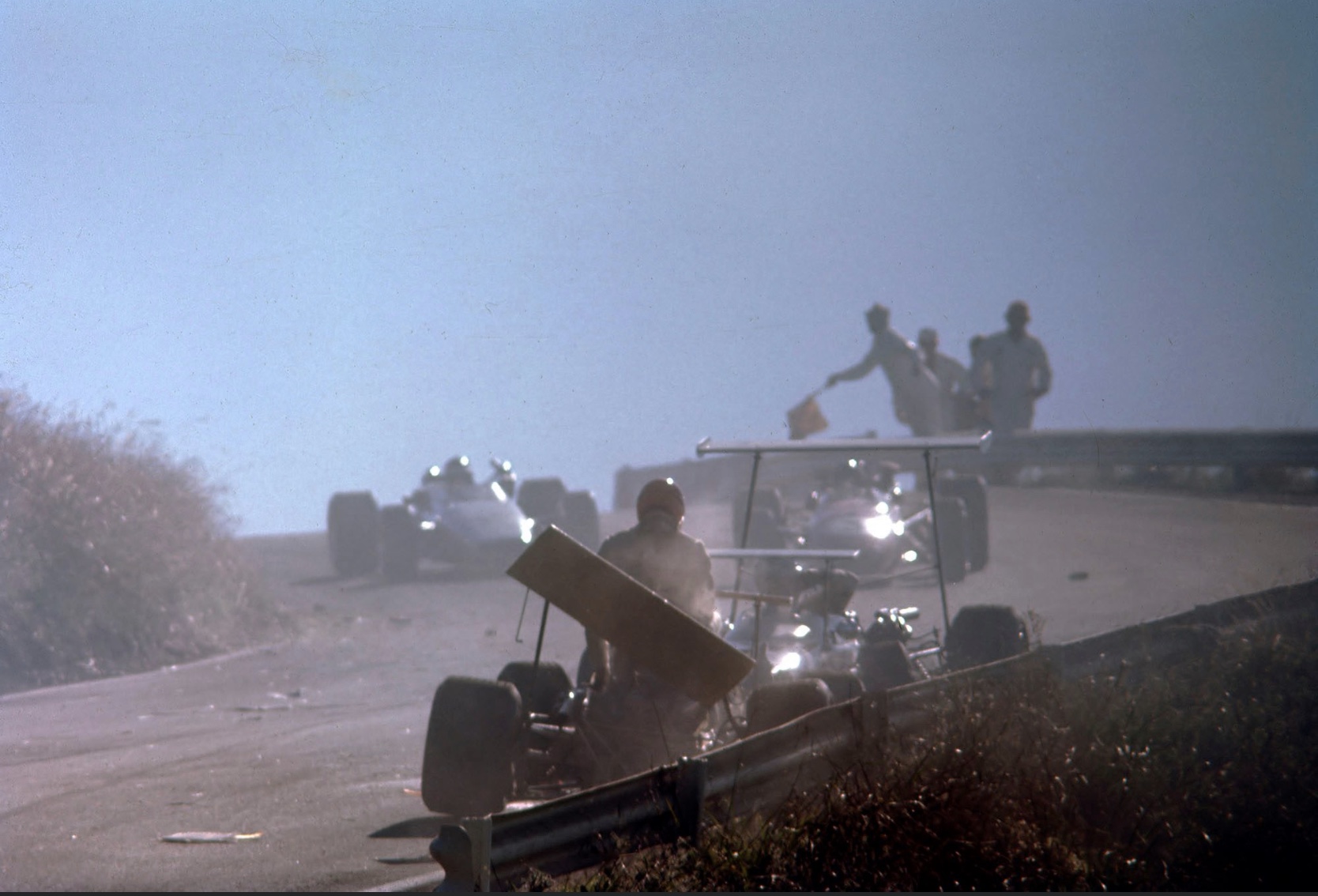
The incident happened when Max misjudged his braking behind John Harvey, locked a brake and boofed the fence in his Mildren Waggott 1.6. Niel was right up Max’ chuff in his ex-Piers Courage McLaren M4A Ford FVA 1.6 and couldn’t avoid him. Out of shot is Queenslander Glynn Scott’s Bowin P3 FVA who also joined in the fun!

(D Simpson)

Dick Simpson’s shot was taken at precisely the same time as John Arkwright’s (look at Max in each shot) albeit a bit further down the mountain. Its Leo Geoghegan’s Lotus 39 Repco framed by Allen’s wing with Glynn baring down on the action on the left and about to become a part of it.

Terrific shots both, ‘instant reaction’ stuff but beautifully framed all the same.

image

Nice butt shot of Harvey’s BT23E; note wing mounted to cars uprights at rear, ‘RB740’ ‘between the Vee engine’ and oil cooler up in the breeze (oldracephotos.com)

Here (above) is a shot of Harve’s Bob Jane owned Brabham BT23E Repco, it was Jack’s works ’68 Tasman car, sold to Bob at the end of the series then raced by John in the following years. In fact it wasn’t a lucky car for Harvey, he had a big accident at the same Easter meeting in ’68 when an upright broke, rooting the car and John. He was in hospital for quite a while after the prang, his speed undiminished when he returned to racing Jane’s stable of racers, sports-racers and tourers.

image

Harvey’s BT23E at Bathurst after his big practice accident on 14 April 1968 (Dale Harvey)

Click here for an article on this car;

https://primotipo.com/?s=brabham+bt23e

These fellas are favourites; property developer Allen was later as quick as Australia’s F5000 ‘Gold Standard’ Frank Matich without nearly as many seat miles, Stewart a multiple ‘Gold Star’ (1971/4) and AGP winner (19734/5) and Harvey a winner in everything he raced; speedcars, single-seaters, big sportscars and touring cars, the Bathurst enduro included.

image

Start of the Bathurst ’69 Gold Star race: front row comprises Max’ yellow Mildren Waggott, Niel Allen McLaren M4A FVA and on the inside Leo Geoghegan’s Lotus 39 Repco. The blue car behind is Glynn Scott’s Bowin P3 FVA and Harvey’s red Brabham BT23E, the torque of which clearly gobbled up Stewart and Allen on the steep climb up the mountain for Max to nearly run into him heading down the mountain. The white car is Henk Woelders’ 3rd placed Elfin 600 Ford t/c. You can just see Jacks red Brabham on the outside beginning his charge. He had fuel feed problems in practice so was off grid 7 with times well below the cars potential (Neville McKay)

The race was won by Jack Brabham’s F3 based Brabham BT31 Repco on a rare Gold Star Australian appearance fitted into his European program. This little jigger was powered by a 2.5 litre ‘830 Series’ SOHC, 2 valve Repco V8. Easter Bathurst is an historically significant meeting in Repco terms; it was Jack’s last Repco race and win in Australia. Brabham’s last International Repco races were those contested by he and Peter Revson in the USAC Championship that year in Brabham BT25’s powered by Repco ‘760 Series’ 4.2 litre DOHC, 4 valve, methanol fuelled V8’s.

image

Brabham between Skyline and The Dipper, BT31 Repco during the race (Dick Simpson)

Check out, rather than repeating myself these articles on the BT31;

Brabham BT31 Repco: Jacks ’69 Tasman Car…by Rodway Wolfe

and on Brabham’s 1969 and 1970 seasons;

Easter Bathurst 1969: Jack Brabham 1970 and Retirement…

This article was inspired by Lindsay Ross uploading quite a few images of this meeting on his oldracephotos.com Instagram page, check it out, they pop up a post every day or so. It seemed an idea to put the images floating around of this meeting in one place. I’ve an Instagram page too, as well as Facebook, just key ‘primotipo’ into the respective search engines and follow the prompts. The FB page has quite a lot of shots I don’t use on primotipo so may be worth a look every few days.

image

Brian Page in BT23A with ‘740 Series’ Repco, DNF with broken exhaust on lap 15 in the ex-Brabham/Scuderia Veloce machine (oldracephotos.com)

The first lap accident ruined what could have been an interesting race, Jack cruised to an easy race win by 1.5 minutes from Harvey’s car and Henk Woelders F2 Elfin 600B Ford t/cam.

Historically interesting is that this meeting was on the weekend of 7 April 1969, high-wings were banned globally at Monaco on the GP weekend of 18 May 1969, so it’s interesting to see the ‘Australian State of the Art’ in terms of fitment of said aero devices immediately before they were banned. Brabham tried the ‘bi-wing’ below setup on his BT31 in practice but raced with only a rear wing fitted.

image

Of arcane interest, perhaps (from the master of the arcane and tangential) is that all of Jacks ‘works’ Repco engined Tasman cars competed in this race bar one…

Brian Page’s BT23A(1) is JB’s ’67 Tasman car, Harve’s BT23E(1) is the ’68 weapon and Jack raced BT31 the car, late arriving in Australia, which did the ’69 Sandown round only.

Missing is BT19(F1-1-65) the chassis in which Jack won the ’66 World F1 Drivers and Constructors titles, and in 2.5 litre ‘620 Series’ engined form, raced in the ’66 Tasman Series, putting valuable pre-GP season race miles on Repco’s ‘brand-spankers’ V8 at Sandown and Longford.

The only car not in Oz now is BT23E(1) which was, and still may be in the US.

image

Jack Brabham guiding BT19 (F1-1-65) into The Viaduct, Longford on his way to 3rd place during the South Pacific Trophy on 7 March 1966, the third race for the new RB ‘620 Series’ V8. The race was won by Jackie Stewart’s BRM P261

Whilst on the arcane it occurs to me is what a versatile, influential and successful design Ron Tauaranac’s BT23 space-frame was in the Brabham Pantheon…

’twas Ron’s clean sheet design for the new for ’67 1.6 litre European F2; it’s variants won a million F2 races over the following years in the hands of aces like Rindt but also in the care of privateer ‘coming-men’. Mind you it didn’t ever win the title despite winning 6 of the ten championship rounds in 1967, ‘graded drivers’ like Rindt were ineligible for championship points. Matra and Lotus took the ‘works entry’ approach more seriously than Jack and Ron during these years, in any event, as a customer racing car the BT23’s won lotsa races, the 1968 Rindt driven BT23C the most successful car of the year.

image

Jochen Rindt typically all ‘cocked up’ on the way to a win in the 9 July 1967 ‘GP de Rouen-les-Essarts’, Brabham BT23 Ford FVA. 1.6 litre F2 formula one of great chassis, it not engine diversity, Ford’s Cosworth FVA won every title from 1967 to 1971. F2 was 2 litre from ‘72 (unattributed)

From an F1 perspective the ’67 World Championship winning BT24 Repco was a ‘beefed up’ BT23, to the extent that Ron initially raced his BT24’s with an FT200 Hewland, the Maidenhead gearbox gurus ‘F2 box’ but found that tranny overstressed with ‘740 Series’ Repco V8 torque tearing away at its gizzards, its CWP in particular. I won’t bang on about the BT24 now as I’m in the process of writing an article about the ’67 Brabham/Repco winning season and go into much BT24 detail. Suffice it to say that the F2 BT23 begat the F1 BT24, my favourite Brabham.

image

Denny Hulme jumping his BT24 Repco at the Nurburgring during his ’67 Championship winning season. He won the German GP by 40 seconds from Jack (unattributed)

From an Australian viewpoint the BT23 Repco Tasman cars were very important as they provided much needed cars on skinny local grids…

The Tasman Series 2.5 Formula grids were ‘chockers’ with cars and stars, the domestic championship contained quality but not quantity. Budgets for these relatively expensive cars were hard to find in the sixties and Australia’s march to Touring Car domination was already well underway so ‘taxis’ were starting to absorb sponsorship budgets previously devoted to real racing cars.

Funnily enough, even though there was a swag of Repco engined BT23’s running around it was Alec Mildren’s, one off, 2.5 litre Alfa Romeo Tipo 33 V8 engined BT23D(1) which took a Gold Star. Frank Gardner raced this car in the ’68 Tasman, it was then taken over by Kevin Bartlett, the Aussie ace took the ’68 Gold Star in it. Repco never won a Gold Star title, a topic to explore at some stage during the Repco series of articles I am gradually writing with Rodway Wolfe and more recently Nigel Tait’s help.

image

Simply sensational Dick Simpson shot of Kevin Bartlett in BT23D Alfa, Hell Corner Bathurst Easter 1968, KB was walking away with the race until a broken rear upright ended his run. Dominant in this car in ‘68/9 (Dick Simpson)

Delving deeper into this BT23 tangent, whilst a BT23 Repco never won a Gold Star, a BT23 Waggott nee Mildren did…

Denny Hulme raced a works F2 Brabham BT23(5) FVA in the ’68 Tasman Series comprehensively boofing the car in the New Zealand Grand Prix at Pukekohe on 6 January, the series opening round.

Denny’s chassis was Jochen Rindt’s Winkelmann Racing entry in ’67, he won 9 Euro F2 races in it including the Rouen event pictured above. Another car (BT23-2) was sent from England for Denny to race in the rest of the series. Feo Stanton and Ian Rorison of Rorstan Racing bought the wreck and sent it to Rennmax Engineering in Sydney for Bob Britton to repair.

Instead of doing so Bob made a jig from the bent frame and sent a new chassis, the Rorstan Mk1 back to the Kiwis. Seven cars were built on the BT23 jig; the Rorstan, Mildren, two Rennmax BN2 and three BN3’s. Of these the Mildren, so named by Alec Mildren, the Sydney Alfa Romeo dealer, team owner and former Gold Star champion was the most successful. The Britton jig was also put to good use over the coming years repairing cars like Harvey’s bent BT23E!

image

Max Stewart ‘harry flatters in top gear’ heading down Surfers Paradise main straight and about to guide his 2 litre Waggott powered Mildren missile under the fast right hander and Dunlop Bridge. 9th in the ‘Surfers 100’ Tasman round in 1970 against the F5000’s. Graham McRae’s McLaren M10A Chev won the race but Bartlett’s 2 litre Mildren Mono Waggott was 2nd on this power circuit (Dick Simpson)

So…the Mildren pictured resting against the Skyline Armco fencing at this articles outset is a BT23 design. Max Stewart was prodigiously fast in the Mildren Waggott, he was one of those guys who seemed to get quicker as he got older, in ’69 he was quick, by the mid-seventies he absolutely flew in his Lola F5000’s. He was one of the very small number of blokes in Oz who squeezed absolutely everything out of these, big, demanding, fast, spectacular, fabulous 500bhp V8’s.

Bartlett, Matich, Allen, John McCormack, Bruce Allison, Warwick Brown, John Walker and Stewart in my book were the F5000 aces with Matich, if I have to pick one, the first among equals. Mind you, on sheer speed Alf Costanzo who came relatively late to the F5000 party could have been ‘the one’. Its an interesting topic to debate, end of F5000 tangent!

One of the pit sights which always amused me, and admittedly small things amuse small minds was big Max, he wasn’t a ‘fat bastard’, but he was 6’2”, crammimg himself into one of his cars before setting off for the dummy grid. If there was a taller bloke than Max in F5000 globally I’d be intrigued to know his name. He must have given away at least 10Kg to the rest of the grid before he even plopped his arse into the tight aluminium monocoque confines of the F5000 Lolas in which he excelled.

image

Max was big of stature and heart; here he is after winning the Rothmans International Series ‘Sandown Cup’ on 20 February 1977, his last big win, Lola T400 Chev, sadly not too long before his untimely death at Calder, 19 March 1977 (Ian Smith)

By the time Merv Waggott was building 2 litre variants of his superb DOHC, 4 valve, Lucas injected, bespoke aluminium blocked engines they were outright winners in 2.5 litre Tasman Formula events in the hands on the Mildren Duo, Messrs Bartlett and Stewart. The first Gold Star for F5000 was in 1971; Max’ Mildren Waggott won the Gold Star with about 275bhp from his close mate Bartlett in a much less nimble and reliable 500bhp McLaren M10B Chev in a year of speed and consistency. I don’t care what anyone says, F5000’s driven to their limit were always a little brittle.

So, to join the dots, a BT23 design did win the Gold Star albeit called a Mildren. Stewart’s Mildren Waggott and Bartlett’s Mildren ‘Yellow Submarine’ Waggott are tangents too far for this article and a wonderful future topic, there is a sensational article to be written there with Kevin Bartlett’s first-hand assistance on both chassis’ and engine if I ask him nicely…

image

Merv Waggott changing plugs in his baby, Wigram 1970. Bartlett’s Mildren Mono ‘Yellow Submarine’ Waggott (Bill Pottinger/the Roaring Season)

Merv Waggott changing plugs in one of his superb jewels. An all alloy, DOHC, gear driven 4 valve Lucas injected circa 275bhp 2 litre engine. Its in the back Of Kevin Bartlett’s Mildren ‘Yellow Sub’ Waggott, shot is in the Wigram paddock, 1970 Tasman round on 17 January on 7 December. KB had a lousy meeting, not setting a practice time and DNF on lap 6 with engine dramas, Stewart was 3rd though in his car, Matich the winner in his McLaren M10A Chev.

The Waggott 2 litre engine was first built in late 1969 and initially developed circa 250bhp, its output later circa 268-275bhp with about 160 lbs/ft of torque. It raced to a win in KB’s hands in the ‘Sub upon debut in the ’69 ‘Hordern Trophy’ at WF, KB won again at the 1970 Warwick Farm Tasman round ahead of all the F5000’s and 2.5 Tasman Formula cars.  2 litre Waggotts won Australias’ Gold Star in 1970 for Leo Geoghegan (Lotus 59) and Stewart in ’71 as noted above.

An article about Merv and his creations is a wonderful feature for another time. Briefly for international readers Waggott’s Sydney shop built race winning engines from the 1950’s, checkout the article below on the WM Special/Cooper T20 Waggott Holden twin-cam 6 cylinder raced by Jack Myers and tested by Stirling Moss in the late ‘50’s as some background.

Stirling Moss and Jack Myers: Cumberland Park Speedway, Sydney: Cooper T20 / WM Holden 1956…

Winding the clock forward, as the ANF1 2.5 litre formula spluttered on in the late sixties a ‘battle to the death’ was fought for the new ANF1 category in Oz between opposing forces who supported either F5000 or 2 litre F2. The latter to commence in Europe from 1 January 1972, F5000 commenced in Europe in 1969 and was born in the US as Formula A earlier still.

Waggott engines were initially of 1600cc, then later 1860cc and used the ubiquitous Ford Cortina block, same as Cosworth’s 1’6 litre FVA wherein Keith Duckworth tested his design ideas in advance of finalising his DFV design. In 1600 form the Waggott would have been Euro F2 legal, it used a production block as the regs required. The 1.6 litre F2 started in ’67 and ended in 1971 when it grew to 2 litres. There were a few FVA’s racing in Australia, the 1.6 Waggott more than a match for them, no Waggott’s, sadly, ever raced in Euro F2.

image

Lance Ruting studio shot of one of the engines, Ford block by the look of it so 1600 or 1860 (autopics.com)

Waggott 2 litre engines used a bespoke aluminium block as the stock cast iron Ford block maxxed out at about 1860cc. Beyond that the pistons kissed! Mike Hailwood’s Surtees TS10 won the ’72 Euro F2 Championship running Brian Hart built Ford BDA’s of 1850cc, those competitors running greater capacity than that had unreliability. The final Euro 2 litre F2 regs required production blocks from 1972-75 until ’76 when ‘racing engines’ were allowed. So, in the earliest years of the class the Waggott was ineligible.

Merv’s engines could have raced in F2 from ’76 but he had long before told CAMS to ‘shove it’ after F5000 was chosen (probably rightly given the backing of Ford, Holden and Repco who were building V8’s/wanting to develop an F5000 variant of the Holden engine in Repco’s case) as Australias’ new ANF1 from the 1971 Gold Star competition.

Had the ingenious, beautifully built little engine been Euro F2 Championship legal in 1972 Sydney’s Waggott Engineering had the winning engine! The engines were tried, tested championship winning donks ready to pop into any car. 275bhp and a big fat torque curve, Kevin Bartlett quoted the usable rev range of 6800-8750rpm, would have done the trick in 1972, the BMW M12 changed the F2 game from ’73 of course.

A wonderful ‘mighta-been’ all the same. Merv could have ‘stolen the F2 march’ in 1972 in much the same way Repco did in F1 with its Olds F85 production block based ‘620 Series’ V8 in 1966…

image

Max Stewart on the way to winning the ‘Angus & Coote Trophy’, the 1971 Oran Park Gold Star round on 27 June. Mildren Waggott 2 litre, Graeme Lawerence was 2nd in a Brabham BT30 FVC, the little cars succeeding as the F5000’s fell away (Dick Simpson)

Credits…

John Arkwright, oldracephotos.com, Dick Simpson, Dale Harvey, Bill Pottinger/The Roaring Season, Ian Smith, Neville McKay, autopics.com.au

Bibliography…

oldracingcars.com, F2 Register

Tailpiece: A Lotus to end an article on Brabhams…

image

Leo Geoghegan’s Lotus 39 Repco with ‘830 series’ Repco V8, started from the Bathurst ’69 pole but out on lap 12 with a gearbox problem, his time would shortly come with this car, winning the JAF Japanese GP later in 1969 amongst a classy field (oldracephotos.com)

Click here for an article on this ex-Clark chassis;

https://primotipo.com/?s=lotus+39

Finito…


image

(Jarnoux)

Jack Brabham and Francois Cevert ecstatic after winning the 1970 1000 Km of Paris at Montlhery on 18 October, Matra MS660…

Its interesting to look at the absolute delight they have and reflect on their relative careers right then and there; for Jack it was his last ‘International’ win before his ‘retirement’. Yes he did have a few appearances in touring cars in Oz in the 1970’s, not to forget his works Porsche 956B drive at Sandown’s World Endurance Championship race in 1984 but in reality 1970 was ‘it’ after a long, vastly successful career.

For Francois it was the year he broke into F1, Johnny Servoz-Gavin’s premature retirement with an eye injury gave Francois his opportunity in Ken Tyrrell’s March 701, one he embraced with both hands and capitalised upon. The world was at the talented Frenchman’s feet.

I wrote articles about Jack’s 1969/70 seasons and Francois’ early years, click on these links to read the articles which remain amongst my ‘most read’; https://primotipo.com/2014/09/01/easter-bathurst-1969-jack-brabham-1970-et-al/ and; https://primotipo.com/2014/11/07/francois-cevert-formative-years/

image

Brabham in the works Aston DBR1 he shared with Stirling Moss at the Nurburgring 1000Km in 1958, JB very much in a support role that day (unattributed)

I don’t think of Jack as a sportscar driver although he started his professional sportscar career with a bang really; first in the 1958 Nurburgring 1000Km with Stirling Moss and second in the Tourist Trophy at Goodwood with Roy Salvadori in works Aston Martin DBR1’s.

But he was such a busy boy in the 1960’s he simply didn’t have the time for sporties; driving and testing Coopers, then forming Motor Racing Developments with Ron Tauranac. Brabham Racing Organisation entered and raced the F1 cars, he had garage and conversion businesses, ghosted magazine articles and depending upon the season raced in F1, F2, Indy not to forget the 7 or 8 Internationals/Tasman Series events he did in Australasia in January/February. Commercially it also made sense, other than the BT8, MRD didn’t build sportscars, so why not focus on what you sell?

So, his events in two seaters are relatively rare in the pantheon of his long career, a good obscure topic for an article actually!

image

Monaco collage 1970, 2nd in the race won by Jochen Rindt’s Lotus 49D Ford. Brabham BT33 Ford (Schlegelmilch)

1970 was his ‘last racing season’ though. He had promised his wife Betty he would retire at the end of 1969 and having got the ‘leave pass’ which was pretty much forced upon him when Jochen Rindt decided to stay at Lotus, had one of his busiest season in ’70.

Jochen told Jack he was returning to Brabham but changed his mind when Colin Chapman made him an offer too good to refuse. So Jack raced on, a rethink forced upon him as by that stage no other number 1 drivers were available. So Jack made every post a winner; he raced F1, F2, Indy and most of the endurance events Equipe Matra Elf contested in 1970.

It wasn’t a ‘cruise and collect’ year for Jack though, he was still razor sharp, famously winning the season opening South African GP in Tauranac’s first monocoque F1 car, the Brabham BT33. He lost Monaco to Rindt after a last lap fumble under pressure from Jochen and the British GP to Jochen again, when, leading and driving away from the Austrian’s Lotus 72, he ran light on fuel, an error ‘credited’ to Ron Dennis, then his mechanic.

image

Nice portrait of Jack at LeMans in 1970; at 44 he was as fast as the ‘quicks’ of the era, anyone who can hang onto Rindt at the peak of his powers is not too shabby, at 44 Jack was still ‘up there’ to say the least (Getty)

Brabham spoke about the pleasure of just ‘rocking up to drive for Matra’ in the biography he wrote with Doug Nye; ‘…to drive a car someone else had to develop and prepare was a rare luxury, which i really enjoyed’.

In 1970 Matra contested the Daytona 24 Hours and Sebring 12 Hours in America, then in Europe the Brands Hatch and Monza 1000Km events and of course the Le Mans 24 Hours in June. They elected not to race Targa, the Spa and Nurburgring 1000Km events and the championship season ending Watkins Glen 6 Hour back in North America on 18 October.

The endurance championship that year was dominated by the 5 litre, 12 cylinder Porsche 917 and Ferrari 512S, the dominant ‘small car’, the 3 litre Porsche 908/3 which mopped up the events on circuits so suited; Targa and Nurburgring.

image

Brabham in the MS650 he shared with Jean-Pierre Beltoise to 12th, Pedro Rodriguez beat the rest of the field in a blinding Porsche 917 display . Brands 1000Km 1970 (Schlegelmilch)


Matra’s primary 1970 tool was an updated 1969 Matra MS650, the new MS660 made its debut in the hands of Jean-Pierre Beltoise and Henri Pescarolo at Le Mans. The car raced at the Sarthe by Brabham and and Francois Cevert was the earlier MS650, both cars retired with engine failure within 3 laps of each other (laps 79 and 76 respectively)

Brabham was paired with Cevert at Daytona, the duo bringing the V12 engined car home in 10th place, the race run on 31 January/1 February 1970. Brabham didn’t contest the next round at Sebring, ‘his car’ paired Dan Gurney with Francois in a one-off drive. Henri Pesccarolo and Johnny Servoz Gavin achived the best championship Matra result for the season in 4th place, the race won by the Ferrari 512S of Ignzio Giunti, Nino Vaccarella and Mario Andretti.

The Brands Hatch 1000Km on April 12 was a famous demonstration of driving mastery by Pedro Rodriguez, the Mexican sportscar ace flinging his demanding, fidgety 5 litre Porsche 917K in the wet as though it were a Merlyn Formula Ford from one of the support races. Jack was paired with JPB, the duo were 12th.

At Monza later in the month the duo were 5th in the race won by the Rodriguez/Kinnunen JW Automotive Porsche 917K.

image

Brabham ahead of a Lola T70 Mk3B Chev, Montlhery 1970 (Jarnoux)

With the Manufacturers Championship decided in Porsche’s favour from Ferrari and Alfa Romeo the Montlhery race was a chance for Matra to win in front of its home crowd.

The annual enduro wasn’t a Manufacturers’ Championship round, as stated above, but always had a good amateur entry. Matra entered two cars, the Linas-Montlhéry circuit only a few miles from its Velizy home base. Both cars were MS660’s, Beltoise and Pescarolo, drove a ‘sprinter’ variant, lightened a lot compared to Le Mans spec. The weight loss was achieved by deletion of lights, the charging system and the use of a Hewland gearbox rather than heavier, stronger ZF unit. The engine was the GP variant of the V12, able to use 11,000 r.p.m. against the normal 10,500 r.p.m. endurance limit. The other heavier ‘Le Mans spec’ car was driven by Jack and Francois.

There was no factory opposition to Matra but the Martini International Racing Team/Team AAW, had a 917 Porsche driven by Gerard Larrousse and Gijs van Lennep, as well as their Porsche 908’s, piloted by Rudy Lins/Helmut Marko and Claude Ballot-Lena/ Guy Chasseuil, the other 29 cars were private entries.

image

‘MotorSport’s’ race report said; ‘A circuit of 7.821 kilometres long was used, comprising half of the banked track, with chicanes at each end of the banking, and part of the road course, and the race was over 128 laps and was run in warm and fine weather. Beltoise set the pace with the lightened Matra 660 and only van Lennep proved to be any sort of challenge, but the 917 engine broke early in the race leaving the Beltoise/Pescarolo car unchallenged. Robbed of his drive in the 917, Larrousse took over the 908 of Ballot-Lena/Chasseuil, and after a slow start Brabham and Cevert moved up into second place.

The leading Matra ran into trouble with its Hewland gearbox, due to the oil breather system not being right, and after some delays at the pits the car was forced out of the race by horrid noises in its transmission, this letting the second Matra take command. In second place was the carefully driven, privately-owned Ferrari 512S of the Spaniard José Juncadella, with the young French driver Jabouille as his partner. In spite of retiring, the lightweight Matra was classified in fourth position’.

660 drawing

Matra MS660…

The MS630/650 had multi-tubular spaceframe chassis, the 660 one of Velizy’s famed aluminium monocoques clothed in a very sexy, swoopy aerodynamically clean and efficient Spyder body.

The 2993cc 60 degree, all aluminium, quad cam, 4 valve, Lucas injected V12, ever evolving in detail spec, engine was a common element of both cars and gave circa 400bhp. The ZF 5 DS25 5 speed gearbox was also a common element although the Hewland FG400 unit was also used.

Ventilated brakes used ATE calipers, steering was Matra rack and pinion, the suspension period typical; upper and lower wishbones and coil spring/shocks at the front and single top link, twin parallel lower links, two radius rods and coil spring/shocks at the rear. Adjustable roll bars front and rear. Weight was circa 700Kg dependent upon spec.

Credits…

MotorSport December 1970, Patrick Jarnoux, Rainer Schlegelmilch

Tailpiece: Francois Cevert caressses the sleek, swoopy MS660 around Montlhery, 1970…

image


image

Jack Brabham ponders wing settings on his Brabham BT26 Repco during the Canadian Grand Prix weekend at Mont Tremblant, 22 September 1968…

I blew my tiny mind when Nigel Tait sent me the photo, neither of us had any idea where it was. A bit of judicious googling identified the location as Mont Tremblant, Quebec, a summer and winter playground for Canadians 130km northwest of Montreal.

Regular readers will recall  Nigel as the ex-Repco Brabham Engines Pty. Ltd. engineer who co-wrote the recent Matich SR4 Repco article (a car he owns) and has been helping with the series of articles on Repco’s racing history I started with Rodway Wolfe, another RBE ‘teamster’ a couple of years ago.

When Nigel left Repco in the ACL Ltd management buyout of which he was a part, he placed much of the RBE archive with his alma mater, RMIT University, Melbourne. Its in safe hands and available to those interested in research on this amazing part of Australian motor racing history. The archive includes Repco’s library of photographs. Like every big corporate Repco had a PR team to maximise exposure from their activities including their investment in F1. The Mont Tremblant shot is from that archive and unpublished it seems.

Its one of those ‘the more you look, the more you see’ shots; from the distant Laurentian Mountains to the pitlane activity and engineering of the back of the car which is in great sharpness. It’s the back of the BT26 where I want to focus.

The last RBE Engines article we did (Rodway, Nigel and I) was about the ’67 championship winning SOHC, 2 valve 330bhp 740 Series V8, this BT26 is powered by the 1968 DOHC, 4 valve 390bhp 860 Series V8. It was a very powerful engine, Jochen plonked it on the front row three times, on pole twice, as he did here in Canada in 1968. But it was also an ‘ornery, unreliable, under-developed beast. Ultimately successful in 4.2 litre Indy and 5 litre Sportscar spec, we will leave the 860 engine till later for an article dedicated to the subject.

image

Check out the DG300 Hewland 5 speed transaxle and part of the complex oil system beside it to feed the 860. Also the big, beefy driveshafts and equally butch rubber donuts to deal with suspension travel. It’s interesting as Tauranac used cv’s in earlier designs, perhaps he was troubled finding something man enough to take the more powerful Repco’s grunt, the setup chosen here is sub-optimal in an engineering sense.

The rear suspension is period typical; single top link, inverted lower wishbone, radius rods leading forward top and bottom and coil spring/damper units. It appears the shocks are Koni’s, Brabham were Armstrong users for years.

The uprights are magnesium which is where things get interesting. The cars wings that is, and the means by which they attach to the car…

See the beautifully fabricated ‘hat’ which sits on top of and is bolted to the uprights and the way in which the vertical load of the wing applies it’s force directly onto the suspension of the car. This primary strut support locates the wing at its leading edge, at the rear you can see the adjustable links which control the ‘angle on the dangle’ or the wings incidence of attack to the airflow.

I’ve Lotus’ flimsy wing supports in mind as I write this…

Tauranac’s secondary wing support elements comprises steel tube fabrications which pick up on the suspension inner top link mount and on the roll bar support which runs back into the chassis diaphragm atop the gearbox.

image

The shot above shows the location of the front wing and it’s mounts, this time the vertical force is applied to the chassis at the leading front wishbone mount, and the secondary support to the wishbones trailing mount. This photo is in the Watkins Glen paddock on the 6 October weekend, the same wing package as in use in Canada a fortnight before. The mechanic looking after Jack is Ron Dennis, his formative years spent learning his craft first with Cooper and then BRO. Rondel Racing followed and fame and fortune with McLaren via Project 4 Racing…

image

Jim Hall and Chaparral 2G Chev wing at Road America, Wisconsin 1968 (Upitis)

The great, innovative Jim Hall and his band of merry men from Midlands, Texas popularised the use of wings with their sensational Chaparral’s of the mid sixties. Traction and stability in these big Group 7 Sportscars was an issue not confronted in F1 until the 3 litre era when designers and drivers encountered a surfeit of power over grip they had not experienced since the 2.5 litre days of 1954-60.

During 1967 and 1968 F1 spoilers/wings progressively grew in size and height, the race by race or quarter of a season at a time analysis of same an interesting one for another time.

image

Hill’s winged Lotus 49B, Monaco 1968 (Schlegelmilch)

In some ways ‘who gives a rats’ about the first ‘winged Grand Prix win’ as Jim Hall pioneered ‘winning wings’ in 1966, the technology advance is a Group 7 not F1 credit; but Jacky Ickx’ Ferrari 312 win in the horrific, wet, 1968 French Grand Prix (in which Jo Schlesser died a fiery death in the air-cooled Honda RA302) is generally credited as the first, the Fazz fitted with a wing aft of the driver.

But you could equally mount the case, I certainly do, that the first winged GeePee win was Graham Hill’s Lotus 49B Ford victory at Monaco that May.

Chapman fitted the Lotus with front ‘canard’ wings and the rear of the car with a big, rising front to rear, engine cover-cum-spoiler. Forghieri’s Ferrari had a rear wing but no front. The Lotus, front wings and a big spoiler. Which car first won with a wing?; the Lotus at Monaco on 26 May not the Ferrari at Rouen on July 7. All correspondence will be entered into as to your alternative views!

image

Jacky Ickx’ winning Ferrari 312 being prepared in the Rouen paddock. The neat, spidery but strong wing supports clear in shot. Exhaust in the foreground is Chris Amon’s Fazz (Schlegelmilch)

Lotus ‘ruined the hi-winged party’ with its Lotus 49B Ford wing failures, a lap apart, of Graham Hill and then Jochen Rindt at Montjuic in the 1969 Spanish GP. Both drivers were lucky to walk away from cars which were totally fucked in accidents which could have killed the drivers, let alone a swag of innocent locals.

A fortnight later the CSI acted, banning high wings during the Monaco GP weekend but allowing aero aids on an ongoing basis albeit with stricter dimensional and locational limits.

image

Mario Andretti has just put his Lotus 49B on pole at Watkins Glen in October 1968, Colin Chapman is perhaps checking his watch to see why regular drivers Hill and Jackie Oliver are being bested by guest driver Andretti who was entered at Monza and Watkins Glen at seasons end! Andretti put down a couple of markers with Chapman then; speed and testing ability which Chapman would return to nearly a decade later. More to the point are the wing mounts; direct onto the rear upright like the Brabham but not braced forward or aft. Colin was putting more weight progressively on the back of the 49 to try and aid traction, note the oil reservoir sitting up high above the ‘box. Stewart won in a Matra MS10, Hill was 2nd with both Andretti and Oliver DNF (Upitis)

Chapman was the ultimate structural engineer but also notoriously ‘optimistic’ in his specification of some aspects of his Lotus componentry over the years, the list of shunt victims of this philosophy rather a long one.

Lotus wing mounts are a case in point.

Jack Oliver’s ginormous 125mph French GP, 49B accident at Rouen in 1968 was a probable wing mount failure, Ollie’s car smote various bits of the French countryside inclusive of a Chateau gate.

Moises Solana guested for Lotus in his home, Mexican GP on 3 November, Hill won the race whilst Solana’s 49B wing collapsed.

Graham Hill’s 49B wing mounts failed during the 2 February 1969 Australian Grand Prix at Lakeside, Queensland. Then of course came the Spanish GP ‘Lotus double-whammy’ 3 months after the Lakeside incident on 4 May 1969.

image

Faaaarck that was lucky one suspects the Lotus mechanics are thinkin’!? The rear suspension and gearbox are 200 metres or so back up the road to the right not far from the chateau gate Ollie hit. It was the first of several ‘big ones’ in his career (Schlegelmilch)

For the ‘smartest tool in the shed’ Chapman was slow to realise ’twas a good idea to finish races, let alone ensure the survival of his pilots and the punters.

I’m not saying Lotus were the only marque to have aero appendages fall off as designers and engineers grappled with the new forces unleashed, but they seemed to suffer more than most. Ron Tauranac’s robustly engineered Brabhams were race winning conveyances generally devoid of bits and pieces flying off them given maintenance passably close to that recommended by ‘Motor Racing Developments’, manufacturers of Ron and Jack’s cars.

The Brabham mounts shown earlier are rather nice examples of wings designed to stay attached to the car rather than have Jack aviating before he was ready to jump into his Piper Cherokee at a race meetings end…

‘Wings Clipped’: Click on this article for more detail on the events leading up to the CSI banning hi-wings at the ’69 Monaco GP…https://primotipo.com/2015/07/12/wings-clipped-lotus-49-monaco-grand-prix-1969/

Credits…

Nigel Tait, Repco Ltd Archive, Rainer Schlegelmilch, Cahier Archive, Alvis Upitis

Etcetera…

Hill P, ‘Stardust GP’ Las Vegas, Chaparral 2E Chev 1966

image

Now you see it, now you don’t; being a pioneer and innovator was the essence of the Chaparral brand, but not without its challenges! Phil Hill with 2E wing worries at Las Vegas in 1966, he still finished 7th. Jim Hall was on pole but also had wing problems, John Surtees’ wingless Lola T70 Mk2 Chev won the race and the first CanAm Championship  (The Enthusiast Network)

The 13 November 1966 ‘Stardust GP’ at Las Vegas was won by John Surtees Lola T70 Mk2 Chev, CanAm champion in 1966. Proving the nascent aerodynamic advances were not problem free both Jim Hall, who started from pole and Phil Hill pictured here had wing trouble during the race.

The Chaparral 2E was a development of the ’65 2C Can Am car (the 2D Coupe was the ’66 World Sportscar Championship contender) with mid-mounted radiators and huge rear wing which operated directly onto the rear suspension uprights. A pedal in the cockpit allowed drivers Hall and Hill to actuate the wing before corners and ‘feather it’ on the straights getting the benefits in the bendy bits without too much drag on the straight bits. A General Motors ‘auto’ transaxle which used a torque converter rather than a manual ‘box meant the drivers footbox wasn’t too crowded and added to the innovative cocktail the 2E represented in 1966.

Its fair to say the advantages of wings were far from clear at the outset even in Group 7/CanAm; McLaren won the 1967 and 1968 series with wingless M6A Chev and M8A Chev respectively, winning the ’69 CanAm with the hi-winged M8B Chev in 1969. Chaparral famously embody everything which was great about the CanAm but never won the series despite building some stunning, radical, epochal cars.

phil

Phil Hill relaxed in his 2E at Laguna Seca on 16 October 1966, Chaps wing in the foreground, Laguna’s swoops in the background. Phil won from Jim Hall in the other 2E (TEN)

Hill G, Monaco GP, Lotus 49B Ford 1968

image

Interesting shot of Hill shows just how pronounced the rear bodywork of the Lotus 49B was. You can just see the front wing, Monaco ’68 (unattributed)

Hill taking a great win at Monaco in 1968. Graham’s was a tour de force of leadership, strength of mind and will. Jim Clark died at Hockenheim on 7 April, Monaco was on 26 May, Colin Chapman was devastated by the loss of Clark, a close friend and confidant apart from the Scots extraordinary capabilities as a driver.

Hill won convincingly popping the winged Lotus on pole and leading all but the races first 3 laps harnessing the additional grip and stability afforded by the cars nascent, rudimentary aerodynamic appendages. Graham also won the Spanish Grand Prix on 12 May, these two wins in the face of great adversity set up the plucky Brits 1968 World Championship win. Remember that McLaren and Matra had DFV’s that season too, Lotus did not have the same margin of superiority in ’68 that they had in ’67, lack of ’67 reliability duly noted.

graham

Hills 49B from the front showing the ‘canard’ wings and beautifully integrated rear engine cover/spoiler (Cahier)

Ickx, Rouen, French GP, Ferrari 312  1968

image

Mauro Forghieri, Ferrari’s Chief Engineer developed wings which were mounted above the engine amidships of the Ferrari 312. Ickx put them to good use qualifying 3rd and leading the wet race, the Belgian gambled on wets, others plumped for intermediates.

Ickx’ wet weather driving skills, the Firestone tyres, wing and chaos caused by the firefighting efforts to try to save Schlesser did the rest. It was Ickx’ first GP win.

jacky

It looks like Rainer Schlegelmilch is taking the shot of Jacky Ickx at Rouen in 1968, note the lack of front wings or trim tabs on the Ferrari 312 (Schlegelmilch)

Tailpiece: The ‘treacle beak’ noting the weight of Tauranac’s BT26 Repco is none other than ‘Chopper’ Tyrrell. Also tending the car at the Watkins Glen weighbridge is Ron Dennis, I wonder if Ken’s Matra MS10 Ford was lighter than the BT26? If that 860 engine had been reliable Jochen Rindt would have given Jackie Stewart and Graham Hill a serious run for their money in 1968, sadly the beautiful donk was not the paragon of reliability it’s 620 and 740 Series 1966/7 engines generally were…

image

Finito…

image

Introduction…

As Brabham, Tauranac and Denny Hulme scanned the competitive landscape as 1966 unfolded they formed the view that a similar formula to ’66 stood a good chance of success in 1967. A small, light, responsive chassis, this time designed around the engine. Remember that Jack’s successful ’66 mount, BT19 was an adapted, unraced 1965 GP car Tauranac designed around the stillborn Coventry Climax Flat-16. Ron’s ’67 BT24 was and is a superb car, its race record we shall review in an article about Brabham Racing Organisation’s (BRO) successful ’67 season.

In terms of the engine, keeping it simple and light had paid big dividends for Repco Brabham Engines Pty. Ltd. (RBE) in the first year of the 3 litre formula.

The fortunes of Ferrari, BRM, its H-16 engine the antithesis of the Brabham Repco’s in terms of weight and complexity and the Maserati V12 were well covered in my article on the ’66 season. Dan Gurney’s Weslake V12 engine showed promise but reliability continued to be an issue. The Ford Cosworth DFV didn’t race until the Dutch GP in June 1967. Brabham’s needed more power of course, too much power is rarely an issue, but they figured they needed less power than most others on the grid. If Jack and Denny started the season with a reliable, just quick enough package BRO could retain their title as others sought to make what were ultimately potentially quicker, more sophisticated multi-cylinder, multi-cam cars reliable. Click here for my article on Jack’s successful 1966 season; https://primotipo.com/2014/11/13/winning-the-1966-world-f1-championships-rodways-repco-recollections-episode-3/

denny le mans

The beautifully fast, light, forgiving championship winning Brabham BT24 Repco 740 ahead of Chris Amon’s Ferrari 312 at Le Mans during the ’67 French GP. Denny 2nd to Jacks winning sister car, Amon DNF with throttle linkage failure (Automobile Year)

They were an intensely pragmatic group of racers in this Brabham/Repco senior mix…

Repco’s Charlie Dean, Phil Irving, Norman Wilson (designer of the ’67 RBE740 Series V8) Brabham and Tauranac all built winning cars (and bikes in Phil’s case) themselves, as in built with their own hands. Dean created the extraordinary series of Maybach Grand Prix cars, look at my Stan Jones article for much detail about this series of racers built by Charlie and initially raced by him, and then later by Stanley with much success. Norman Wilson built a Holden engined special in his youth covered in brief at the end of this article. Tauranac and his brother Austin built and raced the ‘original’ Ralts before Ron joined Jack in the UK in 1961.

Dean, Wilson, Tauranac and Brabham had been/were drivers. They knew what it took to win races. They understood winning was as much about torque as power. Handling was essential, the circuits then were all far from just requiring top end power, what was needed at Monza was different to the blend of corners and contours at Brands. All had driven cars and lost races due to unreliability. They understood a balanced package was critical, that whatever power they had needed to be put to the road. The point I make is that these guys were practitioners not theorists on ‘an engineering jolly’.

The RB group were about the application of sound pragmatic engineering practice, they didn’t have to think deeply about this stuff it was part of their DNA given the ‘build and develop it yourself’ school from whence they came. These guys weren’t ‘university engineers’ (which is not to say they lacked formal qualifications) but very practical chaps. Let the others chase ‘engineering perfection’ as they saw it, ‘an evolution of what we have is probably enough to do the trick’ was the correct thinking.

It was a whole different ballgame they confronted at the same time in ’68, but this was mid-’66, the game-changing DFV was still a distance away…

rb 740

Repco studio shot of the front of the amazingly compact ’67 championship winning ‘RBE740’, SOHC, 2 valve ‘between the Vee exhaust’, circa 330bhp V8. The ‘mix and match’ of engine parts described in the text is proven by use of 620 water pump, 630 chain timing cover, oil filter American ‘Purolator’, note oil pump below the dry sump pan, and up top the ends of aluminium water cooling rails, Bosch distributor and Lucas fuel injection trumpets (Tait/Repco)

1967 Engine Design Deliberations…

Ex RBE Engineer Nigel Tait; ‘By July 1966 the World Titles had already been ‘wrapped up’ for the year so the team were already thinking about the engine for 1967. Phil, Jack and Ron were all keen on the idea of getting the exhausts out of the airstream to clean up the car in terms of better aerodynamics and also for ease of plumbing the exhausts which otherwise had to negotiate the tubular chassis frame’. The 1966 BT19 championship winning chassis did not present a very effective frontal profile, its exhausts well out in the breeze.

Colin Chapman was far from the first chassis man to be prescriptive about design elements of an engine, as he was to Keith Duckworth in relation to the Ford Cosworth DFV, particularly in relation its integration with ‘his’ chassis.

Between the Vee exhausts had been raced successfully by BRM with its P56 1.5-2 litre family of V8’s in recent years. Ferrari also chose the same approach with its ’67 3 valve V12, its fair to say it was an F1 design trend of the time. In some ways Ferrari’s approach was better than Brabham’s as Ron maintained outboard springs and shocks on both the front and back of his ’67 BT24 chassis. Ferrari, as they did in 1966, used a top rocker and inboard front spring/shock presenting less resistance to the air at the front of the car at least. Ferrari went outboard at the back like Brabham. (and the rest of the grid)

rb 620 and 740

Old and new; ’66 RB620 305 bhp V8 left and ’67 RB740 330 bhp V8 right, F1 champions both. 740 was 3 inches shorter, 4 inches wider across the heads and 15 lbs lighter than 620. Dimensions otherwise the same; 25.5 inches long, 17.25 inches wide across the bellhousing (Repco)

Conceptual Design of the Heads…

RBE Chief Engineer Norman Wilson; ‘ It would have been Jack’s idea to put the exhausts in the centre (of the Vee). Jack asked if it could be done. I remember when i started designing them i spent a lot of time, probably 3 or 4 days, just drawing one cylinder up to try and prove that you could fit everything in. See you have got a whole row of head studs, you have got to have water passages between the port. The whole idea was to prove that you could get the inlet port in, exhaust port and all the head studs. That was a giant task to figure out in a way’.

‘It meant putting the outer row of studs underneath the exhaust ports. I don’t think i have the layout now but i remember spending a huge amount of time and finally i went to Frank Hallam (RBE General Manager) and said i think we can do it. And thats how the 40 Series heads started’. ‘To manage to get everything on one side and the thing is unlike most engines we built as we wanted big ports. So to fit all these big ports in plus the port wall, plus the bolt bosses was a major task. I think it took about three days work for me to fit everything in a rough layout’.

jack butt

Jack’s BT24 Repco 740 being fettled during ’67, circuit unknown. ‘Box is 5 speed Hewland DG300 transaxle, note rubber ‘donuts’, Lucas injection ‘bomb’ or fuel pump to the right of the box, also rear spaceframe chassis diaphragm. Getting the exhausts outta the airstream shown to good effect in this shot (unattributed)

The ’40 Series’ Between the Vee 1967 Cylinder Heads Design Detail…

‘…the new cylinder heads retained parallel valves but they were now in line with the cylinder axis (instead of at 10 degrees to the axis as on the ’66 20 Series heads and were flush to the head face’ said Wilson. ‘The 40 Series heads used the Heron head design. In this design the cylinder head is flat and the piston has the combustion chamber in the top of the piston (a bowl in piston arrangement). The other feature of the 40 Series head is that it had a tall inlet port. It had a fairly long, relatively straight section there on Jack Brabham’s suggestion. He had received some highly secret information from Honda that this was the way to go. In hindsight i don’t think so. All these things are better in hindsight, but that’s how we did it’

‘The Heron head, i think everyone agreed, had to be the way to go because the Cosworth SCA (F2 engine) was 1000cc and was putting out 120bhp. At the time in F2 it was winning everything. I think it put out 123bhp. Now if you are looking at a 3 litre engine, thats 369bhp. And at that time that would have been been looking for us a fairly exciting sort of figure. The other point about the Heron head is it allowed us to have a single camshaft which we wanted to have the low weight, simplicity and ease of manufacture’.

‘The 40 Series head was purely made for the car. No other reason. It put the exhausts down the centre of the Vee…thats what Ron wanted, he made the car so why not get what he wanted’.

‘The highest output of the 740 Series 3 litre was only a bit over 330bhp. This horsepower rivalry between the different engine manufacturers at the time, the horsepower numbers were really irrelevant. At the time Maserati claimed about 500bhp, but they were adding on about 100bhp to make up for the exhaust gas pollution in the test cell. But really its about the area of horsepower curve’. ‘If they had 500bhp they would be leaving us behind a lot quicker than they are leaving us behind!’ was a quip Rod Wolfe recalls Jack making to the boys in the RBE engine assembly area on one of his trips to Australia in 1967.

‘One of the philosophies was for the engine to always have a wide power range and good power at the bottom end of it which suited the light car. So if ours was 330bhp there was no way other cars had 400-500bhp claimed. Our power was distributed much more evenly across a wider range of revs. Thus Denny Hulme would say it was great to drive a Repco Brabham because he could overtake competitors in the corners as if they were ‘tied to a fence’.

There were some problems with 40 Series head porosity during ’67 as ex-RBE machinist/storeman Rodway Wolfe recalls; ‘Norm did a fantastic job to even succeed with the casting and it proved to be a great engine in larger capacity too, bigger valves etc…we were able to fit very large valves without too many seat problems. The 40 series did have a lot of porosity problems with the ports, some we scrapped as the ports actually broke through when we were porting them and there was not the welding equipment available that we have nowadays to repair them. Porosity, a big drama, as i say, one of my jobs was to send the castings to ‘Nilsens Sintered Products’ in Richmond where they placed the heads in a vacuum and impregnated them with hot resin. Vacuum impregnation solved some of these problems’.

jack wf

Brabham on the Warwick Farm grid, WF Tasman round in 1967. In relation to the cooling duct feeding the engine Rodway Wolfe comments ‘There were a few heat problems in the valley of the engine with the 40 series as the fuel metering unit was also located in the valley but small heat shields seemed to correct this problem and it was not an issue once the car was on the track of course’. It seems these ducts were used in the ’67 Tasman rounds on the 640 engines used by Jack and Denny and subsequently sporadically on the 740 engines, Le Mans for example (Bruce Wells)

A typically pragmatic decision to the heads was made in relation to the 1967 Repco block…

Remember that the ’66 engine used a heavily adapted version of the Oldsmobile F85 aluminium block. Repco still had a swag of unused blocks sitting in Rod Wolfe’s Repco store at Maidstone. The blocks had been successful, a world title proof enough of their effectiveness, but the machining and adaption required to make them an effective race tool meant they were expensive but still sub-optimal. But it wasn’t all plain sailing with the block however much it may have seemed so from the outside, Tait; ‘For much of 1966 we had serious blowby issues due to distortion of the dry sleeves and it was not until almost the end of that year that we went to wet sleeves. The F85 Olds blocks came with dry sleeves in situ’.

Repco’s race engine commercial ends were to be served by building and selling engines for Tasman use and for Group Seven sportscars, burgeoning at the time globally; 2.5 litres was the Tasman Formula capacity limit, the F85 ‘maxxed out’ at 4.4 litres which was the capacity used for the sportscar engines. Repco’s first sale of a customer engine was the 4.4 litre 620 Series unit sold to Bob Jane for his Elfin 400.

So Repco decided to ‘have their cake and eat it too’. The new bespoke ‘700 Series’ block would allow all of the F85 ‘600 Series’ bits and bobs to attach to it; heads, timing case, sump the lot. So Repco could gradually use its stock of F85 blocks for Tasman and sportscar use whilst ‘700 Series’ blocks were used in F1 for 1967 and more broadly in capacities up to 5 litres subsequently. As engines were rebuilt the 600 blocks were replaced progressively by 700 series units, 600 blocks ceased to be used when there were none left. Typically practical, sensible and parsimonious Repco!

Whilst the ‘700 Series’ block design decision, to allow 600 hardware to be attached was a ‘functional’ pragmatic decision the aluminium block itself was also improved being redesigned to increase rigidity. The new block design was commenced by Irving, he and others say, prior to his departure from RBE, but the completed block is his replacement as Chief Design Engineer, Norman Wilson’s design.

rb team

The post Phil Irving RBE design team; L>R GM Frank Hallam and Engineers Norman Wilson, Lindsay Hooper, John Judd and Brian Heard (Repco)

Phil Irving’s departure by resignation or sacking by RBE GM Frank Hallam is an important part of the RBE story and will be dealt with in a separate article. I explore not just the difficult relationship between these two characters but also the broader issues of the leadership of Repco, CEO Charles McGrath’s key enduring support of the RBE program and the appointment of Bob Brown as the Director responsible for RBE instead of alternatives including Charlie Dean at the projects outset. The antipathy between Hallam and Irving was partially about personality but also about politics and legacy in terms of who is responsible for what of the RB620 design and build. More on this topic very soon.

For now lets just focus on the RB740 engine which in no way shape nor form was negatively impacted by Irving’s departure…whilst noting that their probably would have been no 740 had it not been for the success of Jack and Phil’s RB620, JB as the engines conceptual designer and PI as its detail designer and draftsman…

block

Machining the RB700 block, note the stiffening ribs referred to in the text (Wolfe/Repco)

Norman Wilson; ‘When i went there (to RBE from Repco Research) John Judd (who had been seconded to Repco by BRO in the UK) had done a new crankcase. So i asked to look at it and John showed it to me and i said we can’t make it. It was impossible because it was the basis of a whole new engine. It became a mutual decision (by the design team) that we make a crankcase that went underneath, on top of and behind exactly what we had’. ‘We couldn’t have made a crankcase, head and timing case all at once. So we made a crankcase and then we did the 40 series heads. We had to have a timing case with the heads but it meant we didn’t have too much to do at once and we just kept progressing’.

Wilson;’The new crankcase was designed from scratch but was also designed so it could accommodate the 20 series cylinder head if we wanted to. It was critical being a fairly small outfit that we had the maximum amount of interchangeable flexibility between all the components that we made. So the 700 series crankcase was designed to overcome the problems that we had seen or experienced with the Oldsmobile F85 600 series crankcase. It had wet liners, that in part was due to the fact that it was easier to cast the cylinder block with a wet liner design in that it simplified dramatically the coring required for the casting of the block’.

‘The Oldsmobile engine showed it had main bearing problems so we altered the main bearing arrangement to be much more rigid. We extended the studs up through into the centre of the Vee with nuts on top to take some of the load up through to the top of the block. The unfortunate part of that was the design was right but people would always do the nuts in the top up tight. And of course what would happen was the cylinder block being aluminium would expand more than the stud and would eventually break it. What they should have done, and no one would listen, was do them up at a much lower torque so when the engine got hot it would put the right load on the stud’.

repco boys

RBE Boys, Maidstone, undated but circa 1966/7. Back L>R Kevin Davies, Eric Gaynor, Tony Chamberlain, Fred Rudd, John Mepstead, Peter Holinger. Middle; Vic Mosby, Howard Ring, Norman Bence. Front; David Nash, Rodway Wolfe, Don Butler (Tait/Repco)

‘The front bearing panel of the block was made stronger because this had proved to be a weakness with the Oldsmobile block. The back of the block was made with the same stud pattern as the Olds block so that all the existing gearbox adaptors could be used. The block was made with the idea of making it as light as possible and that was one of the critical things in design. In the end Frank suggested we put some diagonal ribbing on the 700 series crankcase walls to strengthen them’. ‘The sidewalls of the crankcase were actually bolted to the main bearing caps…cross bolting (and strengthened the crankcase considerably). So i felt the diagonal ribbing was really quite irrelevant. …Frank wanted it and, you know, he was a pretty good boss to work for, so thats what we did’.

‘The other thing about the block was that later when we made the 4.2 litre Indianapolis engines (760 Series DOHC, 4 valve V8 in 1968/9) we could alter the sealing arrangements, in fact the later F1 engines (’68 860 Series) were the same, so we used Cooper rings instead of head gaskets. Cooper rings sealed the combustion chamber and O rings sealed the water passages. But we also then had a groove around the outside of the Cooper ring joined with a shallow slot to the edge of the head so if one Cooper ring leaked slightly there was no way it would pressurise the cooling system’.

rb block

RBE700 Series block, note the cross bolted 5 main bearings (Repco)

‘With the Indianapolis engine (760 Series 4.2) those grooves came out of the inside of the Vee. So you could run your engine in the pits and you could put your finger over the end of each groove and you’d know if any of the Cooper rings were leaking slightly. The 700 block was the same height as the Olds F85 block. And the 800 block (860 F1 and 830 Tasman 2.5) was a (1.5 inches) lower one to make the engine smaller.’

The 700 Series block apart from being stronger was also 15 Kg lighter than the F85 ‘600 Series, Norman Wilson again; ‘The F85 block was designed to be diecast on a diecasting machine, it was perhaps a bit thicker in spots just to make it easier to cast. We got rid of a considerable amount of aluminium around each cylinder…The Repco block didn’t have all the bosses down the centre along the block for the cam-followers. It didn’t have the cam-bearings for the centre camshaft (of the F85) We didn’t have the stiffener plate on the bottom. The bearing caps were bigger but they were done a bit better and they were probably no heavier than what was there. And in all the places where strength was not required we just skinned them down as much as we could’.

brochure

(Wolfe/Repco)

Most of the components for the engine were made by Repco subsidiary, Russell Engineering, few were contracted out.

Wolfe; ‘Most of the RBE engine components were made at the Maidstone factory. The pistons and rings however were other Repco companies and the crankshafts Laystall in the UK but no other F1 engine constructor made their own pistons and rings in 1966, even Ferrari used Hepolite pistons so Repco were unique’.

Harold Clisby’s engineering business in South Australia cast many of the heads. Kevin Drage, the senior engineer at Castalloy, the Clisby subsidiary who made the heads recalled that around 120 cylinder heads of four types’ 30,40, 50 and 60 Series were cast by the company over the period of the RBE program.

The 30 Series head was detailed by John Judd and was two valve with inlet and exhaust ports on either side of the head, ‘crossflow’ inlets between the Vee and exhausts out the side. 40 Series (the ’67 championship winner) heads were detailed by Norman Wilson which had inlet and exhaust ports on the same side of the head, between the Vee exhausts.

Drage recalls that; The two valve 30 and 40 Series heads were soon followed by the four valve 50 and 60 series designs. John Judd drew these up with the 50 Series design having diagonally tangentially ported inlet and exhaust valves resulting in 16 inlet trumpets and 16 exhaust pipes, the 60 Series design having siamesed inlet and exhaust ports’. The 50 Series heads which were built and dyno tested and the 60 Series 1968 F1 4 valve, DOHC design are a subject of a future article. The fact that RBE persevered so long, at GM Frank Hallam’s insistence with the 50 Series heads delayed development of the 60 Series design, to RBE and BRO’s cost during the ’68 F1 season.

The Commonwealth Aircraft Corporation at Fishermens Bend, not too far from RBE’s Maidstone factory made the alloy crankcases and timing covers, note that Wilson went to double-row timing chains with RB740 compared with the single chain of RB620.

Ex-Repco engineer George Wade is often given credit for the camshafts but Rod Wolfe says; ‘we made the camshafts for all of the engines, George Wade profiled them to various specs but we turned the billets with a mimic tracer on our Tovalieri lathe. The very first 620 cams were cast iron but were changed to steel in 1966’.

Lucas fuel injection was of course again used, as well as a Bosch distributor.

Summary of RBE740 F1 3 litre engine specifications/suppliers…

Bore/Stroke; 3.5X2.55 inches, capacity 2996cc. Power 330bhp@ circa 8400rpm, weight 350 pounds

Compression ratio 12:1, valve sizes 1 13/16inches inlet /1 1/2 inches exhaust, valve angle vertical, valve lift .40. Valve timing 50, 70, 50, 70

Pistons, rings and main bearings by Repco, big end bearings supplied by Vandervell

Lucas fuel injection, Bosch coil and distributor, Champion plugs, Esso fuel and oil and Borg and Beck clutch

Denny Hulme and Jackie Stewart, Levin NZ Tasman 1967 (Digby Paape)

Denny Hulme DNF ignition and Jackie Stewart 2nd in their ‘between the Vee’ exhaust Brabham BT22 ‘640 Series’ Repco and BRM P261 respectively Levin, NZ 14 January 1967 (Digby Paape)

Racing the 640: 1967 Tasman Series…

The first race of the 1967 GP season was the South African GP at Kyalami on January 2, Jack and Denny raced 620 Series V8’s, the 740 was running late due to delays in patterns being made for the 700 crankcase. Its an interesting observation given that Hallam told Brabham by letter dated 23 September that the 700 patterns were half finished. In any event, the engine was late so made its debut in the Tasman Series, or more specifically 640 Series engines did; the new heads atop the 600 Series/F85 Olds blocks.

jack south africa

Brabham giving his 620 engined BT20 some welly at Kyalami during the South African GP at Kyalami on 2 January 1967, he was 6th from pole with Denny 4th from grid 2. Pedro Rodriguez won in a Cooper T81 Maserati (unattributed)

RBE staff numbers during the Christmas/New Year 1966/7 period swelled to 37, 23 engines being assembled during this period. Frank Hallam records that due to the great amount of dismantling, assembly and experimentation that took place only four 2.5 litre motors raced in the Tasman Series. The 640 series 2.5 litre Tasman engines gave circa 265bhp@8500rpm.

Brabham’s full ’67 F1 season i will cover in a separate article, here we look at the Tasman races for the 640 and early season F1 races of the 620 and 740.

gasking and bton, pre sandwon

RBE’s Michael Gasking and BRO’s Roy Billington and another mechanic prepare Brabham’s ‘RB640’ 2.5 V8 engined BT23A before the Sandown Tasman round on 26 February 1967, DNF ignition. Repco Maidstone factory (Wolfe)

If you take the view that the ’67 Tasman was a warm up for the ’67 World Championship then it was a success for Brabham and RBE. The 40 Series heads were thoroughly race tested during the annual Australasian summer contest.

Equally important was Jacks mount, his car designated BT23A was an adaptation of Ron Tauranac’s very successful new 1967/8 BT23 F2 design, which won dozens of races in Ford Cosworth FVA 1.6 litre F2 spec. The Tasman BT23A was effectively the prototype of the BT24 which went on to win the ’67 titles, so the Tasman ‘blooded’ both the chassis and engine well before the F1 season. The reliability which flowed from this development process won RBE and BRO the ’67 championships, the Lotus 49 Ford Cosworth DFV was well quicker but had not had the development miles the Brabham Repco’s had…

Jim Clark took the 1967 Tasman title in an F1 Lotus 33 fitted with a stretched to 2 litre Coventry Climax FWMV V8 engine, a quick, reliable, well proven combination. Clark took 3 wins, Jackie Stewart 2 in a similar F1 BRM P261. But the stretched to about 2.1 litres P56 V8 stressed the BRM transmission to its limits, the ‘tranny its weakness that summer. Jack was equal 3rd on the points table to JYS with 1 win.

Jim Clark, Lotus 33 Climax, NZ Tasman, Levin 1967

Jim Clark Lotus 33 Climax, Levin International winner, 14 January 1967 (Digby Paape)

Jack and Denny contested all rounds of the championship with the exception of Teretonga, the last Kiwi event. Jack took a win at Longford and Denny 3rd at Wigram his best. Brabham had a lot of unreliability but the problems weren’t in the main engines; for Denny a radiator hose at WF, gear selector at Sandown and electrical problems at Longford and for Jack a driveshaft breakage at Teretonga and ignition dramas at Sandown.

Denny Hulme, Brabham BT22 Repco, 1967 NZ Tasman, Levin

Denny Hulme’s pretty, effective, Brabham BT22 ‘640’ Repco, Levin 1967. DNF ignition (Digby Paape)

At that stage Repco hadn’t sold customer Tasman 2.5 engines of any type, the engines were made available later in the year in time for commencement of the domestic Gold Star series (640 & 740 Series 2.5 V8’s) in the meantime the more important business of getting the 3 litre ‘740 Series’ V8’s into Tauranac’s exquisite little BT24 was the priority.

jack and denny

Jack from Denny in BT20’s; Jack’s 740 engined and Denny’s 620, Denny won both heats and Jack the final giving the 740 the first of its many wins in 1967. Oulton Park ‘Spring Cup’, 15 April 1967 (Brian Watson)

The first F1 event of the European ’67 season was the Race of Champions at Brands Hatch on 12 March.
Dan Gurney won both heats and the final in his Eagle T1G Weslake, Jack was 9th a ’66 spec 620 engined BT20 with Denny DNF, similarly equipped.

The ‘Daily Express Spring Cup’ at Oulton Park followed on 15 April, Brabham ‘cleaned up’ in BT20’s; Denny won both heats and Jack the final taking a great race win for the new 740 3 litre V8 with Denny 2nd in a 620 engined ’66 chassis.

jack monaco

Jack proved the speed of the new RB740 V8 at Monaco, its championship race debut, plonking it on pole but it went bang with a broken conrod in the races 1st lap, car is Jack’s beloved ‘old nail’ Brabham BT19, his ’66 championship winning chassis. Denny won in ‘last years’ quick and reliable BT20 Repco ‘620’ (unattributed)

BRO fitted its first 740 Series engine just in time for the Monaco GP on May 7.
Apart from the delays caused by late patterns for the blocks, Repco Die and Tool Co forged conrods developed faults. After being unable to establish why the Repco rods were failing the team went the Carillo route, the team using these tried and true products…despite not being made in Oz! Rod Wolfe; ‘We did discover that the champfer at the bolt heads did not match the bolt radius under the head of the bolt and even when tensioned correctly they were not seating properly resulting in a couple of failures’.

The definitive RB ‘740 Series’ engined Brabham BT24 didn’t appear until Jack gave the chassis/engine combination its championship debut at the Belgian GP, Spa on June 18. This was 2 weeks after the Ford Cosworth DFV V8 took the first of 155 GP wins, the 1967 successful Brabham GP season a Repco story for next time…

denny spa

‘Black Jack’ at La Source during the ’67 Belgian GP. Both he and Denny retired with engine problems in BT24 and BT19 respectively. Dan Gurney took a famous and well deserved win in his Eagle T1G Weslake V12, 18 June. Compact nature of the F2 derived BT24 clear (unattributed)

Repco 1966/7 promotional film…

Check out this great footage, the first half covers Brabham’s victorious 1966 F1 season, the other bit the ’67 Tasman season, the debut of the 640 Series V8’s including some factory footage of the engines build.

Etcetera…

test house

Rodway Wolfe ‘The dyno test house at the rear of the Repco Maidstone factory. The silver drum on the side was the fuel tank which was changed when needed. The walls of the building were very thick…when the engines were running at full noise you could hold your hand against the wall and get a massage! Fascinating!’ (Wolfe)


Roy Billington and Denny Hulme in the middle of a ratio change in the Wigram paddock. Note the Brabham BT22 Hewland gearbox, high pressure Lucas ‘bomb’ fuel pump and 640 engine of course (J Manhire)


jack wf

Repco 640 2.5 V8 power; Jack all cocked up in Warwick Farm’s Esses during the AGP, Warwick Farm 19 February 1967. Brabham was 4th in his BT23A, Stewart won from Clark and Frank Gardner in BRM P261, Lotus 33 Climax and Brabham BT16 Climax respectively (unattributed)


repco holden

Repco works Brabham Repcos’ on the move, Tasman Series, Longford, Tasmania 1967. ‘Rice Trailers’ the ducks guts at the time, tow cars are Holden ‘HR’ Panel Vans, 3 litre straight OHV 6 cylinder engines and ‘3 on the tree’ column shift manual ‘boxes (Ellis French)


jack sandown

Sandown Tasman, 26 February 1967, Brabham, Brabham BT23A Repco, Stewart BRM P261 and Hulme on the outside, Brabham BT22 Repco, all DNF! Jack with ignition, Stewart crown wheel and Hulme gear selection problems. Clark won in a Lotus 33 Climax. You can see the ducts directing cooling air between the Vee shown in an earlier shot (unattributed)


rcn

Jack hooks into the Viaduct ahead of Jim and Denny in David Chintock’s impression of the ’67 Longford Tasman round which Brabham’s BT23A won (Wolfe/Racing Car News)

Etcetera: Norman Wilson RBE740 Chief Designer…

rb norman

Norman Wilson in the study of his St Kilda, Melbourne bayside home in early 2016 (Greg Smith)

Its interesting context to Wilson’s work at Repco Brabham Engines to look at the car he built as a ‘youngster’ before his ‘glory years’ as part of the Maidstone team. The car is both innovative and practical in its adaptation of proprietary parts, a combination applied in his later work.

As the cars current owner Greg Smith observes ‘the Norman Wilson Special is a beautiful study of a late fifties racing car with its Mercedes’ styling and layover engine, side vents and knock-off wire wheels’

rb nw spl

‘Norman Wilson Spl’ in the foreground at Templestowe Hillclimb in then outer eastern Melbourne. Pat Hawthorne’s Lycoming Spl behind. The carbs are Webers, sidedraft right angle alloy castings (Greg Smith)

Norman started his 6 cylinder Holden engined ‘Norman Wilson Spl’ around 1956 aged 29/30. The chassis is a spaceframe, front suspension Wilson’s using inverted Holden uprights and wishbones, his own cross member and geometry. Steering is rack and pinion. The rear end is a ‘cut and shut’ Holden with an offset diff to lower the driver, springs are quarter elliptics with some neat locating links.

The clever bit was laying the Holden engine over at 30 degrees to the horizontal to both lower both the centre of gravity and bonnet line. By the time the car was finished Norman had moved to Repco, where it was completed and furnished with 3 large, single throat Webers Charlie Dean bought for Maybach but never fitted to it when that car was fuel injected. The ‘box was Jaguar, the beautiful aluminium body built by Barry Hudson who also did the Ian Mountain (Peugeot) Spl.

Norman raced the car, mainly in Victoria from 1960-63, it passed through several hands before being ‘chopped up’ in the late ‘60’s. With the interest in historic racing growing, and knowing the historic significance of the car and driver, reconstruction was commenced by Graemme Brown in Adelaide in the mid 1980’s, its first run in 1997. The car is currently being rebuilt by Victorian racer, engineer and raconteur Greg Smith to its precise period spec from whom this history and photos were provided. There is a whole lot more to this incredibly clever car built by Wilson in his youth, we will do a feature on it when Greg is close to its completion, I’ve seen it, the thing is sensational, Smithy will race it during 2017. I also plan to write more about Norman Wilson’s career, too little is known about this fella, now 91. so important in the Repco story.

Bibliography…

Recollections of Rodway Wolfe and Nigel Tait

Norman Wilson quotes from Simon Pinder’s ‘Mr Repco Brabham’, Doug Nye ‘History of The Grand Prix Car’, ‘Phil Irving: An Autobiography’

Kevin Drages comments from ‘The Nostalgia Forum’

Greg Smith’s photos and details of Norman Wilson and the ‘Norman Wilson Spl’

Photo Credits…

Rodway Wolfe and Nigel Tait Collections, Repco Ltd archive

Autocourse, Digby Paape, David Keep, Bruce Wells/The Roaring Season, David Keep/oldracephotos.com, Automobile Year, Ellis French, David Nash, John Manhire

Tailpiece: Jack Brabham guides his Brabham BT23A Repco into the Viaduct on his way to victory in the ‘South Pacific Trophy’, Longford 5 March 1967. He takes the first of many ’40 Series’ Repco 1967 wins…

jack longford

Finito…

a jack

Brabham, Cooper T23 Bristol, Altona, 9 March 1954 (SLV)

Jack Brabham thrilled a crowd of over 12000 with his Cooper Bristol’s speed during the inaugural car meeting of the new Altona circuit in Melbourne’s inner west on 9 March 1954…

Brabham made the switch from speedway to circuit racing in, one of the characteristics of his driving style was the ‘Brabham Crouch’ over the wheel, its much in evidence down the years and very much present at the 2 1/4 mile Altona track.

a jack b

Brabham crouch, Cooper Bristol, Altona 1954 (SLV)

Jack set a lap record of 1:50, an average speed of 73.5 mph, the Cooper was timed at nearly 130 mph. Stan Jones won the F Libre open event after Jack’s Cooper sheared the magneto drive of its Bristol engine. ‘The duels between Brabham and Jones Cooper 1100 were a feature of the meeting, the brilliant cornering of the latter helping him hold the bigger faster car’ The Age newspaper reported.

a whiteford

Many of the noted racers of the day entered the meeting; Jones, Reg Smith, John O’Dea and Lex Davison in 1100 Coopers and Bill Patterson in a 500. Cec Warren’s Maserati 4CLT, Ted Gray’s Alta Ford, Tom Hawkes Allard, Doug Whieford in his Ford Spl ‘Black Bess’ as well as Lex Davison’s HWM Jaguar, it won the AGP at Southport on Queensland’s Gold Coast, later in the year completed a strong line-up

a map

Aerial view of the Altona Circuit and Williamstown horse racing course taken in 1958 after the circuits closure , at the top of the shot is Port Phillip Bay (SLV)

Over the years there was motor racing at Point Cook (one race only, the 1948 AGP on the airforce base) Fishermans Bend and Altona, they are all in the ‘same part of the world’, respectively 26/6/16 Km from Melbourne’s CBD. Of the three, Altona was the least successful, only six meetings were held.

Well known Melbourne racer/businessmen Stewart and Neil Charge invested between 35000-40000 pounds in the venture. They acquired land on the west side of Millers Road transforming ‘ a swamp into a GP track…they formed the Altona Motor Racing Co with preliminary work to commence in two weeks’ the ‘Williamstown Chronicle’ reported on 2 April 1953.

Neil Charge took leave from the family trucking business to pull the enormous project of creating the facility, ‘the track was built from fly-ash from the South Melbourne gasworks’

The swamp was converted into ‘Cherry Lake’, later reports suggested the promoters intention to ‘dredge the lake (deeper) to form a speedboat circuit’. Six meetings year were planned with local charities to benefit to the tune of about 4000 pounds per year.

Somewhat prophetically ‘The Chronicle’ noted the circuit may pose new problems for the promoters of Phillip Island, the expectation that Altona because of its close proximity to Melbourne may draw larger crowds. In the event, Phillip Island is still with us, despite a few ups and downs over the decades and Altona is long gone and largely forgotten!

a nes pap

‘Williamstown Chronicle’ 19 February 1954

Altona was completed on time, its first meeting, for bikes, was opened by former Australian Olympic cyclist, Federal Parliamentarian, Sir Hubert Opperman on 21 February 1954…

Before the opening meeting the Williamstown Chronicle described the circuit as the first of its type in Australia, the Charges ‘have laid more than 2 1/4 miles of all weather bitumen fully enclosed by a steel safety fence…future plans provide for stands, changing rooms, fully equipped racing pits and permanent refreshment rooms’. The opening included a novelty match race between Jones Cooper and F Sinclair’s Vincent Spl sidecar, its not reported who won!

Car racing events were promoted by the Victorian Sporting Car Club, there were problems with the surface from the start. The track was ‘re-surfaced and built up where necessary after the recent ‘consolidation’ meeting. The track surround is safer with the removal of boulders and an encircling safety fence’. Edges were levelled to give a safe emergency run-off area. The Argus reported the improvements cost 4000 pounds with speeds expected to be higher by 20% compared with the first meeting.

In a 2013 interview Altona owner Neil Charge said that had the investors in the consortium, (there were 6 he said, not just he and his brother as reported by the media at the time) known that Albert Park was to be used for motor racing they would not have proceeded with their investment. International readers will understand the inherent beauty of Albert Park and its proximity to Melbourne’s CBD. Imagine the exact visual opposite; what was then flat, featureless, muddy or dusty, industrial land on the cities outskirts. In short, in a popularity contest close to Melbourne’s CBD, Albert Park wins hands down every time from a spectators perspective.

That the Charge brothers didn’t know about Albert Park as a racing possibility is a little hard to fathom, they were well connected Melbourne businessmen and stalwarts of the local racing community, which was even more incestuous then than now.

Other issues which inhibited the circuits success was the converted swamp land upon which it was built, land consolidation not understood as well then as now. The land continually subsided making the track difficult to maintain and dangerous, which is the reputation it gained from competitors. Entry numbers suffered as a consequence. If you can’t attract the cars, the ‘punters’ don’t come to watch and so a bit of a downward spiral started.

The Phillip Island Auto Racing Club in its own history relating the trials and tribulations of getting their circuit running have this to say; ‘ One example of a circuit hurriedly built and opened was Altona in 1954. With sharp corners, narrow straights and a dangerous lack of shoulders running along the edge of the circuit the track started to deteriorate from the very first (motor cycle) race. With four cars rolling over the same spot and several parts of the track crumbling to powder, it was clear the track was doomed from the beginning. This was despite an average lap speed of below 65mph’

alt cherry

Cherry Lake, Altona in modern times, the industry of the Inner West is in the distance (unattributed)

Ultimately the Altona investors made the commercial decision to sell the land, the acquirer, local authorities who used it as parkland. Charge said the transaction resulted in a small profit which must have been some kind of miracle given the sum invested and paucity of spectator numbers in the 6 meetings run. Now the area is a residential one, the local amenity very much enhanced by Cherry Lake!

There are few photos to be easily found of this interesting track, if any Australian readers have an image or three you would like to share I am sure we would all like to see them! Please get in touch.

jack cooper

Hand colored print of the Redex Spl prior to the 1954 AGP at Southport on Queenslands Gold Coast. (Kev Bartlett reckons its Mt Druitt not Southport) The Bristol engines front camshaft bearing turned in its housing blanking off the drilling for lubricating oil, seizing le moteur. Stub exhausts interesting, not they way they were raced in the UK (Nye/Brabham)

Jack’s Cooper T23 Bristol…

I have done the ‘Cooper Bristol to death’ in terms of articles written, check these links out for information and photos about these important, wonderful cars, rather than me repeat it all again;

The shots of Jack’s car do beg the question about its history though, important as it was in his development as a driver. His success in it directly lead to his decision to try his hand in England in 1955, in fact he regretted selling the car in Oz, carefully developed as it was. Peter Whitehead’s Cooper Alta, the car he bought and raced when he first arrived in the UK was not a patch on the car he left behind.

The summary of the car is based on an article from John Blanden’s book, that research largely based on Doug Nye’s Cooper tome albeit its somewhat truncated. The best source of information on Jack’s formative years is the biography he wrote with Doug Nye, picking that book up always brings a smile to my face.

JB publicised ‘The Jack Brabham Story’ in Melbourne shortly after it was published and in the Friday before the 2004 AGP. He spoke at a function at the Windsor Hotel, the book was sold after the event and autographed by the champ for those prepared to stand in a long queue. My youngest son was 8, the only kid amongst 300 businessmen at the breakfast.

jack tucker

Windsor Hotel menu of the day! I wish i had the presence of mind to get Jack to sign this as well as the book! Sponsors are the Age Newspaper and Dymocks, a book retailer

Local ‘motor-noter’ and TV commentator Will Hagon was MC for the event, they used a question and answer format which worked well. Hagon was a great choice as the ‘right questions’ were asked rather than the crap someone with no knowledge of the sport, ‘how fast did she go Jack?’ ask.

Brabham was an absolute prince in the way he dealt with Nick when we collected his signature. ‘Bic’ still remembers that gig, Jack and the long day we had together strolling the wide open spaces of Albert Park. We still do the wide open spaces of Albert Park but all three sons are as interested in the beers on dad as much as the racing! You would think I would get one racer outta them given the number of events they did with me racing my Historic FF!? (Lola T342 at that time)

alt brab

Brabham at Parramatta Speedway on 26 February 1954. Harley V twin engined speedcar owned by Spike Jennings modelled on Jack’s old car (Fairfax)

Brabham cut his racing teeth in the immediate post-war years on Sydney Speedways. By the early fifties he was essentially making his living on his prizemoney, racing three times a week made it difficult to keep up with the workload of his machine shop as well. He ran his Speedcar in some hillclimbs, and, fitted with front brakes won the 1951 Australian Hillclimb Championship at Rob Roy in outer Melbourne.

Beating the road racers with his Speedway car caused quite a stir, but also ‘put his name and capabilities up in lights’. He was effectively a professional in an amateur sport (road racing in Oz) well before he left for the UK. It was during these years he met Ron and Austin Tauranac who were racing their Ralts at the time, RT of course the other half of the ‘BT’ partnership.

Jack enjoyed the hillclimbs which convinced him to give circuits a go. In quick succession he acquired and raced Coopers Mk 4 and 5. To fund his road racing he sold his speedcar, continuing to race on the dirt tracks in a car owned by Spike Jennings with whom he shared the prizemoney.

The big step up was purchase of the Cooper Bristol.

Chassis ‘CB/Mk2/1/53’ was despatched to Australia as a new car to the order of David Chambers, prior to the cars arrival by sea, he committed suicide as a consequence of the financial trauma in which he was engulfed. The car was offered for sale on behalf of his deceased estate, Brabham’s bid of 4250 pounds, supported by some funds from his father and Redex, his sponsor, was the successful one.

Jack recounts how, upon testing the new car at Mt Druitt, an old WW2 emergency landing strip just outside Sydney for the first time, the Bristol engine lost oil pressure within a few laps. A subsequent tear-down revealed a bent crank and badly worn bearings. It soon became apparent that the new car was thoroughly ‘shop-soiled’, it had been raced by its first owner, John Barber in Argentina. Upon return to the UK, it was given a ‘cut and polish’ and then despatched to Chambers as a new car. It was not the first or last time ‘colonials’ were shafted by ‘nasty furriners’ in the UK and Europe a long way from the South Pacific!

jack mechanic

Jack fettles the Cooper in his Penshurst workshop. He recounts the story of welding a crack under the engine, the torch ignited some fuel vapours. Brabham’s extinguished was in another locked shed, he ripped the lock off in his bare hands to get the ext and doused the fire but ‘that day i could have lost everything’ (Nye)

When Jack carefully assessed the Bristol engine, having raced the car a few times, he couldn’t believe the hefty flywheel and quickly modified it along the lines of the Harley Davidson clutch assembly used on his Speedcar. He lightened the clutch/flywheel assembly from around 34Kg to 7kg thereby vastly improving the responsiveness of the engine and its reliability. The long, thin crank of the Bristol engine was a weakness because of the vast weight of the flywheel assembly. Further improvements to the engine were made with the assistance of British pre-war racer Frank Ashby who had moved to Sydney’s Whale Beach.

Jack had already replaced the Bristol’s Solex carbs with ex-Holden Stromberg units which were modified further after Ashhby’s suggestion to incorporate smoothly shaped bell mouths to aid air entry with consequent increases in power. Jacks hands-on engineering capabilities were part of his ‘competitive back of tricks and unfair advantage’ which never left him.

Brabham quickly established himself as one of the men to beat with the Cooper winning many events. His battles with the nascent Confederation of Australian Motorsport and their ‘no advertising on cars’ policy became  a constant thorn in his side, RedeX’ commercial involvement essential to his ability to run the car.

jack

Brabham at Altona again in 1954 (SLV)

In Europe and the UK the ‘no advertising thing’ didn’t seem to hold the sport back, there were enough wealthy individuals to make up the numbers and manufacturers to give worthy drivers without wealth a steer. Here in the mid fifties the drivers of ‘ANF1’ cars were either ‘silvertails’ like Lex Davison, mind you he made much more than he inherited or ‘self made’ blokes, a whole swag of whom were motor traders (Mildren, Jones, Stillwell, Patterson, Hunt, Glass and others, I’ve included Patto and Stillwell on this list but they too had family $ behind them from the start). The point is it was RedeX money which helped fund Brabham’s campaign, without it he probably wouldn’t have achieved what he did. What am I saying? The Americans goddit right from the start with a totally commercial approach which allowed those with talent access to sponsors funds to help them progress.

The cars race debut was at Leyburn, Queensland on 23 August, he won the ’53 Qld Road racing Championship. Brabham set quickest time in the NSW GP at Gnoo Blas, Orange but non-started the 1953 AGP at Albert Park after he ran the Bristol’s rear camshaft bearings in practice due to excessive friction.

Brabham contested the 1954 New Zealand Grand Prix, finishing 6th, meeting Tony Gaze, Reg Parnell, Peter Whitehead, Ken Wharton and a VERY young Bruce McLaren. Jack stayed in the McLaren home, Leslie McLaren a local racer and garage owner. The race was won by Stan Jones Maybach .

The car continued to do well throughout Australia, his clashes with Davison’s HWM Jag, Dick Cobden’s Ferrari and Jones Maybach were highlights of the period.

At the ’55 NZGP meeting two visitors from the UK, Dunlop Racing Manager Dick Jeffrey and Dean Delamont, Competition Manager of the RAC, convinced him he should try his hand in the UK the following year. By the time he alighted the ship on the journey back to Sydney he determined to do just that, and the rest as they say is history.

stan

Stan Jones in the ex-Brabham Cooper T23 Bristol, Altona, date uncertain (unattributed)

Stan Jones was the eager buyer of the Cooper having destroyed his new Maybach 2 whilst leading the 1954 AGP. Stan was lucky to survive a very high speed journey backwards through Southport’s trees. Whilst Charlie Dean and his band of merry, Repco men designed and built Maybach 3, Stan first raced the CB in the Victorian Trophy at Fishermans Bend on 19 February. The nose of the car was slightly modified before his next race at Albert Park in March 1955.

Stan retained ownership and had Ern Seeliger race at Bathurst Easter 1955, Ern was 2nd in the ‘Bathurst 100.’ Jones was forever buying and selling racing cars, ‘moving metal’ was his business after all! Have a read of my article about the champion racer if you are unfamiliar with Alan’s father and his own impressive racing CV;

Stan Jones: Australian and New Zealand Grand Prix and Gold Star Winner…

Later in 1955 Jones sold the car to ‘Ecurie Corio’s’  Tom Hawkes, the Geelong businessman raced the car for 3 years before leaving for Europe.

hawkes

Hawkes in the Cooper T23 Holden at Port Wakefield, SA, Labor Day meeting 1957. Top shot! (Geoff Chennells)

Hawkes first race was the 1955 AGP at Port Wakefield, winning a heat but DNF in the race itself with fuel feed problems. Tom then modified the car by lengthening the nose, altered the front suspension and most importantly fitted a Holden ‘Grey Motor’ incorporating a Phil Irving Repco ‘Hi-Power’ head. The car raced in this form at Albert Park in March 1956 and over the next 2 years in this spec.

hawkes holden

Cooper T23, with its neat 6 cylinder Holden Repco engine Gnoo Blas or Bathurst (Ian McKay)

The car was very fast in this form, not quite an outright contender amongst the ‘heavy metal’ of 250F’s, Ferrari 500/625 and Ted Gray’s V8 engined Tornado but still quick enough to finish 2nd in the 1957 Gold Star series to Davison. Those points were amassed by finishing 4th in the Victorian Trophy, 2nd in the Qld Road Racing Championship, 2nd in the NSW Road Racing Championship. He was a terrific 3rd in the 1958 AGP at Bathurst.

hakes

Same meeting as the pic above, longer in the nose and all the prettier and quicker for it. Gnoo Blas or Bathurst (Ian McKay Collection)

hawk in car

Tom Hawkes, Cooper T23 Holden Repco, about as pretty as racer of the period can get, and mighty fast in ‘Hi-po’ Repco head form (Ellis French)

Ace historian/researcher Stephen Dalton dates these Phillip Island shots (above and below) of Tom’s T23 as during the October 1957 meeting, note the mixed grid of MG T Spls. The shots show just how sleek the car has become in its ‘definitive’ later Repco headed Holden form. It may not have quite been an outright car in terms of outright performance by then but Hawkes did a mighty fine job of extracting all the car could give.

hawk on grid

Next to Hawkes Cooper T23 Holden on the right is Eddie (father of Larry) Perkins, Porsche Spl and Ted Gray in the Tornado Chev at left, Unlimited Racing Car event, October 1957, Phillip Island (Ellis French)

When Hawkes left for the UK at the end of 1958 he retained the car but tasked Murray Rainey to fit a Chev Corvette 283cid ‘small block’ V8 into the Coopers lissom spaceframe chassis.

This job was completed by Earl Davey Milne who bought the car in April 1962. Gearbox used was  Borg Warner T10, a slippery diff was also fitted and the bodywork modified. The car is still retained by his family 50 years later. Because it never raced ‘in period’ in this form the Cooper is ineligible for a CAMS ‘Certificate of Description’ and appropriate logbook.

The car appears in demonstrations from time to time, looking immaculate, its importance as the first Mk2 CB and its role in the ‘Brabham Ascent’ appreciated by all enthusiasts.

coop 2

The ‘Cooper Corvette’ ex-Brabham T23 driven by Troy Davey-Milne at Albert Park  in one of the historic demonstrations during the AGP carnival (Davey-Milne)

coop 1

Chev 283 Corvette ‘small block’ with 2 big Holleys atop, installation very neatly done ‘in period’ but ‘Cooper Corvette’ never raced in this form. Albert Park 2006 (Davey-Milne)

1995 Geelong Sprints - Davey-Milne 01

Troy Davey-Milne in #CB/Mk2/1-53 Cooper T23 Chev at the wet Geelong Sprints, Ritchie Boulevard in November 1995 (Stephen Dalton)

coop 3

Still a handsome car, Troy Davey Milne at Albert Park in 2006 (Davey-Milne)

Etcetera…

Probably too arcane a topic for international readers but some Australian enthusiasts may find this short photo based article about the Charge Brothers on the great ‘Aussie Homestead’ site, of interest. None of the photos of the brothers cars are at their Altona circuit. In fact they are everywhere in Victoria but the place which is not what I wanted at all! Click on this link to have a look;

http://aussieroadracing.homestead.com/Charge-Bros.html

altona prog

Photo Credits…

State Library of Victoria, Stephen Dalton Collection, Fairfax Media, Troy Davey-Milne, Ellis French, Ian McKay Collection, Geoff Chennells

Bibliography…

The Age 3/3 and 9/3 ’54, Williamstown Chronicle 2/4/53, 19/2/54, The Argus 17/2/54, 28/4/54

Doug Nye ‘The Jack Brabham Story’

Tailpiece…

a brabs

JB again @ Altona in 1954 (SLV)


image

(John Ellacott)

Lex Davison #4 lights up his Dunlops with Bib Stillwell and David McKay on the front row of the ‘Victorian Trophy’ grid, Calder Raceway on 13 March 1963…

They finished in this order, Lex’ ex-McLaren Cooper T62 the winner from the Stillwell and McKay Brabham BT4 Climaxes. David’s was a ‘little’ 2.5 litre FPF, the other two were toting big ‘Indy’ 2.7 litre engines.

In a season of consistency Stillwell won his second Gold Star, Taswegian John Youl won at Warwick Farm and Mallala, Davo won at Calder, Bathurst and Sandown but only Sandown was a championship round so the Melbourne motor dealer took the second of 4 Gold Stars on the trot, 1962-1965.

image

Calder Victorian Trophy grid 1963 from the front, Davo, Stillwell and McKay (John Ellacott)

Tale of the Cooper T62 #’CTA/BM/2’…

It’s a sad tale too. This car was successful, winning races in the hands of both Bruce Mclaren for whom it was built and for Lex Davison who raced it next. But for those around the car there was much tragedy, so its an interesting tale if not a happy one. Rocky Tresise died at its wheel, not much has been written about the young Melburnian, Davo’s protégé. The point of the article is largely to right that a little, if you can add more to Rocky’s story I am interested to hear from you to flesh it out further.

Perth hosted the Commonwealth Games in 1962…

The Lord Mayor, like so many before and after him globally saw the games as a way of putting his city on the map and expediting the development of much needed infrastructure.

The event was tiny by the standards of Commonwealth and Olympic games today; 35 countries sent 863 athletes to compete in 9 sports but the event was huge in the context of the cities small population of around 500,000 people.

image

The games were the first to have an athletes village, till then competitors had been housed in hotels and billeted in private homes. As a fan of Perth’s City Beach I was astounded to learn the area was largely bushland until 65 acres were developed for the village in advance of the games. Now it’s a great place to live beachside and an easy train ride into town.

At the time the Australian Grand Prix didn’t have a permanent home, the event was rotated around the countries six states. This was good and bad.

Good in the sense that spectators/competitors had a chance to see/participate in their home race every few years but bad in the sense that no one circuit owner/promoter could set up ‘infrastructure’ knowing they had one or two big events they could plan their revenues and therefore capital outlays around. This ‘sharing arrangement’ applied until the first F1 AGP in Adelaide in 1985, which became Albert Park when the nasty Victorians ‘nicked the race’ from SA.

image

image

Perth circa 1964 (unattributed)

It made good sense to have the AGP in Perth at the time of the games to get along a decent crowd of locals and overseas visitors.

The ‘Games, held from 22 November-1 December were noted for ‘heat, dust and glory’. The opening ceremony was 105 degrees fahrenheit, (40.5 centigrade) the heat continued throughout the competition. The army were pressed into service ferrying constant supplies of water to parched competitors.

image

image

The 18 November 1962 AGP was held at Caversham, an ex-military airfield circuit in Perth’s Swan Valley, 20 km north-east of the city centre and was also scorching hot.

The circuit hosted two AGP’s in 1962 and 1957, that race was won somewhat controversially by Lex Davison’s Ferrari 500/625, co-driven by Bill Patterson, again in scorching heat. To this day many pundits believe the race was won by Stan Jones Maser 250F who took the chequered flag but subsequently the win was given to his great friend and Melbourne rival after ‘lap countbacks’ and protests

In order to secure some world class competitors Brabham and McLaren were paid to attend, both brought cars intended to compete in the Antipodean summer internationals which traditionally commenced in New Zealand early in the new year.

The Brabham BT4 and Cooper T62 were variants of the respective marques 1962 F1 cars, the BT3 and T60, both powered in that application by the Coventry Climax 1.5 litre FWMV V8.

For ‘Tasman’ use, actually Formula Libre at the time, both cars were fitted with 2.7 litre Coventry Climax FPF 4 cylinder engines, CC’s 2.5 litre very successful 1959/60 World Championship winning engine taken out to 2.7 litres. These ‘Indy’ engines were originally developed for Jack’s first Cooper mounted Indianapolis appearance in the Memorial Day classic.

brab mac

Brabham and Stillwell take to the Caversham track, AGP weekend 1962. Brabham BT4 and Cooper T53 (Terry Walker)

‘The History of The Australian Grand Prix’ relevant chapter was written by Graham Howard. He records that Jack and Bruce started the race very evenly matched; Jack ‘popped’ his 2.7 Climax in practice, Bruce lent him his 2.5 spare, indicative of the great friendship between two guys who were also fierce competitors particularly on ‘their home turf’ during the annual Tasman races.

For McLaren’s part, Bruce had his Cooper handling beautifully having tested the car at Goodwood prior to his trip but then John Cooper grabbed the springs fitted to it for Monza F1 use leaving Bruce with a skittish, twitchier chassis than was his optimum.

So, Bruce had a bit more ‘puff’ than Jack, the alcohol fuelled 2.7 FPF giving around 260bhp to Jack’s 230 but Jack had the sweeter handling car- the scene was set for a fascinating contest.

Whilst the entry was ‘skinny’ the race promised to be a close one and so it was.

Other entries included the Coopers of Davison T53, John Youl T55, Bib Stillwell T53 and Bill Patterson, the latter somewhat hamstrung by driving an older T51.

agp bib

Stillwells Cooper T53 cruising the Caversham paddock (oldracephotos.com)

Local enthusiasts who raced were Syd Negus’ Cooper T23 Holden, E Edwards TS Spl and Jeff Dunkerton’s Lotus 7.

cav start

Small field shown in this start shot, fortunately the torrid duel between Brabham and McLaren made up for the paucity of competitors. Brabham then dark green Coopers, Patterson’s white one, Davo’s red Cooper and similar colored BRM P48 Olds of Arnold Glass, then the front engined Cooper T23 Holden of Negus, green TS Spl of Ted Edwards and finally the green Lotus Super 7 of Jeff Dunkerton, the last sports car to start an AGP. Note the State Governor’s Roller in the foreground (Lyn Morgan/Terry Walker)

The race only had 10 starters, Perth is a long way from the east coast where most of the Gold Star contenders were based. The balance of the field was made up of WA competitors. Indicative of the change in the nature of AGP fields is that this race was the last for a front engined car (the appearance of the Ferguson in 1963 excepted), the last for an air-cooled and Holden engined cars.

cav brabham

Brabham’s brand new BT4 Climax at Caversham, this car the first of many very successful ‘Intercontinental’ Brabhams; the Coventry Climax powered BT4/7A/11A won a lot of races in Australasia (Milton McCutcheon)

Even though the field was small the race settled into an absorbing battle between McLaren and Brabham at the front. The thrust and parry continued for over 40 laps, the gap varying between 2 and 8 seconds as attack and counter-attack was staged.

agp lex

Lex with a big smile for the cameras! Cooper T53 Climax 2.7 ‘Lowline’ . The T53 was the works only ’60 GP car and sold to customers for ’61 (oldracephotos.com)

The race went on with Jack unable to get past Bruce but opportunity arose when Bruce ran wide lapping Arnold Glass for the second time.

Jack focused on Bruce, Glass took his line for the next corner, he and Brabhamcollided, the latter racing an ex-Scarab aluminium Buick V8 powered BRM P48. Arnold finished but JB was out on lap 50 leaving Bruce to take a popular win.

cav mac win

McLaren takes the plaudits of the crowd on his victory lap, Caversham 1962 (Terry Walker)

Youl was 2nd after an interesting battle with Stillwell 3rd, 4 seconds behind, Patterson 4th, then Glass in the BRM and Negus the first of the locals in the Cooper T23 Holden.

cav gov

McLaren takes the plaudits of the crowd and the Governor, McLaren manager/journalist Eoin Young is the ‘blood nut’ in glasses behind the governor (Terry Walker)

With that Bruce and Jack returned to Europe for the finish of the season and then returned in January to race the cars in the annual Australasian summer series of races.

t 62 front

Bruce McLaren shows racer/journo/team owner David McKay his new T62 toy, McKay could not race having damaged his ex-McLaren Cooper T55, famously demolishing a marshalls ‘dunny’ after an off into Warwick Farm’s infield. Front wishbone suspension, Alford & Alder uprights, big oil reservoir for the CC FPF and aluminium side fuel tanks all clear (Peter Longley/Terry Walker)

Cooper T62 Climax…

The Cooper was conventional for its day the T60 F1 chassis was laid out by Owen Maddocks after discussion with Bruce and John Cooper.

The T62 was built on the T60 jig by Tommy Atkins team at his Chessington ‘shop, Harry Pearce and Wally Willmott did the work. The rear frame was designed to take a P56 BRM 1.5 litre V8, the plan was for Bruce to drive it in non-championship F1 races Cooper themselves were not interested to contest.

When the engine was late, Atkins shelved the project and instead modified its frame to accept a 2.7 litre ‘Indy’ Coventry Climax FPF engine and Colotti T32 5 speed transaxle for ‘Tasman’ use.

t62 rear

Bruce and David again, rear frame detail and big 58DCO Weber fed 2.7 litre CC FPF engine, circa 260bhp on alcohol (Terry Walker)

Suspension was upper and lower wishbones and coil spring/shocks at the front and rear. There were adjustable roll bars front and rear, rack and pinion steering and disc brakes all round clamped by Girling BR/AR calipers front/rear. Wheel diameter was 15 inches.

coop bruce

#10 McLaren Cooper T62, Tony Maggs Lola Mk4 and Davison Cooper T53 on the ’63 Longford grid preliminary race (Ellis French)

McLaren raced the car that summer in the Antipodean Internationals

He took Kiwi wins at Wigram and Teretonga in January and then Sandown and Longford in Oz.

He was third at Warwick Farm and retired at Pukekohe, Levin and Lakeside. Bruce then sold the car, which had won five of its nine starts to Lex and headed back to Europe.

coop agp

1963 AGP at Warwick Farm 10 February 1963; #2 Surtees Lola Mk4a 2nd #5 David McKay Brabham BT4 4th #10 McLaren Cooper T62 3rd, Brabham won the race in his BT4 (Howard)

1963 Internationals and Gold Star…

As stated in the first paragraphs of this article, Bib Stillwell won the second of his four Gold Stars with consistent performances in his Brabham BT4 all year. Lex showed plenty of speed in the T62 winning the Victorian Trophy at Calder and Bathurst 100 but neither were Gold Star rounds that year. Sandown was another T62 win, a hometown one and a championship round in September.

Jack Brabham won the AGP at Warwick Farm, the race held on 10 February whilst the ‘Tasman’ drivers were in the country, a pattern which continued for years, making the race much harder, and prized, to win by locals. Bruce was 3rd in the T62 with John Surtees 2nd in his Lola Mk4A.

McLaren won, as stated in the T62 at Longford and Sandown before selling the car to Lex and John Youl took two great wins in his Geoff Smedley fettled Cooper T55 at Mallala and Warwick Farm, the final 2 races of the Gold Star championship.

t62 bath

Davison with ‘Bathurst 100’ victory laurels 15 April 1963, the Cooper T62 looks superb, his cars always beautifully presented and prepared by Alan Ashton and the rest of the crew (John Ellacott)


calder

Lex T62 ahead of Stillwell’s Brabham BT4 during the Victorian Trophy, Calder 11 April 1963 (‘stan patterson’)

Lex had 1963 Gold Star speed if not reliability. In the ’64 Tasman Series, he contested  the Sandown, Warwick Farm and Longford rounds for DNF/8th/6th  in the T62.

Bruce returned to the Antipodes with a 2 car team in 1964, the so-called ‘first McLarens’ were Cooper T70’s designed by Bruce, albeit built in the Cooper ‘shop. Bruce took 3 wins, Brabham 3 as well in his new BT7A but greater consistency gave Bruce the title.

Denny Hulme was Jack’s teammate in the Brabham BT4 Jack used the previous year, the car Davison would later purchase at the series conclusion.Tim Mayer showed great speed and promise in the other T70 but sadly lost his life in an accident at Longford.

davo sandown

oopsie! Lex having a moment in the T62 at Sandowns turn 1 or Shell Corner, in front is Frank Matich  and behind Jack Brabham both in Brabham BT7A Climaxes. AGP which Brabham won, 9 February 1964, the other two both DNF (Howard)

Lex joined the ‘circus’ for his home race, the AGP at Sandown on 9 February but was out with piston failure in the T62 on lap 29, Jack won the race.

Davo was 8th and 2nd local home behind Stillwell at Warwick Farm, Brabham again taking the win.

He didn’t contest the ‘Lakeside 99’ in Queensland but was 6th a little closer to home at Longford in early March, this time Graham Hill won in a Brabham, David McKay’s Scuderia Veloce BT4.

image

Longford ‘South Pacific Trophy’ grid 2 March 1964; #2 Brabham BT7A, Hill in the red winning BT4 and Matich in the pale BT7A, then Stillwell on row 2 in the dark BT4 with Lex alongside in the red T62 and the rest (Geoff Smedley)

Lex started the ’64 Gold Star series in the Cooper but soon ‘got with the strength’ and bought one of Ron Tauranac’s ‘Intercontinental’ Brabhams, the marque pretty much had a stranglehold on the domestic competition from this point for the next few years. From 1963-68 to be precise.

coop and brab

Cooper T62 (right) and new Brabham BT4 with Davison team engineer Alan Ashton’s Ford Mainline ute towcar. ‘The BT4 was JB’s works car then Denny Hulme’s winning the AGP and Tasman Champs then to Davo and later John McCormack’s first ANF1 car. This is the BT4’s first run at Calder by Davison still in factory colors, after this meeting ’twas painted red (Terry Walker/Denis Lupton)

Stillwell again won the Gold Star, his well developed and beautifully prepared Brabham BT4, the national championship now run to the Tasman 2.5 litre formula.

He was more than quick enough to take the title with a win at Lakeside and strong placings elsewhere including an excellent 2nd to Brabham at Sandown in the AGP contested by the internationals on 4 February.

Lex won at Mallala in his new Brabham BT4 with Rocky Tresise finishing third at Warwick Farm in Lex’ Cooper T62, the nearly 1 hour race great preparation for the internationals Tresise was to contest that summer. The quicker 2.5’s of Matich and Stillwell didn’t finish the race but Rocky finished in front of Lex who was 4th. Leo Geoghegan and Greg Cusack were 1st and 2nd in Ford/Lotus 1.5 powered Lotus 32 and Elfin FJ respectively

Rocky Tresise…

Davo raced the Brabham from the 13 September Lakeside round giving Rocky Tresise, an up-and-comer and neighbour some races in the now second-string T62 during 1964.

Rocky’s first exposure to motor racing was as a 15 year old Melbourne Grammar schoolboy attending a Fishermans Bend meeting in 1958 with a mate whose family knew David McKay. The Scuderia Veloce chief was racing his Aston DB3S at the meeting.

Tresise was hooked ‘the noise, the smell and the excitement really got me in and from then on I bought every motor magazine I could get to try to learn more about motor racing’ he said in an AMS article about him in June 1964.

rocky

Rocky Tresise in 1964 aged 21 (AMS)

Rocky worked as a ‘servo’ pump attendant and on a farm in his school holidays to get together sufficient money to buy a car when he turned 18, his MGA contested 52 races at Sandown and Calder in 1962 having started in sprints and hillclimbs.

In 1961 the Davisons moved to Clendon Road, Toorak, one of the best streets in Melbourne, the Tresise family were the neighbours.

Chris Davison, Lex’ son and a racer himself recalls; ‘We grew up at Killara Park, the farm at Lilydale my grandfather established, dad used to commute into Collingwood each day where the shoe factory was. (Paragon Shoes) As we got older and needed to be closer to Burke Hall (Xavier Junior School) in Kew dad bought a house at 81 Clendon Road, Toorak just over the road from St Johns Toorak’.

‘Rocky had obviously heard via the grapevine we were moving in and on the very first night, the first night as we sat down to dinner there was a helluva racket, an engine being blipped and revved next door. Dad said ‘what the hell is that?’ and went next door to investigate, so they literally met the first night we moved into Clendon Road! Rocky’s furious blipping and revving of the engine was to let dad know there was a racer next door’

‘Rocky was a terrific bloke, i was 13/14 and liked him a lot. I often travelled with he and his girlfriend Robyn Atherton between race meetings. Rocky’s dad died some years back and Lex quickly became someone Rocky looked up to. A bit of a father figure and as time went on dad spoke of Rocky as his protege. Dad was famous for his Dame Nellie Melba (Australian opera singer) like retirements and comebacks but he knew his time to retire wasn’t too far off. The one of these i remember most was during one of the Albert Park meetings when we had Stirling Moss staying with us, we spent the whole weekend on a boat in the middle of Albert Park Lake so dad wouldn’t be tempted to get involved!’.

tres tri

Tresise scoots thru The Esses in the Triumph 2000 Mk1 he shared with Lex at Bathurst in 1964 (autopics)

Rocky, having gained useful experience, but not winning any races in his stock car, realised he would not be competitive without extensive and expensive modifications to the MGA.

RT had met Jack Hunnam racing a Morris 850 in the same team during the 1962 Armstrong 500 at Phillip Island, Hunnam sold Rocky his Lotus 18 Ford FJ, Hunnam was moving up to an Elfin.

The MG was sold, his road car an A Model Ford, his goal of an open-wheeler the important next step was a choice made with Davo’s advice. Rocky’s first race in the car was at Calder in January 1963, he didn’t exactly cover himself in glory touching wheels with another and having it aviate over the top of his Lotus.

In another race a rear suspension failure resulted in a spin, these mechanical problems were typical of his 1963 but he worked hard at night at Hunnams to better prepare the car whilst Lex assisted with advice on race craft, lines and so on. His first success, a 3rd in the 1963 Australian FJ championship. Tim Schenken later bought the Lotus which was an important part of his ascension.

After that success Rocky managed 4 wins and a 2nd from 5 starts in FJ events. By this stage he was working fulltime as a hardware salesman for the family business. Chris Davison did some research and identified WP Tresise & Co Pty. Ltd. with outlets in Flinders Lane, Melbourne and Lower Malvern Road, East Malvern as the family company.

On April 9 1964 Tresise (real name Rodney) was given the ultimate 21st birthday present when Lex gave him an Ecurie Australie pocket emblem as a welcome to the team, he was to drive the Cooper T62 at the 19 April Victorian Trophy Sandown meeting.

‘Dad wasn’t an easy bloke, he was a stickler and a tough disciplinarian so he would have had Rocky under a tight rein and insisting on him doing as he was asked. The famous occasion was when Rocky ran off at the bottom of Conrod at Bathurst during the 500 and arrived back at the pits…’what about getting the car son!’ was dads response!’

lex

During lunchtime on the Friday before the April Victorian Trophy meeting Lex drove the circuit with Rocky in his DB4 Aston. They stopped at various points to discuss lines, gear change and braking points and then played ‘follow the leader’, Lex in the Brabham, Rocky the Cooper.

Tresise got his times down to mid 14’s, the lap record then was Brabham/McLaren’s 1:8.1. Tresise  ‘I thought I’d be frightened of the car, but I wasn’t. Even when it’s sitting still you know it’s tremendously fast, everything is so functional but the biggest thing about it is it’s fantastic acceleration’ he quipped.

Spencer Martin was having his second start in the Scuderia Veloce Brabham Climax both of the young drivers performed well albeit Rocky fluffed a gear off the grid causing engine failure later in the race.

In the 15 lap feature he was last into Shell Corner, having botched a change but got his times down to the mid 12’s, up to 5th by lap 4 and on lap 10 3rd behind Stillwell and Lex after Frank Matich retired from the lead. On lap 13 the engine popped but 1:12.3 was good after only half an hour behind the wheel of what was one of the fastest single-seaters on the planet at the time. These 2.7 litre FPF Climax engined cars were quicker than the 1.5 litre F1’s of the day.

Lex Davison had this to say of Tresise in his AMS column; ‘…he has had over 60 starts. This is more than Bib Stillwell, Bill Patterson, Doug Whiteford, Stan Jones or myself had in our first 10 years of racing. His driving has improved gradually and after the usual errors of youth, over-confidence and inexperience he has developed a businesslike and earnest approach to driving racing cars’.

During 1964 Davison and Tresise shared a Triumph 2000 in the Bathurst 500 finishing 8th in class D, the race was won by the Bob Jane/Harry Firth Ford Cortina Mk1 GT.

In November 1964 Tresise borrowed Ian Kaufman’s ex-works Frank Matich driven Elfin for the Victorian 1500cc Championship, the final of five rounds of the Lucas/Davison Trophy Series. Rocky was 4th outright and won the 1100cc class in the race taking out the 1100cc championship, the car prepared by Lou Russo ‘in such good shape that some of the 1500cc cars couldn’t get near it’, the Australian Motor Sports race report said.

Hunnam won the series from Leo Geoghegan’s Lotus 27, Tresise was 5th in the pitscore and Lex presented Geoghegan and Rocky their trophies. Interestingly AMS records Alan Jones racing Stan’s Cooper T51 Climax in a special handicap race ‘Alan handled the big car well to come 2nd’ to Bib Stillwell’s Cooper Monaco Buick.

Ecurie Australie December 1964

Ecurie Australie in the Warwick Farm paddock during the Hordern Trophy weekend, December 1964. L>R Jon Davo, Lou Russo, Lex, Alan Ashton, Rocky, Peter Davo and Warwick Cumming, Brabham BT4 left and Cooper T62 right (Chris Davison Collection)

As stated earlier Tresise contested the ‘Hordern Trophy’ at Warwick Farm over the weekend of 5/6 December 1964.

Rocky finished third in the Cooper T62, the nearly 1 hour race great preparation for the internationals Tresise was to contest that summer. The quicker 2.5’s of Matich and Stillwell didn’t finish the race but Rocky finished in front of Lex who was 4th. Leo Geoghegan and Greg Cusack were 1st and 2nd in Ford/Lotus 1.5 powered Lotus 32 and Elfin FJ respectively.

17

Rocky in the T62 at Warwick Farm during the ‘Hordern Trophy’ 1964 (Bruce Wells)


davo nz

He may not have been the youngest driver in the field but Davo could still make a car dance; here left on the front row in Brabham BT4 alongside Clark’s Lotus 32B and Hills Brabham BT11A, NZGP Pukekohe 1965 (Jack Brabham with Doug Nye)

1965 Tasman Series…

The ’65 Tasman was won convincingly by Jim Clark’s Lotus 32B Climax, who started his amazing 1965 season with a bang. That year he won the Tasman, Indy and his second F1 World Championship.

Lex raced his Brabham BT4 in the season opening NZ GP at Pukekohe starting off the front row and proving their was very much still ‘life in the old dog’ starting alongside Hill and Clark and ahead of all the rest including Brabham, Gardner, McLaren, Phil Hill and others. It was an amazing performance which deserved better than a DNF with overheating on lap 33.

He chose not to race the remaining Kiwi rounds, shipping the car back to Oz, direct to Sydney where Ecurie Australie, Lex in BT4 and Rocky in T62 contested the ‘Warwick Farm 100’ on 14 February.

wf roc

Rocky has the Cooper T62 on tippy-toes as he finesses the big,powerful car around the technically challenging ‘Farm circuit 14 February 1965 (Bruce Wells)

Clark won the race, Rocky was 9th, 3 laps behind Clark with Lex withdrawing on lap 3 with a broken steering wheel, not the first time that had happened to him! Rocky’s was a good performance, he was behind the 1.5’s of Roly Levis and Leo Geoghegan but he still lacked miles in the car.

wf roc and bib

Tresise ahead of Bib Stillwell during the Tasman ‘Warwick Farm 100’, Cooper T62 and Brabham BT11A, Bib first resident local home in 4th 14 Feb 1965 (Bruce Wells)

Racing in this company and finishing was a fillip to his confidence. It was only his third meeting in the car. The top 6 were Clark, Brabham, Matich, Stillwell, Hill G and Jim Palmer, drivers of vast experience and calibre…

wf lex

Lex in the Brabham BT4 at Warwick Farm during his last race, a broken steering wheel the cause. Thats the Ecurie Australie badge to the right of the mirror. He died at Sandown 6 days later (Bruce Wells)

Sandown Tasman Meeting, 20 February 1965…

The teams then pointed their trucks south down the Hume Highway, from Sydneys western outskirts horse racing venue to Melbournes eastern outskirts horse racing facility, Sandown Park.

During that tragic weekend Lex Davison died when his Brabham left the circuit on a Saturday practice session in an undemanding part of the track, the gentle right hand kink on the back straight, he went over a culvert and hit the horse racing perimeter fence coming to rest some distance further on in the circuit infield.

Chris Davison, a racer himself; ‘Dad had done a few ‘Nellie Melba’s’, retired and come back. He’d had some warnings about his heart from the doctor. What is probable is that something happened to his heart, maybe not an attack as such but he may have momentarily blacked out, the car following him, Glynn Scott, said the car turned inexplicably left and we lost him as a consequence of the collision itself. Days later his badly damaged helmet was delivered home to Clendon Road by a couple of policemen, I’m still not sure where it is now after all these years’.

I don’t propose to go into this further, the salient facts above are sufficient.

The result was that one of Australian motor racings greatest, a titan since the 1940’s was lost.

Rocky’s Cooper was of course, withdrawn from the meeting.

photo (25)

Chris Davison; ‘I really like this photo with all the Davo clan and a young Rocky. Taken at the Vic Trophy Race at Calder in 1963. That’s me wearing Dad’s cap and Richard with Rocky at the back wheel’ Cooper T62 (autopics)

The impact of Davison’s death cannot be overstated in Melbourne at the time…

Lex was a four time AGP and the inaugural Gold Star title winner, a well known sportsman in a city obsessed with sport. He was a successful, respected businessman, Paragon Shoes, the business his father started was an employer of a large number of people. A good looking athletic bloke, his wife Diana was an attractive woman so they cut a fine figure as a couple in Melbourne at a time it was small. It was big, very sad news for the broader populace let alone the Davison family and extended network.

Enthusiasts of a particular age remember what they were doing when they heard the news on 20 February 1965, it was one of ‘those’ events in ones lifetime.

Aussie GP driver Tim Schenken, a Melburnian provided a personal perspective in a MotorSport interview ‘…in 1964 Rocky Tresise was selling his Lotus 18 because he was joining Lex Davison’s team. I borrowed the money from my dad to get it. Now I was in a proper racing car started attracting a bit of attention at Calder, Winton, Tarrawingee and Sandown…’

‘Then out of the blue Lex Davison called. He was a major figure of course and a real hero of mine. He told me he was going to retire and Rocky Tresise was going to take over his big single-seaters. He’d watched me in the Lotus 18 and wanted to put me in his Elfin. (Lex had paid a deposit on a new Elfin 100 ‘Mono’ 1.5 Ford) It was unbelievable for me’. Barely a week after Lex’ conversation with Tim, Lex died at Sandown and then Rocky the weekend after that at Longford.

‘Because of Lex’s status in Australia, there were hundreds of people at his funeral in Melbourne’s St Patricks Cathedral including Jack Brabham and Bruce McLaren. I’d never been to a funeral before and it was dreadful. On the coffin was a chequered flag his helmet and gloves. I didn’t know anyone, I just hung around on the edge of it, very muddled about it all’.

‘It was terrible, Lex and Rocky dying on consecutive weekends. It just stunned everybody. The thing was the weekend after Rocky’s crash I was due to run for the first time under the Ecurie Australie banner at Calder in my Lotus 18. The newspapers got hold of it and were speculating about whether it would be three fatal crashes in 3 weekends. I went to see Diana Davison and she pleaded with me not to race at Calder. I was under a lot of pressure not to drive; I felt I couldn’t talk to my parents about it but all I wanted to do was to go racing. I was a very confused boy’, Tim raced the Lotus at Calder entered in his own name, the transmission broke on the startline.

Matich Rocky Tresize Warwick farm 1964

Frank Matich, left and Rocky at Warwick Farm during the Hordern Trophy meeting in December 1964 (autopics)

Australian Grand Prix, Longford 1 March 1965…

Chris Davison ‘Longford was usually one of ‘my’ races as a kid so i knew the place well. A few days after dads funeral which was huge, it was like a State funeral so many people attended, the city was brought to a standstill, i was still numb just trying as a kid to absorb what had happened. It was like looking outside watching people going about their daily lives and wondering why they didn’t see what you are going through, that things weren’t the same at all’.

‘Rocky and dads team; Alan Ashton, Lou Russo and Warwick Cumming came to the house to see the family and find out if they should race the car the following weekend at Longford. To go or not to go was the call we had to make. Over all these years when this question comes up i ask people what you would do, what would you have decided was the right thing? Most say ‘race on in Lex’s honor’ which is of course what we decided’.

And so the scene was set. Ecurie Australie crossed Bass Straight on the overnight ‘Princess of Tasmania’ voyage. After berthing in Devonport the team took the short drive to Longford, a picturesque village 25km from Launceston, Tasmania’s ‘northern capital’ in the Apple Isles northern midlands.

The race was always held on a long weekend and was well supported by non-motor racing type Taswegians as a major sporting event on their calendar, over 30000 attended the ’65 event.

This 1964 documentary footage captures the essence of the place and its inherent dangers in a modestly powered sedan, let alone a GP car, click here to see and enjoy it;

Overseas visitors to Oz doing a ‘motor racing tour’ should include Longford amongst your ‘must visit’ circuits. Other circuits/ex-circuits whilst itinerary planning are Phillip Island and Albert Park in Victoria, Mount Panorama at Bathurst NSW, and the Lobethal and Nuriootpa road courses in SA’s Barossa Valley. Lobethal is amazing. Checkout the Adelaide GP street circuit whilst you are in town of course.

longford rocky

Middle of the grid before the ‘Examiner Trophy’ preliminary race. Stillwell #6 Brabham BT11A, Matich BT7A and Frank Gardner in the yellow Mildren BT11A with Rocky in the red Cooper T62 in the row behind (Stephen Dalton)

Rocky hadn’t raced on the demanding, dangerous, fast, over 100mph average speed and technical road circuit before. Lex wasn’t there to guide him. Its intriguing to know who looked after him in terms of getting his head around the circuit and his approach to it that weekend with all of the tragedy of the week before at the forefront of his mind. He was a very brave young fella of great character to race.

He practiced and started the preliminary race ‘The Examiner Road Racing Championship’ without incident. Bruce won from Jack and Graham Hill, Rocky was 10th.

He had misgivings about contesting the main race ‘The South Pacific Trophy’ on the Monday though.

‘Racing Car News’ and ‘History of The Australian GP’ journalist Ray Bell recalled on The Nostalgia Forum in 2015 ‘Rocky did have some serious misgivings about driving in the race. He’d been talking to (Tasmanian racer) Lynn Archer earlier in the day. Lynn told him if he didn’t feel like driving he should tell the team and pack the car away, but it was his decision and nobody else could make it for him’.

coop tres

The Ecurie Australie Cooper T62 is pushed onto the grid for its last fateful race in Rocky’s hands 1 March 1965 (oldracephotos.com)


long

Start of the AGP Longford 1965. Graham Hill BT11A on the right gets away well with Brabham BT11A in the middle and winner McLaren Cooper T79 at left. #8 is Clark’s Lotus 32B, #7 Gardner’s Brabham BT11A, #11 is Phil Hills Cooper T70, #3 Matich BT7A and Stillwell alongside Frank in the dark BT11A, Tresise in #12 T62 is to Bibs left with Bob Jane in the light colored Elfin Mono Ford 1.5 beside and behind Rocky #15 is Jack Hobden’s Cooper T51 and #9 Bill Patterson’s light coloured Cooper T51 (Howard)

In terms of the Grand Prix itself, Bell summarised it thus; ‘ It was a stinking hot day, we saw the greatest race I ever saw. A contest that had four World Champions (Phil and Graham Hill, Jack Brabham, Jim Clark) and a multi-times second placegetter (not to mention Tasman Champion, Bruce McLaren) at each others throats for the whole distance…Phil Hill had his last open-wheeler race, it was more than that to him. It was the best race he ever drove in his opinion and when I reflect on what I saw that day it certainly was a great drive’.

longford map

The road narrows beyond Mountford Corner as the cars pass the end of the pits which is where the accident ocurred. You can see from the start shot above how wide the circuit is in that start/finish/pits area of the track

Rocky‘…had trouble all weekend getting first gear out of Mountford. The first time he got it right (that is selected and used 1st gear from the tight corner) was at the end of that first lap, then he came boiling out of the hairpin passing 1.5 cars one after the other. Tragically that’s why he ran out of room (where the circuit narrows). I’d met Robin d’ Abrera just a few weeks earlier, he was with Peter Bakalor whom I’d known for a year or two. He was really enjoying being with the other photographers and following this important series for Autosport.’

‘So for Anthony Davison, the family representative that day, a young man, (17)  after running across to the crash site and learning of Rocky’s death, he had that to deal with before, an hour or so later, having to present the new trophy named in his fathers honour to Bruce McLaren’ the race winner in his Cooper T79. Jack was next, 3 seconds behind in his BT11A and Phil Hill a further second back in Bruce’ Cooper T70.

longford bruce

Bruce McLaren won the tragic ’65 AGP in a great drive, Cooper T79 Climax. Two motorcyclists also perished at Longford that weekend, an incredibly black one for the sport (Howard)

The Davison family ordeal was far from over though, Bell; ‘The night of the race Anthony, Peter and Jon (Davison) flew back to Essendon Airport, Melbourne and went straight to the Tresise home. There Rocky’s older brother and sister were waiting to hear what happened to their brother. The older brother asked Jon (a decade later a leading F5000 racer) ‘He kept his foot down when he should have backed off’ said Jon. It was that simple. The road has narrowed as he ranged alongside Glynn Scott (Lotus 27 Ford 1.5), with two wheels in the dirt the car lost traction, skewed sideways and started the crazy flight that took the lives of Rocky and Robin d’Abrera’.

Chris Davison; ‘I didnt go to Tasmania that year in all the circumstances of course but i can still recall arriving home from rowing practice on the Monday evening (of the South Pacific Trophy in which Tresise died) and a friend of the family giving me the news about Rocky’s accident. I was devastated, the team, dad, Rocky dead. It was just too much for a kid to absorb, tragic on so many levels. Rocky had two other brothers, one was an army officer, David, Ian the other brother was at the races decades later when David Purley raced here in the LEC sponsored Lola T330 F5000, he had some sort of connection with that company. Rocky was special, he was kind and generous to me, gave me space that was sometimes hard to get with my older brothers dominating the space’.

As to the future of the Tresise family little is known, Chris; ‘Rocky’s mother was Val Tresise, she married some years after Rocky was killed…a man from Western Victoria, or Penola in South Australia, i think his name was Arch de Garris. Rocky’s fiancé was Robyn Atherton and sadly I have no idea what happened to Robyn after Rocky was killed. I guess I was too young to really understand what was happening in those difficult years after both Lex and Rocky were killed, and by the time I was 17, I just wanted to get on with my own life, so I went bush as a jackaroo at Hay and lost contact with many people. The person who was all knowledgeable on these matters was my mother and sadly she has taken all this knowledge with her’.

Anything i say at this point would be trite or superfluous. I am very thankful to Chris for discussing and sharing his recollections of this quite extraordinary fortnight in the lives of the Davison and  Tresise families.

The remains of the Ecurie Australie Brabham and Cooper were advertised and bought by Victorian racer Wally Mitchell who used some of the components to build the ‘RM1 Climax’ sportscar.

Mitchell crashed the car at Symmons Plains on 12 March 1967 suffering burns which claimed him, he died on 18 April, to make the story even more macabre.

Prior to his demise historian Stephen Dalton advises his uncle, John Dalton had done a deal with Mitchell to acquire the T62 bits, these components passed to John after delicate discussions with his distraught widow.

Dalton; ‘I remember it under my uncles house at Olinda during the September school holidays of 1978, I was earning some money tidying things up to put more MG stuff under there! I was 13 and didn’t know the sad history of the car at the time’.

‘The car remained a crumpled wreck until the mid to late eighties when a new chassis was built by Charlie Singleton, the car was displayed in chassis form at one of Paul Sabine’s Classic Car Shows in the late 80’s/early 90’s. Things went pear shaped financially and John sold it in the early 1990’s. By the time it was displayed Roger James had ownership and perhaps Richard Bendell was involved. I think Gary Dubois built the body for it’.

The car was sold to the ‘States in the early 1990’s and has been sold a couple of times since when I saw it at Sandown Historics in 2014, but I’m not sure who owns it’, but it seems the car is now owned by an American enthusiast.

bruce

Bruce McLaren winning the 1962 AGP at Caversham in the Cooper T62 Climax (oldracephotos.com)

The Cursed Car?…

Its a fact that a whole swag of people closely associated with the Cooper T62 died before their time, not just the obvious four; McLaren, Davison, Tresise and Wally Mitchell. Later owners or part owners John Dalton and Roger James died early, so too Paul Higgins a respected Melbourne journalist ‘attached’ to the Davison team who was murdered along with his wife in gruesome circumstances twenty years ago.

The above are facts not the stuff of a fictional thriller. For those of us a little superstitious the reality is that some cars shouldn’t be rebuilt, but buried. Perhaps this is one such car…

Etcetera…

coop fac

Cooper T62 upon completion at an early Goodwood test in late 1962 prior to shipment to Fremantle, WA (Mike Lawrence)


McLaren in the Lakeside paddock in early 1963, Tony Shelly behind (B Williamson)


coop mallala

Alan Ashton aboard Lex’ T62 at Mallala, Gold Star round 14 October 1963. Behind is Stillwell’s Cooper Monaco and Pat Hawthorn’s Aston Martin DBR4, blue #16 is Mel McEwin’s Elfin FJ Ford. John Youl won this race in a Cooper T55 (Kevin Drage)


cav ad

Credits and Bibliography…

Chris Davison who was very generous with his time and insights into a very difficult part of his life as a young teenager

‘History of The AGP’ by Graham Howard and Ors in particular the 1962 and 1965 chapters written by Howard and Des White

‘The Nostalgia Forum’ threads in relation to Lex and Rocky in particular the contributions/insights of Ray Bell and Stephen Dalton

‘Australian Motor Sports’ June 1964 issue, the Melbourne ‘Age’ newspaper 20 February 1965

‘MotorSport’ interview with Tim Schenken

Stephen Dalton Collection, Chris Davison Collection John Ellacott, Terry Walker, oldracephotos.com, Milton McCutcheon, Peter Longley, Ellis French, Geoff Smedley, Ron Lambert Collection, Denis Lupton, Geoff Smedley, autopics.com.au, Murray Lord, Bob Williamson

Tailpiece: Davo in the best of company: Graham Hill’s Brabham BT4, Davison’s Cooper T62 and the white nose of Jim Palmer’s Cooper T53 Climax, Longford 1964

coop lex

(Ron Lambert Collection)

Finito…