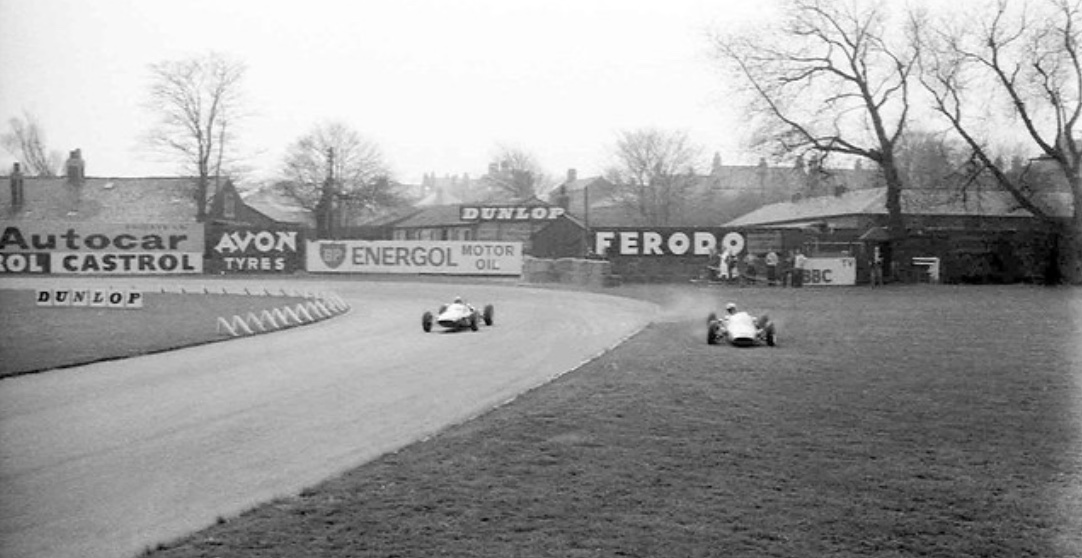
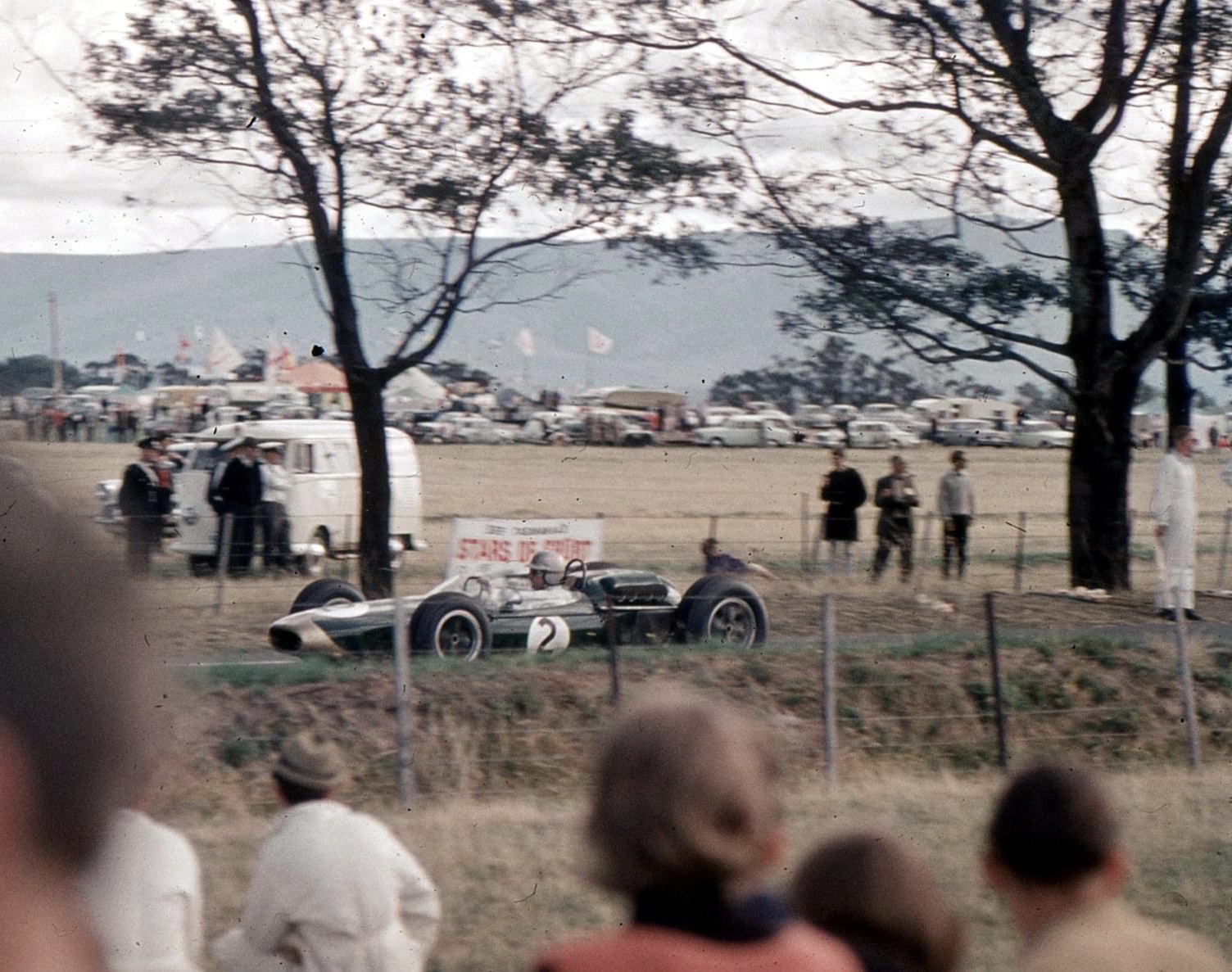
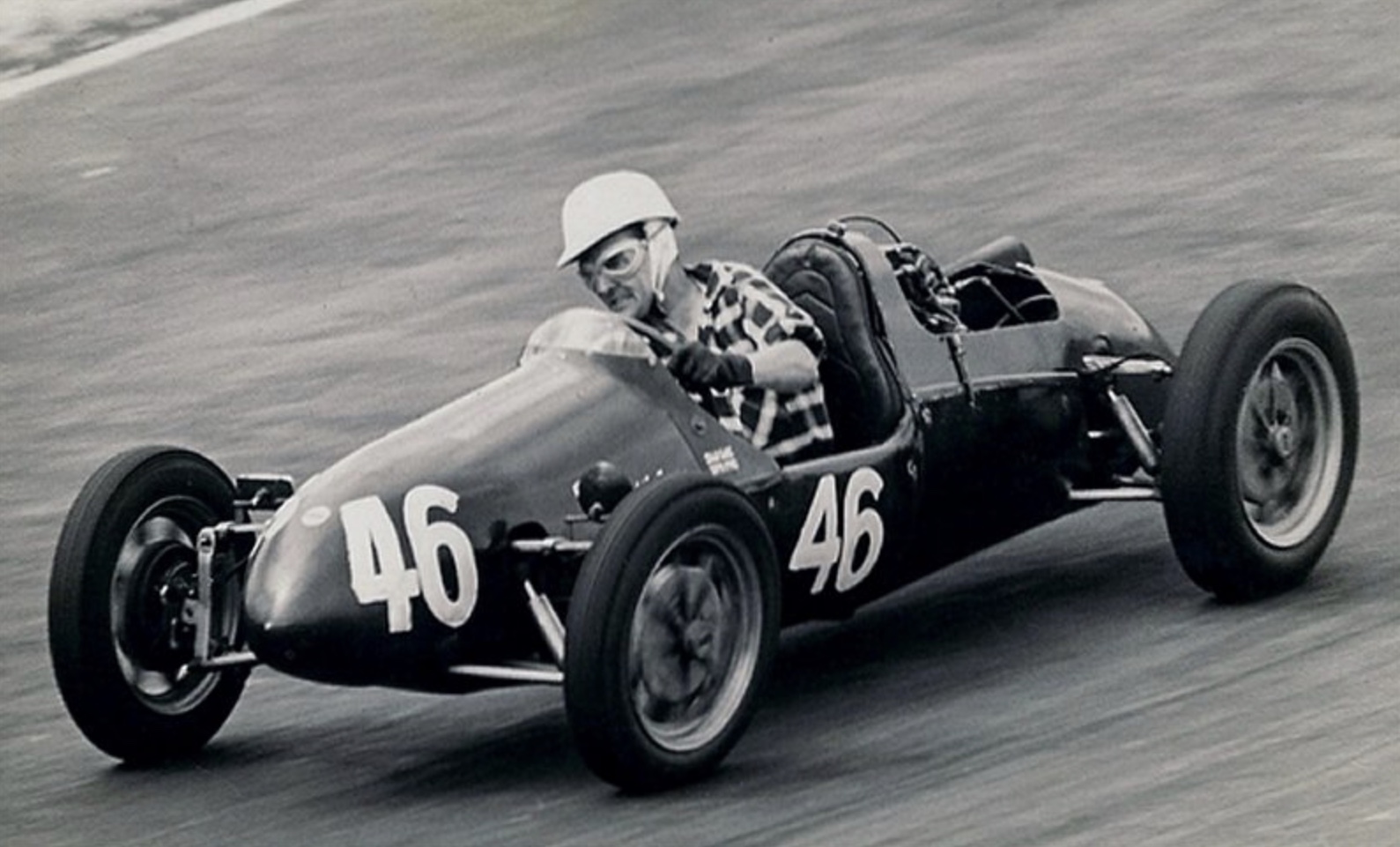
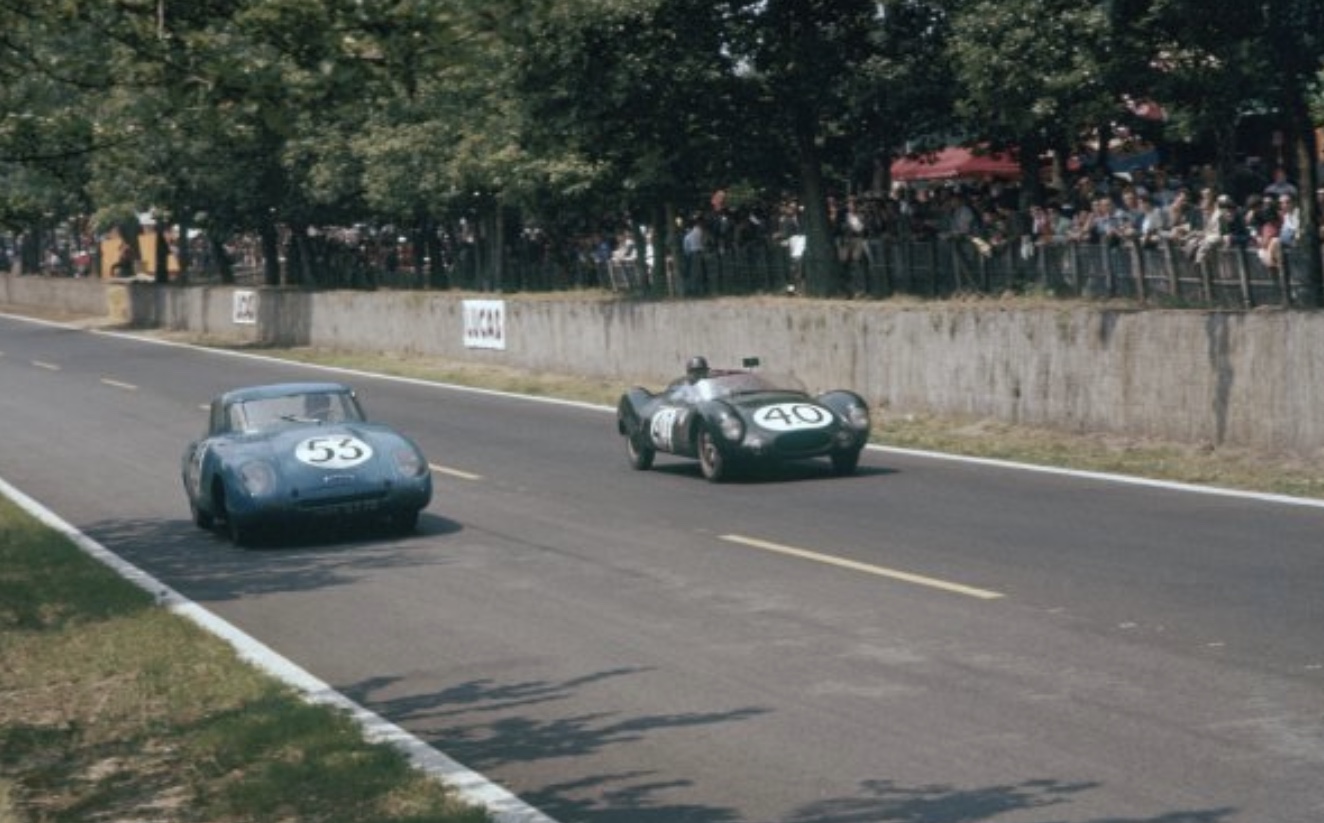
Appendix J tustle into Mountford Corner circa 1964- Alan Robertson’s Peugeot 203 dives under an FJ Holden, the finish line is only 500 metres away, perhaps this is a last lap lunge…
It’s a corker of a shot.
‘Longford 2’, who is he kidding, Longford 10 you may well reasonably say!
Everything in motor racing in moderation my friends, unless it comes to Lola, Lotus, Elfin, Rennmax, Bowin, Birrana or anything to do with Repco-Brabham, Alec Mildren Racing, Scuderia Veloce or Equipe Matich, Warwick Farm and most of all Longford where the rules of moderation simply don’t apply- just suck it up ok!?
Apart from my Longford fascination, Tasmania is one of my favourite states, on top of that I seem to be in a Covid 19 induced sixties nostalgia zone at present so I’ve mixed in some period Tassie snaps of interest- to me at least.
The wonderful racing photographs are by Lia Middleton’s mum, the ladies name would be great to know if someone can provide it, and Jim Langdon. Here we go with this Tasmanian assemblage.
(J Langdon)
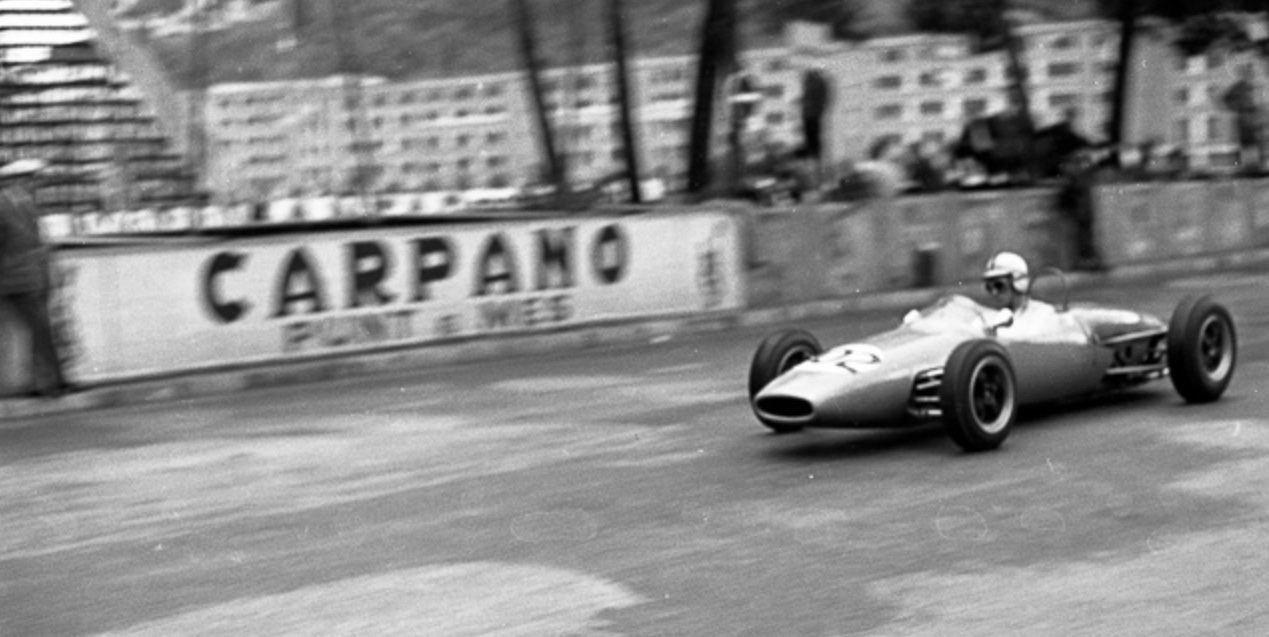
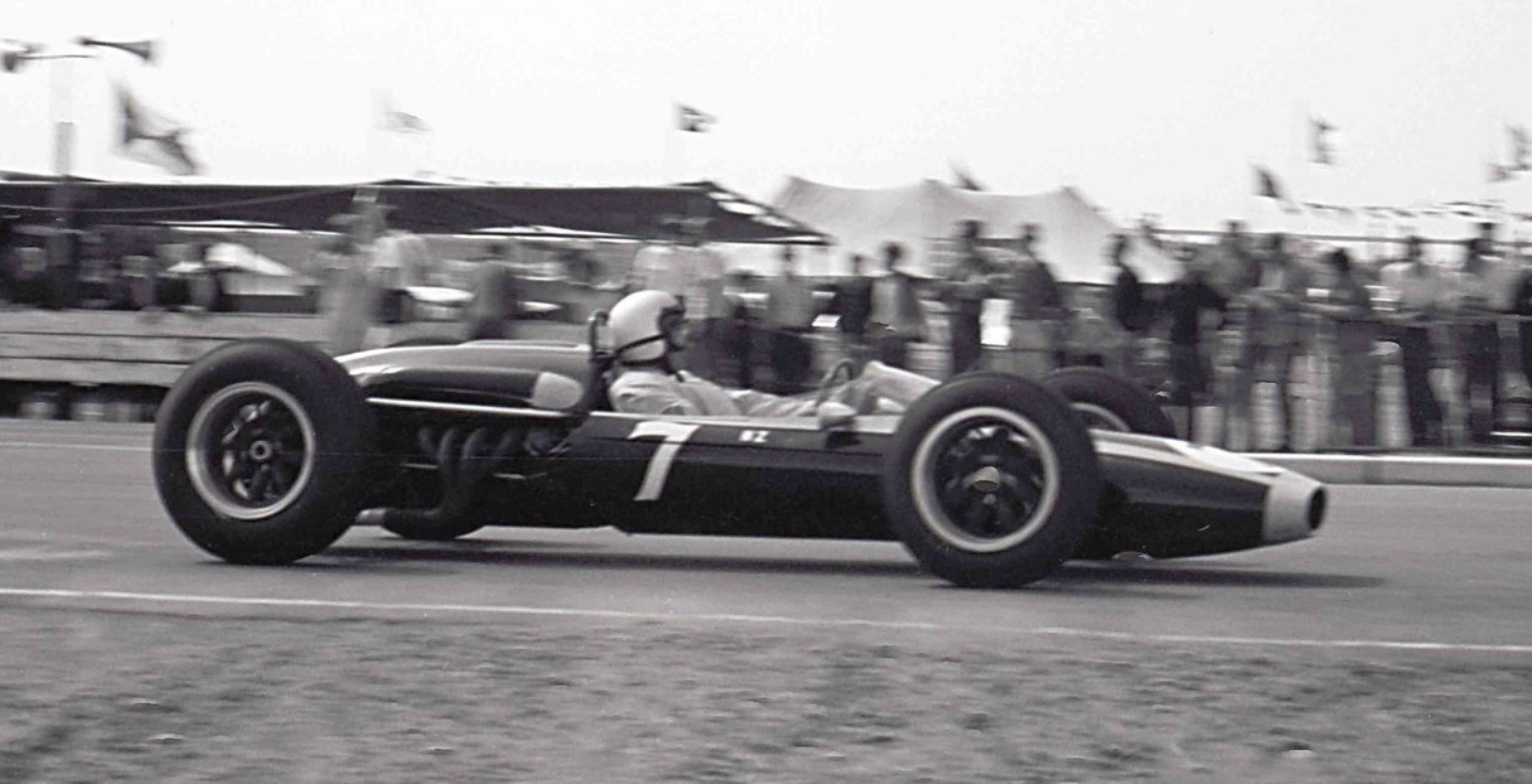
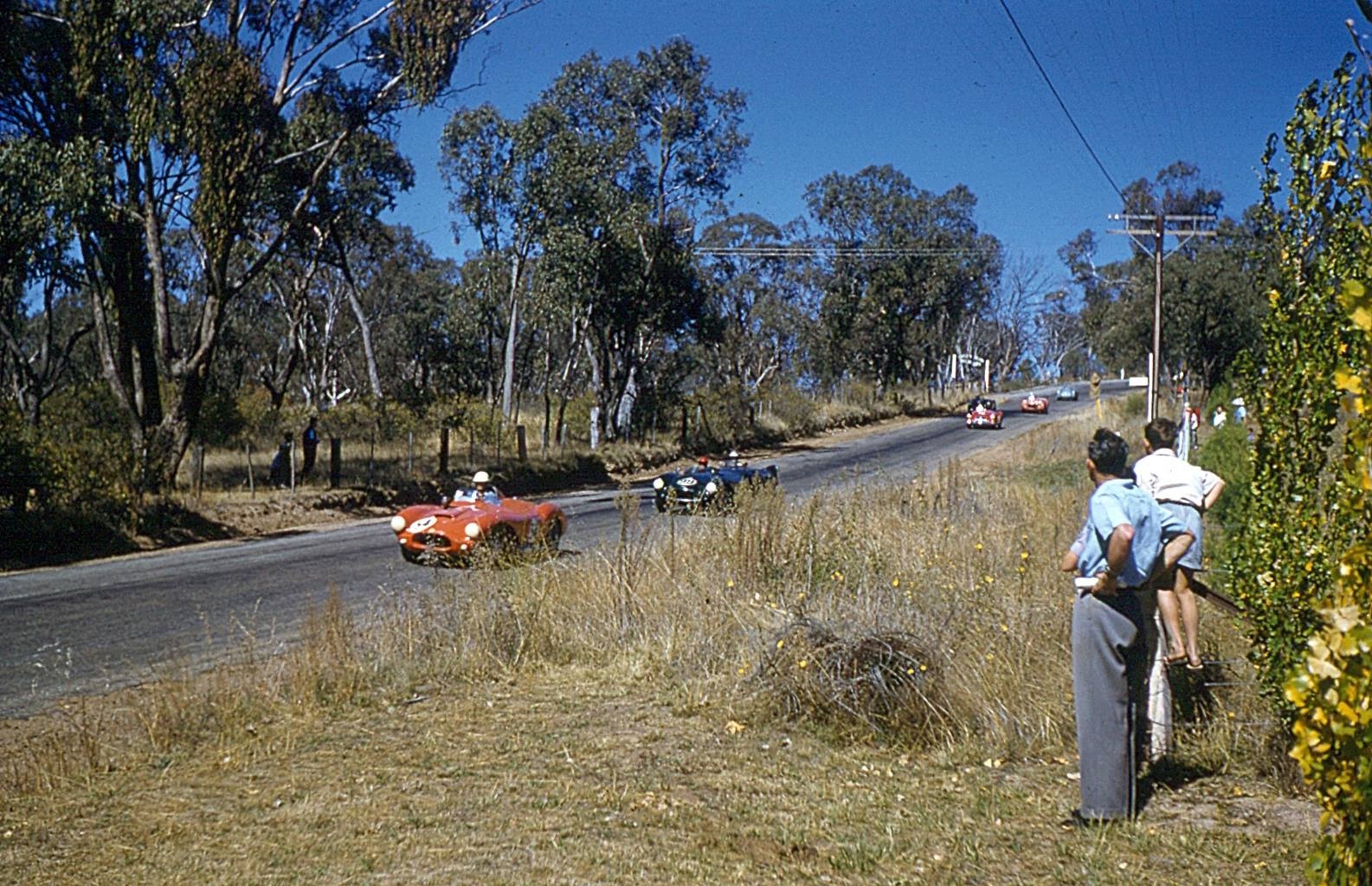
Jack Brabham whistles into Mountford, Brabham BT7A Climax, South Pacific Trophy 1964…
Graham Hill won the race in the Scuderia Veloce BT4 from Bruce McLaren’s Cooper T70 and Frank Matich aboard another Brabham, this time a BT7A, all Coventry Climax 2.5 litre FPF powered.
Things must be going mighty goodly as Roy Billington even has time to laugh at one of Jack’s one-liners- Longford paddock with the Hewland HDS or is it HD5? and Coventry Climax FPF laid bare. This second in a series of three ‘Intercontinental Brabhams were very successful cars.
Brabham always had time for the punters didn’t he!? A smile rather than the death-ray stare of some others- a Pro our Jack.
(Middleton Family)
(C Raine)
I wonder if it was cheaper to travel by TAA Vickers Viscount or the Princess of Tasmania?
These days the plane is the ‘no brainer’ in terms of cost and convenience compared with the overnight ferry from Port Melbourne to Devonport but it may not always have been so, I wonder what the relative cost was.
The plane on the tarmac at Launceston.
(Middleton Family)
All the fun of the fair!
What a brilliant shot, doesn’t Mrs Middleton capture the mood of the meeting? Technically she has framed and cropped the shot beautifully. I wonder what year this Pit Straight bridge went in?
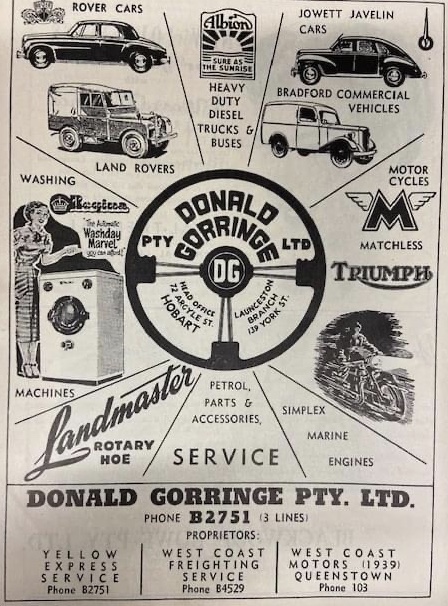
The shot below gives us a read in part on Don Gorringe’s business interests which funded his involvement and support of motor racing.
(Middleton Family)
1968 South Pacific Trophy field race in the dry, so it’s the preliminary ‘Examiner Scratch Race, contested over 12 laps, it rained cats and dogs on the Labour Day Monday public holiday.
The shot above is from towards the rear of the pack diving into the Viaduct- the two BRMs of Pedro Rodriguez and Richard Attwood, I can’t differentiate between the two, then the yellow Mildren Brabham BT23D Alfa Romeo of Frank Gardner on the outside, to FG’s left is his teammate Kevin Bartlett, Brabham BT11A Climax with the red/maroon car at the head of this pack, Piers Courage, winner of the very last Longford Tasman Cup event in his McLaren M4A Ford FVA.
In a short race of attrition, Graham Hill won from Jim Clark, both in Lotus 49 Ford DFWs and Frank Gardner’s Brabham Alfa- Clarkset a lap record of 2:14.7 during the race but this time was battered by Chris Amon in the Scuderia Veloce Ferrari Can-Am 350 which did a 2:12.6- Chris’ best was 10 seconds a lap better than second place man Ian Cook in Bob Jane’s Elfin 400 Repco 4.4 V8- Amon’s Ferrari was famously timed at 182mph on ‘The Flying Mile’.
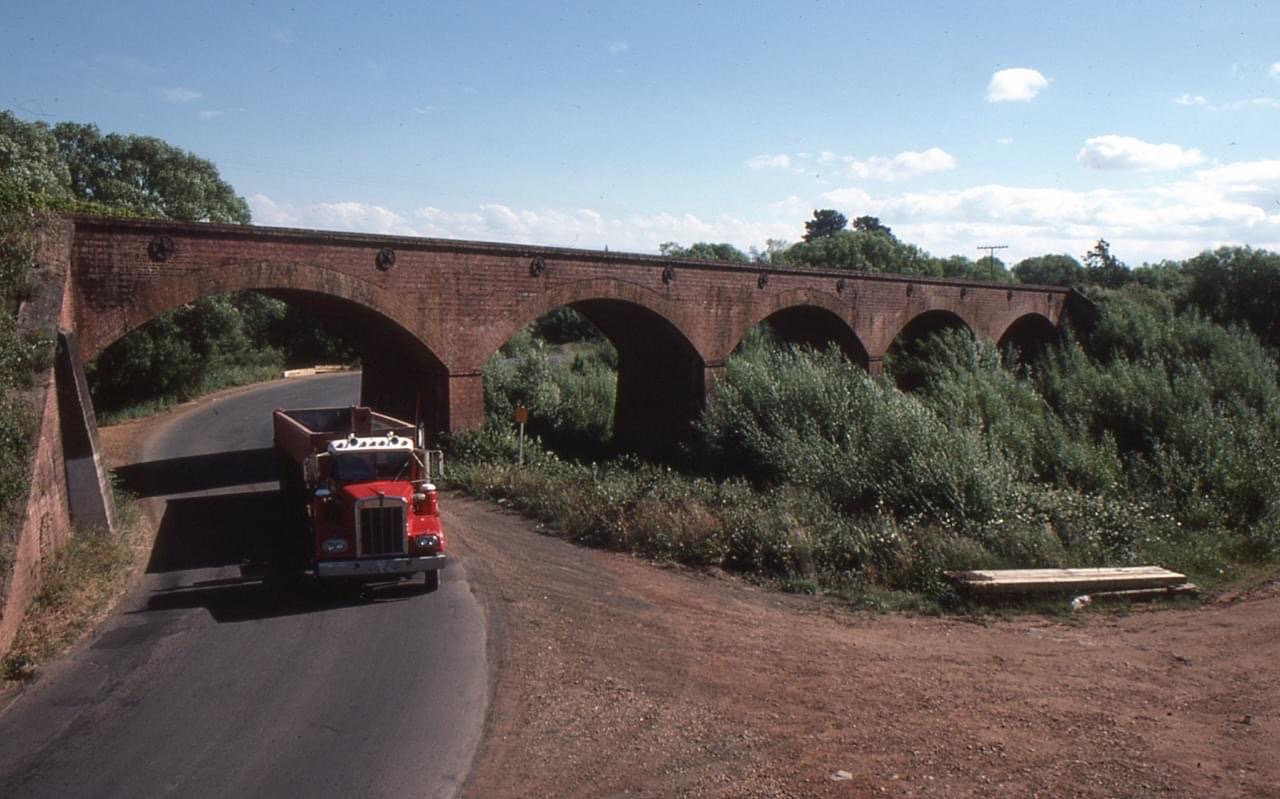
The truck is heading in race direction towards Mountford Gate, Viaduct, I wonder what year this shot was taken?
(Middleton Family)
Local Longford racing club chief and landowner Ron McKinnon gives Jack Brabham and the race winner, Bruce McLaren a lift after conclusion of the 1965 Australian Grand Prix- McLaren drove a Cooper T79 Climax whilst Jack was aboard a BT11A and Ron an MGA. 1965 AGP here; https://primotipo.com/2019/09/27/longford-1965/
(D Febey)
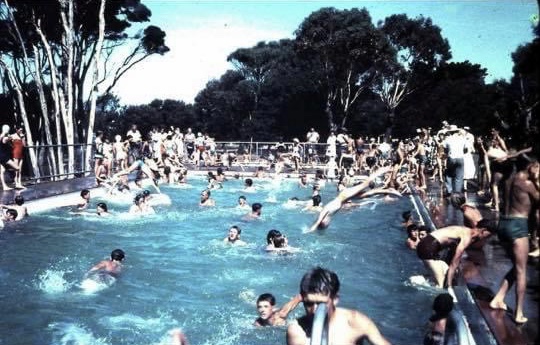
No Australian kid’s summer holidays was complete without a holiday at the beach or in the local pool- you really were ‘posh’ if yer folks had a pool back then.
Just looking at this brings back so many memories, not the least of which was the difficulty of executing a ten outta ten dive whilst not landing on top of some schmo in the process- this is the pool at The Bluff in Devonport.
(Middleton Family)
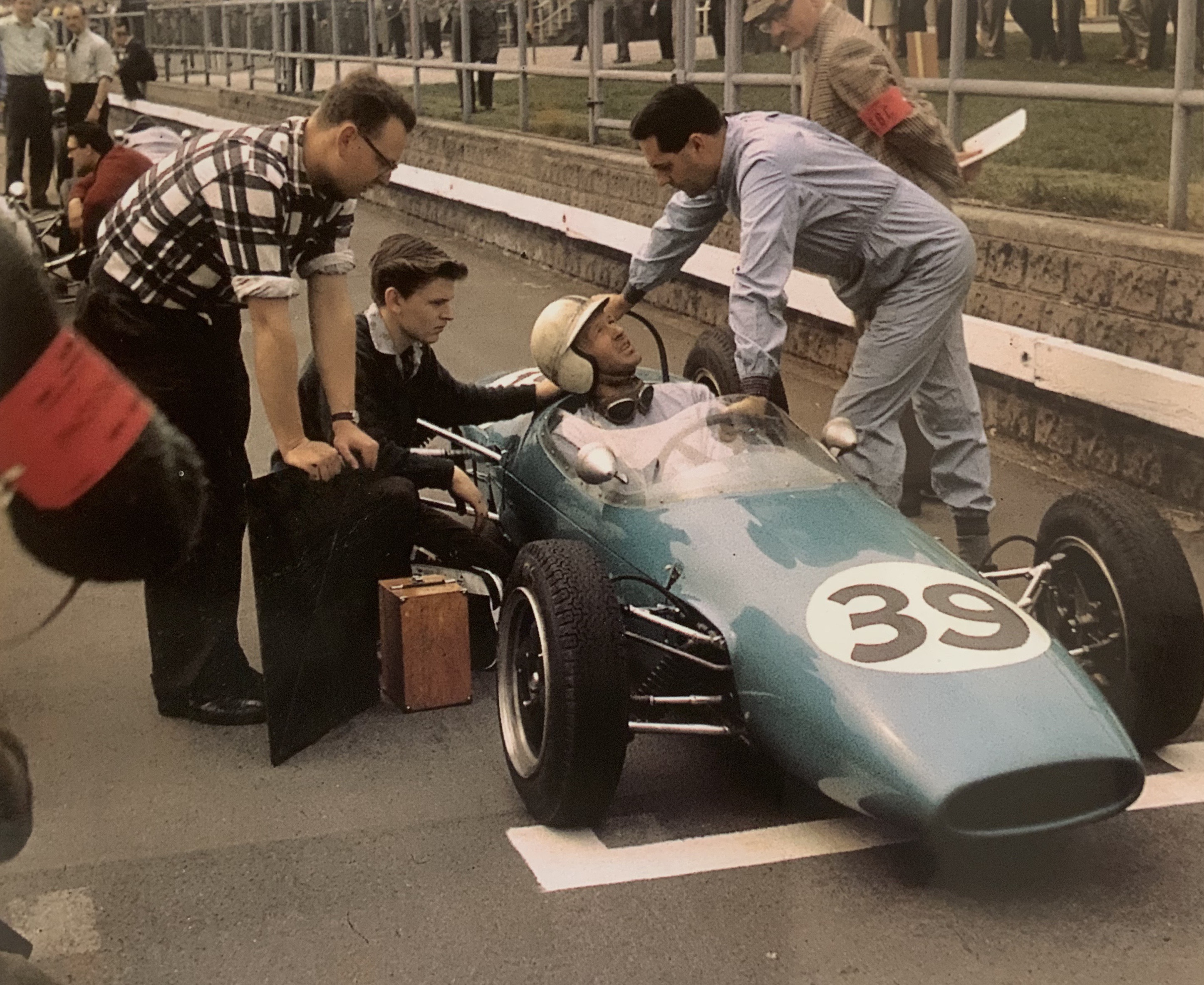
Graham Hill looking a bit more earnest and focused than Jack in a similar car- a Repco Brabham BT4 Climax owned by David McKay’s Scuderia Veloce.
That’s him in the cap on the right with Bob Atkin and another fella pushing- Hill’s focus was rewarded, he won the 1964 South Pacific Trophy as mentioned earlier. Brabham BT4 here; https://primotipo.com/2016/10/16/point-of-sale/
Kings Pier, Port of Hobart in the mid-sixties. Salamanca Place and the Port is these days a wonderful place to stroll around and dine whilst still a working port (R MacFie)
Scuderia Veloce again, this time the great Spencer Martin kicking the tail of the Ferrari 250LM about with gay abandon in 1965, it’s one of the machines very first meetings- the exit of Mountford Corner with a very appreciative crowd.
These cars, production sports-racing Ferrari won Le Mans in 1965 after the top gun Ford GT40, Mk2 and Ferrari P2s dropped by the wayside, Jochen Rindt and Masten Gregory raced the winning NART entry.
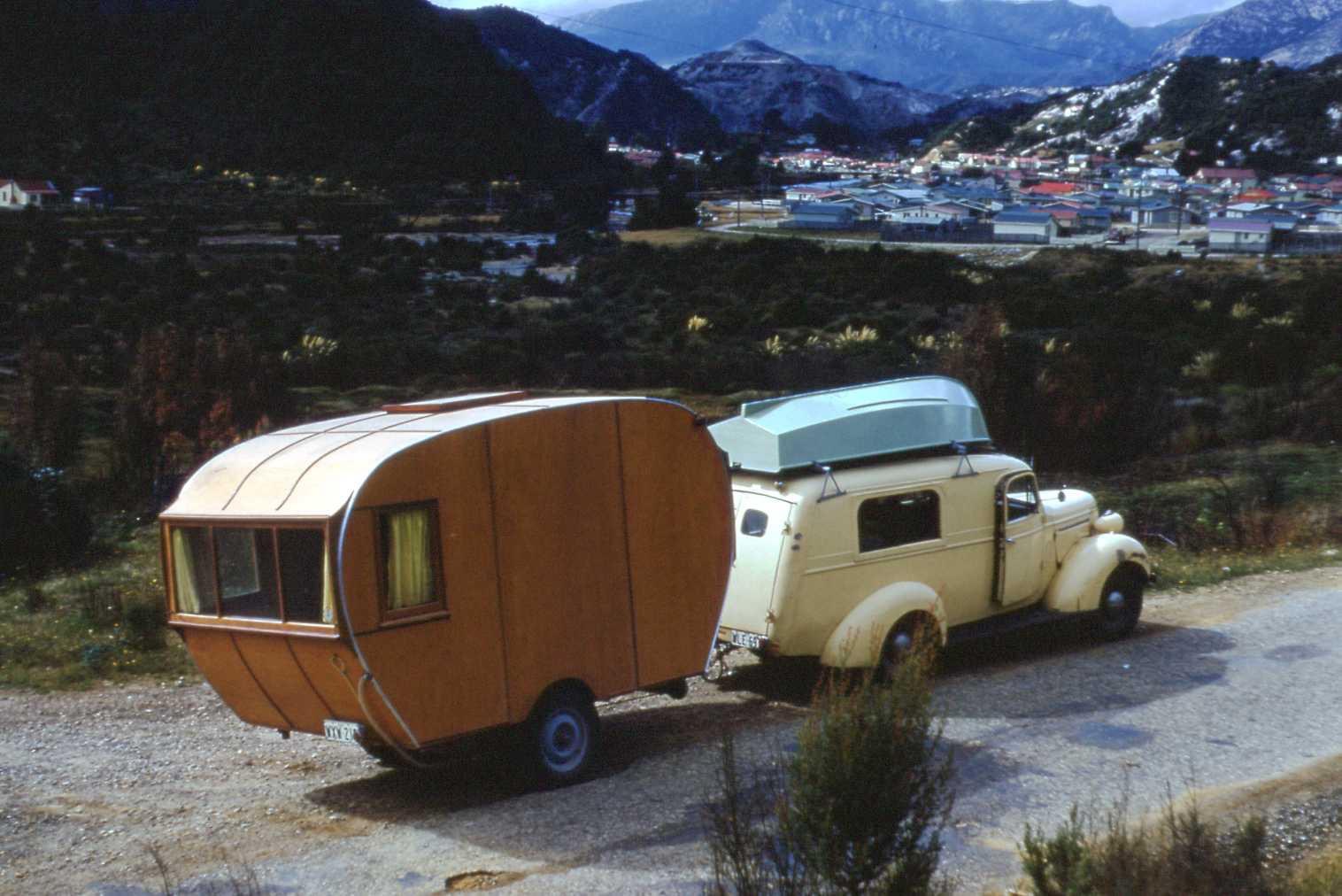
I blew my tiny mind upon seeing these photographs of Minuet Stephens- they pinged ‘Queenstown’ in my mind but some of you Tassies can set me straight if I have that wrong, it’s only two years since the last time I swung through, it’s circa 1963 given other shots in this collection.
Isn’t ‘the rig’ amazing, what make and model is the home built caravan’s tow car or truck? The wow factor was succeeded by memories of long interstate trips Australian style before dual-lane highways became common in the eighties- Melbourne to Sydney then, about 500 miles now, was ‘a lot longer then’ on the Hume Highway as yer Dad’s 186cid HK Kingswood wagon was stuck behind outfits like this one and semi-trailers which did not gobble up the road as they do now. ‘How much further Dad?!’ every thirty minutes, its a wonder he didn’t strangle the three of us really.
I imagine on the relatively quiet roads of the Apple Isle this kind of touring would have been very pleasant indeed.
(J Langdon)
(J Langdon)
Bib Stillwell turns in for Mountford with Pit Straight, the Control Tower and Water Tower in the distance- Brabham BT4 Climax in 1964.
By this stage the ‘late blooming’ Melbourne car and aviation businessman had been a front-runner for a halfa decade, in fact he won his third Gold Star on the trot in this chassis that year, having won it in ‘IC-3-62’ as well in 1963.
A quick glance suggested BT11A to me- the airbox led me there but tell tales of BT4 are the external radiator pipe- it looks like a pinstripe and the location of the top front wishbone rear pickup.
The Aston Martin DB5 is rather nice too.
(J Buddle)
Groometals scrap metal warehouse and lead smelting establishment on the corner of Harrington and Warwick Streets Hobart and looking very much in 1998 just before its demolition, as it did in 1965.
The nostalgic observation here is that so many of our inner urban main arteries looked like this until these streets filled with restaurants and retail outlets instead of small business ‘workshops’ as the inner suburbs became places many of us wanted to live.
I gave my Formula Vee a birthday at the end of 1979- amongst other things the suspension was nickel plated and chassis sand-blasted and then stove-enameled in two different ‘shops in Bridge Road, Richmond which these days is all restaurants and retail outlets- many with ‘to lease’ signs reflecting the decade old on-line retail revolution and of course forty-five thousand coffee shops. Still it was forty years ago, so some change should be anticipated I guess!
(Middleton Family)
Look at that crowd on Pit Straight.
Look very carefully to the left and you can just see a couple of jousting Scots- Jim Clark’s Lotus 39 Climax is just in front of South Pacific Trophy winner, Jackie Stewart in a BRM P261 1.9 litre V8.
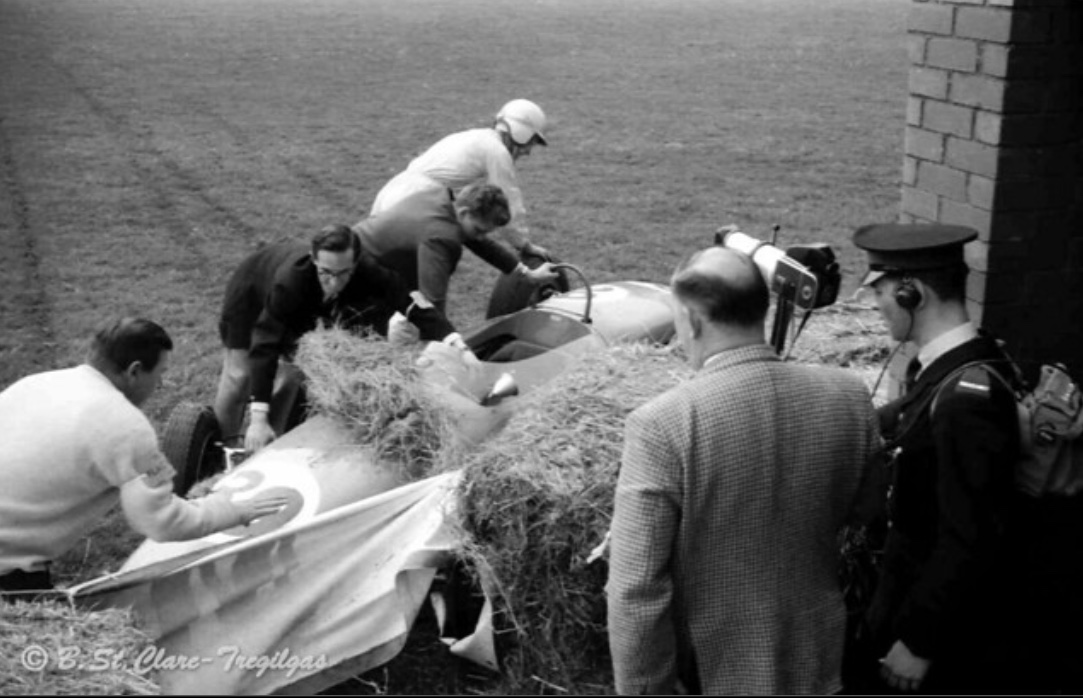
In the shot below Arnold Glass has neatly popped the nose of his ANF1.5 Lotus 27 Ford twin-cam into the Mountford haybales during the 1964 meeting- hopefully no great damage has been done in ‘The Mercury’ 10 lapper for racing cars.
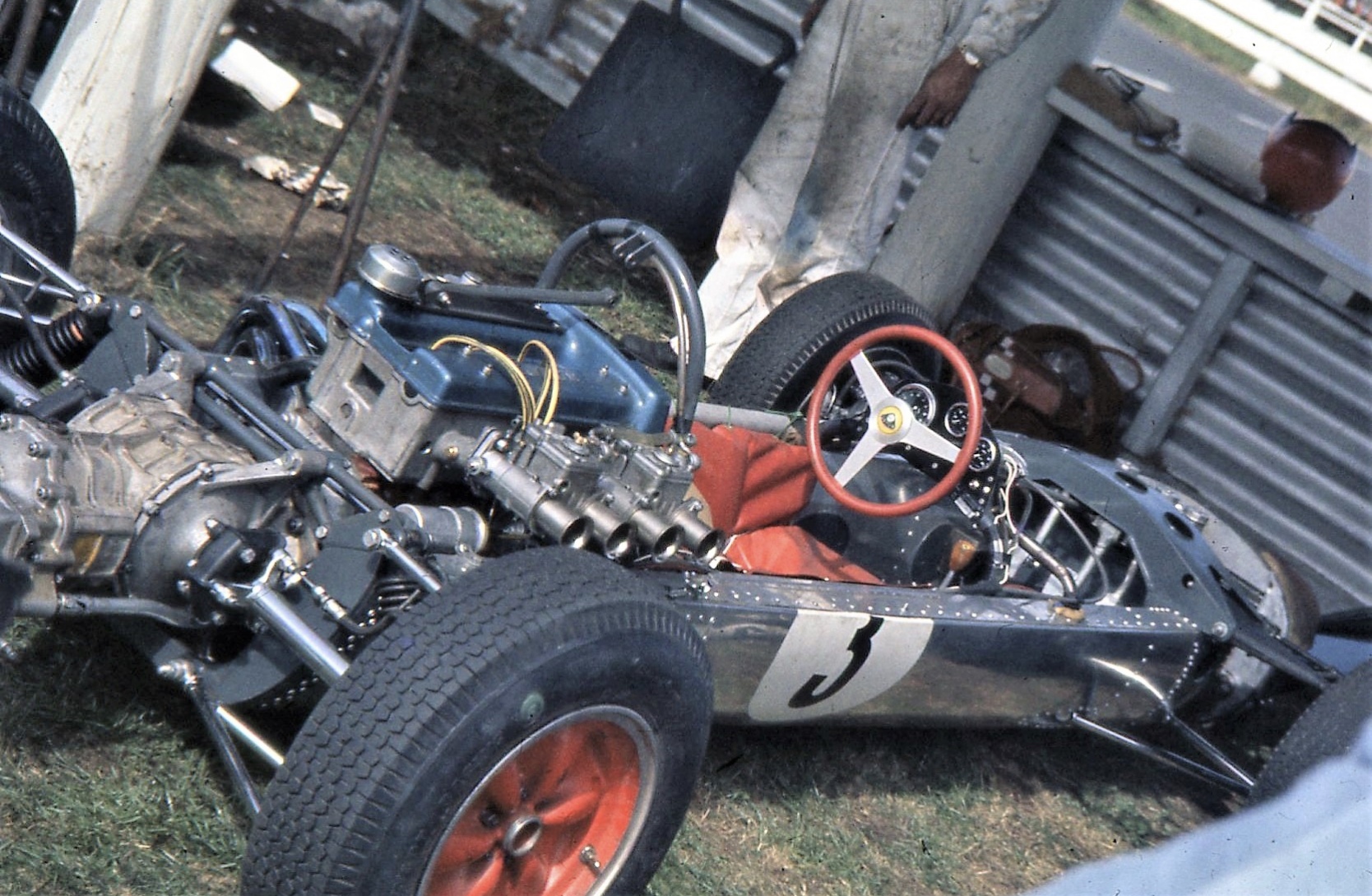
Below is the business end of the monocoque Lotus 27 which very much apes the F1 Lotus 33 in basic specifications- chassis, suspension whilst noting the 1.5 litre FWMV V8 gave circa 210bhp whereas this 1.5 litre Cosworth built Lotus-Ford four cylinder engine gave circa 125bhp. Hewland gearbox of course, lovely Ron Lambert shot in the Longford paddock, the cockpit/nosepiece is off the car, perhaps being repaired…
(R Lambert)
The lighthouse supply ship SS Cape York off Maatsuyker Island on Tasmania’s southwest coast, mid-sixties (Nat Arc Oz)
(Middleton Family)
(Middleton Family)
A couple more shots on the approach and downhill plunge to The Viaduct.
The touring car experts can probably date the event- two EH Holdens chasing a trio of Morris Coopers- Barrett, Smith, Bromfield, Boot and Evan Thomas are the tips of racers Danny Newland and Barry Cassidy- as to the single seater race, who knows?
(M Stephens)
‘You muck around like a pack of old chooks at a Christening’ was one of my Dad’s sayings!
This group of ladies reminds me of my grandmother and her four sisters frocking up, hats and all for a family ceremonial occasion- like a Christening!
It reminds me how ‘white’ we all were too- Gough Whitlam finally repealed the ‘White Australia Policy’ in 1973 for chrissakes- Asian immigration was negligible until President Ford rang Malcolm Fraser and said ‘you pricks helped us create the mess in Vietnam so you malakas have to help mop it up’ or diplomatic weasel words to that effect anyway.
So now we have a wonderful, mainly harmonious multi-cultural mix rather than the mono-cultural Anglo society reflected in the scene of matrons above.
(Middleton Family)
Montford Corner again with a gorgeous Elfin Streamliner confronting a big special- wotizzit?
Huge crowd again, year uncertain.
( Middleton Family)
Ron McKinnon again this time aboard a Datsun Fairlady- his passengers appear to be Bruce McLaren and Graham Hill, so first and second in the 1964 Sou-Pac Trophy.
Never drove a Fairlady but did have a drive of its big-brother Datsun 2000 and couldn’t believe how much better a car it was than the MGBs i was looking at at the time.
(Libraries Tasmania)
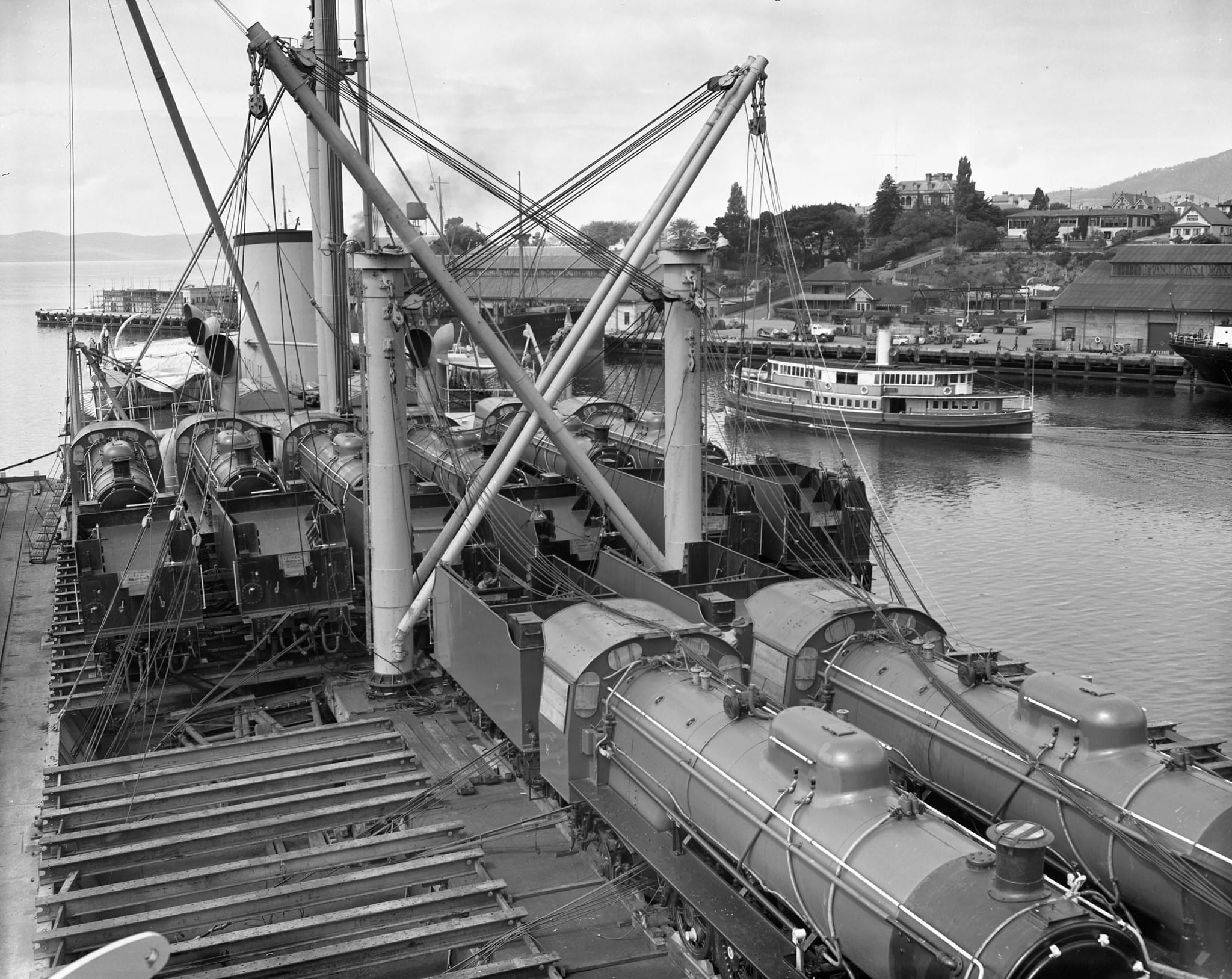
I sorta missed the whole steam engined thing- Puffing Billy excepted, ten years older and it would have been front and centre for me in a way that it no doubt was for many of you.
These eight H Class locos are sitting aboard the ship ‘Belpareil’ at the Hobart docks, I cheated with the decade though, it’s October 1951. I wonder who the manufacturer was/is?, wonderfully five of these trains still exist.
(Middleton Family)
It’s rotating so hopefully the driver of the Humpy Holden missed the Mountford trees, the physics of it all is working in his favour I think. Who is it?
(Middleton Family)
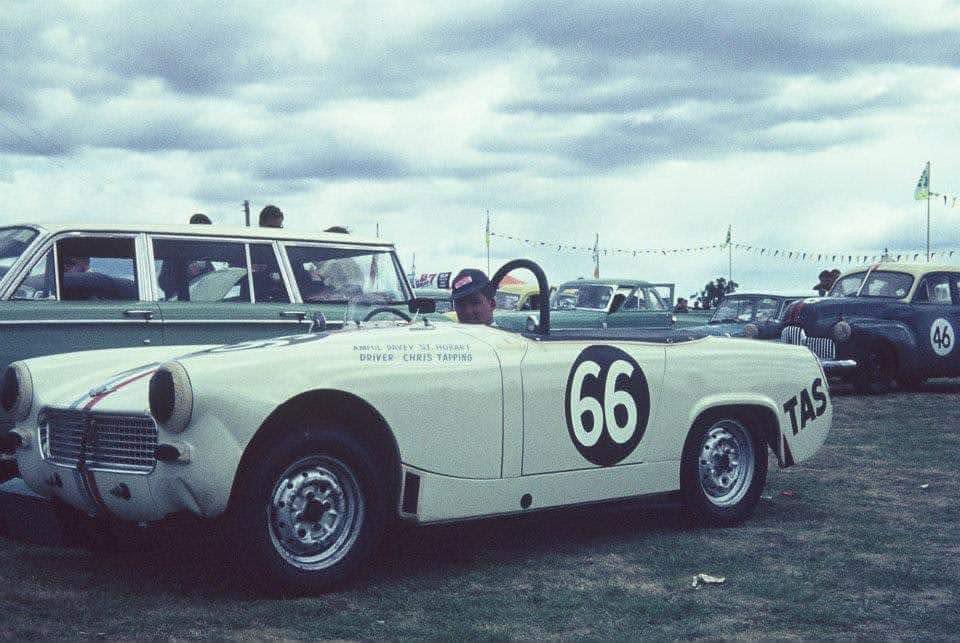
The wonderful thing about Longford is that for every international who raced there the bulk of the weekends entertainment was provided by local/national drivers who got to play on one of the greatest, most challenging and dangerous road racing tracks in the world, as our Sprite friend, Chris Tapping is doing just here.
(C Broadfield Collection)
The gent in the hat does not seem phased at all by the sight of the yacht ‘Heemskerk’ being shifted by road from Sandy Bay, where it was built to the Hobart Port closeby where the owner Edney Medhurst launched the sleek hulled craft in 1953.
Credits…
Jim Langdon, Chris Raine Family, Lia Middleton Family, Rob MacFie, Daryn Febey, Minuet Stephens, Jeremy Buddle, National Archives of Australia, Libraries Tasmania, Craig Broadfield Collection, Ron Lambert
Tailpiece…
(M Stephens)
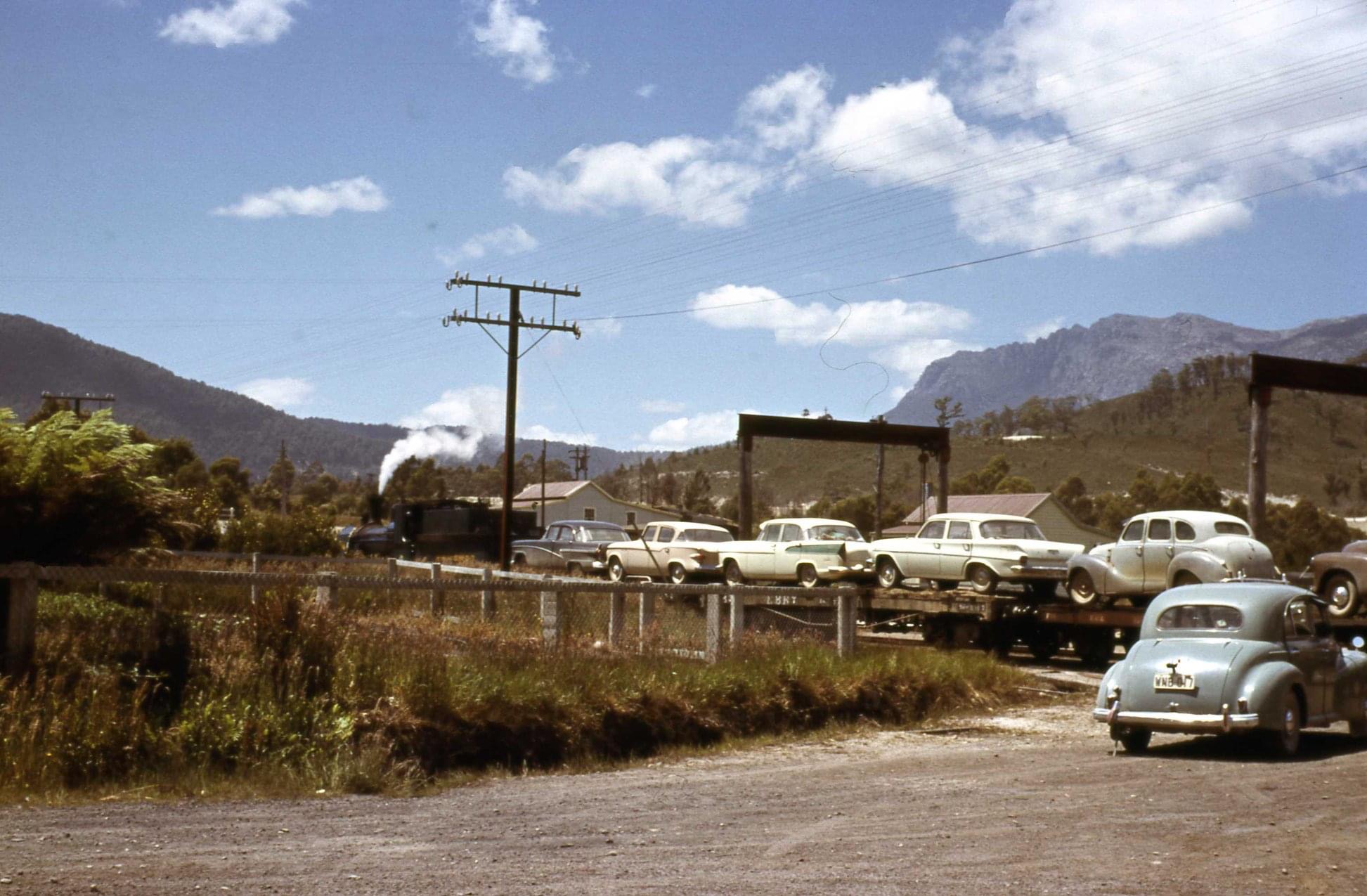
Another Queenstown shot i think, the most recent car is an EJ Holden so let’s date the queue of cars on the steam train as being circa 1963.
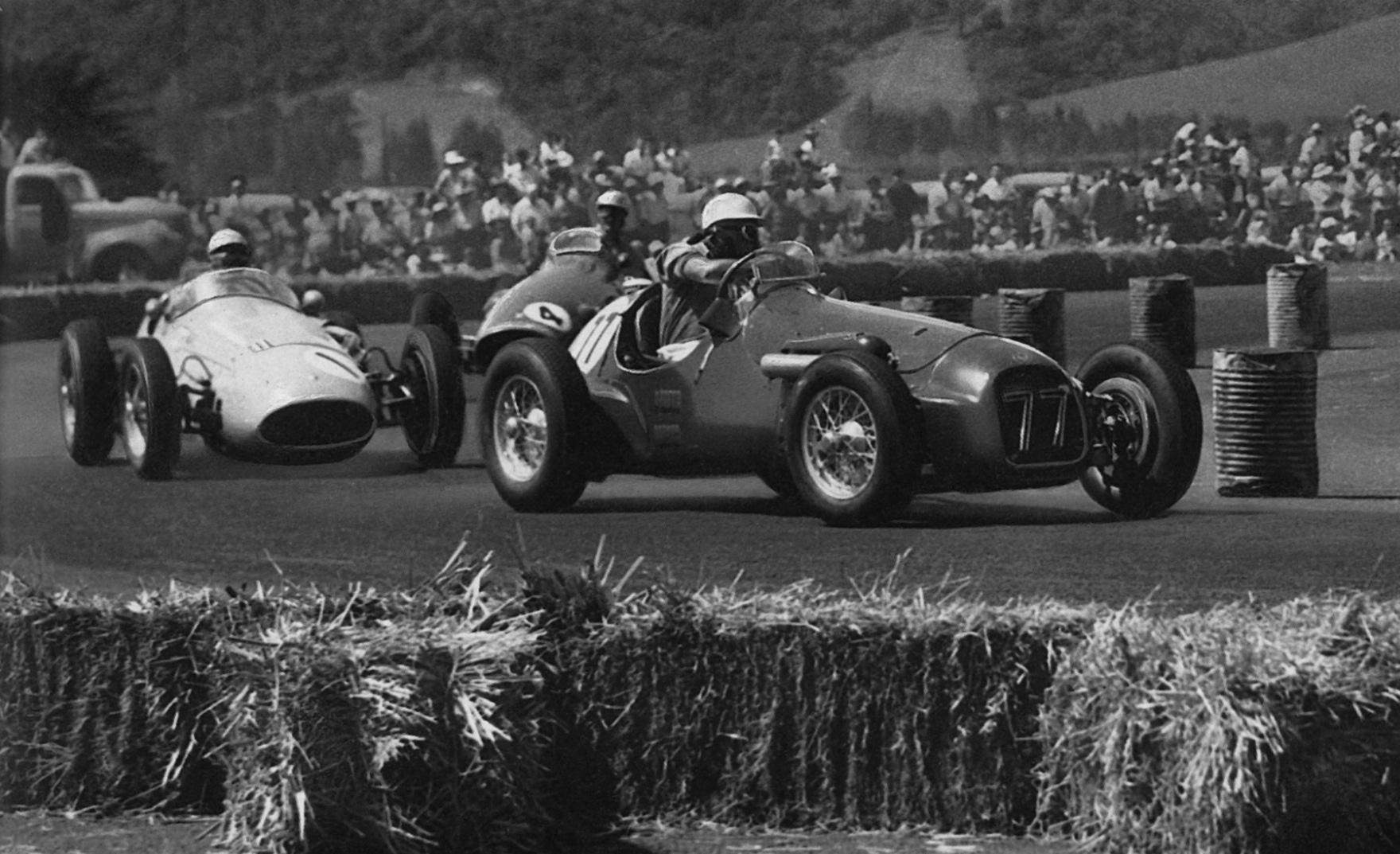
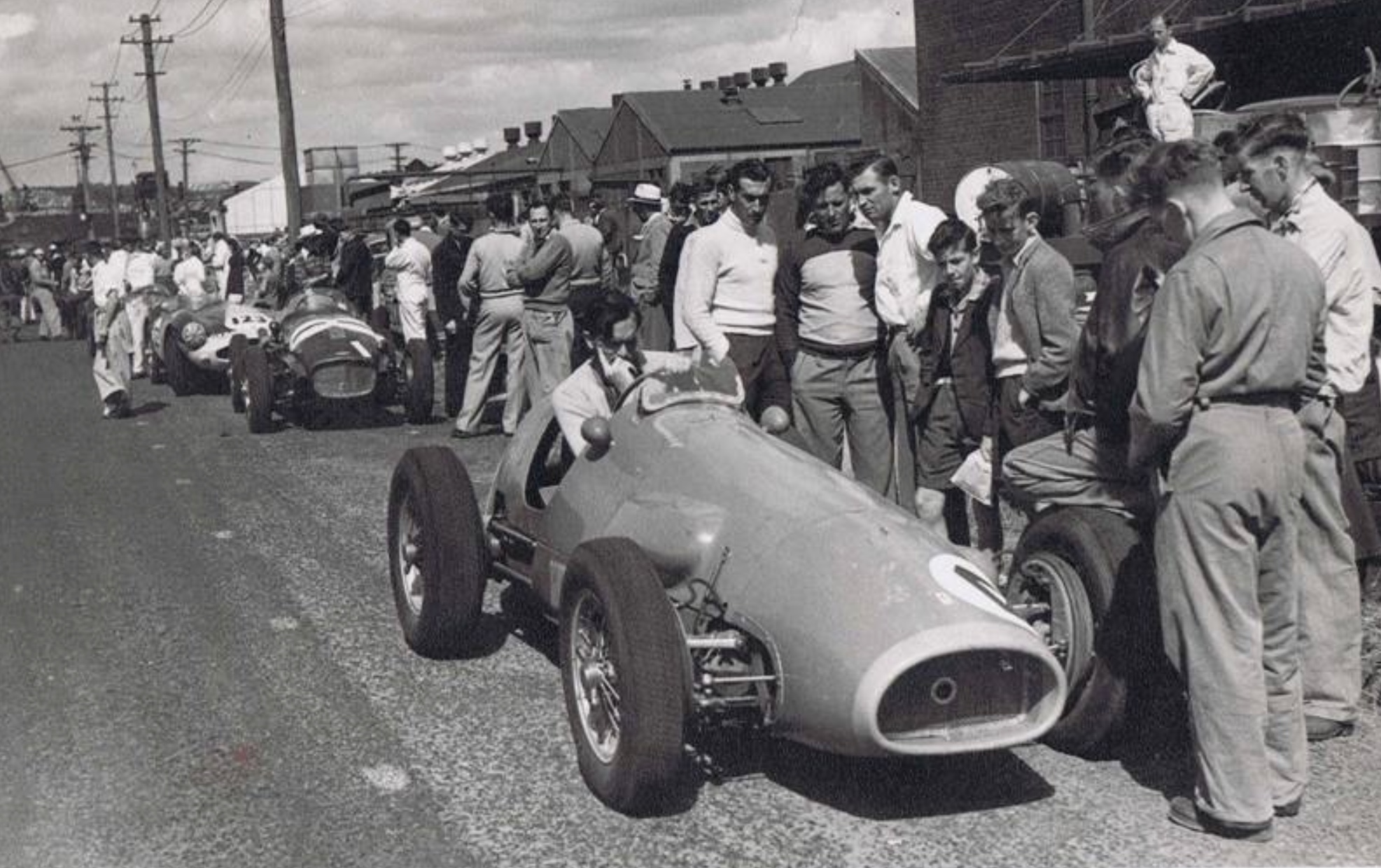
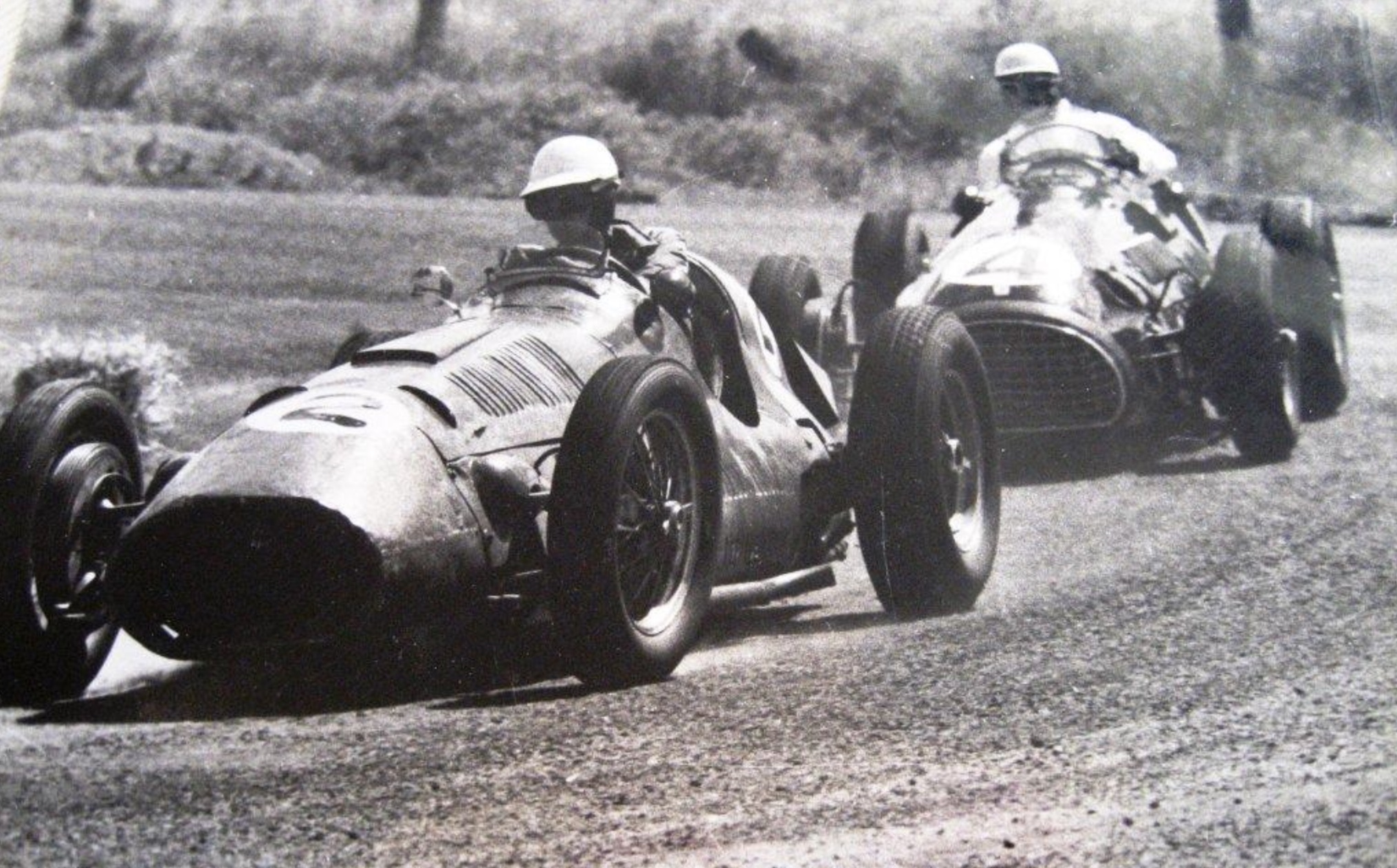
Jack Brabham’s tiny Cooper T41 Climax takes on the big Ferrari 555 Super Squalo’s of Peter Whitehead #5 and Reg Parnell #4- to the right is Syd Jensen in another T41, Ardmore, New Zealand Grand Prix 1957…
Jack’s ‘slingshot’ didn’t topple the big guys that weekend but Stirling Moss ‘put the writing on the wall’ with his Argentinian GP Cooper win twelve months hence and by 1959 it was all over-red rover for the big front-engined glorious Grand Prix cars.
Brabham built this car at Coopers late in 1956 racing racing it twice in the UK before shipment to Australia- in the 22 September Oulton Park Gold Cup, DNF, the race won by teammate, Roy Salvadori’s T41, and then the BRSCC F2 race at Brands Hatch on October 14 where he again failed to finish with piston failure, again a T41 headed the field, Tony Brooks was at the wheel of Rob Walker’s car.
Off to the Antipodes he contested the NZ Internationals, the AGP at Caversham in March, and then the Victorian Trophy at Albert Park the following weekend- he then returned to Europe at the end of the summer having sold the car to Alec Mildren.
T41 chassis number ‘F2/P/56′ was fitted with a 1476cc Coventry Climax FWB sohc, two valve engine which gave circa 100 bhp @ 6500 rpm- it was a trend-setter in that it was the first of many, very many Climax engined Coopers to come to Australia. The design and construction progression of these Coopers (T41-T53) is covered in detail here; https://primotipo.com/2019/10/04/cooper-t41-43-45-51-53/
Despite giving away 2 litres in engine capacity to the Ferraris, Brabham was third at Ardmore until lap 100 of the 120 lap race when his engine temperature soared and he retired with a burst radiator hose which had fried the Climax engines cylinder head gasket- Parnell won from Whitehead and Stan Jones’ Maserati 250F.
Brabham was Q3 and second at Wigram behind Whitehead, started from pole in the Dunedin Road Race this time finishing second to Parnell and then retired after completing 9 laps of the wild Southland Road Race at Ryal Bush where Peter Whitehead again prevailed.
Brabham at Oulton Park during the Gold Cup weekend, Cooper T41 Climax FWB (MotorSport)
Brabham during the 1957 AGP at Caversham in March 1957- behind him is the Fred Coxon driven Amilcar Holden Spl DNF (K Devine)
Caversham AGP start 1957- Brabham, Cooper T41 Climax, Davison, Ferrari 500/625, Lukey, Cooper T23 Bristol and Jones Maserati 250F. Car #12 Syd Anderson, Alta GP2, #14 Syd Taylor, TS GMC Special, #8 Tom Hawkes, Cooper T23 Holden- behind him is Tom Sulman’s Aston Martin DB3S, #6 Alec Mildren, Cooper T20 Bristol and #5 Jack Myers, Cooper T20 Holden (K Devine)
Off to Perth for the 4 March AGP Jack was third in the scorching hot event behind the 3 litre Ferrari 500/625 of Lex Davison and Bill Patterson and Stan Jones’ Maserati 250F which did that event with its 300S motor.
Then it was back across the continent for the Moomba meeting at Albert Park where the little car contested the 32 lap 100 mile Victorian Trophy Gold Star round finishing second behind Davison’s Ferrari 500/625 and in front of Doug Whiteford’s Maserati 300S.
Jack then returned to Europe but not before, Graham Howard wrote, driving Ron Tauranac’s new Ralt Vincent at Mount Druitt- i wonder who has a shot of that test day?
Alec Mildren raced the T41 only briefly ‘finding that the chassis kept breaking due to it being too light’ John Blanden wrote- in short order the car was owned and raced by Arthur Griffiths and John Roxburgh before passing to Lyn Archer in Tasmania who raced it very successfully, ultimately with a highly modified Hillman Imp engine, he sold it to buy an Elfin Catalina Ford, a machine he raced for years and is still owned by his family.
The T41 passed through many hands in the decades which followed before Tom Roberts acquired it with David Rapley heading up the restoration of the car, which made its debut at the 2003 Albert Park AGP.
Etcetera…
Australian colours aren’t they?- green with the gold nose, lovely profile shot by racer/photographer David Van Dal at Caversham, ditto below in the paddock.
(K Devine)
Jack aboard a Cooper T43 Climax FPF 1.5 at Brands Hatch, 8 August weekend 1957, he won both heats of the Rochester Trophy F2 event (unattributed)
Credits…
‘History of The Australian Grand Prix’ Graham Howard and others, ‘Glory Days: Albert Park 1953-58’ Barry Green, ‘Racing Cars in Australia’ John Blanden, sergent.com, Ken Devine Collection, David Van Dal, MotorSport, F2 Index
Tailpiece…
(unattributed)
Lets go back to where we started, Ardmore 1957, and another cracker of a shot, this time just after the start.
Up front it’s all Ferraris- Ron Roycroft’s 375 V12 from the two four cylinder Super Squalos of Whitehead and Parnell. Then out wide on the left is Jack’s Cooper, the Peter Whitehead owned, fourth placed #18 Ferrari 750 Monza driven by Ross Jensen and far right the HWM Alta I wrote about not so long ago being driven by Tom Clark.
The Cooper T39 Climax Bobtail is Ronnie Moores- to the right of him is the Talbot Lago T26C of Allan Freeman, and then, perhaps, Horace Gould’s #2 250F, whilst in the middle of the pack the unmistakable, regal lines of the Alfa Romeo Tipo B/P3 raced by John McMillan, the almost as ancient Maserati 4CLT-48 of Pat Hoare is out to the right- alongside him is the Jones 250F. I’ll take advice on the rest…
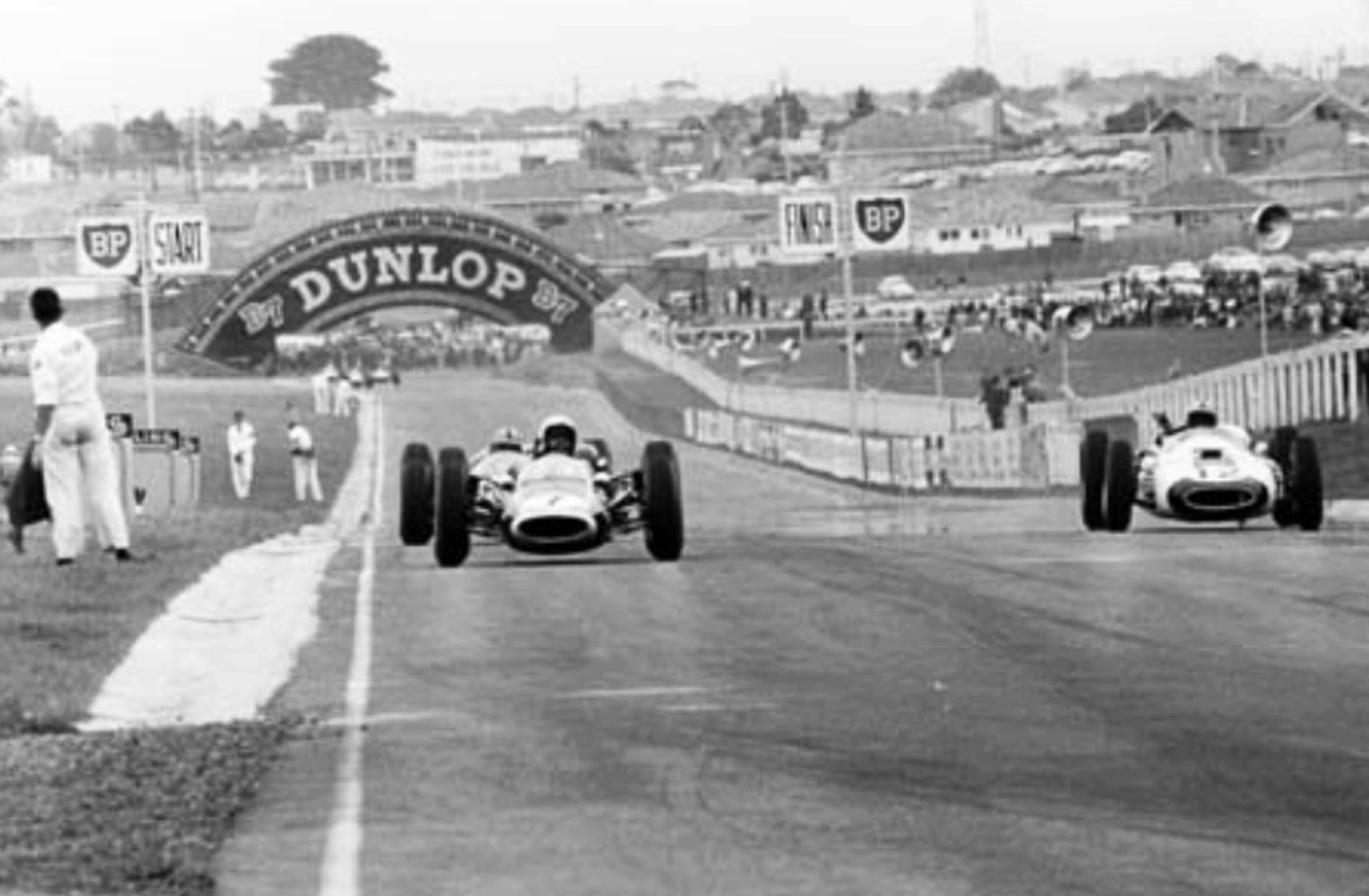
Bruce McLaren, Cooper T70 Climax, Australian Grand Prix, Sandown Park 1964…
Its an unusual angle, Bruce is thinking about brakes as he passes the end of the pit counter and heads towards the tight ‘Peters’ left-hander before the blast up the back straight- unusual in that the shot is taken from outside the circuit, between the Armco fence and access road, a prohibited area for spectators and ‘snappers for most of the tracks life.
This one is also at Sandown but a year later, 1965, as the drivers listen intently to the Clerk of The Course before the off.
Roy Billington is on the rear wheel of Jack’s Brabham BT11A Climax- the winning car, then the tall Tyler Alexander, Bruce is in the ‘Persil’ white Firestone overalls, Bib Stillwell behind him, Jim Clark, Jack Brabham and David McKay playing with his iPhone. Jack won from Jim and Phil Hill’s Cooper T70.
Jack posing patiently for Paul Stephenson in his victorious BT11A- Sandown pitlane.
(P Stephenson)
(unattributed)
Back to the 1964 Sandown Australian Grand Prix.
Bruce takes a glimpse in his Cooper T70 mirror before lining up for the Shell Corner left hander, Jack Brabham in close attendance- Brabham BT7A Climax. Over to the right alongside the fence Jim Palmer is giving them plenty of room in his Cooper T53 Climax, he was sixth. Jack won whilst Bruce was out with engine problems.
Credits…
autopics.com.au, Jeffrey Lay, Paul Stephenson, Graham Rhodes in Australian Autosportsman
Tailpiece…
(Graham Rhodes photographer)
I chuckled when randomly coming across this photo because it is taken within 20 metres or so of the first one but is taken from under the Armco on the outside of Peters rather than the opening shot from outside Pit Straight towards the braking area into Peters.
Just to add to the date confusion, this one is the year before mind you- Bruce is in the Cooper T62 he raced that 1963 summer inclusive of the 1962 AGP at Caversham in November, Lex Davison acquired it at the end of that summer- lengthy piece on that car here; https://primotipo.com/2016/05/20/bruce-lex-and-rockys-cooper-t62-climax/
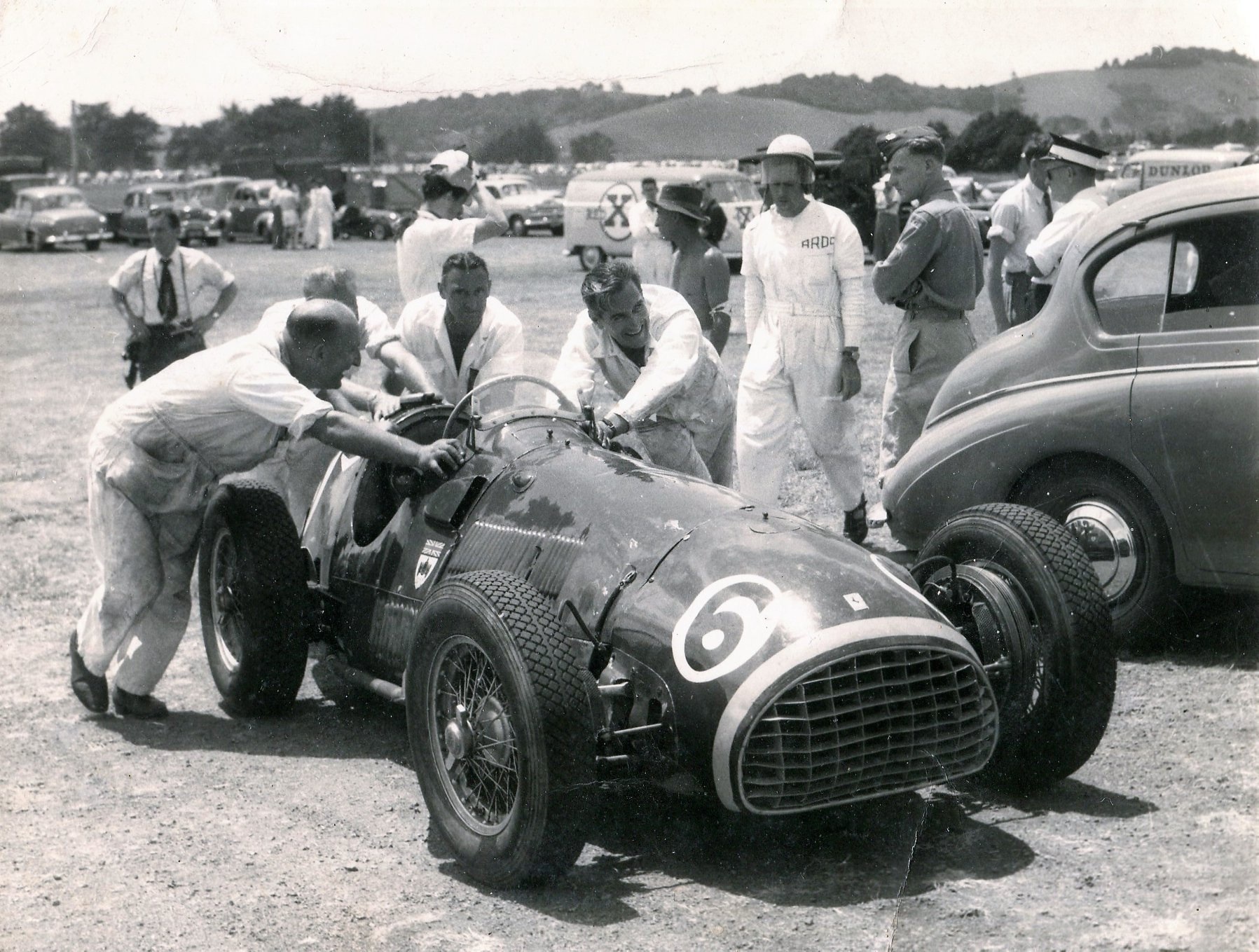
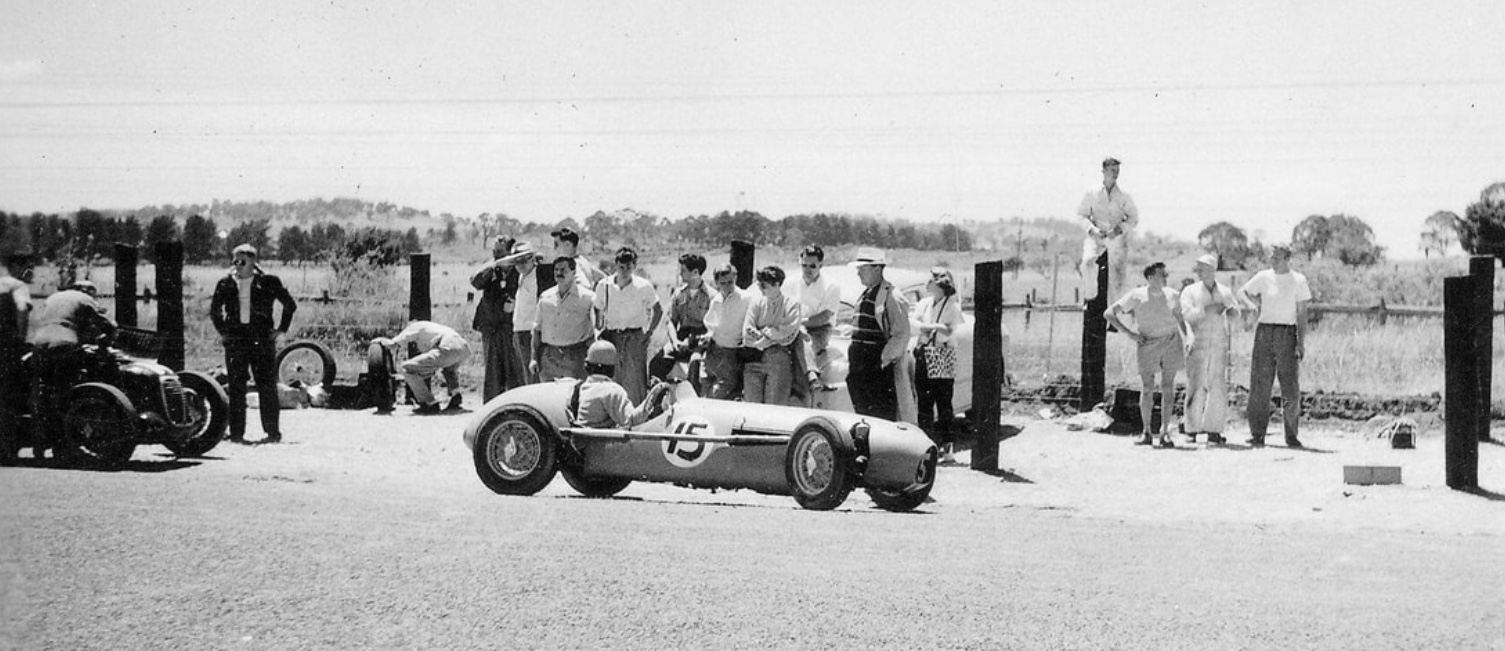
Dick Cobden’s Ferrari 125 being pushed through the Gnoo Blas paddock- that’s lanky, slim Jack Brabham with helmet on behind (F Pearse)
The natural or established order of Australian motor racing was shaken up and greatly changed by events over the summer of 1955…
The Ardmore, New Zealand Grand Prix in January was won by Prince Bira’s Maserati 250F from Peter Whitehead and Tony Gaze in their matching Ferrari 500/625 3 litre, four cylinder hybrids, Jack Brabham’s Cooper T23 Bristol and Reg Hunt’s new Maserati 250F engined A6GCM, fifth.
Other Australians who made the trip but failed to finish were Stan Coffey, Cooper T20 Bristol, Lex Davison, HWM Jaguar and Dick Cobden in the Ferrari 125 V12 s/c he acquired from Peter Whitehead after the NZ GP the year before.
Lex Davison being chased by Bira and Tony Gaze at Ardmore, 1955 NZ GP. HWM Jaguar, Maserati 250F and Ferrari 500/625 (thechicaneblog.com)
(CAN)
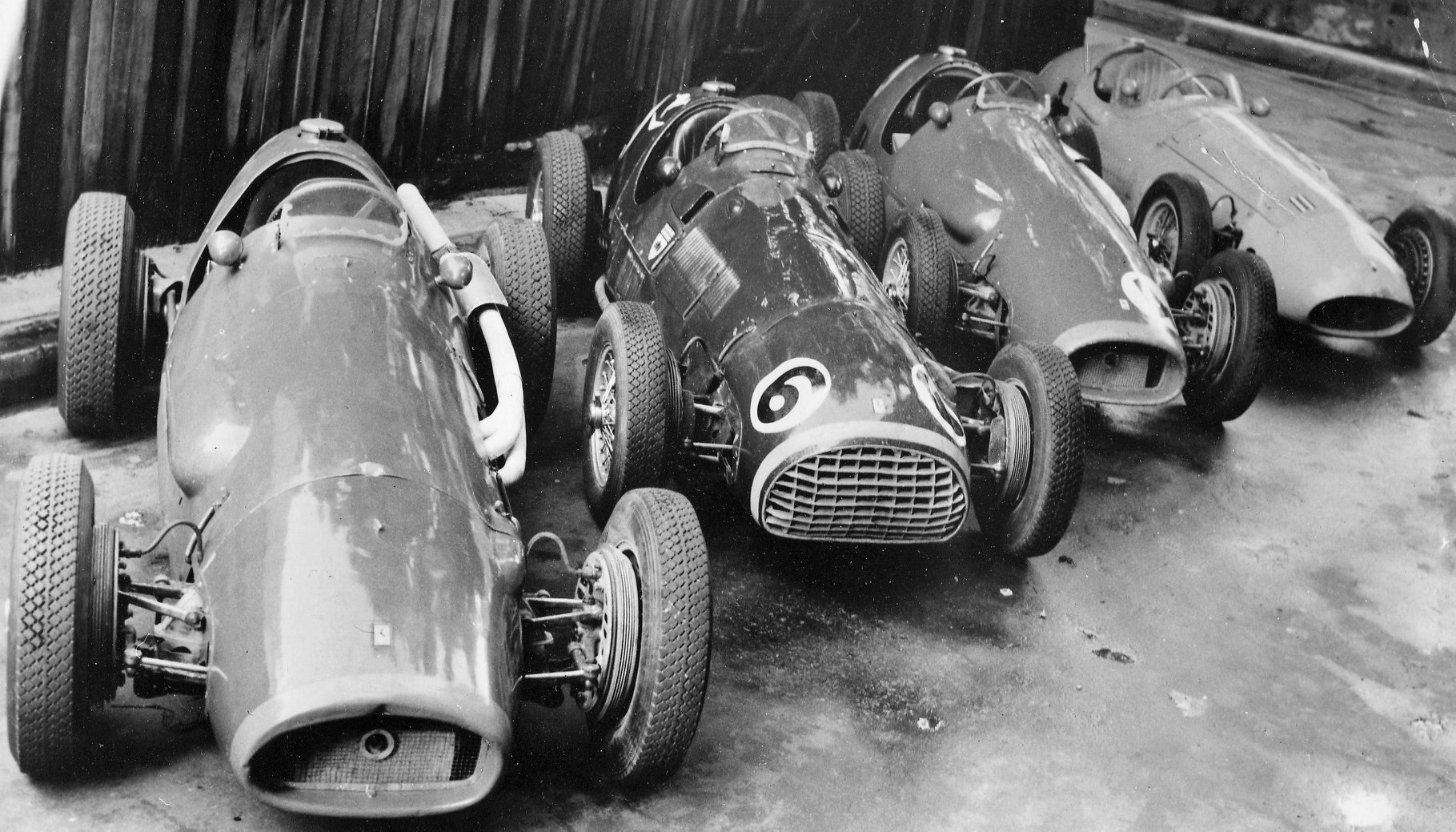
A group of the front running cars at Ardmore in ‘Phil Neill’s showroom a day or two before the race.’
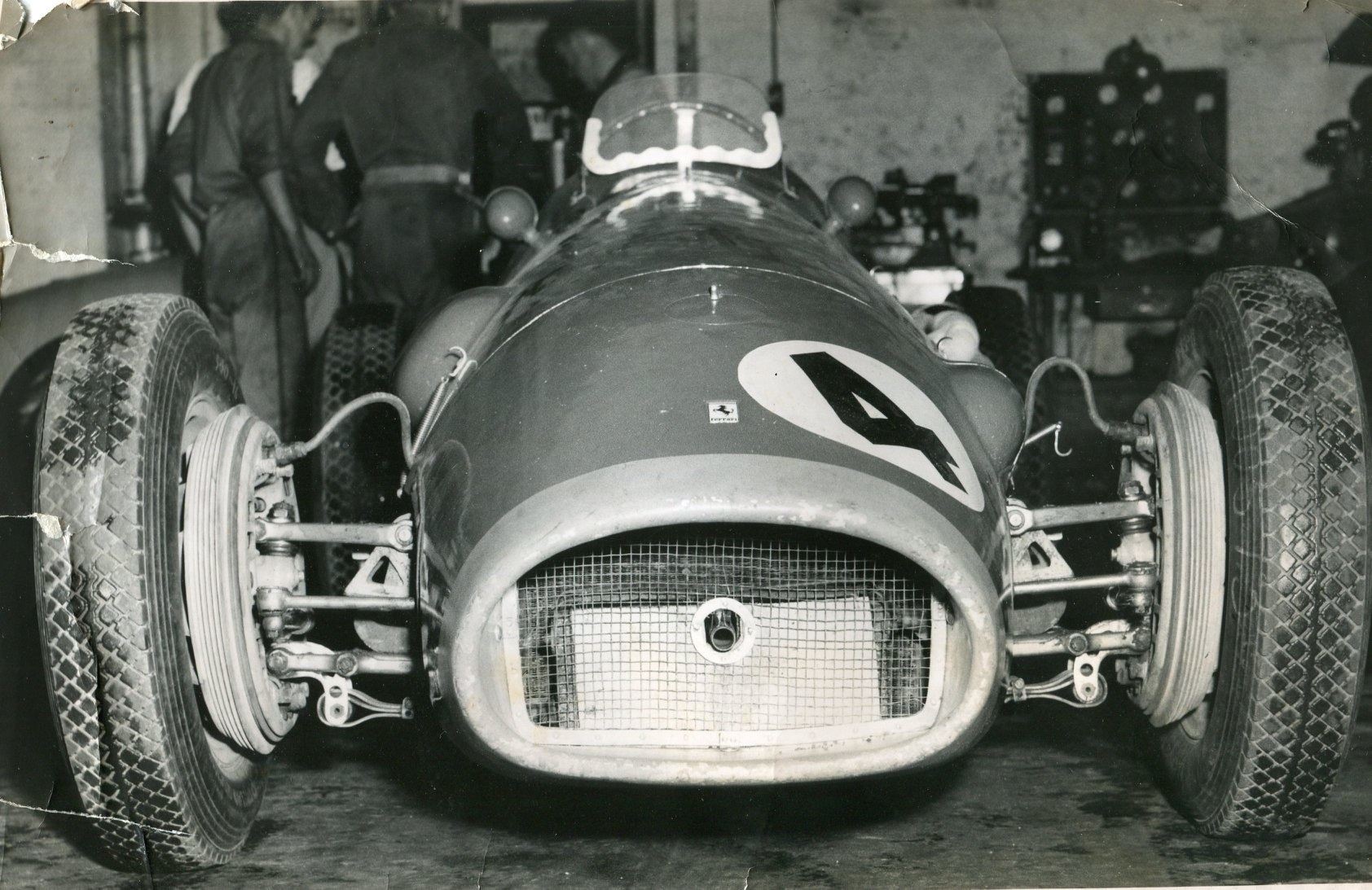
Bira’s 250F and Gaze Ferrari 500 in front with Whitehead’s #2 similar 500, #3 is Reg Hunt’s Maserati A6GCM, #77 Lex Davison’s HWM Jaguar, #9 George Palmer’s Mercury powered Palmer Spl, #6 Cobden’s Ferrari 125 and hidden, unfortunately, in the corner Bira’s ‘second-string’ Maserati 4CLT Osca V12 with a Ford Consul providing marvellous context!
Tony Gaze warms up his 3 litre Ferrari four with plenty of admiring Kiwis by the Dunedin wharves, Ferrari 500/625, January 1955. Reg Parnell’s Aston Martin DP155 is behind and then an Aston Martin DB3S (unattributed)
By the end of the Ardmore weekend, Brabham, buoyed by his speed and his mind filled with ambition, ideas of opportunity and success paid bonuses from trade suppliers in the UK by the visiting RAC’s Dean Delamont- had determined to sell his Cooper and chance his luck in the UK.
Dick Cobden, another of the fast-men in Australia- his dices with Brabham during 1954 had drawn fans to meetings from far and wide, also planned a racing holiday in England in between continuing his stockbroking career in a London brokers office.
‘He was accompanied by mechanic Fred Pearse and the fascinating, frustrating Ferrari (125), and enjoyed some mobile spectating…Cobden hoped to collect the D-Type he had ordered, but long delays led to him cancelling the order, and the overseas trip was effectively his farewell to motor racing’ Graham Howard wrote.
Fred Pearse attending to Cobden’s Ferrari 125 (F Pearse)
Pat Ratliff and Tony Gaze with Gaze’s Ferrari 500/625- the oh-so-famous ex-Alberto Ascari 1952 and 1953 World Championship winning chassis- one of the ‘winningest’ if not the most, GP cars ever (F Pearse)
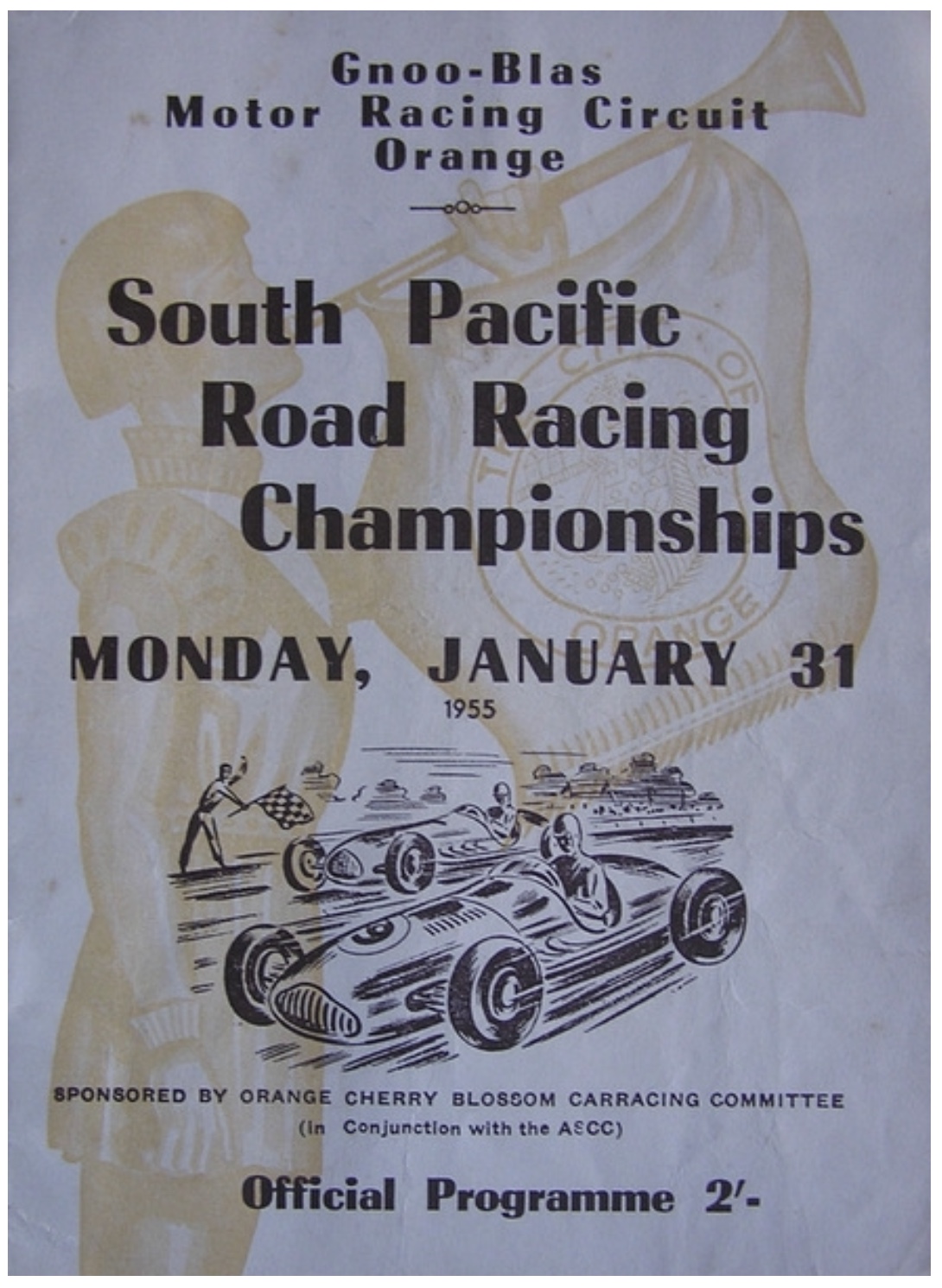
But first the travelling circus headed by sea to Sydney and then by road west to the Gnoo Blas road circuit at Orange for the ‘South Pacific Championship’ international held on 31 January. Bira, Whitehead and Gaze then planned to race their cars in South Africa.
Whilst Brabham and Cobden contested Gnoo Blas, Hunt and Davison, Lex the winner of the 1954 Southport AGP did not- Hunt was short of some critical parts for his A6GCM whilst Lex did not make the trip.
Hunt’s pace had always been apparent in Australia and in the year he raced a Cooper 500 in the UK and Europe- with the purchase of the A6GCM he vaulted over the top of everyone in Australia- the speed of car and driver was THE combination of 1955.
Whilst Lex’ HWM Jag was fast, it wasn’t fast enough nor, despite ongoing development was it sufficiently reliable, it did of course hold together at Southport some months before, the 1954 AGP win was the first of Lex’ four victories in Australia’s premier event.
Davison no doubt showed more than passing interest in his good mate Gaze’s Ferrari 500 in the early months of 1955- a purchase he would consummate later in the summer of 1955-1956 and as a consequence set the standard- along with the local 250F’s of Hunt and Jones and Ted Gray’s bellowing V8 Tornado 2 Ford/Chev in the coming years.
Gaze #4 and Whitehead Ferrari’s getting a tickle- car behind is Bira’s Maserati 250F and at the rear the Broadbent/Haig Hurst Bentley (F Pearse)
In Orange the ‘star cars’ were garaged in a workshop where several of these photographs were taken. The images by Fred Pearse, kindly circulated on social media by Peter Reynell who cared for Fred in his final years, take ones breath away.
Bob Pritchett makes mention in his AMS report of the race, of the OSCA being looked after at Lapham’s Garage in Orange, Mr Lapham was the Chairman of the Orange ‘Cherry Blossom Car Racing Committee’ which staged the event along with the Australian Sporting Car Club. Laphams is most likely the venue of the garage shots.
Tony Gaze Ferrari 500 (F Pearse)
Ratliff and Gaze (F Pearse)
Thirty-nine cars entered the 100 mile South Pacific Championship, there were also events for sport and touring cars, a purse of two-thousand five hundred pounds was offered for the feature race, very good money at the time.
The entry included Kiwis Fred Zambucka in the Maserati 8CM he raced in the ’54 AGP and John McMillan’s Alfa Romeo Tipo B- both pre-war machines which were at that stage a little too long in the tooth to be a threat, the race was a scratch event, even if, in a nod to the past, handicap placings would also be awarded.
Jack Murray, Allard Cadillac, Ted Gray aboard Tornado 1 Ford was fitted with the Lou Abrahams developed fuel injection setup for the first time. Tom Sulman had rebuilt his Maserati 4CM after a blow up at Gnoo Blas’ last meeting with parts flown specially from Italy to Sydney. Curly Brydon’s supercharged MG T single-seater special was one of the fastest in the country. Albury’s Jack Seaton entered a Maserati, Jack Robinson his Jaguar Special and Stan Jones had Maybach, a Cooper JAP and his Lancia GT entered- in the end Stan raced only the Lancia .
A special practice session was laid on before breakfast on the Sunday for the benefit of Bira, Gaze and Whitehead but it wasn’t of much benefit to the member of the Thai Royal Family when his Maserati 250F threw a rod after only 3 laps of practice, the car had done some miles in New Zealand, was rather tatty and overdue for a rebuild- this was the precursor to the tragedy which followed involving Iain Mountain and his very clever Mountain Peugeot Special the following day.
Practice itself started after breakfast and continued with breaks through until 5.30pm. No appearances were made by Hunt, Zambucka, Davison, the Jones Cooper 1100, James Barclay Special, the Moy MG Magnette Holden or the Peek MG Q Type.
Both Gordon Greig and Sydney’s Bill Reynolds appeared at the wheel of the Alfa Tipo B Alvis which Greig had only just acquired from Ash Marshall. Cobden’s Ferrari was spewing oil out of its breathers, Gaze’s had clutch and magneto problems and Bira’s crew had work to do on the exotic V12 OSCA’s oil scavenge pumps, so there would be no shortage of midnight oil poured in Lapham’s workshops.
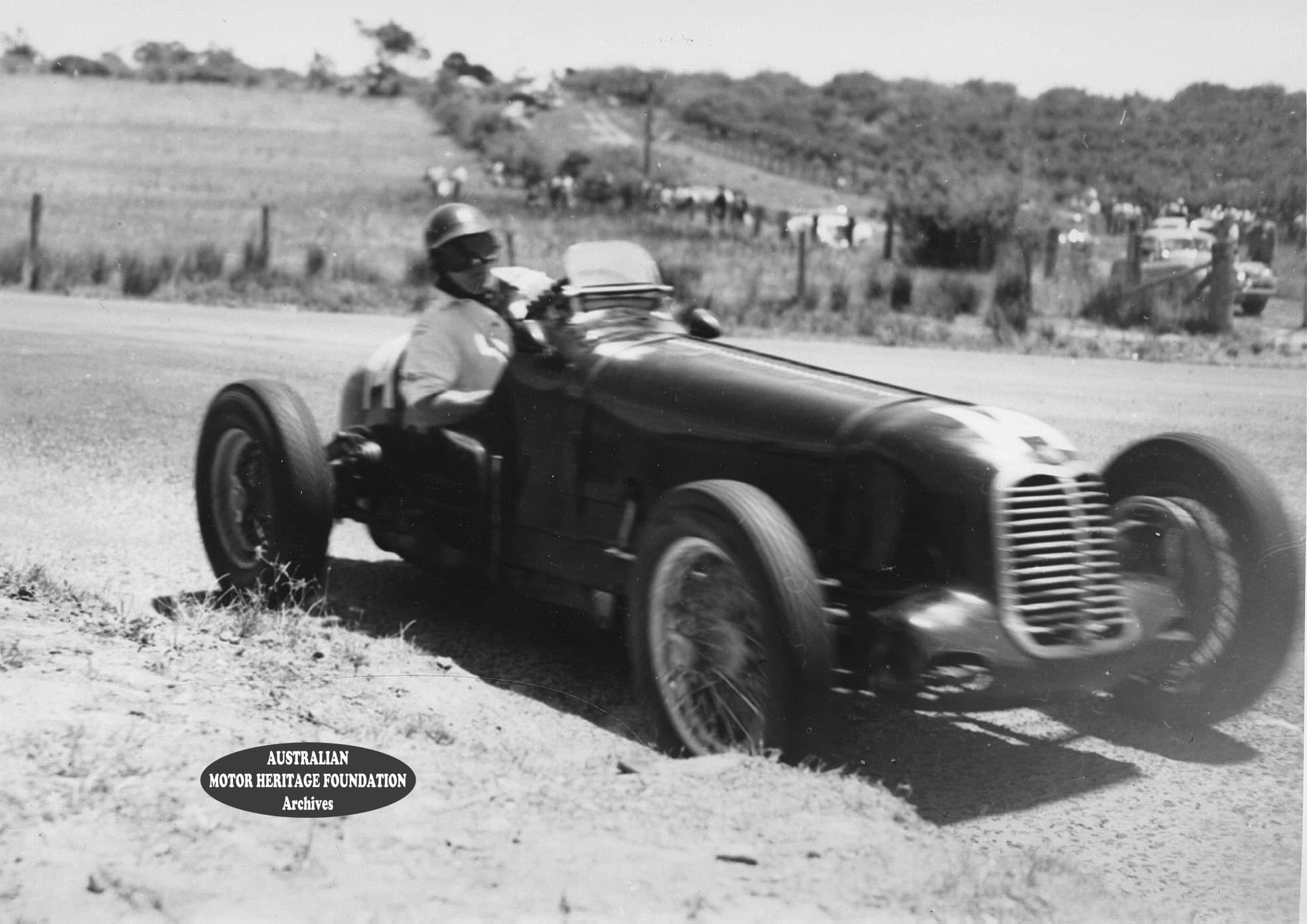
Alf Harvey, ex-Bira Maserati 4CLT Osca V12 aka Osca V12 from Dick Cobden’s Ferrari 125 at Gnoo Blas during the 1956 South Pacific Trophy – Can’t find a shot of Bira in the car the year before (Gnoo Blas)
The ill fated Ian Mountain aboard his neat Peugeot Special, Sulman’s Maserati behind (K Devine)
Brabham’s Cooper T23 Bristol
Raceday started at 10.20 am with the ‘KLG Handicap’ for closed cars under 1100cc won by R Long’s Fiat 1100. The 5 lapper for Sports and Closed cars was taken by Jack Myers Holden, was he the ‘King of The Holdens’ at that stage?
Bira’s spare car was his OSCA V12- a marriage of a 4.5 litre, circa 300 bhp OSCA V12 with his old Maserati 4CLT/48 chassis, as noted earlier his crew had been trying to adequately prepare the car the evening before the race.
In the preliminary 5 lap ‘Gnoo-Blas Handicap for Racing Cars’ event it too suffered a major mechanical failure- a scavenge pump, the motor dumped its oil all over the road with Iain Mountain, who was following closely, lost control on the oil, left the road and crashed through a barbed wire fence at Connaghans Corner killing himself and 26 year old Ballan, Victoria, spectator James Young. Several spectators were injured, two of them were admitted to hospital- all were standing in restricted areas.
The MotorSport account is the one above, the Australian Motor Sports report of the race attributes the accident to driver error ‘Ian had been cautious about the corner on which he came to grief and it could be that he was off line to avoid stones thrown up by Curly Brydon’s car, which he was chasing; Curly actually saw him behind, and slowed down, having discussed the corner with Ian and knowing how he felt about it…’
Whatever the case it was a tragic motor racing incident, the ‘lotsa-money superb preparation of car’ Bira days were long gone. Poor Mountain, 26, had only married four months prior to the 1954 AGP weekend at Southport and had only been racing the beautifully built car from its first appearance at Fishermans Bend in early 1954.
Jack Robinson’s Jaguar Special won the race in which Mountain died, the South Pacific Championship for Closed Cars and another similarly titled 14 lap 50 mile race were won by Les Cosh’ Aston Martin DB2 and Bill Kelly’s Jaguar XK120 respectively.
South Pacific Championship…
The main event was delayed by 50 minutes for obvious reasons, with some indecision about the grid- it was to be 4-3-4, then decided to be 3-2-3 given the narrow road and ended up being 3-2-4. What follows is a summary of the AMS race report.
As the flag quivered before dropping, Jack Murray shot his Allard Cadillac between Gaze and Whitehead and led the field out of sight of the hill crest; Gaze somehow managed to get his clutch operational enough for the getaway and almost as soon as the last sound of the last cars had died, Jack Brabham flashed past the pits, his Cooper Bristol a good fifty yards ahead of Whitehead’s Ferrari, then Murray, Gaze, Cobden, and MacMillan in close quarters.
Gaze was past Murray in the next lap, but Cobden’s Ferrari was smoking and retired after 2 laps at Muttons Corner with a cylinder full of water and a bent rod which was shades of the last Orange meeting.
Brabham (K Devine)
Murray, Allard Cadillac (K Devine)
Tom Sulman, Maserati 4CM
Brabham’s lead was shortlived, it was not many laps before Whitehead was past the Cooper Bristol- but he drew away slowly indeed and, on the fast sweep and slow right angle corner, Brabham was very visibly fastest of any car in the race, drifting the sweep beautifully with all four wheels leaning outwards, braking late and going through Muttons Corner as clean as a knife…
Gaze, hampered by not having a fully operational clutch and only one effective magneto, was not as happy as he could have been.
For some laps there was a good duel between MacMillan in the Alfa Tipo B and Greig in the Alfa Tipo B Alvis, the two red cars looking very impressive as they came around in close company. Jack Robinson and Joe Murray went at it for most of the race, the Jaguar just ahead until towards the finish when he stopped briefly at the pits and lost two laps.
Curly Brydon, always quick and neat, kept hard on Tom Sulman’s hammer, and Bill Wilcox went very well in his green Ford Special until it went bad over a space of 3 laps or so and he retired. Noel Barnes had the ex-Ron Ward MG Special sounding very sweet and healthy even though he was lapped several times by the faster cars.
Finally, the sun well down on the Western horizon, Peter came around grinning and without his crash hat and we knew the race was finished. As Brabham was less than a minute behind at the end he naturally won the handicap, Peter had fastest lap in 2:21.
Peter Whitehead Ferrari 500/625, won from Brabham, Cooper T23 Bristol, Gaze, Ferrari 500/625, Jack Murray Allard Cadillac, Tom Sulman Maserati, Curly Brydon MG Spl, G Greig Alfa Tipo B Alvis
Whitehead’s top speed was 149 mph, Gaze 147, Brabham 136, Sulman 110 and Brydon’s 115mph.
Cobden about to go out, Sulman readies his Maserati (K Devine)
One of the Ferrari 500s at Laphams (F Pearse)
Snippets by AMS’ Bob Pritchett…
‘The 3 litre motors of Gaze and Whitehead have a bore and stroke of 104 x 90 mm and the inlet valve is open for, wait for it, 330 degrees of the revolution…I saw Gaze’s motor stripped later; the valves are simply tremendous, and the pistons are like outsized salmon tins with bumps on them, rods like a short length of RSJ and the five bearing crankshaft a beautiful piece of work’.
Big Muvvas: Weber sand cast 58 DCO’s (F Pearse)
Hunt didn’t race but was present in person ‘…With no Maserati, marooned in Melbourne with a broken back plate. He tried to borrow one of Bira’s spares but received the rather discouraging reply, that he could have them all and the car for 4000 sterling. Slightly different to the Australian approach- Tony Gaze did the race with a magneto coil out of Cobden’s Ferrari for instance.’
Bira’s Maserati 250F (F Pearse)
‘I reaped some sort of macabre delight out of watching the Clerk of Course Daimler steaming around festooned with advertising matter during the wrangle about slogans on cars which resulted in Coffey’s dramatic retirement on the (start)line, masking tape all over Murray’s Allard Cadillac, funny little blobs of green paint on Brabham’s Cooper Bristol and such.’
Stan Coffey’s Cooper Bristol, after a stoush with CAMS about advertising he did not take the start, I see Clive Adams prepared the car. Cobden Ferrari 125 at rear (K Devine)
Etcetera…
(K Devine)
Jack Robinson being push-started in his Jag Special whilst alongside Tom Sulman fettles his Maserati, photo below of Robinson’s Jag XK engine.
(K Devine)
#2 Whitehead, Ferrari 500 #4 Gaze’s similar car and #1 Bira’s 250F (F Pearse)
Tom Sulman, Maserati 4CM
Bibliography…
MotorSport May 2006 article by Jim Scaysbrook, Australian Motor Sports February 1955 race report by Bob Pritchett
Photo Credits…
Fred Pearse Collection, Ken Devine Collection, Stephen Dalton Collection, Allan Dick’s ‘Classic Auto News’, Australian Motor Heritage Foundation, Russell Hawthorn, Doug Chivas Collection
(D Chivas)
Postscript…
Brabham left for the UK in mid-March 1955 after a function held at Jack’s parents home in Hurstville attended by over 100 guests including the Mayor and Mayoress- at that stage he was expected to be away for six months.
It turned out to be rather longer than that of course, the great Australian finally retired from Grand Prix racing at the end of 1970 having been a front runner that season inclusive of one GP win which but for poor luck should have been three- competive to the very end of his long career.
He couldn’t stay away from racing for too long though, by August 1971 he was back in the seat of the Jack Brabham Ford sponsored Bowin P4X Formula Ford and won the ‘Race of Champions’ at Calder from Frank Matich, Kevin Bartlett, Bib Stillwell, Alan Hamilton, Allan Moffat and others.
I think it was his last ever real ‘race win’, 1978 Sandown demo with JM Fangio duly noted?…
(R Hawthorn)
Tailpiece: Smorgasbord of ‘Big Red Cars’…
Whitehead, Cobden, Gaze and Bira, not that his 250F was red (F Pearse)
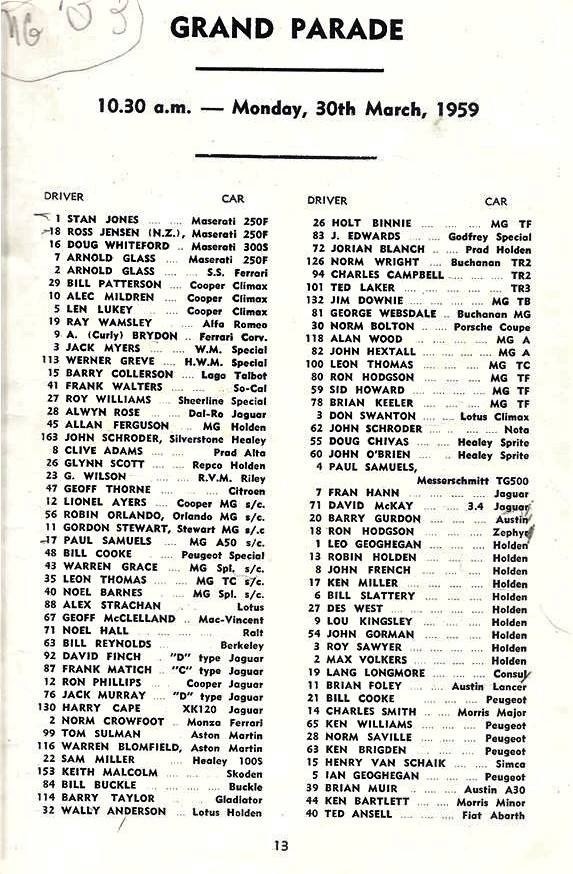
Leo Geoghegan’s Holden 48-215 from Frank Hamm’s Jaguar Mk5, Bathurst, Easter 1959…
I’m not sure if this is the parade lap described below or a race but the presence of the sportscar in amongst the touring cars suggests the former.
The stunning series of photographs are uber-rare ones from the inside of Conrod Straight, the cars have just cleared Forrests Elbow and are winding up in top gear. The kid standing on the fence is Rick Meyer, his father took these wonderful rare photos trackside, ‘locals’ photographs.
The Easter meeting was the Gold Star round traditionally- there are a huge number of past, current and future top liners or champions amongst the entry list. ‘Currents’ include Stan Jones, Doug Whiteford, Ross Jenson, Curley Brydon, Jack Myers, Jack Murray and David McKay. ‘Future stars’ are Len Lukey, Alec Mildren and Bill Patterson- Gold Star winners in 1959, 1960 and 1961 respectively, Lionel Ayers, Glynn Scott, Arnold Glass, Frank Matich, Ron Phillips, Ron Hodgson, Doug Chivas, Leo Geoghegan, John French, Des West, Max Volkers, Brian Foley, Ian Geoghegan, Brian Muir and ‘Ken’ Bartlett- no doubt Kevin Bartlett learned the value of clean, clear hand-writing on entry forms when he perused the race program at the circuit!
The photo below is from the same spot and shows reigning World Champ Jack Brabham on the 2 October 1960 weekend when the local boy returned to Australia having retained his F1 drivers title, to win the ‘Craven A International’ from a classy field of locals.
The Cooper T51 Climax leads the similar white-coloured machine of 1961 Australian Gold Star Champion, Bill Patterson. Patterson was second in the race with Bib Stillwell, also T51 equipped in third- he is probably that flash of red car behind Patto.
(R Meyer)
The photo below is again Geoghegan who is about to take, perhaps, Barry Gurdon’s Austin on the run down Conrod, or is it a Triumph Herald? By this stage Leo’s car is very quick and much modified- light weight, it has a Repco Hi-Power cylinder head and multiple SU carbs, is fitted with an MG TC gearbox, slippery diff and disc front brakes.
The introduction of the Australian Touring Car Championship from 1 January 1960 run to Appendix J regulations would reign-in the ‘costs out of hand’ development of touring cars without in any way constraining the appeal of tin-top racing to either spectators or owner-drivers.
(R Meyer)
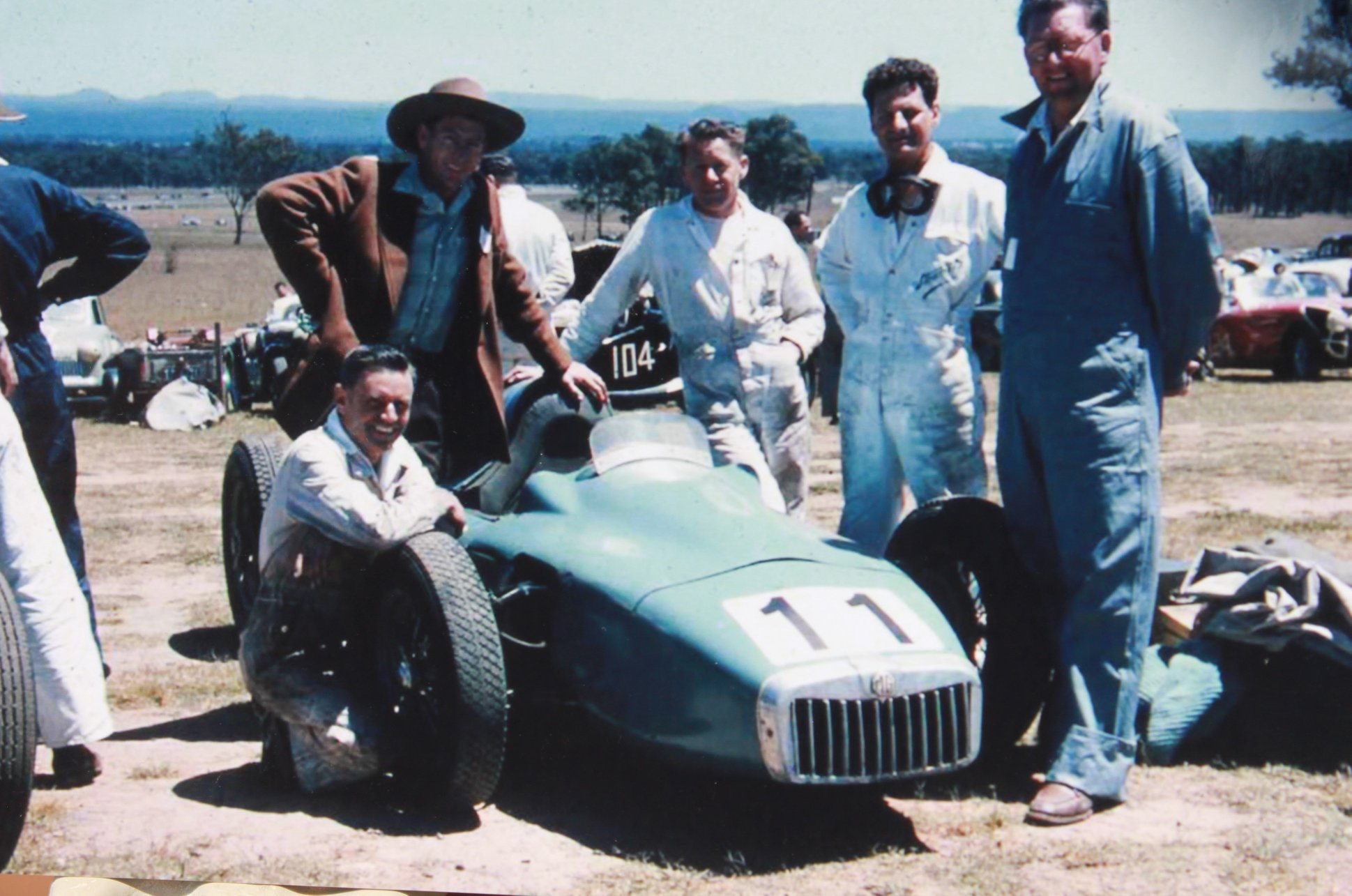
Beautiful picture of the Les Wheeler funded, Gordon Stewart designed and built Stewart MG…
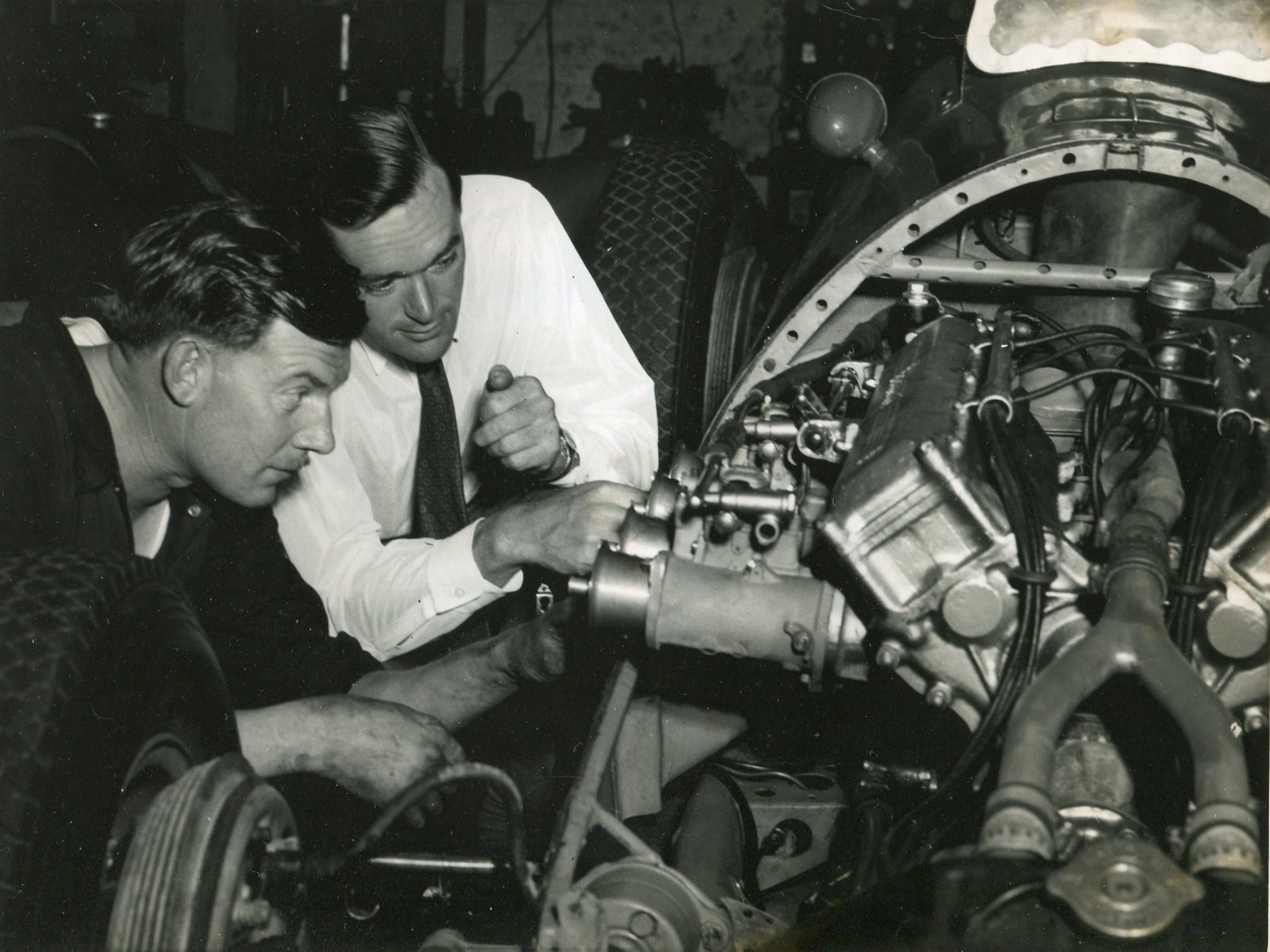
Believe it or not this very advanced car was concepted and constructed in the early fifties around a tubular steel spaceframe chassis, MG TC engine and brakes. With a Bob Baker built body, modified in the nose here, it first raced at Mount Druitt in 1955.
(R Meyer)
The engine was 1350cc in capacity and fitted with a Laystall crank and locally made rods. By the time the car appeared lots of serious stuff from Europe was racing locally so it missed the boat a bit as a potential ‘outright’ contender but its 1957 Gordon Stewart driven 142 mph made it the fastest TC speed ever over Bathurst’s Flying One-Eighth!
Here, Dick Willis says the car is supercharged ‘B-Series’ BMC powered, still with Gordon at the wheel. This car is extant and a wonderful feature article, such is its conceptual design and execution, for another time.
(D Willis)
A bit more from Dick Willis, here the Stewart MG crew- ‘Ecurie Cinque’ at Mount Druitt probably in 1958. ‘Jim Robson (at right) of Silverdale fame was a technical writer for Riley (Nuffield) before the war writing workshop manuals etc. After the war he emigrated to Australia and soon struck up a friendship with the like, Nuffield minded, Gordon Stewart- Jim was one of the team who developed the Stewart MG…’
Credits…
Rick Meyer, Dick Willis, Paul Newby
Tailpiece: Finish as we started, neighbour still with hands on hips and the obedient Rick still on and behind the fence!…
(R Meyer)
Cars are Horst Kwech’s RM Spyder (Buchanan body) and Tom Sulman’s Aston Martin DB3S during the Easter 1960 meeting.
Paul Newby explains that Horst Kwech built the RM Spyder whilst working at Regional Motors in Cooma- New South Wales sub-alpine country, hence the ‘RM’. It comprised a Buchanan bodied upside-down Singer chassis powered by a Repco Hi-Power headed Holden ‘Grey’ six-cylinder engine and still exists in Canberra.
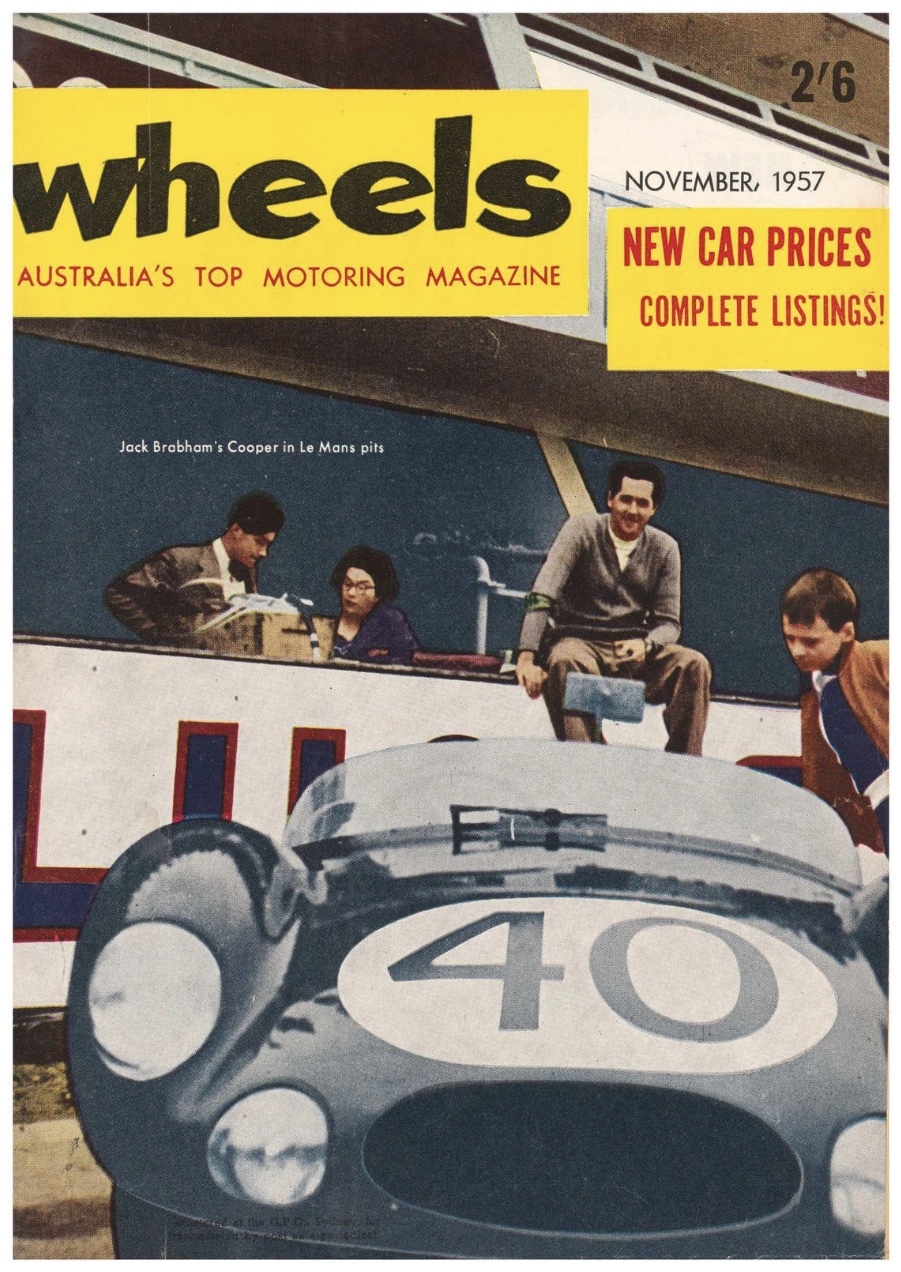
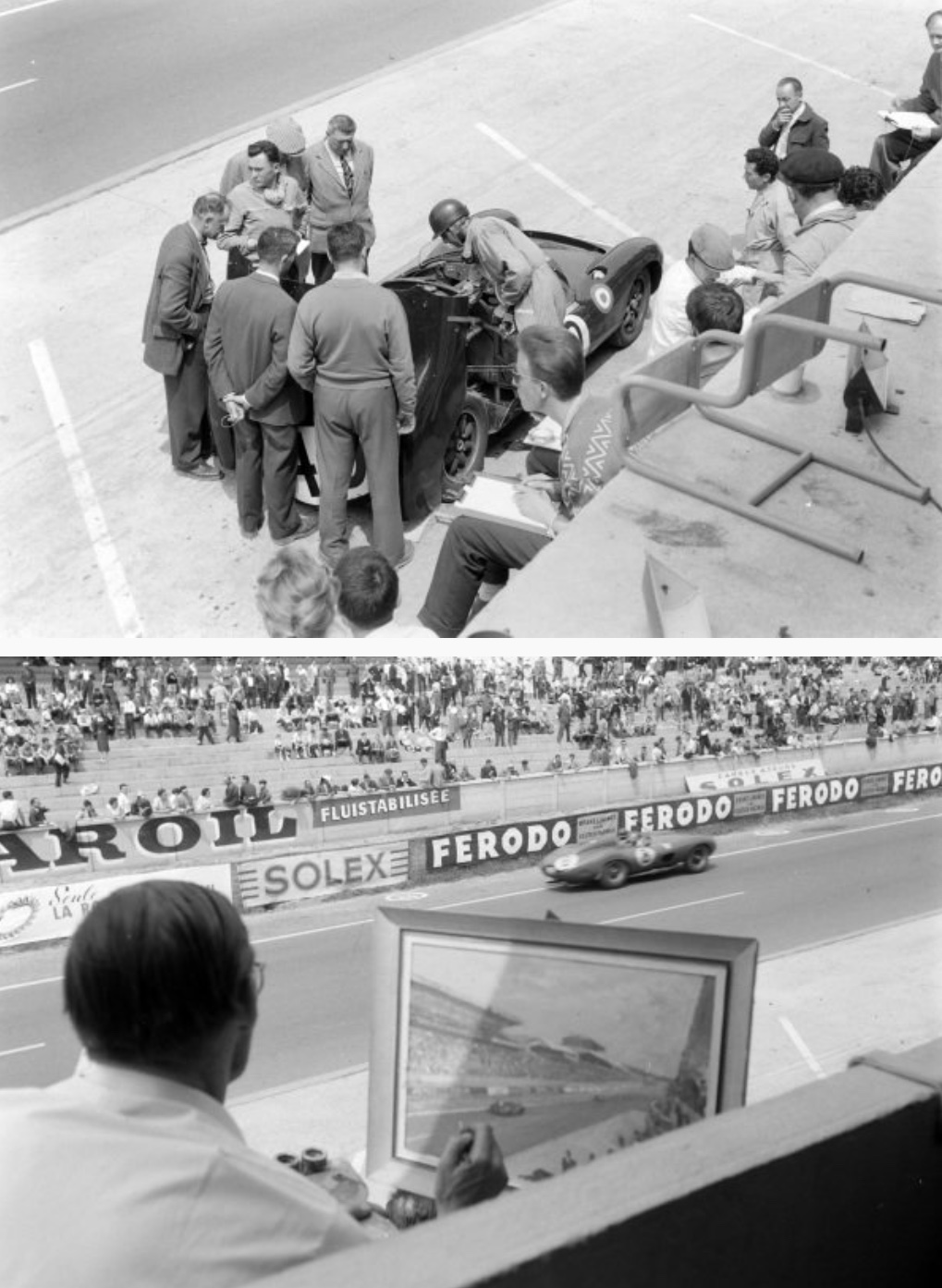
Jack Brabham’s first Le Mans 24 Hours was the 1957 running of the endurance classic during which he shared a Cooper T39 Climax with Englishman Ian Raby…
Whilst the Coventry Climax 1097cc FPF engined car was quick the duo finished fifteenth outright and third in their 1100cc class behind the similarly engined works Lotus 11 of the American duo Herbert Mackay-Fraser and Jay Chamberlain (ninth overall) and the Bob Walshaw/John Dalton Lotus 11 FPF (thirteenth overall).
Upfront it was a Jaguar D Type rout, the marvellous British six-cylinder beasts occupied the first four places with the Ron Flockhart/Ivor Bueb Ecurie Ecosse car at the head of the chasing pack- the new 3 litre short-stroke XK engine did the trick. Click here for an article in part about this race; https://primotipo.com/2015/01/17/le-mans-1957-d-type-jaguar-rout-ron-flockhart-racer-and-aviator/
Jack and Ian Raby with their Le Mans steed, what airport folks? (unattributed)
(Motorsport)
Jack has his hand up to his face, perhaps he is about to indicate to a low flying Jaguar or Ferrari that he wants the pass before the next corner.
The Cooper T39 ‘Bobtail’ was based on the Owen Maddocks’ contemporary 500cc design specifically to accept the new Coventry Climax FWA four cylinder, two valve, single overhead camshaft, twin SU fed 1100cc engine. Later the 1460cc Climax FWB was offered and still later sleeved down 1100cc versions of the 1.5 litre FPF twin-cam, two valve engine as used by Brabham and Raby here.
(Motorsport)
Here the eighth placed, first in 1500cc class, Ed Hugus/Carel de Beaufort Porsche 550A RS chases Brabham through the ever present sand banks awaiting the unwary or careless.
I’m cheating with this shot, it’s Le Mans but a year later- in 1958 Jack shared an Aston Martin DBR1/300 with Stirling Moss, never a good guy to share with at this event given his usual role as ‘the hare’.
The car, leading strongly at the time from the start was out after only 30 laps with a buggered conrod- Jack didn’t get a steer on raceday- Olivier Gendebien and Phil Hill won that year in a Ferrari 250 Testa Rossa 3 litre V12.
Shots of Jack actually in an Aston Martin DBR1/300 are thin on the ground- let’s make this one almost in…
Its Goodwood, the RAC Tourist Trophy in September 1958 in which he shared a car with Cooper teammmate Roy Salvadori to second place in the race won by Stirling Moss and Tony Brooks in a sister car with another DBR1 crewed by Carroll Shelby and Stuart Lewis-Evans in third place.
Winners are grinners, so too are finishers in this gruelling race- Ian Raby and Jack looking pretty happy and looking forward to a bath and a beer or a Beaujolais perhaps.
Etcetera…
(Motorsport)
Jack contemplates his Climax engine with plenty of support during practice whilst an artist sets to- the car passing is the #8 Lewis-Evans/Severi Ferrari 250 TR which swallowed a piston in practice and did not start. The pair raced a 315 Sport to fourth placed and as such were the best placed Ferrari and the only one of five Scuderia Ferrari entries to go the distance albeit 27 laps adrift of the winning Jag.
(Motorsport)
Brabham goes around the outside of one of the Lotus 11s early in the race. These ‘Bobtails’ started as central seat sportscars but as race organisers got a little antsy about that were also built with a seat either side of the centre of the car- as here.
(Motorsport)
Ian Raby…
Ian Raby on the hop, the Brighton garage owner/motor trader died after an accident in an F2 Brabham BT14 Ford Twin-cam at Zandvoort in 1967.
Raby is the type of bloke I admire- a racer to his core, he started in a Cooper Mk2 or Mk4 JAP as ‘chief cook and bottle washer’- driver, entrant, sponsor and mechanic of his little 500 and progressed to F1 as a privateer in exactly that manner. He used the moniker ‘Puddle Jumper’ on the side of some of his cars which reveals a good sense of humour and self- it is the way I described myself as a runner in my school cross-country days meaning I was an amateur compared to some of the more serious blokes.
After racing in sportscars, Formula Libre and Formula Junior he bought Keith Greene’s Grand Prix Gilby-BRM retiring from his World Championship debut race at Silverstone that year. He progressed to Brabham’s very first F1 car- BT3, by then BRM P56 V8 engined for 1964 finishing eleventh in the 1965 British GP at Brands- doubtless he was a proud man that day.
Raby, Cooper Mk8 Norton, Brands Hatch, Francis Beart Trophy, 4 September 1955- he won his heat but was unplaced in the final (500race.org)
The ‘Puddle Jumper’ Cooper T39 Climax in Denmark circa 1957, details appreciated (unattributed)
Formula 2 was a bit more cost-effective so Ian raced a Merlyn Mk9 Cosworth SCA sporadically in 1965 and a more competitive 1965 Brabham BT14 in 1966. Whilst not running right at the pointy end- it was a Brabham Honda year, and he was a regular Cosworth customer not up the front of the SCA queue- but he finished usually just behind the F1 pros and true ‘coming-men’- eighths at Oulton, eleventh at Goodwood and then a splendid fourth at the Nürburgring in April in front of Rindt, Peter Arundell and Kurt Ahrens- good company!
Rabu had an accident in the Brabham at Brands in October but repaired the car and fitted a Lotus-Ford Twin-cam for the first year of the 1.6 litre F2 in 1967 and slipped down the lists- sometimes he was the best of the twin-cams but they were giving away 20bhp or so at best to the dominant 210bhp FVAs.
Ian was eighth at Snetterton, thirteenth at Silverstone, sixteenth at the Nürburgring that year- far below his performance with a more competitive package the previous year. What shows in just skimming through the results is that he was a finished- he wasn’t the fastest bloke on track but he was consistent and brought the thing home- he could obviously prepare his cars well too.
Raby during the 1963 Silverstone British GP weekend, Gilby BRM, DNF gearbox from Q19- Clark won in a Lotus 25 Climax (unattributed)
Ian Raby, British GP, Brands Hatch 1964. Q17 and DNF undisclosed, Brabham BT3 BRM (unattributed)
In the Guards International Trophy meeting at Mallory he was sixth behind Surtees, Gardner, McLaren, Ickx and Allan Rollinson. Ninth in the Limborg GP in Belgium followed and then two appearances at Hockenheim for eighth in June and fifth in the F2 Championship round in July. At Tulln-Langenlebarn, Vienna he finished thirteenth and was a DNF at Jarama in late July.
After that weekend he towed his little Brabham to Holland for the 30 July Grand Prix of Zandvoort on 30 July. Whilst Jacky Ickx set about winning the race in Ken Tyrrell’s Matra MS5 FVA Ian left the road on lap 6 and went through the fence at the very fast Rob Slotemaker Esses, he was extracted from the badly damaged car with critical fractures to his head, back and legs and then seemed to be on the road to recovery before succumbing three months after the accident.
Ian Raby, born 22 September 1921, died on 7 November 1967 aged 46, a dedicated racer taken before his time.
Ian Raby, Brabham BT14 Ford twin-cam, Eiffelrennen, Nurburgring 1967
Credits…
Motorsport, F2 Index, Jornal Dos Classicos, 500 Owners Association, Harry Michelbach
Tailpiece…
(Motorsport)
Jack ranging up to pass the Monopole X88 Panhard Coupe- twentieth overall but not running at the finish- the little 750cc machine was crewed by two Pierres- Chancel and Flauhault.
Len Lukey’s Cooper Bristol, Mount Druitt, NSW, in May 1958, having set FTD at 13.53 sec for the standing quarter (J Ellacott)
‘Now that really is a beautiful looking racing car! Wotizzit I wonder’, the young gent seems to thinking…
The smartly attired chap is surveying the lines of Len Lukey’s Cooper T23 Bristol at Mount Druitt in Sydney’s west in May 1958. Len Lukey was both a champion driver and successful businessman, founding ‘Lukey Mufflers’ in the 1950s, a brand still respected today.
Melbourne-born, Lukey started racing relatively late, aged 32, having established and built Lukey Mufflers from its Nepean Highway, Highett base. Generations of enthusiasts are aware of his name because of the original equipment and performance exhausts and mufflers he produced. No lowered, worked EH Holden with wide chromies and twin SUs was complete without the distinctive Lukey logo being displayed on its exhausts for following traffic to know its performance intent.
Lukey started competition in the Victorian hills with a side-valve Ford Mainline Ute, Australia’s ubiquitous workhorse down the decades. It was in this car at the opening Altona meeting in 1954 that he frightened the life out of Stan Jones in Maybach when he spun whilst coming through The Esses, the car looking all the while as though it had lost its way transporting a load of mufflers from Highett to Williamstown. The competition regulator, the CAMS, frowned upon the use of such utilitarian vehicles in racing, so he switched to the first of a series of Ford Customlines.
Len Lukey, Ford Customline, Rob Roy, 1957 (B King)Equipe Lukey during the 1959 AGP weekend at Longford, Cooper T45 Climax: unknown, Neil Marsden, Helen Lukey, Claude Morton and Len Lukey (Jock Walkem)Awesome shot at the start of the 1959 AGP at Longford, showing not least how narrow the track was then. The old start line was on The Flying Mile towards Mountford Corner. Winner Stan Jones has the jump in his Maserati 250F, then Len, partially obscured in his Cooper T45 Climax, then Arnold Glass, Maserati 250F, Doug Whiteford, Maserati 300S, Ron Phillips, Cooper T33 Jaguar, Alec Mildren, Cooper T45 Climax and the rest (unattributed, I’d love to know the name of the photographer)
It’s interesting to review the stunning march of touring car domination of Australian motor racing and look at the role Len Lukey had in its rise. Australian Motor Sports had this to say in its January 1960 issue, ‘…there can be no doubt that by tuning these massive cars to the highest possible pitch, Len Lukey started the ball rolling towards the day when the term production car racing became such a farce that a special Gran Turismo Class had to be instituted’.
Lukey had some spectacular moments as he learned his craft, a trip through the hay bales at Albert Park and a lucky roll at Phillip Island, there was no rollover protection in those days, both were lucky escapes.
The car was timed at 106mph at Gnoo Blas, Orange in 1956, beating both Jack Myers and the Aldis Bristol. His dices against Jack Myers, the Sydney Holden driver, were crowd pleasers in the way Geoghegan/Beechey battles were a little further down the track.
He soon took hillclimb class records at Rob Roy, Hepburn Springs and Templestowe, all in Victoria.
Both Myers and Lukey progressed into single-seaters via Cooper Bristols. In Lukey’s case, his ascent to the top was quicker than just about any Gold Star winner, and then, he almost immediately upon achieving the prestigious award in the longest ever season, 12 rounds in five states, retired as a competitor but remained in the sport as a circuit owner and sponsor.
Team Lukey during the 1957 AGP weekend at Caversham- Customline and Cooper T23 Bristol (K Devine)
Lukey commenced racing the ex Reg Hunt/Kevin Neal Cooper Bristol in 1956…
He was ninth in the ‘Olympic’ Australian Grand Prix won by Stirling Moss at Albert Park in a works Maserati 250F.
In the 100-mile Victorian Trophy race he was fifth behind Davison’s Ferrari 500/625 3-litre, Brabham’s Cooper Climax, Doug Whiteford’s Maserati 300S and Tom Hawkes’ Cooper T23 Holden, it was an auspicious open-wheeler debut. He started a campaign to contest the Gold Star the following year- the first time the Australian Drivers Championship had been contested.
The season commenced at Caversham, 16km from Perth, held in searing heat and famously won, after much argument about lap-counting, by Davison’s Ferrari, which was shared by Lex and Bill Patterson. Len was fourth in a fast, reliable run in the Cooper. He was fifth at Albert Park and then late in the season scored two thirds in the New South Wales Road Racing Championships at Mount Panorama and in the Port Wakefield Trophy held at the South Australian circuit in rough bush country 100km north-west of Adelaide.
He set Australian National Speed Records in both the Cooper – 147.4mph and the Customline at 123.3mph – outside Coonabaraban in north-western NSW in 1957.
The Cusso was timed one way at 130mph, the car that weekend was festooned with masking tape, shields over its headlights, an enclosed radiator and sealed doors and boot to squeeze every bit of speed from the beast. Len had to enter the car through the windows; safety was again very much to the fore!
The car which ran at Coonabarabran was a new shell, but all the learnings and good bits of the earlier one were transferred across. Len raced it for a further year before being selling it to Melbourne driver Owen Bailey but it was badly damaged in an accident at Albert Park in 1958, Bailey’s first meeting in it.
On the way to winning the South Australian Trophy, Gold Star round at Port Wakefield in April 1958, Cooper T23 Bristol (unattributed)Lukey at Albert Park during the Melbourne GP in November 1958, Lukey Bristol, Jaguar Corner. ‘Vanwall-esque’ nature of the body clear if not as beautiful in execution (B King)Len Lukey is being congratulated by Derek Jolly for his second place in the October 1958 Victorian Road Racing Championship at Fishermans Bend. Lukey Bristol, Ted Gray won in Tornado 2 Chev (K Drage)
Its amazing to compare and contrast the short four or five round Gold Star contests of later years with the more arduous nature of the series earlier on, particularly given the standard of Australian highways then.
The 1958 award was contested over nine rounds, starting at Orange in New South Wales, from there to Fishermans Bend in Melbourne, then south across Bass Straight to Longford, to Port Wakefield north of Adelaide in South Australia, then two rounds at Lowood, Queensland, in June and August. So I guess depending upon other race commitments, one could leave your car up north, then to Mount Panorama, Bathurst in New South Wales for the Australian Grand Prix in October and then, finally, two rounds in Victoria- Albert Park in November and Phillip Island in early December.
The 1959 Gold Star was held over a staggering twelve rounds, and so it was that Len committed himself to a couple of serious tilts at the title in 1958-59, the lessons learned in 1958 were applied with great success the following year when he won the title.
Len was third in the opening South Pacific Championship round at Gnoo, Blas Orange in January, Jack Brabham won that event in his Cooper T43 Climax but was ineligible for Gold Star points as a non-resident.
Back home to Victoria, Len was fourth at Fishermans Bend in February and fifth in the Longford Trophy in March. Stan Jones won at the Bend and Ted Gray at Longford in the big, booming Chev Corvette 283cid V8-engined Tornado 2.
He scored his first splendid Gold star win in the South Australian Trophy at Port Wakefield in April, winning from Austin Miller’s Cooper T41 Climax and Keith Rilstone in the amazing Zephyr Special s/c.
Then followed a long haul back to Melbourne to ready the car and then a 1650km tow to Lowood Queensland for the two rounds held on the disused airfield circuit.
He bagged a pair of thirds in the Queensland Road Racing Championship at Lowood in June and the Lowood Trophy in August. Alec Mildren won both of these events in his Cooper T43 Climax, with Len looking lovingly and with considerable longing for one of these mid-engined cars, an aim he would realise before the year was out.
Lukey had developed his own thoughts on how to improve the performance of his Cooper and built a new spaceframe, high-bodied chassis, the ‘Lukey Bristol’, into which the mechanicals of the factory car were fitted.
Ready for the AGP, the car was taken to Bathurst but finished a distant sixth, two laps in arrears of Lex Davison, Ern Seeliger and Tom Hawkes aboard a 3-litre Ferrari 500/625, a 4.6-litre Maybach 4 Chev and a 2.3-litre Cooper T23 Holden-Repco, respectively.
The last two rounds of the championship were back in Victoria, he was fifth in the Melbourne Grand Prix, an exciting race weekend in which Stirling Moss and Jack Brabham scrapped at the front of the field in 2.2-litre Cooper T45 Climaxes, the race won by Moss from Brabham then Doug Whiteford’s Maserati 300S, Bib Stillwell’s ex-Hunt Maserati 250F and then Len.
Lukey was quickly in discussion with Brabham about the purchase of the Cooper T45, the very latest of Surbiton’s machines at the time, and would soon have the 2-litre Coventry Climax FPF-engined machine in his workshops, providing him with the tool to do the job in 1959.
Len was still active on the hills, winning both a new NSW sprint record and FTD at Mt Druitt in 13.53 seconds; this article’s opening photo is at that meeting. In July, he spun at the end of Rob Roy when the throttle jammed open. Len was thrown from the car before it rolled to a halt, but it was a lucky escape.
The final Gold Star event was the Phillip Island Trophy on Boxing Day but Len spun the Cooper in a preliminary event, damaging the car’s suspension enough to non-start the championship race. The Coad brothers sportingly lent him their Vauxhall Special but the car was outclassed, with Lukey third in the Gold Star with 21 points, then Alec Mildren on 23 with Stan Jones deservedly taking the title with 31 points. Stan won two rounds at Fishermans Bend and Phillip Island and was third on three occasions- Gnoo Blas, Longford and the first of the two Lowood rounds.
The Lukey boys push the Cooper T23 Bristol thru the Longford paddock in March 1958, behind is the Lou Abrahams owned, mighty Tornado 2 Chev, victorious that weekend (HRCCTas)Len and Stan Jones on the cover of the March 1959 issue of AMS in recognition of a marvellous AGP dice resolved in Jones’ favour 1959- Cooper T45 Climax from Maserati 250F
After Brabham contested three New Zealand internationals in early January 1959, Lukey bought the car from Jack. It was fitted with a 2-litre FPF rather than one of the 2.2s Jack had been using. These engines were rare with the full 2.5-litre variants built around new blocks being readied back in Coventry for Cooper, Rob Walker and Lotus’ use in F1 that season – rather successfully so as events transpired.
In 1959, as mentioned above, the Gold Star was contested over 12 gruelling rounds, between 26 January and 14 June, the halfway mark of the season, those on the title chase travelled from their home base, to Orange, then Fishermans Bend, Longford, Port Wakefield, Bathurst and Lowood – Victoria, Tasmania, New South Wales and Queensland, with an arduous second half of the season still to come.
The competition was strong, Len and Alec Mildren raced Cooper T45s, Bill Patterson a T43 with Stan Jones the other racer who had committed to most of the rounds, racing his Maserati 250F, Maybach 4 Chev and later in the season he took delivery of a Cooper T51 Climax as did Bib Stillwell, David McKay and Austin Miller but the latter trio did not race across the continent in the manner Len, Alec and Stan did.
In much the same way that the new-fangled Coopers were challenging the front-engined orthodoxy in Europe, so too, of course, was the case in Australia, albeit there was no surprise at the speed of the Coventry Climax-engined cars, given the giant-killing nature of the air-cooled Coopers since the first appearance of one at Bathurst in the dawn of the 1950s.
Only two points separated the Cooper T45 Climax duo of Lukey and Mildren at the seasons end – Len won the title with 68 points to the Canberra motor-dealers’ 66.
Mildren won three rounds, Fishermans Bend and the two Lowood rounds mid-season, whereas Len won two- at Caversham and the last round at Phillip Island when the pressure was well and truly on. The Cooper’s differential failed during Saturday practice. Len did not have a spare; Noel Hall did, but it was affixed to his car, which was in Sydney. Jack Myers removed the gearbox and popped it onto a plane, the precious cargo was collected from Essendon Airport and then taken to Phillip Island where it was fitted to the car. The machine was finally ready about an hour before the off. Lukey led from the flag and on the final lap equalled the lap record, a memorable win indeed.
Alan Jones quizzing Lukey about the handling characteristics of his Cooper. Otto Stone, racer/engineer/mechanic and fettler of the Stan Jones Maserati 250F at the time, is to the right of Alan, and Stan is at the far right but one in the white helmet ready for the off, Phillip Island 1959 (unattributed)Lukey and Jones scrapping through Longford Village, AGP 1959, pub corner. Cooper T45 and Maserati 250F (oldracephotos.com)
Stan Jones won two rounds as well, notably the Australian Grand Prix at Longford after a race-long dice with Len. It was a classic battle of the time between the powerful front-engined 2.5-litre Maserati and the more nimble, but less powerful 2-litre Climax-powered Cooper. There was a bit a karma in Stan’s race win as no-one in the field, other than Mildren, deserved an AGP win more and Alec’s time came twelve months afterwards after an even more thrilling dice between Lex Davison’s 3-litre Aston Martin DBR4/300 and Mildren’s 2.5-litre Cooper T51 Maserati at Lowood.
Jones also won at Port Wakefield in March in the big, booming Maybach 4 Chev, stepping back into the car he vacated two years before when he acquired his Maserati 250F. His friend and engineer, Ern Seeliger had replaced the SOHC straight-six Maybach engine with a Chevy V8, and made other changes to what had been called Maybach 3. There was something a bit poetic about a Maybach taking one last win this late in the piece, given the front-running nature of this series (of three or four variants of cars, depending on how yer do your count) of cars for the best part of a decade.
Bill Patterson, like Mildren and Jones had a very long race CV which he enhanced in 1959 with two wins in his Cooper T43 Climax – arguably a quicker driver than Mildren and Lukey, if not Jones – Patto was also in a run to Gold Star victory, his turn would come in 1961 aboard a Cooper T51 Climax the year after Mildren.
Single round wins that year were taken by Jack Brabham, taking his traditional win at the season opening Gnoo Blas South Pacific Championship before heading back to the UK and by Kiwi Ross Jensen’s Maserati 250F in the prestigious Bathurst 100 at Easter, but neither qualified for Gold Star points as non-residents.
Bib Stillwell was the other round winner in his new Cooper T51 Climax at Bathurst in October. Bib was perhaps the slowest of all of this generation to mature as a driver at the absolute top level but he won four Gold Stars on the trot from 1962 to 1965 with a blend of speed, consistency and the best of equipment.
What was impressive about Lukey’s ’59 win was his relative inexperience against the fellows he beat, all of whom had fifteen years to a couple of decades on him in race experience, but it was a close-run contest. That year, a driver could only count their scores from nine of the twelve rounds. Len and Alec scored in ten rounds apiece; both had to drop a round – both discarded three points, and so it was after a long, intense year of racing criss-crossing the vast brown land that Lukey won from Mildren by only two points. Amazing, really, but the CAMS learned the lesson and the event was never held with that many rounds again.
Lukey only raced once more, in the 1960 NZGP at Ardmore and then sold the car to concentrate on his business interests.
It was a good performance too, seventh on the grid amongst all of the 2.2 and 2.5 litre FPFs but it all came to nothing after undisclosed dramas after finishing 36 of the events 75 laps. Brabham won from McLaren, Stillwell and Jones – two Cooper 2.5s from two Cooper 2.2s rather put the state of play at the time into sharp relief.
No photoshop here, Jones and Lukey during their 1959 Longford AGP dice getting some serious air as they cross the railway line on the outskirts of Longford village on Tannery Straight (C Rice)Left to right, Lukey and Mildren in Cooper T45 Climaxes and Bib Stillwell in his new T51 at Caversham in October 1959- Len took the win (K Devine)(B King)
Whilst Lukey retired from competition to focus on his business, he remained a friend of motor racing until his untimely death in 1978…
He provided financial support to various competitors, not least Jack Brabham. The works F1 Brabhams of the 1960s used Lukey exhaust systems right into the 1966-67 championship-winning Brabham BT19 620 and BT24 740, all of the works F1 cars were fitted with Lukey exhaust systems.
Look closely at the rear of one of the Brabham BT24 Repco 740s during the 1967 GP season in the photograph below, and you can see the Lukey Mufflers made exhausts on the car, and the company name on the chrome-plated exhaust endpieces.
In 1962 Len acquired a Holman Moody built Ford Galaxie ‘R Code’ 406cid four-door which was raced initially by Lex Davison, Len no doubt encouraging his purist racing car friend in the direction of the ‘dark side’. The shot below is of Norm Beechey racing the machine against Max Volkers’ Cortina at Lowood in August 1964, I wonder who got the better of this encounter in the wet? The Galaxie still exists.
(B Thomas)Brabham BT24 Repco during the 1967 season (unattributed)
The 1962 Armstrong 500 (miles) production car race resulted in extreme circuit damage to the Phillip Island track. The Phillip Island Auto Racing Club (PIARC) could not afford to repair the bitumen out of meagre club funds, and as a consequence, the track sat idle for two years.
During the initial track fund raising a decade before, Repco and Olympic Tyres supported bank guarantees for PIARC to a value of £17,000. Without funds to service the loan, no race meetings and therefore no income, Repco and PIARC made the regretful decision to sell The Island property.
Shortly thereafter Lukey was chatting to racer/enthusiast George Coad at Essendon Airport whilst awaiting a plane. Upon learning from Coad that PIARC was forced to sell the facility, Lukey immediately rang the clubs President and offered to buy it for £13,000.
As part of the deal, Len imposed a condition on the club that racing be revived. Lukey would develop the property and PIARC re-build the track and facilities and run four events a year for ten years. Lukey had a passion for the island and the circuit but also knew what it would take to revive and run the place having been a PIARC committee member some years before. PIARC paid Len $2 per year in rent.
The first public race meeting was held three years later in September 1967. The circuit was sold again after Lukey’s death and is now the wonderful facility we all know and love, without Lukey’s timely investment it would not be there today.
The Lukey brand hasn’t been in family hands for decades but lives on as a wonderful reminder of its founder, a great driver of both touring cars and single-seaters, a lifelong enthusiast and supporter of the sport.
Love this shot of the Cooper T23 Bristol during the 1956 AGP weekend at Albert Park, the machine is getting plenty of attention. Finned drum brakes and top transverse leaf springs, front and rear, clear (G Smedley)
These big barges occupy a lot of real estate and did no harm at all to attract the punters. Touring cars were on the rise, sadly, even in 1956. Len Lukey from Norm Beechey in Ford Customlines during the 1956 AGP carnival. Is the Holden 48-215 on the right front below that of Jack Myers?
(unattributed)
Cooper T23 Bristol..
(unattributed)(B King)
Lukey’s Cooper T23 Bristol blasts past the Army Barracks at Albert Park during the 1956 AGP, and below the cockpit of the immaculately prepared Cooper at Templestowe Hillclimb in Melbourne’s east.
(B King)
Doug Nye wrote the history of the 1953-built Cooper Mk2 Bristol chassis on The Nostalgia Forum in 2003. Nye lists ’11 (ish) to 12 (ish) chassis. The Lukey car is ostensibly ‘CB/9/53’.
‘1953 ‘5’ The Tom Cole Mk2 – in effect totally destroyed in fire at Syracuse
1953 ‘5B’ The Tom Cole Mark 2 rebuilt as above around a fresh frame, driven by Swaters, Cole, Graham Whitehead – to Dick Gibson – sold to Australia, probably Reg Hunt. (Reg Hunt’s Mark 2- alleged sold NEW in 1954) for Kevin Neale in Australia – to Len Lukey – Frank Coad – Eddie Clay – Ken Cox – Peter Menere – Jumbo Goddard, and to Tom Wheatcroft for The Donington Collection. But this was surely in reality the ex-Tom Cole second Mark 2 of 1953…ex-Gibson’ Nye wrote.
(B King)
Gardening at Templestowe circa 1958, no harm done by the look of it.
(A Lamont)
It would have been a wild ride around Longford, mind you, the forgiving nature of the Cooper Bristol chassis would have made it slightly less challenging than some other cars of the day.
This wonderful shot is during the 1958 Gold Star meeting in March, the first ‘national’ Longford meeting won by Ted Gray in Tornado 2 Chev.
(unattributed)
Len at Albert Park, guessing 1957, who and what is that behind him?
(B King)
Lukey Bristol...
(unattributed)
Lukey heads up the Mountain, Mount Panorama, during the 1958 Australian Grand Prix in October. He was well and truly outgunned in his new Lukey Bristol, which had made its race debut at the previous Lowood Gold Star round, on a circuit that rewards power and a forgiving chassis.
The Lukey Bristol was an evolution of the factory product, but lighter with a chassis designed by Lukey. It had a more enveloping body, clearly influenced by Frank Costin’s Vanwall design, and used castings made and machined in Melbourne. The engine from his Cooper Bristol was used; the new machine also had a transverse leaf rear end like the original.
It was advertised for sale in this form, as were the various components and fibreglass body panels. Bob King believes three of the chassis were built: the Lukey Bristol, Faux Pas and a third. Both cars mentioned are in the hands of David Reid.
(Miller Family)
The photograph above and below are of the construction of the Lukey Bristol at right, with the Cooper T23 at left denuded of its constituent parts, at the Lukey factory in the Nepean Highway.
Note the rifle on the wall to scare off late night intruders, ‘chicky-babe’ calendars on the wall and robust spaceframe chassis, who the artisans are would be great to know.
Things have progressed in the shot below with a rear suspension corner, straight off the T23 soon to be bolted on, transverse top leaf spring carried over, the chassis clearly lower and wider than the original.
(Miller Family)(B King)
The page above is included for the section about the ‘Lukey Mufflers Chassis’ and related components. I was going to crop and then thought, let’s all read it and weep – Frank Shuter’s Maserati 8CM will do me!
The ad makes mention of both front and mid-engined chassis availability, the former were of the type used on the Lukey Bristol, the latter built off a jig created from the Cooper T45 chassis. One of the Cooper experts will be able to hazard a guess as to how many chassis were built using this jig, it was not the only T45/T51 jig in Australia, either!
(B King)
Len Lukey, Lukey Bristol chase Bib Stillwell’si 250F during the 1958 Melbourne Grand Prix; they were fourth and fifth, ex-Hunt Maserati respectively. Stirling Moss won the race in a Rob Walker Cooper T45 Climax from Brabham’s similar car – the chassis bought by Len at the end of the summer, and Doug Whiteford’s Maserati 300S. Look at the lean of the heads into the corner and the relative roll of the Lukey Bristol compared with the Maserati.
(unattributed)
Winning at Part Wakefield in the Cooper Bristol in 1958 and contesting the 1958 AGP at Bathurst the same year, he was sixth. The #56 car behind is Bill Reynolds in the Orlando MG Spl 1.5 – Murrays Corner.
(B King)
More Australian Motor Sports, this time incorporating the ad for the sale of the Lukey Bristol.
Cooper T45 Climax...
(G McNeill)(unattributed)
Lukey rounds Stonyfell Corner, Port Wakefield, South Australia, in the 1959 Gold Star round- Cooper T45 Climax. The shot below was taken during the Fishermans Bend Gold Star round in early 1959.
(unattributed)
Information about this car is a bit opaque, like so many Coopers of the period, but the story goes something like this. Chassis T45 F2-10-58 was believed to be a factory machine raced by Jack Brabham until it was damaged at the 1958 Moroccan Grand Prix.
It was acquired by Jack after being rebuilt around a new frame, brought to Australia and raced to second place behind Stirling Moss’ similar Rob Walker owned car in the 1958 Melbourne Grand Prix at Albert Park, the last race meeting held at the celebrated circuit in its first iteration as a motor racing venue.
Jack then took it to New Zealand to contest the 10 January Ardmore NZ GP, again finishing second behind the Walker/Moss T45. He was second at Wigram and third at Teretonga behind Ron Flockhart, BRM P25 and Bruce McLaren’s Cooper T45 Climax and then headed back to Europe, Len acquired the car at this point.
The car was then bought by Melbourne’s Jon Leighton, who raced it successfully for a couple of years, albeit the competition got pretty tough with so many 2.2 and 2.5-litre FPF engine T51 Coopers on the scene.
It passed into the hands of Melbourne Architect Richard Berryman, then later to Len Lukey’s widow, the car was an attraction at the Phillip Island museum for many years during the long period the Lukeys owned the track, and was occasionally raced by Keith Lukey, Len’s son.
Robert Shannon, founder of the insurance business well known in Australia was the right kind of owner sensitive to the car and it’s importance. I recall speaking to him about it during Melbourne City Chamber of Commerce meetings on several occasions.
After Robert’s sudden death by heart attack, Ron Walker, ‘father’ of the Albert Park Australian GPs of today, owned it, did nothing with it, and then rather blotted his local copybook by selling it via Bonhams in the UK. It would have been rather nice if the Cooper, with such a significant Australian history, had been advertised locally and stayed here.
Do contact me if you can assist in filling the gaps.
Cooper T23 Bristol Today…
In June-July 2025 Guy and Harry Plante – father and son – custodians of the ex-Lukey Cooper T23 got in touch with the following information and photographs.
‘The Cooper Bristol was purchased by me (Guy Cape) in 2014 in the UK from Bob Gilbert, who bought it from the Tom Wheatcroft Museum. TW was friendly with a gentleman called Jumbo Goddard, a Bentley man who lived in Sydney, who sourced the car for him in Australia to then put in his UK museum.
(G Plante Collection)
When I bought the car, it was painted in Aussie colours, yellow and green ( I have pictures). Having researched its previous life before going to Australia I learned that the first owner was Tom Cole, a British – American racing driver, who, with his parents moved to the US the day before WW2 broke out. Cole raced a Cadillac-Allard J2 with the marque founder Sydney Allard, Cooper T23s and later a Ferrari 340MM in which he was later killed at Maison Blanche in Le Mans.
I returned the car to Cole’s Atlantic Stable racing team colours whilst keeping it as original as possible.
I still race it today with the Historic Grand Prix Association and have entered the Monaco Historique Grand Prix with it three times. Last year, I won the class with an overall 9th position out of 24 entries, beating my previous best of 14th position.
(G Plante Collection)(G Plante Collection)
A few years back HGPCA drivers were invited to race in Australia. We did so at Philip Island where I was amazed to see so much history and memorabilia in the circuit’s museum. I told the lady in the museum that I know owned the car which she said ‘you can’t do it’s in a museum in the UK!’ She was very good friends with Keith and Lyn Lukey whom she telephoned to say some English nutter reckons he owns his dad’s car. We all met up, they came to watch me race and two weeks later we had a demonstration race before the F1 Grand Prix at Albert Park.
I was overseas at the time in 2024, but the car was also driven by my friend Will Nuthall at Goodwood Members’ Meeting, where it came first, winning the Parnell Cup (see some tremendous footage online).
I am 63 years old but have no intention of retiring from racing or ever selling this most wonderful car – it will be Harry’s turn next! I hope you find the above interesting – Harry has started the continuation of this fabulous part of motoring history.’
(G Plante Collection)
Credits and references…
John Ellacott, Kevin Drage, Ken Devine Collection, Bob King Collection- Spencer Wills photographer, ‘History of The Australian Grand Prix’ Graham Howard and others, Doug Nye on ‘The Nostalgia Forum’, oldracingcars.com, Wikipedia, Jock Walkem, Charles Rice, Geoff Smedley, Andrew ‘Slim’ Lamont, Greg McNeill, Austin Miller Family Collection, Guy and Harry Plante. Special thanks to Bob King for some wonderful photographs and tidbits from his AMS collection,
Tailpieces: Lukey with Cooper T23 Bristol sans bodywork, Templestowe circa 1958…
My theory is that there are only a relatively small number of ‘T-Intersections of Life’ decisions which are key in determining the paths which follow…
Its interesting to read Tony Davis’ biography (with Akos Armont who has directed the accompanying documentary due in cinemas early next year) of Jack and pick what those may be.
Johnny Schonberg’s wife and her pressure on him to give up racing in 1948 gave Jack his start- that it was a speedway car meant Brabham both got a taste of competition and also entered the sport in Australia at its professional end- that is he quickly realised there was a dollar to be made if you were good.
David Chamber’s suicide meant his Cooper T23 Bristol was available when it landed in Australia in 1953- Jack was able to buy it with his savings and assistance from his parents and REDeX. Whilst Jack was a name in speedway the RedeX Special put his name in lights on the circuits. Cooper inclined, he bought Peter Whitehead’s Cooper Alta to race in England- a shit-heap as it transpired, but he attracted the attention of the John and Charles Cooper with it when he moved to the UK, donned some overalls in Hollyfield Road, initially on an unpaid basis and six years later had bagged two World F1 Titles with the team.
Jack poses with Number 28, the Midget he and Johnny Schonberg built which was then powered by a 996cc 8/80 JAP engine. It’s his first race night in a 23 year career, Parramatta’s Cumberland Oval on 5 December 1947 (T Wright)
Brabham’s Cooper T23 Bristol REDeX Spl at Mount Druitt circa 1954. The sponsorship arrangement and advertising, not allowed by CAMS, caused Jack plenty of grief (Nye/Brabham)
Betty Evelyn Beresford was the right choice of Jack’s partner in life- she allowed Brabham to have absolute focus on his racing whilst she brought up the family of three boys- all successful racers themselves of course.
It transpires that Brabham was ‘Jack The Lad’ and not averse to a bit of Hanky Schpanky outside the matrimonial boudoir, this ultimately caused the end of his marriage in 1994. Jack’s second marriage to his secretary, Margaret Taylor, in 1995 is not explored in the book, a shame as she looked after him for over two decades but maybe this was simply too painful for the Brabham boys who unsurprisingly adored their late mother. Conversely, Gary Brabham’s charges and jail for child sexual offences in 2009 and 2016 are covered in brief, to the credit of Davis and the Brabhams.
The partnership between Ron Tauranac and Jack was key of course, this relationship dates back to 1951. Brabham involved him in consulting on major modifications to the Cooper T45/51 whilst he and his brother Austin were building the first series of Ralts before he came (home in a way, he is a Brit by birth) to England to commence Motor Racing Developments Ltd with Jack at the dawn of the sixties.
It transpired they needed one another too- Davis explores Jack’s ‘relevance deprivation syndrome’ and mental health after he retired to the bucolic splendour of outback Australia and Ron had been shafted in the sale of MRD to Bernard Charles Ecclestone within twelve months of Jack jumping a Qantas 707 to enjoy his boat on the Georges River.
Yeah, well you may well be the boss of McLaren in a decade cocko but to soften the front bar turn it the other way! Tauranac, Brabham and Ron Dennis at Monaco in 1970- BT33 Ford Cosworth, second after that last lap mistake- Jochen Rindt the winner in Lotus 49D Ford
Repco RBE640 2.5 litre ‘Tasman’ V8 in the back of Jack’s Brabham BT23A at Warwick Farm in the summer of 1967 (B Wells)
The precise start of Brabham’s relationship with Repco- when they gave him his first free part is unknown and never will be but from little acorns did big things grow. Jack saw close up Charlie Dean and his Repco Research Team and their work in building and racing the Maybachs, got a further sense of their facilities and capabilities in the manufacture of the Repco Hi-Power cylinder heads for the Holden ‘grey-six’ cylinder engine- designed by one PE Irving. At some stage, probably via Charlie Dean, Jack met ‘Dave’ McGrath, Repco Ltd CEO, Frank Hallam saw on opportunity to look after Jack’s Coventry Climax FPF’s in Richmond circa 1962, and the rest- a cuppla world titles is history.
The final T-Intersection call was to retire at the end of 1970- its significant in that Brabham pulled the stumps at the top of his game and was able to die in his Gold Coast bed, an opportunity Bruce McLaren, Piers Courage and Jochen Rind- statistics in 1970 did not have. Davis relates how Jack thought he still had a year or three in him but Geoff Brabham speculates that Brabham knew it was getting harder for an older guy to run at the front as cars became more aero dependent and developed greater G-forces. Jack was 44 in 1970, Ronnie Peterson was 26 to put the Australian’s challenge into some kind of competitive perspective…
She’ll be ‘comin down The Mountain, Easter Bathurst 1969. Brabham BT31 Repco RBE830 2.5 V8- its practice, he raced with the rear wing only- first place in his last commitment to Repco in Australia (D Simpson)
Betty, Jack and his self built monoposto, all enveloping bodied Cooper T40 Bristol during his championship F1 debut at Aintree in 1955. Happy times and the world at their feet (S Dalton)
This is the fourth book on Brabham but the first biographical account- what makes it different are the perspectives of Geoff and David Brabham, Ron Tauranac, Stirling Moss, John Surtees, Denny Hulme, Frank Matich and many others rather than the account being largely Jack’s perspective.
There is plenty of ‘nuts and bolts’ for we uber-enthusiasts, i do like Tony’s ‘Cooper T45 Climax’ rather than ‘Cooper’, much of the story will be familiar to those of us of a certain age but there are a heap of fragments which were new to me. What was interesting throughout the process- i need to declare a bias here as i was engaged twelve months ago to read and comment upon the manuscript along with a few others, was to get to know Tony and understand some of the commercial elements of publishing. The intended readership is much broader than you and i, targets extend to more casual observers and those from outside racing, i believe Tony has made that ‘straddle’ of ‘average punter’ to enthusiast masterfully.
Australian readers of the Sydney Morning Herald and Australian Financial Review will be aware of Davis as a motoring writer but he is also a noted author of adult and kids fiction as well as a number of motoring books. He is the son of Pedr Davis, who turned 90 in November, one of the doyen of Oz ‘muttering rotters’ from the sixties to nineties.
After reading the first few chapters of the manuscript i rang Tony and advised him that he was a Perick! ‘Why?’, he enquired. ‘Because you write with a beautiful descriptive fluidity, and i have been made acutely aware of my own limitations’ i responded.
Do buy the book, its a great read over the festive season or otherwise!
‘Brabham- The Untold Story of Formula One’, published by Harper Collins, ISBN: 978 1 4607 5747 5 (hardback) and ISBN: 978 1 4607 1122 4 (ebook)
Photo and other Credits…
Terry Wright’s ‘Loose Fillings’, Stephen Dalton Collection, Dick Simpson, Getty Images, Nye/Brabham, Bruce Wells
Jack loved the races he did for Matra in 1970- all he had to do was rock up and drive rather than have responsibility for ‘the lot’.
Here he is in the MS650 3 litre V12 prototype during the Brands Hatch 1000km- he shared the car with Jean-Pierre Beltoise to twelfth, Jack’s best result was a win at Montlhery later in the year, the Paris 1000km, his co-driver on that occasion was Francois Cevert in an MS660.
Ken Wharton, BRM P15 V16 during the 1954 Lady Wigram Trophy…
Alfred Owen started what became a long commitment to race his BRM’s in Australasia to further the Owen Organisations commercial interests with a trip by the stupendous, stunning and thoroughly nutty P15 V16 to New Zealand in 1954.
Its fair to say the car underperformed as it usually did, but the impact it made on all who saw and heard the marvellous machine at both Ardmore for the NZ GP and Wigram has endured for far longer than a more reliable but less memorable beast.
Wigram (VC Browne)
Such free and easy days- Wharton warms the car up before the NZ GP start at Ardmore (J Short)
The 1954 New Zealand International Grand Prix was the second in the history of the race, the first was won by local, John McMillan’s Ford V8 engined Jackson Special in 1950.
The Kiwi organisers leapt over their Australian neighbours across the ditch in attracting an international field to their Formula Libre race including Wharton, Peter Whitehead’s Ferrari 125, Horace Gould in a Cooper Mk23 Bristol as well as Jack Brabham’s similar car, Tony Gaze, HWM Alta, Stan Jones in Maybach 1- the eventual winner, Lex Davison’s ex-Moss/Gaze HWM and others.
Wharton had the race won in P15 chassis ‘2’ but suffered complete front brake failure- vaporised brake fluid streamed from the front brake cylinders coming down the main straight so Wharton slowed and came into the pits.
Repairs were impossible so the front brake pipes were disconnected with Stan Jones in Maybach 1 winning the race, and subsequent protests about lap-scoring. Stan had more than his share of those post-race contests over the years but he won this one, perhaps at Gould’s expense.
Wharton was second ‘…in what must have been one of the greatest drives of his career to bring the BRM home and to complete the longest race in the cars history’ wrote Doug Nye- Tony Gaze was third, Horace Gould fourth, Ron Roycroft fifth in an Alfa Romeo P3 and Jack Brabham sixth.
Wharton’s problems were caused by a bit of circuit grit lodging in one of the calipers preventing a piston returning fully and causing the brakes to overheat through constant friction, eventually popping off a brake hose union and releasing fluid onto the scorching disc.
(CAN)
At Wigram (above) Wharton again started from pole from Peter Whitehead’s Ferrari, Tony Gaze’s HWM Alta and Fred Zambucka in a pre-war Maserati 8CM.
Whitehead won from Gaze and Wharton, then John McMillan in an Alfa Romeo Tipo B the first local home. Wharton bagged the fastest lap and lap record- as he had at Ardmore.
The BRM had a fresh engine installed between the meetings the car exceeding 150mph on the back straight- shrieking and bellowing in the most audio-erotic fashion in all of motor racing.
(M Hanna)
‘Wharton more or less had the race under control until he had to pit around lap 42 and took on a gallon of oil, the car eventually quit short of the finish line, Wharton pushed it across the line home for third place’ wrote Bob Homewood.
‘The long-distance venture had not proved to be the prestigious demonstration Owen Racing Organisation had hoped…The car was shipped home on the SS Karamea…Ken Wharton flew home via Hawaii…while (mechanic) Gordon Newman decided that New Zealand was such a pleasant country he eventually settled there’ Doug Nye wrote in ‘BRM 1’.
(BRM 1)
Ken Wharton pushed the big, beefy BRM a quarter of a mile over the line just as fourth placed man McMillan’s Alfa Romeo P3 commenced its last lap, encouraged by the BRM mechanics.
(B Homewood)
Gold dust- a Lap Chart from Bob Homewood’s collection ‘…from my BRM in NZ stuff, I make no claim that the pencil lap times are correct’ he quips.
Whilst the Mk2 P15 returned to the UK the team would return many times to Australasia, on the next occasion with a Type 25 for Ron Flockhart in 1959, shown below at Wigram- he won the prestigious Lady Wigram Trophy from Brabham and McLaren’s Cooper T45 Climaxes that day, a story for another time…
(CAN)
Credits…
VC Browne & Son, Classic Auto News, Bob Homewood Collection, Winton Bristow via Roger Dowding, Merv Hanna Collection, ‘BRM 1’ Doug Nye, sergent.com
Etcetera…
(BRM 1)
Jack and Ken at Ardmore.
Brabham in the cap looks across as Wharton sets off for some screaming but sonorous 1.5 litre V16 supercharged practice laps, Cooper T23 Bristol ‘Redex Spl’ looking suitably modest alongside its more aristocratic but far less successful countryman.
(BRM 1)
Lotsa plugs and lotsa plug changes…Newman and Southcott set to it, which of the two airfield circuits is unclear.
(unattributed)
Beast at rest in the Wigram pits
(W Bristow)
Roger Dowding wrote ‘…sketch by Winton Bristow…I have about eight of them, some finished some not (love to see ’em!) but interesting cars, I have Win’s notes too. Win was a car enthusiast…’. Luvvit!
Pity the long distance travelling race mechanic in 1954, read Nye’s account of Gordon Newman and Willie Southcott’s trip from Lincolnshire to the other end of the world in December 1953.
’…the adventure began at 8am in Bourne, when they caught the bus to Peterborough.
This was followed by a train to King’s Cross, London to report to KLM’s Sloane Street office at noon, a bus to Heathrow and then a 5pm flight to Amsterdam, thence to Auckland via Sydney, Australia.
They had a worldwide Letter of Credit with them, value £130, comprising 50% of 15 weeks wages (£60), expenses at £3 a week (£45) and an extra £25 for contingencies. The NZ GP was…run on January 9 and…Wigram…in the South Island on February 7 with sundry exhibition dates in between.’
No rest for the wicked…
The mighty supercharged 1.5 litre V16 engine (Vic Berris)
Wigram again (unattributed)
Tailpiece: Wharton, Wigram 1954- not exactly a light car, just ask Ken…
Jack Brabham awaits the start of one of the ‘Wills Trophy’ heats at Silverstone on 27 March 1967…
Is that John Cooper saying gedday before the off?
Jack is aboard BT23 chassis number 1- the very first in a long line of successful F2 and Tasman Formula cars- let’s not forget the BT23 spawned Ron Tauranac’s F1 Championship winning BT24 Repco design too.
Denny Hulme’s Brabham BT24 Repco during the 1967 US GP at Watkins Glen- he was 3rd behind the Clark/Hill Lotus 49 Ford duo (LAT)
Weren’t British enthusiasts blessed with championship F2 choice over Easter 1967?
They could have watched Jochen Rindt win at Snetterton on Good Friday and see him do it all again at Silverstone 180 Km away on Easter Monday aboard the same BT23-5 he used throughout a dominant 1967.
In a small tangent of Australian motor racing history this chassis is the one Denny Hulme raced in the 1968 Tasman Series- he boofed it at Pukekohe in a terrible accident involving Lawrence Brownlie’s Brabham and replaced it with BT23-2 in time for the Lady Wigram Trophy two weeks later.
Feo Stanton and Alec Mildren bought the remains less suspension and sent them off to Rennmax Engineering in Sydney for Bob Britton to built a jig and a run of new cars, the ‘Rorstan’ for Feo and ‘Mildren’ for Alec. Numerous cars really, the Rorstan, Mildren and Rennmax BN3’s all owe their lives to Jochen’s dead BT23-5.
Jochen blasts off at the start of heat 1- wheel on the right is Rees. Stewart’s Matra MS5 behind his Austrian buddy, Brabham’s BT23 #1- behind Brabham is Gardner, BT23 and alongside him in the red helmet is Widdows’ similar car with the red/orange tipped nose to the right on the same grid row, Mike Spence Parnell ex-F1 Lotus 33 FVA (Getty)
The Snetterton ‘Guards 100’ was the first championship race for the new 1.6 litre Formula 2 which commenced on 1 January that year, the category was enormously popular and successful even if, from the off it was ‘Formula FVA’, with special mentions for the Ferrari Dino V6 and BMW M11 in-line four.
Rindt came into 1967 as the acknowledged F2 King and left it with his crown polished ever more brightly, a quick perusal of ‘F2 Index’ results suggests he won all of the rounds in which he started and finished- Snetterton, Silverstone, the Nurburgring and Tulln-Langelbarn.
He had a DNF, a puncture at Jarama, that race was won by Clark’s Lotus 48- whilst he was occupied elsewhere the other race wins were taken by Stewart at Enna, Gardner at Hockenheim and 1967 European Series Champion, Jacky Ickx in a Ken Tyrrell Matra MS5 FVA was victorious at Zandvoort and Vallelunga.
McLaren and Surtees, McLaren M4A and Lola T100 (V Blackman)
Surtees in Lola T100 ‘SL/100/4’ given I am bandying chassis numbers around. Surtees primary programs that year were leading Honda’s F1 campaign and his Team Surtees Can-Am Lola program in the US- busy boy. That’s Ickx’ Matra MS5 behind and Mike Spence, Lotus 33 further back
As a ‘Graded Driver’ Jochen was ineligible for F2 Championship points, so Ickx won in 1967 from Gardner’s works BT23 and Jean-Pierre Beltoise’ works Matra MS5, Piers Courage in John Coombs McLaren M4A, Alan Rees in the other Roy Winkelmann BT23 and Chris Irwin’s works Lola T100 FVA and T102 BMW.
Creation of a new category brings forth a wonderful commercial opportunity with Cosworth Engineering flogging heaps of FVA’s (putting aside the derivatives of the motor which followed and the DFV proof of cylinder head design concept Duckworth’s FVA in part represented), Hewland Engineering dozens of FT200’s and of course availed the chassis manufacturers a great opportunity too.
Jack’s new BT23-1 and new Hewland FT200- in front of that 5 speed transaxle is a Ford Cortina blocked, Cosworth four-valve, Lucas injected 1.6 litre circa 210 bhp powerhouse. Tauranac’s typically simple combo of spaceframe chassis and outboard suspension provided a phenomenally fast, chuckable, robust, winning combination year after year. I don’t think he ever built a dog- Brabham or Ralt?
Bruce McLaren is aboard chassis number 1 too. M4A-1 was the first car designed by the McLaren/Robin Herd combo
The class of 1967 included the monocoque Lotus 48, Matra MS5/MS7, Lola T100 and McLaren M4A but arguably the car of the year, even putting aside Rindt’s dominance as a driver, was the spaceframe Brabham BT23- bias hereby declared by the way! Perhaps the BT23/23C are the ‘winningest cars’ of that 1967-1971 1.6 F2 period?
I really should prove that assertion statistically I guess, when and if I can be bothered. ‘Nicer cars’ in my book are the Lotus 59 and 69, Matra MS5/MS7 and Ferrari Dino, but more successful, I’m not so sure.
Whatever the case, in this immediate pre-wing year these cars were and are a mouth watering, very fast selection of single-seater racing cars.
Jackie Stewart above and below in one of the two Tyrrell Racing Organisation Matra MS5’s-Ickx in the other car.
Another year of the GP BRM H16 in 1967 was one too many for Jackie, and so it was that Ken Tyrrell stitched together a winning F1 combination of Matra, the Ford Cosworth DFV, Stewart and of course his own team’s preparation and organisational skills.
Bruce McLaren is behind Jackie in the shot below.
Silverstone’s BARC 200 was run over two heats of a little over 30 minutes in duration, Rindt won both with John Surtees third in the two events, Alan Rees was second in one and Graham Hill runner-up in the other.
The aggregated results gave Rindt the round from Rees’ BT23, Surtees T100, Bruce’s M4A, Stewart’s MS5, Gardner’s BT23 and Jacky Ickx’ MS5.
The entry lists right from the get-go of the new category were top notch, other drivers who raced at Silverstone included Robin Widdows BT23, Mike Spence in a Tim Parnell ex-F1 Lotus 33 fitted with an FVA, Denny Hulme BT23 (DNF with a busted conrod in heat 2), Piers Courage M4A, Jean-Pierre Beltoise MS5, Jo Siffert in the BMW factory Lola T100 BMW (all three of whom had injection dramas) Mike Costin, Brian Hart and Trevor Taylor. The list of Did Not Arrives was equally impressive.
Siffert, Lola T100 BMW M11, fuel injection dramas brought an end to Jo’s run (unattributed)
Of twenty-four starters, four were fitted with Lotus-Ford twin-cam motors, Siffert’s Lola (above and below) the very interesting BMW M11 Apfelbeck, the balance were toting Ford FVA’s so Duckworth and the lads had the production line in Northhampton humming along nicely.
There were a couple of FVA users with Lucas injection dramas, but Denny’s buggered rod was the only example of greater mechanical mayhem in a package which proved a paragon of reliability over the ensuing years.
(unattributed)
This has to be the most distinctive, simple piece of personal branding ever- in colour or black ‘n white Hill G or Hill D are so easy to pick in their London Rowing Club colours aren’t they? Lotus 48 Ford FVA.
Sydneysiders had the chance to see a Euro F2 1.6 car earlier than most, Warwick Farm promoter Geoff Sykes did a one race deal for Graham to race Lotus 48 ‘R1’ in the Australian Grand Prix that February.
Having come all that way the car’s FT200 expired after 25 laps of the race, Jackie Stewart’s BRM P261 2.1 prevailed, the series was won that year by Jim Clark racing an F1 Lotus 33 Climax FWMV 2 litre V8.
Graham raced ‘R2’ back in Europe with Jim Clark using ‘R1’ as his mount in 1968.
Stewart, BRM P261, Clark, Lotus 33 Climax and Hill, Lotus 48 Ford FVA, row 2 Brabham left Brabham BT23A Repco and Leo Geoghegan, Lotus 39 Climax and against the fence, Denny Hulme, Brabham BT18/22 Repco. AGP, Warwick Farm, February 1967 (B Wells)
Rindt and Hill- and Rees to the right jump similarly at the start of heat 2.
Thats Brabham, Surtees and McLaren on row two and Hulme, Gardner, Ickx and far right in the red McLaren- Piers Courage. The result was Rindt, Hill, Surtees.
(V Blackman)
Jochen with a delicate slide out of Woodcote, the proximity of ‘snappers to the action back then never ceases to amaze.
Rindt’s car control is right up there with the rest of the Gods of that art- Nuvolari, Fangio, Peterson, Villeneuve et al.
Etcetera…
Jack looks happy enough before the off.
Its only several weeks after the end of the Tasman Series- Brabham finished a pretty skinny series for the full on Repco-Brabham two car works assault on the championship that year well, he won the Longford final round in his one off Brabham BT23A on 5 March.
Two Repco ‘640’ engined cars were raced by Jack and Denny in all eight meetings of the six round championship- that season Levin and Teretonga were not championship rounds.
In fact there were a whole swag of blokes on that Silverstone grid who had raced in Australasia that summer- Stewart, Brabham, Gardner, Irwin, McLaren, Hill and Hulme- Clark was the only absentee from the roll-call.
(L Ruting)
Brabham fries a set of Goodyears and proves just how chuckable a BT23 can be in the hands of an Ace- AGP Warwick Farm 1967.
Its BT23A-1, JB’s 1967 Tasman weapon, a one-of-a-kind BT23 variant powered at that stage by a 640 Series Repco 2.5 litre Tasman V8, this machine is still in Australia, it was acquired by the National Motor Museum in 2018.
An imperfectly executed pan of Hill’s Lotus 48 chasing Brian Hart’s Protos 16 FVA. Now there is a interesting marque topic to explore one day!
Who are those fellows looking after Bruce?
Piers Courage in John Coombs M4A behind McLaren, and in the photograph below. This car, ‘M4A-2’, Piers acquired from Coombs and raced in the 1968 Tasman and brained everybody with his speed and commitment.
He capped off an amazing summer with a blinding wet weather drive at Longford, his deft pace won the race from the 2.5’s which were hampered in their ability to put their power down on the slippery, bumpy bitumen.
The car was bought by Niel Allen at the end of the series, he did well in it and survived an almighty car destroying accident in it at Lakeside, it was rebuilt around a Bowin Designs built tub and then was one of the cars in which Warwick Brown made his name when owned by Pat Burke. Not so sure its still in Oz?
The photographs of the Courage McLaren in Australia below are during the Warwick Farm 100- he was second in the race won by Clark’s Lotus 49 Ford DFW.
The two monochrome photos below are during his victorious Longford weekend in March 1968, the great circuit’s final meeting.
(P Hudson)
Piers nipping the right front brake of M4A-2 on the entry to Mountford Corner during the dry, earlier over the Labour Day long weekend.
Courage ran the car on a shoestring assisted by Australian ex-Lotus mechanic Ray Parsons with two FVA’s, his performances that summer in many ways re-launched his career.
(oldracephotos.com.au)
It really did piss down on raceday, sadly for all, not least for the venues future, crowd numbers were way down although better than the ‘three men and a dog’ perspective provided by the shot below.
The hardy natives saw one of the great drives, Courage won from Pedro Rodriguez’ BRM P261 and Frank Gardner’s Brabham BT23 Alfa with Richard Attwood’s BRM P126 fourth.
(oldracephotos.com.au)
(unattributed)
‘And to think Jack pays me to do this shit! Its such a blast!’
Denny having a ball at Silverstone, he seems to have lost his front number but no doubt this was addressed by race day. The stars affixed to the cars are part of the Wills corporate identity i guess, sponsorship became less subtle from 1 January 1968!
Denny is racing BT23-2, his regular mount during 1967, although his primary commitments that year were winning the World Championship, which he managed nicely, and running the second of McLaren Cars, McLaren M6A Chevs in the Can-Am Challenge Cup- he was second to Bruce.
(D Simpson)
Max Stewart is shown above in the Mildren Waggott during the 1970 Sandown Cup, Tasman round.
Niel Allen won that day in his F5000 McLaren M10B Chev from Graeme Lawrence’s ex-Amon Ferrari Dino 246T, Ulf Norinder, Lola T190 Chev and then Max in the 2 litre Waggot TC-4V engined car- Max ‘won everything’ in Australia in this jigger including the 1971 Gold Star.
The photo is included for the sake of completeness to show one of the seven cars built by Bob Britton from the jig created from Rindt’s dead BT23-5, which these days of course is alive and well and racing in Europe.
Speaking of which, the photo below is of Denny ranging up on Lawrence Brownlie at Pukekohe during the 1968 NZ GP on 6 January in BT23-5, Lawrence’s car is a Brabham BT15/23 Ford t/c.
In a move which is still hotly debated by Kiwi enthusiasts decades later, Denny and Lawrence collided destroying both cars and ending Brownlie’s career.
(Classic Auto News)
1.6 F2 Reference Resource…
Most of you know Allen Brown’s oldracingcars.com is a primary reference source for me inclusive of F2 1.6, click here for his F2 homepage and then navigate the site easily to look at seasons, individual races and in many cases car and individual chassis histories; https://www.oldracingcars.com/f2/
Getty Images, LAT, F2 Index, oldracingcars.com, LAT, Lance Ruting, Paul Hudson, Dick Simpson, oldracephotos.com.au, Victor Blackman, Bruce Wells, Classic Auto News
Tailpiece: Six 210 bhp F2 Missiles whistle into Copse at speed…