Archive for the ‘F1’ Category

image

(Klemantaski)

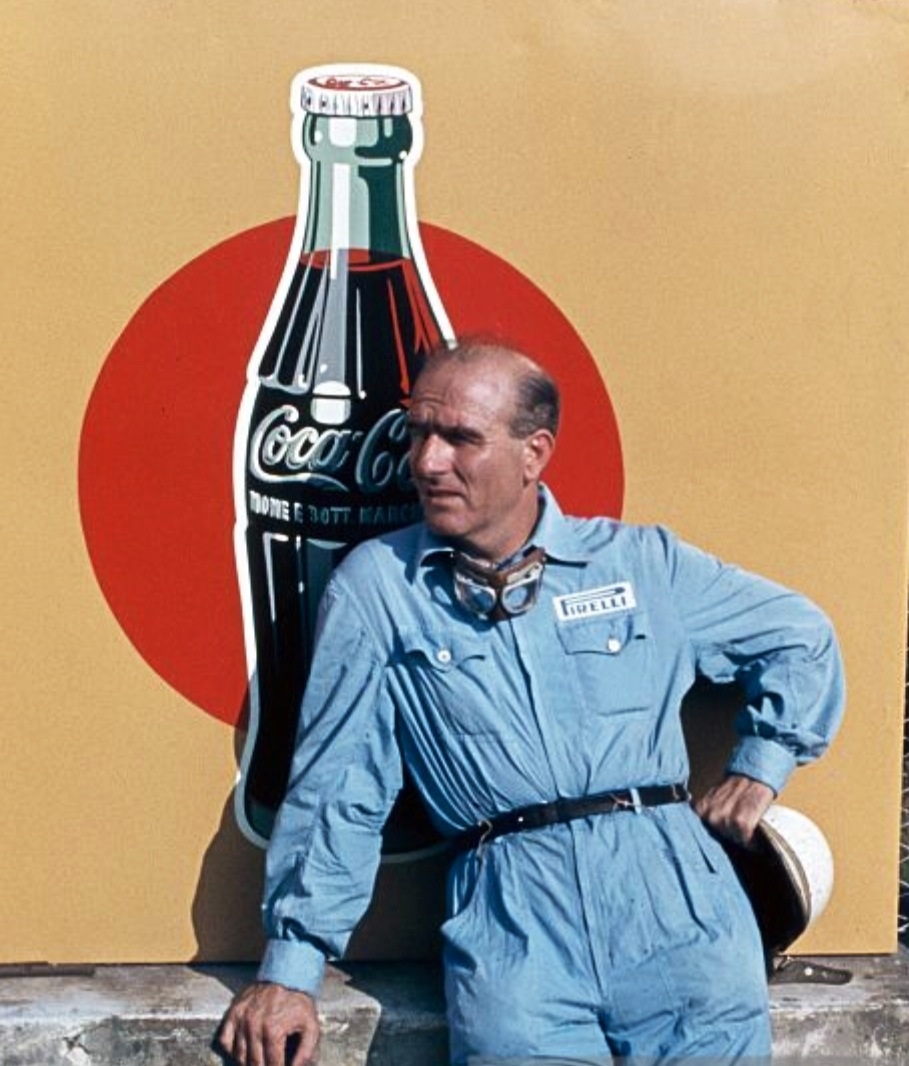
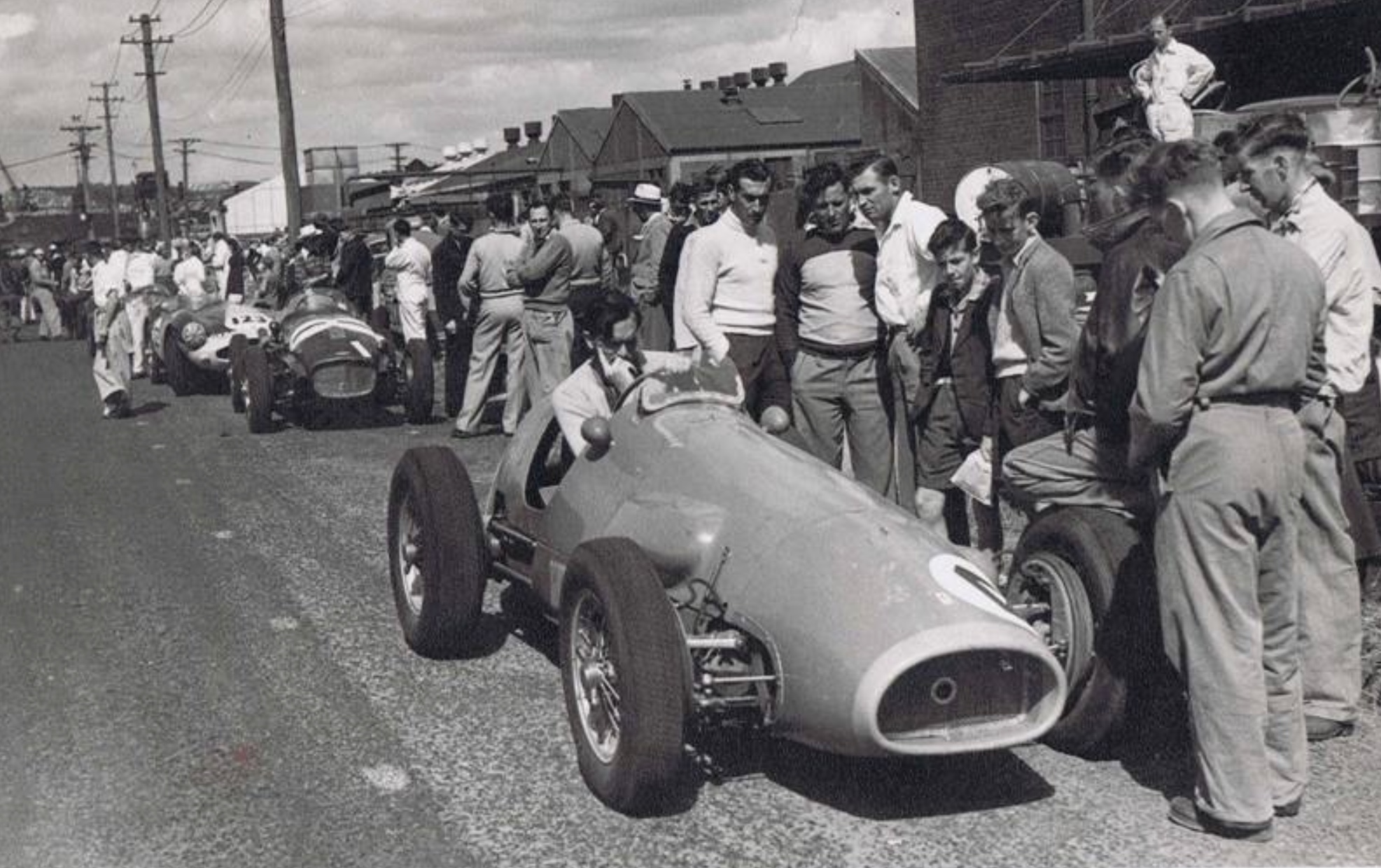
Coke! and it seems Giuseppe Farina agrees…

He is in the Monza pits all ready to ‘load up’, exact date and meeting uncertain but the Pirelli overalls suggests maybe his 1950 Alfa Romeo 158 Alfetta championship season or ‘praps the year after.

All correspondence entered into…

(unattributed)

And here in the Silverstone pits aboard his Alfa Romeo 158 ‘Alfetta’ during the 1950 British Grand Prix weekend- the very first round of the inaugural FIA’s World Championship for Drivers in the fourth year of Formula 1.

Farina won three of the seven rounds- at Silverstone, Bremgarten and Monza in his works Alfa Romeo from teammate JM Fangio who also won three rounds, but fell three points short of the Italians total of 30 points.

The Indy 500, one of the seven rounds back them, was won by Johnnie Parsons in a Kurtis Kraft Offenhauser.

Credit…

Klemantaski Collection

image

(Klemantaski)

Finito…


(Theo Page)

The Cooper Mark 1 (later referred to as T41) was the Surbiton marques prototype or first mid-engined F2 car…

Note that there were also Mk1, 2, 3 etc air-cooled Coopers, the T41 was typically fitted with a Coventry Climax 1.5 litre FWB SOHC, two-valve engine.

This article was spawned by Theo Page’s Type 41 cutaway above. I thought ‘that would be nice to add to an existing article on the Paul England/Austin Miller car’ and then I came upon T45, multiple T51 drawings as well as the ‘Lowline’ T53 so the idea of a piece on the early water-cooled mid engined Coopers popped into my head.

I knew the John Ross and Dave Friedman archives had some great workshop/circuit photographs of the cars engineering detail but that was going to create too much visual clutter so the article is in two parts.

The first bit is the overall story- Who, What, Where and When if you like, the second is more around the design and engineering of the cars with photographs providing great visual support. An ‘eyeful is better than an earful’ and all that.

In terms of photographs I’ve already written a lot of Cooper articles, often ‘quickies’ with all of the best Australian photographs I could find contained therein- rather than re-use these, key ‘Cooper Climax’ and ‘Cooper Maserati’ into the search spot on the upper left primo home page and you can check them out at your leisure, I have sought photos hopefully many of you have never seen before- other than a few Kiwis anyway!

Off we go.

Wally Baker Cooper Mk8 Norton, South Canterbury Hillclimb circa 1960. ‘Clellands Zig Zag’, near Cave, on the east of NZ’s South Island. The road is tarmac these days (CAN)


1949 Cooper Mk3 JAP (Getty)

If John and Charles Cooper’s first mid-engined Coopers of 1948 set the company on a path to change the face of motor racing, the T41 hastened the onslaught on the long established (Auto Union pre-war duly noted) front engine motor racing paradigm.

Lets not forget the performance of the Cooper Bristols Mk1 and Mk II or T20 and T23 which were born as F2 machines and became Grand Prix cars with the adoption of F2 to determine the drivers and manufacturers championships in 1952 and 1953.

Those cars ‘launched the careers’ of a swag of top line pilots not least two World Champions in Mike Hawthorn and Jack Brabham.

The performance of the T39 ‘Bobtail’ and T40 Bristol which Jack ‘knocked together from the Cooper parts bin’, and in which he made his F1 Championship debut at Aintree in 1955- and aboard which he won the Australian Grand Prix at Port Wakefield later that year, emboldened human dynamo John Cooper to build a mid-engined car for the new 1.5 litre F2 which took effect from 1 January 1957.

Jack Brabham in his famous ‘REDeX Special’ Cooper T23 Bristol in the backyard of his parents house in Hurstville, Sydney circa 1953 (HRCCT)


Cooper Mk1 or T20 Bristol (Vic Berris)


Reg Hunt’s Len Lukey driven Cooper T23 Bristol during the 1956 AGP weekend at Albert Park. Doncha think blokes look at racing cars in the same way they check out chicks- with absolute focus, totally oblivious of anything else going on in the immediate environs? Ninth in the race won by the Moss works Maserati 250F (G Smedley)


Colvin Algie, Normac/AC Special about to be lapped by Brian Pescott, Cooper T23 Bristol and Angus Hyslop, Jag D during the 1959 Ahuriri Road Races- Port Ahuriri, Napier, NZ North Island. JW Lawton Cooper 2 litre won from DC Hulme Cooper T45 FPF 2 litre and Pescott (CAN)


Brabham in his 1955 British GP debut/AGP Port Wakefield winning Cooper T40 Bristol, here at Mount Druitt, Sydney, probably also 1955 (Uni Newcastle)

In the UK six F2 races were held between the 14 July Silverstone British GP support race won by Roy Salvadori’s works T41 Climax FWB and the 14 October BRSCC Brands Hatch race won by the RRC Walker Racing T41 similarly engined car. The new T41’s won five of the six races, Salvadori four and Brooks one. Colin Chapman won at Brands on 9 September in a Lotus 11 FWB sportscar, an occasion where the T41’s were absent.

Finally the Brits had, in Coventry Climax, a manufacturer of modern, competitive engines which were available to all who could stump up the readies. During 1957 the SOHC, two-valve FWB was supplemented by the twin-cam, two valve FPF putting in place the family of engines which carted away two F1 titles in 1959/60.

Similarly, Cooper built cars for all.

There is other ‘confluential’ stuff which contributed to Cooper’s rise and rise too;

Jack Brabham arrived at Cooper in 1954 with his unique blend of driving, testing, mechanical and engineering skills. The energy of Jack and John Cooper must have been a truly awesome thing to watch- I’m not so sure I would have wanted to work for them but to view it all from the sidelines would have been quite something.

RRC Walker racing ‘attached themselves’ to the lads from Surbiton, specifically the contributions of Walker RRC, Moss S, and Francis A were mega, as we will see.

Not to forget the son and father combination of John Cooper, a racer to the core, and Charles Cooper who kept the business alive and well. As anyone who has run a small business well knows keeping an enterprise afloat is not easy especially in the fickle ‘only as good as yer last race’ world of motor racing. Cooper Cars was highly profitable throughout with John selling at ‘the right time’ a decade hence not too long after Charles died.

Where were we?- back to the Mark 1, or make that, for me, T41!

John Cooper and Owen Maddock produced a car which was strongly based on the T39 albeit the machine was ‘slipper bodied’ rather than having the all-enveloping body of the other car. Similarly it had independent suspension front and rear using top transverse leaf springs and wishbones at the bottom.

Jack, T41 Climax at Caversham during the 1957 F Libre AGP. Modern as tomorrow Cooper a contrast with the partial nose of the Fred Coxon Amilcar Holden Spl behind (K Devine)


Brabham, T41 FWB on his way to third in the 1957 AGP behind the Ferrari 500 3 litre of Lex Davison/Bill Patterson and Stan Jones Maserati 250F (D Van Dal)


Lady Wigram Trophy 1957. They are off, F Libre- Brabham in T41 FWB against the ‘Big Red Cars’- Reg Parnell and Peter Whitehead Ferrari 555/860 and Ron Roycroft in the light coloured Ferrari 375. D Type is Bob Gibbons, Syd Jensen, Cooper T41 Climax and Horace Gould, Maser 250F #2 on row 2. Look at the size of the Brabham and Jensen Coopers in relation to the Ferrari’s (CAN)


Austin Miller, Cooper T41 Climax leads Bill Patterson, Cooper T39 Bobtail Climax off Long Bridge, Longford during the 1958 Gold Star round won by Ted Gray’s big, booming Tornado 2 Chev. Both of these fellas progressed to T51’s, Patto won the 1961 Gold Star in one of his. He owned more Coopers in Australia than anyone?- perhaps Stillwell and Jones count was similar. Paul England raced Austin’s T41 in the 1957 German GP- DNF distributor after 4 laps

The production 1957 Mark II (T43) was settled upon that winter and put into build at Hollyfield Road.

It had a longer wheelbase that the Mk1 and bulkier bodywork to accommodate two pannier fuel tanks rather than the scuttle tank of the Mark 1- the suspension was the same as the earlier car, the drooped nose was a means of distinguishing between Coopers very latest offering and its predecessor.

Brabham debuted the Coventry Climax FPF engine- it took its bow at the 1956 London Motor Show, in the first race of the year, the Lavant Cup at Goodwood on 22 April finishing second to Tony Brooks Walker T41 FWB. Initially the 1475cc engine developed 141bhp @ 7300rpm and most importantly a swag of torque from 4000rpm- it’s peak was 108.5 lb-ft @ 6500rpm. The pint sized package weighed only 225 pounds.

It was a year of F2 dominance for the marque- in sixteen national and international races  Brabham won five, Tony Marsh, George Wicken and Roy Salvadori two apiece and Tony Brooks and Ronnie Moore one. Tom Dickson won at Snetterton in May aboard a Lotus 11 FWA when no T41/43 was present, Maurice Trintignant was victorious at Reims in a Ferrari 156 and Edgar Barth in a Porsche 550RS at the Nürburgring but otherwise it was all Cooper.

Pescara GP 1957. Jack in front and Roy Salvadori behind, Cooper T43 FPF 2 litre- 7th and DNF from Q16 and 15. Moss won aboard a Vanwall VW (57)


Dunedin International Road Race 1958. McLaren, T43 Climax #47, Syd Jensen, Cooper MkX Norton with #51 Geoff Mardon, VA Vanguard and Merv Neil in another T43 alongside. You can just see the Frank Cantwell Tojeiro Jag at left rear. Ross Jensen Maser 250F won from McLaren and Syd Jensen (CAN)

Meanwhile in Europe privateers were racing the cars in non-championship Grands Prix. George Wicken took his T43 FPF to Siracusa in early April DNF, Brabham was fourth in the Glover Trophy at Goodwood behind two F1 Connaught B Types and a BRM P25. Salvadori was second at the GP de Caen in July behind Behra’s BRM P25 but ahead of four Maserati 250F’s, a car Roy knew rather well.

In the BRDC International Trophy Innes Ireland’s T43 was sixth in his heat and Brabham second in his. Fourteen Cooper T41/43’s contested this race, the best placed was Salvadori in eighth behind BRM P25’s and Maserati 250F.

With a 2 litre FPF available Cooper ran a limited World Championship campaign that year, the best results were Salvadori’s fifth at Aintree and Brabham’s sixth at Monaco. Doug Nye explained how the 2 litre variant came about.

Early in 1957 Roy Salvadori tested Rob Walker’s F2 T41 and F1 Connaught Type B on the same day at Goodwood. He quickly realised the potential pace of a water cooled mid-engined Cooper and floated the idea of increasing the capacity of the FPF enough to tackle GP racing.

Soon, with Walkers financial backing- Rob ordered a chassis and 2 litre engine, the project was underway. Climax’ changes involved increasing the bore and stroke which required new pistons, liners and crank- the result, with only two days fettling was an astonishing 176bhp @ 6500rpm. Brabham used the engine at Monaco and ran as high as third before pushing the car over the line in sixth after fuel pump failure.

At the end of Jack’s European season he came home for the summer commencing his race campaign with the Australian Grand Prix at Caversham, an ex-airbase circuit out of Perth.

His T41 qualfied and finished third behind the Formula Libre 3 litre Ferrari 500 of Lex Davison/Bill Patterson and Stan Jones’ Maserati 250F.

The 1958 Mark III (T45) added significant refinement in that the front suspension was changed to use coil springs and both upper and lower wishbones. At the rear the transverse leaf remained with upper lateral links added which released the spring to do just that, relieved of its additional wheel locational function.

Coventry Climax chief Leonard Lee had endorsed a further increase in the capacity of the FPF to 2.2 litres, the maximum the original block could accommodate. Production of these engines was geared around resourcing two car Cooper and Rob Walker Cooper entries.

The F2 Index lists twenty F2 races in 1958 with Cooper T43/45 victory honours shared widely. Brabham and Bruce McLaren- Jack brought Bruce to Europe that year after Bruce had much Cooper success at home, had three wins each, Moss and Ian Burgess two, with one each to Stuart Lewis-Evans, Kiwi, Syd Jensen, Maurice Trintignant, Henry Taylor, Tim Parnell and Jim Russell.

The big news of course was Stirling Moss’ win aboard Rob Walker’s T43 in the Argentinian Grand Prix.

The car was fitted that day with one of the 1960cc FPF’s. Continental tyres contributed too, he ran on them from start to finish in place of his usual Dunlops. Vanwall, to whom Moss was contracted in F1 that year chose not to travel to Argentina given its cost, distance and because Tony Vandervell’s engines were not quite running well enough on Avgas just yet- there were new fuel regulations in place from 1 January.

So Walker and Moss decided to have a crack at the race- and won! Use of Continentals was Rob Walker firing a shot across Dunlop’s bows ‘because they weren’t being very helpful on tyres at the time’ Doug Nye quoted Walker as saying in ‘The History of The Grand Prix Car’. The Conti’s were were worn through to the canvas at the end of the race- Ferrari fell for the ruse of a prospective tyre change when Alf Francis and another mechanic paraded with wheels and jacks in the pitlane for a stop which was never planned to happen.

In non-championship GP’s Moss won the Aintree BARC 200 in April and the GP de Caen, on both occasions aboard a Cooper T45.

In Australia we were all excited by Cooper pace watching Moss and Brabham face-off in the Melbourne Grand Prix at Albert Park, the last race at the Park until the modern era, won in searing heat by the Walker/Moss T45.

Roy Salvadori leads the marauding pack into the first turn at Monaco in 1958. He is followed by #6 Jean Behra, BRM P25, Tony Brooks Vanwall with #28 Stirling Moss, Vanwall. Brabham is to the right out of shot. Maurice Trintignant won in Walkers Cooper T45 with a bit of luck in a race full of DNF’s and clever strategy. Brabham Q3 and 4th, Roy Q4 and DNF gearbox (Getty)


Equipe Lukey during the 1959 AGP weekend at Longford, Cooper T45 2 litre FPF Climax. With a 2.5 FPF Len Lukey would have won in his ex-Brabham machine, but Stan Jones prevailed in a close tussle in his Maser 250F by 2 seconds (Walkem)


Bruce’ works T45 in the Ardmore NZ GP paddock 1960- Jim Palmer’s Lotus 15 Climax and Pat Hoare, Ferrari 256 behind. Brabham’s works T51 first- then Bruce and Stillwell and Stan Jones in T51’s (CAN)

At championship level Cooper enjoyed considerable success in addition to the Walker/Moss Argentine win.

Salvadori was second at the Nürburgring, third in Britain and fourth at Zandvoort whereas Jack was fourth at Monaco.

The 2.2 litre FPF made its debut at Monaco in the Salvadori/Brabham works cars. There, Maurice Trintignant ran a Walker T45 with an interim 2015cc engine and centre lock detachable Borrani wire wheels and in a crazy race of attrition, he won- two races on the trot for the RRC Walker Racing new-fangled Coopers!

In the more open faster races of the season the Coopers were simply giving away too much capacity but that would be remedied in 1959.

T51 Climax (T Matthews)

The 1959 Mark IV (T51) was identical in terms of chassis and suspension to the Mark III- the technical details of which are dealt with in the second part of this article.

It was one of the great customer racing cars of all time in that so many were sold (28 orders according to period factory records but the actual number of chassis built was far greater than this) and so many used it to win for two or three years hence in all corners of the globe.

Interesting insights by Cooper historian Doug Nye are voluminous and fascinating not least the fact that Coopers weren’t all factory constructed by Cooper staff. Some were, but others were built up by customer team mechanics at Cooper or using a ‘kit of parts’ provided by Cooper and built up elsewhere. The ‘kits’ could be complete or otherwise which is reflected in the many different details between cars which are nominally of the same model type.

The British Racing Partnership/Yeoman Credit take on a Cooper T51 Climax at Monaco in 1960- Tony Brooks Q3 and 4th-Moss won in a Walker Lotus 18. Compare the bodywork and detail of this car with the ‘factory standard’ car of Noel Hall below (D Friedman)


Noel Hall’s Cooper T51 Climax at Lowood, Qld in 1959. Probably during one of the two Lowood Gold Star rounds (unattributed)

Whilst, as noted above, the T51 chassis and related componentry inclusive of the gearbox was carried over from the T45, the critical aspect of the package essential for ultimate success was redesign of the FPF to the maximum allowable F1 capacity limit of 2.5 litres unsupercharged.

The 2.2’s of 1958 were fragile at the margin, the block and crankcase had been weakened in the process of taking the engine from its original 1.5 litres to a smidge over 2.2. The crank counter-weights could not be enlarged and as a consequence the motor vibrated and ran roughly- its life was usually short if over-revved.

Walter Hassan’s redesign started as late as 1 December 1958.

A new block was made by Birmal in light alloy integrating both the block and crankcase and extended from 3 1/2 inches below the crankshaft to 8 5/32 inches above it, Nye wrote. The bore/stroke was 94mm x 89.9mm for a capacity of 2495cc. Cast iron wet liners were used and a five main bearing crank. Beneath the crank was a jackshaft which carried three oil pumps- one pressure and two scavenge. The engine was ‘cross-bolted’- eight studs each side of the block screwed into the main caps.

The two valve, DOHC engine, as before, had its cams driven by a train of gears. The Mk1 2.5 litre heads had 1 1/2 inch bore ports feeding 1.937 inch inlet valves and 1.687 exhausts. Nye notes the engine was ‘under-valved’ initially in case of structural deficiency elsewhere. Fitted with twin-Weber 58 DCO carbs the engine revved happily to 7000rpm developing circa 240bhp @ 6750rpm and ‘pulled like a train from as little as 4000rpm’. Remember that the 2207cc unit produced 194bhp.

Brabham would have well and truly noticed the weight gain mind you- the 1.5 FPF weighed 225lb, the new 2.5 290lb.

Doncha hate thoughtless crops! Headless Repco technician, probably Michael Gasking, with an FPF bottom end in the Repco Engine Lab, Richmond circa 1963 which means its probably one of Jack’s 2.7 ‘Indy’ spec engines used in the NZ/Oz pre-Tasman F Libre days. Note the beefy steel Laystall crank, deep block as per text and row of holes ‘at the top’ for the cross-bolt studs. It’s a story in itself but Repco were licensed or approved by Climax to look after the FPF’s which extended to manufacture of rings, bearings and pistons with CC providing block and head castings which were machined by Repco. Brabham was the first ‘customer’ (M Gasking)

Cooper’s factory drivers changed in 1959 as Roy Salvadori, for years a contracted Aston Martin driver, committed himself to David Brown’s old-school front-engined cars in F1 as well as their sportscar program.

It was a remarkably loyal call by Roy but one not readily understood given his back to back test of Rob Walker’s old and new cars only twelve months or so ago. Roy was very much the quicker of he and Jack in 1958 and really was in the box seat with all of the knowledge about what was coming down the Cooper pike…A Le Mans win together with Carroll Shelby that summer was some compensation for the Aston Martin DBR4 which was ‘too little too late’ without getting lost in that tangent.

John Cooper therefore recruited Masten Gregory and promoted Bruce to the F1 squad with Jack’s unique contribution in and out of the car ongoing.

Vanwall withdrew from Grand Prix racing, and soon altogether, so Stirling Moss raced Rob Walker’s Coopers. The primary difference in specification between the works cars and Walker’s were that John Cooper didn’t provide his you-beaut modified ERSA gearboxes. Walker was left to his one devices, contracting Valerio Colotti to build transmissions, which it transpired failed repeatedly.

In some ways it could be said 1959-1960 were the years of the gearboxes. Moss would have won in 1959 had the Colotti’s held together in the Walker 51 and a Lotus 18, ‘the car of 1960’ would perhaps have won in 1960 were it not for the unreliability of Colin Chapman’s sequential ‘Queerboxes’.

Having said that Cooper created their own luck by building modified versions of the Citroen-ERSA boxes in 1959 and the Owen Maddock designed, Jack Knight built ‘Cooper-Knight CS5’ transaxle in 1960.

Ifs, buts and maybes mean nothing in motor racing- but they are interesting all the same!

Chassis #F2-16-59 , Noel Hall’s T51 was a new car ex-factory, fitted with a 2.2 litre FPF, here outside his garage business- where was that? (J Ellacott)

Jack Brabham won the 1959 title with 31 points from Tony Brooks, Ferrari Dino 246 and Vanwall on 27, Moss 25 1/2 and Phil Hill, Ferrari Dino 246 on 20 points.

The season was open in that Brabham, Brooks and Moss won two races apiece- Monaco and Aintree for Jack, Nürburgring and Reims for Tony and Monsanto and Monza fell to Stirling.

Moss lost the Monaco and Zandvoort leads- and was out early at Monza due to Colotti failure. But the works-boxes were marginal too and Jack nursed them, there is little doubt he had greater mechanical sympathy than Moss- and most other drivers for that matter. One does often make ones own luck in all forms of human endeavour.

2.2 Coventry Climax engine detail and ‘curvaceous’ Maddock frame (J Ellacott)

Both Jo Bonnier and Bruce McLaren took their first Championship Grand Prix wins that year- at Zandvoort (also his last) and Sebring aboard BRM P25 and Cooper T51 respectively.

Five non-championship events were held in 1959 and there, too the Coopers were dominant- T51’s took the Glover Trophy at Goodwood- Moss from Brabham powered by their brand new Coventry Climax 2.5 litre FPF’s, the International Gold Cup at Oulton Park went to the Moss/Walker Cooper and Jack bagged the BRDC International Trophy at Silverstone.

Front-engined non-champ victories went to Jean Behra’s Ferrari Dino 246 at Aintree- the BARC 200 and to Ron Flockhart’s BRM P25 at Snetterton in October- the Silver City Trophy.

This is one of my favourite Cooper shots- Harry Schell in a delicate, high speed Yeoman Credit T51 Madgwick drift at Goodwood during the April 1960 Glover Trophy. DNF engine after 20 laps. Ireland’s Lotus 18 won from the T51’s of Moss and Chris Bristow (Getty)


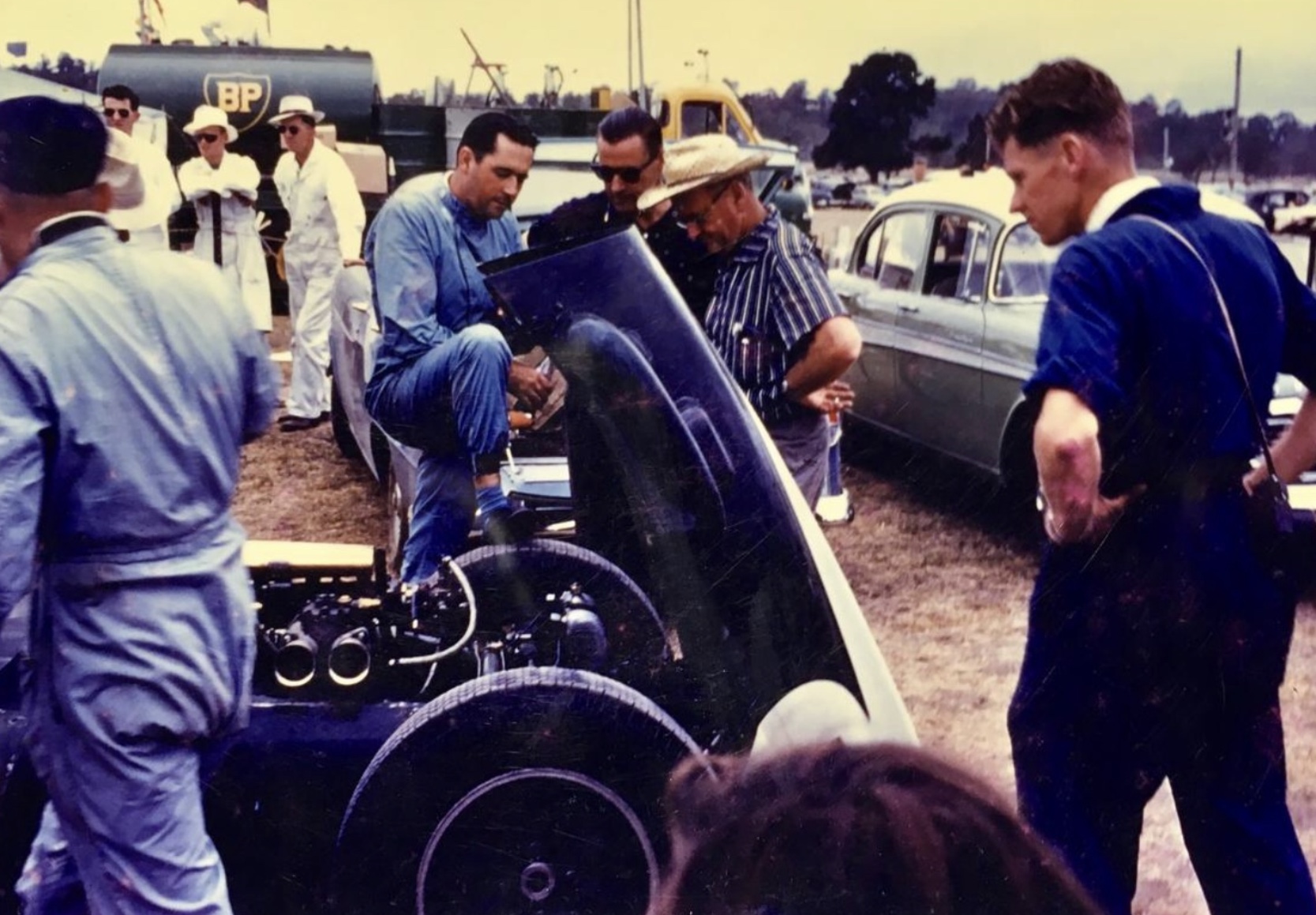
Jack with T51 in the Longford paddock 1960. Is that Alec Mildren in the striped shirt? Jack won in ‘F2-4-59’?) from Mildren’s T51 Maserati and Bib Stillwell, T51 Climax. Lovely atmo shot! Big, hungry DCO mouths (R Lambert)

Cooper were more dominant in Formula 2 where Coopers T43, T45 and T51 ‘cleaned up’.

The most successful combination of the year was Moss at the wheel of Rob Walker’s Borgward engined T43 and T45 with four wins. Tim Parnell and Chris Bristow took three apiece, Brabham two and one each for a lengthy rollcall- Jim Russell, Henry Taylor, Jack Lewis, Maurice Trintignant, Roy Salvadori, Harry Schell, Stan Hart, Trevor Taylor, Ron Carter and Tony Marsh. Amazing really, Cooper built and sold a lotta motor cars!

Moss’ Walker T51 Climax in the Ardmore paddock, NZ GP 1960. Moss DNF clutch after 27 laps- Brabham T51 won from McLaren T45 and Stillwell T51, Bib’s 2.2 the other two fellas 2.5’s (LibNZ)

At the European seasons end Moss, Brabham and McLaren headed south to the Antipodes for what would become an annual trip to race hard in the sun and play hard in the sun…

The NZ GP at Ardmore was won by Jack’s T51 as was the Longford Trophy in early March.

The Surbiton boys received a rude awakening when they fronted up in Argentina on 7 February with their T51’s to be comprehensively blown off by Innes Ireland’s new Lotus 18 Climax- Chapman’s first crack at a mid-engine design was a rather successful one in FJ, F2 and F1…

Bruce won the race after the Lotus failed but Jack DNF’d with heat-treating failure in his ERSA gearbox.

Suitably chastened the Cooper crew famously began the design of what became the Cooper T53 ‘Lowline’ on the long haul flights back to the UK. Doug Nye records that they landed in Heathrow on 17 March with the 14 May Silverstone International Trophy the deadline for completion of new cars.

Mike Barney preparing Jack and Bruce #18 T53 Climax in the Reims paddock in 1960- first and third, Jack won from pole. Technical details as per second part of the article but note the ‘bungy’ retained huge ally fuel tanks and relative height of T53 compared with T45/51

A head start was provided by Owen Maddock’s Cooper-Knight CS5 gearbox- it was just entering limited volume production in Knight’s workshops. McLaren’s College drawing skills were deployed to assist Maddock with Jack providing thought leadership and sketching whilst John chased suppliers for parts.

In essence the T53 was longer, sleeker, lower and lighter with a new, reliable gearbox able to take the loads of the more powerful FPF 2.5- itself mounted a smidge lower in the stronger in torsional stiffness by 25% (over the T51) Lowline frame- in the final year of the long-lived, very successful and interesting 2.5 litre F1.

The second half of the article covers the T53 technical advances in plenty of detail.

Cooper T53 ‘Lowline’ (Brian Hatton)

Innes Ireland won the Glover Trophy at Goodwood in April and the International Trophy at Silverstone in May- Jack’s T53 was second.

Moss could see the Lotus writing on the wall so Rob Walker acquired an 18 prior to Monaco- Stirling promptly won the race albeit Jack led until lap 41 when he spun on  a wet patch and clobbered the Ste Devote wall- the damaged frame was repaired in time for Zandvoort where he won- the Lowline’s first win was on the board.

At Spa the cars were jets- Jack was 2.5 seconds quicker than the nearest pursuer in practice. He won easily with Bruce second after others fell by the wayside- Nye notes Bruce’ car topped 180mph.

By Reims the T53’s were fitted with larger capacity oil pumps to prolong crown-wheel and pinion life. Jack started from pole and won again after a great long duel with Phil Hill’s potent Ferrari Dino 246.

Jack won again in Britain after Graham Hill’s BRM brakes faltered and he spun 6 laps from home, Bruce was fourth, adrift of the two Lotus 18’s of Surtees and Ireland.

This photo and the one below are to illustrate the size and shape differences between the 1959 T51- here Lance Reventlow’s works car and the 1960 T53- Bruce’ #2 car at Silverstone during the British GP weekend- up the road is one of the BRM P48’s. Brabham’s T53 won from the Surtees and Ireland Lotus 18’s. Bruce was 4th and Lance’s car was raced by (his Scarab fellow driver) Chuck Daigh- DNF overheating from Q19 after 56 laps


The shot from the rear is during the 1960 French GP at Reims- Olivier Gendebien T51, 2nd at left with Bruce’ T53 at right, 3rd. Jack won. Great effort by Gendebien in the BRP Cooper

Fortune again favoured the team at Oporto with another one-two whilst in non-championship events Ireland continued to win- the cars had the speed to win shorter events but not the reliability to win Grands Prix. He won the Lombank Trophy at Snetterton in September and Moss the Oulton Park Gold Cup in Walker’s Lotus later the same month.

The Italian organisers engineered a Ferrari win at Monza by running their race on the banked circuit and Moss- well and truly back after his terrible Spa crash on that deathly weekend early in the season, the victor in the US GP at Riverside in the Walker 18.

In Formula 2 Cooper did not have it all their own way in 1960 as they had the year before- of 26 races Cooper won twelve, the Lotus 18 six, Porsche 718 five and Ferrari 156 three- the latter car ‘a dry run’ for their 1961 World Championship winning cars. Of the Cooper brigade Brabham and Jack Lewis won three races, Mike McKee two and George Lawton, Roy Salvadori, Maurice Trintignant, and Klaas Twisk one apiece.

Bruce works T53 FPF 2.5 Lowline at a very soggy Wigram 1961. Bruce was fourth behind Brabham, Moss and Angus Hyslop- Cooper T53, Lotus 18 and Cooper T45, all Climax FPF powered (CAN)


Technical…

T43..


In a Motorsport Gordon Murray appreciation piece about the Cooper T51/53 he wrote that when he went to Brabham (in 1972/3) he inherited Pete Beddings and his Dad who made all of the early Cooper shells ‘…but I don’t know who styled them. Whoever it was obviously had an eye, because they were very pretty and quite effective aerodynamically. I suspect it was John saying “its a bit like this”.’

‘I still love to see a little Cooper at Goodwood: they still stir the blood just the same as a Ferrari or a Lotus. They were also well made for the period- if you look at, say, a Ferrari of the time, the frame technology is pretty basic: the rear engined Coopers were at least multi-tubular. Not pure spaceframes like Chapman moved on to later (I think he was well and truly there already Gordon!), but they were clever-simple for reliability.’

The T43 chassis was made of the usual Cooper 1 1/2 inch steel tube. The Mark 1 tall frame hoop encircled the seat back bulkhead and was unbraced whereas here (below) it was unbraced but the top chassis longerons each side of the engine bay were braced against the lower longerons by a three piece ‘Y member’.

What about those Cooper chassis’ which have always offended the purists- a true multi-tubulars spaceframe chassis should use straight tubes only, each stressed in either compression or tension.

Famously, after laying out several straight tube designs for the Mark 8, and in John’s absence having them rejected by Charles Cooper, Owen Maddocks decided to take the piss and presented an option in which every tube was bent- to his surprise it was embraced by Charles, a good intuitive Engineer.

Doug Nye recounts Owens account of the discussion about the approach when John Cooper returned.

’Curving the top frame rails down to meet the bottom ones reduced wracking through the frame. You could run curved tubes where they wouldn’t interfere with fuel tanks and suchlike. One of our very good welders always told me he preferred simple joints- with just one tube jointed into another- to multiple joints with with three or four tubes involved. We didn’t like weld overlapping weld and so tried to arrange things to avoid that. With curved tubes we could follow the body lines more closely, so we didn’t need the old strip -steel frame to support the body panels. What had started as a joke began to look quite logical, and very practical…’

The F2 Coventry Climax 1475cc gave circa 141bhp @ 7000rpm in its first evolution and drove through a Citroen-ERSA transaxle, which coped pretty well with the demands put upon it at that stage. Note the change linkages and beautiful rear suspension detail- traditional transverse leaf and wishbones Cooper design.

Coopers curvy frame shown to good effect.

In 1956/7 wire-wheels were still very much the norm in motor racing, Coopers progressive inclination was reflected on the magnesium alloys specified on their cars pretty much from the start. Objects of beauty, lower unsprung weight and strength were amongst the favourable properties.

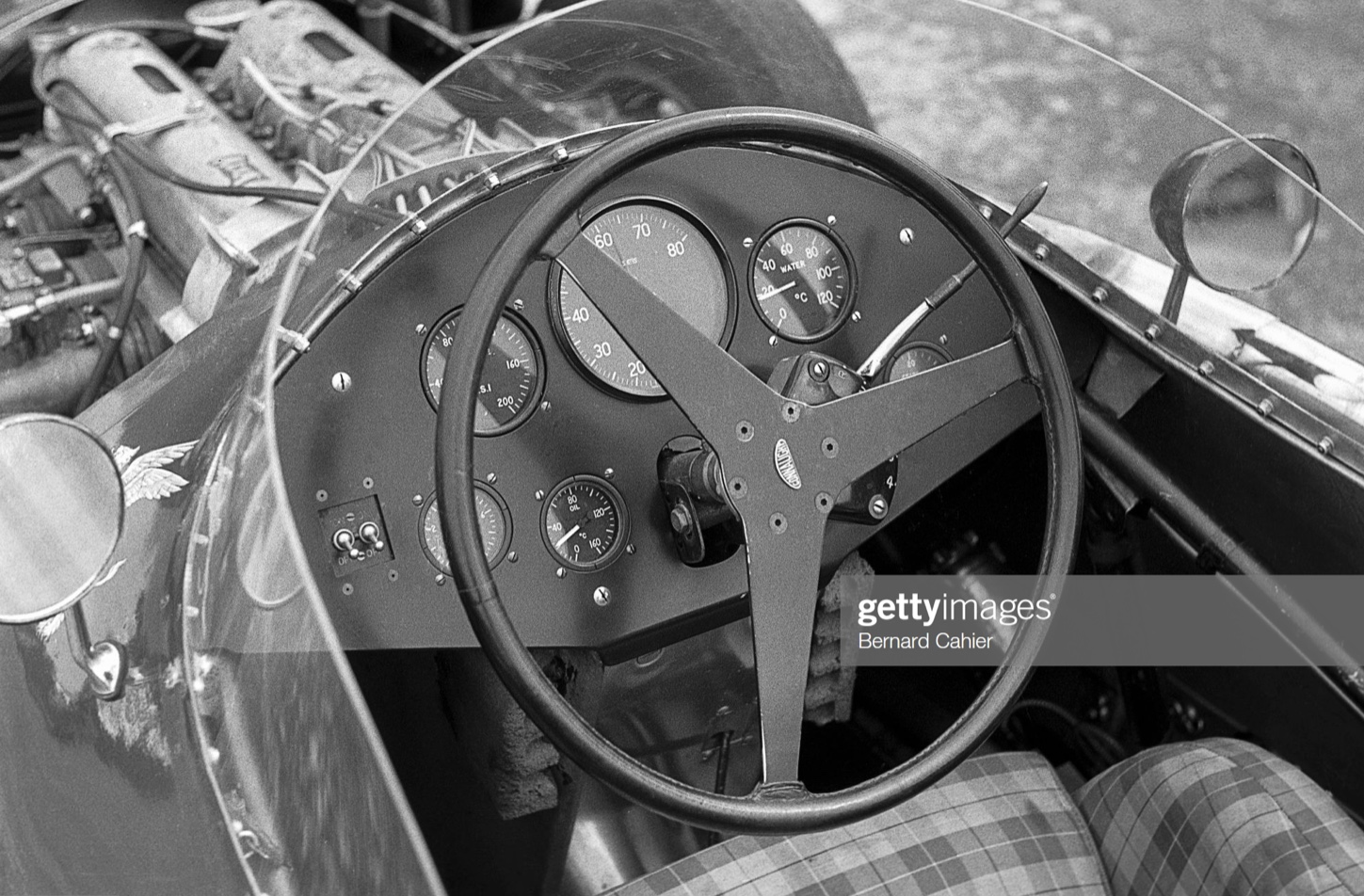
Crystal clear John Ross shot- not quite close enough to checkout the chassis number however! I wonder who was the steering wheel provider of choice.

Note the gear lever and linkages to the left- the weak link of the higher powered T45 and T51’s covered in this article were the gearboxes, a solution was finally arrived at for all in the form of Mike Hewland’s concern in the early sixties when a racing gearbox finally ‘became a spacer between the engine and rear of the chassis.’

Smiths instruments of course- I wonder if one of those to the lower left is for gearbox oil temperature?

The engine progression in 1957 goes something like this.

F2 Coventry Climax FPF 1500cc 141 bhp was the ‘standard engine’ for F2 T43’s.

In F1 Jack Brabham raced at Monaco with a 1960cc FPF for the first time and later in the season, as outlined earlier in the article, 2.2 litre engines were approved by Leonard Lee late in the year and made available to the works and Rob Walker teams in 1958- and others later.

The T41’s side panels wrapped tightly around the chassis hoops whereas the T43’s were bulged to clear the fuel tanks either side of the driver- sufficient tankage was incorporated for a race of 200 miles duration. The bulged body panels were carried clear of the frame on light-guage outriggers.

See the bungees retaining the fuel tanks above. Brakes in standard form as here, were Lockheed 10 inch x 1 3/4 inch drums but Girling discs were an option and commonly specified. Shock absorbers were Armstong and uprights, I think, fabricated in-house.

Very slippery.

Lean, lithe, light and uber-responsive given the low polar moment of inertia.

Not for the faint of heart and not everybody familiar with a front-engined racer could successfully make the switch- mind you, by 1956 a generation of racers had cut their teeth on air-cooled, mid-engined Coopers so they were rather used to the handling properties of the little beetle-backed machines.


T45…


This group of photographs are all of an F2 T45 FPF 1.5 but the technical elements of the F2 and F1 T45’s are the same with the exception of engine capacity of course.

The Mk3/T45 F2 and F1 and 1959 Championship winning Mk4/T51 F2 and F1 cars are virtually identical so lets take a deepish dive into the T45 and the changes over the previous T43.

This chassis is fitted with an F2 1475cc FPF- T45’s were also fitted with 1960cc, 2015cc and 2207cc FPF’s in 1958.

The bore/stroke at the latter capacity was 3.5 inches- this ‘square’ configuration was only made possible by slipping a ‘sandwich plate’ between the block and the head to get the required stroke height. On Avgas this motor produced 194bhp @ 6250rpm.

The shot above provides just a glimpse of the rear transverse leaf spring aft of the chassis cross tube.

Its lateral location was now provided by a short link pivoted on the left side frame trunnion and bolted to a centre clamp (you can just see the inner end) retaining the leaves in the middle of the spring.

Front to rear weight balance of most Coopers was about 44-56%- quite similar to the best front engined cars with a rear mounted fuel tank.

The T45 chassis was  1/2 inches lower than the T43- at the front it now incorporated upper and lower wishbones and coil spring/Armstong shocks rather than the transverse leaf used by Coopers from the start.

Ain’t she sweet.

Note the Alford and Alder forged front uprights, these wonderful bits of kit, then fitted to the Standard 8 and Triumph TR3 Road cars, were installed in F1 Brabhams up to and including the 1966 World Championship winning BT19 Repco- and Formula Fords well into the late seventies and beyond. One of motor racings most ubiquitous components, surely?

The front wishbones were of the welded tubular type and included a Chorlton ball joint at their outer end. The uprights lower threaded trunnion was coated with cadminium plating setting the finished product off nicely. Roll bars were housed within the bottom frame cross-member.

The photograph below shows (apart from the very obvious) the top leaf outer end, Armstrong shock and inboard mount for the lower wishbone. The wishbones were more widely based at both the top and bottom than on the Mk2/T43. The outboard mount for the Armstrongs was stiffened- it was on a crossbrace welded between the wishbone legs. Note the fuel filter, starter motor and height of the gearbox.

On the earlier cars the height of the engine in the frame was determined by the Citroen based gearbox as its input shaft from clutch to gearbox passed high above the inner driveshafts.

In the early Mk2’s the engine was canted 18 degrees to the right and inclined downwards at the front by 5 degrees to lower the centre of gravity.

Jack Brabham’s ongoing contribution to design elements of Coopers in addition to set up and on circuit tuning is well established and recognised. Brabham maintained ongoing correspondence with Ron Tauranac back in Sydney. It was Ron’s suggestion to use ‘drop gears’- spur gears inside the gearbox bell-housing which allowed the engine/gearbox to be lowered a full 2 1/2 inches within the chassis frame.

Cooper worked with ERSA in Paris, the gearbox manufacturer and Jack Knight’s specialist shop in Balham, to effect those changes. A bonus was incorporation of a quick-change final drive ratio feature.

Jack famously visited ERSA in early 1958 and had six gearboxes cast with extra strengthening ribs. He laid out all the patterns on the bench and added Plasticene here and scraping a core there- the trick cases were just man enough to handle the power of the 2.2 engines in 1958 and 2.5’s in 1959. ZF slippery diffs were added too- a side trip for Jack whilst in Germany, back at Surbiton ‘…John covered his tracks so Charlie would not hear of the extra expense’ Nye wrote.

‘All Cooper chassis pickups…had been provided by drilled triangular welded-on brackets known as “Bradnack Lugs”, and on the Mark 3 frame those anchoring the inboard pivots of the lower wishbones were aligned above the bottom frame rails instead of below them. Both top and bottom frame longerons were more widely spaced than on the preceding Mark 2’s with less pronounced tube curvature’ Doug Nye wrote.


Whilst noting Cooper’s mid-engine approach itself was at the time revolutionary, the evolution of the cars from T43 to T45/51 was more evolutionary in nature addressing design/performance weaknesses or strengthening componentry based on hard won experience.

Charlie, John and Jack were all racers…and supreme pragmatists.

They were not after the great leap forward- they had that conceptually, beyond that they sought performance advantage and reliability whilst Charles, with a ready eye on the family fortunes, ensured the whole kit and caboodle could be sold at a profit and repaired and maintained cost-effectively back at Hollyfield Road or by a customer in the paddock at Gnoo Blas.

Doug Nye is at pains to point out in HAGP that the specification of these cars is not fixed or hard and fast given so many of them, as we covered earlier, were built in the factory by the teams running them or using kits of parts supplied. The ultimate detail and personal tweaks applied means that individual chassis differed from one another almost as a matter of course.

Take your pick of artists in terms of T51 cutaway drawings!

The one earlier in the article is Tony Matthews, above is James Allingtons’ and the one below is Brian Hatton’s so every angle and detail must be well and truly covered!


T53 ‘Lowline’..


(D Friedman)

As mentioned earlier the threat of the Lotus 18 meant that a ‘clean sheet’ approach was needed- a Cooper-esque clean sheet in any event! Every part of the T51 was quickly scrutinised through lenses of lightness, simplicity, strength and efficiency.

Fundamental design tenets were laying the driver down to aid aerodynamic efficiency, a coil sprung rear end (Charles Cooper fought a pitched battle on this score Nye records by insisting that a transverse leaf rear also be designed should the coils fail), greater torsional stiffness and an improvement in performance around the T51 ‘weak tracks’ which included fast places like Reims and the Avus.

(D Friedman)

The chassis was still essentially a four-tuber of 1 1/2 inch 18 gauge thick top rails and 19 gauge bottoms. Diagonals braced the frame bays ahead of the cockpit but that area was un-braced ‘other than small tube ties welded across the joint apices’.

The long rear bays were unbraced on both sides, when the engine and gearbox were fitted- the latter ‘CS5’ had five mount points frame stiffness was of course enhanced. There were two diagonals in each side with a common apex halfway along the bottom chassis rail.

The engine mounts were welded onto curved tubes to reduce the length of the mounts, both of which were welded to the middle of the main frame members, this ‘would have been heresy to an accomplished stress man like Colin Chapman’ Doug notes.

(D Friedman)

The engine was lowered another inch over the T51 by reducing centre-offset between the step-up gears in the gearbox and allowing the driveshafts to rake upwards to the hubs rather than being parallel with the ground when static.

The steering column was lengthened and moved from behind the front axle line to ahead of it- thus the pedals could go forward and the steering wheel rake made more vertical all allowing the driver to adopt a more laid-down pose aiding aero on those fast courses.

The oil tank capacity was the same but its shape was changed- it was lower and wider, still behind the radiator but pushed forward to reduce nose height.

(D Friedman)

Suspension wishbones were wider and stronger.

The ‘CS5’ transaxle was a lovely bit of kit. It was remote sumped in its gearbox section with splash-feed to the final drive and ZF diff. The unit placed its gears above the oil level so only a pressure pump was needed.

The gearbox ‘…proved essentially trouble free…Jack Knight recalled the vast amount of machining required…its cost to Cooper was around 1000 pounds a box which was virtually prohibitive. John Cooper managed to hush it up, telling his father they cost around 400 pounds each- and The Old Man was livid even then!’ Nye wrote.

No doubt Chapman would have been keen to get hold of a couple of these boxes half way through 1960, fitted thus he had a championship winning car.

Note the CS5 gearbox and pressure pump on the outside casing, oil filler neck and upper and lower rear suspension wishbone mounts (D Friedman)

The prototype Lowline was completed at around 9 am on Friday 6 May 1960 and taken to Silverstone, where after a few shakedown laps, Brabham drove faster and faster- within 10 laps he was 2 seconds under the lap record. Then Bruce jumped in and went quicker still.

Cooper were well and truly back in the game!


Bruno Betti’s take on the Cooper T53 ‘Lowline’

So where does this series of cars fit in the pantheon of racing cars and motor racing history?

Gordon Murray was rather eloquent about that aspect.

‘When I think back to GP milestones , its pretty obvious really, the first rear-engined F1 Cooper. Not so much from a technical point of view even though it was so simple and so effective compared to the other more complex cars of the time but because it brought with it probably the most significant change in Grand Prix cars…’

‘Who else can lay claim to such an impact. And i’m including pre-war cars like Auto Unions because they were such bad examples of rear-engined cars…The real pioneers were Charles and John Cooper, first with the 500 F3 cars and then having the bottle as a small concern to go ahead and do a GP car.’

‘Really the Cooper was more significant, more forward looking even than the Lotus 25 because it meant a fundamental change in packaging, weight distribution, frontal area, in philosophy. And it was an ultra simple car as well, easy to run easy to work on. I always tried to build my GP cars at both Brabham and McLaren to be as simple and easy to work on as possible, and therefore get reliability, and the Cooper was such a good car from that angle. And that Climax was a very under-rated engine because it was built by a very small company. So, the whole package was pretty radical. John probably hasn’t had the credit he should have overall.’

‘All kinds of things appeal to me about it: firstly it was a great little family business, two bright guys and then the giant killing aspect…I just love that aspect. And these guys did two titles back to back…’

Finally, Gordon concluded ‘As a designer i’d have loved to have been the first to say “hang on that’s a  bit cranky having the engine in the front”, with that weight distribution, that frontal area, the prop-shaft losses, compared to the extra traction, better braking- everything gets better with the engine behind. You can’t help saying “Why didn’t somebody think of this before”…

1961 February Teretonga International, NZ. L>R Tony Shelly, Cooper T45 Climax, Pat Hoare, Ferrari 256 (in essence a Dino 246 with 3 litre Testa Rossa V12) Denny Hulme Cooper T51 2.5 FPF leased off Yeoman Credit and Jo Bonnier Yeoman Credit Cooper T51 Climax- to the right is Malcolm Gill in the silver Lycoming, a very successful, iconic Kiwi aero-engine special. No less than Jim Clark was impressed with a drive of this car! Bonnier won from Roy Salvadori, Lotus 18 off the back of the grid, Hulme and Hoare (CAN)

Etcetera: Cooper Mark and Type Numbers…

Allen Brown advises that the ‘T type’ descriptor started at Cooper in 1963. It was applied both prospectively and retrospectively. Stephen Dalton ‘tangibilises’ this in that after extensive research, he can see Cooper using a ‘T number’ for the first time in an October 1962 issue of Autosport where Cooper are quoted about ‘the new Cooper Monaco, the Type 61’

Doug Nye wrote more broadly about the timing of the detailed way in which racing cars commenced to be identified (that is, for example, when a Cooper or Cooper Climax became a Cooper T51 Climax) ‘When it comes to a type numbering system- as in so many things Cooper- don’t rely on published references to same…I have seen all types of T scrawls on some drawing copies.’

‘When I publicised manufacturer type classifications in a “Motor Racing” magazine article reviewing the 1 litre F2 seasons 1964-5 that was the first detailed references that many people had seen to some model classifications which are now used as common terms. I was not the first- but I think at least amongst the first- to present such nerdy detail.’

‘Race reporters had seldom used even Brabham BT classification before then…Brian Jordan had previously produced a little booklet essentially for model makers which included type number detail. I also seem to recall Paul Watson freelance writer/entry fixer of the 1960’s having on a few prior occasions cited a type number’ Doug concluded.

Renwick 50, in the very north of New Zealand North Island, November 1961. Flagman at the bottom of his downward arc on the podium at right! Preliminary heat on the one off rectangular circuit which used the main street. Bob Eade, on pole Maserati 250F, Tony Shelly, Cooper T45 FPF 2 litre. Pat Hoare (won the main race in his Ferrari 256 V12) on row 2 then the Bob Eade 250F and the rest including Chris Amon- in front of the sportscar on the right perhaps? (CAN)

Credits…

Special thanks to the fantastic John Ross Motor Racing Archive and Dave Friedman Archive, Theo Page, Brian Hatton, University of Newcastle, The Nostalgia Forum, ‘CAN’-Classic Auto News- Allan Dick, Milan Fistonic, Geoff Smedley, David Van Dal, oldracephotos.com.au, Getty Images- Bernard Cahier and GP Library, John Ellacott, Ron Lambert, Tony Matthews, James Allington, Bruno Betti, Ken Devine Collection

Bibliography…

‘History of The Grand Prix Car’ Doug Nye, grandprix.com, oldracingcars.com, F2Index-Fastlane, Motorsport ‘Cooper T51/53’ interview with Gordon Murray in June 2000

Tailpiece…

Jack at his happiest and most creative.

‘Jack Brabham…was always working with the cars, looking at them, thinking about them…’Owen Maddock fondly observed of Jack to Doug Nye.

Its a posed shot above no doubt but it illustrates the point all the same…

Finito…


Catchy name for a martini?

The cutaway is a conceptual illustration of the 1958 Russian Kharkov Type 6…

The car was positioned as a potential F1 competitor, in the specification above it would have been an evolution of the Type 6 record-breaker shown below.

As depicted the machine is of ‘advanced paradigm specification’ for the day- powered by a DOHC, twin plug, fuel injected six with rear mounted transaxle in unit with de Dion, coil spring/shock rear suspension and twin wishbones up the front. The body is a nod at the Mercedes W196 Streamliner, the chassis is advanced too- two solid lower longitudinal members but multi-tubular spaceframe in design. Drum brakes were to be used by the look of it.

The car broke cover as shown in the article and photograph below published in ‘Sports Illustrated’ and other newspapers in early 1958.

The ‘1956 Type 6 Monoposto Record Car’ was driven in land speed record attempts by the cars designer/builder Vladimir Nikitin, also variously first-named Konstantin and Vassili.

The cars specification incorporated a Pobeda Agregate (a large Russian car of the forties to seventies) four cylinder, two-valve, single and later two-stage ‘Popieda M20’ supercharged 1970cc (79x100mm bore/stroke) engine which produced circa 200bhp @ 6000rpm. Fitted with a three speed gearbox, all up weight was about 1000kg.

The potent little package achieved a two-way average top speed of 280.156 km/h on 10 December 1953 using the Simpheropol-Djankoy public road in Crimea.

Sports Illustrated February 1958


Nikitin centre-stage on this page of the Khadi34 website

Vladimir Konstantinovich Nikitin (1911-1992) was an engineer who developed the successful Kharkov 3 record breaker, the ‘6’ was a development of the earlier car- these were only two of an amazing man’s many creations.

In 1953 Nikitin was one of the founders of the Laboratory of High Speed Automobiles (LSA KhADI), its purpose was to ‘create the fastest cars in the world’. It appears the Kharkov 6 was developed outside this enterprise which begs the question of where it was built- probably the Kharkov Road Engineering Institute. Click here for the achievements of LSA KhADI; http://khadi34.blogspot.com/search?q=nikitin

There was some talk of an F1 car in 1958 but whether that was Russian hype or newspaper ‘puff’ is unclear- nonetheless ‘The Daily Express’ brought the President of the Moscow Automobile Club to the 1958 Silverstone International Trophy meeting- i wonder what the man thought of the racing?

Nikitin’s take on an F1 car would have been interesting, and to a large extent his perspective was a very informed one.

The story of thirteen of Auto Union’s racers making their way from Zwickau to Russia during the autumn of 1945 is reasonably well known. They ended up at the ‘NAMI’ Central Scientific Research Automobile and Automotive Engines Institute, with most then ‘spread to the winds’ to factories and institutions for further research.

During the 1980’s and 1990’s when Russian Americans Paul and Barbara Karassik were pursuing the missing AU’s in Russia- they were ultimately successful in acquiring the remains of several cars, who should they meet via a chain of coincidences (or brilliant patient detective work) but Nikitin.

He explained that two or three of the Auto Unions had been through his hands at a Technical Institute in Kharkov. Eventually, having won Nikitin’s trust over a number of visits the engineer told them about the two or three Auto Unions he had become familiar with at the Kharkov Institute. Several visits later he admitted he knew where there was another car- in the corner of an old brickworks was an unsalvageable body but a complete chassis, engine, gearbox and many suspension parts all of which the Karassiks acquired via a convoluted process.

Nikitin featured in a Russian film about ‘young people captured by speed and Russia’s oldest racing driver’. Check it out here, my Russian is not too flash but I still enjoyed it..https://www.net-film.eu/film-7575/

One might have thought that Nikitin, with his public success may have been lauded in mother Russia but what the Karassic’s came upon was a man much decorated for his achievements but living in penury…


Kharkov Type 6

Etcetera…

Nikitin, khADI 7 in 1967 (Getty)


Credits…

The Nostalgia Forum especially contributors Tom West, ‘Flicker’, Marc Ceulemans, Mike Lawrence

Tailpieces…

(Khadi34)

Nikitin and colleagues around KhADI 7, a helicopter engined machine which exceeded 400km/h in an airport close to Kharkiv in 1968- his next project upped the ante by the use of an aircraft engine from a MIG 19, the only limiting factor was the lack of tyres and a track in the USSR long enough, invitations from the US to run there were unsuccessful…

I have no idea at all but it does have a touch of the Auto Unions about it does it not?!

Finito…

(R Dalwood)

Frank Matich, Brabham BT7A Climax leads Jim Clark’s works Lotus 32B Climax into Pub Corner at Longford in March 1965. A take-your-breath-away shot, composition and execution by Reg Dalwood is something special…

I suspect this is lap 2 with the leading trio of McLaren, Brabham and Hill further up the road. Behind Jim are Bib Stillwell and Frank Gardner in Brabham BT11As, Jim Palmer in a BT7A and then at the rear of the group is Phil Hill, Cooper T70 Climax.

Bruce McLaren won this race, the Australian Grand Prix in his Cooper T79 Climax from Brabham’s BT11A and Phil Hill in the other Bruce McLaren Motor Racing entry – the updated T70 Cooper driven by Bruce and the late Tim Mayer in 1964.

(HAGP)

Bruce wheels his Cooper T79 around Warwick Farm in 1965 hiking his inside right wheel.

These Cooper T70/79 cars are acknowledged now as the ‘first McLarens’ designed and built as they were at Coopers by Bruce and mechanic/technician Wally Willmott. The story of them is here; https://primotipo.com/2016/11/18/tim-mayer-what-might-have-been/

Ron McKinnon gives McLaren and Clark a ride in the sponsors Spitty at the end of the race (B Short)

Hill at left, white car McLaren with Jack and Jim in the next row of two (B Short)

McLaren started the race from pole with Brabham, Graham Hill, Clark, Gardner and Matich behind.

Very sadly, this was the race in which Rocky Tresise died after losing control of the Ecurie Australie Cooper T62 Climax. As most of you know, this was a double disaster for the Davison family as Lex died of a heart attack at Sandown whilst practicing his Brabham BT4 the weekend prior. The Rocky story is here; https://primotipo.com/2016/05/20/bruce-lex-and-rockys-cooper-t62-climax/

I’ve a feature brewing on this race so won’t go into all the detail just now, but rather make use of some of the many images of this AGP floating around on the internet, too many for one article.

In some ways Longford 1965 marked ‘the end of the beginning’ of the Tasman Series in that 1965 was the last year of the dominance of the long-lived Coventry Climax FPF engine.

The world championship winning engines of 1959-60 had pretty much ruled supreme in Australia from 1959 through to the end of Formula Libre in December 1963, and to the commencement of the Tasman 2.5 Formula from 1 January 1964.

In 1966 the BRM V8s made their successful Tasman debut and at the end of the series – Sandown and Longford – the first of the Repco RB620 2.5 V8’s took their bow in Jack’s BT19.

(B Short)

Two nut-brown Aussie summer kids, and the equally well-tanned Oz Lotus works mechanic Ray Parsons push Jim Clark’s Lotus 32B Climax through the Longford paddock.

The Clark/Lotus combo were the class of 1965. Jim’s four of seven Tasman round victories was a precursor to a season which included an Indianapolis 500 win aboard a Lotus 38 Ford, and his second world title in Chapman’s Lotus 33 Climax. Not a bad year really!

Click here for an article on the 1965 Tasman Series; https://primotipo.com/2017/11/02/levin-international-new-zealand-1965/

(K Drage)

Kevin Drage’s shot of the front row of the Longford grid; McLaren, Cooper T79 Climax, Brabham and Hill both in Brabham BT11A Climax’.

KD has an amusing anecdote about Bib Stillwell, Matich’s big rival, and his reaction to FM’s speed that weekend.

“One story I remember from this meeting is Bib’s frustration in not being able to match Frank Matich’s lap times during practice. I was helping Gerry Brown to pit crew for Bib at this meeting, and Bib was even wondering if Frank had slotted in the 2.7 engine from his (Cooper Monaco) sportscar into the Brabham, just for practice to give everyone a bit of a stir up. He even asked me to see if I could manage to go over to the Matich pits to checkout the engine number.”

(unattributed)

Matich during the parade lap at Warwick Farm before the 1965 Tasman round.

FM started the Warwick Farm 100 from pole – in front of Hill, Clark, Brabham, McLaren and Gardner, which rather puts the Sydneysider’s pace into context. He led most of the first lap, ultimately finishing third behind Clark and Brabham.

(oldracephotos.com.au)

Brabham in the Longford paddock getting his BT11A race ready.

Ron and Jack’s Intercontinental Brabhams were supreme racing cars in conception, design and execution. Drivers of the BT4, BT7A and BT11A of varying ability won plenty of motor races in these cars right through towards the end of the sixties. Click here for a piece on them; https://primotipo.com/2018/07/20/matich-stillwell-brabhams-warwick-farm-sydney-december-1963/

Clark in the Longford paddock, Lotus 32B Climax

Credits…

Reg Dalwood on the Historic Racing Car Club of Tasmania website, oldracingcars.com.au, Kevin Drage, Ben Short, HAGP- ‘History of The Australian Grand Prix’ Graham Howard and others, Stephen Dalton Collection, Perry Drury, Ian Smith Collection

Etcetera…

(oldracephotos.com/JEllis)

Brabham, Hill and Clark enter the circuit, the crowd big enough for raceday. Looking back down the road 500 metres or so are the distinctive big pine trees of Mountford Corner. Brabham BT11A by two, and Lotus 32B.

(oldracephotos.com.au)

It may not have been the latest bit of kit, but, continuously modified by Matich and his team his year old car was well and truly as quick as the latest BT11A or anything else on the grid.

Small crowd above suggests ‘IC-1-63’ is being pushed onto the track for practice or the preliminary on Saturday. Graham Matich is steering, it’s Geoff Smedley with his head down at left, who is the other fella I wonder?

(B Short)

The Touring Car grid ready to start, Le Mans style with the ignition key handed from mechanic to driver, can anybody help with car/driver ID.

Check out the crowd above the pits, access bridge and all the fun of the fair.

(I Smith Collection)

The intense concentration is there but otherwise Jack looks relaxed in the cockpit, key to feeling what the BT11A is doing of course.

Shot is taken from atop The Viaduct, a classic shot from this locale. This one has been executed beautifully and shows both Brabham’s form as well as the lines and simple, period-typical suspension of this oh-so-successful series of Intercontinental Brabhams.

All of the shots of this car in the article are a different hue of green, I wonder which is closest to the real McCoy?

Tailpiece…

It’s a butt shot isn’t it.

From the left is the beautifully formed derrière of the lady, such a shame to miss out on the rest of her with a thoughtless crop. Then there is the rear of the FC Holden Wagon and the old bloke standing behind it.

The racer is Jack’s Brabham BT11A Climax ‘IC-5-64’ resting in the paddock after it’s hard won second place.

And finally the rear of an EJ Holden Panel Van.

Atmospheric isn’t it?

(P Drury)

Same scene, same time, same place, while Perry Drury was taking this shot, Ben Short was standing opposite him taking the one above. Jack’s Brabham, Jim’s Lotus and the EJ Wagon…

Finito…
(Natlib)

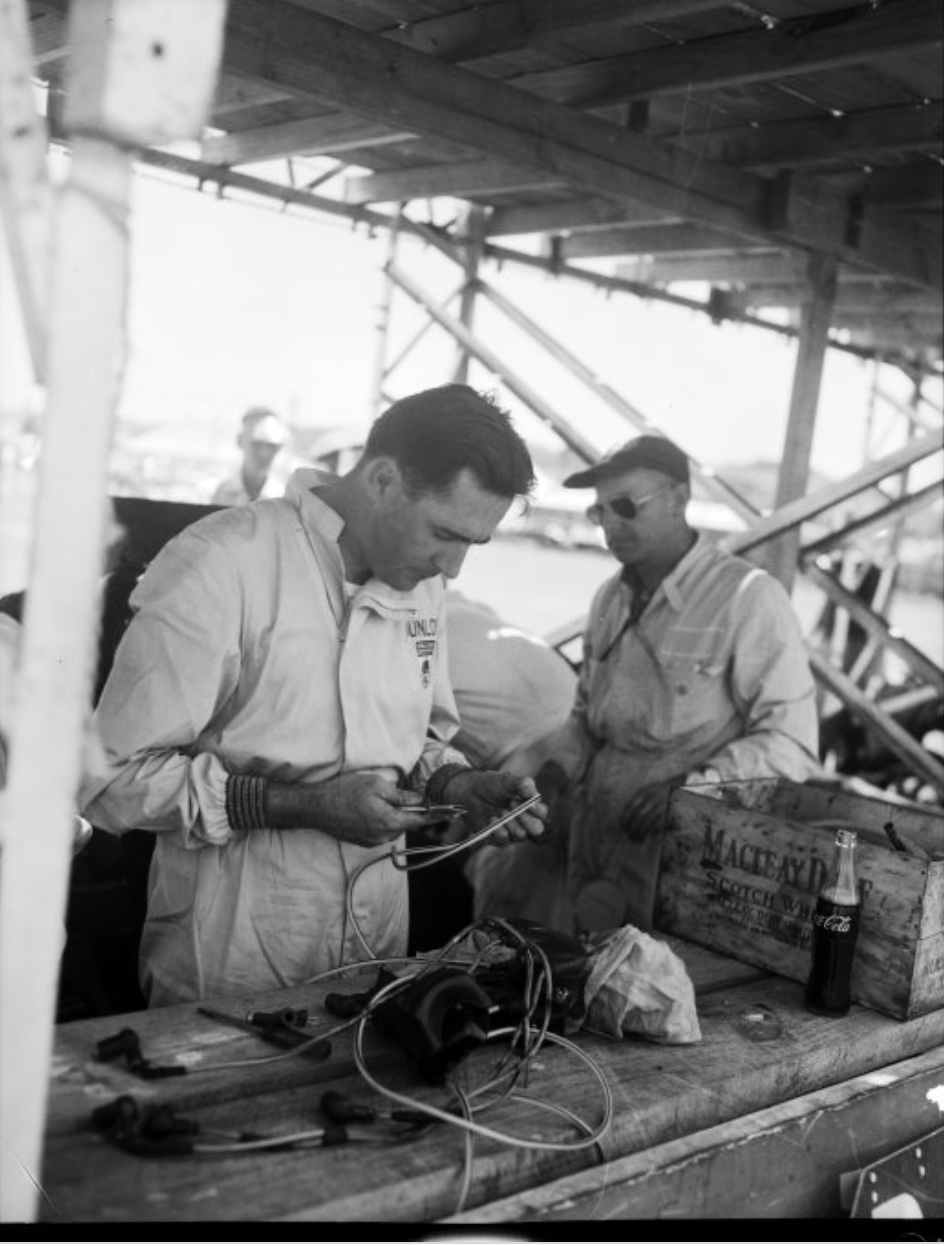
Jack Brabham sorts some Coventry Climax, or more particularly, Lucas electrical problems on the Ardmore pit counter during the 1960 New Zealand Grand Prix, January 9 weekend…

That Brabham’s mechanical abilities were right up there with his talent at the wheel has never been in doubt!

Note ‘the breakfast of champions’ bottle of Coke at the ready. The wooden box of Macleay Duff whisky is more troubling but I think its safe to assume Jack was not mixing the two liquids to assist his quest for greater speed. Not that early in the day anyway.

Brabham at Ardmore 1960, Cooper T51 Climax (Natlib)

Bruce led the race in a Cooper T45 FPF 2.5 ‘brought up to 1959 specs’ wrote Bruce Sergent, whilst Jack’s car was a new 2.5 litre T51.  McLaren’s 3 laps up front ended when he was passed by Moss’ Rob Walker T51, also fitted with a 2.5 FPF.

Brabham and Moss then staged a spirited dice with the lead changing a number of times before ‘Brabham’s determination and slight edge in performance’ put Jack in front on lap 18.

Moss was stopped by a broken clutch-shaft on lap 27- Brabham and McLaren then put on a show for the crowd before a ‘form-finish’- Brabham won from McLaren and then Aussies Bib Stillwell and Stan Jones in 2.2 litre engined T51’s. John Mansel and Arnold Glass followed in Maserati 250F’s in fourth and fifth and best of the front-engined, now, old guard…

(Natlib)

David Piper’s Lotus 16 Climax (DNF driveshaft) from Moss’ Rob Walker Cooper T51 Climax 2.5, #88 Ron Roycroft’s ex-Gonzalez Ferrari 375 (twelfth), Malcolm Gill, Lycoming Special (DNF) then Stan Jones, Cooper T51 Climax 2.2 and Ted Gray, Tornado 2 Chev DNF.

Brabham raced on in Australia after his NZ Tour, click here for that; https://primotipo.com/2015/01/20/jack-brabham-cooper-t51-climax-pub-corner-longford-tasmania-australia-1960/

Credits…

‘Natlib’- National Library of New Zealand, Bruce Sergent on sergent.com

Tailpiece…

(Natlib)

A couple of beaming youths- Brabham and a somewhat bloodied McLaren with the goodies. I doubt Jack thumped him so circuit grit is probably the culprit.

Finito…

So immaculate and spotless is the McLaren factory, make that laboratory really…

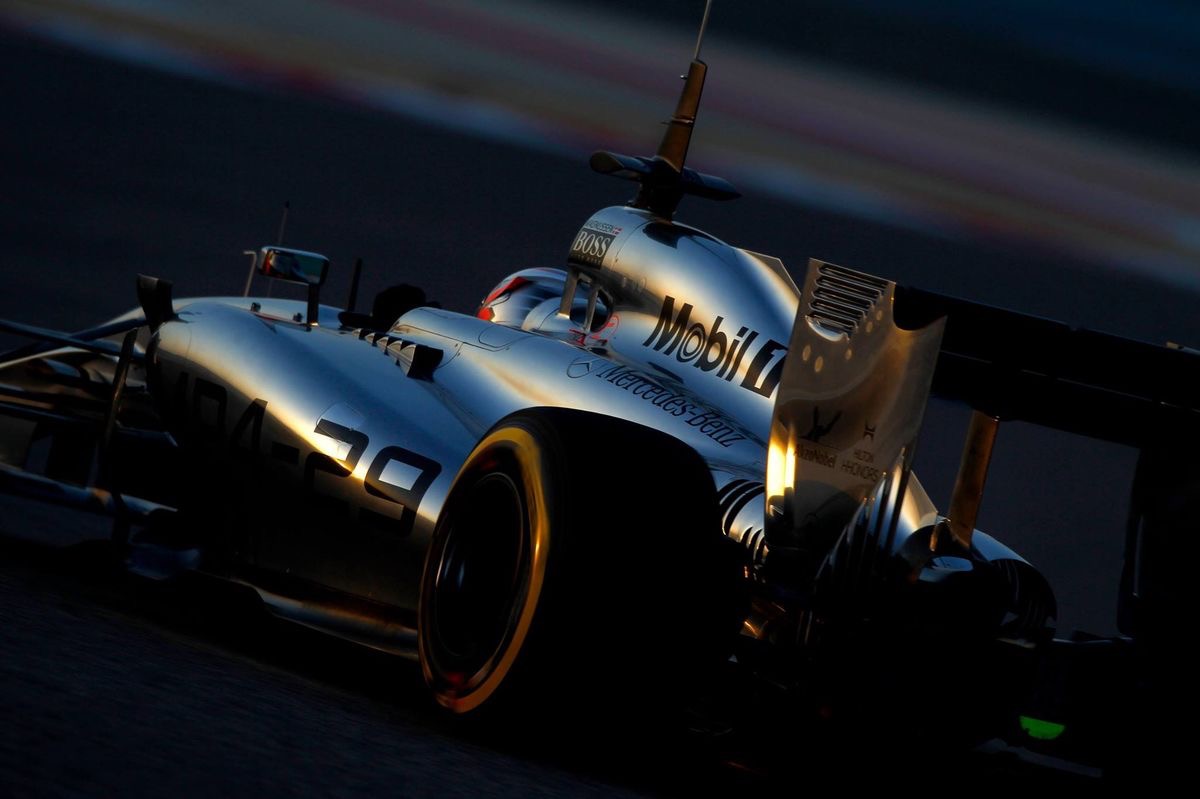
Ron Dennis gives George Osborne, the British Chancellor of the Exchequer, the cook’s tour of the joint- and of Jensen Button’s McLaren MP4/29 Mercedes in the week prior to the 2014 British GP, 27 June.

It wasn’t a great year for the team but a superb one for their engine supplier in a display of dominance which continues to this day- Lewis Hamilton won the title in the Mercedes F1 W05 with eleven wins from Nico Rosberg in the other Mercedes and Daniel Ricciardo, Red Bull RB10 Renault.

The McLaren was a stunning, I didn’t say pretty, bit of kit all the same- the MP4/29 was the end of an era in which McLaren and Mercedes had achieved so much together, it was the last year the Germans supplied engines to the British outfit. They have been in the wilderness ever since.

In the British GP Button was Q3 and fourth with Magnussen Q5 and seventh- the race won by Hamilton’s Mercedes on 6 July, I wonder if Mr Osborne attended the race as The Ronster’s guest?

The new car, designed by a team including Tim Goss, Sam Michael, Simon Roberts and Neil Oatley was launched on January 24 2014 with first tests at Jerez a week later, early on the car looked promising.

In Australia Magnussen and Button were second and third after the disqualification of Daniel Ricciardo for a fuel flow breach, the win taken by Nico Rosberg’s Mercedes, but that performance flattered to deceive- three fourth places by Jenson Button were the best results for the balance of a long year.

A front wing design by new Chief Engineer Peter Prodomou towards the seasons end showed promise- McLaren were fifth in the Constructors Championship behind Mercedes, Red Bull Renault, Williams Mercedes and Ferrari.

McLaren’s lean times continue of course, sadly, the teams last win was scored by Jenson Button’s MP4-27 in the 25 November 2012 Brazilian Grand Prix, a long time ago.

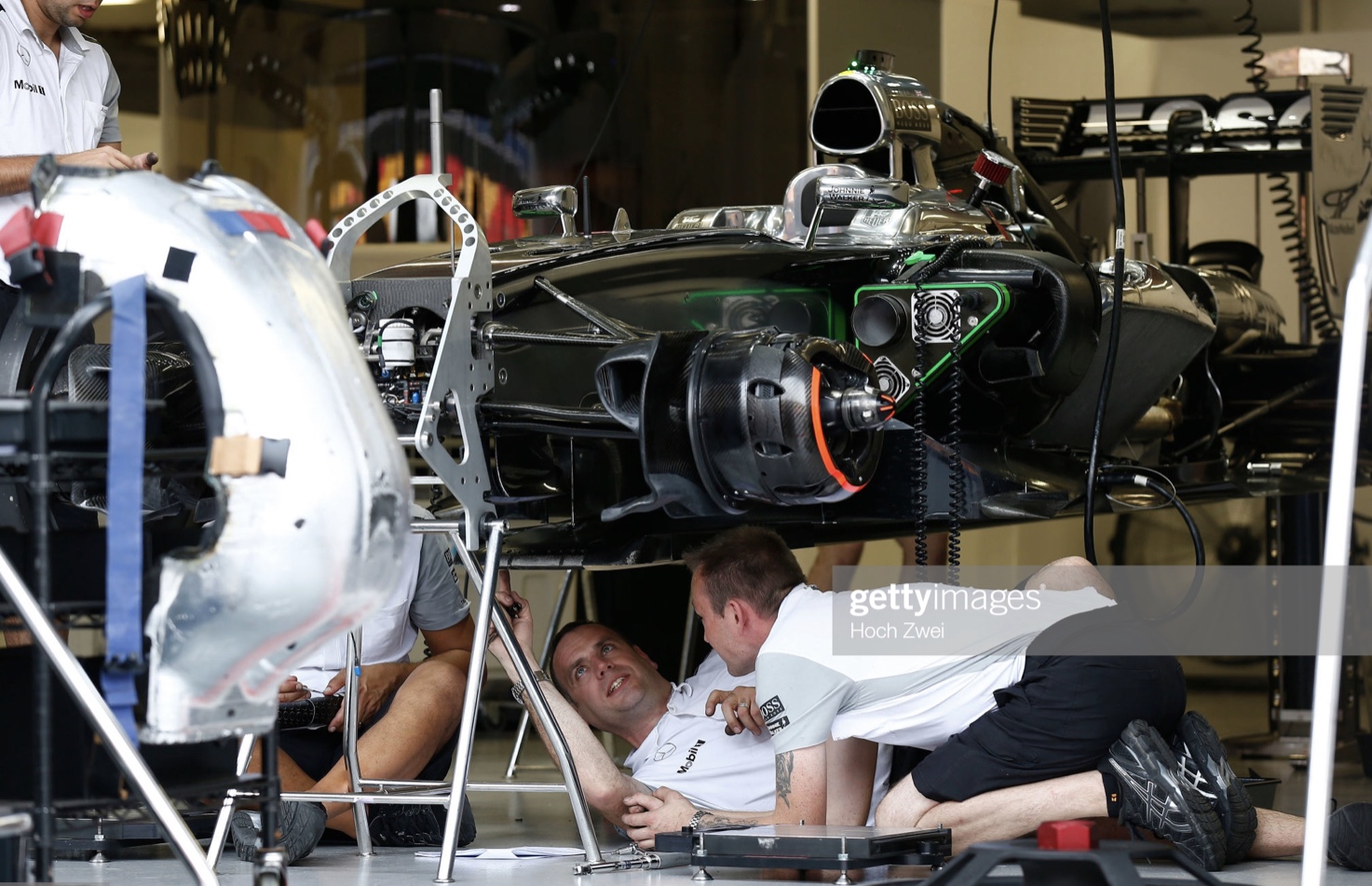
The McLaren boys get to work during the 2014 Singapore GP weekend

Technical Specifications…

Carbon fibre composite chassis and bodywork

Suspension- Front, carbon fibre wishbone and pushrod suspension elements operating an inboard torsion bar and shock system. Rear, same as front but with pullrods

Steering- McLaren power assisted rack and pinion

Brakes- Akebono calipers and master cylinders operating carbon discs and pads, Akebono ‘brake by wire’ rear brake control system

Wheels and tyres- Enkei and Pirelli 12×13/13.7×13 diameter front/rear

Size- 950 mm high, 1800 mm wide, weighs 691 kg inclusive of driver and lubricants but excluding fuel

Engine- Mercedes-Benz PU106A Hybrid. Turbocharged, 24 valve 1.6 litre V6 (80x53mm bore/stroke) with kinetic and heat Energy Recovery System, circa 800-850 bhp

ERS- Integrated Hybrid energy recovery via electrical Motor Generator Units. Energy Store- Lithium-Ion battery solution, between 20 and 25 kg, by Merceds AMG HPP

Transmission- 8 forward and 1 reverse gear, carbon-fibre composite case, McLaren Racing hand-shift. Diff epicyclic with multi-plate slippery diff, carbon/carbon hand operated clutch

Other than that proboscis, the car doesn’t look too bad from above.

Jenson at Monaco, Q22 and sixth- good in the Principality from that grid slot. Magnussen Q8 and tenth- Rosberg’s Mercedes won .

Credit…

Getty Images, F1technical.net

Tailpiece…

(unattributed)

Finito…

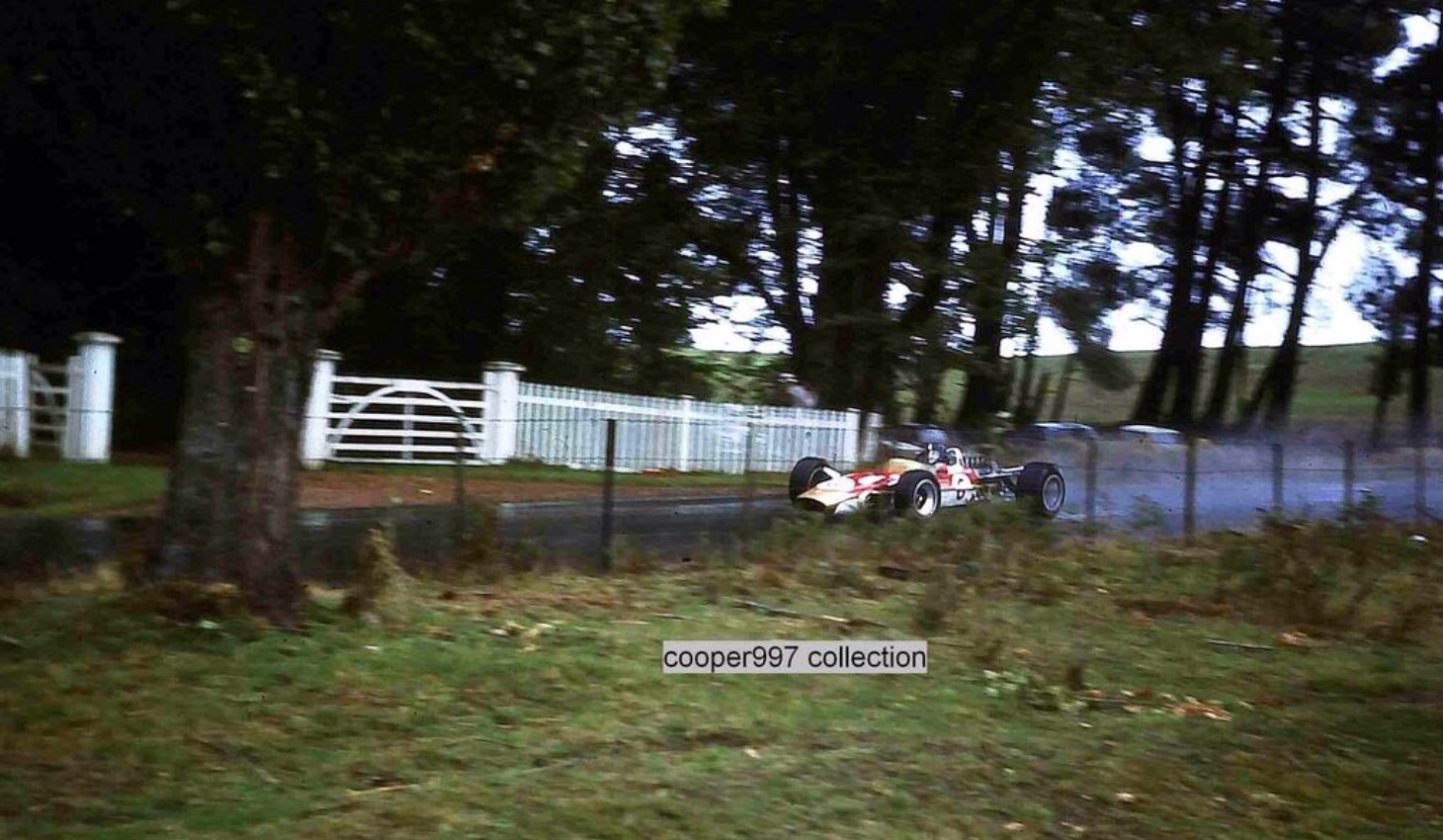
Jim Clark’s Lotus 49 Ford DFW 2.5 on the downhill plunge towards The Viaduct…

Its not the sharpest of images but an interesting one given the ‘different angle’ and Stephen Dalton’s narrative which goes with it.

‘Its Monday March 4 1968, Longford- playing in the rain on his 32nd birthday. After a few laps of mucky weather he is possibly wishing he could whip through the Mountford property gates and have a nice warm cuppa and some birthday cake’ with Ron MacKinnon, the President of the Longford Motor Racing Association.

‘The photo is coming down the hill from the Water Tower to The Viaduct- they are literally the gates to Ron MacKinnon’s Mountford (pastoral) property’ Stephen adds.

I wrote a feature about this race weekend a while back, the highlights of which were perhaps Chris Amon’s exploits in David McKay’s ex-works Scuderia Veloce Ferrari P4/350 Can-Am machine and Piers Courage’s win in the South Pacific Trophy, the very last motor race ever held at Longford in a European F2 McLaren M4A Ford FVA. Click here to read it;

Longford Tasman: ‘South Pacific Trophy’ 4 March 1968 and Piers Courage…

Credit…

Stephen Dalton

Tailpiece: The start…

Finito…

Dunedin 1956 (T Selfe)

The Aston Martin DP155 single seater is surely one of the great marques lesser known models, here at Dunedin, New Zealand in February 1956…

It is significant too as one of the seminal steps in AM’s occasional quest to get into Grand Prix racing. The DBR4/250 cars were tested later in 1957 although not actually raced by Roy Salvadori and Carroll Shelby until 1959 by which time the mid-engine revolution was underway and by the seasons end ‘complete’. The Cooper T51 Climax delivered bigtime on the earlier promise of its predecessors.

I chuckled when I first saw Tony Selfe’s wonderful photo as the most successful individual GP chassis of all time- Tony Gaze’s ex-Alberto Ascari Ferrari 500 chassis ‘5’ is alongside its stablemate Peter Whitehead’s car and one of the least known GP cars of all time in far-away New Zealand! Not that its fair to call DP155 anything more than the test hack it most assuredly was.

There are not a huge number of photos of DP155 extant, whilst not super sharp the shot is useful to be able to further appreciate Frank Feeley’s body design within the constraints of the wide DB3S sportscar chassis upon which it was based and way up high seating position atop the driveshaft.

But lets go back to the start.

The project dates to the early 1950s when Aston Martin Lagonda Ltd first contemplated construction of a Grand Prix car, the first step was intended to be an F2 machine.

The intention was to mate a variant of the 2.6 litre LB6 engine with a DB3 sportscar chassis. An early prototype was assembled in the winter of 1951/2 using a mildly-tuned 2-litre version of the engine, however, Technical Director Prof Dr Robert Eberan von Eberhorst rejected the idea and the car was quickly dismantled and forgotten.

HWM’s John Heath showed interest in the ‘tuned down’ engine for his F2 cars but David Brown knocked that notion on its head.

The CSI announced a new 2.5 litre Formula 1 to which World Championship Grands Prix would be run from January 1 1954- a replacement for the 2 litre ‘F2’ formula of 1952-1953 during which the Ferrari 500’s in works and privateer hands had been dominant.

In Autumn 1953 Aston Martin contemplated F1 once more, but as a low priority, busy as they were with their sportscar programs which made great sense from product development and marketing perspectives.

The project was given the classification ‘DP155’, the car, allocated chassis number DP155-1, comprised a DB3S chassis frame ‘in narrower single seat form’ powered by a 2493cc (83×76.mm) version of the Willie Watson-designed 2.9-litre Aston Martin engine. Doug Nye cites works mechanics John King and Richard Green amongst those involved in the build, whilst Aston Martin’s legendary stylist, Frank Feeley, designed the bodywork.

John Wyer estimated an engine output of circa 180 bhp on alcohol fuel at the time- well short of the Tipo 625 Ferrari and Maserati 250F which developed at least 200 bhp in early 1954.

The twin-plug DB3S engines of 1955/6 developed about 210/215 bhp but by this time the F1 opposition were at 240/250 bhp so ‘it seemed a futile exercise for Aston Martin, whose sports-racing cars were notoriously and persistently underpowered, to contemplate building a Formula 1 car powered by a derivative of these engines’ wrote Anthony Pritchard.

The car was put to one side in the workshop as sportscar programs were prioritised. Click here for articles on the DB3S; https://primotipo.com/2017/09/28/david-mckays-aston-martin-db3ss/, and; https://primotipo.com/2017/10/31/yes-frank-i-love-it-magnificent-in-fact/

Reg Parnell testing DP155 at Silverstone (or is it Chalgrove?) fitted with 3 litre supercharged engine (RAC2)

The DP155 2.5 litre engine was subsequently installed in works Aston Martin DB3S sports-racing car chassis ‘5’, which Reg Parnell drove to good effect in that year’s British Empire Trophy race at Oulton Park- he was third behind Archie Scott-Brown’s Lister Bristol and Ken McAlpine’s Connaught ALSR.

This prompted contemporary rumours that Aston Martin was considering an entry into Grand Prix competition. Such stories were denied but the belief that this was the case intensified when Aston Martin confirmed that Reg Parnell would race a DB3S-based single-seater car in New Zealand during the first months of 1956.

Reg had identified far-away New Zealand races as offering very useful motor racing earnings during the northern hemisphere winter, perhaps in conversation with Peter Whitehead and Tony Gaze who were ‘veterans’ of the trip south to the Land of The Long White Cloud having raced there the two years before in their matched Ferrari 500’s.

The prototype DP155 was dusted off with its original drum-braked 1953 chassis and  fitted with the supercharged 3-litre engine Parnell had used with co-driver Roy Salvadori at Le Mans in 1954.

The supercharged engine then exploded while being tested by Reg at Chalgrove so DP155 was shipped ‘down under’ with a normally aspirated 2493cc engine ‘fitted with special camshafts, connecting rods and pistons’.

The British contingent to New Zealand comprised Stirling Moss, Maserati 250F, the two-amigos Peter Whitehead and Tony Gaze with their Ferrari 750S engined Ferrari 500’s, Leslie Marr’s Connaught B Type Jaguar and Parnell’s Aston Martin.

Sir Leslie Marr (still alive at 97 years of age) is a landscape painter of some considerable note, it was in the formative stages of his evolution as a painter- an interest and capability he explored whilst an RAF Technician during the war, that he also raced cars, contesting amongst other events the 1954 and 1955 British Grands Prix.

Kids Jist Wanna Have Fun. In the Wellington backstreets, just unloaded off a ship and about to be sent by rail to Auckland, Ardmore. L>R Gaze HWM Jag, Whitehead Cooper Jag, McKay Aston DB3S and Moss Maserati 250F (CAN)

The first race of the tour was the Third New Zealand International Grand Prix at Ardmore Airfield, 25 km south-east of Auckland, in the north of NZ’s North Island.

Senior Kiwi motoring journalist Allan Dick wrote a very concise, interesting piece on the development of racing in NZ post-war in his ‘Classic Auto News’, i am going to use elements of that into this article as the history and most of the venues will be unfamiliar to many.

‘As far as can be ascertained, prewar “racing” had been confined to beaches with only one “circuit” race- the 1932 Prosperity Grand Prix run on a road circuit in the Auckland suburb of Orakei- very much a one off.’

‘While there had been motorsport and car clubs before WW2, it was when peace returned that the sport got organised…It had its roots in Dunedin, when, in 1947, Percy and Sybil Lupp and Harry Hedges formed the Otago Sports Car Club…then Harry went south and was one of the prime movers in creation of the Southland Car Club.’

‘With new clubs joining with the old it was decided to form a national umbrella body, which became the Association of New Zealand Car Clubs- the ANZCC…now MotorSport NZ.’

Allan continues, ‘With the new structure, getting circuit racing going became a priority…with no permanent racing circuit in NZ. In 1948 the Canterbury Car Club was determined to hold a race meeting…on the outskirts of Christchurch. The authorities would not approve the road closure…a deputation including Pat Hoare approached the government and approval was given for the use of Wigram Air Force base…it became a regular annual feature for decades.’

‘Inspired by this, the Manuwatu Car Club got the use of the Ohakea Air Force base and staged the first NZ GP there in 1950. In 1951 public roads were closed in Christchurch for the running of a meeting at Mairehau…so…proper circuit motor racing was now well and truly established, but these were temporary airfield or road circuits.’

‘For 1953, Mairehau, Wigram and Ohakea were joined by a fourth- a genuine inner city, “round the houses” meeting near the wharves in Dunedin.’

‘…any “international” aspect to these meetings had come from Australia, but in 1954 the whole motor racing scene shifted up several gears with the first truly international race meeting- the New Zealand International Grand Prix on the air force base at Ardmore…Now we had five race meetings annually- three airfield and two road circuits. Two in the North Island and three in the South.’

The 1954 meeting (and season) contestants included Ken Wharton’s BRM P15 V16, Peter Whitehead, Ferrari 125, Tony Gaze, HWM Alta and a swag of Australians including Stan Jones in Maybach 1, Jack Brabham, Cooper T23 Bristol, Lex Davison’s, ex-Moss/Gaze HWM but fitted with a Jaguar XK engine instead of the F2 Alta unit and others in addition to locals.

Wigram Trophy 1954. Ken Wharton in the extraordinary BRM P15 on pole beside Peter Whitehead, Ferrari 125, Tony Gaze, HWM Alta and Fred Zambucka, Maserati 8CM. Whitehead won from Gaze and Wharton (LibNZ)

The first NZ GP at Ohakea was won by John McMillan, Jackson Ford V8 Spl in 1950, the other two events prior to 1956 were at Ardmore in 1954 and 1955 and won by Stan Jones, Maybach 1 and Bira, Maserati 250F

And so it was that our 1956 visitors looked forward to a summer of great racing with the Moss Maserati a huge drawcard and NZ GP race favourite off the back of Bira’s 250F win twelve months before.

Shipping problems with the Moss car, the two Ferrari’s and Marr’s Connaught- which were sent to Wellington rather than Auckland did not get things off to a good start. The Connaught was deep in its ships hold and had to be flown to Auckland on the eve of the race, hurriedly assembled and run without being properly prepared.

For the other visitors it was missing spares and wheels that were the issues but all was made good by the time of the race.

Moss, Whitehead and Parnell all took 2 seconds off Ken Wharton’s two year old BRM T15 V16 lap record in practice with Moss taking pole from Whitehead, Gaze, Brabham, Cooper T40 Bristol (the car in which he started his championship career during the 1955 British GP- and in which he won the Australian GP at Port Wakefield later in 1955), Ron Roycroft, Bugatti T35A Jaguar and Parnell.

Ardmore 1956 grid. Moss, Whitehead and Gaze #4 up front. Row 2 is the Roycroft Bugatti T35A Jaguar, #6 Parnell, Cooper T38 Jag, Syd Jensen, Cooper Mk9 Norton and Tom Clark, Maserati 8CM on the outside. Frank Kleinig is in the light coloured Norman Hamilton owned Porsche 550 Spyder and probably David McKay’s Aston Martin DB3S beside Kleinig and perhaps Alec Mildren’s Cooper T23 Bristol this side of the Aston (unattributed)
Tony Gaze Ferrari 500 chasing Leslie Marr Connaught B Type Jaguar at Ardmore during the 1956 NZ GP (Ardmore)

Reg had a fraught start to his weekend in that DP155 threw a connecting rod during the second day of practice. He was well and truly up the creek sans paddle without a spare engine but via the good graces of Peter Whitehead raced his Cooper T38 Jaguar in the race, a most sporting gesture (and the car Stan Jones acquired that summer). Click here to read about the car; https://primotipo.com/2019/03/05/mount-tarrengower-hillclimb/

Gaze led for some of the first lap but then Moss romped away for the balance of the 200 mile journey- he had lapped the field by the end of his thirty-third tour. Some late race excitement was provided when a broken fuel lead sprayed fuel into his cockpit but even after a pitstop to top up the cars fuel he won by three-quarters of a minute from Gaze, Whitehead, Marr and Parnell. Brabham didn’t start with gearbox failure- it split as he was warming it up in the paddock.

All the fun of the fair, 1957 Wigram start. The splash of colour on the front row is Ron Roycroft’s blue Ferrari 375 and the red Ferrari 555’s of Peter Whitehead, who won, and Reg Parnell. The green car on the front row left is Brabham’s Cooper T41 Climax (unattributed)
Reg Parnell, DP155 at Wigram (RAC1)

The circus then gathered at Christchurch in the north-east of the South Island for ‘The Lady Wigram Trophy’ held at the RNZAF Airbase 7km from the city on 21 January 1956.

The crew in Feltham ensured a new 2922cc engine was flown out to allow installation in DP155 in time for practice.

Moss had returned to Europe after Ardmore but his 250F was put to good use by Ross Jensen and later John Mansel for the ensuing five years or so.

NZ was to be a happy hunting ground for the Brit who won the countries premier race in 1956, 1959 aboard a Cooper T45 Climax and again in 1962 in Rob Walker’s Lotus 21 Climax not too long before his career ending Goodwood accident.

DP155 finished a distant fourth in the 71 lap Trophy race- up front Peter Whitehead was over 5 minutes ahead of the Aston hybrid- he won from pole ahead of Tony Gaze and Marr. Leslie was 1m 35secs adrift of the winning Ferrari with Syd Jensen the first NZ’er home in his Cooper Mk9 Norton 530cc.

Gaze Ferrari at the Dunedin Wharves- David McKay’s Aston DB3S at left (CAN)
Dunedin heat start- Gaze Ferrari left, the Arnold Stafford Cooper Mk9 Norton in the middle on pole and Roycroft’s Bugatti T35A Jag at right on the second row (unattributed)
Vroom-vroooom-vrooooooom. I can hear the sharp, staccato bark of the 3 litre four as Tony Gaze warms up 500/5 at Dunedin- then the Parnell Aston DP155 and an Aston DB3S (unattributed)
Syd Jensen, Cooper Mk9 Norton on pole for the feature race alongside Gaze’ Ferrari 500 (TA Thompson)

From there the circus travelled south, still on the South Island to the Otago Harbour city of Dunedin for the ‘NZ Championship Road Race’ on 28 January.

The event of 120 km was 44 laps of 2.74 km around the Dunedin ‘Wharf’ Circuit. Not everyone liked the place as the surface was rough and tough and included a section with a gravel surface.

Syd Jensen’s nimble, fast, Cooper Mk9 Norton started from pole with Gaze and Arnold Stafford in a similar Cooper on the outside of the front row. Marr, Parnell and Whitehead were back on row 3- Kiwis Ron Roycroft Bugatti T35A Jaguar 3442cc, Ron Frost, Cooper Mk9 Norton and Tom Clark, Maserati 8CM were on row 2.

Jensen set the crowd afire in the little Cooper harrying the bigger cars finishing third overall and setting the fastest lap of the race.

Gaze won from Parnell, Jensen, Whitehead and Tom Clark. Marr started the race, did one lap to get his staring money and then retired, not impressed with the place at all, with the other overseas drivers complaining that they were unused to driving on a metalled surface where some sections of the track were unsealed.

Parnell head down, bum up whilst Peter and Tony contemplate a post loading cool bevvy. Aston DP155/1 in all of its glory nicely juxtaposed by the industrial surrounds (T Selfe)

Immediately after the Dunedin race these amazing photographs were taken by Tony Selfe of Parnell, Whitehead and Gaze loading their exotic racers onto a low-load railway truck for transport to the next round they were to contest at Ryal Bush, 20 km north of Invercargill, at the very south of the South Island.

Parnell is still ‘suited up’ in his racing kit, the intrepid competitors in the DIY style of the day have helped Tony sip the victory champagne or beer and then taken their machines straight to the adjoining railyards for the Dunedin-Invercargill trip. That chain looks a very butch way to attach the light, alloy Ferrari to the flat rail-car.

Next up is Whitehead’s Ferrari- Peter steering, Tony rear left and Reg at right (T Selfe)

The visitors missed the 4 February South Island Championship at Mairehau but were at Ryal Bush the week later, 4 February for the First ‘Southland Road Race’, a 240 km race- 41 laps of a 5.87 km road course.

Back to Allan Dick’s history lesson on the evolution of NZ circuits.

‘To the farthest south, Invercargill motor racing enthusiasts looked north, and, as one of the founding members of the ANZCC felt it was their duty to join the motor racing scene and they eyed a vacant bit of land on the outskirts of Invercargill on which to build a permanent circuit, but they lacked funds.’

‘But 1956 was Southland’s Centennial Year so it was decided to hold a race meeting on a road circuit to get the sport established and help raise funds. Unlike their Dunedin cousins, the Southlanders opted for a country circuit rather than a city one after plans to close roads around Queens Park failed…they moved into the country and closed three roads around the small settlement of Ryal Bush which included a section of the main road to Queenstown.’

Whitehead was on pole from Marr, Gaze, Clark and John Horton in an HWM Alta 1960cc s/c (ex-works/Gaze) whilst Reg was back on row 3 in the Aston on the stretch of road being used for racing for the first time.

Dick describes the place as ‘…the Reims of NZ- three long straights with three tight corners and high speeds…But unlike Reims, Ryal Bush was narrow and lined with lamp-posts, hedges, ditches, drains and fences. Average speeds were around 150km/h, making it the fastest circuit in New Zealand.’

Given the vast European experience of Whitehead, Gaze and Parnell they should have felt right at home!

(CAN)

Allan writes of the photo above, ‘Photographs of this era are rare. Photographs from Ryal Bush are even more rare. The starters flag has just dropped and the cars are away with a very clear indication of just how narrow the roads were…take your time and drink in the details.’

‘Car #3 is the Ferrari of Peter Whitehead and the Streamliner is Leslie Marr’s Connaught. Car #4 on the second row is Tony Gaze and the antique looking car is Tom Clark in the pre-war Maserati 8CM. Clark had picked and chosen his races this season. Behind Clark is John Horton in the HWM Alta and alongside him is Frank Shuter in the Edelbrock Special.’

‘Also in the photograph can be seen the white Austin Healey 100S of Ross Jensen, the black 100S of Bernie Gillier and the Bugatti Jaguar of Ron Roycroft.’

‘I think it may well have been the start of a heat as there were several other cars entered that aren’t there- including Parnell in the Aston Martin, the Australian Aston Martins (Tom Sulman and David McKay), Pat Hoare’s 4CLT Maserati, Bill Crosbie’s local special and Bruce Monk in the advanced JBM Ford.’

Peter Whitehead won in 1 hour 35 minutes from Gaze, Parnell, Roycroft and Frank Shuter, Cadillac Spl V8 5200cc. Marr retired after an accident on the first lap.

The meeting was a huge success with plenty of money made, preliminary work began on what became Teretonga, its first meeting was in November 1957.

Peter Whitehead, perhaps, in front of Leslie Marr, Connaught at Ryal Bush in 1956- note the row of haybales in front of the wire farm fence and extensive crowd (Southland Times)
Parnell in NZ 1956, Aston DP155 circuit unknown (S Dalton)
Ryal Bush entry list

Peter Whitehead was complimentary about the meeting in an interview with ‘The Southland Times’, quipping ‘We’ll be back next year- if they will have us’- he was too, he won the race in his Ferrari 555 from Parnell’s similar machine.

Peter had some suggestions about how to improve things, these extended to shifting the pits to a slower section of road and that the corners be concreted, apart from that he ‘spoke highly of the race, its organisation and the favourable report he was going to give to the Royal Automobile Club in London.’

The visitors missed the season ending Ohakea Trophy at the airfield of the same name on 3 March, shipping their cars back to Europe- not so Tony Gaze mind you, he sold both the HWM Jaguar sports and the Ferrari 500 to Lex Davison who would also do rather well in the years to come with the ex-Ascari chassis- the 1957 and 1958 Australian Grands Prix amongst its many victories.

Before leaving New Zealand the visitors indulged in some deep sea fishing out of The Bay of Islands for a week before heading home. ‘Whitehead is headed for South Africa, and two important international races, including the South African Grand Prix at Johannesburg- he won the event last year (he won the 24 March Rand GP in March 1956 too aboard the Ferrari 500). Mr Parnell’s next important engagement is the 12 Hour Sebring race in the United States’ the report concluded.

Parnell continued as a works-Aston Martin driver. DP155/1 was put in a corner of the Feltham race shop until it was sold to ‘inveterate specials builder’ and entrant of the RRA (Richardson Racing Automobiles) Specials, Geoff Richardson, who fitted it with a 2.5 litre single-plug engine.

Richardson told Anthony Pritchard ‘I paid about 900 pounds for it and it proved a great source of annoyance to me because John Wyer guaranteed when I bought it that it gave 190bhp. I put the engine on my test bed and got 145/146bhp- Wyer had a twin-plug engine but he wouldn’t sell it to me, I never spoke to him again. I made up a 2483cc Jaguar XK engine for it and got nearly 200bhp on pump fuel.’

Geoff Richardson in DP155/RRA Spl at Snetterton in 1957 (Autosport)
DP155/RRA Special circa 1961 at left and in the early 1970’s at right. Note RRA badge on grille at left, wider wheels and tyres at right (AMOC Register/HAR)

Richardson only raced the car twice before buying an ex-works Connaught B Type and therefore decided to sell it. At the request of David Gossage, the new owner, Richardson rebuilt it in 1957 as a sportscar fitted with the body from the Lord O’Neill DB3S/105- modified at the front with a simple oval radiator intake, it was registered UK ‘UUY504’.

Gossage sold it to a hotelier, Greville Edwards, who had a bad accident in it in which his girlfriend was killed.

Richardson then re-acquired the car and built a replacement chassis using ‘main tubes supplied by Aston Martin’ said Geoff- and further modified it in the rebuild by replacing the torsion bar rear suspension with coil/spring damper units and fitted the de Dion axle with a Watts linkage in place of the sliding guide, also fitted was a Salisbury ‘slippery diff. He modified the nose to make the machine more aerodynamic and finessed a 3 litre crank into a 2.4 litre Jag XK block to give a capacity of about 3.2 litres.

Geoff and his wife ran it in a few sprints and on the road before its sale in 1973. Richard Bell restored the car to original DB3S shape and built a twin-plug engine of correct spec, then the car passed through a couple of sets of hands before being modified to 1955 team car configuration by Roos Engineering in Berne.

The last reported owner is in Tennessee…whilst the line of provenance is clearish the car in the US is quite different to the one Parnell, Gaze and Whitehead loaded onto a train on that gloomy Dunedin evening in February 1956!

DP155 via RRA via DB3S/105 body in 1988 and referred to as chassis 131-DB135 registered UUY504

Etcetera…

Reg Parnell in Peter Whitehead’s Cooper T38 Jaguar at Ardmore during the 1956 NZ GP (sergent.com)

Ryal Bush program signed by Whitehead, Marr, Gaze and Parnell.

Gaze’s Ferrari 500 in the Dunedin railyards 1956 (T Selfe)
Tom Clark’s Maserati 8CM, Dunedin 1956 (CAN)

Photo and Reference Credits…

Tony Selfe, ‘Aston Martin: A Racing History’ Anthony Pritchard, Allan Dick and ‘Classic Auto News’ July 2016 post on Ryal Bush, ‘Hissing Cobra’ by Mattijs Diepraam and Felix Muelas on 8WForix, ‘The History of The Grand Prix Car’ Doug Nye, sergent.com, Aston Martin DP155 thread on ‘The Nostalgia Forum’, Stephen Dalton Collection, Aston Martin Owners Club, The Southland Times, TA Thompson, astonuts.free.fr, Graham Woods Collection

Tailpieces…

(T Selfe)

A crop of the opening shot, Aston Martin DP155 being washed at Dunedin in February 1956, maybe one of you proficient in Photoshop can sharpen it up a bit.

Its just a footnote in motor racing history, but quite an interesting one all the same. It is a shame it lost its single-seater identity, what interest it would create had it survived in ‘original’ specification today.

And below, Reg at Wigram.

(unattributed)

Finito…

(CAN)

Lionel Bulcraig, Aston Martin DBR4/250 3 litre, eighth and last runner in the ‘Waimate 50’ New Zealand Gold Star round on 21 February 1963…

I popped this image up on Facebook a while back and was never satisfied that the car or driver was correctly identified. I strayed onto Allan Dick’s ‘Classic Auto News’ page and got the answer. He wrote, ‘Having made very good sportscars and won Le Mans (in 1959 with the DBR1), Aston Martin toyed with the idea of getting into Formula 1- but they arrived late in the 2.5 litre formula and were swamped by the rear-engined revolution of 1959.’

Aston Martin pulled the plug on the works F1 program but happily sold cars to Lex Davison and Bib Stillwell in Australia- as i wrote a while back Lex came within a car length of winning the 1960 Australian Grand Prix at Lowood, Queensland in his- Alec Mildren’s Cooper T51 Maserati just got home in front after a titanic race long arm wrestle.

See here for that encounter; https://primotipo.com/2018/06/08/mildrens-unfair-advantage/ and this one about Lex and Bib’s Aston passion; https://primotipo.com/2015/09/22/aston-martin-db4gt-zagato-2vev-lex-davison-and-bib-stillwell/

‘Stillwell brought his (chassis number DBR4/250 ‘3’) to New Zealand in 1962 for the last GP at Ardmore then sold it to Kawakawa Car Sales owner Lionel Bulcraig. He raced the car infrequently, this is him at Waimate in 1963 where he was the last running finisher in eighth. Its a rare photograph of a rare car’ Allan concludes.

Indeed it is, mystery solved!

(Ardmore)

Bib Stillwell above in the Aston DBR4/250 during the 1962 NZ GP at Ardmore on the occasion of Stirling Moss’ wet-weather Lotus 21 Climax 2.5 racing masterclass.

He lapped the field in the shortened 50 lap race- John Surtees did unlap himself on the penultimate lap with soggy Bib tenth, six laps in arrears and no doubt wishing he was aboard one of his Coopers.

Click here for an article on Moss’s Lotus 21; https://primotipo.com/2016/04/08/ole-935/

(CAN)

Waimate is a town on the east coast of the South Island 45 km from Timaru, the street circuit was in the local town precinct and 2.25 Km in length.

During that summer of 1963 Bulcraig contested the NZ GP at Pukekohe for Q12 of 17 and DNF in the race won by John Surtees’ Lola Mk4 Climax 2.7 FPF. He DNF at Wigram from mid-grid after colliding with Jim Palmer’s Lotus 20B Ford. He missed the next, Teretonga, round but raced at Waimate for eighth having started from row 2- Palmer won that day.

(CAN)

Several other shots of the 1963 Waimate 50 below.

Tony Shelly, Cooper T45 Climax 2 litre, #27 Ken Sager Lotus 20 Ford, behind him in #20 is John Histed, Lola Mk2 Ford with Arthur Moffat in the Lotus 15 Climax. #44 is Doug Lawrence, Lola Mk1 Ford, #1 is David Young, Cooper T65 Ford FJ.

Allan Dick advises further back is #2 Frank Turpie, Lotus 20 Ford with Barry Cottle’s Lola Mk1 Climax. Cooper T51 Climax #9 is Bill Thomasen, whilst the red car at the rear is Bulcraig’s Aston Martin.

Missing from this wonderful shot is the front row- Jim Palmer, Lotus 20B Ford- the winner, Roly Levis, Cooper T52 Ford and Maurice Stanton, Stanton-Corvette V8.

(CAN)

Tony Shelly has run out of road below, Cooper T45 Climax.

He overshot the corner into the short leg of the main straight. The hay-bales and water-filled drums separated the cars ‘coming and going’ up and down the main street.

(CAN)

Another section of the track with N Cleland’s unidentified mount ahead of WR Baker in a Cooper Norton- it looks like a lot of fun if somewhat perilous!

(CAN)

Credits…

Allan Dick- CAN- ‘Classic Auto News’, Ardmore, NZ Classic Driver

Tailpiece: Len Gilbert, Cooper Bristol, Waimate 1960…

(NZ Classic Driver)

Love this shot of Gilbert’s Cooper Mk 2 Bristol ‘sports’ which rather captures the spirit of the time and place rather well. Len is coming out of Queen Street during the February 1960 meeting.

He was sixth in the race won by John Mansel’s Maserati 250F.

Finito…

(T McCavoy)

Hermano da Silva Ramos, Gordini T16 on the way to a splendid fifth place in the 1956 Monaco Grand Prix…

The French born Brazilian driver was advantaged by a race of attrition, he completed only 93 of Moss’ winning Maserati’s 100 laps, but hey, a points placing was just reward for a good, quick, reliable run by a design which was rather long in the tooth by then.

What a fascinating topic Gordini is.

My interest was piqued by tripping over the photograph of the Gordini T16 engine below, a good supply of largely ‘unseen’ images in the Getty Archive was another source of encouragement. What started as an article on the T16 morphed into one tangentially on Amedee’s final GP machine, the straight-eight T32, at that point the article was pretty much finished.

Then I went to Europe for a holiday and saw a swag of Gordinis in the Cite De L’Automobile in Mulhouse and got interested…So if the thing lacks a logical flow its coz it grew like Topsy from a 500-word-quickie into a not particularly well structured feature.

I guess for me the marque has ‘flown under the radar’ a bit as none ever came to Australia and few if any race globally in historic events. There aren’t many of them in circulation at all when you deduct the 14 Schlumpf Collection Mulhouse cars from the 32 built not all of which survived in any event…Here goes, with a focus on the single-seaters I might add.

Amedee Gordini, Simca Gordini T11, Circuit of Monthlery, 1946
The two T32 straight-eights and Types 15 and 16, Mulhouse (M Bisset)

Amadeo Gordini was born in 1899 at Bazzaro near Bologna, his horse-dealer father died when he was 3, the boy quickly developed an interest in all things mechanical, its said he took an apprenticeship at 10! in a Bologna engineering shop. Aged 11 he moved to a Fiat dealership where he swept the floor and cleaned spare parts, but he was on his way, aided and abetted by the foreman of the garage who saw his potential, his name was Eduardo Weber, who went on to rather well for himself!

At 14 he moved to Isotta-Fraschini where he worked under Alfieri Maserati and after serving in the Italian infantry during WW1 he returned to them, building his first car using a combination of I-F and Bianchi parts. He then moved to Mantova and began a tuning business for Hispano-Suiza’s before holidaying in Paris and deciding to stay, initially working for Cattaneo, the French specialist in Hispanos but in 1925 he set up his own business in Suresnes, close to Henri-Theodore Pigozzis’ assembly plant.

Amadeo had become Amedee, married, had a son named Aldo and together with his half-brother Athos started tuning Fiats. His lucky break came about when Angelo Molinari, who had a string of dance venues, became a friend and client of Gordini who was given a brief by Molinari to do ‘whatever he liked to make his brand new Fiat Balilla Sport go as fast as possible’ for the coming 1935 season.

Gordini in the modified Molinari owned Balilla on the way to a class win at the GP D’Orleans in 1935 (Fiat)

Whilst Gordini’s intial efforts made the car go slower!, work at Fiat and in Gordini’s garage soon had the thing flying, to such an extent, that outside France, the new Simca product became known via the performance of Gordini’s distinctively modified cars.

By the important Bol d’Or in May 1935 Gordini had a revised Balilla with an aluminium body, superior gear ratios and higher compression ratio. When Molinari didn’t turn up, Gordini drove and won the touring class, the race car whizz/racer reputation was underway after the same 24 hour race.

In November 1934 HT Pigozzi formed Ste Industrielle de Mecanique et Carosserie Automobile or SIMCA (Simca) to assemble the Balilla – after his Bol d’Or win he was awarded 20,000 francs – firm commercial support was underway which would be maintained until after the 1951 Le Mans classic.

In 1936 he took a class win at Le Mans in a modified 508S Spyder, in 1957 he created special versions of the new Topolino and it is here ‘where the Simca stops and Gordini begins becomes moot’, according to Pete Vack. Into 1938 he campaigned both 508S open sportscars and Cinq streamliners, one of the latter cars won the Index of Performance in 1938.

Gordini on the way to 10th place and Index of Performance win at Le Mans in 1939 (G Gauld)

In the last year before the war Gordini and Jose Scaron drove the ‘now famous streamlined Simca Huit ‘chassis number 810404’ to an 1100cc Le Mans class win and the Index of Performance.

Britain and France declared war on Germany on 2 September 1939, Amedee was initially engaged by Automobiles Talbot and then Simca as Production Director as the conflict grew. He rented premises at 34 quai Gallieni to store some of his cars and after the French surrender to the Germans in June 1940 acquired the business and premises of the Desmarais Brothers at 69-71 Boulevard Victor in the 15th arrondissement and commenced business there.

Not long after, in the summer of 1941, his operation began to be supervised by the Nazi controlled Todt Organisation, this continued for the duration of the war, the German concern was responsible for marshalling French companies into completion of a huge range of engineering projects.

Post war Amedee quickly picked up where he had left off prior to it despite the theft of his machine tools and some of his cars by retreating Germans. Some were hidden before the war was underway including 1937 and 1938 Sports, the 1939 Le Mans chassis, an old Fiat Balilla as well as Molinari’s open Sport.

In June 1945 it was known that the first post-war race meeting, a three event program was to be run through the Bois de Boulogne public park in the middle of Paris on 3 September. Amedee won the first race of the day, the ‘Coupe Robert Benoist’ for unsupercharged 1500cc cars aboard the 1939 Le Mans winning chassis.

Following this meeting various racing organisations started to make plans to race again from 1946. Mooted was a 4.5-litre unsupercharged/1.5-litre supercharged ‘international formula’ and a ‘small capacity formula’ for cars of 2-litres and under, unsupercharged. The latter was tailor made for Gordini.

Gordini aboard his new Simca Gordini T11 at St-Cloud in June 1946

Whilst many concerns chose to race old cars, Gordini decided to build a new one. Simca expressed interest in supplying Fiat-Simca engines with the Simca design office in Nanterre instructed to help re-establish the Gordini works.

Amedee’s very narrow chassis comprised two longitudinal 72mm chrome/molybdenum tubes forming parallel side frames to which a lightweight tubular framework was attached, and the duralumin bodywork added. Front suspension was Simca 8 derived, whilst at the rear an adjustable torsion bar was linked to a cranked device. The idea was snitched by Amedee and Aldo Gordini from a Wehrmacht NSU track vehicle they studied whilst repairing the machine during the occupation.

The cast iron, three bearing, OHV 1089cc engine, gearbox (4-speed in 1946, 5-speed in 1947) and live rear axle were Simca 8. Without going into the detail, the first engine in ‘GC1’ developed 55bhp @ 5500rpm whilst later five bearing aluminium headed engines developed 70bhp @ 6000 rpm by 1949.

When completed, Gordini whizzed the finished car – given chassis number ‘GC1’ and type number T11 – up and down Boulevard Victor on 20 April and then drove it, sans rego and muffler from Paris to Nice! with a Simca 8 van following containing his crew.

The ‘Simca-Gordini T11’ did not win the Coupe de la Mediterranee but the ex-Le Mans chassis did, Amedee was slowed by an accident, but he did win the Coupe de l’Entraide event at the Marseilles Grand Prix meeting on 11-13 May.

Gordini was away…By this stage Simca had announced it was giving official support to Equipe Gordini with all French Simca agents making a financial contribution. In addition, Gordini had access to the Nanterre design office and workshops to create prototype parts, more machine tools were sent to Boulevard Victor plus a couple of engineers.

Five T11s were built, the T15 followed and had a shorter chassis but maintained the wheelbase. These had torsion bars fitted within the chassis tubes and were reinforced by a third chassis crossmember to take the future 1500cc T15 engines. The T15’s raced through into 1951, the 1988cc T20 six-cylinder engined T16 F2/F1 made its appearance in the GP Marseilles in the hands of Robert Manzon on 27 April 1952

Gordini’s little cars were effective in F2 and some F1 races. Amedee’s F2 pushrod T15 1490cc and DOHC T16 1490cc engines – when Maserati/Roots supercharged – produced 164bhp (T15C) and 173bhp (T16C) and thereby became F1 motors, but results were poor against formidable, purpose designed, GP cars.

After a year of shocking reliability in F1 and F2, as well as the failure of all four 1500cc Equipe Gordini T15S at Le Mans in 1951, Simca withdrew their financial support.

‘It seems probable that Simca’s management had been seeking an excuse to cut their funding of Le Sorcier’s hobby-cum business, and this was it. Within days a terse statement from Simca announced severance of all links with the Boulevard Victor team. From that point forward the marque became simply ‘Gordini’- ‘Simca-Gordini’ no more’ wrote Doug Nye.

Gordini T16, French GP paddock, July 1953, 2 litre straight-six

So for 1952 Amedee went it alone.

No doubt he was delighted to be able to make his own decisions but his ongoing funding source for many years had to be replaced, this was quickly achieved with a variety of French trade suppliers eager to support this born racer.

He built a new Type 20 1987cc ‘square’ (75 x75 mm bore/stroke) six cylinder, all alloy engine.

Wet cast iron liners were used and seven main bearings – nice and strong. The twin overhead camshafts were driven by a train of gears with the valves controlled by rockers. Solex twin-choke 38 carbs were fitted initially and then Weber 38DCO3 (as above) later. Ignition was by Scintilla Vertex magneto with a power output of between 157-175bhp @ 6500 rpm claimed.

The light, new motor was fitted to a new T16 chassis – similar to that which had gone before – with tubular longitudinal beams and cross members with independent suspension by torsion bars at the front and a rear live axle, the Type 16 gearbox was a four speeder.

Robert Manzon raced the car and a youthful Jean Behra joined the team in 1952.

Behra, The Karussell, Nürburgring 1952 – fifth. Ascari, Farina and Fischer first to third in the dominant Ferrari 500 (B Cahier)
Equipe Gordini prior to the 1952 French GP, Reims, car a T16. Car in shot is Behra’s seventh placed car. Car to the right is a T16 but no Gordini with that number took the grid – it’s either a spare or a racer still to have its correct number affixed.

The season started well with Behra’s third in the GP de Pau in April with Bira and Manzon sharing a T15 to second, and Johnny Claes third in the GP de Marseilles, the winner was Ascari’s Ferrari 500.

Behra was then third in the championship Swiss GP at Berne behind two Ferrari 500s of Ascari and Fischer. Jean followed that up with a win in the Circuit du Lac, Aix-les-Bains- T16, taking both heats.

On the most supreme of power circuits, Spa, for the Belgian GP, Manzon was third behind the two Ferrari 500s of Ascari and Farina and ahead of Hawthorn’s Cooper T20 Bristol.

In a rousing day for the team in a strong year, Behra famously won the GP de la Marne at Reims, another power circuit, on a very hot June day winning in front of the works Ferrari 500s of Farina and Ascari with Bira fourth and Claes sixth in other Gordinis. Down the years there have been suggestions that Jean’s engine may have been ‘fat’- a proposition Doug Nye thinks on balance is incorrect.

At Rouen for the French GP Manzon and Trintignant were third and fourth behind a trio of Ferrari 500s led by Ascari. Both French drivers were contracted to Ferrari that year but raced for Gordini when not required by the Scuderia.

In July Trintignant won the GP de Caen at La Prairie, Caen from Behra, their T16’s in front of Louis Rosier’s Ferrari 500. Then it was off to the Nurburgring, Behra was fifth behind four Ferrari 500s again headed by Ascari. In Holland Manzon and Trintignant were fifth and sixth.

1952 was an exceptional year for the not so little team which would be tough to follow. Doug Nye wrote that by the end of that year Amedee employed 50 people, his revenues comprising start, prize and bonus money, he was without blanket sponsorship or Government support.

Despite that, the concern didn’t have the funds to develop a new car or fully exploit the potential of its new engine so ‘Now the cars would be almost literally driven into the ground in an all out scramble to start as many races as possible, purse money from one meeting financing the journey to the next’, Nye wrote.

Maurice Trintignant, Gordini T16, 1953 French GP Reims DNF transmission, Hawthorn won in the famous race long dice with Fangio, Ferrari 500 from Maserati A6GCM. Best placed T16 Behra in 10th (unattributed)

The 1953 season started well with Schell’s third in the GP de Pau in April. Fangio was third and Schell fourth at Bordeaux in May behind two Ferrari 500s – continuing the trend of the previous year when of course, Alberto Ascari won his second World title on the trot – both drove Gordini T16’s.

Off to Chimay, Belgium in late May, Trintignant won with American Fred Wacker third in T16s splitting the Laurent Ferrari 500.

The Dutch GP was the first championship round in 1953, there Trintignant was sixth, Ascari won. Spa followed later in the month, again Trintignant was sixth and Schell eighth. At Reims and Silverstone the T16s were all DNFs, the Nurburgring and Bremgarten equally grim.

At that stage of the season a 1-3 at the GP de Cadours even against skinny opposition must have been a fillip – Trintignant led home Schell and Behra – Trintignant and Schell taking a heat each.

In better championship reliability if not speed, Trintignant was sixth and Mieres eighth in T16s with Fangio taking a welcome win for Maserati in his works A6GCM at Monza.

Fred Wacker, Gordini T16, Monza 1954, a great sixth place in the race won by Fangio, Mercedes W196 (B Cahier)

The 2.5-litre F1 commenced in 1954.

With the simple expedient of enlarging the engines size to 2473cc (80 x 82mm), Amedee had a solution he dubbed Type 23. Depending upon specification and and fuel, between 198-228bhp was produced @ 6500rpm. Amedee had the T23 engine completed early enough to race it at Le Mans in 1953, the sports-racer finished fifth.

Whilst the T16 was the lightest of the 2.5-litre cars, the updated engine was low on power compared with most of the opposition, whilst the chassis – which retained a rigid rear axle – was from the dark ages compared to the Mercedes W196 or even the De Dion brigade exemplified by the Maserati 250F, surely the customer GP car of the era.

Gordini was commercially astute, focusing on non-championship events to get start and finishing francs to keep the show on the road – Behra’s Pau GP win in April, his third in the GP di Bari in May, Pilette’s second at the GP des Frontieres in June, Behra’s win from Pilette in the Circuit de Cadours and Behra and Simon’s Silverstone International Trophy second and third placings were amongst the standout performances in 1954.

Amedee Gordini and Bira, wincing, just before the start of the 1954 French GP at Reims. Bira fourth in a Maserati 250F. Fangio won from Kling upon the Merc W196 race debut
Behra, Spa 1954 DNF suspension with Andre Pilette fifth in another T16, top result. Fangio won in a 250F (unattributed)

At championship level, Pilette was fifth at Spa, the race won by Fangio’s Maserati 250F – before he headed off to Mercedes – with Trintignant second in a Ferrari proving the speed Maurice had shown for years in Gordinis.

Behra was sixth at Reims , Pilette ninth at Silverstone, Behra tenth at the Nurburgring and Fred Wacker a great sixth at Monza (his story would be an interesting one for all of us unfamiliar with the man).

Gordini straight-eight detail (Bonhams)

Gordini had been developing the ambitious new T32 F1 car in 1954, it appeared in mid-1955, but the season commenced with the team still campaigning the good ‘ole T16 – at championship level they were really ‘start money specials’ by this stage.

In Argentina Jesus Iglesias and Pablo Birger failed to finish. At Monaco, Bayol and Manzon were DNFs but Jacques Pollet was a good seventh albeit nine laps behind Trintignant’s victorious Ferrari 625. Matters were not made easier by Jean Behra’s well deserved move to Maserati that season, his fire and speed was missed.

The pickings in non-championship Grand Prix races became much tougher from 1955 when customer Maserati 250Fs were in a growing number of hands, these were winning tools ex-factory. In that context Jacky Pollet’s fourth behind three 250Fs- with ex-Gordini pilot Andre Simon the winner, at Albi, was pretty good.

Gordini T16 Monaco vista in 1955- Jacques Pollet T16 seventh (Getty)
The boss has a steer of the new T32 at Montlhery in mid-1955
(Theo Page)
Jean Lucas during practice at Monza in 1955, Gordini T32 (unattributed)

The team gave Spa a miss but contested the Dutch GP at Zandvoort yielding eighth place for Hermano da Silva Ramos with Robert Manzon a DNF. At Silverstone for the British Grand Prix – won by Stirling Moss in a Benz W196, his first championship GP win – Mike Sparken was seventh with poor Manzon again a DNF, as was Ramos.

The debut of the Type 32 Gordini was scheduled for the French GP, but the Reims classic was cancelled off the back of the Le Mans disaster, the car finally made its first race appearance at Monza in September.

This striking and innovative car had a new Type 25 2473cc straight-eight engine (75 x 70 mm bore/stroke) with twin-overhead camshafts driven off the front of the crank, four twin-choke Weber 38 carbs and single plugs fired by a Scintilla Vertex magneto for which 210bhp in 1954, and 250bhp @ 7000rpm in 1957 was claimed. The later Type 25 ‘2 or B’ engines had a capacity of 2480cc. The motor was mated to a five speed, all syncho gearbox.

The chassis was of the simple ladder type with independent suspension front and rear by torsion bars which operated a pair of L-shaped links pivoted to the side, and cross-members of the chassis, together with Messier dampers.

Jean Lucas was given the honour of racing the car,he lasted only eight laps having qualified 22nd amongst a grid of 23 cars. Pollet and Ramos in T16s were both DNF’s.

Elie Bayol and Andre Pilette, Gordini T32, sixth Monaco 1956. Moss the victor in a 250F

Into 1956 Mercedes Benz had withdrawn from racing with Ferrari progressing development of Lancia’s D50 design, having inherited the cars the year before.

The Lancia Ferrari D50 won the 1956 Drivers Championship for Fangio and the Manufacturers title for the Scuderia – and proved the strength of Vittorio Jano and his team’s original design – whilst noting the development work carried out on the car at Ferrari.

Other contenders that year included Vanwall, the chassis of the car designed by Colin Chapman, Maserati with the development of the 250F ongoing, and which had not yet peaked, Connaught-Alta and Bugatti.

The Bayol/Pilette Gordini T32 being passed by winner Moss, Maserati 250F (B Cahier)

Francs were very tight at Boulevard Victor, whilst Amedee funded the construction of the T32 he did not have the money to develop the interesting design, which, whilst promising was heavy and less nimble than its predecessors.

The team missed the opening championship round in Argentina. In Monaco Bayol and Pilette shared the T32 and finished in sixth place having started from Q11 of 16 cars. Hermano Da Silva Ramos’ fifth place was commented upon at the articles outset. Moss won aboard a works 250F from the Collins/Fangio Lancia-Ferrari D50 and Jean Behra’s 250F.

Ramos on the way to 8th at Reims, French GP in 1956, T32. Peter Collins won in a Lancia Ferrari D50 (LAT)

A high point of the season was Manzon’s T16 win at Posillipo, he won the 6 May GP di Napoli in front of the 250Fs of Horace Gould and Guerino Gerini. The works Lancia D50’s of Castellotti and Musso raced but failed to finish with mechanical problems. Nonetheless it was a good win in what were now old warriors of cars.

It was a busy weekend for the team, in the UK Ramos and Pilette in T16 and T32 contested the 5 May BRDC International Trophy at Silverstone. A typically strong 20 car field entered, devoid of works Maseratis but Vanwall, BRM, Ferrari, Connaught as well as Gordini were present. Indicative of the T32’s pace is that Moss was on pole in Vanwall VW2 12 seconds quicker than Ramos and Pilette who did identical times in T16/T32. Ramos was fifth, 5 laps adrift of Moss up front, whilst Pilette in the eight cylinder car failed to finish with rear axle problems after completing 37 laps.

Enthusiasts at Silverstone flock around the unfamiliar Andre Pilette T32, a much bigger and heavier machine than its T11, 15 and 16 predecessors. Silverstone Int’l Trophy 1956 (Flickr)
Trintignant, Bugatti T251 and Manton, T32 early in the French GP- Bug DNF after 18 laps with sticking throttle and Manzon ninth (unattributed)

The team did not contest Spa but of course raced at home, Reims. There Ramos was eighth and Manzon ninth aboard the two T32s from grid slots 14 and 15, 20 cars practiced. Pilette was eleventh in his T16. This was the race in which the amazing in some ways, ridiculous in others (suspension) mid-engned, straight-eight Bugatti T251 had its first and last appearance in the hands of Maurice Trintignant. Peter Collins won that day in a Lancia-Ferrari D50.

Manzon was ninth in a T32 from Q18 at Silverstone in July, Ramos a DNF from grid 26 in the other eight. At the Nürburgring both Andre Milhoux and Manzon were DNF’s in T32s whilst Pilette crashed his T16 in practice. In August Andre Simon was second in his T16 behind the Schell 250F but in front of Roy Salvadori’s similar machine in the GP de Caen, where there were five 250Fs entered in the 13 car field with Manzon’s T32, DNF fourth on the grid.

But that was it in a year in which grids F2 grids grew with Coopers and Lotus – times were a changin’.

Amedee Gordini, Gordini T32, Monza, September 1956

Da Silva Ramos won the Montlhery Autumn Cup in one of the eight cylinder cars.

At Monza in September Ramos suffered an engine failure in the T32 after only 3 laps – oh to have heard the car bellowing along Monza’s long straights! He qualified twentieth of the 26 cars which practiced. Andre Simon was ninth in a T16 and Manzon, yet again, a DNF, with gearbox failure this time in the other T32.

Into 1957 the financial pressures were becoming insurmountable, the equipe only entered two races, a week apart in April before the francs finally ran out.

Amedee took the team to Pau and ran Ramos in a T32, sixth, and the Andre’s – Guelfi and Simon – in T16s for seventh and DNF. The race was won by Behra’s 250F from Harry Schell’s similar car. I wonder if Jean ever tested the T32?, it would have been fascinating to know what the feisty-Frenchie thought of the car and what sort of times he could have extracted from the attractive but somewhat hefty machine.

Posillipo had been a happy hunting ground for the team before so the they headed south to Naples running Ramos alone in T16 ’35’ used by Guelfi the week before. He failed to finish with brake problems after completing only 14 of the events 60 laps, Peter Collins won from Mike Hawthorn in Lancia Ferrari D50s.

And that was it for a team which had been a mainstay of European racing from the very start of the post-war years.

‘Not a single French manufacturer stepped in to support Gordini…they just waited for the chance  to snap up Amedee’s services once his racing enterprise had gone bankrupt’ wrote Diepraam/Muelas. Gordini approached Pierre Dreyfus at Renault with some ideas about a Dauphine Gordini heralding the commencement of a new era for the born racer.

Amedee sold ten of his cars to the Schlumpf Brothers in one ‘job lot’ in 1964 and another 26S in 1968 where they can be seen on display to this day, in the Cite de l’Automobile at Mulhouse.

Renault kept his name alive inclusive of atop the cam covers of their 1977 epochal GP turbo-charged V6 1.5-litre engine, a prospect Amedee would have never thought of in developing his own supercharged 1.5-litre four a couple of decades before.

Amedee during a soggy and windy test of the Dauphine Gordini at Montlhery in 1957 (Moteurs Courses)
Amedee stands with two of his projects in 1970 – Renault 12 and 8 Gordinis (Renault)
Renault RS01, 1978 Italian GP. Renault Gordini EF-1 V6 t/c

1946 to 1951…

This section of the article is a season by season ‘summary’ from 1946 to 1951 looking at the years not covered in the first half of the article.

The photograph above shows mechanics preparing Amedee’s Simca-Gordini T11 chassis ‘1GC’- the ‘very first’ Gordini before the Coupe du Conseil Municipal, Saint-Cloud, Paris in June 1946. DNF engine after completing 3 laps, the winner was Jose Scaron in a Simca 508C- 20 laps of a 6km course in central Paris.

In 1946 Jose Scaron won the April Coupe de la Mediterranee, Nice in a T8 with Amedee taking the GP du Forez at St Just, Forez, the GP de Bourgogne at Dijon and Coupe de Nantes, Nantes in T11s.

Bira, Manx Cup 10 August 1947 T11- first in the 75km race. #43 is Peter Clark’s last placed HRG Singer (unattributed)
Bira in the Reims paddock before winning the July 1947 Coupe des Petites Cylindrees during the Reims GP weekend

1947 triumphs with recruited drivers Jean-Pierre Wimille, Maurice Trintignant and B Bira included the Coupe Robert Benoist, Nimes – Jean-Pierre Wimille in an S-G T15, Bira leading a Gordini 1-2-3 at Reims in the Coupe des Petites Cylindrees in July where the Prince beat home Jose Scaron and Maurice Trintignant in a great weekend for the team.

Wimille’s second in a T15 amongst all the heavy metal in the July GP de Nice was impressive, equally so victory in the Coupe de Paris in the Bois de Boulogne again amongst more powerful cars in the same month.

Bira and Raymond Sommer were 1-2 in T11s at the Prix de Leman in Lausanne in October to round out a strong year for Equipe Gordini, top-line drivers extracting all that was available from the light and responsive cars which were at their best on tight circuits.

In the winter of 1947/8 the team contested the Argentine Temporada series with a talented local, one JM Fangio having a drive of T11 ‘4GC’ at Rosario and breaking the lap record.

JP Wimille in T11 ‘4GC’ at Monaco in 1948 (LAT)

Into 1948 Maurice Trintignant started the year well with a win in the GP du Rousillon at Perpignan in April in front of Manzon’s Cisitalia D46 Fiat and Sommer’s Scuderia Ferrari, Ferrari 166SC, and then proved the reliability of the Gordini’s with fourth place in May at the over three hour Monaco Grand Prix, a race he would win in 1955 aboard a Ferrari.

The GP de Geneve, in Geneva was a 1-3 Sommer, Bira and Manzon in T11s ahead of a swarm of Cisitalia D46s, six of them in a race dominated by the entry of the two marques.

In sports cars the Equipe were class winners in the Spa 24 Hours and victorious at the Bol d’Or.

The 1949 season commenced on a shocking note when Wimille rolled a T15 in practice at Palermo Park prior to the General Peron GP in Buenos Aires, he swerved to avoid spectators on the course and died after crashing into a tree.

Best results in that years Grands Prix were Fangio’s win in the GP de Marseilles aboard a T15 1.5 with Trintignant third.

In F2/Voiturette events Aldo Gordini won the Coupe d’Argent at Montlhery in April, Trintignant and Jean Thepenier shared a T11 to win the Circuit des Remparts at Angouleme. Equipe Gordini had a great weekend at Lausanne in September taking a 1-2-3 with Sommer leading home Manzon and Trintignant in T15/T15/T11.

Rifts developed between Gordini and Simca after a season that did not go so well with Simca rejecting Amedee’s proposed F2 engine. His response was to import a Wade RO15 supercharger and blow his 1430cc engines via a Solex carburettor creating what quickly became a ‘highly stressed’ F1 Simca Gordini.

Robert Manzon in Simca Gordini T15 chasing the Charles Pozzi/Louis Rosier Talbot Lago T26C during the 1950 French GP at Reims – fourth and equal sixth – in the race won by Fangio’s Alfa Romeo Alfetta 158.

Trintignant was third in the non-championship GP d’Albi and Manzon fifth, the latter also fifth at Geneva in the GP des Nations.

Doug Nye points out that the only win of the blown T15 that year was at the Mont Ventoux Hillclimb when Manzon, Simon and Trintignant all lowered Hans Stuck’s pre-war 6-litre V12 Auto Union time, with Manzon quickest.

In F2/Voiturette races Raoul Martin opened Gordini’s ‘unsupercharged account’ with a T8 win at Marseilles winning the Coupe Rene Larroque. The Ferrari 166F2 was the dominant car in this period with Manzon second to Sommer at Roubaix in May. Andre Simon won the Circuit de Medoc from Roger Loyer both in Simca-Gordini T15’s in May with Sommer’s Ferrari winning at Aix-les-Bains later that month from a swarm of Simca-Gordinis- Simon, Trintigant, Brabnca, Aldo Gordini and Roberto Mieres.

Trintignant won the GP des Nations at Geneva in July from Simon’s T15 ahead of Serafini’s Scuderia Ferrari 166F2/50. Manzon was victorious at Mettet, Belgium winning the Grandee Trophee Entre Sambre et Meuse- he was in front of Stirling Moss and Lance Macklin aboard HWM-Alta’s. Manzon and Andre Simon were 1-2 at Perigeux ahead of Moss in September to round out a successful F2 season for the team.

Bira aboard the OSCA V12 (or pethaps more correctly Maserati 4CLT Osca V12) during the Silverstone 1952 British GP weekend, F Libre support race. He was ninth, the race won by Piero Taruffi in Tony Vandervell’s Ferrari 375 Thin Wall Spl (Getty)

Nye states that Amedee was well aware of the need for more competitive equipment and as early as 1949 designed, with the assistance of an ex-Bugatti engineer named Piquetto, who headed up his small design office, an unsupercharged 4.5 litre V12 and De Dion rear suspension/transaxle assembly which was later sold to the Maserati brothers – the Osca V12 of 1951 was the result.

Bira’s car was his old Maserati 4CLT to which the V12 was inserted, this car came to Australia with the Thai Prince’s Maserati 250F in 1955, his performance in the Gnoo Blas 1955 South Pacific Championship is a stretch too far in this article.

Two bespoke OSCA V12 F1 cars were built, they featured twin-tube chassis frames, coil and wishbone front suspension and a De Dion rear sprung by torsion bars, both were converted to sportscars in period.

Whilst the Simca board rejected Amedee’s V12 Project they backed development of a twin-cam 1.5-litre F2 engine. This 78×78 mm bore/stroke ‘square’, six main bearing four breathed through two 35mm Solex carbs and gave 96-105bhp dependent upon alcohol/petrol fuel. Camshaft mountings were the design’s shortcoming in that first season.

(unattributed)

JM Fangio, Simca Gordini T15 leads Nino Farina, Maserati 4CLT/48 during the Paris GP, Bois de Boulogne in May 1951. The great man won his first world drivers championship title that year aboard Alfa Romeo 159 Alfettas but failed to finish that weekend, out with valve troubles after 49 of 125 laps, Farina won.

Gordini’s best result that year in non-championship GP events was Trintignant’s win in the GP de l’Albigeois – Albi in August aboard a T15.

In F2/Voiturette events Jean Thepenier won the Coupe Rene Larroque at Marseilles in April in a T15 and Johnny Claes the GP des Frontieres at Chimay in a T11 – he won both heats. The Ferrari 166F2/50 continued to be the quickest car with the Simca-Gordinis often best of the rest, Manzon was second to Marzotto at the GP de Rouen.

Reims 1951 French GP vista. The Gordini contingent was #36 Aldo Gordini T11, #32 Trintignant, #34 Simon and #30 Manzon in T15s, all DNF engine sadly. Fagioli won in an Alfetta 159 (Getty)

Manzon headed a 1-2-3 for Gordini at Mettet, Belgium in July, Manzon, Simon, Trintignant ahead of Moss in an HWM-Alta. Similarly Gordini took first to fourth places at Les Sables d’Olonne in July, Simon from Manzon, Behra and Trintignant with another 1-2-3 at the Circuit de Cadours in September, Trintignant, Manzon, Behra in T15/T15/T11.

In a year of shocking reliability in both non-championship and championship Grands Prix Andre Simon’s sixth at Monza, six laps in arrears of Ascari’s winning Ferrari 375 is perhaps indicative of the performance gulf between a big team and a small one probably trying to prepare too many cars with the available resources.

The F2/Voiturette results are a complete contrast with perhaps the 1500cc DOHC supercharged four simply being pushed way beyond its limits to compete with far more sophisticated equipment in Grand Prix racing.

The 1952 season was covered in the first section of this article.

(Getty)

Behra, Gordini T16, GP de Modena, Modena September 1953.

Jean awaits the off but he was a DNF after piston failure on the first lap. Fangio won in a Maserati A6GCM- the best of the Gordini’s Trintignant’s fourth place in another T16.

Maurice had a win at the GP des Frontieres, Chimay in May and Behra a heat win at Aix-les-Baines during the Circuit du Lac weekend in July- both Maurice and Jean won heats of the GP de Sables d’Olonne at Sables d’Olonne in August but Louis Rosier’s Ferrari 500 won on aggregate.

Trintignant won the Circuit de Cadours at Cadours from Harry Schell in a Gordini T16 1-2 in late August.

The 1954 to 1957 seasons are covered in the first section of this article…

So, what do we make of Gordini’s enormous contribution to motor racing?

I don’t pretend to be a master of the subject at all but a few things stick out. First and foremost he was a racer to the core in thought, word and deed. Everything he did in his adult life was about finding the resources to win the next race or build the next car- racing was everything to him.

Those who can race, are intuitive engineers and build the machines we all aspire to are a very special breed.

Post-war he was there at the start- at the Bois de Boulogne in September 1945 and then building new cars to contribute to the grids particularly in France and Europe. He aided and abetted the careers of all the drivers mentioned throughout this piece. He fought in the first war, survived through the second as an employer of over 100 men and then sustained a business in racing for well over a decade before taking a key role as Renault’s performance arm.

Mighta-beens include what he could have done with a slightly bigger budget from Simca. What if he could have extracted more performance from his twin-cam 2-litre and 2.5-litre sixes?- what if he could have fitted independent suspension to his T16?- what if his 4.5-litre V12 was built circa 1951?, let alone getting the T32 onto the grids in late 1954 rather than late 1955.

He achieved more than most of us could manage in several lifetimes, of that let us all be thankful.

Etcetera: Other Photographs…

Robert Manzon #20 Gordini T16 surrounded by the #6 Castellotti and #4 Trintignant Ferrari 555s and #16 Mieres Maserati 250F 1955 Dutch Grand Prix. Fangio won from Moss in Merc W196, Manzon DNF (B Cahier)

Le Mans 1953.

The second placed Moss/Walker Jaguar C Type, Kling/Riess Alfa Romeo 6C3000CM, Behra/Lucas Gordini T24S and one of the Aston Martin DB3S’. Must be some artistic licence here as the Behra/Lucas Gordini did not start either as a ‘race reserve’ or because of suspension trouble depending upon your reference. Wonderful Georges Hamel illustration.

Gordini T32

If Google translate did its thing properly, in 1950 a young writer named Pierre Fisson followed the Gordini team throughout the year and ‘recounted the existence of semi-nomads in the perennial race for start and finish bonuses in “The Princes of Tumult”, a novel reportage.’ I imagine it’s a fascinating book?

Robert Manzon, Gordini T32 before the Glover Trophy at Goodwood in April 1956.

He was sixth in the straight-8, Moss the winner from Savadori’s similar Maserati 250F with Les Leston’s Connaught B Type third.

Period Englebert tyres ad featuring the T32
Promotion of the 1935 Bol d’Or results

Translation welcome…

(unattributed)

Jean Behra contested the 1953 Carrera Panamericana in a Gordini T24S.

He was disqualified for finishing out of time as was teammate Jean Lucas who ran a T16S. Fangio/Bronzini won in a works Lancia D24 from the similar cars of Taruffi/Maggio and Castellotti/Luoni.

(unattributed)
(leroux.andre.free.fr)

Behra’s April 1954 Pau GP win being celebrated by Amedee, Jean and the rest of the team.

Jean qualified sixth and then proceeded to win the race in celebrated fashion ahead of the works Ferrari 625s, Roberto Mieres Maserati A6GCM and others in his little T16.

(Michael Turner)

Michael Turner portrays Jean in front of Froilan Ganzalez’ Ferrari 625 (DNF crankshaft) and Harry Schell’s Maser A6GCM (DNF rear axle). Behra won from Trintignant’s Ferrari 625 and Mieres’ Maserati.

Did Amedee ever wear overalls!?

He seems immaculately dressed in a suit at the circuits and in most of his dyno sessions, as here in 1957.

Gordinis as far as the eye can see. 1948 Coupes des Petites Cylindrees, Reims July 1948.

#26 R Sommer, #42 Igor Troubetsky and #28 Ferdinando Righetti all in Ferrari 166SC. #6 JM Fangio, #2 JP Wimille, #4 H Schell and #16 Unidentified in Gordini T15’s. #22 is Roger Loyer in a Meteor BMW.

Sommer won the 202 km race from Righetti both in Ferrari 166SC and Eugene Chaboud, Meteore BMW.

Theo Page cutaway drawing of a T16

By the Numbers…

Gordini built three Fiat and five Simca based cars pre-war. Post-war he constructed 32 or 32’ish chassis.

T11 ‘GC1’ ‘1100cc formula car’ was the first Gordini designed chassis built in 1946. 5 of these were constructed in 1946/7, the T15 which followed was in essence a shorter chassis T11. Most of ths T11’s were modified or upgraded to become T15’s which were mostly of 1490cc in capacity. T15’s were often converted into sportscars, making them T18’s…

Each of the 32 cars had a chassis number more or less in order of construction- the letter ‘S’ after the chassis number indicated a sportscar. The engines had type numbers as well with the 1490cc T15 the most common fitment.

There is a book, ‘Amedee Gordini: A True Racing Legend’ written by Roy Smith in recent years, I don’t have it but it looks the goods having been critically acclaimed by most reviewers, it is on my purchase list, highly recommended.

Gordini Types are as follows;

Extracted from a combination of Doug Nye’s ‘History of The Grand Prix Car’ and Roy Smith’s ‘Principal List of Studies of the Gordini Company’ from 1946 to 1957 – any errors of interpretation are mine.

1946 T11  single-seater. 1100cc, 1221cc and 1433cc

1948 T15  single-seater. 1500cc and others

1950 T16  single-seater. 2 litre F2/F1 fitted with T20 DOHC six

1952 T16S  sportscar. Sports version of T16 chassis

1953 T17S  sportscar. Sports version of T15 chassis

1950 T18S sportscar. T15 chassis with T16 rear suspension

1952 T20 single-seater. T16 chassis, T20 engine

1952 T20S sports coupe. T15S chassis with T20 engine

1952 T23S sportscar. T15S chassis with T22 engine- 2.3-litre six

1953 T24S sportscar. T24S chassis with T24 engine- 3-litre straight-eight

1952 T26S sportscar. T16S chassis with T23 engine- 2.5-litre six

1954 T31S sportscar. T15S chassis and T23 engine- 2.5-litre six

1954 T32 single seater. F1 car with T25 engine- 2.5-litre straight-eight

Gordini Build Years are as follows;

1946 Two T11’s chassis ’01’ and ’02GC’

1947 Four T11’s chassis ’03’, ’04’, ’05’ and ’06GC’. One T15 prototype ’07GC’ and one Mille Milles sports prototype ’01GCS’

1948 One Mille Milles sports ’02GCS’ and two T15’s ’08’ and ’09GC’

1949 Four T15’s- ’11’, ’12’, ’14’ and ’15GC’. Note that the first three of these cars were converted to sportscars in 1952. Four T15S sportscars, chassis ’16’, ’17’, ’18’ and ’19GCS’

1950 One T15 ’22GC’ and two T15S sports, chassis ’20’ and ’21S’

1951 None built, this was the year of Simca’s financial withdrawal

1952 Four T16’s, chassis ’31’, ’32’, ’33’ and ’34’. Four T15S sports- three converted T15’s, as noted above, ’16S’, ’17S’ and ’18S’ converted from ’11GC’, ’12GC’ and ’14GC’. The other, numbered ’18S’ was ex chassis T11 ‘4GC’

1953 Two T15S, chassis ’18’ and ’39’, two T24S chassis ’36S’ and ’37S’, one T16S chassis ’38S’ and one T16 single-seater chassis ’35’

1954 One car- T15S chassis ’43’ converted from 1949 chassis ’18GCS’

1955 Two T32 F1 cars- chassis ’41’ and ’42’

1956 None

1957 One T15S chassis ’44’ a conversion of 1949 chassis ’16GCS’

The boss at Reims during the French GP weekend in 1954

Bibliography…

8W Forix article by Mattijs Diepraam and Felix Muelas, ‘Pre-War Gordinis and Simca Huits’ by Pete Vack in velocetoday.com, ‘The History of The Grand Prix Car’ Doug Nye, ‘Amedee Gordini: A True Racing Legend’ Roy Smith, F2Index, oldracingcars.com

Photo Credits…

Getty Images photographers Roger Viollet, Bernard Cahier, Maurice Jarnoux and Klemantaski, Graham Gauld Collection, Michael Turner, LAT, Renault, Fiat

Tailpiece…

Robert Manzon, Gordon T16 failed to finish after failing brakes caused an accident on lap 91 at Monaco in 1956.

Finito…