Archive for the ‘F1’ Category

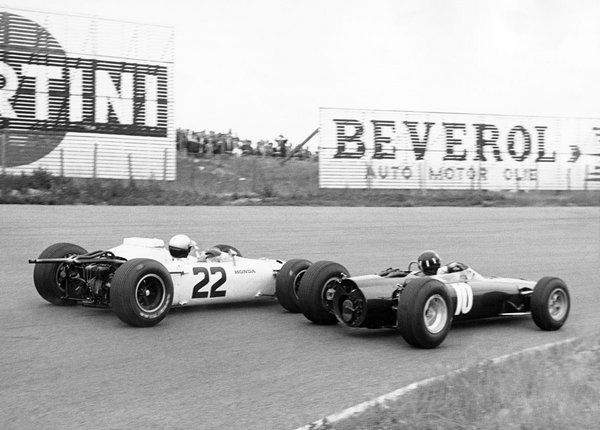
Denny Hulme and Jackie Stewart, Levin NZ Tasman 1967 (Digby Paape)

Denny Hulme Brabham BT22 Repco and Jackie Stewart BRM P261, the natty tartan attire of the BRM Equipe a contrast with the more casual Australian approach…Hulmes’ engine is Repco ‘640 Series’ 2.5 litre; original ’66 series Olds ‘600 Series’ block with the ’67 F1 Championship winning ’40 Series’, exhaust within the Vee, heads. Definitive Repco 1967 F1 Championship winning variant is the ‘740 Series’, Repco’s own ‘700 Series’ block and aforementioned ’40 Series’ heads. Early and very important 1967 F1 testing days for Repco, engine making its debut the weekend before at Pukekohe (Digby Paape)

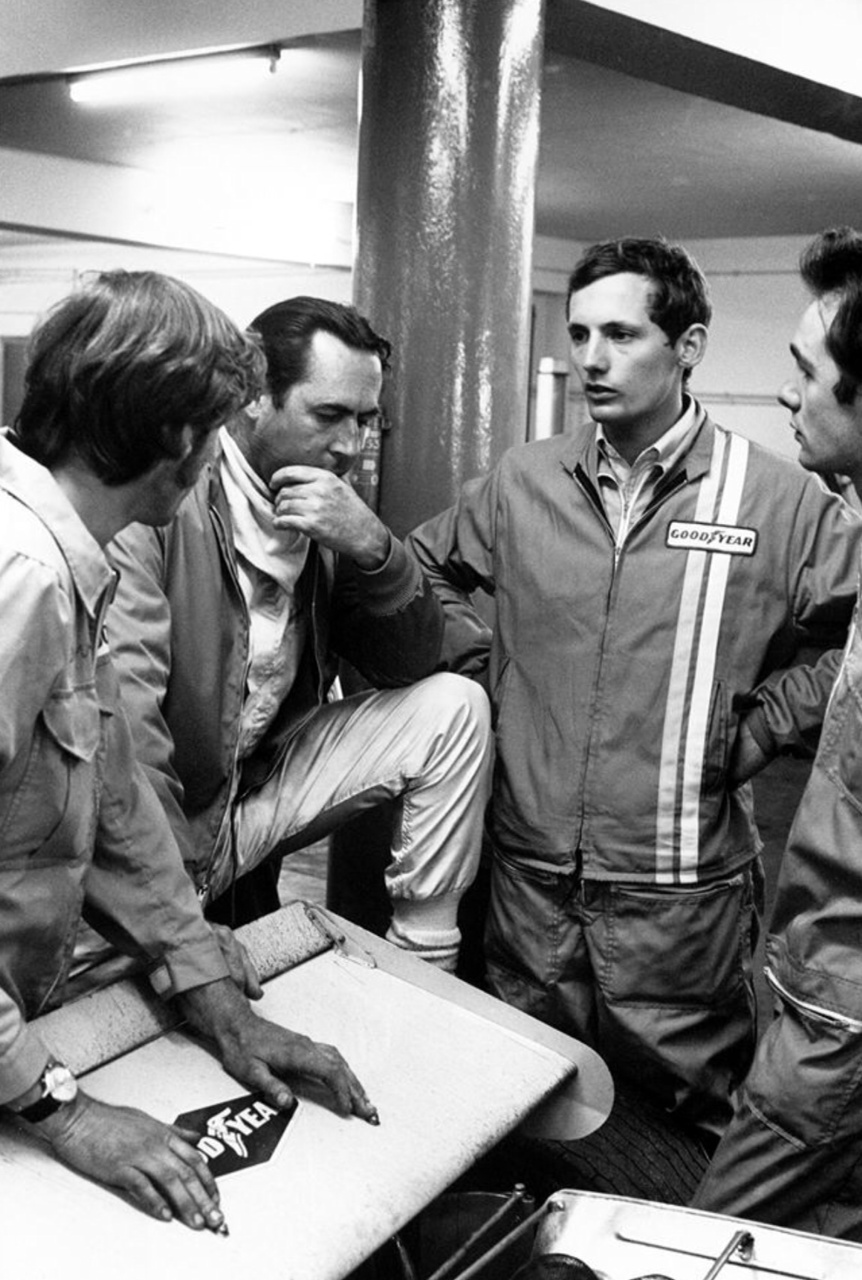
Denny Hulme and Jackie Stewart awaiting adjustments to their cars setup, Levin, New Zealand, Tasman Series 13 January 1967…

Digby Paape took these fantastic, evocative shots of Stewart, Hulme and Jim Clark-‘I was 22 at the time, my father had been president of Motor Sport NZ, and though I was unknown on the North Island I felt I could go anywhere with my Contax, i was masquerading as a journo for the ‘Hutt Valley Motoring Club’. I took all the shots @ F8 @ 250th of a second. Each car only had a couple of mechanics, it was hard to know what was being said. Later on I was the Radio NZ and TVNZ commentator for these and other events, Levin was always hot and the action was close. Close enough for good shots without a telephoto lens’.

Stewart beat Clark in the first Tasman round at Pukekohe the previous week, winning the NZ Grand Prix, the two drivers were the class of the field at Levin as well, despite intense pressure Clark won the 50 mile ‘Levin International’ by less than a second from Stewart’s BRM. Richard Attwood was third in another BRM P261 and Frank Gardner finished fourth in the first of the four cylinder cars, a Brabham BT16 Climax. Denny Hulme retired with ignition problems.

It’s interesting to reflect upon the year to come for each of the drivers…

Denny Hulme, Brabham BT22 Repco, 1967 NZ Tasman, Levin

Denny Hulme, Brabham BT22 Repco, Levin NZ, 1967 (Digby Paape)

It was a tough Tasman for Denny and his team leader Jack Brabham…

They had great unreliability from the new, exhaust between the Vee Repco ‘640 Series’ engines, mainly centred around fuel injection and ignition dramas, but the primary object of the exercise was really to get the engines raceworthy for the 1967 GP season in any event. Jack did have a good win at Longford in his BT23A, the power circuit in Tasmania and last round of the series.

Repco sorted the problems, the new Repco (as against the 1966 Oldsmobile blocked ‘620 Series’) blocked ‘740 Series’ engines were reliable early in the GP season.

Denny broke through for his first GP win at Monaco, 620 engined, but there was no joy in the victory as Lorenzo Bandini perished aboard his Ferrari 312 in a gruesome, fiery accident, which finally helped galvanise action to improve safety standards on the world’s circuits.

In a season when five different drivers won a Grand Prix, his consistency paid off, he won the title with two wins, the Nurburgring the other, from Jack with Jim Clark third in the epochal Lotus 49 Ford Cosworth DFV.

image

Hulme en route to his first Grand Prix victory, Monaco 1967 in his Brabham BT20, still fitted with the ’66 series ‘RB620’ engine. Jacks car was fitted with the new ‘740 Series’ the engine blew early in the race. Hill and Amon second and third in Lotus 33 BRM and Ferrari 312 respectively (unattributed)


1967 CanAm Road America

Can-Am Road America 1967 parade lap: #4 Bruce McLaren, Hulme alongside in the other McLaren M6A Chev, Dan Gurney Lola T70 Ford behind Bruce, Jim Halls’ winged Chaparral 2G Chev easy to pick…and the rest maybe some of you can help me with the caption? Denny won the race from Mark Donohue and John Surtees , both in Lola T70 Mk3B Chevs (unattributed)

In a full season, Hulme was recruited by his compatriot Bruce McLaren as his teammate in the Can-Am series. Robin Herd’s McLaren M6A Chev was a stunning car, concepted by he and Bruce, and started the teams domination of the series which finally ended when Porsche joined the series, and ruined it! with its 917/10 in 1972.

Denny narrowly lost the series to McLaren but the relationship started a commitment to the team by Denny which endured to the end of his career and saw him race the team’s F1, Can-Am and Indy Cars through to the end of 1974, when he finally returned to NZ.

Jim Clark, Lotus 33 Climax, NZ Tasman, Levin 1967

Jim Clark, Lotus 33 Climax, Levin 1967. ‘R14’ was the last of the trendsetting Lotus 25/33 series built, the first ‘modern-monocoque’ which made its debut in Holland 1962. Clarks 2 litre V8 was giving away some power to most of his serious competition, the 2.1 litre BRM’s and 2.5 litre Repco’s but his driving abilities were more than up to closing the deficit (Digby Paape)

Clarks Lotus 33 ‘R14’ was a chassis which had been kind to him…

He first raced it at Brands Hatch in July, and, fitted with the super trick 2 litre version of the Coventry Climax FWMV V8 had served him well in 1966, he drove the car when the heavy BRM ‘H16’ engined Lotus 43 was unsuited to the circuit or circumstances- his best result against the new 3 Litre F1’s was a strong third in Holland.

He won the Tasman series in ‘R14’, assisted greatly by the unreliability of the Brabham Repcos and the BRM P261’s, the latter so dominant the year before. The two 2 litre FWMV V8’s were shipped to the Antipodes, the Mk8 1976cc engine was created by using the big 72.39mm bore of the 1964/5 Mk4-7 engines with the 1961/2 Mk1-2 60mm longest stroke to create a circa 245bhp motor. With the ‘R14’/2 litre FWMV combination Clark won five of the eight Tasman Series 100 mile races, three- at Wigram, Lakeside and Sandown were Tasman Cup championship events, the other two at Levin and Teretonga were non-championship races.

Clark raced a Lotus 43 BRM in South Africa, the first GP of 1967, then ‘R14’ for the last time at Monaco, finally getting his hands on the Lotus 49 at Zandvoort. By that time he was a British tax exile so the first time the Scot saw the car was when he drove it in Holland, he hadn’t even tested the thing, those duties had been faithfully carried out by Graham Hill.

Jim Clark, Lotus 49 Ford, Dutch GP June 1967

Jim Clark on his way to a debut win with the Lotus 49 Ford, Dutch GP, Zandvoort June 4 1967…both engine and chassis changed the face of GP racing in an instant (unattributed)

The car was ‘right’ from the start, he won on its debut and then a further four 1967 races, but Dennys’ consistency got him over the line that year in the equally new Brabham BT24, lets not forget that it, too, was cleansheet in terms of chassis and engine that year. Click here for a piece on the Brabham BT24; https://primotipo.com/2017/12/28/give-us-a-cuddle-sweetie/

The Lotus 49 package was dominant in 1968, but sadly Clark’s 1968 South African GP triumph, off the back of his third Tasman Cup win, was his last, he died tragically in a Lotus 48 Ford FVA  as a consequence of probable tyre failure in the during the ‘Deutschland Trophae’ Hockenheim F2 race on 7 April.

The king of the 1.5 litre formula proved he was also king of the 3 litre formula in 1967, and anything else he drove!

Graham Hill heroically galvanised the Team Lotus after Clark’s death, winning the title in 1968 and provided leadership Chapman initially did not, grieving for Clark as he understandably was.

Jackie Stewart took two Tasman Cup wins…

Mechanical woes, particularly weaknesses in the BRM P261’s transmission crown wheel and pinion cost him victories, but his speed was apparent and close to Clark’s- the two races he won were biggies too- the NZ GP at Pukekohe and AGP at Warwick Farm. Unlike Jim, who had the F1 Lotus 49 to look forward to, BRM persevered with the heavy, complex and slow ‘H16’ engined BRM P83/115 in 1967.

It was to be a long, character building year, a second and third in Belgium and France respectively but retirement in all eight of the other championship rounds awaited the young Scot.

He had won his first Grand Prix in the lithe, nimble P261 in Italy in 1965 but it was then a ‘long time between drinks’ in F1, his undoubted speed was finally reflected in wins when he departed to Team Tyrrell which started running Ford DFV engined Matras in 1968, his first title came in 1969 aboard the glorious MS80. Click here for an article on that Matra; https://primotipo.com/2016/07/01/matra-ms80-ford/

Jackie Stewart, BRM P83, Nurburgring 1967

Jackie Stewwart wrestling his big BRM P115 ‘H16’ BRM, Nurburgring 1967. He was running fourth when the transmission failed, ‘yumping’ hard on the ‘tranny at the ‘Ring! Hulme won the race in his light, nimble Brabham BT24 Repco (unattributed)


image

Team Tyrrell ran Matra F2 cars in 1967, Jacky Ickx taking the Euoropean F2 title, and Jackie Stewart, pictured here in an MS7 FVA at ‘Oulton Park’ took one championship win…and critically the team took the view the cars would be successful in F1 (Eddie Whitham)

What duels there may have been as Stewart matured as a driver and took on his friend and countryman Clark- mind you we saw it in the 1967 Tasman as they were in essentially cars of equal performance, albeit JYS’ BRM often did not run for long enough for the duels to run their course…

As Digby Paape says ‘how lucky we were to see the international drivers in current F1 cars as we did in those wonderful 2.5 Tasman years, the equivalent of seeing Schumacher in that years winning Ferrari’. Indeed it was.

Photo Credits…

Digby Paape, Eddie Whitham, Doug Shaw Collection

Tailpiece: Pukekohe 1967…

Love the hats on the gals at the motor racing!

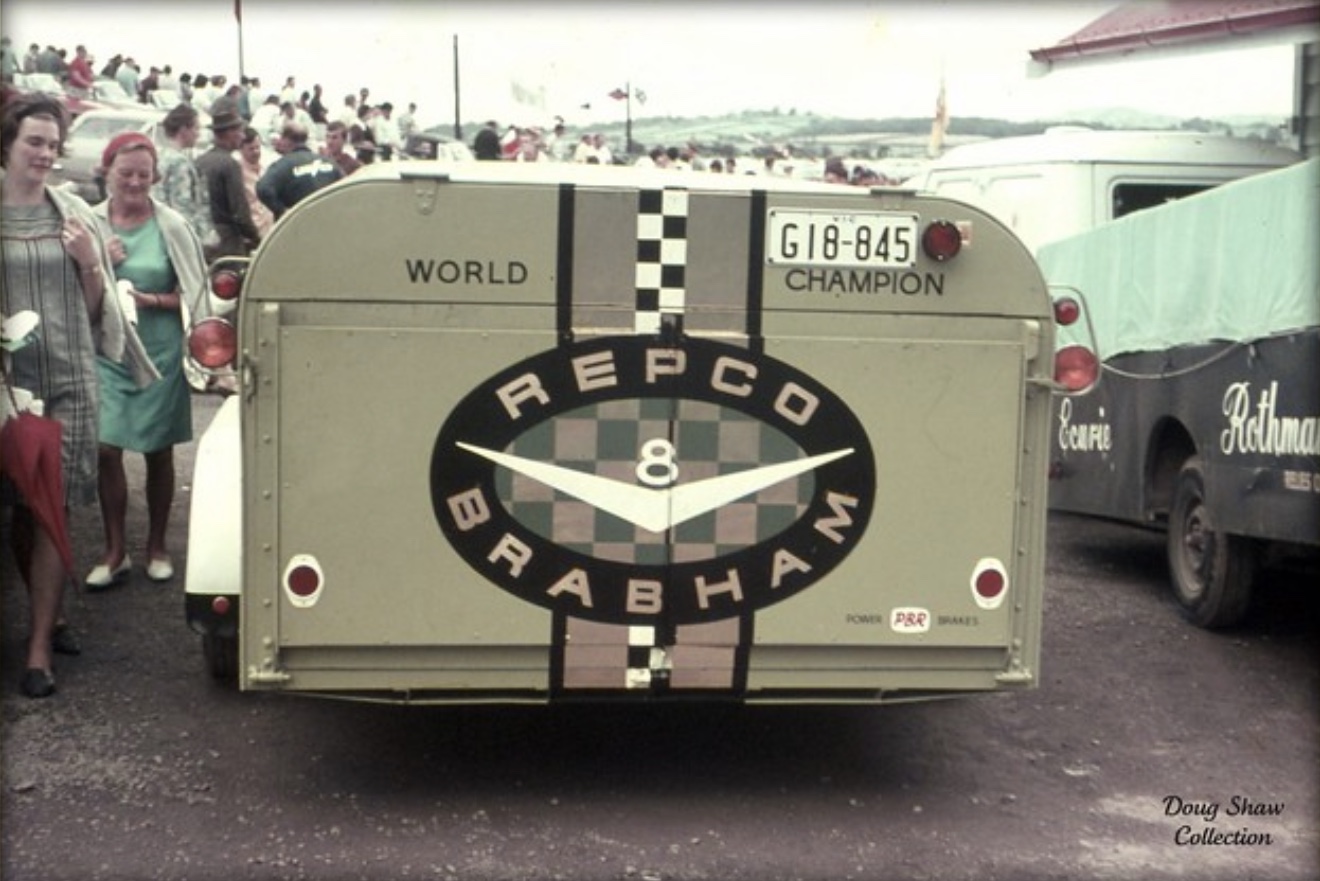
Clearly they have a penchant for ‘Rice Trailers’- it seems said equipment made the trip across the Tasman as well as the two cars, not the happiest of Tasmans for the Repco-Brabham crew despite an ‘all out’ effort to take the Tasman Cup.

Finito…

Senna Mc Laren lambo
(Sutton)

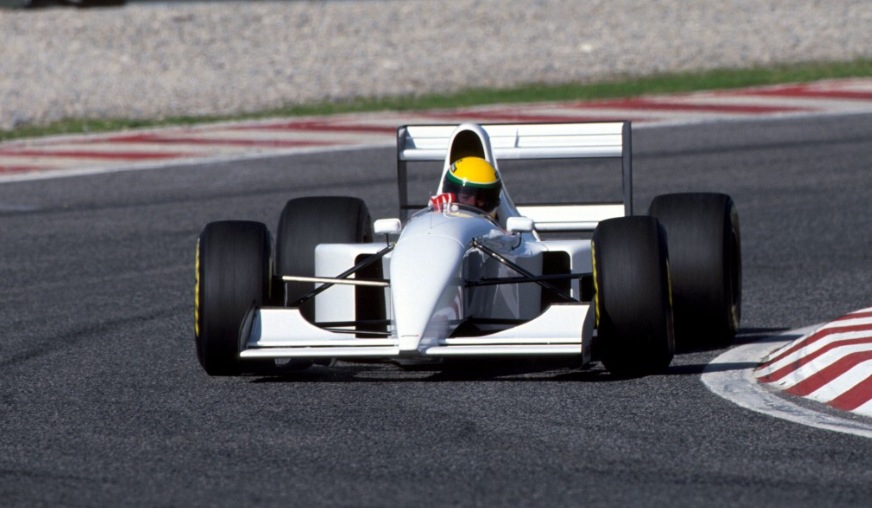
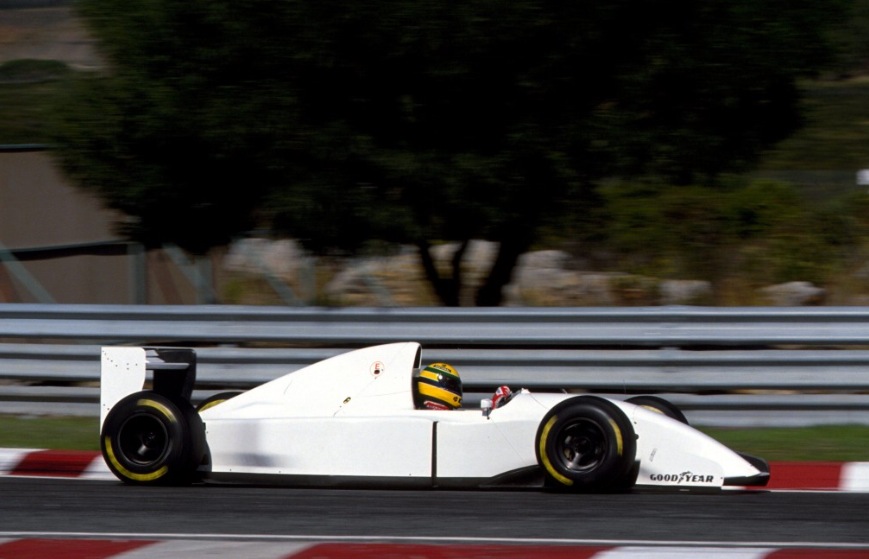
Ayrton Senna testing the McLaren MP4/8B Lamborghini at Estoril, 27-29 September 1993…

By Senna’s standards 1993 had not been a successful year. He won five races in his McLaren Ford as a customer Cosworth user, Schumacher’s Benetton with the more powerful factory Ford Cosworth engines only won a single event. Even worse, arch rival Alain Prost won the title for Williams Renault.

Scrambling to find an engine deal to keep its star driver happy and with the team for 1994, Ron Dennis signed a test contract with Chrysler who then owned Lamborghini.

McLaren modified one of its MP4/8 Ford chassis to take the jewel like little 3.5-litre V12.

Lamborghini 3.5 litre V12 F1 engine

The Mauro Forghieri designed Type 3512 Lambo V12 was first used in F1 in 1989. Larrousse, Lotus and Minardi used the engines in the following years. A new engine for 1993 was the smallest, lightest V12 ever, it gave circa 750bhp @ 14500rpm without pneumatic valves, more than the Cosworth V8 of the day.

Senna tested the car initially at Pembrey, at Silverstone twice, and later at Estoril. He wanted to race it in the three final races of the year at Portugal, Japan and in Australia but Dennis wouldn’t allow it given the contractual arrangements already, and in the process of being put in place with sponsors and the like.

Senna suggested to the engines designer, Ferrari legend Mauro Forghieri, that the V12 would be better with a less brutal top end and more mid range torque, these changes were made, the engine producing around 750bhp.

Mika Hakkinen was the team’s test driver that year, Senna’s race teammate was Michael Andretti until Mika took over the race seat from the Portuguese GP. Hakkinen was 1.5 seconds faster at Silverstone in the Lambo powered MP4/8B than the Ford engined MP4/8 had been during the ’93 British GP weekend.

McLaren MP4 8 Lamborghini Silverstone 1993
Senna, Estoril (Sutton)
Hakkinen at Estoril (MotorSport)

Adrian Burgess was a member of McLaren’s test team in 1993 and was one of three mechanics who worked on the MP4/8B and spoke about his experiences to Which Car? magazine.

“I remember going to Estoril the day after the Grand Prix (it was a three day test, September 27-29, 1993 involving Senna and Hakkinen) Ayrton loved the engine. Within half a day we were 4.9 seconds quicker than the Larrousse LH93 was the day before with the same engine.” Philippe Alliot and Eric Comas were 10th and 11th in their Larrousse Lamborghinis in the race won by Michael Schumacher’s Benetton B193 Ford.

“The problem with it was that by the time it was warm it normally had hand-grenaded itself. I think the furthest we went was 19 laps before all of a sudden you could look down through the inlet trumpets and actually see out the bottom! It hand-grenaded itself in the most magnificent ways. It was like Scalextric car dragging con-rods down the front straight at Estoril. The thing just blew up.”

(Sutton)

As the balance of the 1993 season played out, Prost resigned, Senna won the last two races in Australia and Japan in his MP4/8 Ford. McLaren did a deal with Peugeot and Senna went to Williams for 1994…and the rest as they say is history, a sad one at that.

Photo Credits…

Sutton Images, Autosprint

Tailpieces…

Finito…

Jack Brabham Oulton Park Gold Cup 1966, Brabham BT19 Repco

Jack Brabham wins the Oulton Park ‘Spring Cup’ 1966. Brabham BT19 Repco (Brian Watson)

The second episode covered the design and building of the 1966 ‘RB620’ V8, the engine which would contest and win the World Constructors and Drivers Championships in 1966, this is a summary of that season…

Brabham BT19 cutaway

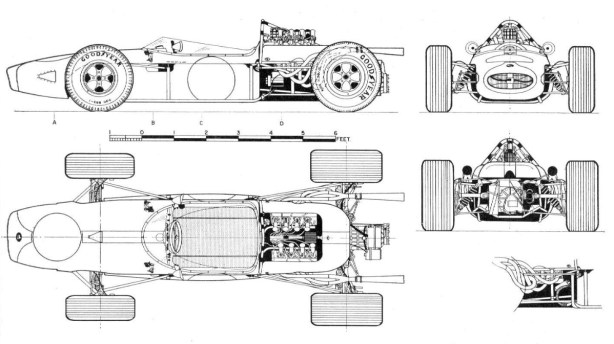
Cutaway drawing of Brabham BT19 # ‘F1-1-65’, JB’s 1966 Championship Winning mount. Produced in 1965 for the stillborn Coventry Climax Flat 16 cylinder 1.5 litre F1 engine and modified by Ron Tauranac to fit the ‘RB620’ engine, which was designed by Phil Irving with Brabham/Tauranacs direct input in terms of ancilliaries etc to fit this chassis. A conventional light, agile, driver friendly and ‘chuckable’ spaceframe chassis Brabham of the period. Front suspension independent by upper and lower wishbones and coil spring/ damper units. Rear by upper top link, inverted lower wishbone, twin radius rods and coil spring/ damper units. Adjustable sway bars front and rear. Hewland HD500, and later DG300 ‘box. Much raced and winning chassis…still in Australia in Repco’s ownership (Motoring News)

The 1966 South African Grand Prix…whilst not that year a Championship round was the first race of the new 3 litre F1 on 1 January.

In December 1965 the first 3 Litre RB620 ‘E3’ was assembled and with slightly larger inlet valves, ports and throttle bodies than the ‘2.5’ produced 280bhp @ 7500rpm. After six hours testing it was rebuilt, shipped to the UK and fitted to Jacks ‘BT19’, a chassis built during 1965 for the stillborn Coventry Climax 16 cylinder engine, the rear frame modified to suit ‘RB620’.

Brabham started from pole and lead until the Lucas injection metering unit drive coupling failed. He achieved fastest lap but was the only 3 litre present.

Straight after the race the car was flown to Melbourne and fitted  with  Repco 2.5 engine ‘E2’ for the Sandown Tasman round on February 27, Repco’s backyard or home event…
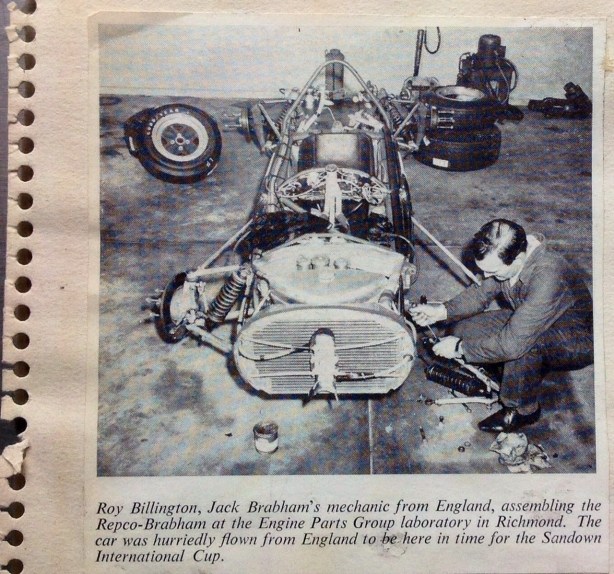
BT19 on the factory floor in Melbourne

Roy Billington prepares BT19 for fitment of the’RB620′ 2.5 Tasman engine in place of the 3 litre used in South Africa on 1 January 1966 (Wolfe/Repco)
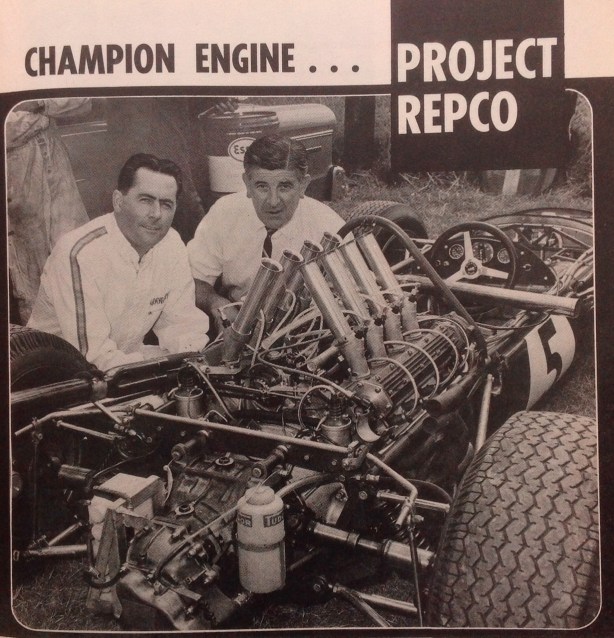
 

Brabham and Frank Hallam, Sandown 1966

Jack Brabham with RB Engines GM Frank Hallam at Sandown 1966. Publicity shot with BT19, long inlet trumpets give the engine away as a ‘Tasman 2.5’. Car sans RH side ‘Lukey Mufflers’ exhaust tailpipe in this shot ‘, sitting across the drivers seat. Rear suspension as described in cutaway drawing above, twin coils, fuel metering unit, HD500 Hewland, battery and ‘expensive’ Tudor oil breather mounted either side of ‘box (Brabhams World Championship Year’ magazine)

During a preliminary race the car set a lap record- the race won by Stewart’s BRM. But in the main race but an oil flow relief valve failed, causing engine damage, Stewart won from Clark Lotus 39 Climax and Graham Hill in the other BRM P261.

Upon dissasembly, it was found a sintered gear in the pressure pump had broken. The engine was then rebuilt for the final Tasman round at Longford Tasmania.

In a close race, with the engine overheating, the car ran short of fuel and was beaten by the two 2 litre BRM P261’s (bored out 1.5 litre F1 cars) of Stewart and Hill, Jackie Stewart easily winning the 1966 Tasman Championship for the Bourne team.
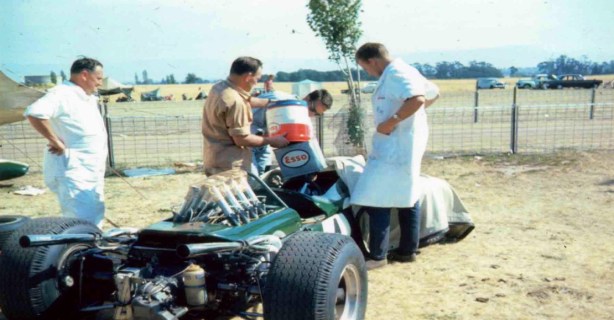
Brabham BT 19 refuelling, Longford 1966

BTT19 being filled with the sponsors product, Longford paddock 1966 (Ellis French)

In early January 1966 the engine operation was transferred from Repco’s experimental labs in Richmond to the Maidstone address and factory covered in episode 2 where the operations were ‘productionised’ to build engines for both BRO (Brabham Racing Organisation) and customers.

So far the engine had not covered itself in glory but invaluable testing was being carried out and problems solved.

Meanwhile back in Europe other teams were developing their cars for 1966…

All teams faced the same challenge of a new formula, remember that Coventry Climax, the ‘Cosworth Engineering’ of the day were not building engines forcing the ‘English Garagistes’ as Enzo Ferrari disparagingly described the teams, to find alternatives, as Jack had done with Repco.

Ferrari were expected to do well, as they had done with the introduction of the 1.5 litre Formula in 1961, they had a new chassis and an engine ‘in stock’, which was essentially a 3 litre variant of their 3.3 litre P2 Sports Car engine, the ‘box derived from that car as well. The gorgeous bolide looked the goods but was heavy and not as powerful as was claimed or perhaps Repco’s horses were stallions and the Italian’s geldings!
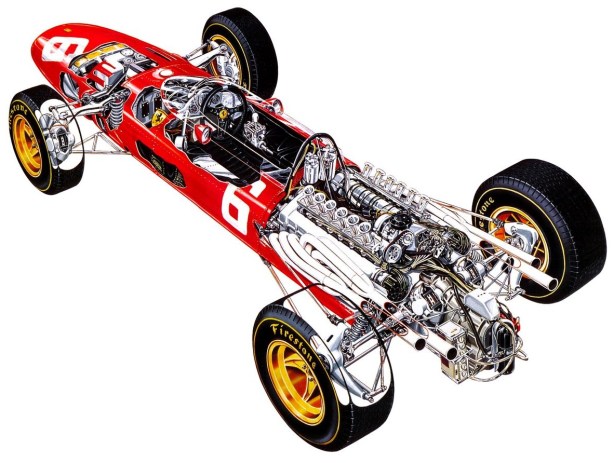
Ferrari 312 1966 cutaway

Hubris or too little focus on F1 in 1966…on paper the Ferrari 312 shoulda’ won in ’66…when Surtees left so did their title hopes, Ferraris’ decline in the season was matched by Brabhams’ lift…

Cooper also used a V12, a 3 litre, updated variant of the 2.5 litre engine Maserati developed at the end of the 250F program in 1957 when it was tested but unraced.
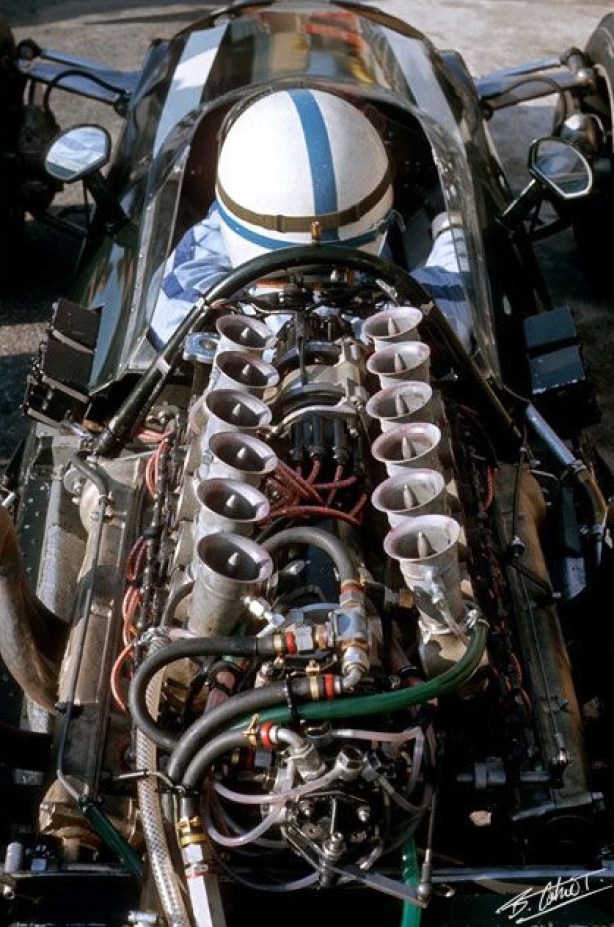
Cooper T81 Maserati engine 1966

Coopers’ 1966 T81 was an aluminium monocoque chassis carrying a development of Masers’ 10 year old ‘Tipo 10’ 60 degree V12. DOHC, 2 valves per cylinder, Lucas injected, and a claimed 360bhp @ 9500rpm. The cars were heavy, reasonably reliable. Surtees and Rindt extracted all from them (Bernard Cahier)

Dan Gurney had left Brabham and built a superb car designed by ex-Lotus designer Len Terry. The T1G Eagle was to use Coventry Climax 2.7 litre FPF power until Dans’ own Gurney-Weslake V12 was ready. Again, the car was heavy as it was designed for both Grand Prix and Indianapolis Racing where regulation compliance added weight.

Denny Hulme stepped up to fulltime F1 to support Jack in the other Brabham.

The dominant marque of the 1.5 litre formula , Lotus were caught without an engine and contracted with BRM for their complex ‘H16’ and were relying also on a 2 litre variant of the Coventry Climax FWMV 1.5 V8…simultaneously Keith Duckworth was designing and building the Ford funded Cosworth DFV, but its debut was not until the Dutch Grand Prix in 1967.

BRM, having failed to learn the lessons of complexity with their supercharged V16 1.5 litre engine of the early 50’s, and then reaping the benefits of simplicity with the P25/P48/P57, designed the P83 ‘H16’, essentially two of their 1.5 litre V8’s at 180 degrees, one atop the other with the crankshafts geared together. They, like Lotus were also using 2 litre variants of their very fast, compact, light and simple 1965 F1 cars, the P261 whilst developing their ‘H16′ contender.

Honda won the last race of the 1.5 litre formula in Mexico 1965 and were busy on a 3 litre V12 engined car, the RA273 appeared later in the season in Richie Ginthers’ hands.
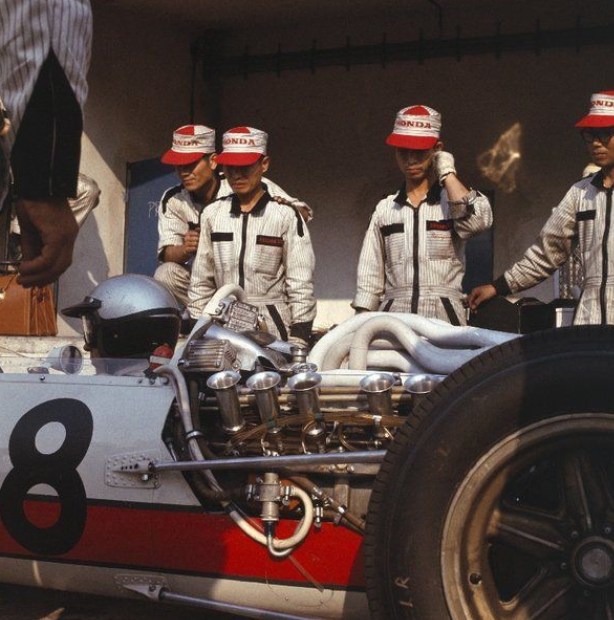
Ginther Honda RA273 , Monza 1966

Richie Ginthers’ powerful but corpulent, make that mobidly obese Honda RA 273 at Monza, the heaviest but most powerful car of 1966…it appeared too late in the season to have an impact but was competitive in Richies’ hands, a winner in ’67 at Monza…(unattributed)

Bruce Mclaren produced his first GP cars, the Mclaren M2A and M2B, technically advanced monocoque chassis of Mallite construction, a composite of balsa wood bonded between sheets of  aluminium on each side.

His engine solution was the Ford ‘Indy’ quad cam 4.2 litre V8, reduced to 3 litres, despite a lot of work by Traco, the engine whose dimensions were vast and heavy, developed way too little power, the engine and gearbox weighing not much less than BT19 in total…He also tried an Italian Serenissima engine without success.
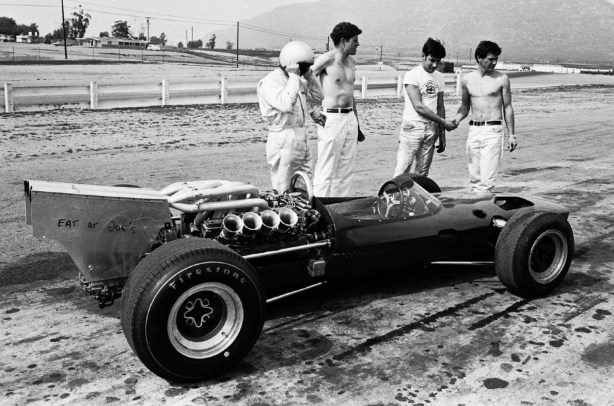
Bruce McLaren, McLaren M2A Ford Indy, Riverside 1966

Bruce testing M2A Ford at Riverside, California during a Firestone tyre test in early 1966. M2A entirely Mallite, M2B used Mallite inner, and aluminium outer skins. Note the wing mount…wing first tested at Zandvoort 1965. L>R: Bruce McLaren, Gary Knutson, Howden Ganley and Wally Willmott (Tyler Alexander)

So, at the seasons outset Brabham were in a pretty good position with a thoroughly tested engine, but light on power and on weight in relation to Ferrari who looked handily placed…

Variety is the spice- 1966 MotorSport magazine visual of the different F1 engine solutions pursued by the different makers

Brabham contested two further non-championship races…with the original engine in Syracuse where fuel injection problems caused a DNF and at Silverstone on May 14 where the car and engine achieved their first wins, Brabham also setting the fastest lap of the ‘International Trophy’.
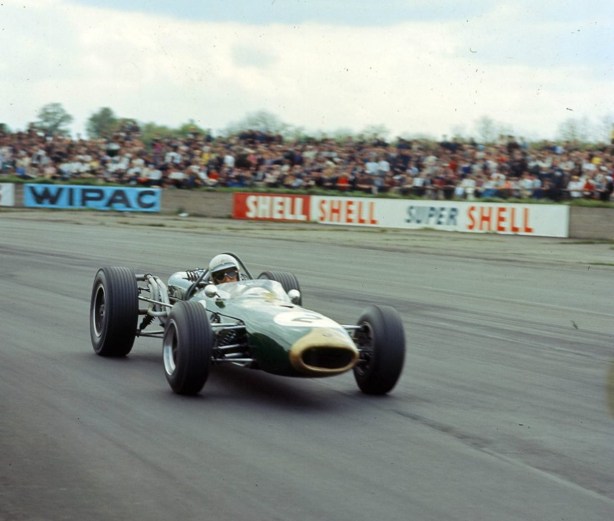
Brabham , Silverstone Trophy 1966, BT19 Repco

First win for BT19 and the Repco ‘RB620’ engine, Silverstone International trophy 1966 (unattributed)

Monaco was the first round of the 1966 F1 Championship on May 22…

Clark qualified his small, light Lotus 33 on pole with John Surtees in the new Ferrari alongside. Jack was feeling unwell, and the cars were late arriving after a British seamens strike, Jack recorded a DNF, his Hewland HD 500 gearbox jammed in gear.

Mike Hewland was working on a stronger gearbox for the new formula, Jack used the new ‘DG300′ transaxle for the first time at Spa. Clarks’ ‘bullet-proof’ Lotus 33 broke an upright, then Surtees’ Ferrari should have won but the ‘slippery diff’ failed leaving victory to Jackie Stewarts’ 2 litre BRM P261.
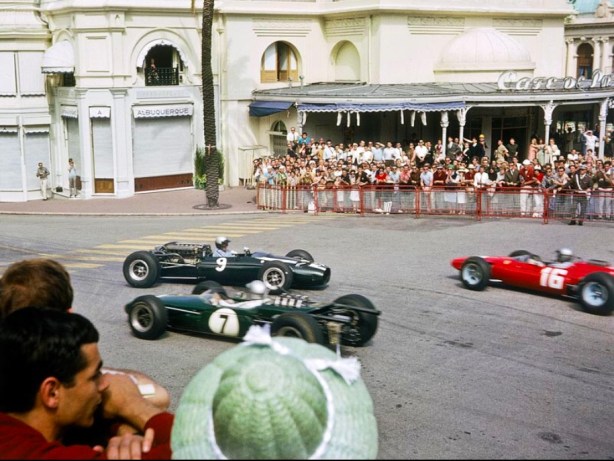
Richie Ginther Monaco 1966

Richie Ginther going the wrong way at Monaco whilst Jack and Bandini find a way past. Cooper T81 Maser, BT19 and Ferrari 246 respectively. Nice ‘atmo’ shot (unattributed)

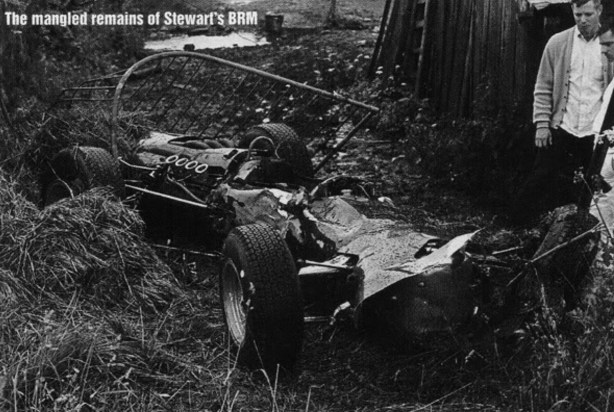
Off to Spa, and whilst Brabham was only fourth on the grid…he was quietly confident but a deluge on the first lap caused eight cars to spin, the biggest accident of Jackie Stewarts’ career causing a change in his personal attitude to driver, car and circuit safety which was to positively reverberate around the sport for a decade.
image

The rooted monocoque of Jackie Stewarts’ BRM P261, Spa 1966. He was trapped within the tub until released by Graham Hill and Bob Bondurant who borrowed tools from spectators to remove the steering wheel…all the while a full tank of fuel being released…(unattributed)

Surtees won the race from Jochen Rindt in a display of enormous bravery in a car not the calibre of the Ferrari or Brabham, Jack finished fourth behind the other Ferrari of Lorenzo Bandini. Denny Hulme still driving a Climax engined Brabham.

At this stage of the season, the ‘bookies pick’, Ferrari, were looking pretty handy.
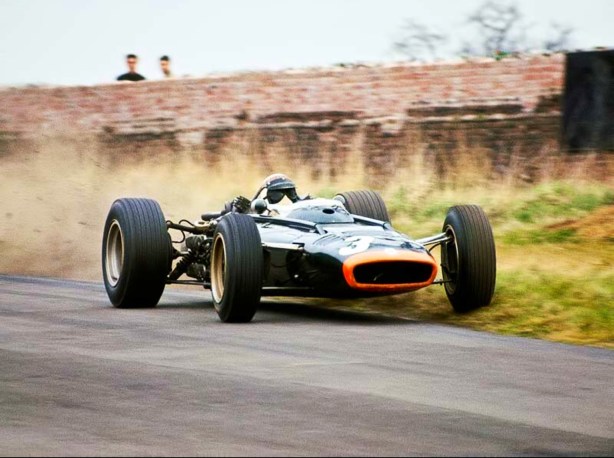
BRM P83, Stewart, Oulton Park 1966

Another major new car of 1966 was the BRM P83 ‘H16’…love this shot of Jackie Stewart trying to grab hold of the big, unruly beast at the Oulton Park ‘Spring Cup’ 1966. The car got better as 1966 became 1967 but then so too did the opposition, the message of Brabham simplicity well and truly rammed home when the Lotus 49 Ford appeared at Zandvoort in May 1967…free-loading spectators having a wonderful view! (Brian Watson)

Goodyear…

Dunlops’ dominance of Grand Prix racing started with Engleberts’ final victory when Peter Collins won the British Grand Prix for Ferrari in 1958.

Essentially Dunlops’ racing tyres were developed for relatively heavy sports prototypes, as a consequence the light 1.5 litre cars could compete on the same set of tyres for up to four GP’s Jimmy Clark doing so in his Lotus 25 in 1963!

Goodyear provided tyres for Lance Reventlows’ Scarab team in 1959, returned to Indianapolis in 1963, to Europe in Frank Gardners’ Willment entered Lotus 27 F2 at Pau in 1964 and finally Grand Prix racing with Honda in 1964.

In a typically shrewd deal, Brabham signed with Goodyear in 1965, it’s first tyres for the Tasman series in 1965 were completely unsuitable but within days a new compound had been developed for Australian conditions, this was indicative of the American giants commitment to win.

By 1966 Goodyear was ready for its attack on the world championship, we should not forget the contribution Goodyears’ tyre technology made to Brabhams’ wins in both the F1 World Championship and Brabham Honda victory in the F2 Championship that same year.

Equally Goodyear acknowledged Brabhams’ supreme testing ability in developing its product which was readily sought by other competitors at a time when Dunlop and Firestone were also competing…a ‘tyre war’ unlike the one supplier nonsense which prevails in most categories these days.
Dan Gurney Eagle T1G Climax, Spa 1966

Dan Gurney, Eagla T1G Climax, Spa 1966. In my top 3 ‘GP car beauties list’…Len Terry’s masterful bit of work hit its straps 12 months later when the car, by then V12 Eagle-Weslake powered won Spa, but in ’66 the car was too heavy and the 2.7/8 Climax lacked the necessary ‘puff’…Goodyear clad cameraman exceptionally brave!, shot on exit of Eau Rouge (unattributed)

The French Grand Prix was the turning point of the season…

Brabham arrived with three cars- Hulmes’ Climax engined car as a spare and finally an ‘RB620’ engined car for the Kiwi. Perhaps even more critically for Brabham, John Surtees had left Ferrari in one of the ‘Palace Upheavals’ which occurred at Maranello from time to time, fundamentally around Surtees’ view on the lack of F1 emphasis, the team still very much focussed on LeMans and the World Sports Car Championship, where the marques decade long dominance was being challenged by Ford.

Surtees was also, he felt, being ‘back-doored’ as team-leader by team-manager Eugenio Dragoni in choices involving his protege, Lorenzo Bandini. The net effect, whatever the exact circumstances was that Surtees, the only Ferrari driver capable of winning the ’66 title moved to Cooper, Bandini and Mike Parkes whilst good drivers were not an ace of 1964 World Champ, Surtees calibre…

Reims was the ultimate power circuit so it was not a surprise when four V12’s were in front of Brabham on the grid, the Surtees and Rindt Coopers and the two Ferraris. Surtees Cooper failed, and Jack hung on, but was losing ground to Bandini, until his throttle cable broke with Brabham leading and then winning the race.

It was Jacks’ first Championship GP win since 1960, and the first win for a driver in a car of his own manufacture, a feat only, so far matched by Dan Gurney at Spa in 1967.

It was, and is a stunning achievement, but there was still a championship to be won.

Jack Brabham French GP 1966 Brabham BT19 Repco

Brabham wins the French GP 1966, the first man to ever win a GP in a car of his own construction. Brabham BT19 Repco (umattributed)


image

Brabham’s BT19 leads out of Druids at Brands Hatch, ’66 British GP. Gurney Eagle T1G Climax, Hulme’s Brabham BT20 Repco, Clark’s Lotus 33 Climax and the two Cooper T81 Masers of Surtees inside and Rindt, then Stewart’s BRM P261 and McLaren’s white McLaren M2B Serenissima and the rest (unattributed)

At Brands Hatch Ferrari did not appear…

They were victims of an industrial dispute in Italy. Cooper were still sorting their Maser V12, the H16 BRM’s did not race nor did the Lotus 43, designed for the BRM engine. BRM and Lotus were still relying on 2 litre cars. Brabham and Hulme were on pole and second on the grid, finishing in that order, a lap ahead of Hill and Clark.

At Zandvoort, in the Dutch sand-dunes

Brabham with beard Dutch GP 1966

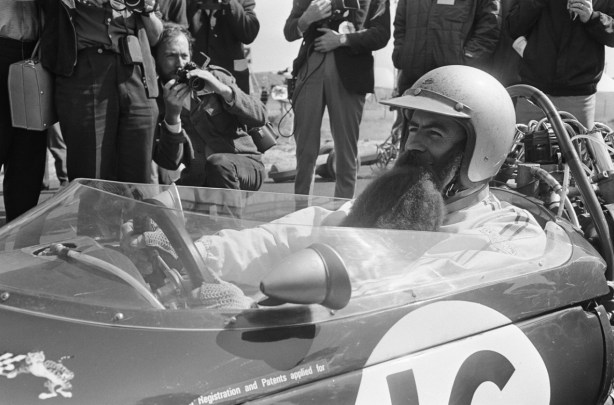
Jack was tough but had a sense of humor…he had just turned 40 a month or so before, there was a lot in the press about his age so JB donned a beard, and with a jack-handle as walking stick approached BT19…much to the amusement of the Dutch crowd and press (Eric Koch)

Brabham and Hulme again qualified one-two but Jim Clark drove a stunning race in his 2 litre Lotus leading Jack for many laps, the crafty Brabham, just turned forty playing a waiting game and picking up the win after Clarks’ Climax broke its dynamic balancer, the Scot pitting for water and still being in second place when he returned, such was his pace. Clark fell back to third, Hill finishing second, the Ferraris and Coopers off the pace.

Brabham in BT19 Repco, Dutch GP 1966

Bernard Cahiers’ famous shot of Brabham ‘playing with his Goodyears’ in the Dutch sand-dunes is still reproduced by Repco today and used as a ‘promo’ handout whenever this famous car, Jacks’ mount for the whole of his ’66 Championship campaign, still owned by Repco, is displayed in Australia
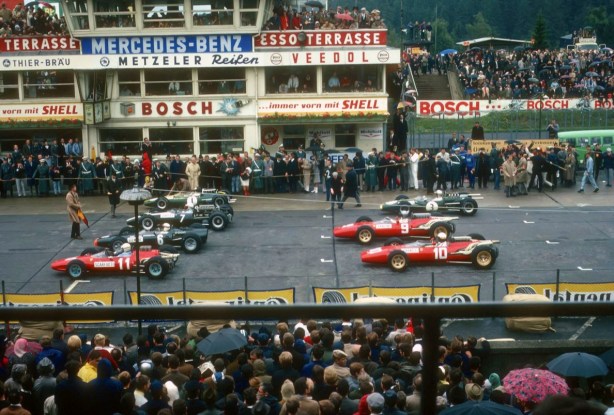
 

German GP grid 1966

German GP grid, Nurburgring 1966. I like this shot as it says a lot about the size of 1966 F1 cars and the relative performance of the ‘bored-out 1.5 litre cars vs. the new 3 litres at this stage of the formula. The only 3 litre on the front row, is Ferrari recent departee John Surtees Cooper Maserati #7, Clark is on pole #1 Lotus 33 Climax, #6 Stewart BRM P261, # 11 Scarfiotti Ferrari Dino, all ‘bored 1.5’s. Row 2 is Jack in BT19, and #9 and #10 Bandini and Parkes in Ferrari 312’s, all ‘3 litres’. The physical difference in size between the big, heavy Ferraris, and the little, light BT19 ‘born and built’ as a 1965 1.5 litre car for the stillborn Coventry Climax Flat 16 engine, is marked (unattributed)

The Nurburgring is the ultimate test of man and machine…

Brabham qualified poorly in fifth after setup and gearbox dramas. Clark, Surtees, Stewart and Bandini were all ahead of Jack with only Surtees, of those drivers in a 3 litre car!

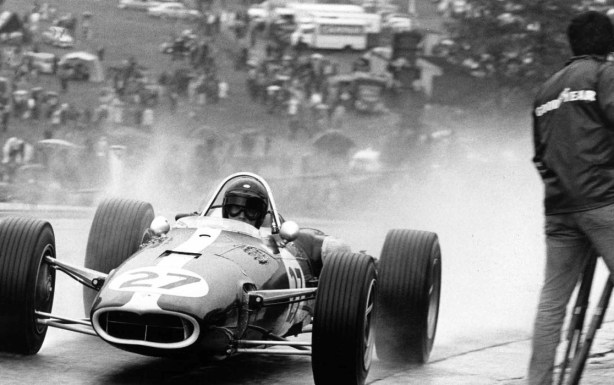
The race started in wet conditions, Jack slipped into second place after a great start by the end of lap one and past Surtees by the time the pack passed the pits, Surtees suffered clutch failure widening the gap between he and Brabham, Rindt in the other Cooper finishing third. Hulme was as high as fifth but lack of ignition ended his race.

Hill and Surtees were still slim championship chances as the circus moved on to Monza.
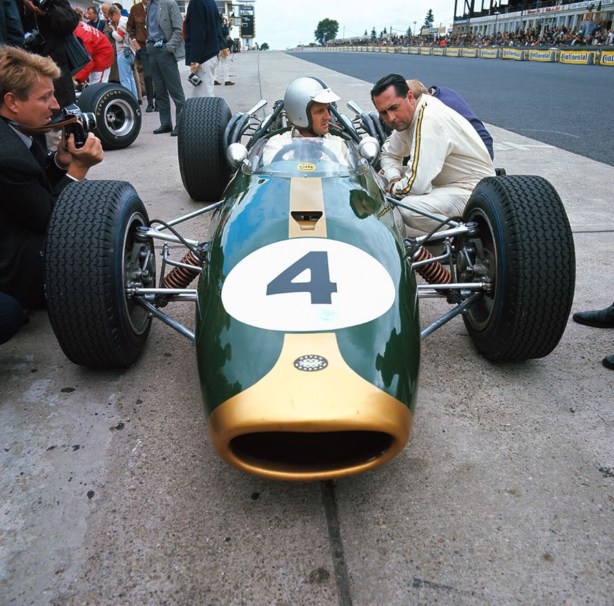
Jack Brabham and Denny Hulme, German GP 1966

Denny and Jack ponder the setup of Hulmes BT20, practice conditions far better than raceday when Jack would triumph (unattributed)

Ferrari traditionally perform well at home…and so it was, Ludovico Scarfiotti winning the race on September 4.

Another power circuit, Brabham was outqualifed by five ‘multis’ the V12’s, the Ferraris of Parkes (pole) Scarfiotti and Bandini, the Cooper of Surtees and the H16 Lotus 43 BRM of Clark in third.

The Ferraris lead from the start from Surtees, but Brabham sensing a slow pace took the lead only losing it when an inspection plate loosened at the front of the engine, burning oil, the lubricant not allowed to be topped up under FIA rules. Hulme moved into second as Jack retired. The lead changed many times but Surtees retirement handed the titles to Brabham, Scarfiotti winning the race from Parkes and Hulme.

The cars were scrutineered and weighed at Monza.

The weights of the cars was published by ‘Road and Track’ magazine. BT19 was ‘Twiggy’ at 1219Lb, the Cooper T81 1353Lb, BRM 1529Lb, similarly powered Lotus 43 1540Lb and Honda RA273 1635Lb. Lets say the Repcos’ horses were real at 310bhp, Ferrari and Cooper (Maserati) optimistic at 360 and BRM and Honda 400’ish also a tad optimistic…as to power to weight you do the calculations!
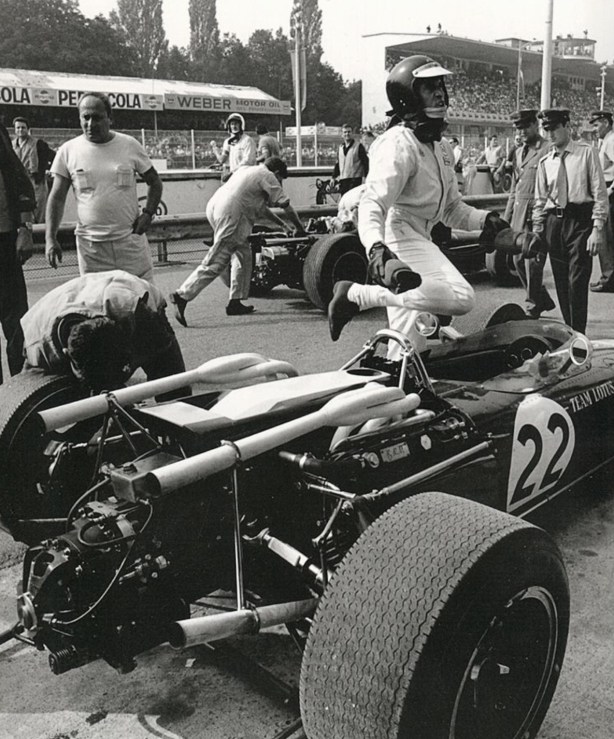
Jim Clark Lotus 43 BRM Monza 1966

Jim Clark jumps aboard his big, beefy 1540Lb Lotus 43 BRM whilst Jacks light 1219Lb BT19 is pushed past, ’66 Monza grid. Love the whole BRM ‘H16’ engine as a technical challenge…(unattributed)
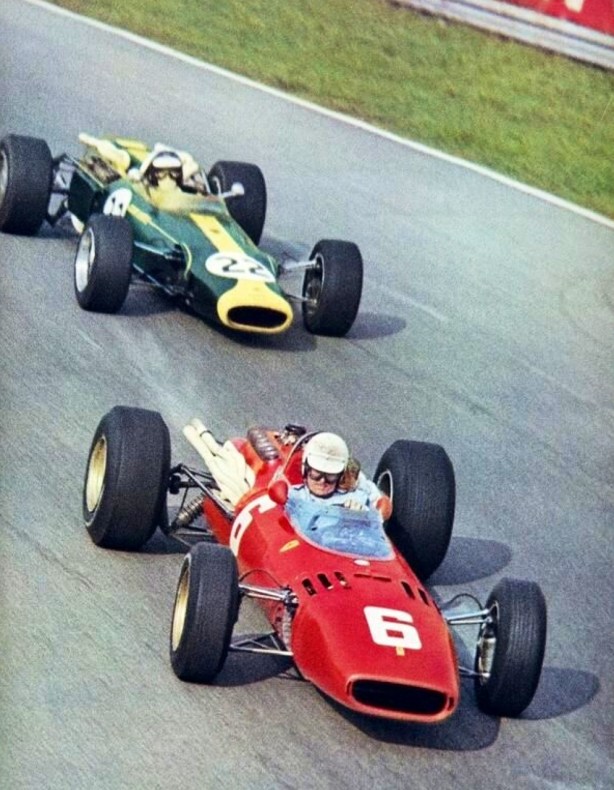
 

Scarfiotti and Clark Italian GP 1966

2 of the ‘heavyweights’ of 1966, Ludovico Scarfiottis’ Ferrari 312 leading Jim Clarks’ Lotus 43 BRM at Monza, Scarfiottis’ only championship GP win (unattributed)

Jim Clarks’ Lotus 43 BRM achieved the ‘H16’s only victory at Watkins Glen…the Scot using BRM’s spare engine after his own ‘popped’ at the end of US Grand Prix practice. Jack’s engine broke a cam follower in the race, Denny also retiring with low oil pressure.
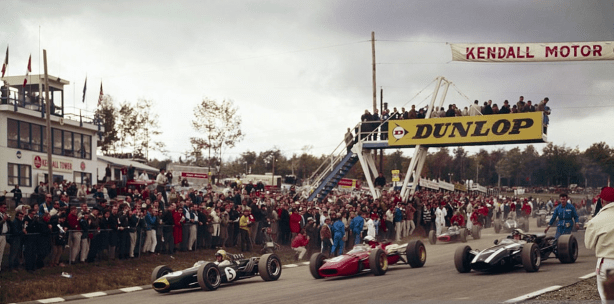
jack us

Front row of the Watkins Glen grid. #5 Brabham’s BT20 on pole DNF, Bandini’s Ferrari 312 DNF and Surtees Cooper T81 Maser 3rd (Alvis Upitis)

The final round of the 1966 was in Mexico City on October 23…

The race won by John Surtees from pole, in a year when he had been very competitive, and perhaps unlucky. Having said that, had he stayed at Ferrari perhaps he would have won the title, the Ferrari competitive in the right hands. Brabham was fourth on the grid, best of the non-V12’s with Richie Ginther again practicing well in the new, big, incredibly heavy V12 Honda RA273. Surtees’ development skills would be applied to this car in 1967.

Surtees finished ahead of Brabham and Hulme, despite strong pressure from both, whilst Clark was on the front row with the Lotus 43, the similarly engined BRM’s mid-grid, it was to be a long winter for the teams the postion of many not that much changed from the seasons commencement…
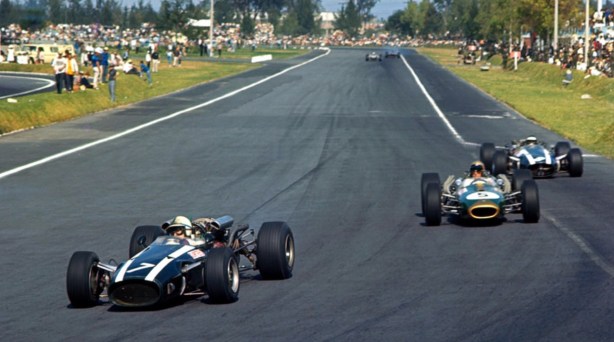
Mexican GP 1966, Surtees, Brabham and Rindt

John Surtees, Jack and Jochen Rindt, Coopers T81 Maserati X2 and BT19. Mexican GP 1966. Ferrari missed Surtees intense competitiveness when he left them, the Cooper perhaps batting above its (very considerable!) weight as a consequence, Rindt no slouch mind you. The Coopers’ competitive despite the tough altitude and heat of Mexico City. (unattributed)

Malcolm Prestons’ book ‘Maybach to Holden’ records that 3 litre engines ‘E5, E6, E7 and E8’…were used by BRO in 1966, in addition to E3, all having at least one replacement block.

Some engines were returned to Melbourne for re-building and at least three were sold in cars by Brabham to South Africa and Switzerland, whether Repco actually consented to the sale of these engines, ‘on loan’ to BRO is a moot point!, but parts sales were certainly generated as a consequence.

Detail development of the ‘RB620’ during the season resulted in the engines producing 310 bhp @ 7500rpm with loads of torque and over 260bhp from 6000-8000rpm.

Brabham team with BT19 1966

Back In Australia…

The Tasman ‘620’ 2.5 litre engine was not made available to Australasian customers in 1966, they were in 1967, a Repco prepared Coventry Climax FPF won the ‘Gold Star’, the Australian Drivers Championship in 1966, Spencer Martin winning the title in Bob Janes’ Brabham BT11A.

4.4 litre ‘RB620′ engines were built for Sports Cars, notably Bob Janes’ Elfin 400, we will cover those in a separate chapter.

Development of the F1 engine continued further in early 1966 in Maidstone, whilst production and re-building of the ‘RB620’ for BRO continued, we will cover the design and testing of what became the 1967 ‘RB740′ Series engine in the next episode…

Meanwhile Brabhams’, Tauranacs’, Irvings’ and Repcos’ achievements were being rightly celebrated in Australia where ingenuity, practicality and brilliant execution and development of a simple chassis and engine had triumphed over the best of the established automotive, racing and engineering giants of Europe…
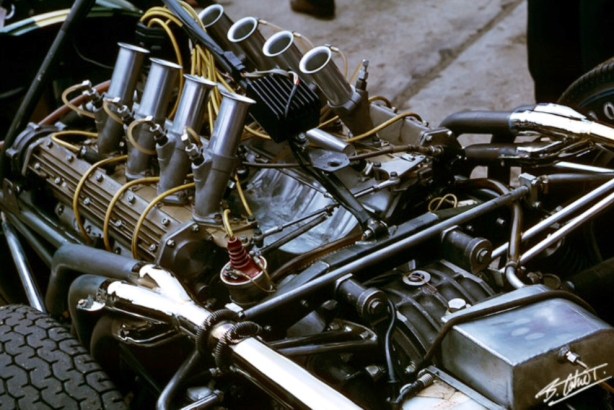
Repco 'RB620' 3 Litre F1 V8

‘RB620’ 3 litre V8 in Brabham BT19, 1966 F1 World Champions (Bernard Cahier)

Etcetera…
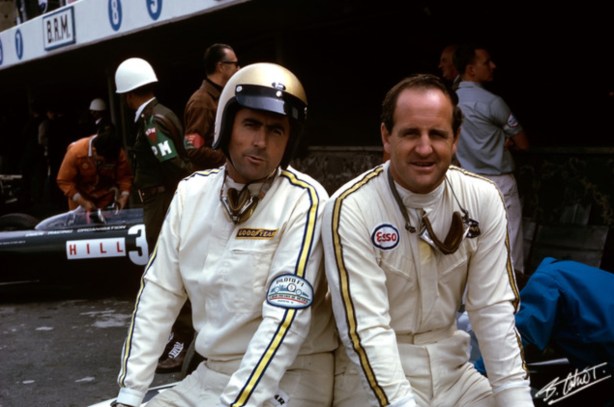
Jack Brabham and Denny Hulme , Mexican GP 1966

Jack Brabham and Denny Hulme, 1st and 4th in the World Drivers Championship 1966. Mexican GP 1966, lovely Bernard Cahier portrait of 2 good friends. Graham Hills’ BRM P83 ‘H16’ at rear.
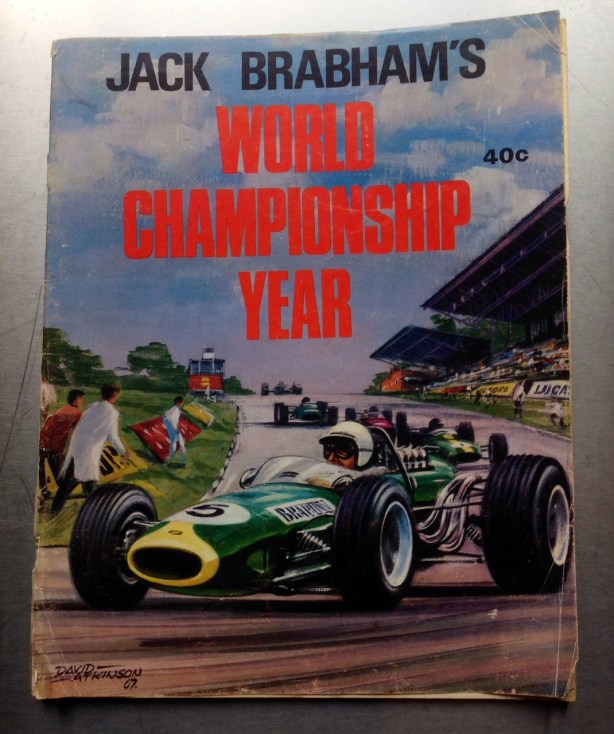
 

Brabham 'Championship Year' magazine

BT19 cutaway

BT19 Repco cutaway (unattributed)


london Racing Car Show 1967

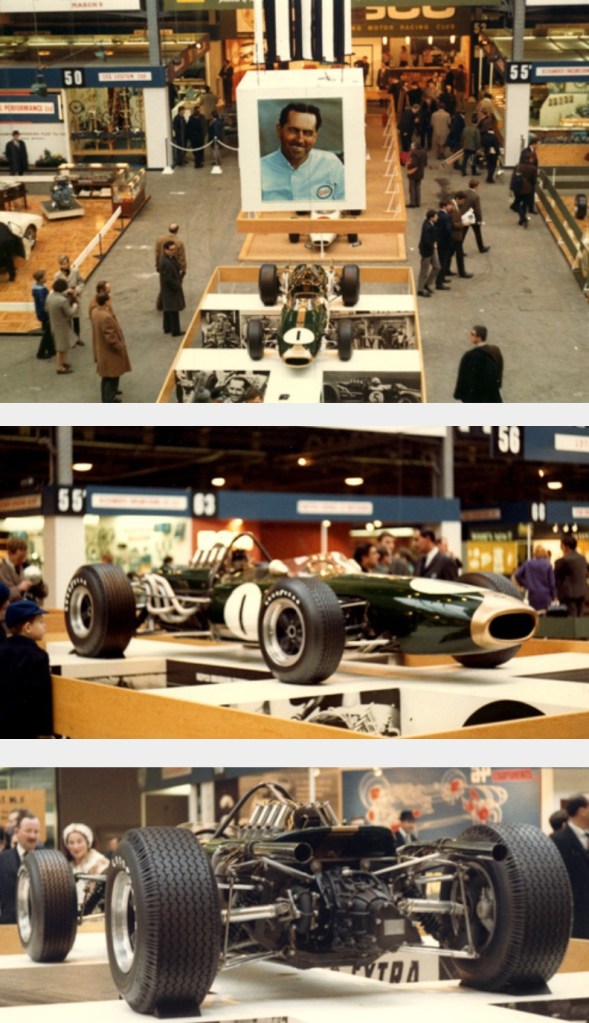
Brabham BT19 Repco on ‘centre stage’ at the 1967 London Racing Car Show (unattributed)


RB Nose

Brabham after Rheims victory 1966

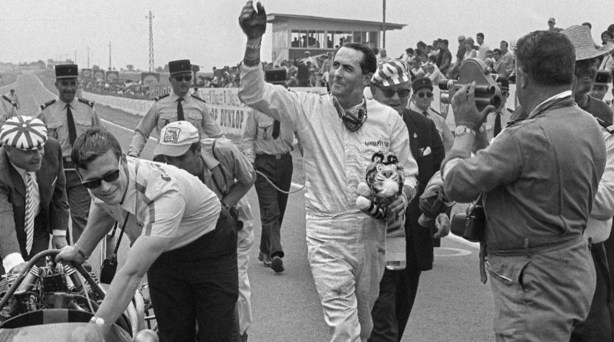
A fitting photo to end the article…the joy of victory and achievement after his Rheims, French GP victory. The first man ever to win a GP in a car of his own manufacture, Brabham BT19 Repco (unattributed)

Bibliography…

Rodway Wolfe Collection, ‘Jack Brabhams World Championship Year’ magazine, Motoring News magazine, The Nostalgia Forum, oldracingcars.com, Nigel Tait Collection

‘Maybach to Holden’ Malcolm Preston, ‘History of The Grand Prix Car’ Doug Nye

Photo Credits…

The Cahier Archive, Brian Watson, Tyler Alexander, Ellis French, Eric Koch, Alvis Upitis, Rodway Wolfe Collection

Tailpiece: The Repco hierachy at Sandown upon the RB620’s Australian debut, 27 February 1966. Phil Irving leaning over BT19 and trying to grab another fag from Frank Hallam’s packet. Norman Wilson with head forward leaning on the rear Goodyear, Kevin Davies and Nigel Tait in the white dust coat…and Jack wishing they would bugger ‘orf so he could test the thing. Nigel Tait recalls that the car probably had 2.5 engine #E2, had no starter motor and he the job of push-starting the beastie…

sandown

(Tait/Repco)


pirelli

Wonderful Pirelli Ad showing Ascari and Farina in their Ferrari 375’s at Valentino Park, Turin on April 6 1952…

Luigi Villoresi won the race in another 375 from Piero Taruffi and Rudolf Fischer both in Ferrari 500’s. Ascari #34 was fifth having lead strongly but running short of fuel with a leak, and Farina #20 crashed on lap 31 having pushed too hard keeping up with Ascari.

Ascari and Farina were in the latest long wheelbase ‘Indianapolis’ Models bound for Indy that May, whilst the winning car was a normal SWB 375.

In those far-off days there were many non-championship F1 races, 1952 was a strange year as Formula 2, for 2 litre cars counted for the World Championship, and Formula 1 races were run but were non championship events…Alfa Romeo withdrew from Grand Prix racing at the end of 1951, BRM were still struggling with their V16, the FIA believed only having Ferrari as a title contender was contrary to the interests of the sport, so F2 became F1 if you will, where fields were of greater depth!

Mind you, Ferrari had the game covered, the Ferrari 500, Lampredi designed 4 cylinder DOHC cars absolutely dominant in 1952 and 1953.

This non-championship race in Italy was well supported with entries from Maserati, Talbot-Lago, Osca and of course Ferrari who entered their 1950/51 F1 375 V12 engined cars, as well as their Ferrari 500 F2, but for 1952/3 cars contesting the world championship. Moss, Fangio, and Ken Wharton were entered in their BRM V16’s but the cars failed to appear, still not being race ready.

Valentino Park, located in Turin on the west bank of the Po River was used for motor racing from 1935 to 1954, different layouts were used varying in length from 2.92 to 4.8 kilometres.

farina

(www.ferraristuff.com)

Farinas’ abandoned, crashed Ferrari 375, Valentino Park, Turin 1952.

These ‘LWB’ cars were being developed for Indianapolis in May, this chassis didn’t make the trip, it was too badly damaged to be repaired in time for shipping to the ‘States.

The shot below is of Nello Ugolini, Team Manager, Aurelio Lampredi, the 375’s Designer, Luigi Villoresi, Enzo Ferrari and Alberto Ascari gathered around a Ferrari 375 in 1952. Nice shot of the 4.5 litre SOHC V12, 3 Weber carbs and cold airbox also clear.

fazz team

(Pinterest)

The Ferrari 375…

The 4.5 litre, normally aspirated, Aurelio Lampredi designed V12 finally broke the dominance of the Alfa Romeo 159, supercharged, straight-8, 1.5 litre ‘Alfettas’- Froilan Gonzalez famously won the 1951 British Grand Prix at Silverstone.

The chassis of the car was a conventional tubular steel frame fitted with drum brakes and a four speed ‘box. Suspension was independent at the front by upper and lower unequal length wishbones, a de Dion rear axle located by radius rods and using transverse leaf springs front and rear. Shocks were Houdaille hydraulic.

The engine was a 4493cc 60 degree V12 with SOHC per bank, two valves per cylinder and was fed by three Weber 42DCF carburettors- it developed circa 350bhp @ 7000rpm.

cutaway 375

Etcetera…

britsish gp

(Unattributed)

Ferrari’s first championship Grand Prix win, British GP Silverstone 1951.

This evocative shot shows Gonzalez Ferrari 375 # 12 on pole, alongside is Farina Alfa 159, Ascari in # 11 375 and Fangio in the Alfa # 2 alongside him. Then Sanesi in the other Alfa and Villoresi in the final Ferrari 375.

indy

Four ‘375s’were sold to American customers for Indy 1952, the only car which qualified and was classified was that driven by Alberto Ascari, here with his crew pre-race.

He was 25th of 33 starters, 19th fastest but put further back on the grid due to the peculiarities of Indy and the day on which you set your fastest qualifying time. He retired on the 40th lap, classified 31st in the event.

paddock

(Unattributed)

Alberto Ascari helps move a heavy looking Ferrari in the Indy Paddock. It appears as though some surgery has been applied to the airbox. In Indy spec the ‘375’ V12 had a capacity of 4382cc and a power output of 380bhp @ 7500rpm.

Photo Credits…

Pinterest, ferraristuff.com

Finito…

Francois Cevert, Tecno 68 Ford F3 1968

(Automobile Year)

Francois Cevert applies some gentle correction to his Tecno 68 Ford F3 car, Rouen, France 1968…

I was researching another article and tripped over some photos of a very young Francois Cevert in an Alpine in his F3 days…

It reminded me of how many talented young drivers were killed before their prime well into the 1970’s- Francois, Tom Pryce, Gerry Birrell, Roger Williamson, Piers Courage and Tony Brise all spring readily to mind.

The monocoque chassis of the 1970’s were far stronger than the spaceframes of ten years before but as the width and grip of tyres and the aerodynamic downforce the cars produced improved, it meant that accidents, when they occurred at the higher cornering speeds could be particularly horrific. It was a collision with an armco fence, in an accident of this type when his Tyrrell got away from him which killed Francois at Watkins Glen in 1973.

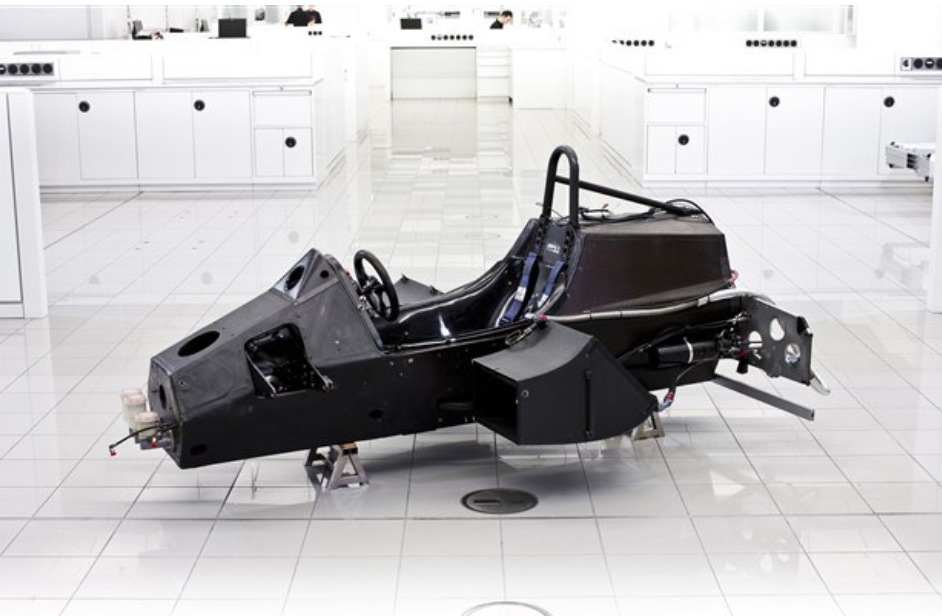
John Barnards’ pioneering use of a carbon fibre chassis in the first McLaren MP4 in 1981 was a driver safety ‘game-changer’.

Francois Cevert 1968

Cevert in his ‘Bell Magnum’ 1968 (unattributed)

As a young teenager just getting interested in racing Cevert ‘had it all’- dazzling film star looks, talent aplenty and racing for a team which was carefully nurturing his talent.

Ken Tyrrell recruited Francois into his Elf sponsored team after the retirement of Johnny Servoz-Gavin due to an eye injury. Jackie Stewart spotted Cevert in 1969 when contesting F2 races and suggested to Tyrrell he keep an eye on him.

Stewart immediately clicked with the young Frenchman, they had a remarkably mature relationship as teammates by the standards of today (Piquet/Mansell, Prost/Senna, Rosberg/Hamilton for example!) with Stewart mentoring the younger man, exactly as Graham Hill had done with the young Scot in 1965. Francois fitted into the ‘family team’ that Tyrrell was. Norah and Ken, Jackie and Helen Stewart, Derek Gardner and the mechanics was a famously friendly place to be- albeit a very competitive one.

Cevert made his Grand Prix debut in the team’s March 701 Ford at the 1970 Dutch GP, by the end of 1971 he won his one and only GP victory at Watkins Glen, ironically the circuit at which he would lose his life.

Stewart freely admitted Ceverts’ equal or superior speed in 1973, the team leading role Cevert was to play in 1974, when JYS retirement was planned was cruelly stolen from him.

Francois Cevert, Alpine A280 Renault, Brands Hatch F3 October 1967

(unattributed)

Francois in the Brands Hatch paddock (above) for the ‘ER Hall Trophy’ Meeting October 29 1967.

Alpine A280 Renault, DNF in a race flagged off after 10 laps due to the conditions, the top 10 finishers included future F1 drivers Henri Pescarolo, John Miles, Peter Gethin, Reine Wisell, and Derek Bell- the field also included future F1 drivers Ian Ashley, Gijs Van Lennep, Jean-Pierre Jaussaud, Dave Walker, Clay Regazzoni, Piers Courage, Howden Ganley…a field of some depth!

This article and photographs celebrate Francois’ time in his formative F3 and F2 years.

Cevert, born in 1944, originally became interested in racing via Jean Pierre Beltoise, his sister was dating the future French champion at the time.

After two years doing National Service he enlisted in a racing school at Magny Cours, winning the ‘Volant Shell’ competition, the prize was an Alpine A280 Renault F3 car.

Francois’ Magny Cours drive was funded by a married woman ‘Nanou’, he met her aged 19 and  she fell for him during a holiday in which she too was completing the race course- the shot below is of his wet, winning drive in a Merlyn Mk 7.

cev vol

(unattributed)


cev dep

Francois and Patrick, Volant Shell 1966 (unattributed)

Patrick Depailler also contested the final, finishing second, here the pair of them are looking very sodden after the race.

The Winfield Racing entered car was underfunded and relatively uncompetitive in 1967 but Francois did enough to be offered a works Alpine drive for 1968 but he turned this down and talked his way into the Tecno team, who had a much more competitive machine.

Francois Cevert , Pau F3 1967, Alpine A280 Renault

Early in the 1967 season, April 2 with the Alpine A280 Renault, at Pau. DNF in the race won by Jean-Pierre Jaussaud’s Matra MS6 Ford (unattributed)

He missed five rounds of the French Championship but won the first he entered at Monthlery on May 12, he was immediately competitive in his Tecno. A strong fourth place followed in the  Monaco F3 GP and  put his name into prominence, Ronnie Peterson placed third, he too would make his F1 debut in a March 701 in 1970.

Francois then took further wins at La Chatre, Nogaro and Albi winning the French F3 championship that year.

Francois Cevert, Albi 1968, Tecno 68 Ford F3

1st place in the 1968 French F3 Championships’ final 1968 round at Albi. Tecno 68 Ford (unattributed)

Francois progressed to a factory F2 Tecno in 1969…

The Ford FVA powered Tecno 69 was a very competitive car also driven by fellow 1970 F1 ‘newbee’ Clay Regazzoni. The class was hotly contested by drivers including Jochen Rindt, Jackie Stewart, Graham Hill and Piers Courage, the class contained both pretenders to the thrones of current champions and the champions themselves.

Johnny Servoz-Gavin won the European F2 Championship that year in a Matra MS7 Ford from Hubert Hahne in a Lola T102 BMW/ BMW 269 from Francois in third, it had been a strong debutant F2 season in a field of great depth.

Francois Cevert, Tecno 68 Ford FVA, Pau 1969

Francois Ceverts Pau 1969 was more successful then his 1967 visit- fourth in the F2 race in the Tecno 68 Ford FVA  won by ‘F2 king’ Jochen Rindt Lotus 59B Ford FVA. High wings banned shortly thereafter by the FIA during the 1969 Monaco GP weekend (unattributed)


Francois Cevert, Tecno 69 FVA, German GP 1969

Francois in the Tecno 69 Ford FVA F2 car during the 1969 German GP. He qualified sixteeth, and second quickest of the F2 cars in a field of 26 cars. DNF after 9 laps with gearbox failure (unattributed)

Into 1970 Francois continued in F2 and was also picked up by Matra for their endurance program, the 3 litre V12 sportscars provided his first taste of real power.

Cevert drove for the team for the rest of his life, Servoz retired and the rest, as they say, is history and one of Grand Prix Racings’ great ‘mighta-beens’…

Other Cevert Reading…

Francois and Jack Brabham at Matra in 1970; https://primotipo.com/2016/09/09/jack-and-francois-matra-ms660/

Tyrrell Aerodynamic Evolution; https://primotipo.com/2016/05/31/tyrrell-002-monza-1972/

Etcetera…

Francois Cevert , Matra MS660, Monthlery 1970

(unattributed)

Jack Brabham and Francois Cevert teammates at Matra in 1970.

Jack was in his last year of F1 and Francois his first- winners of the Paris 1000Km at Monthlery in 1970, Matra MS660

Francois Cevert, March 701 Ford, Dutch GP 1970

(unattributed)

First Grand Prix, the Dutch in 1970, Team Tyrrell March 701 Ford.

Q 15 of 24 cars and DNF with an engine failure on lap 31 of the race won by Jochen Rindt’s Lotus 72 Ford. This was the tragic race in which Piers Courage lost his life in a high speed crash in his De Tomaso 505 Ford.

Francois Cevert, TecnoTF71Ford FVA , Imola 1971

(unattributed)

Cevert continued to do the occasional F2 race after he had broken into GP racing.

Here he is aboard a Tecno TF/71 Ford FVA, in the ‘City of Imola GP’ in July 1971. He was non-classified tenth in the race won by Carlos Pace’ March 712M Ford FVA. ‘Tyrrell nose’ quickly adopted by others after appearing at the French Grand Prix earlier in July, but pioneered by Chevron in F2.

Brigitte and Francois 1971

(unattributed)

Francois and Brigitte Bardot at the Paris Racing Car Show in 1971.

By this time Cevert is a GP star if not an ‘ace’- the car is Graham Hills F1 mount of 1970, the Rob Walker owned Lotus 72 Ford- they make an attractive couple!

image

Cevert F3 victory celebration with parents, Tecno 68 Ford , 1968

(unattributed)

Francois celebrates a 1968 F3 victory with his parents, circuit not disclosed. Tecno 68 Ford F3.

Below, Ceverts #44 Tecno in the Monaco F3 paddock 1968- #39 Francois Mazet also Tecno 68 Ford mounted and #40 Etienne Vigoureux Martini MW3 Ford.

Monaco F3 pit scene 1968

(unattributed)


Francois Cevert, Tyrrell 002 Ford, USGP 1971

(unattributed)

Francois, Monza 1971, Tyrrell 002 Ford.

He was third in that blink of an eye finish between Peter Gethin, Ronnie Peterson, March 711 Ford, Francois and Mike Hailwood, Surtees TS9 Ford- Gethin’s BRM P160 V12 was the victor by a tenth of a second from Peterson and Cevert.

Tecno logo

Credits…

Automobile Year 16, DPPI, The Nostalgia Forum’, F2 Index, oldracingcars.com

Finito…

masten

Masten Gregory settles down in his fifth grid spot, works Cooper T51 Climax. Incredibly evocative period shot…

Gregory finished seventh in the race won by his team leader Jack Brabham with Bruce McLaren third in the last of the Cooper team T51’s, Moss splitting them in his BRM P25.

These amazing shots are from the ‘John Ross Motor Racing Archive’ http://www.johnrossmotorracingarchive.co.uk/index.php

grd

Carroll Shelby in the Aston DBR4, Hill in #28 Lotus 16 Cliamx, #22 Ian Burgess Cooper T51 Climax, #30 Innes Ireland Lotus 16 Climax, #42 Ron Flockhart BRM P25, #36 Brian Taylor JBW Maserati…9 Cooper T51’s and 2 T45’s started the race…where Maserati 250F’s provided the bulk of the field 2 years before Cooper now filled that role! (John Ross)

trintignant

Fireman at rest..whilst Trintignants Rob Walker Cooper T51 Climax passes…he finished 8th (John Ross)

hill lotus 16

Graham Hill’s Lotus 16 Climax, 9th (GP Library/Getty)

aintree crossing

Peter Ashdown, Cooper T45 Climax, from Graham Hill, Lotus 16 Climax and Roy Salvadori, Aston Martin DBR4…12th, 9th, and 6th respectively (John Ross)

masten

Masten Gregory, undated and unattributed but circa 1959…(pinterest)

Etcetera…

aintree layout

Aintree Circuit is located in Merseyside, Liverpool it is still used for motor sport in a limited manner, it last hosted the British GP in 1962

cooper

Cooper T 51 Coventry Climax, World Champion in 1959. Spaceframe chassis, 4 wheel disc brakes, IFS front by upper and lowere wishbones and coil spring/damper units. IFS rear by upper and lower wishbones and transverse leaf spring. 5 speed ‘box and DOHC, Weber carbed Coventry Climax FPF 2.5 litre 4 cylinder engine developing around 230bhp

Credit…

John Ross Motor Racing Archive, GP Library/Getty

Finito…

olivier 2

Olivier Gendebien in the Ferrari 250 Testa Rossa 59 he shared with Phil Hill to second place in the Nurburgring 1000Km in 1959…

Olivier was an interesting driver, born in Belgium in 1924 he fought the Germans as part of the Belgian Resistance movement, joined the Britsh Army and became a paratrooper.

After the War he worked in the forestry industry in the Belgian Congo and met a rally driver, commencing his own rally career. He won the Tulip Rally with Pierre Stasse in an Alfa 1900 Ti in 1954 and soon  came to the attention of Enzo Ferrari who signed him as both a Sports Car and occasional Grand Prix driver.

ring

Another view of Gendebiens # 4 TR at rest in the ‘Ring pits. #1 is the winning DBR1 of Moss/Fairman, #15 is the Porsche RSK 718 of Umberto Maglioli/ Hans Hermann (Pinterest)

Grands Prix…

belgian

1961 Belgian GP, Spa. Gendebien finished fourth in a Ferrari 156, behind the other similar cars of Phil Hill, ‘Taffy’ Von Trips and Richie Ginther, Hill on his way to the 1961 World Championship.Gendebiens car is painted in Belgiums national racing color, yellow, the car entered by ‘Equipe National Belge’. Less powerful than his teamamtes cars, the 156 was still a formidable weapon (Pinterest)

He competed in 15 Grands Prix, making his debut in a Ferrari 625 in Argentina 1956 finishing fifth. His best season was in 1960 at the wheel of a ‘Yeoman Credit’ Team Cooper Climax , his best results in the French and Belgian Grands Prix.

bristh

Olivier Gendebien in the 1960 British GP, Silverstone. ‘Yeoman Credit’ Cooper T51 Climax (The Cahier Archive)

Sports Car Ace…

sebring 19659

Ferrari 250 Testa Rossa 59, Olivier Gendebien, Sebring 1959. Gendebien shared the car with Americans Chuck Daigh, Phil Hill and Dan Gurney (Pinterest)

Whilst he was quick in a single-seater he was supreme in Sports Cars, Phil Hill the only driver who was his equal in the Ferrari Team during this period.

He first won Le Mans with Phil Hill in 1958, winning again with him in 1961 and 1962. He also won in 1960 with Paul Frere, his fellow Belgian. He won the Tour of Sicily, the Tour de France, and the Reims 12 Hour twice. Victorious also in the Targa Florio and Sebring 12 Hours thrice, he won the Nurburgring 1000Km once.

Gendebien was from a wealthy family, and under pressure to quit racing by his wife, retired after his fourth Le Mans win in 1962 aged 38. During retirement he ran a succession of businesses dying in the South of France in 1998.

targa 1962

Pitstop for the Gendebien/Ricardo Rodriguez/Mairesse Ferrari Dino 246SP, Targa Florio winners 1962 (Pinterest)

le mans 59

Le Mans 1959. The Gendebien/Hill Ferrari 250 TR 59, with Olivier sitting on the car talking to Phil Hill. Salvadori/Shelby won in an Aston Martin DBR1. Car # 15 is the Cliff Allison/ Hermanos da Silva Ramos TR . Both DNF(Pinterest)

bubbles

Gendebien, left,  and Hill enjoy the spoils of their 1962 and last Le Mans victory together. Olivier retired shortly thereafter. Car was a Ferrari 330 TRI/LM. The last front engined car to win Le Mans. Hill competed well into the decade, his last international win the Brands Hatch 1000km in a Chaparral 2F in 1967. (Pinterest)


Etcetera…

frencj gp

1959 French Grand Prix in a Ferrari Dino 246. Olivier finished fourth in the race won by his teammate Tony Brooks in a similar car. Olivier made his GP debut in a much less competitive Ferrari 625 in Agentina 1956 but still finished 5th on debut (Pinterest)

fazz

Ferrari pits Spa 1961. The 4 156 cars being prepared, Gendebiens yellow car contrasts the # 2 car of Von Trips, the winning #4 of Phil Hill, and Richie Ginthers third placed car # 6. The more you look the more you see… (Pinterest)

gendebien

Same scene from the other side of the Ferrari pit (Pinterest)

bekoan butt

Belgian butt shot..rear of Gendebiens Ferrari 156, Spa 1961 (Pinterest)

olivier

Gendebien watching the Ferrari 250 TR 61 of Ireland/Moss/Fulp/Tavano whizz past. It was disqualified for illegal refuelling. Olivier finished second in a 250GTO with Phil Hill. the race was won by the Bonnier/Bianchi Ferrari Tr 61 (Pinterest)

Photo Credits…

The Cahier Archive, Pinterest

The End…

mario

Mario Andretti ‘using the cushion’ during qualifying for the ‘Sacramento 100’ Champ Car event, California, Fall 1969…

The Sacramento 100 was contested at the California Sate Fairgrounds in Sacramento, 100 laps of a one mile oval on 28 September. The event was won by Al Unser from Gary Bettenhausen and brother Bobby Unser. Mario had a loss of oil pressure, retiring his 1960 Kuzma D/Offy on lap 83, winning $853 for his efforts…

andretti 66
Bernard Cahiers’ portrait of Mario Andretti circa 1966

Magic Mario…

One of my mates contends that the title of ‘most versatile racer ever’ goes to John Surtees hands down, it’s hard to argue with the ‘World Championships on two wheels and four’ line of logic. The only other contenders are Mike Hailwood and, perhaps Johnny Cecotto, with Hailwood the far better credentialled of the two on four wheels.

But what about most versatile on four wheels?

Right up until the 1970s the nature of drivers contracts allowed them to race in other classes. In fact the pro’s needed to race lots of cars to earn the start and prize-money to eke out a living. The likes of Jim Clark could and would jump from Lotus Cortina, to Lotus 30 sportscar, to Lotus 25 GP car, and then some, in British national meetings.

It isn’t necessarily the case that drivers will be equivalently quick in single seaters, sports cars, touring cars, on bitumen and dirt, and road and speedway courses, but that is the criteria to apply in working out our ‘most versatile’.

If we limit ourselves to the absolute elite, Grand Prix winners, there are a few names which usually come up in these conversations: Stirling Moss, Jack Brabham, Graham Hill, John Surtees, Dan Gurney and Mario Andretti to name a few. I’m not discounting the Pre-War aces who raced GP and Sports cars on varying surfaces, but suggest the greater variety of cars was available to post-war rather than pre-war drivers.

hill and mario
Lotus GP teammates that year, Mario Andretti and Graham Hill, Indy 1969. Hill is an absolute candidate for most versatile as the only winner of motor racings Triple Crown: World F1 title, Le Mans and Indy 500 victories (unattributed)

Moss apart from his obvious success in GP and sportscars, also rallied successfully.

Brabham’s career started on Sydney speedways, and then encompassed single seaters of all types, front and mid-engined like most of his peers, some sportscars, and some touring cars. He also raced Champcars and Can-Am. So Jack has to be up-there in consideration.

John Surtees is very similarly credentialled to Brabham without the speedway or equivalent dirt experience.

Dan Gurney is similar to Jack, but without the dirt background. He came from the West Coast sportscar scene, not through the rough and tumble of dirt speedways, and then into road racing in the way AJ Foyt, Parnelli Jones and Mario Andretti did.

Mario is hard to toss as our most versatile ever. He started in speedway racing sedans and midgets, then into faster cars, dirt champcars, paved speedway champcars, into Nascar whilst still racing on dirt speedways and then as he built his name and reputation, he moved into road racing as well.

He was scooped up for the factory Ford GT40 program, to Lotus in grands prix, and all the rest, but still, well into the 1970s racing speedway – he walked away from GP racing for a while in the 1970s as he could not get the driving variety he sought by signing a restrictive F1 contract – Vels Parnelli, the American team with whom he made his F1 comeback allowing that freedom.

Lotus 64 Indy 1969
Andretti testing the Lotus 64 Ford, 4WD and turbo-charged at Indy. The car was fast in testing, but a hub failed causing Andretti to hit the wall hard, with no time to rectify the problem, the cars were withdrawn and Andretti drove his regular USAC mount, a Hawk Ford to victory (unattributed)
312p
Andretti hands over to Chris Amon in the Ferrari 312P, this car a 3 litre V12 engined Group 6 prototype. Sebring 1969 (unattributed)

Its interesting to look at just one season, 1969 to see the breadth of cars, classes, surfaces, and circuit types on which he raced, just to test my contention…

Early in the year he raced at Sebring, co-driving a factory Ferrari 312P with Chris Amon. In March he did the first of three 1969 Grands’ Prix for Lotus – the South African GP, he also contested the German GP at the Nurburgring and US GP at Watkins Glen later in the year.

His maiden GP was at Watkins Glen, in upstate New York, the year before, 1968, he put his Lotus 49 on pole, really shaking the established order. In 1969 he drove both the conventional Lotus 49 and experimental, four-wheel drive Lotus 63, quite different challenges, the latter a very unsuccessful car.

LOTUS 63
Another challenge…driving the Lotus 63 Ford 4 wheel drive car on the Nurburgring, one of the toughest driving challenges in one of 1969’s worst cars. The 4WD experiments that year of Matra, McLaren and Lotus were all unsuccessful, tyre technology and wings providing the grip the teams sought with 4WD (unattributed)
brawner
Andy Granatelli of STP, crew and Andretti in the 1969 Indy winning Brawner Hawk Ford, a turbo-charged 2.65-litre V8 (unattributed)

His primary program for 1969 was the USAC Championship. Most of May was spent at Indy, very successfully, winning the 500 in his turbo-charged Brawner Hawk III Ford V8 on the famous Super Speedway. He won the 1969 USAC Championship which was contested on five dirt speedways, ten races on paved tracks, eight on road courses, and a hillclimb, this series alone a true test of a driver’s versatility and adaptability.

In late June he contested the Pikes Peak Hillclimb, winning it in a mid-engined Chevy V8 powered open-wheeler on the famous dirt course 12.4 mile ‘climb to the clouds’.

hawk ford
Andretti in his Hawk Ford, Pikes Peak 1968, he was 4th in ’68, won in ’69, the majestric but challenging nature of the course readily apparent (unattributed)

The Can-Am was run annually in the Summer. Holman & Moody entered a Ford 429 powered McLaren M6B in several of the events, not a particulary competitive car, but another quite different driving and engineering challenge. Andretti in a factory McLaren M8B would have been quite someting to watch!

mclaren
Andretti prepares to board his Holman & Moody entered and prepared McLaren M6B Ford 429 Can-Am car at Texas International Speedway, test session (unattributed)
Mario Andretti Riverside 1969, Ford
Mario in his Ford, ‘Motor Trend 500’ Nascar race on the Riverside road circuit February 1969. He qualified seventh and was classified 18th after engine failure on lap 132 (spokeo)
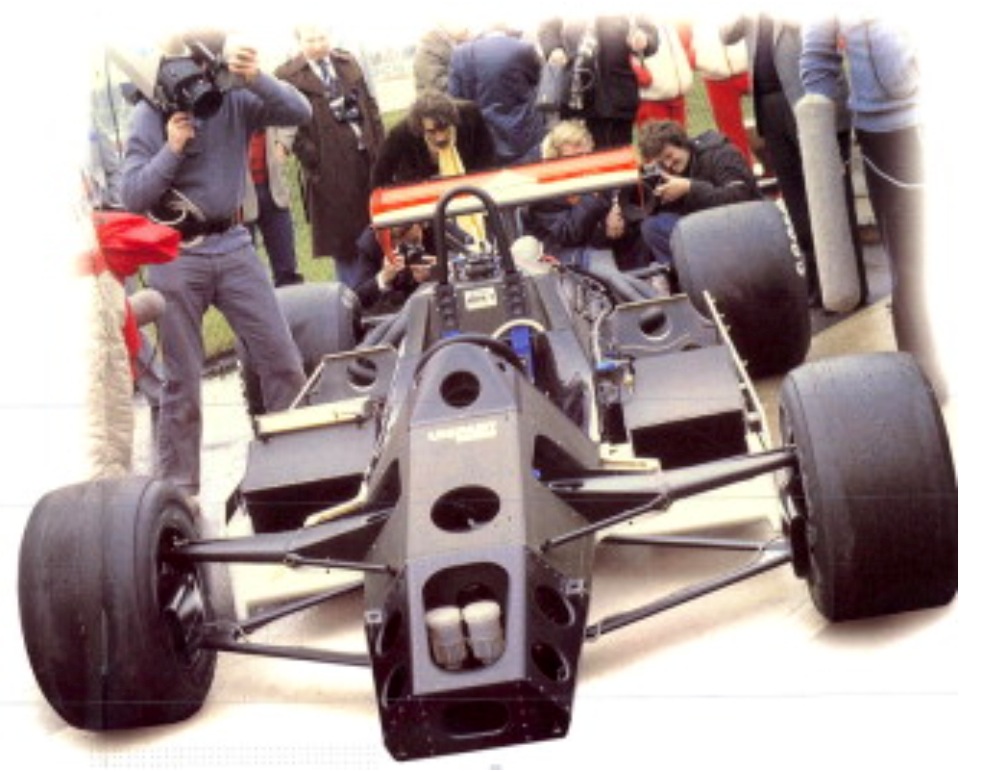
Mario only did one Nascar event in 1969…at Riverside in February, one of the road racing circuits on the tour, it was never a big part of his career but still demonstrates his versatility.

Andretti raced on 34 weekends in 1969. His season commenced with a front-engined, rear drive Ford Nascar and then a Ferrari mid-engined 3-litre V12 sports prototype…the Lotus GP cars he raced were the 3-litre Ford Cosworth normally aspirated V8 powered 2WD 49, and the 4WD 63.

His Hawk ‘Indycar’, for paved road-courses and speedways was a mid-engined single-seater, 2WD car powered by a turbo-charged Ford V8, but he also practiced the Lotus 64 mid-engined 4WD Turbo Ford at Indy.

His dirt-track ‘Kuzma’ was a front engined, rear drive four cylinder Offy powered single seater His McLaren Can-Am car a mid-engined sports car powered by a normally aspirated 429CID Ford, finally his Pikes Peak car was a Chev engined ‘Grant King’.

The variety of cars and different driving challenges is enormous, the differences in cars and venues in one year of his career qualifies him as our most versatile ever! Let alone the other four decades in which he competed.

Andretti won the World Drivers Championship in a Lotus 79 Ford in 1978 and he returned to Indycars after leaving F1, his last Indycar was win in 1993. Perhaps the only big win which eluded him is at Le Mans, but he was successful elsewhere in sportscars of course.

He is synonymous with speed, and revered globally as a champion driver, sportsman and ambassador for our sport…he is also, surely, the most versatile driver ever?

Andretti Ford Mercury 1969
The gift of communication…Andretti with the press, Riverside 1969. Ford Mercury Cougar (unattributed)

Photo Credits…

Pinterest unattributed, Spokeo, The Cahier Archive, Getty images-Paul Rondeau

Tailpiece…

(P Rondeau)

Mario makes a pitstop at Phoenix Speedway to take his final open-wheeler win, Lola T93 Cosworth XB, April 4, 1993.

It was Andretti’s fourth career win at Phoenix, and at 53 years, seven months and seven days old he became the oldest recorded Indycar winner on a traditional road course, as well as the first driver to win car races in five consecutive decades. Andretti still holds Indycar records for most starts (407), most poles (67) most laps led (7595) and most career top-three finishes (144).

Finito…

niki

Niki Lauda aviating his 312T in the Eifel Mountains, 1975…

He won the race and the world championship for the first time that year.

Ferrari turned the corner of uncompetitiveness with the 312B in 1970, the combination of chassis and new ‘flat 12’ engine was very competitive in the second half of the season.

Into 1971-3 they largely lost the plot with their chassis…Mauro Forghieri returned from the wilderness in late 1973.

The 1974 combination of Lauda, then in his third year of F1, Ferrari ‘returnee’ Clay Regazzoni, Forghieri and very young Luca Di Montezemolo as Team Manager commenced an era of Ferrari success if not dominance.

The cars were powerful, relatively light despite the additional fuel load needed by the Flat12 relative to the Ford Cosworth V8, handled superbly and were as aerodynamically advanced as the competition, until the ‘game-changing’ Lotus 78 arrived at least .

Lauda, Regga, Reutemann, Villeneuve, and Scheckter extracted all the performance as well.

The 1975 312T, so called because of the transverse location of the gears within the ‘box was the start of a series of cars which won drivers world titles in 1975, ’77, and ’79 for Lauda twice and Jody Scheckter once.

The car was not the prettiest of the mid-70’s to my eye but was an incredibly cohesive, beautifully integrated design. Without doubt one of Ferraris finest.

Lauda was up for the developmental and testing task, it was why Ferrari hired him but he also proved he was a winner. Montezemolo welded the group into an effective fighting unit, rather than the ‘Palace Intrigues’ of Maranellos’ past holding the Scuderia back …

regga

Clay Regazzoni, Ferrari 312T, Nurburgring 1975. DNF engine. (Pinterest)

fazz

niki

Enzo Ferrari, Luca Di Montezemolo & Niki Lauda, test session at Fiorano 1974 (Pinterest)

Photo Credits…

Pinterest unattributed, Werner Buhrer drawings

francois

Lisa in Pete Arons ‘Bell Magnum’…

The iconic John Frankenheimer 1966 ‘Grand Prix’ is an evocative racing epic most of us have seen, if you haven’t make sure you do, it captures the Grand Prix cars of the sixties very essence!

Described by some film purists as ‘a few million dollars worth of star power and a nickels worth of plot’, from a racing point of view its superb, and features cameos of some of the stars of the day including Phil Hill, Graham Hill, Juan Manuel Fangio, Jim Clark, Jack Brabham and Jochen Rindt.

Francoise Hardy plays Lisa, the ‘romantic interest’, in the politesse of the sixties, of Ferrari driver Nino Barlini.

francois

(Getty Images)

Hardy first found fame as a singer and was signed to her first record label at 17. She achieved her first Gold Record in 1962 with ‘Tous Les Garcons et les Filles’. She played minor roles in several films including ‘Whats New Pussycat’, and in ‘Grand Prix’, her primary career has always been as a singer, in French, English, Italian, Spanish and German…

She is now 70 and lives in Paris, and still a style icon…

jack

Francoise Hardy and Jack Brabham, Italian Grand Prix , Monza 1966. The car is Jacks’ 66′ championship winning BT19 Repco, DNF in this race won by Scarfiottis’ Ferrari 312. Jack looks happy and who wouldn’t be? (Bernard Cahier)

fazz

‘Lisa’ in Nino’s ‘Ferrari’, which i think, is a Brabham Climax, its certainly a Coventry Climax FWMV V8, despite the exhaust…anyway its all about Francoise not the car…many of the cars used in the film were F3 cars in ‘F1 Drag'(Pinterest)

Credits…

Bernard Cahier, Pinterest