Archive for the ‘Touring Cars’ Category

(HRCCT)

Michael ‘Moose’ Warner, Holden 48-215 leads Tony Edmondson, BMW 1602 Repco at Symmons Plains circa 1974…

Touring Cars (a ‘Sports Sedan’ in this case) are not my thing but that BMW is powered by a Repco Brabham 4.4 litre ‘620 Series’ V8 so by definition it’s of interest!

The Historic Racing Car Club of Tasmania continues to post wonderful photographs on its Facebook page- just pop the name into the FB search engine and have a look. Grab a beer before you do so, you cannot do the job properly in less than two or three hours.

(B Smart)


(B Smart)

Edmondson, who started racing a Ford Cortina GT with a good deal of pace in his native Tasmania circa 1970 was the latest in a long list of drivers whose career was aided and abetted by Tasmanian businessman Don Elliott- others include Robin Pare, John Walker and Mark McLaughlin.

The pair raced this BMW, then the ex-McCormack Valiant Charger Repco-Holden F5000 V8 and later still the two K&A Engineering built Alfa Romeo Alfetta GTV Chev V8’s- he had a really nasty accident in the first of these at Surfers Paradise.

Later still, in the mid-eighties, they acquired Elfin Sportscars, bless ’em- after Garrie Cooper’s untimely death and built some fantastic FV, ANF2 and one Formula Holden before the economic realities finally caught up with them and the business changed hands to become a builder of road/race cars rather than racing cars. (i’m truncating)

Edmondson and Grice top of The Esses at Baskerville in 1978 looking as though it could turn to tears at any moment’ indeed Grant Twining, but did it!? (K Midgley)

I always admired Edmondson’s aggression, pace and mechanical ability- another guy wasted on Sports Sedans I thought, if he handles 5 litres so well why not jump aboard the ‘real F5000 deal’…

I do recall the BMW, not that I ever saw it race in Victoria- did it ever race on the ‘Big Island’ i wonder? No doubt it did.

The Baskerville photos, circa 1973, are great, particularly Tony’s cavalier disregard for his racegear- perhaps he was ‘just tootling around’ on a day of testing.

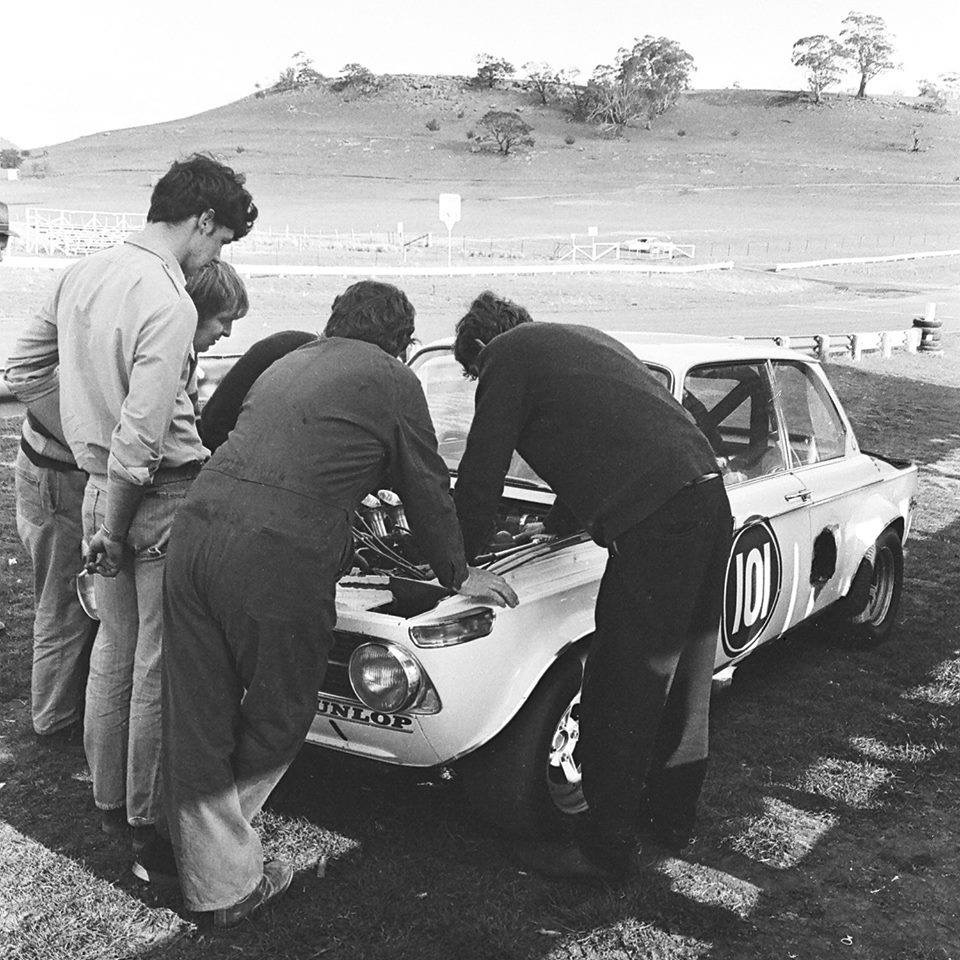
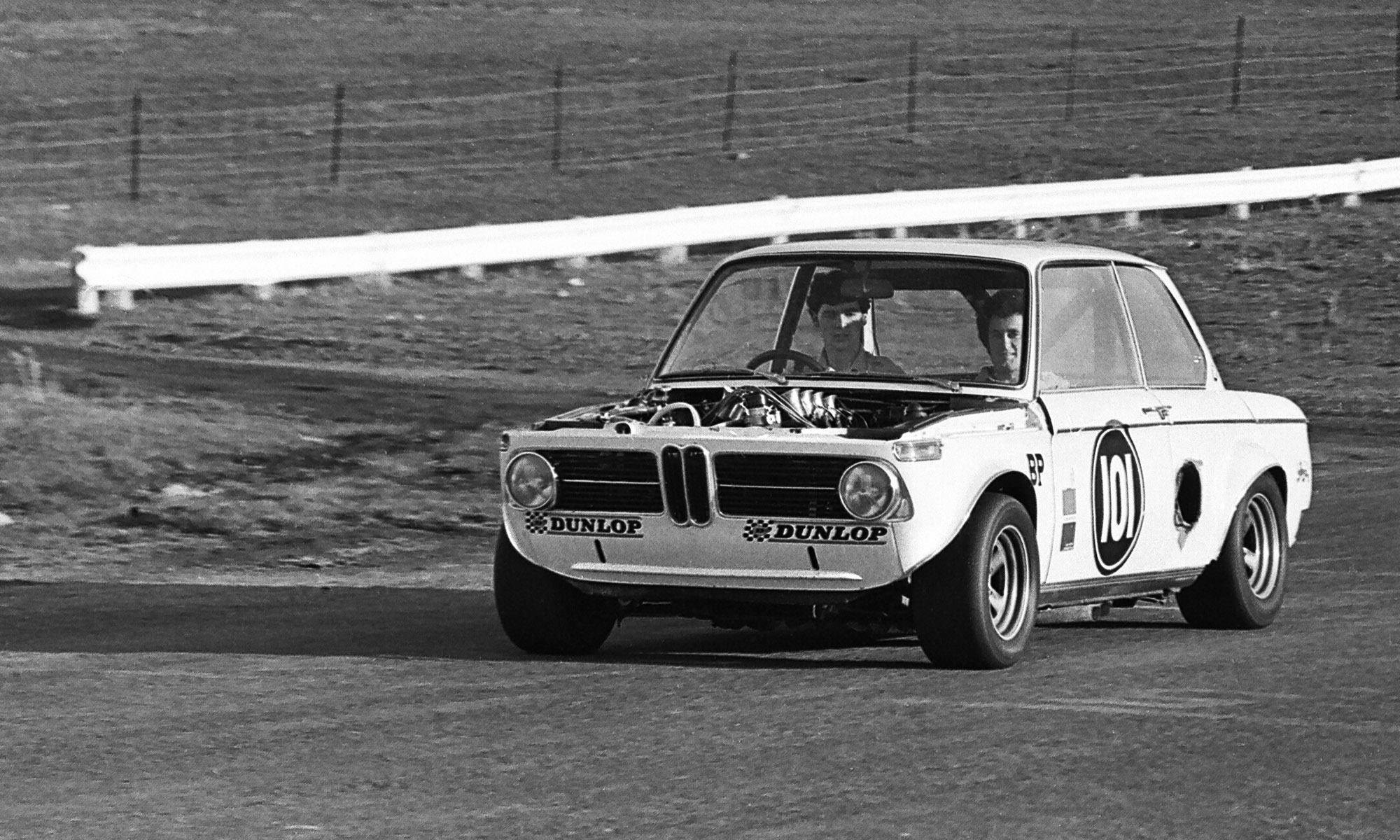
Bruce Smart, the photographer advises that is exactly what the team were doing ‘I took the photos in mid-1973 on the main straight at Baskerville. It was a private test day and they were the only ones there. The Repco BMW was still being developed and they were having issues with cooling. It had a boot mounted radiator, you can see the hastily cut vents in the rear guards which were made to enhance airflow.’

‘Tony was only driving slowly, hence no helmet, in fact it was barely fast enough to get a speeding ticket in the Hobart CBD. They would do a couple of laps, return to the pits and scratch their heads, then do a few more laps. Eventually the cooling was sorted.’

I’m very interested to know who did the engine installation- presumably a Borg Warner four-speeder is attached to the back of the RBE V8 but i’m just guessing. Which particular RBE 620 izzit, where did it come from and where is it now? Where is the BMW shell too I guess, although that is of less interest. The Holden ‘was one of the best Humpy’s going around, unfortunately it fell over one day and was binned’ wrote the HRCCT’s Grant Twining.

Lindsay Ross advises Don Elliott is about 90 years old and that Tony Edmondson still works for his ‘Elliots Self Storage’ business in Hobart. He also recalls the ‘Repco 4.4 gave them so much grief with cracking blocks.’

Correspondence welcome!

Don Elliott supervises proceedings at Baskerville, hungry Lucas mouths atop RBE620 (B Smart)


oldracephotos.com.au/Harrisson)

Top shot above is of Edmondson a few months later with the car now complete at Baskerville, 1973.

Credits…

Bruce Smart via Historic Racing Car Club of Tasmania, Keith Midgely

Etcetera…


(B Smart)

‘Its not too noisy, no cops about, how bout we swing past mums on the way back to Hobart’, or some such. As I say, very interested to find out and publish the fullest technical specifications of this car we can come up with.

Social media suggests the car ended up in Western Australia at some point?

(HRCCT)

That’s not Edmondson in the ‘Fastman’ race suit- he is almost fully obscured by blue-cardigan man- who is the other racer?

Tailpiece: Turn-in is real noice…

(B Smart)

‘Hmm, maybe time to put my fire-proofs on’ is perhaps the drivers thoughts. And ‘Shit! This thing gets up and boogies.’

Note the Mawer Engineering wheels and ‘well back’ location of the engine. Intriguing to know the difference in weight between the cast iron block, alloy head BMW four and all alloy Repco V8.

This conversion is a ‘well-travelled path’ in the sense that the 1970 similarly engined Bob Jane Racing, John Sheppard built, Holden Torana GTR-XU1 ‘620’ 4.4 V8 showed just how quick this combination of compact car and very light ‘racing’ V8 could be.

Click here for a piece in part about this car, the Charger Repco and Corvair Chev; https://primotipo.com/2015/06/30/hey-charger-mccormacks-valiant-charger-repco/

Finito…


(HRCCT)

Norm Beechey and Jim McKeown at Symmons Plains in February 1968…

Both the Chev Nova and injected Lotus Cortina Mk2 were top-liners in 1968 albeit the one race Australian Touring Car Championship was won again that year by Pete Geoghegan’s Ford Mustang from Darrell King, Morris Cooper S and Alan Hamilton’s just arrived in the country Porsche 911S/T. It was Geoghegan’s fourth of five ATCC titles.

The 34 lap event was held at Warwick Farm on 8 September, by that stage Norm had replaced the Nova with a Chev Camaro- he retired with mechanical dramas after 11 laps whilst Jim’s race was over after only 2- axle failure the cause.

(L Ruting)

Photographs of the Camaro SS are not plentiful as it raced for only a short period- four meetings (Warwick Farm twice, Calder and Catalina) from July to September 1968 inclusive of the ATCC race where he qualified on the second row- the car was an ‘in between’.

The Nova raced from Easter 1966 and the Holden Monaro’s with which he became synonomous in the latter stages of his career date from October 1968, the Camaro fitted in between.

The photo above is during the first lap of the 1968 ATCC race with Pete up front, then Norm and the Bob Jane Mustang.

See this piece on the 1969 ATCC; https://primotipo.com/2018/02/01/1969-australian-touring-car-championship/ , and on 1970; https://primotipo.com/2018/04/01/variety-is-the-spice/

Beechey trying to pursuade the Nova to turn in, Paul Fahey and Red Dawson in Mustangs, Rod Coppins in Chev Camaro at Baypark, NZ 1968 (T Marshall)

Etcetera…

(M Rogers)

Beechey and John French, Nova and Cooper S on the Surfers Paradise grid in 1967.

Credit…

Historic Racing Car Club of Tasmania, Lance Ruting, Rod MacKenzie, Steve Holmes- The Roaring Season, Terry Marshall, Mervin Rogers

Tailpiece: Beechey and Geoghegan at Catalina Park 18 August 1968…

(R MacKenzie)

Classic Ford/GM, Geoghegan/Beechey battle. Who won?

Finito…

(J Wright)

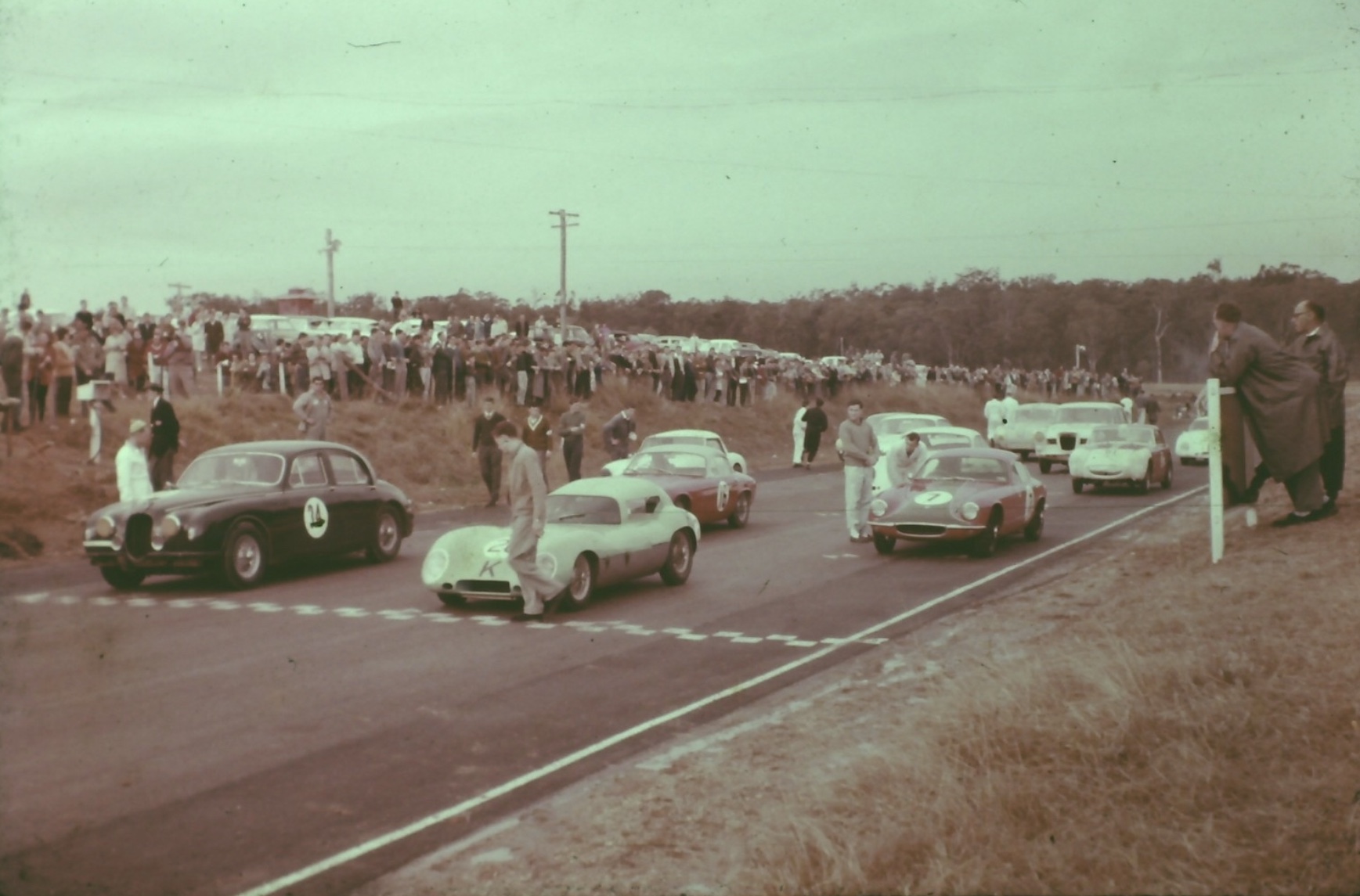
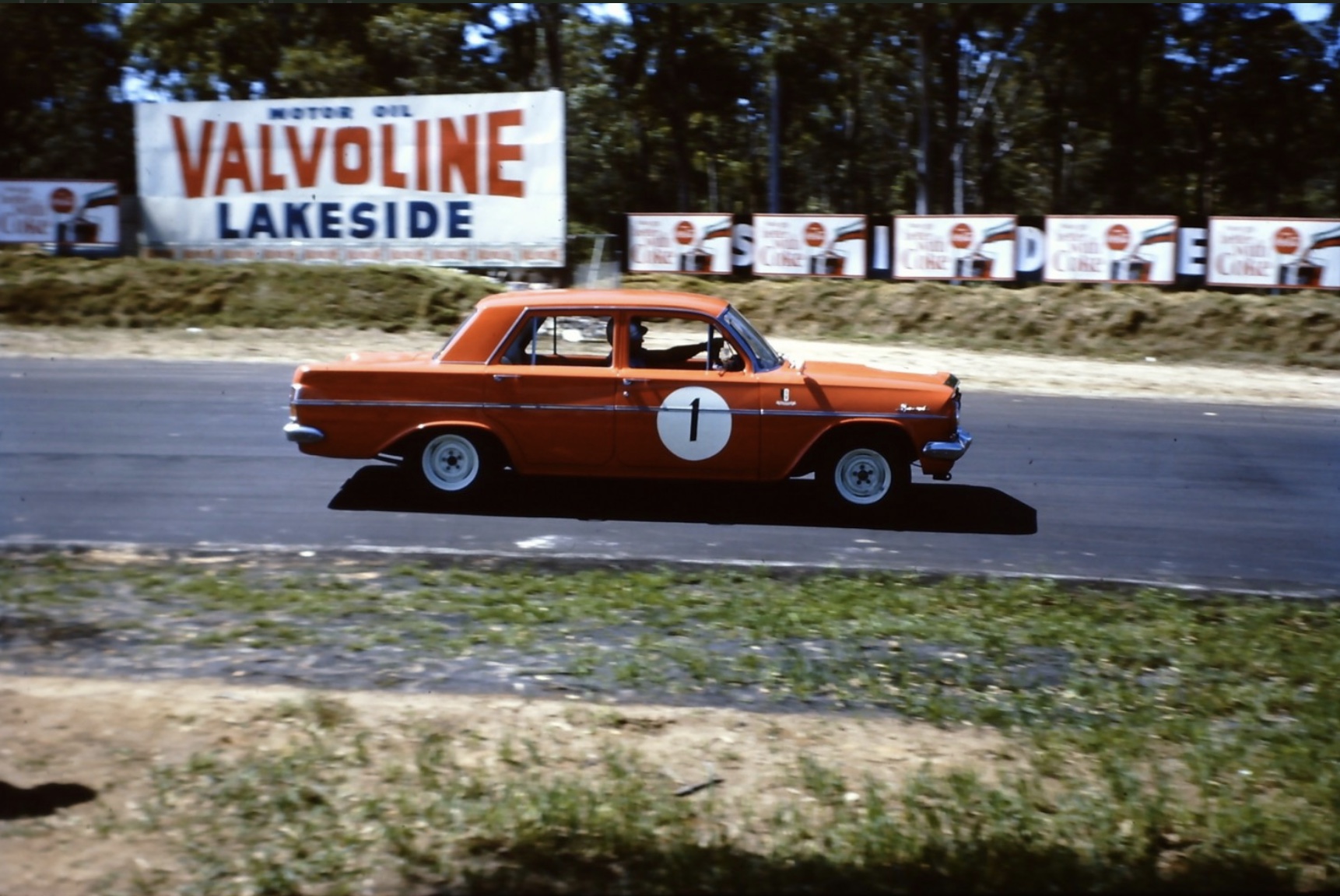
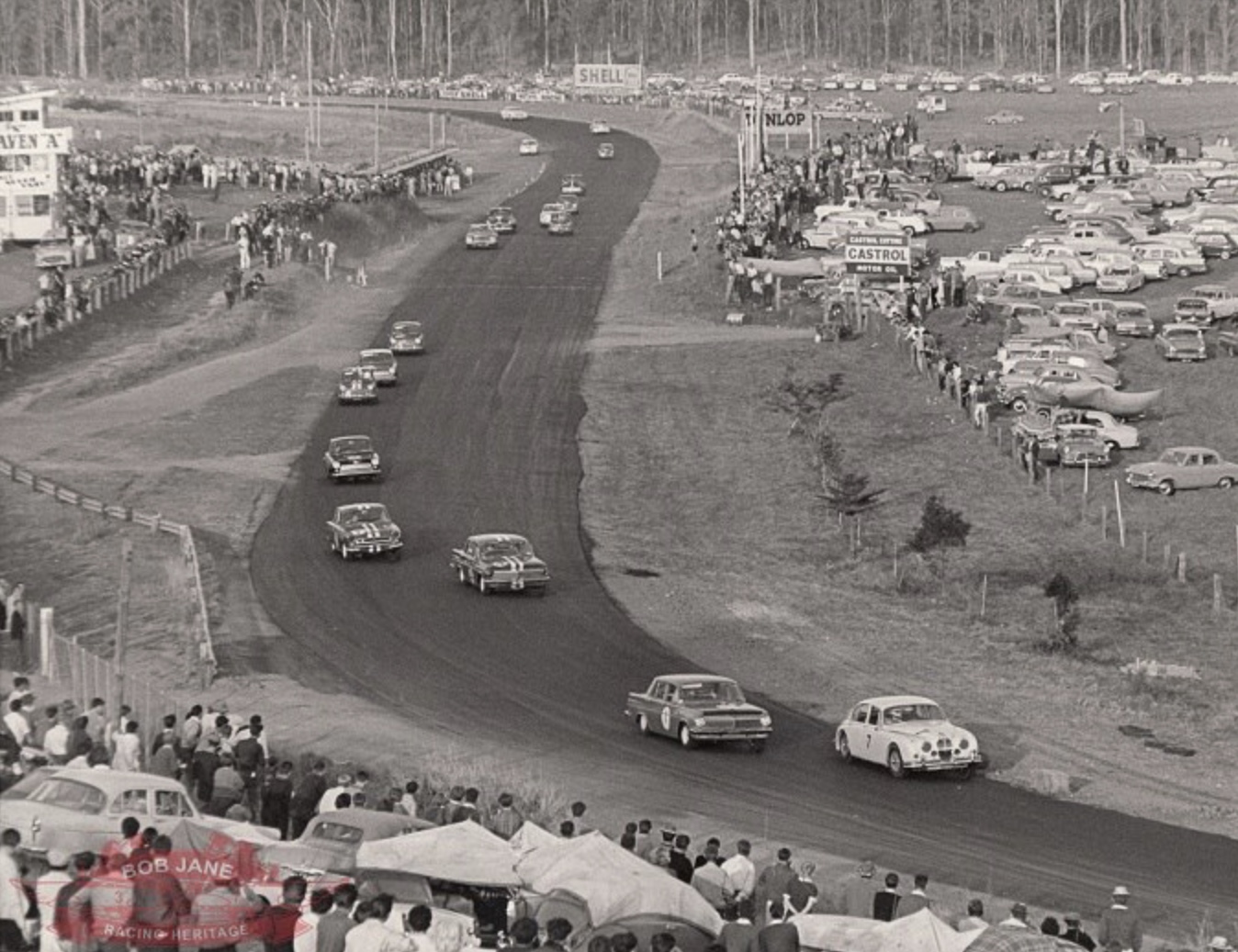
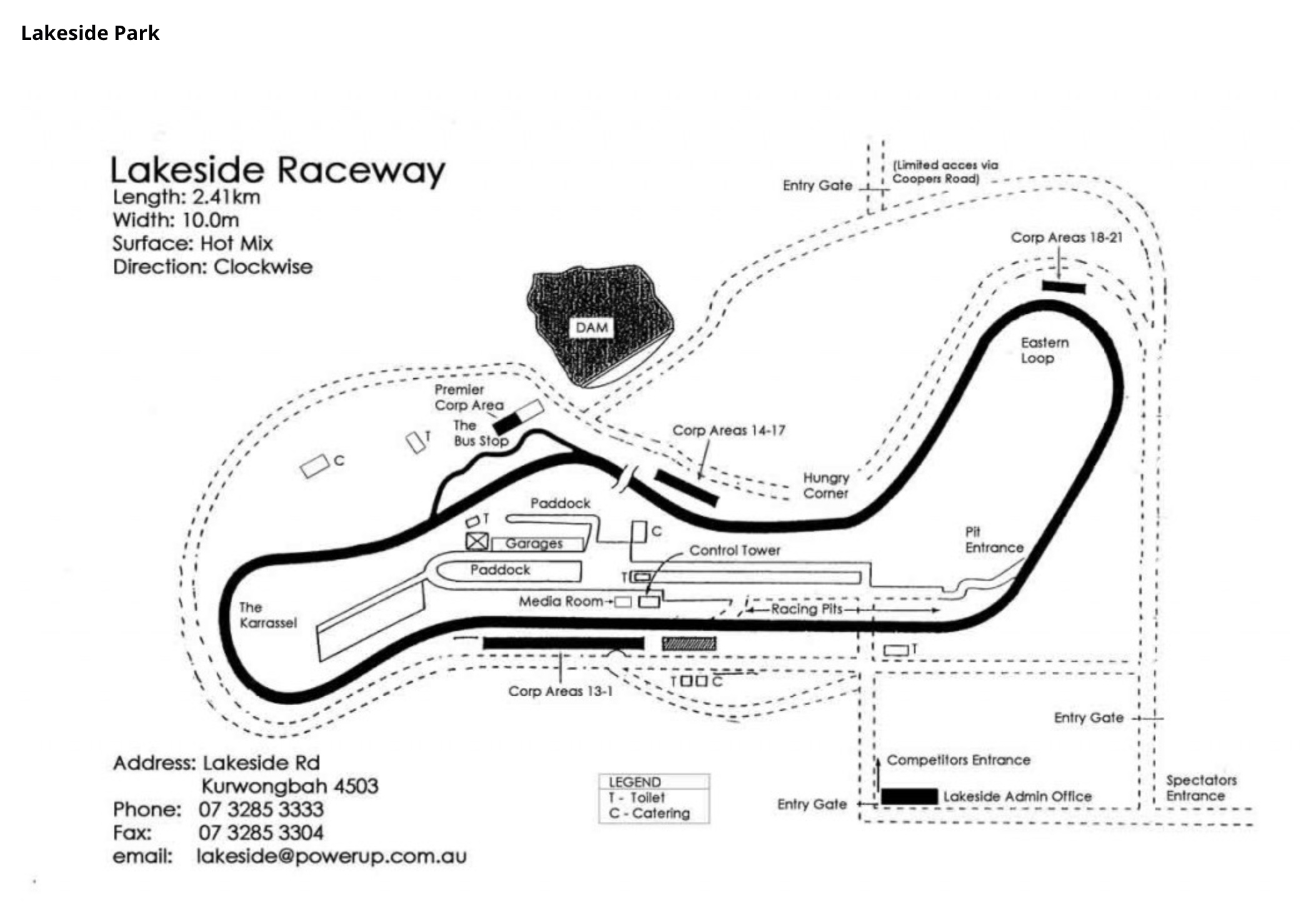
The grid for the Australian GT Championship at Lakeside, Queensland on 8 July 1962…

Bill Pitt, Jaguar 3.4 alongside John French in the Centaur Waggott/Holden, then the two Lotus Elites of Tony Osborne #16 and #7 Brian Foley. On the row behind is #21 Les Howard, Austin Healey Sprite Ford-Cosworth, in the middle the partially obscured #31 Porsche 356 of Tony Basile and on the left the white #30 Renault Floride of Terry Kratzmann .

The light coloured Sprite further back is #51 Sib Petralia, #60 Paul Fallu, Karmann Ghia whilst the #4 Wolseley has long time competitor Ken Peters at the wheel. The unmistakable outline of the grey Renault Dauphine is #6 M Hunt. Dennis Geary #22, was also entered in the HWM Jaguar- now in two-seat Coupe form but with the very same chassis and mechanicals of the car raced by Lex Davison to win the 1954 Australian Grand Prix, ‘just down the road’ at Southport on the Gold Coast.

The 50 lap 75 mile race was won in 62:6.06 minutes/seconds by French from Basile, Pitt, Howard then came Foley. Sib Petralia won the under 1 litre class, Basile the 1000-1600cc, French the 1600-2600cc and Pitt the 2600cc class and over.

The race was the third Australian GT Championship for Appendix K cars- the first was held at Bathurst during the October 1960 meeting and won by Leo Geoghegan’s Lotus Elite, the 1961 event was at Warwick Farm in July- Frank Matich won in his Jaguar D Type.

The CAMS relaxed attitude to the requirements of App K was that cars such as the Matich D, Bob Jane Maserati 300S, David McKay Lola Mk1 Climax and many other sports-racers were allowed to run to fill scanty grids, with hardtops cobbled together for the purpose.

Which rather negated the intent of the CAMS regulatory changes, lets not go down that path.

The first photograph had me tossed- I got Pitt and French but not the locale at all, i’ve never been to Lakeside and some earthworks after the first several years changed the look of the place a bit in any event.

So, many thanks for the detective work of regular collaborator Stephen Dalton and Glenn Moulds- the wise owls of The Nostalgia Forum can usually solve these knotty Who, What, Where and When problems.

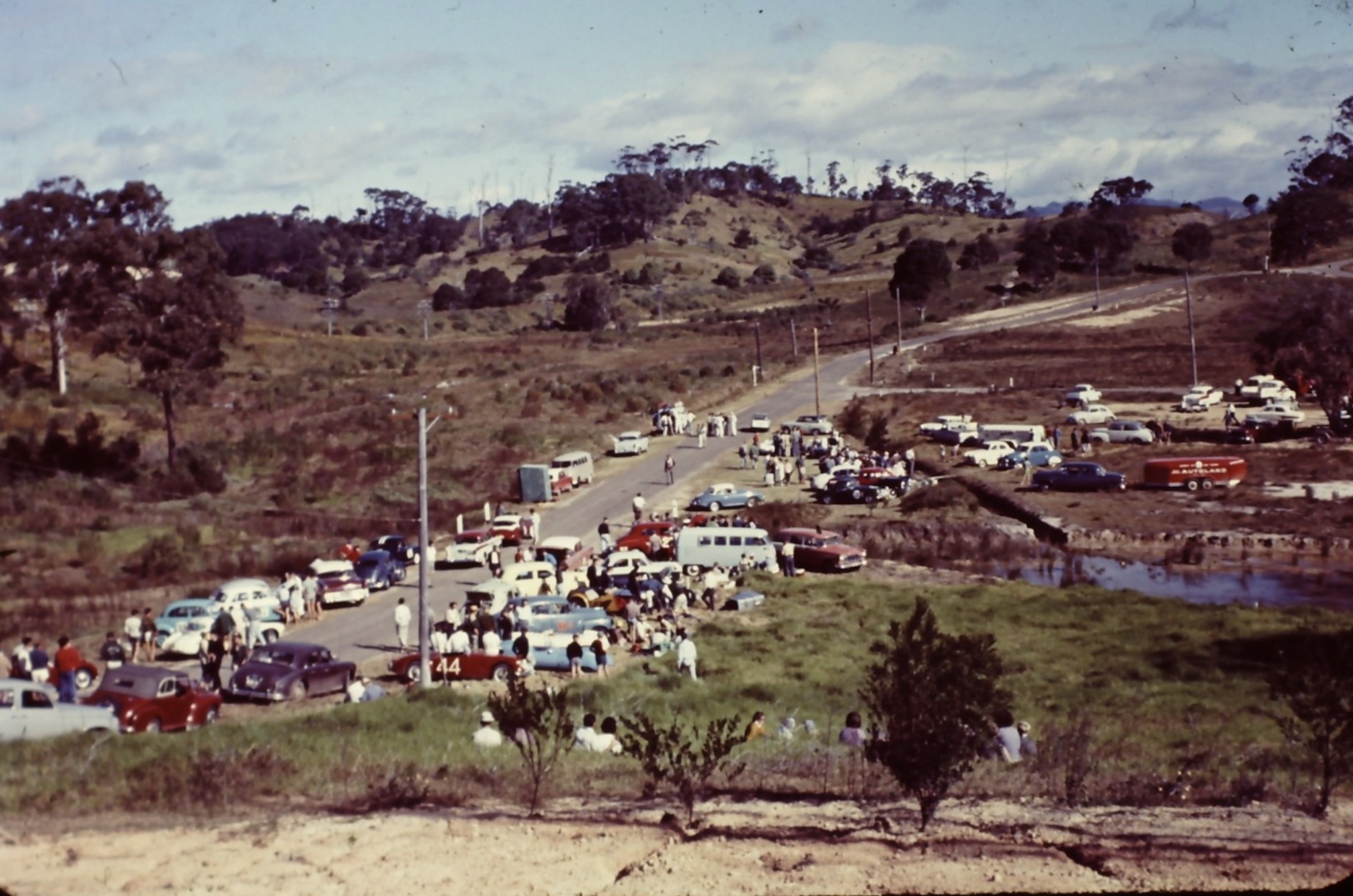
Mind you, we are still cogitating in relation to the shot below, said to be Lakeside too.

If there are some Queenslanders out there who can confirm the whereabouts of the scene below that would be a bonus. My suggestion that its on the Jindabyne-Charlottes Pass road near Charlottes in the NSW Snowies so far has little support.

(J Wright)

Most of these photographs were popped up on the Shannons Insurance website by Dr John Wright a couple of years ago but only three were identified- we on primotipo…backed by the research horsepower of the TNF Crew are happy to oblige.

Lakeside was built on farm land purchased by Geoffrey Sidney Sakzewski at Petrie 30km north of Brisbane in 1957.

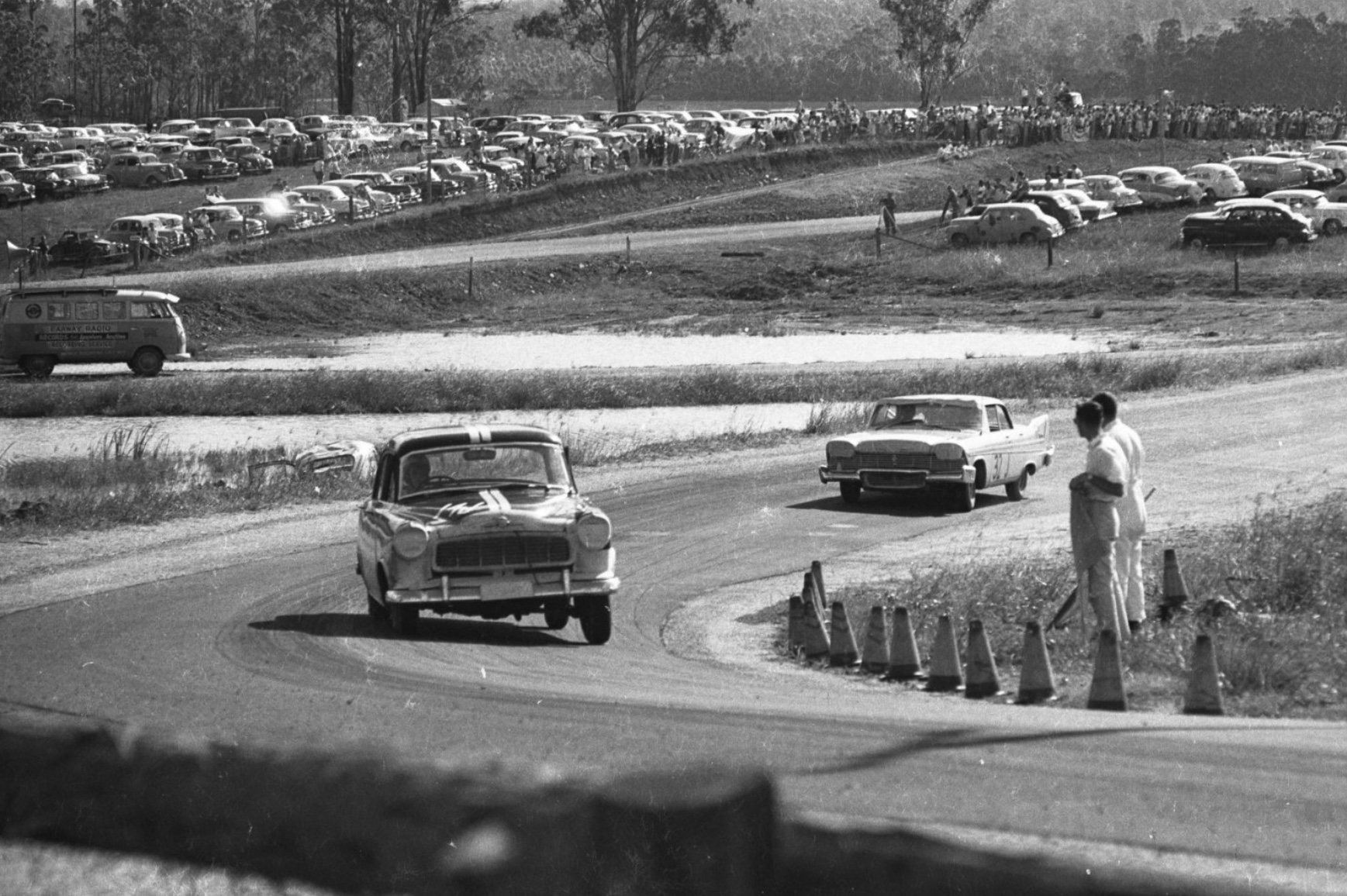
The first open race meeting was held on 19 March 1961- the landlord was keen to compete so pressed into service his wife’s  four door, light-green pillarless Plymouth Belvedere- here he is chasing the Jeremiah driven Holden FE. Rob Bartholomaeus advises the race was the Queensland Touring Car Championship- Bill Pitt is on his way to winning aboard his 3.4 Jaguar up the road- these two are scrapping for second, a battle won by the Jeremiah.

(J Wright)


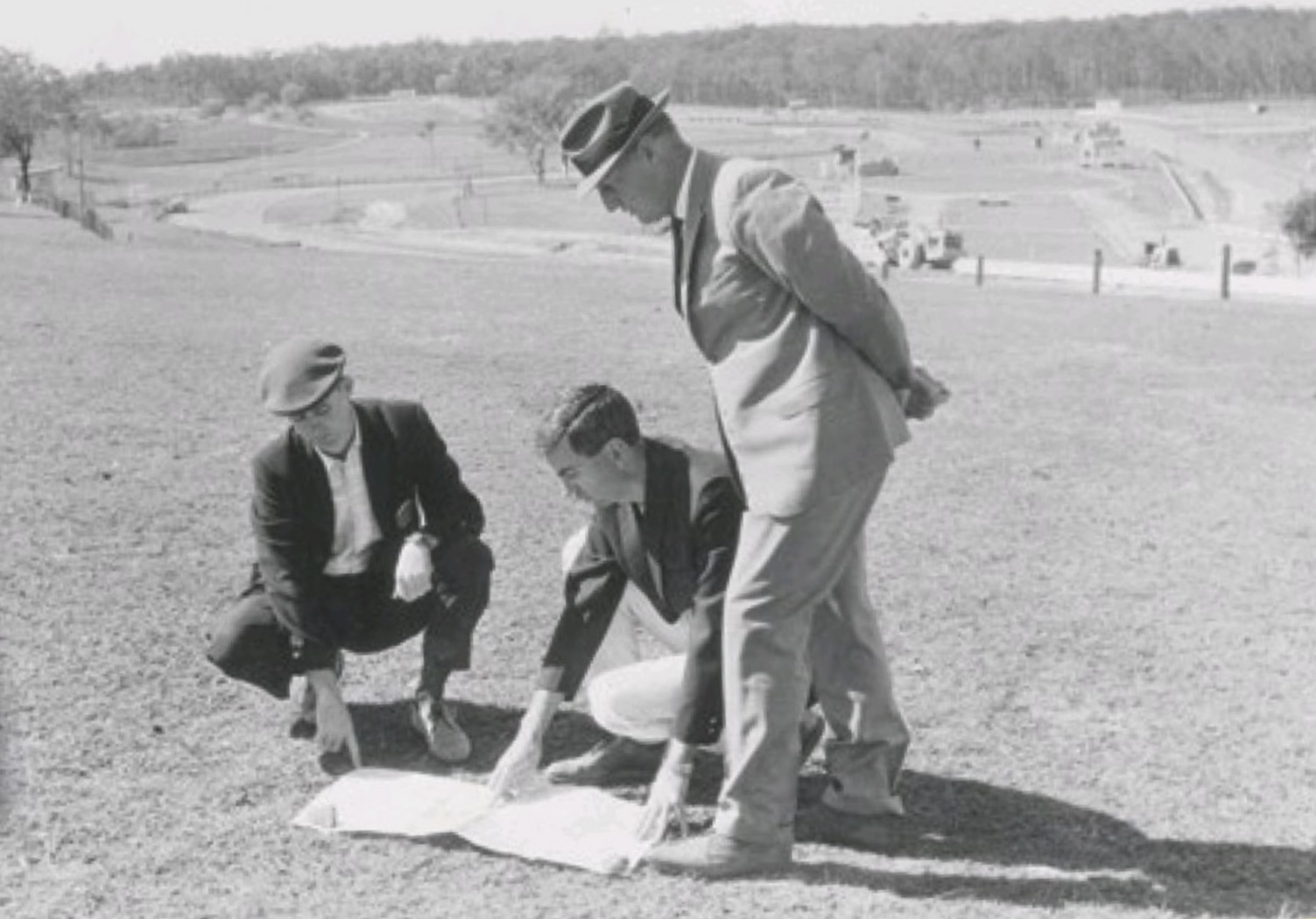
Pondering and working on the remodelled Lakeside layout in 1965 before the 1966 AGP- David Harding, Ken Peters and Sid at right (unattributed)


(J Wright)

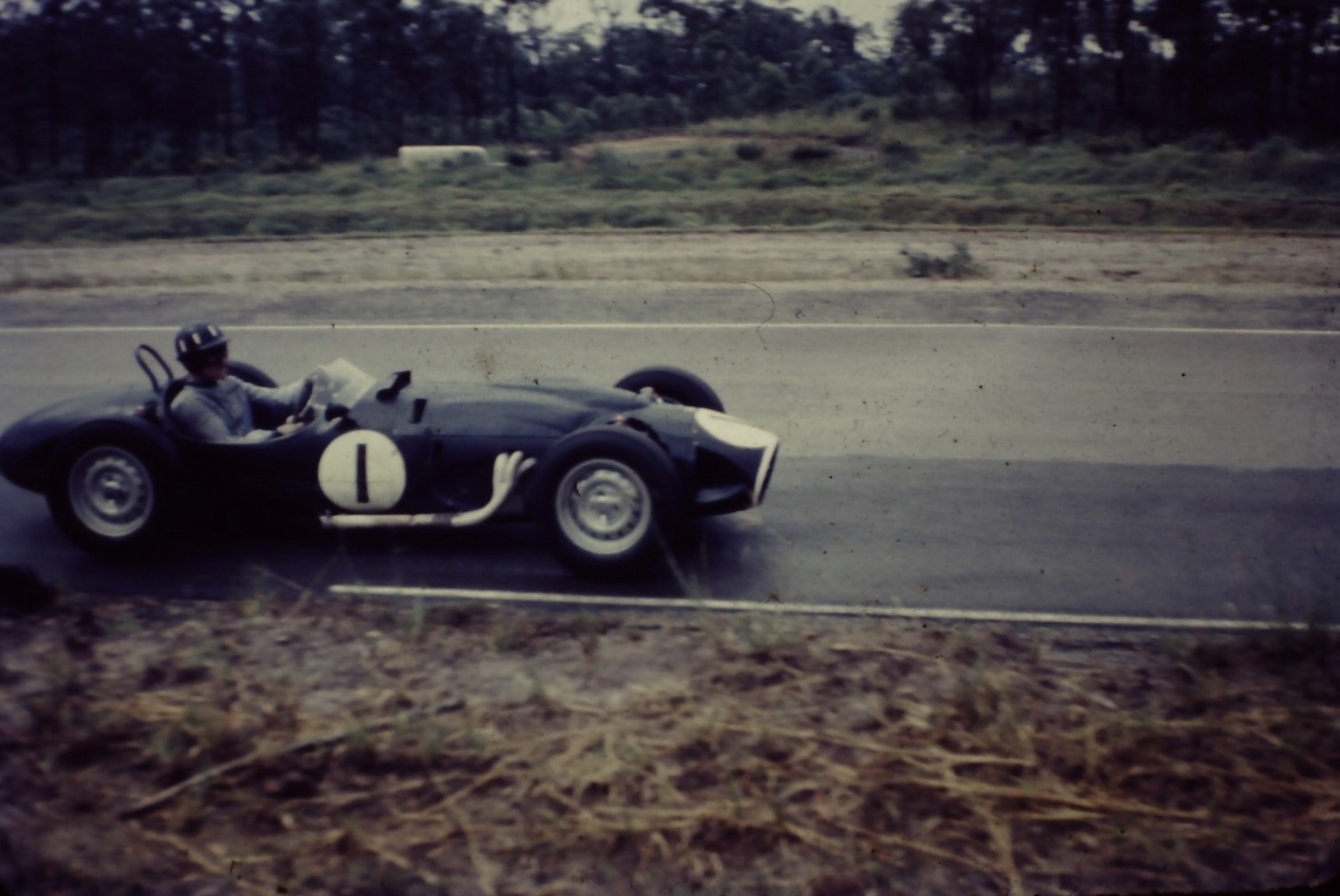
The profile of car and the helmet above will be familiar to most of you, its Hill G on his 1963 Australasian Tour during which he raced the Ferguson P99 Coventry Climax 2.5 FPF.

The rest of the hotshots ran 2.7 Climaxes in their Coopers, i’ve always thought it interesting to ponder how Graham would have gone with a bigger engine under the cars shapely bonnet.

Mind you, his only race win on the tour was a heat at Lakeside- its looks a tad soggy so I would not be surprised if Graham is on the way to a Saturday victory aboard this magnificent bit of engineering.

I waxed lyrical a while back about it, click here; https://primotipo.com/2015/01/30/ferguson-p99-climax-graham-hill-australian-grand-prix-1963/

(J Wright)

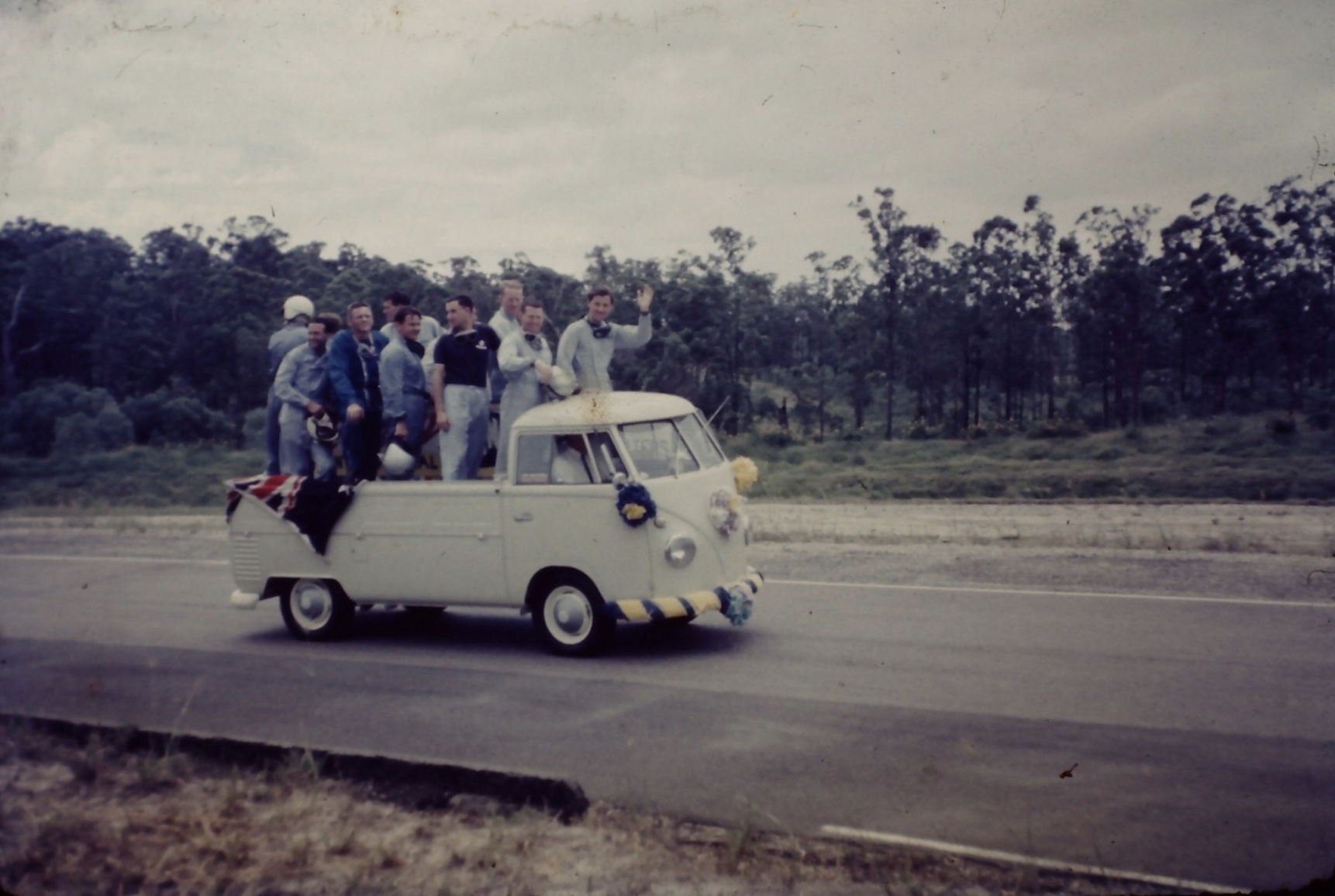
The poor old Kombi is groaning under the weight of so many champions in one place- 1200cc this model? and now highly sought after of course.

She’s a bit grainy but my best guess- and happy to hear from you, goes a bit like this from left to right- Frank Gardner in the white helmet looking away at the kangaroos, dunno holding the helmet, Arnold Glass in the darker blue race suit, Bruce McLaren holding the light silver helmet, short-sleeved fella probably Greg Cusack, Bib Stillwell and Graham Hill. ‘Blondie-locks’ behind is John Youl perhaps. Do get in touch with your bids.

The 1963 Lakeside International was won by John Surtees, Lola Mk4A from Hill’s Ferguson P99 and Bib Stillwell’s Brabham BT4- Climaxes all.

Back in the days of yore, until 1969, the Australian Touring Car Championship was decided over one race- the honour to host the event was awarded to Lakeside in 1964- race day was 26 July.

Lakeside’s proximity to Brisbane ensured a good crowd saw a contest waged between a huge variety of cars with Ian ‘Pete’ Geoghegan winning the first of his ATCC’s aboard a Ford Cortina GT from Norm Beechey, Holden EH S4, Bob Jane’s Jaguar Mk2 4.1, the Brian Foley and Peter Manton Morris Cooper S’, Glynn Scott’s Cortina GT and Brian Muir’s EH S4.

A series of heats, split into engine capacity classes determined the grid- Jim McKeown’s Lotus Cortina was on pole from Jane, Muir, Beechey and Manton.

Muir, Jane and Beechey led initially from Geoghegan and McKeown- Jim moved forward to second behind Muir- leadership of the race by Muir (below) was the first time a Holden had led an ATCC event- it would not be the last! Brian went off to fame and good fortune in Europe not so long after this.

(J Wright)

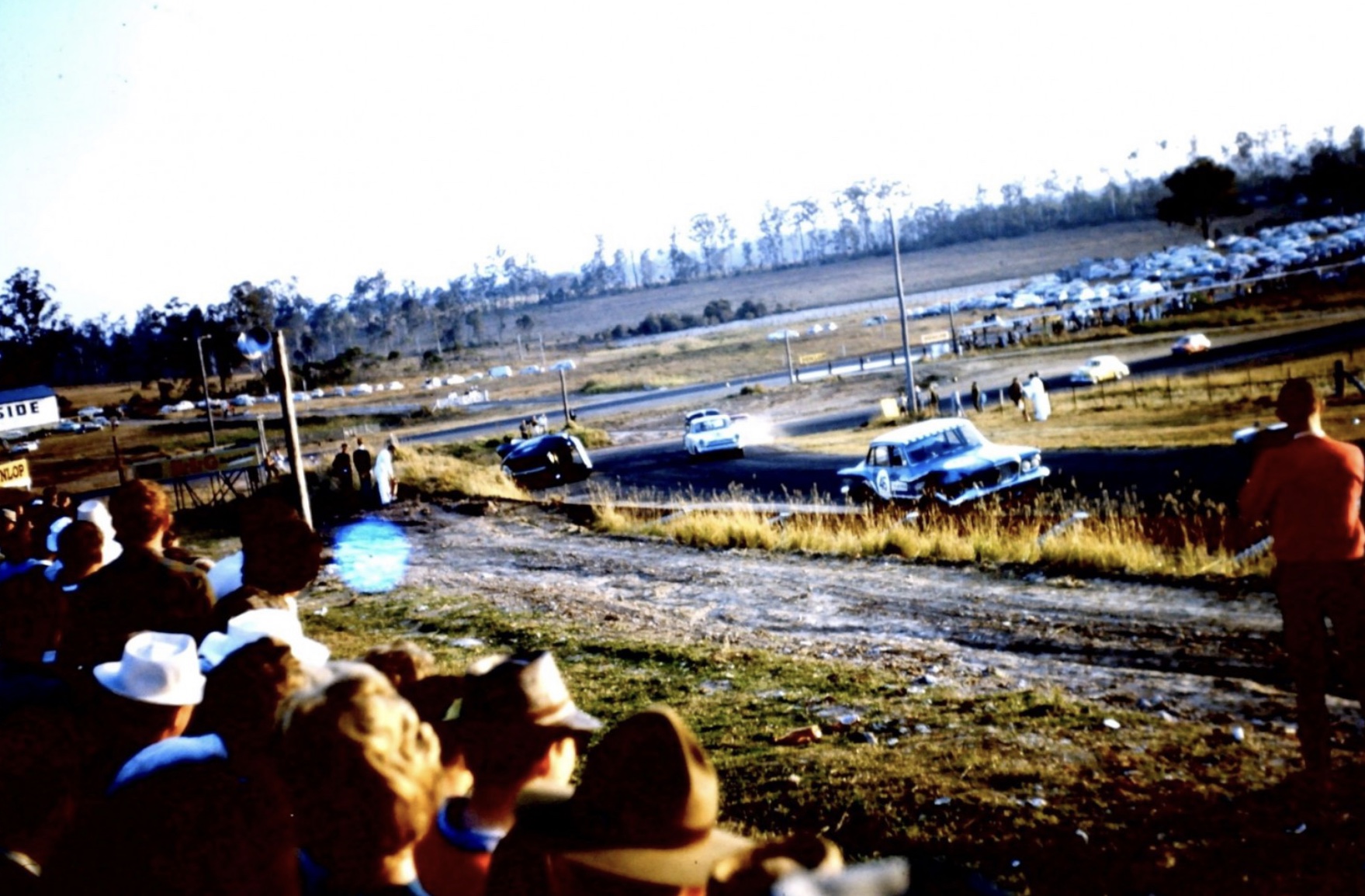
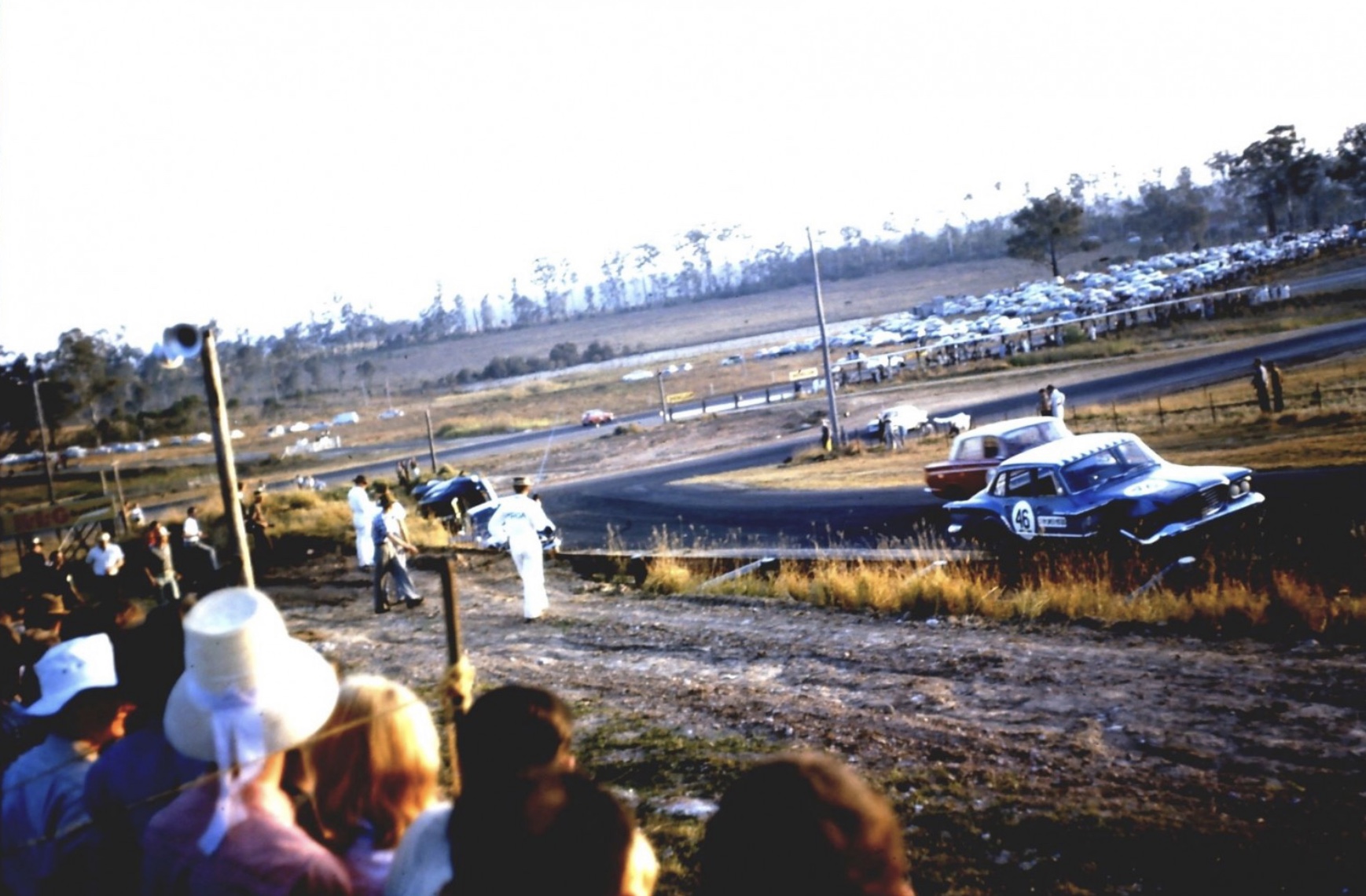
McKeown took the lead from Brian Muir on lap 7 with Beechey and Geoghegan battling for fourth. Bob Jane moved to second on lap 11 and then first when McKeown made an error and dropped to third behind Muir- at about the same time Warren Weldon locked a brake on lap 15, hit the bank and rolled onto his side a little bit behind Clem Smith who had clobbered the same bit of Queensland on lap 2, rendering his Valiant hors de combat.

The obstacles were raced around back in them days…Clem Smith’s very precarious Valiant R Type, and behind him Warren Weldon’s Holden 48-215 on its side. In the photo below you can see the blue McKeown Lotus Cortina partially obscured by the marshal. Passing Cortinas in both shots (J Wright)


(J Wright)


Done this one to death- Smith, McKeown and Weldon in line astern (unattributed)

Jane’s lead over Muir was up to 100 metres before clutch problems intervened circa lap 31- Muir then led from Pete and Norm who both passed Bob Jane. Encouraging for Holden, Muir led for the next 6 laps before a puncture forced him to pit, ‘While fetching the spare wheel, one crewman accidentally handed his motel keys to another crewman trying to open the cars boot lid. The delay cost Muir two laps and his chance of victory’ Wikipedia says.

Beechey led from Geoghegan who applied plenty of pressure to the EH in the lighter Ford taking the lead on lap 43, he held on for the next 7 laps to win by 1.2 seconds from Beechey. Jane was third despite a shagged clutch, thirty seconds adrift, with Foley and Manton’s Coopers the remaining cars on the lead lap.

Etcetera…

Start of lap 2 1964 ATCC.

Jane, Muir, Beechey, McKeown, Geoghegan, Manton, Firth, Foley and the rest.

(TRS)

Beechey and Muir in Holden EH S4’s with an obscured McKeown’s blue Lotus Cortina on the inside with Foley in the red Cooper S.

(TRS)

Pete Geoghegan’s winning Cortina GT ahead of McKeown’s Lotus Cortina.

(TRS)

Bob Jane’s very quick Jaguar 4.1 chasing Brian Muir’s Scuderia Veloce Holden EH S4, drivers using all of the available bitumen and a smidge of gravel on the inside.

Tailpiece: Lakeside Magazine looks good….

Credits…

John Wright Collection, The Nostalgia Forum- Stephen Dalton and Glenn Moulds, ‘TRS’- The Roaring Season’, Rob Bartholomaeus

Finito…

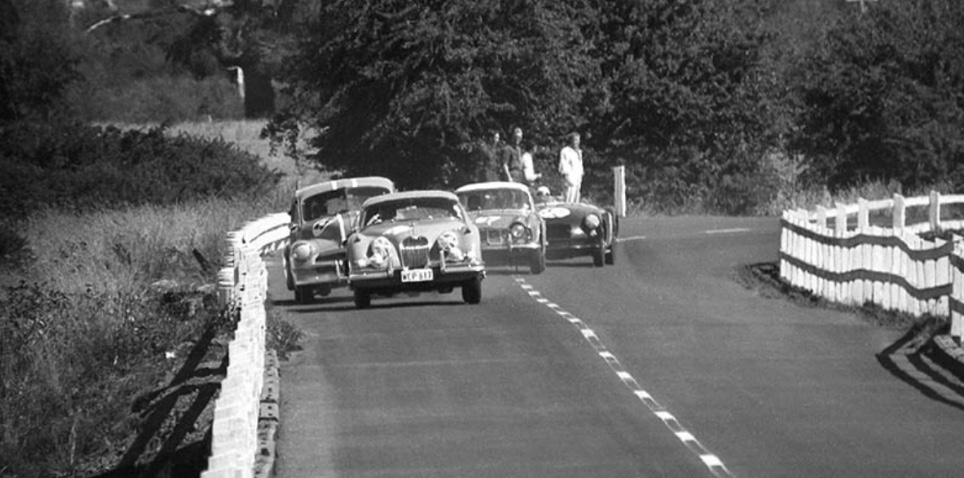
Touring Car and Sportscar tustle at Longford in 1965…

Don Gorringe, John Goss, Bob Curran and Greg Ellis blast over the River Esk- they have just completed the fast left-hander onto Long Bridge.

These blokes are all Tasmanian’s- I think it’s probably one of the locals only races, Gossy learned his trade pretty well down south- the only fella to win the Australian GP and Bathurst 1000 race double of course.

Goss is in an Appendix J Holden FJ, in front Gorringe is aboard a Jaguar XK150- which is clearly the successful businessman’s ‘daily driver’ given the rego plate affixed to the front bumper. Bob Curran’s Triumph TR4 was a machine he raced through to 1970 at least and the last car is Ellis’ MGA, it too appears as though he raced it for quite a bit.

Do any of these cars still exist? Who won the race?

Love this David Keep photo, it’s very much a ‘feel the noise’ shot…

Credit…

oldracephotos.com.au/D Keep

(R Thorncraft)

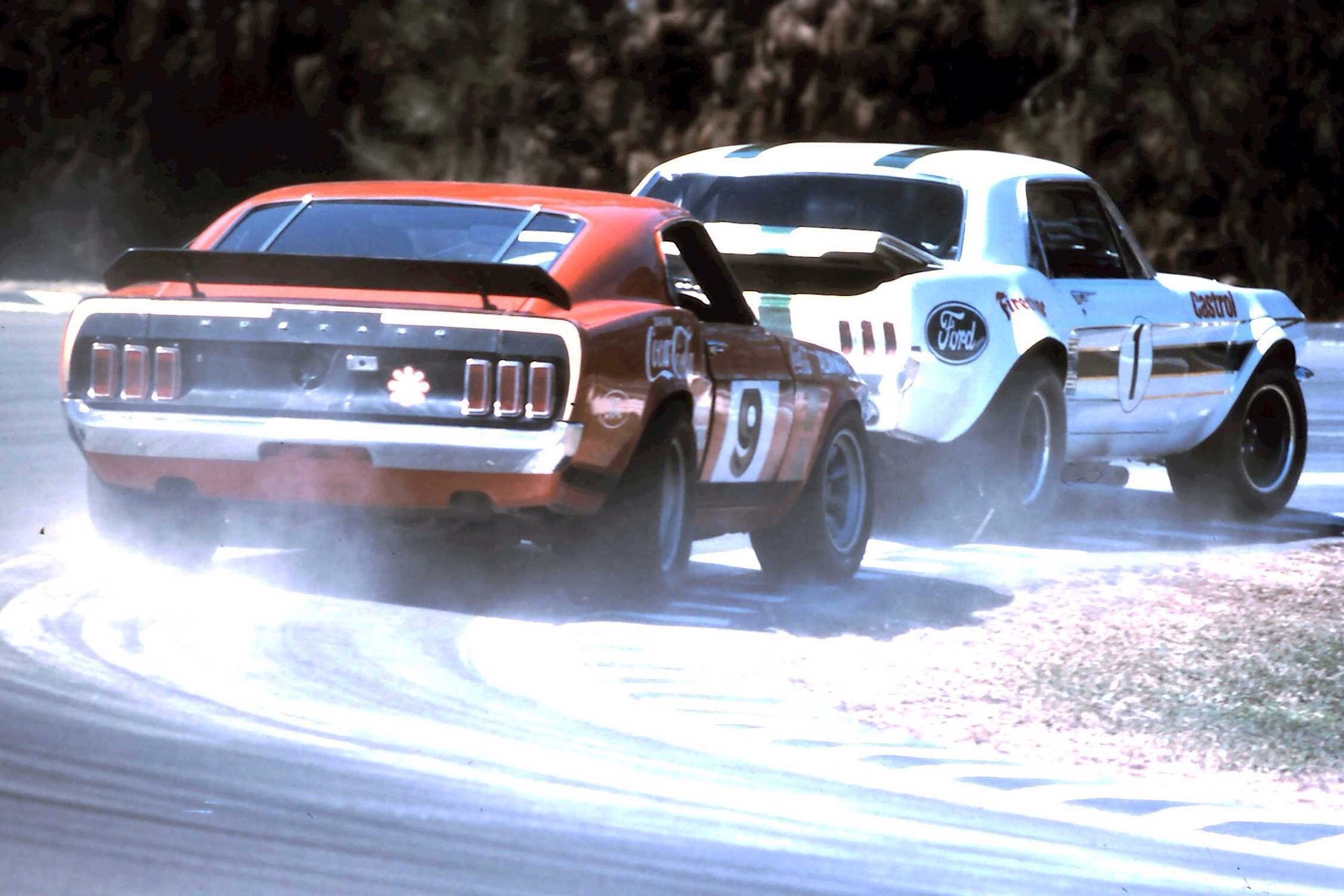
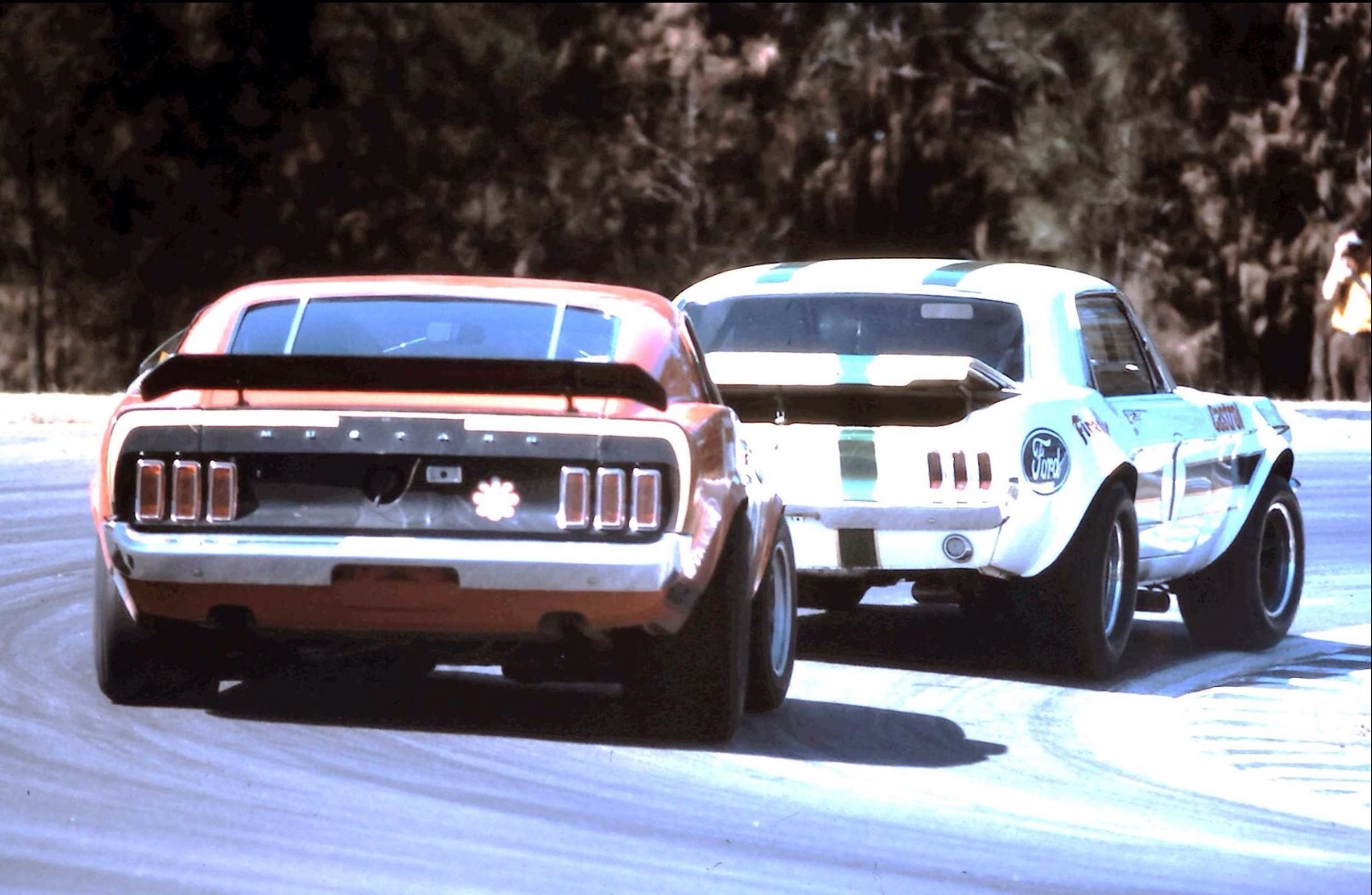
Allan Moffat chases Pete Geoghegan out of Creek Corner at Warwick Farm in September 1970…

Goodness knows how many dices these fellas had over the two short years the race histories of the cars converged- Geoghegan’s car was locally built in Sydney by John Sheppard and was continually developed from the time of its debut in 1967, Al Pal’s was a factory KarKraft machine which arrived in Australia in early 1969.

Russell Thorncraft’s photo has drama too- all the dust and shite being thrown up by the cars using all of the road and then some. The meeting is dated by Pete’s ‘rear spoiler’ too- remember him trying a jacked open boot lid either ‘for real’ as downforce or as a ruse!

Etcetera…

(L Hemer)

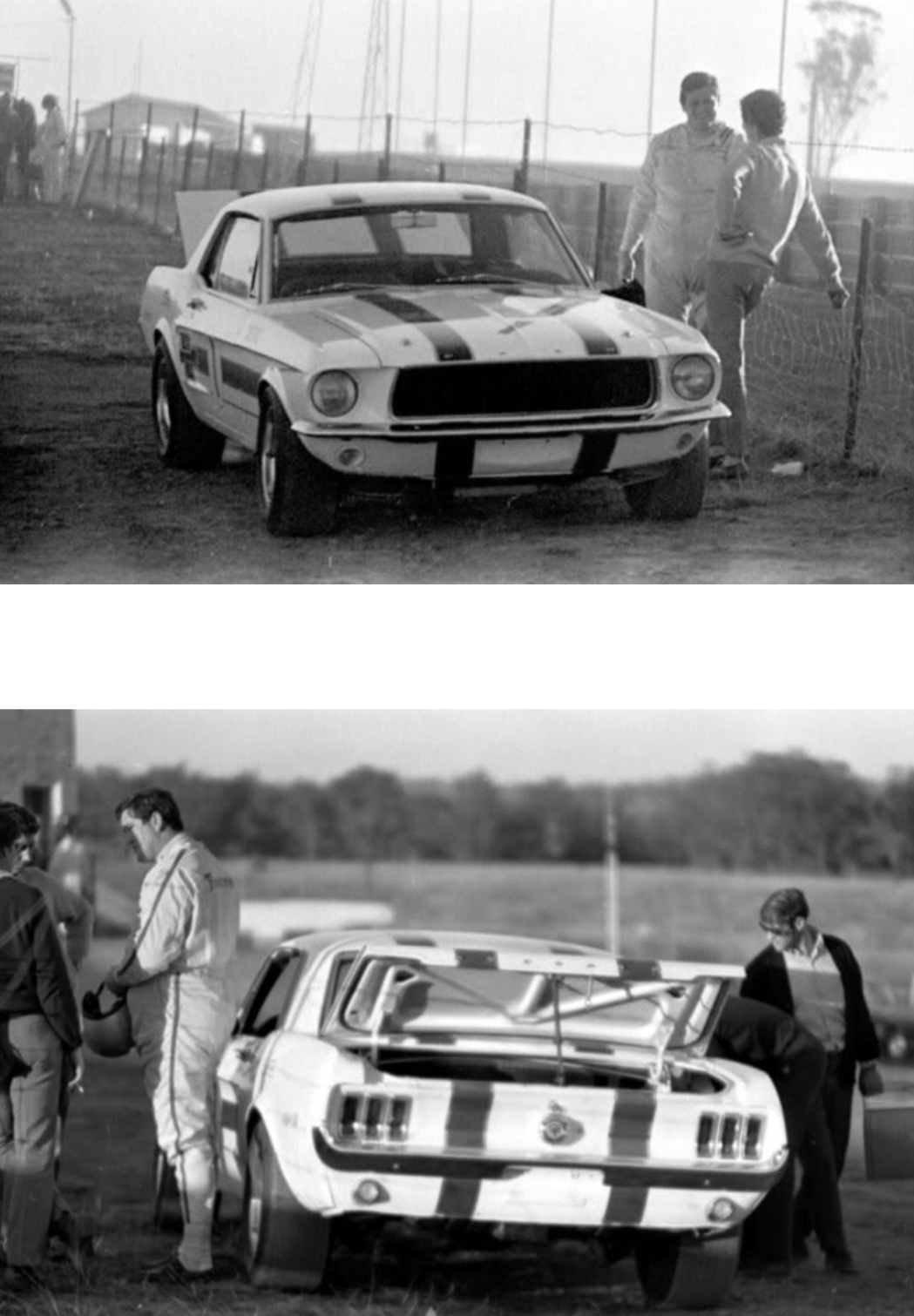
Lynton Hemer’s shot of Pete at the end of practice at Oran Park above on 9 August 1969 shows some aero experimentation- note the boot strut support.

Lynton recalls ‘These are a couple of overexposed, grainy photos of Pete…Note the strut under the boot lid. If my memory serves me right, I remember him running the car with the boot up in some type of Colin Chapman like experiment with downforce.’

‘Whether he raced the car that way, I can’t recall, but it only happened this once that I know of’- we can now see he did race this way at the ‘farm in 1970.

‘Whether the scrutineers frowned upon it, or it just didn’t work who knows? The car was unbeatable at Oran Park that year (1969) and most of the next, so why he tried it is a mystery’ Hemer concluded.

The photo below shows him deploying his secret weapon as he hunts down Alan Hamilton’s Porsche 911 R/T at Oran Park in 1969- same OP meeting Lynton refers to as above?

(R Thorncraft)

Credits…

Russell Thorncraft, Lynton Hemer

Tailpiece…

(R Thorncraft)

Finito…

It’s funny how stuff happens sometimes, I finally bought a Mini Cooper S last month, mind you, the one I lusted after in my teens was a Morris Cooper S…

Most normal fourteen year old ‘knob-jockeys’ were looking at Playboy and Penthouse and giving the sav a serious slap. Being the sick little unit that I was I spent most of my waking hours looking at Sports Car World, Racing Car News- and Autosport which required a trip to town- Technical Books in Swanston Street, Melbourne will be well known to Victorian enthusiasts over 40.

The cars I lusted after as my first road car- then four years down the track weren’t the local muscle cars but the Cooper S, Escort Twin-Cam, Lotus Europa with my dream car the Ferrari Dino 246GT. The Dino fantasy lasted for a several decades until Gordon Murray’s McLaren F1 finally blew it off its pedestal.

I always thumbed through magazines whilst sitting in a beanbag watching the teev, whilst other cars came and went, my diet of articles always came back to this group of cars with the Cooper S always to be my first car, restricted to a student income as I was.

I had a Castrol promotional brochure (remember the set of seven or eight stapled into Racing Car News, one at a time each month?) about John Leffler’s Cooper S Lwt Sports-Sedan, which I looked at endlessly together with road tests of the S and Clubman GT.

I can still remember the standard Cooper S 1275cc oversizes of the ‘A Series’ block at 1293cc and 1310cc, the factory race AEA 648/649 and rally AEA571 cam part numbers are still in my woolly head long after the intricacies of the accounting and economics I was studying at the time have well and truly disappeared.

Castrol brochure featuring the BMC Racing Team, John Leffler Cooper S, leading Barry Sharp, Ford Falcon at Oran Park circa 1970. Leffo a few years later, 1973, won the Australian FF Championship in a Bowin P6F and in 1976 the Gold Star in an F5000 Lola T400 Chev

I came close to buying Coopers twice and still kick myself for missing out on the first one, a BRG 1969 car in Richmond. Dad insisted I get an RACV (Royal Automobile Club of Victoria) mechanical test on it, which was the right parental advice (not that I usually listened to it) and of course the car sold on the Sunday with my deposit dutifully refunded a couple of days later. I cracked the shits with him for well over a month.

Spending all of my Monash Uni student income on Elfin 620B Formula Ford laps at the Calder based Bob Jane-Frank Gardner Race Driving School whilst 18 changed everything- I found god and he raced single-seaters!

So the focus then became a road tow car and a Formula Vee by the time I started full-time work, that was achieved. I bought a Venom Vee in February 1979 and started work the following month. So, the Cooper S never happened, why bother rattling around in road cars on-circuit when you can drive the real thing? Here are the exploits of one of Australia’s most prominent FV drivers. Not. https://primotipo.com/2016/10/06/formula-vee-and-the-summer-of-79/

I have owned a few Cooper S TYPE cars though; three Alfasuds- Sedan, TI twin-carb and Sprint and an Alfa 147GTA amongst other things.

The Lotus Europa, when I finally drove one was a heap of shit- what a disappointment, ‘shake-rattle-and roll’ it wasn’t a flash example i guess, but the Lotus fetish never left me- my Elise was a wonderful 5 year experience if somewhat challenging in the winter.

I looked at a beaut ‘Vermillion Fire’ red Escort Twin-Cam an old codger (he was far younger than I am now) had for sale in Glen Iris but by then a mate had an Alfa Giulia Sprint GT (nee 1600 GTV) in which I drove a lot of miles and it was a far more cohesive bit of kit than the Escort- and I had couple of 105 Series coupes as a consequence.

The Italian Sheila

Roll on a cuppla decades, had kids, raced historic Formula Ford, got divorced and got a girlfriend. An Italian one actually- if I’d known what Northern Italian sheilas were like at 18 I’d have specialised in that breed from then- but you live and learn right?

Five years ago she bought an R53 Cooper S auto (sub-optimal as a manual driver but too easy round town), in fact I wrote about it a while back;

‘Perdriau Master Cord Tyres’: Mini Cooper S: Nuriootpa and Lobethal Australian Grands Prix Tour…

In recent times the thing, which always used a lot of oil, has been using a forty-four of expensive lubricant a fortnight. Our mechanic put this down to the car probably not being run in properly in its infancy- Patrizia being ‘WUBs’ second owner. The funny thing is you can’t see the oil being burned like you could in the old days- the plume of pungent but sweet smelling blue smoke has not been there.

She-who-must-be-obeyed looked at new Abarth 595’s last summer and only baulked when I pointed out the lack of cruise-control- so we, she, kept driving The WUBster and I kept shoving expensive oil down its gullet on a weekly basis whilst alternative, automobile deliberations continued.

WUB @ Tarra Warra Estate near Healesville

And then, as they say in the classics, it happened!

Ok, I did insist we use her car for the trip to Kyneton, comfier than mine as it is.

A few kays past Calder, going up the long hill towards Diggers Rest the little beastie lapsed onto 3 cylinders- not a big deal I thought as the same thing happened in almost the same place twelve months before and was just a duff plug. An easy, cheap fix.

Not so this time.

The long gradual build up of carbon on #3 piston from all that not fully burned oil over all those years, ignited, blowing a neato hole in said aluminium component and did some block damage to add insult to injury. Worse, it was ALL MY FAULT as I insisted we use her car not mine- I was driving the thing at the moment of destruction.

Never mind the fact that the ‘liddl fokker could have let go on a similar trip she did to McRae the week before…’twas all my fault, deploying all of the chick logic they have.

No amount of cunning-linguistics on my part, and my powers of persuasion are not too shabby given forty years in business, were going to shift the crossed arms of The Italian Sheila.

So my friends, having first got interested in Coopers circa 1971, I am now the proud owner of an R53 in 2019, it’s easily the most expensive in Australia too. My heart feels good but my wallet is not so flash.

The Italian Sheila did buy the Abarth in the end- it’s great, in some ways the ultimate inner city tool, I’ll bore you with that another time.

As I said at the outset, it’s funny how stuff happens sometimes, and more often than not a chick is involved…

PS; Hopefully The Italian Sheila does not read this, she never looks at primotipo, all good, I trust, hope and pray.

Tailpiece: The new Abarth 595 in Brunswick Street, North Fitzroy…

Castrol Cooper S Brochure- the rest of it…


Finito…


(G Ruckert)

‘Brian Foley in the Alfa Romeo GTAm nicely on line as he exits The Karrussell, Lakeside 18 April 1971’ wrote photographer Graham Ruckert…

This is about as natural a setting, devoid of signage and the visual clutter typical of racetracks by the early seventies you could hope for to capture surely one of the most beautifully proportioned and delicately toned Touring Car racers ever?

Foley’s ex-works car in its various incarnations is very well known to Oz enthusiasts, I’ll get around to writing about it again one day- I first did so in an Alfa Romeo Owners Club of Australia magazine circa 1978! About time to do so again, thankfully the car is still in Australia, in Melbourne’s east and in the very best of Alfista hands too.

Photo Credit…

Graham Ruckert

(S Hood)

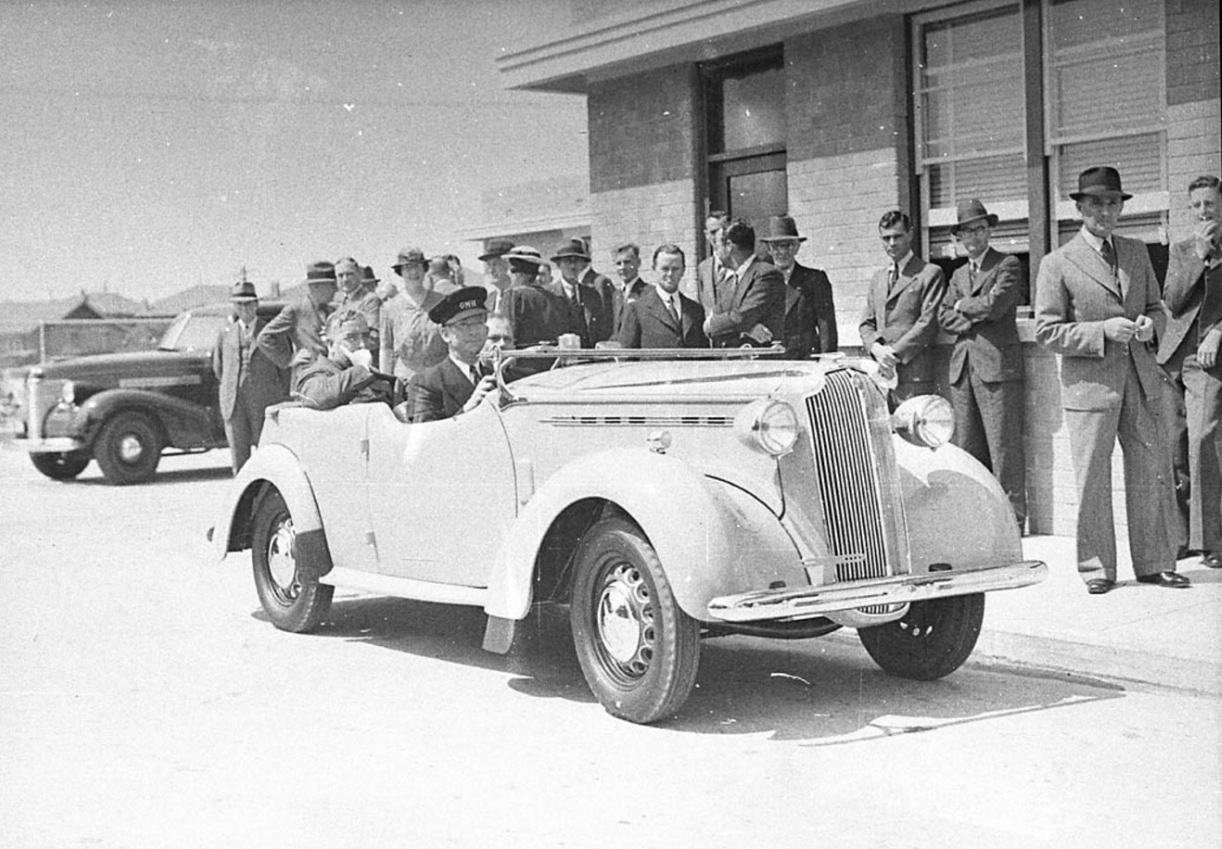
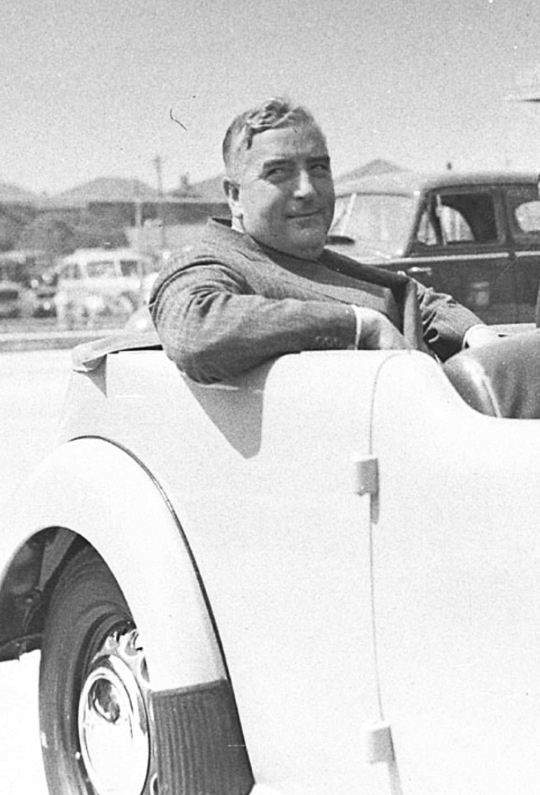
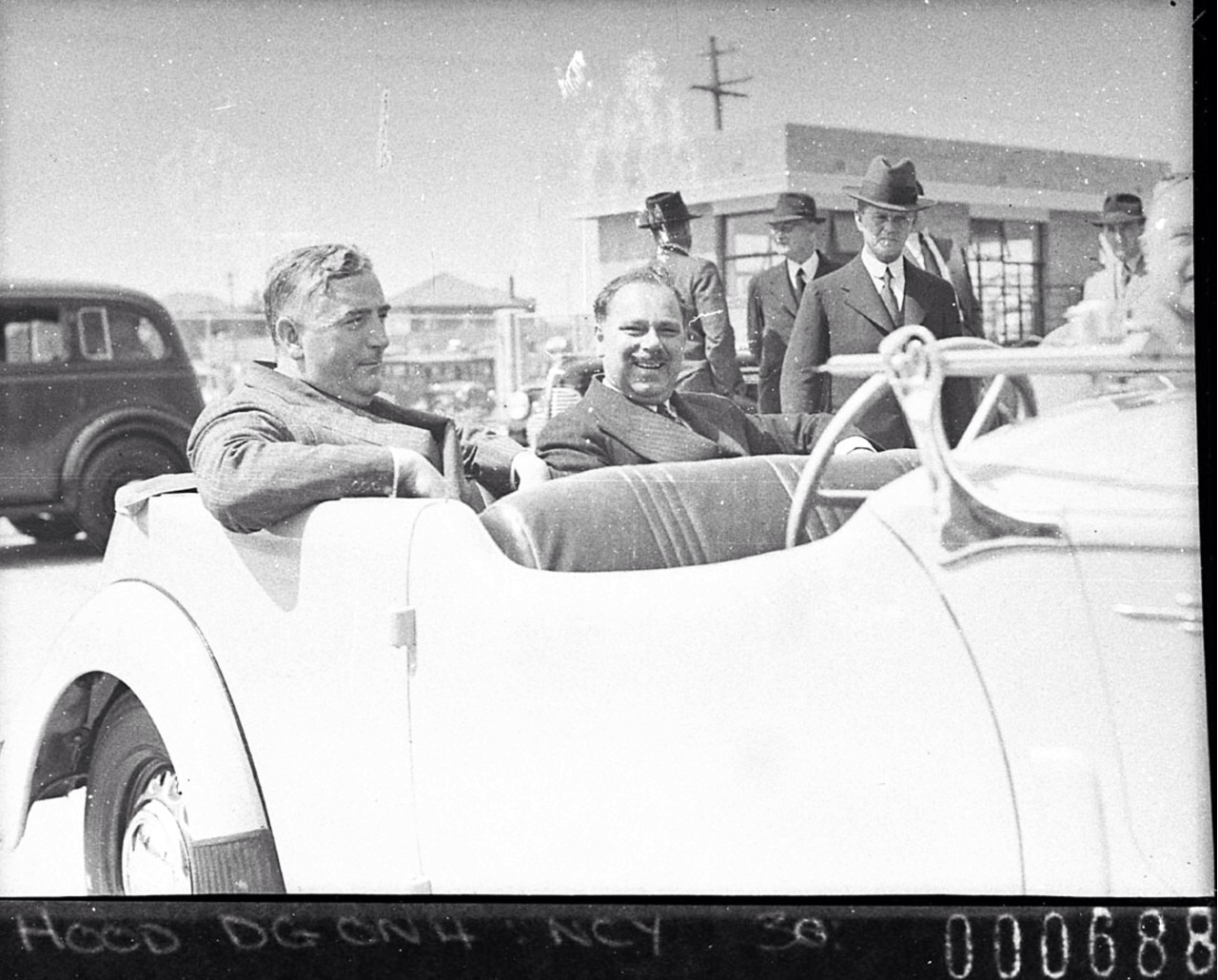
Prime Minister Robert Menzies and Laurie Hartnett in the back of a Vauxhall Wyvern Caleche Tourer having opened General Motors Holdens new factory at Pagewood, in Sydney’s southern suburbs 1940…

I know its not a motor racing shot so it would normally be outside primotipo’s focus but the photos were too good to waste, and I will get there, a racing element is here to be found in a little bit.

(S Hood)


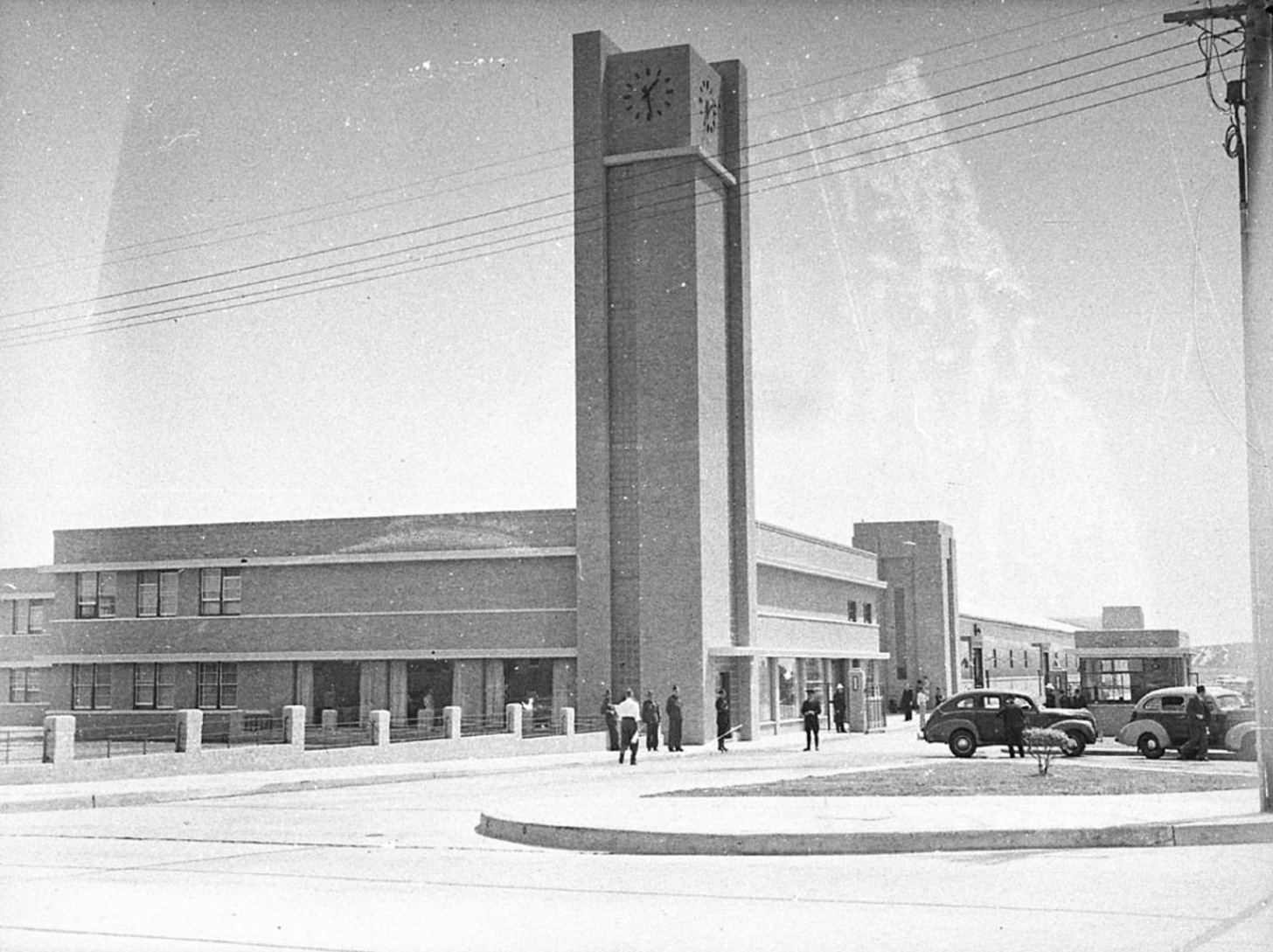
GMH Pagewood on the day of the plant’s opening (S Hood)

The merger of Holden Motor Bodies Ltd with General Motors (Australia) Pty Ltd as a result of the stress caused to the former during the great depression forged the basis of one of Australia’s great manufacturers and an iconic marque, the merged entity was named General Motors-Holden’s Ltd.

A great Touring Car Racing brand as well- there is the racing link I guess.

The new company opened its first factory at Fishermans Bend, in Melbourne’s inner west in 1936 and at Pagewood in 1940.

After World War 2 the business made coachwork for Buick, Chevrolet, Oldsmobile, Pontiac and Vauxhall.

By the mid-forties the automotive industry had the government onside to encourage the development of Australia’s own car.

Holden, led by Hartnett got the upper hand on Ford in a pitch by keeping their demands for taxpayer support to a lower level than FoMoCo.


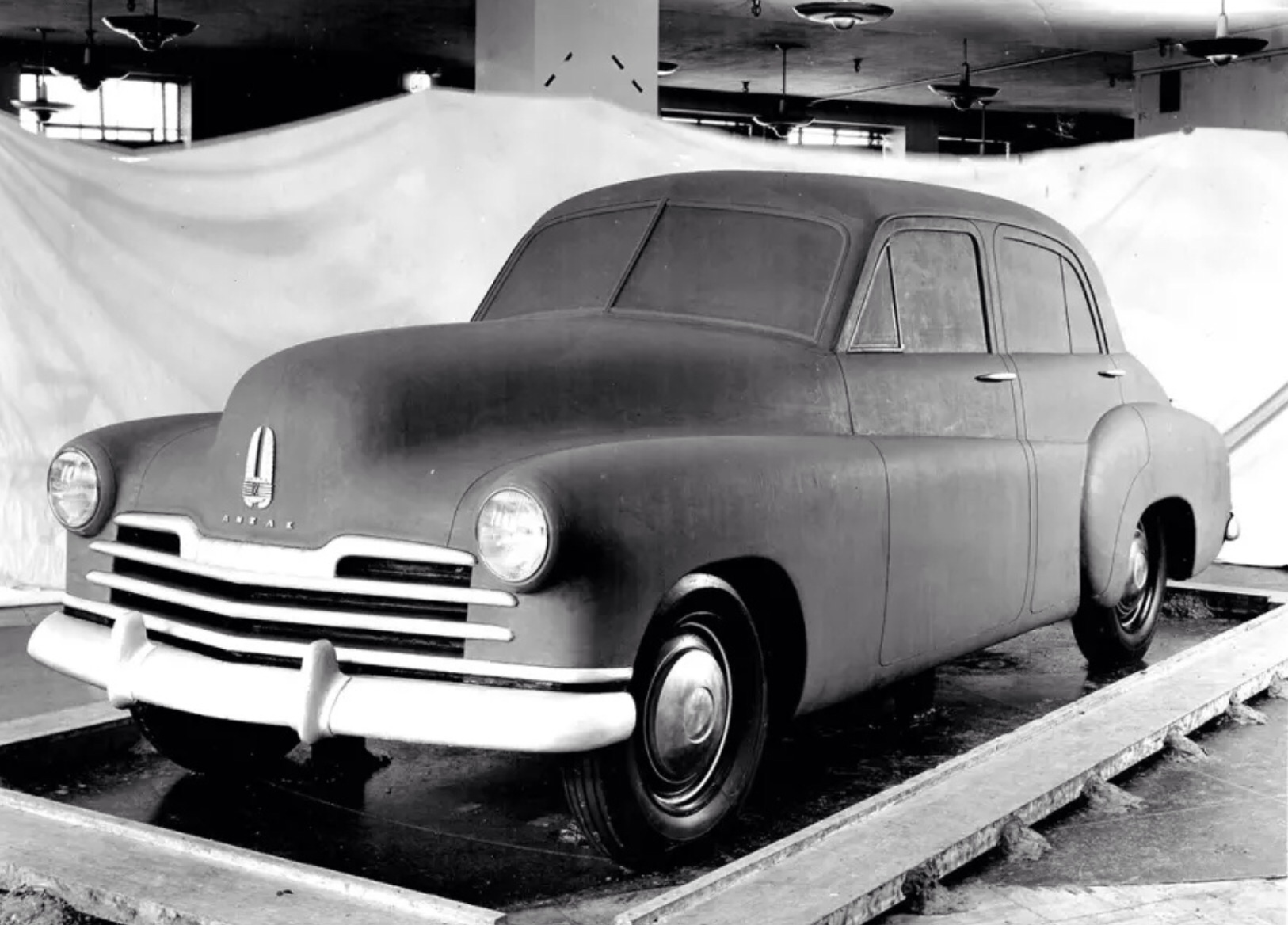
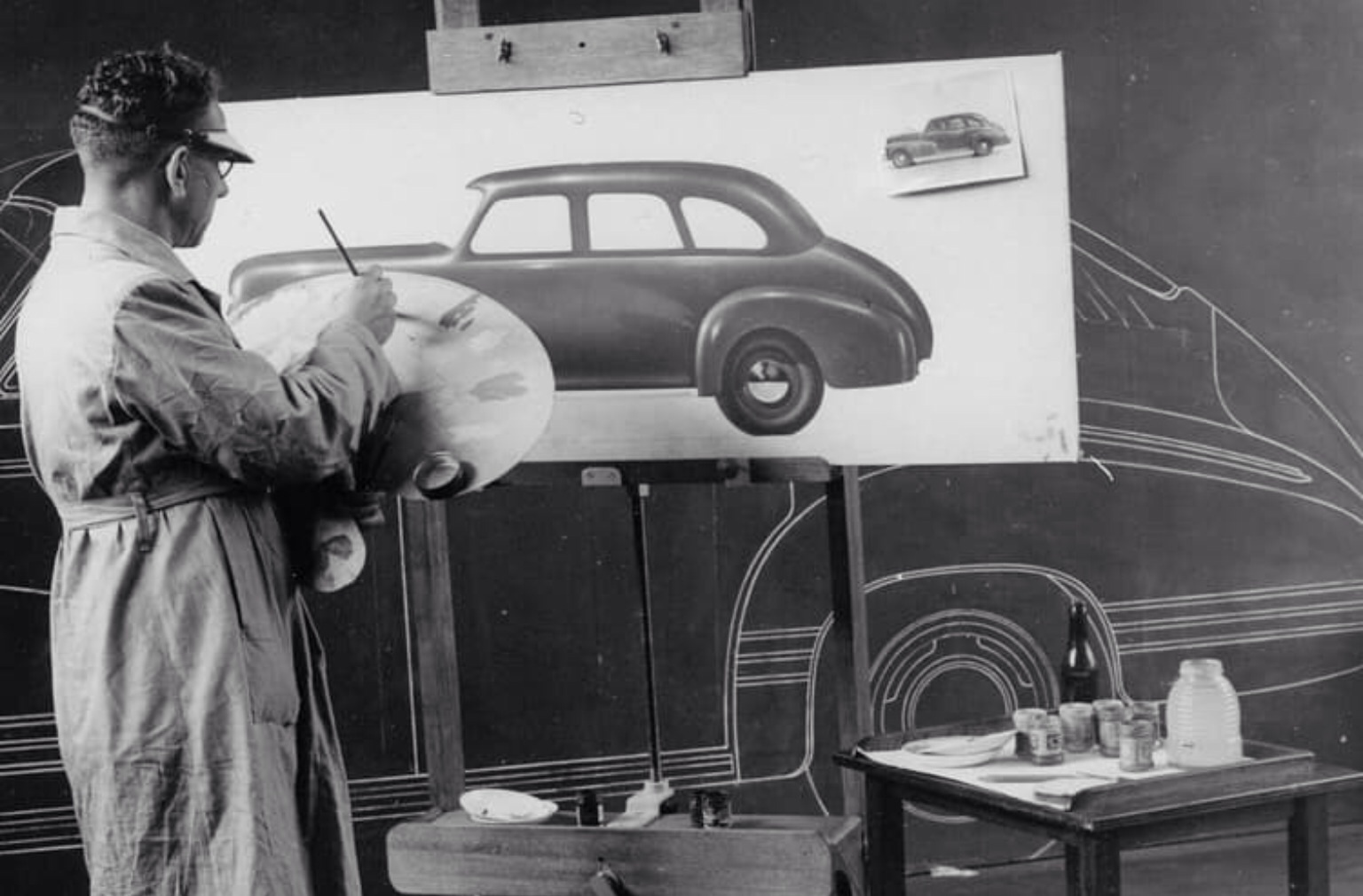
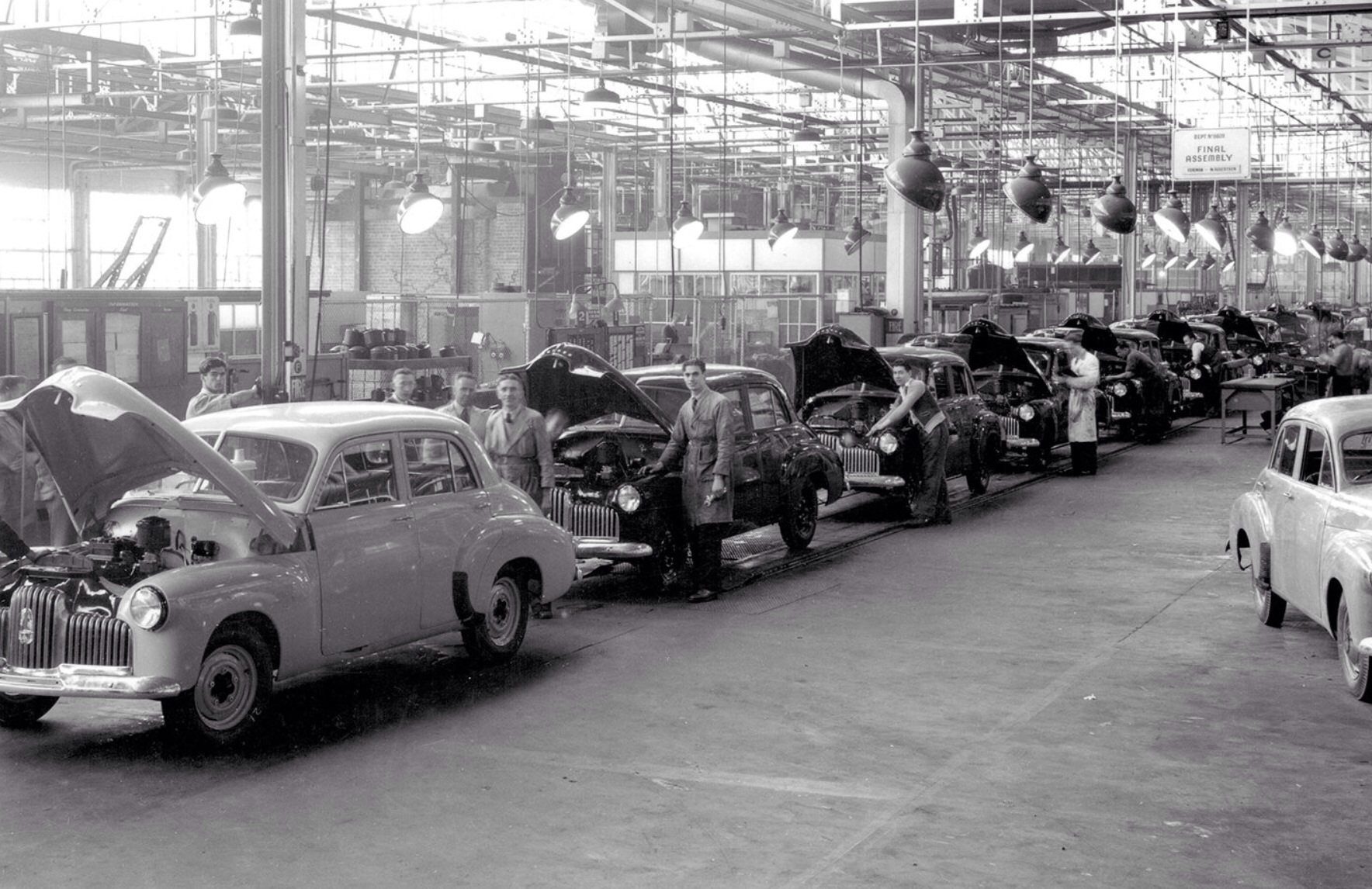
The first Holden was built to a reject 1949 model design based on 1946 Chevrolet mechanicals. The car was to sit between the bigger American’s and smaller British machines which dominated in Oz at the time. The engine was also Chev based. This photo is the 1945 clay model of the Holden 48-215, named the ‘Anzac Holden’ by its clay modeller, Frank Herschey

(SLSA)


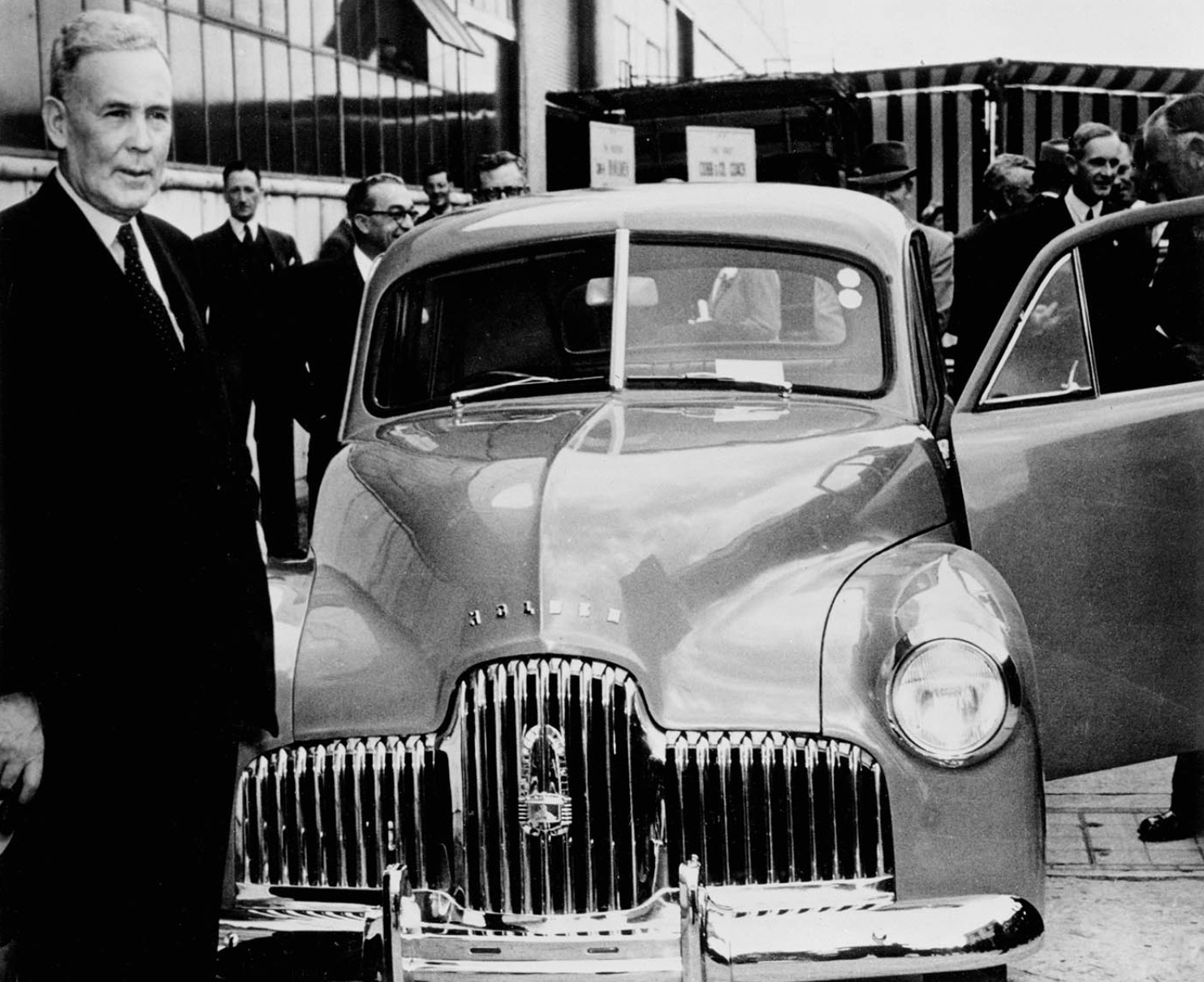
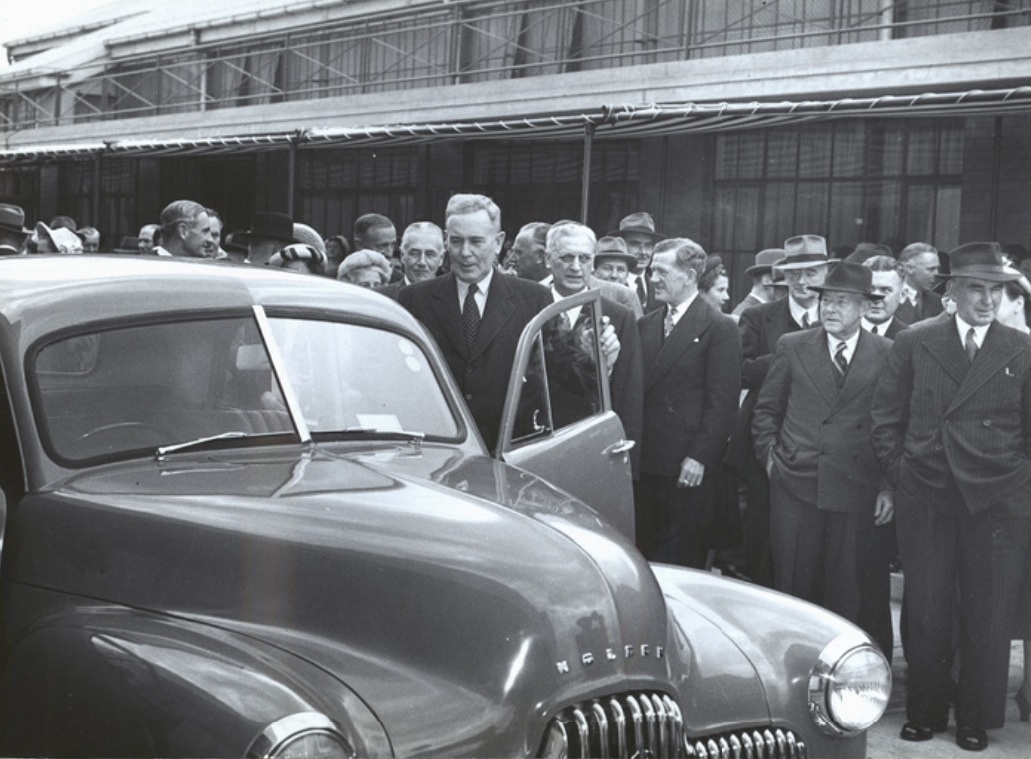
Ben Chifley at the Holden launch, Fishermans Bend, 29 November 1948 (NMA)

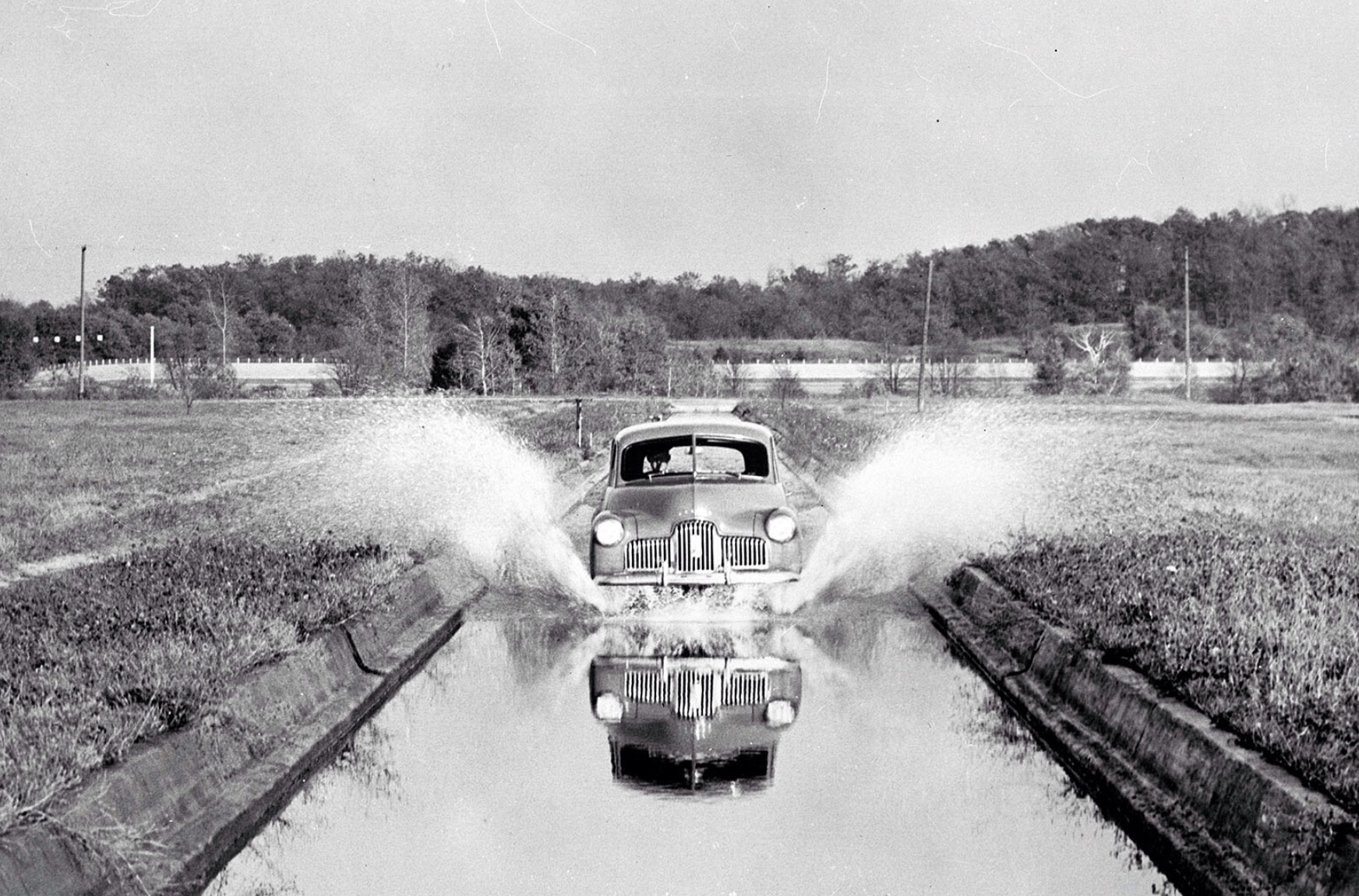
In 1944 the feds invited GMH to build a family car suited to our unique, extreme climatic conditions.

American and Australian engineers hand built three Holden test cars at GM’s experimental workshop in Detroit- the first, chassis ‘19525’ was completed on 30 August 1946. After months of durability tests the cars were secretly shipped back to Fishermans Bend.


The very first Holden prototype ‘car number 19525 from Project 2000, which then became Project 320 and the initial prototype of the future 48-215 in the United States showing the cars temporary name ‘GMH’ above the ‘Holdens’ badge on the bonnet’. Rego Michigan BK-46-48 (SLSA)


Further testing took place locally and then GMH engineers and technicians built two further prototypes in Australia, the first of these was completed on 22 August 1947- these became the definitive model and shape we all know and love.

For the record, the first production Holden was completed on 1 October 1948, largely built off-line, it was a ‘Gawler Cream’ 48-215, body #6, VIN ‘8-1001-M’ and fitted with engine # ‘1001’.


In 1948 in a ceremonial scene akin to the opening image, then Prime Minister Ben Chifley pulled the covers off Holden #1, the ’48-215′ or Holden FX at Fishermans Bend on 29 November 1948, with mass production starting at the heady rate of ten cars a day!

Soon production boomed of course, and the rest, as they say is history- including the closure of the final Holden production line at Elizabeth, South Australia on Friday 20 October 2017.

The Australian motor industry as manufacturers of mass-market cars no longer exists. We now have a tiny number of niche companies- god bless Michael Borland and Spectrum Racing Cars down Mordialloc way in outer Melbourne for example.


Fishermans Bend 1948 (SLV)


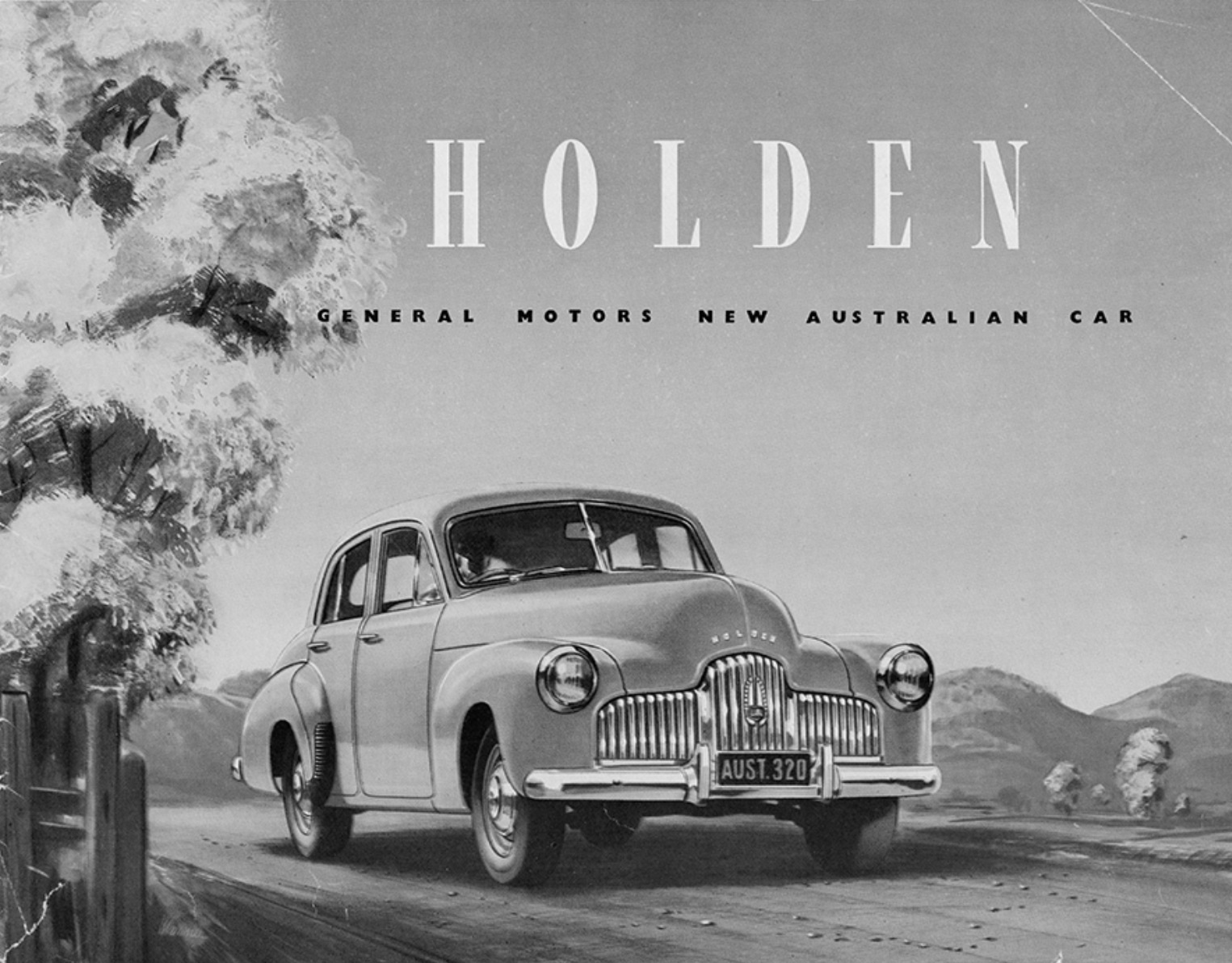
48-215 first brochure


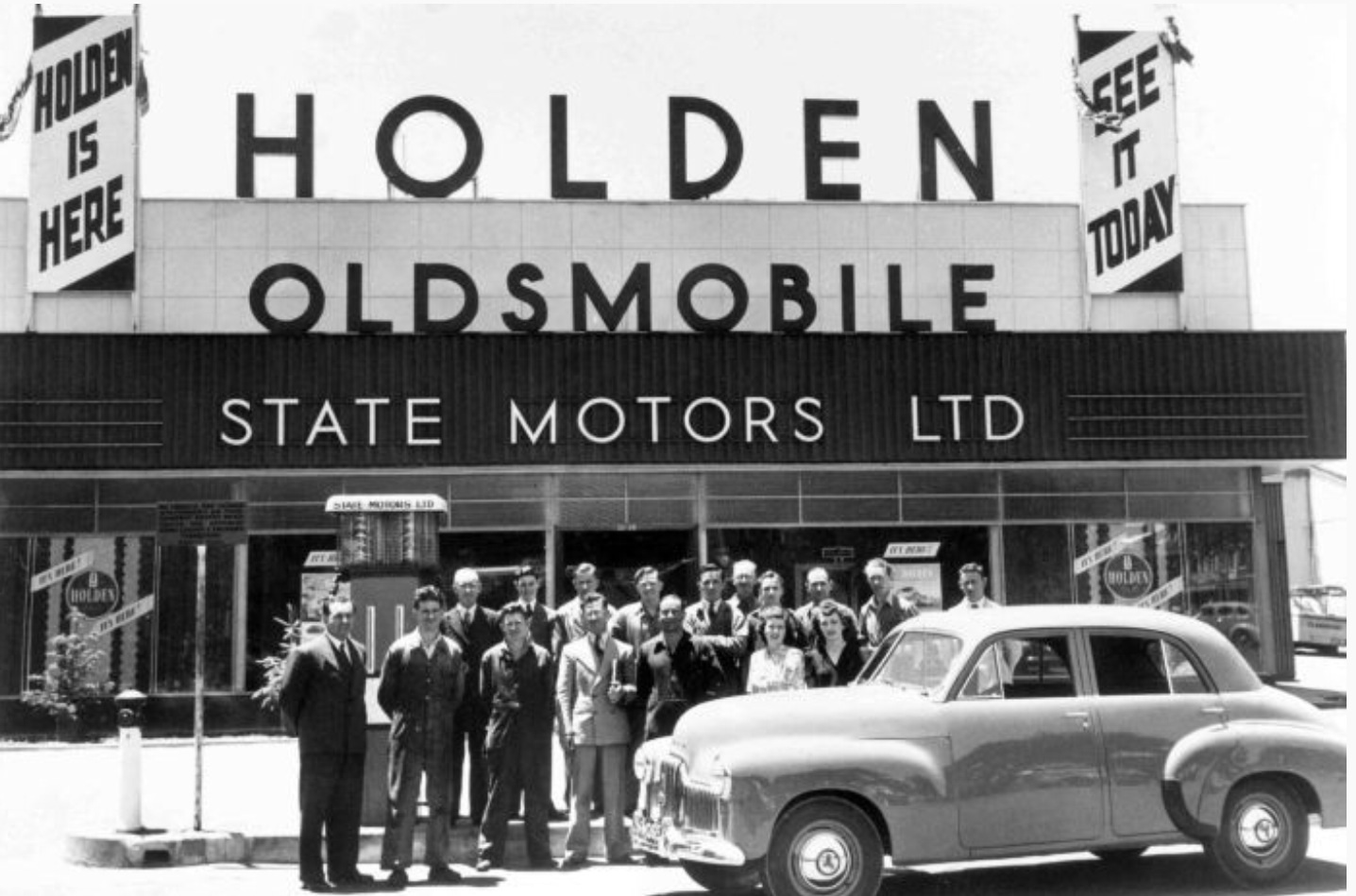
States Motors team, South Australia with one of their first two Holdens in December 1948 (D Loffler)

The ’48-215′ was economical, sturdy, stylish, light and with its modern’ish cast iron, OHV, 2171 cc/132.5 cid, in-line six cylinder engine gave better performance than similarly priced, or in some cases, more expensive cars.

In standard form the undersquare engine (bore 3 inches, stroke 3 1/8 inches) gave 60 bhp @ 3800 rpm and 100 foot/pounds of torque at a very relaxed 2000 rpm on a compression ratio of 6.5:1. The motor was fed by a single downdraft Stromberg BXOV-1 carburettor with spark provided by a Delco-Remy distributor. Gearbox was 3 speed- the shift was column mounted, the four-wheel drum brakes had a kerb weight of 2230 pounds to stop.

Amenable to tuning, enthusiasts were soon fitting twin-SU’s or Strombergs or Amals, extractors and giving the heads the usual port ‘n polish treatment to extract additional neddies which were easily found.

The post war explosion of the Australian economy with full employment, industry protected by high tariff walls and the ready availability of consumer credit made it possible for a family man or salesman to have not just day to day transport but also a car for club motorsport.

In many ways the work-horses of Australian motor-racing were MG’s of all sorts, both pre and post-war but especially T Types and the 48-215 or more colloquially the FX, and FJ ‘Humpy’ Holdens in the fifties and into the sixties- so many folks cut their racing teeth in these machines.


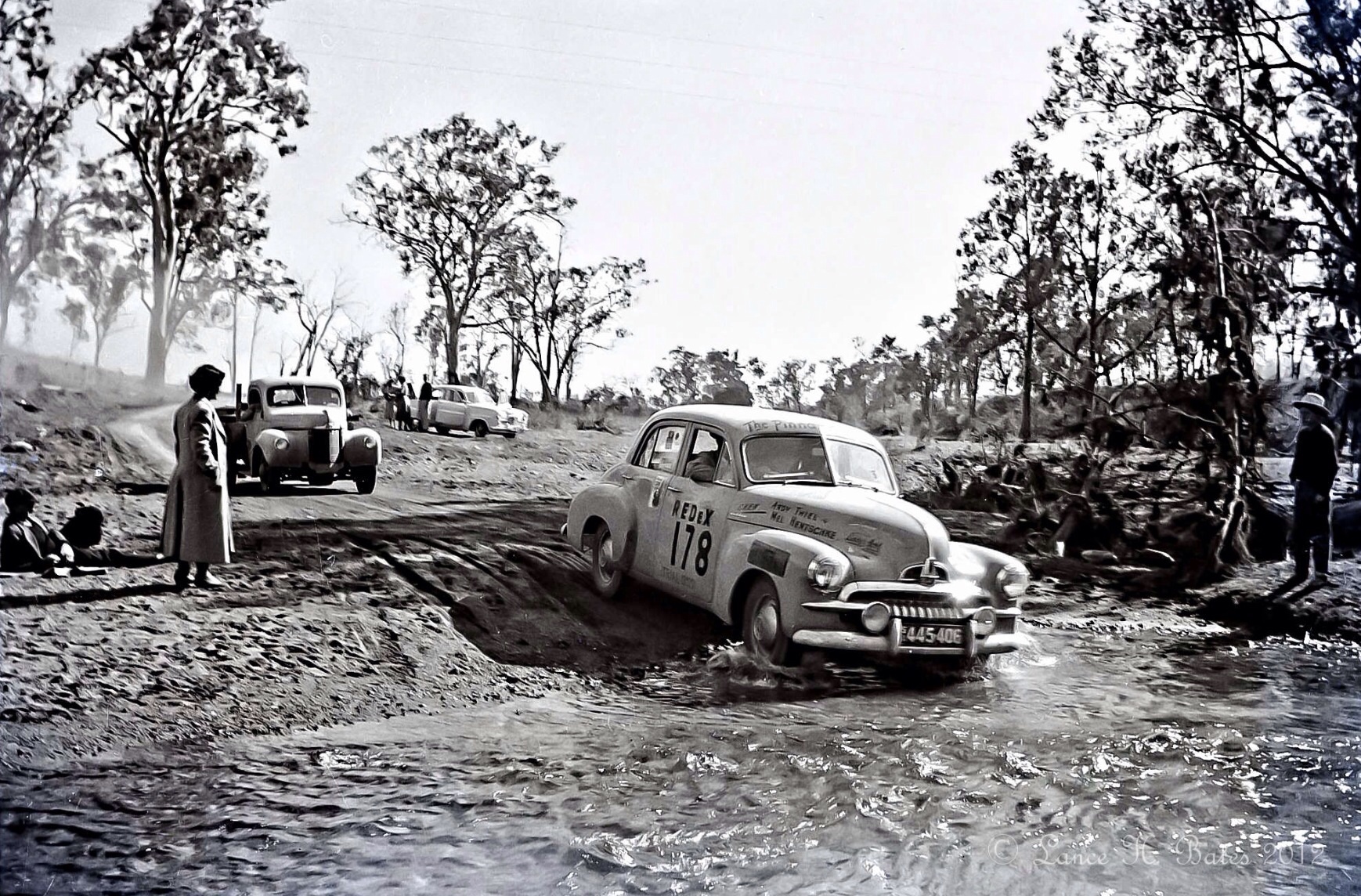
Redex Round Australia Trial Holden FJ competitor- in South Australia but otherwise intrigued to know the details (Adelaide Advertiser)


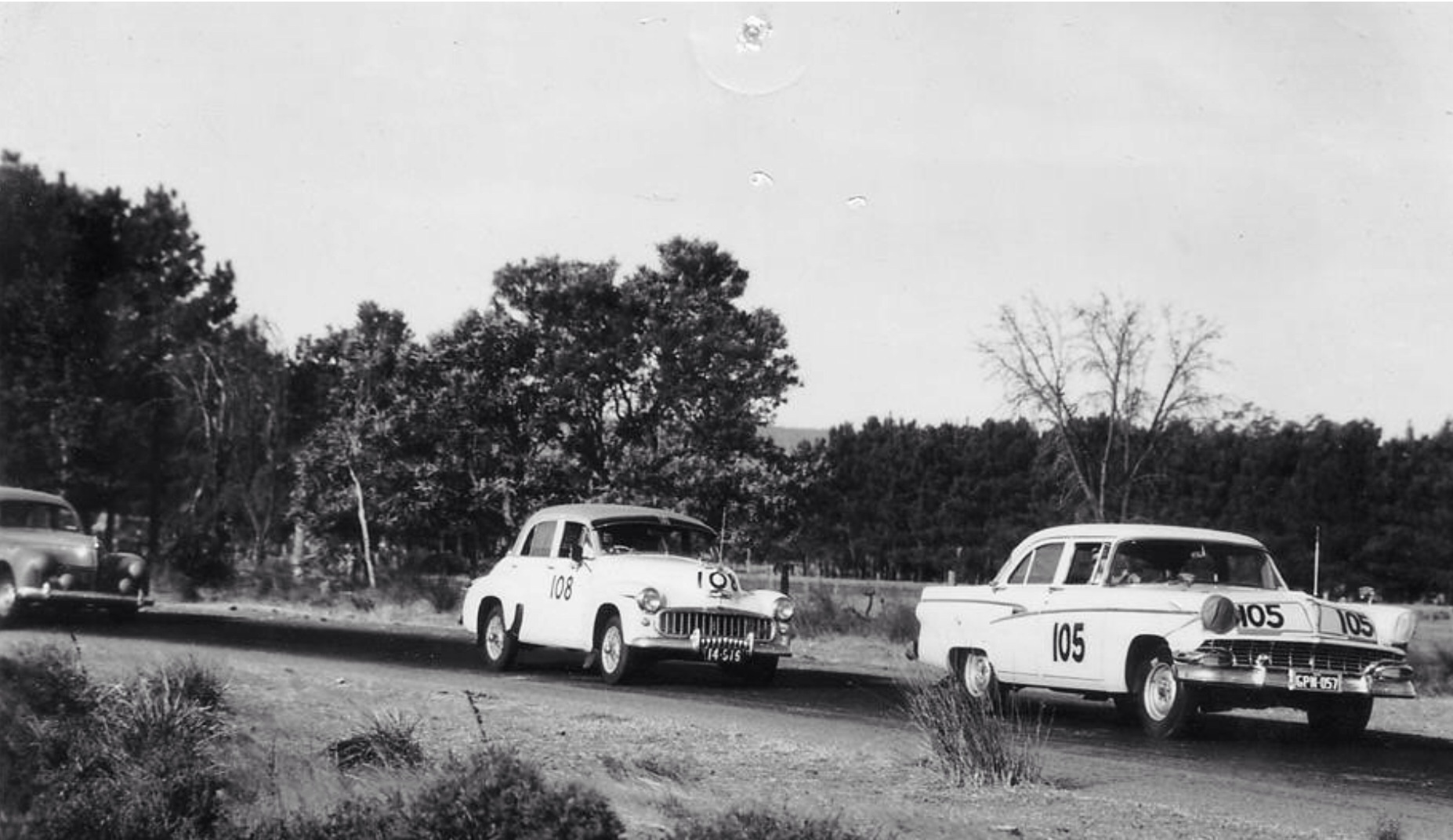
Len Lukey’s Ford Customline from Syd Anderson’s 48 Series (with non-standard grille) and Bob Holden, Peugeot during the 1957 Caversham AGP weekend (K Devine)


Touring car racing started in Australia at the sports inception, daily drivers in the earliest days were the cars which competed in trials and the timed speed events- hillclimbs and sprints within trials. The first Australian Touring Car Championship (Australian Stock Car Championship) was held during the Australian Grand Prix weekend at Lobethal, South Australia in January 1939.

The inexorable and later rapid rise of tourers over pure racing cars in Australia was largely due in the 1950’s to grids chockers with Holden’s- spectators turned out in large numbers to a growing number of race-tracks to watch blokes compete in cars outwardly similar to those in which many of the punters arrived at the race meeting.

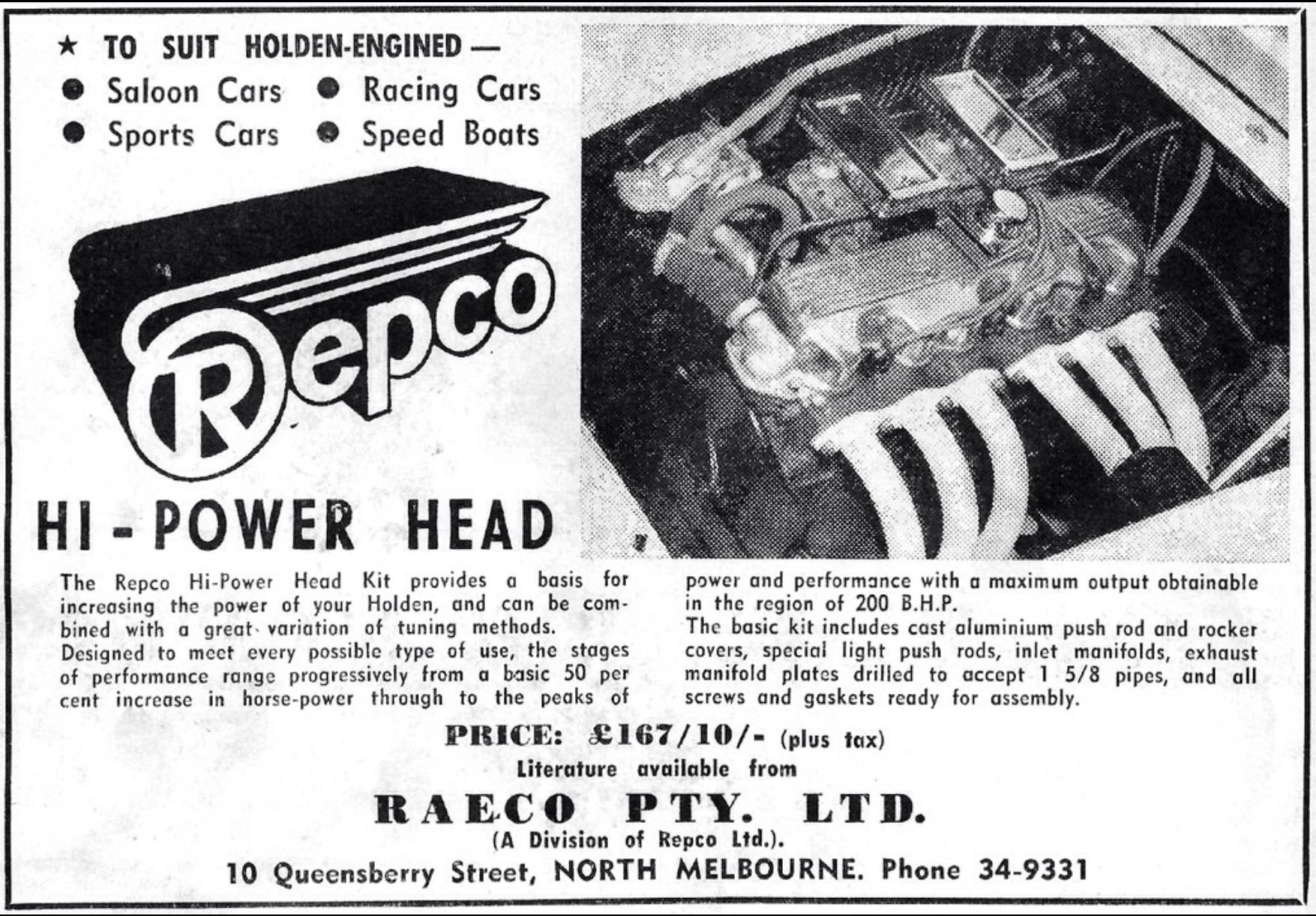
In fact by the end of the fifties the quickest of the Holdens were quite sophisticated racers incorporating Phil Irving designed Repco ‘Hi-Power’ cylinder heads, two or three carburettors with one or two cars fitted with Merv Waggott’s twin-cam heads to create an ‘ultimate spec’ Holden.

MG TC and sometimes Jaguar four speed boxes replaced the Holden ‘three on the tree’ column shift gearbox, four wheel discs replaced the standard drums, the cars were extensively lightened and all of the rest…


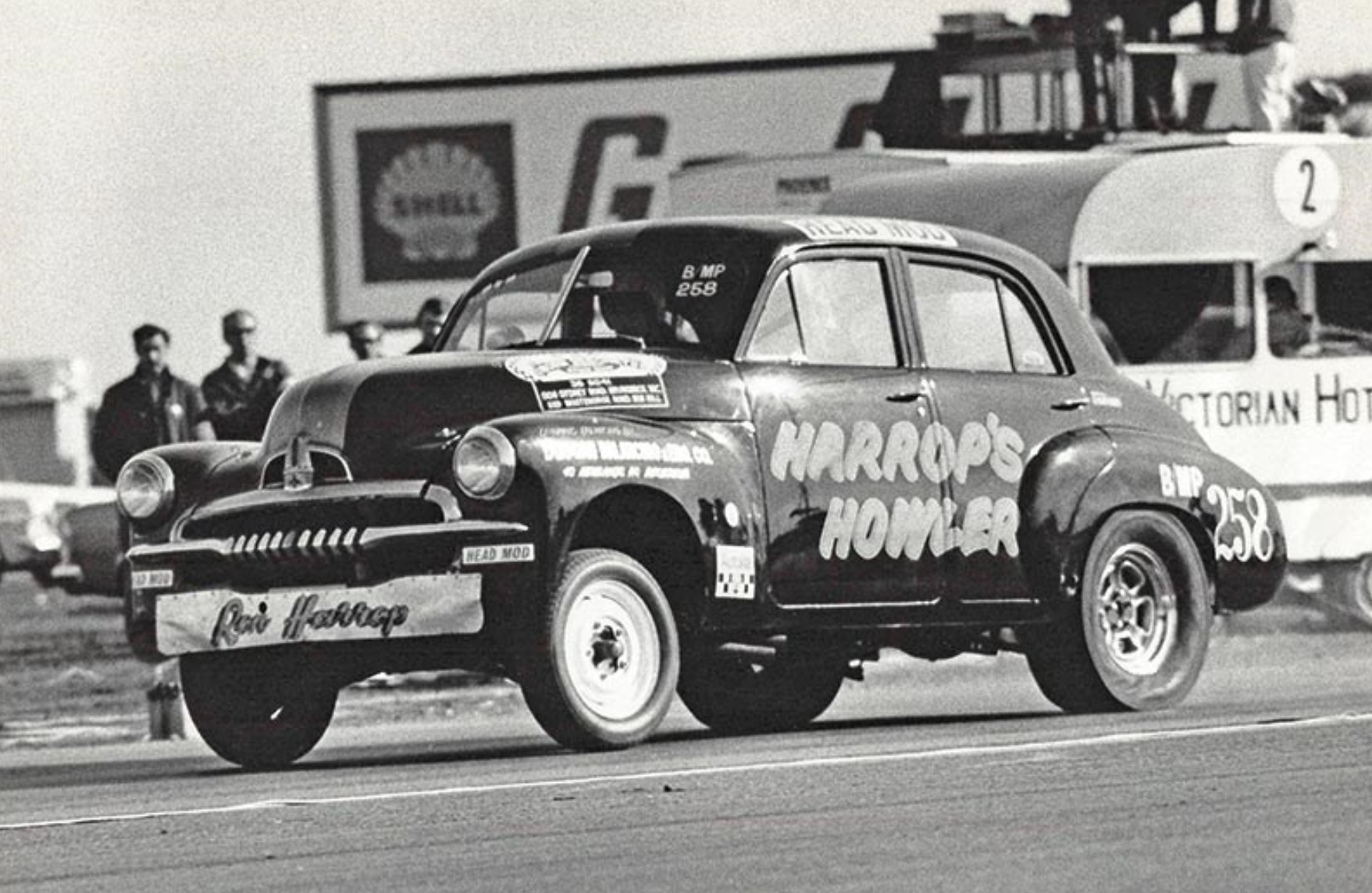
Ron Harrop’s ‘Howler’ at Calder in the early seventies- Holden FJ with highly developed Holden ‘Red motor’ successor to the ‘Grey’. Harrop became a touring car circuit ace and a Holden engineer par-excellence (unattributed)


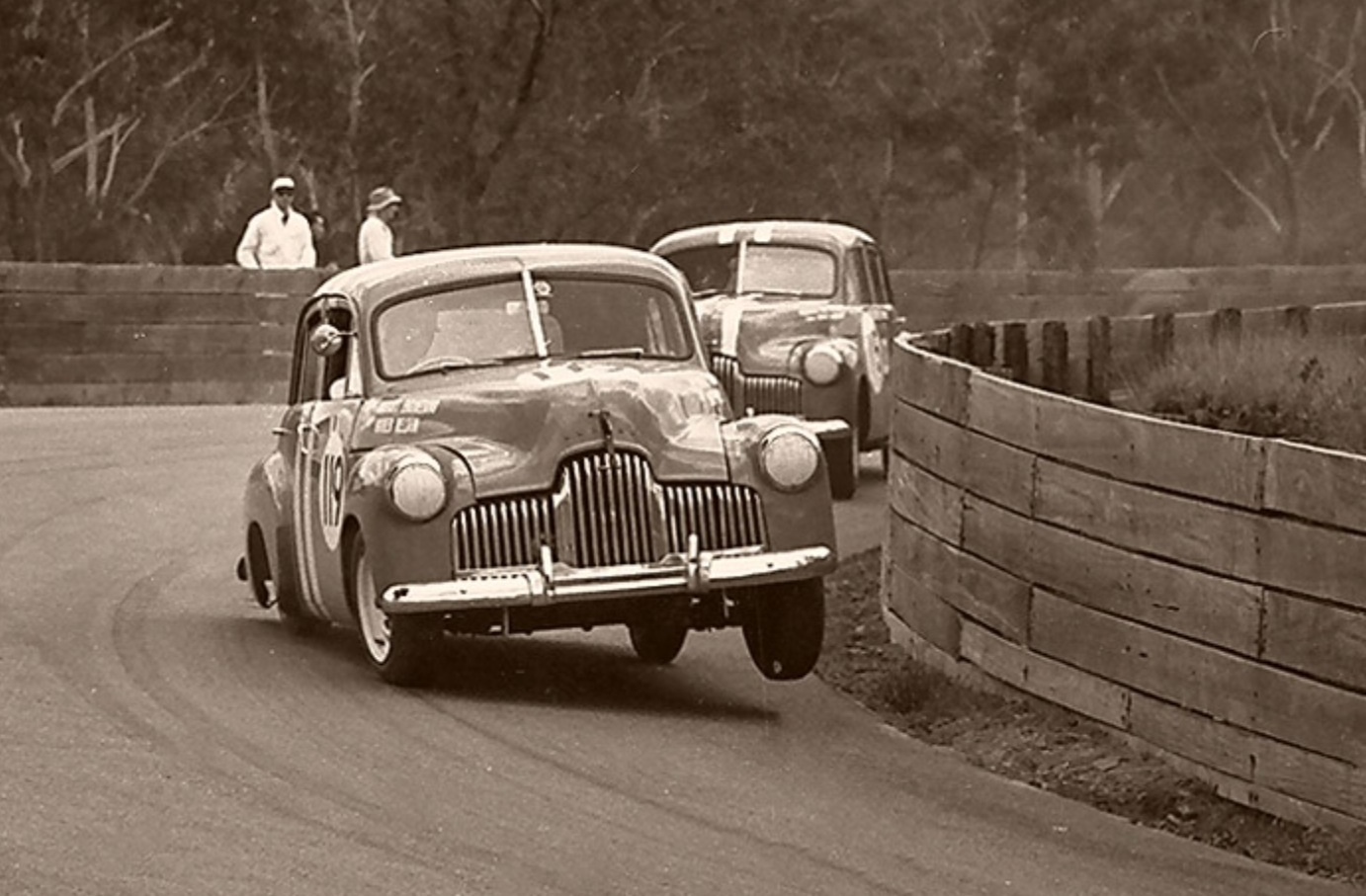
Warren Weldon from Bo Seton, Holden FX by two: Catalina Park early sixties (B Wells)


Great names who raced ‘Humpy Holdens’ included Jack Myers, the ‘Holden King of the mid-fifties’, John French, Leo and Pete Geoghegan, Max Stahl, Spencer Martin, Des West, Norm Beechey, Brian Muir, Warren Weldon, Bo Seton, John Goss and many, many others.

Into the dawn of the sixties CAMS adoption of Appendix J put paid to the wild modifications which had started to proliferate- it became the category to which the Australian Touring Car Championship was run. ‘Series Production’ or standard road car racing provided the basis for further growth in tourers by spawning endurance classics such as the Phillip Island and later Bathurst 500, relative to racing cars which became progressively starved of sponsorship funds and less and less relevant to the ‘football, meat-pies and touring cars lovin’ Australian public.

Be in no doubt my friends, Holden Motor Bodies Ltd in 1919 begat General Motors Holdens Ltd which gave birth to the ’48-215′, the intrinsic qualities of the design created a worthy competition car in modified form, the ready availability of which gave rise to the accelerated (pun intended) growth of touring car racing in Australia.


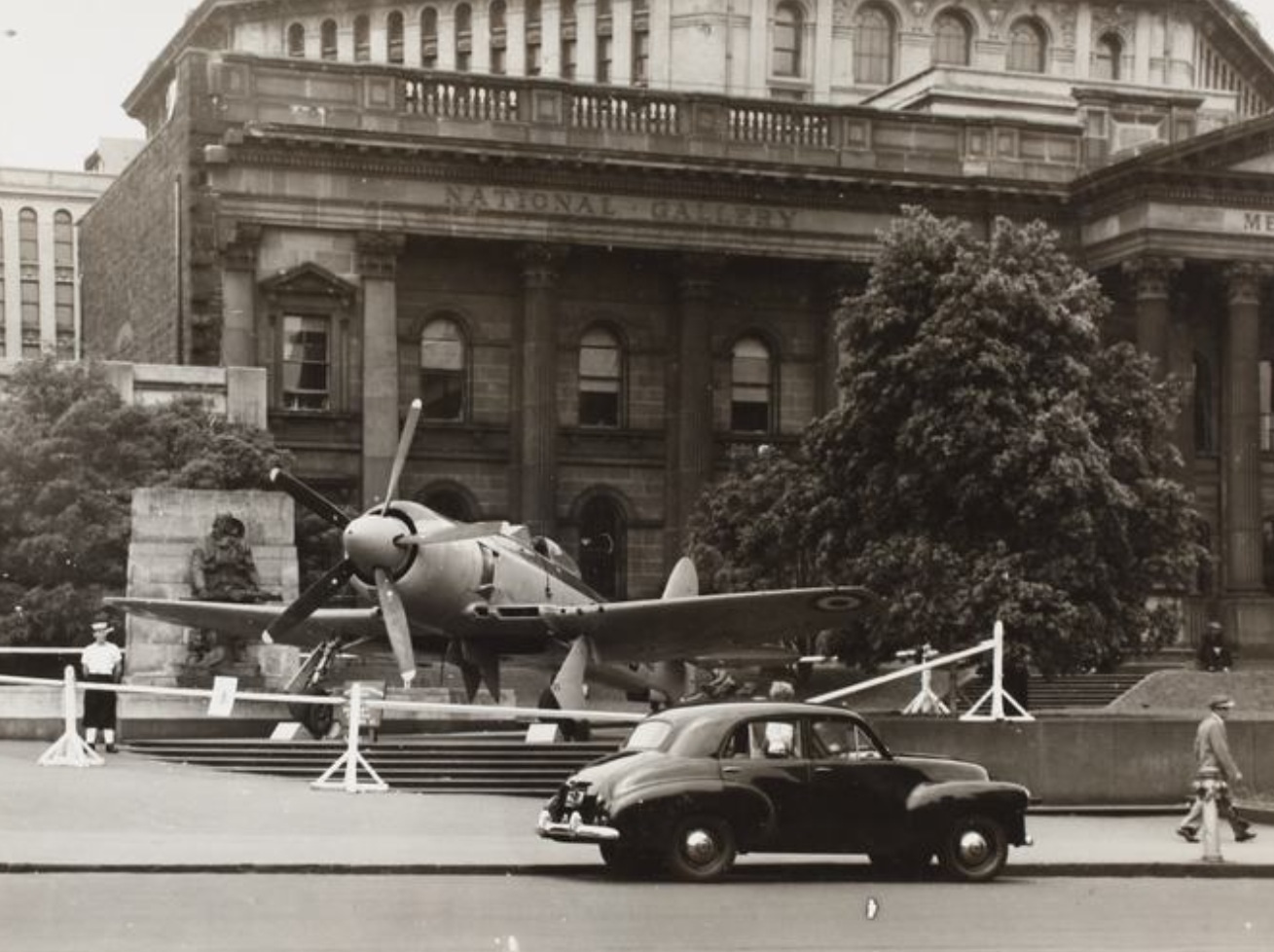
Melbourne Museum, Swanston Street. Royal Australian Navy Hawker Sea Fury (VW626) with Holden 48-215 in the foregrund during the ‘Jubilee of Flight’ exhibition in July 1953 (Museums Victoria)

After-thought: Sir Laurence Hartnett…

Laurie Hartnett strode the Australian manufacturing landscape like a colossus throughout his career but his pugnacious attitude to his American masters as to the design elements of an All Australian Holden led to his removal as Chief Executive of GMH Ltd in December 1946.

He was offered a role with the GM Corporation in the US but did not want to leave Australia- he never got to give birth to Australia’s own car- his own Hartnett was a notable achievement all the same. I’m not going to get lost in this tangent but click here to read in brief about a quite remarkable man.

http://adb.anu.edu.au/biography/hartnett-sir-laurence-john-12602

Etcetera…

Repco Hi-Power Head..

‘Repco Record’ Car and Repco ‘Hi-Power’ Head…

Holden ‘Grey’ as Racingcar and Sportscar Engine…

Whilst the focus of this article is the 48-215 and FJ as competition cars themselves the Holden Grey was adopted by many racers as replacement engines for their single-seater or sportscar originals or as the very basis of a special.

The Bristol to Holden conversions of Cooper T20 and T 23’s are examples of the former and the Lou Molina and Sil Massola ‘Molina Monza’ an example of the latter.

Click here; https://primotipo.com/2015/02/10/stirling-moss-cumberland-park-speedway-sydney-cooper-t20-wm-holden-1956/

and here; https://primotipo.com/2015/05/13/shifting-gear-design-innovation-and-the-australian-car-exhibition-national-gallery-of-victoria-by-stephen-dalton-mark-bisset/

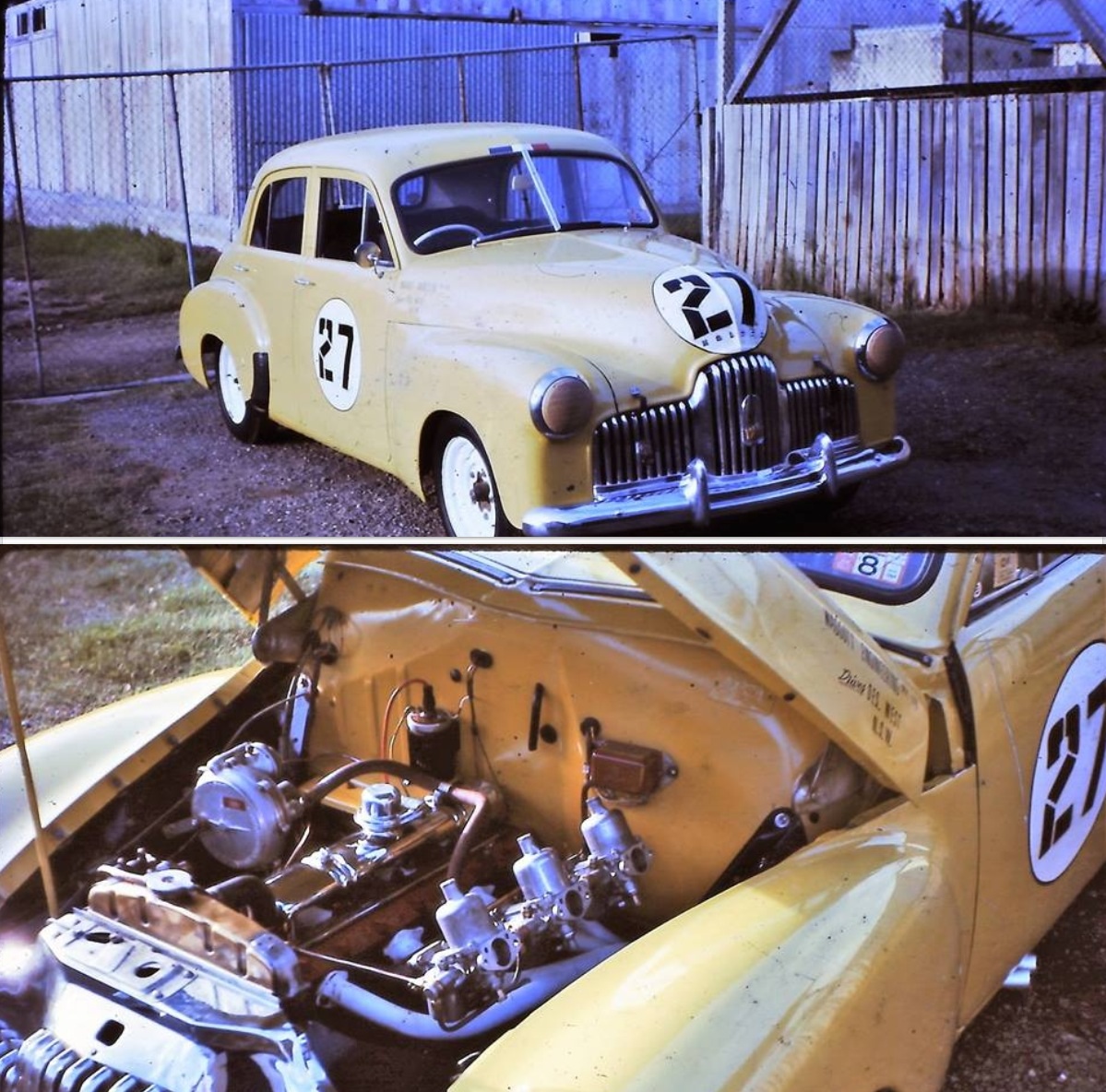
Des West’s 48-215 Racing Specifications..

http://www.thegreymotor.com/2014/11/des-west-fx-27-grey-survivor.html

Des West’s second 48-215 racer pictured at home, Wingham, NSW having set the fastest Holden record time at Lowood in 1964 (G Woodward)

Rally and Race..

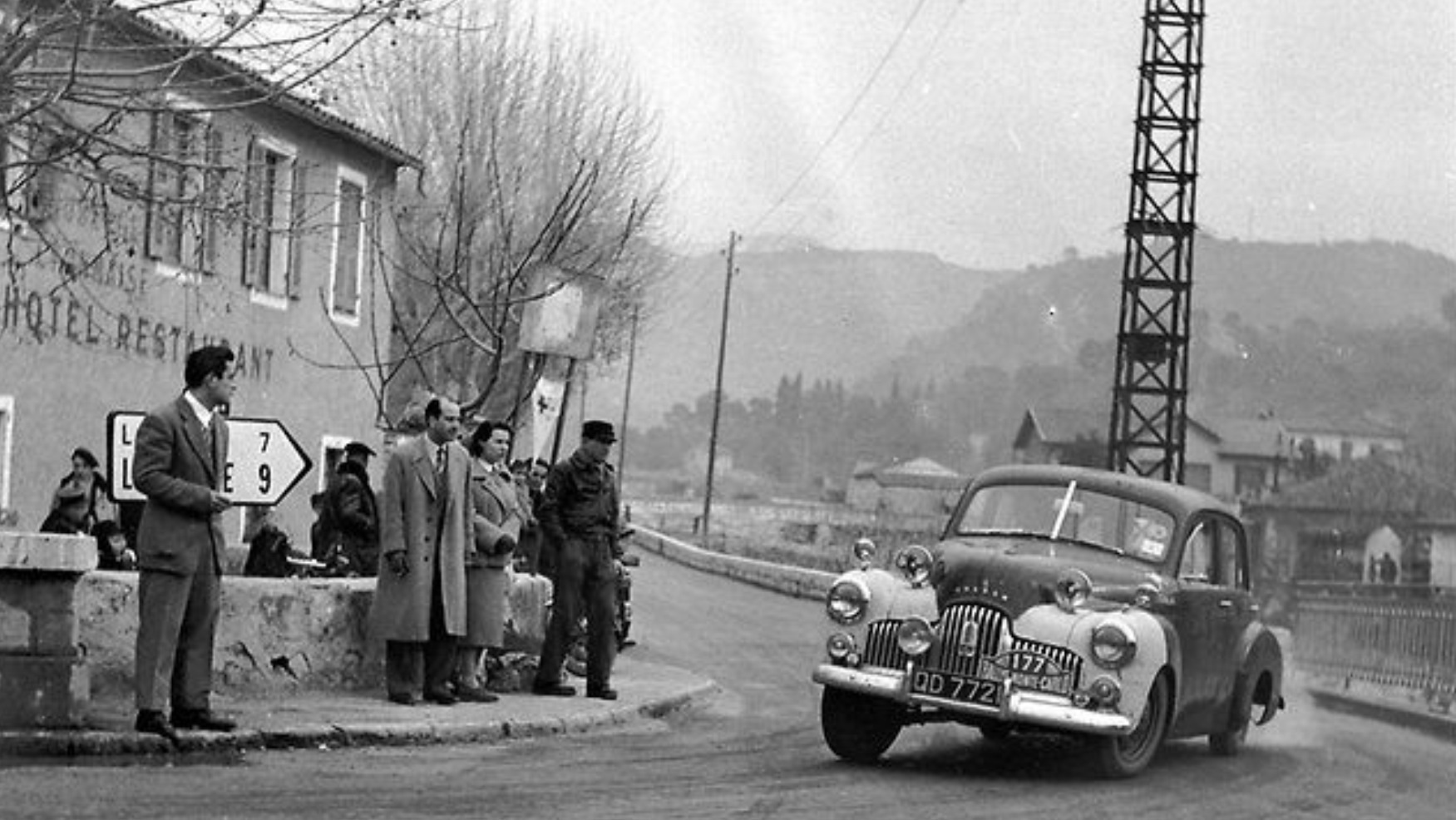
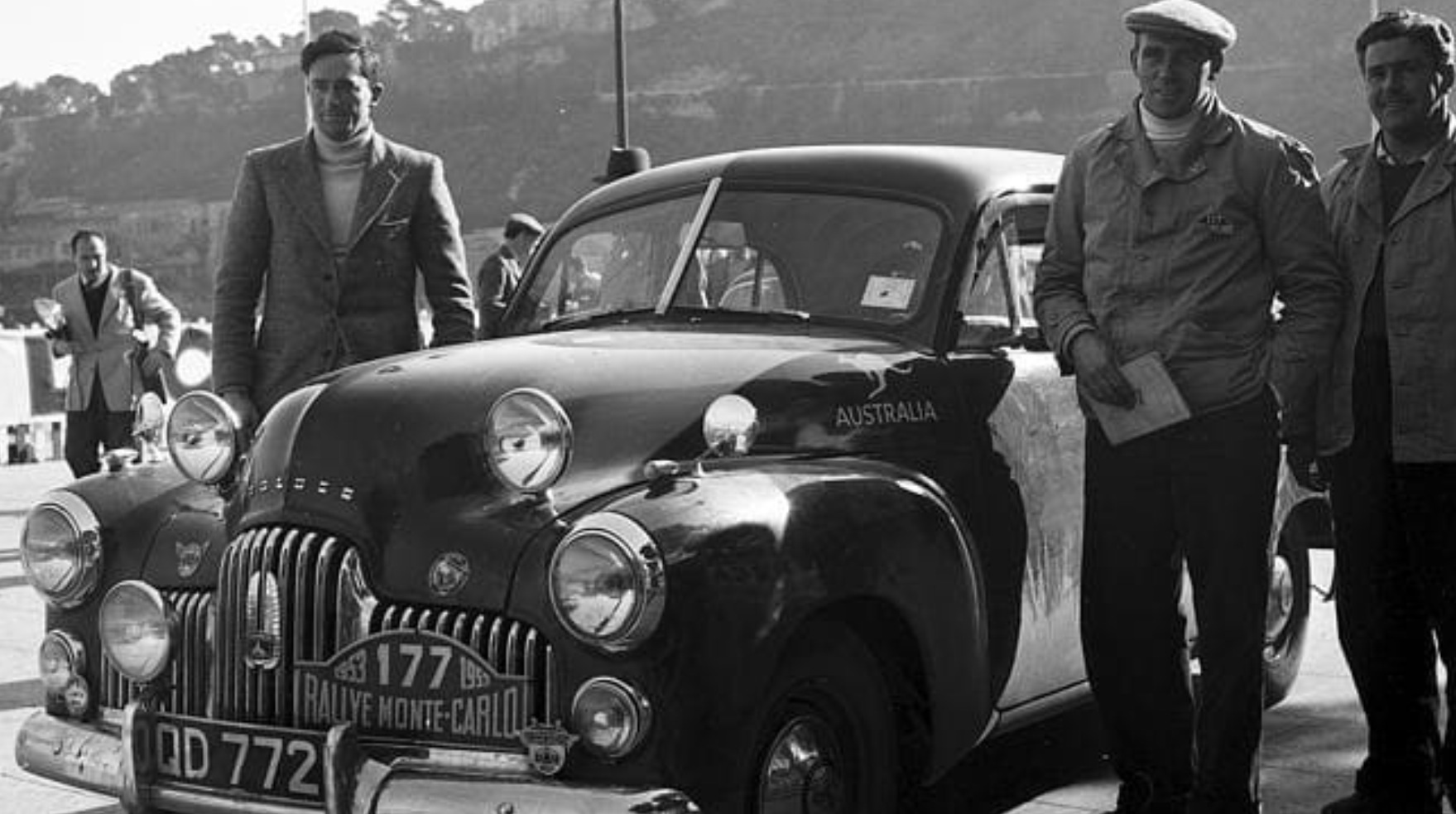
June 1953 Monte Carlo Rally, Davison, Gaze and Jones DNF. Gatsonides/Worledge won in a Ford Zephyr (unattributed)


1953 Monte Carlo Rally- Messrs Gaze, Davison and Jones- Aces All


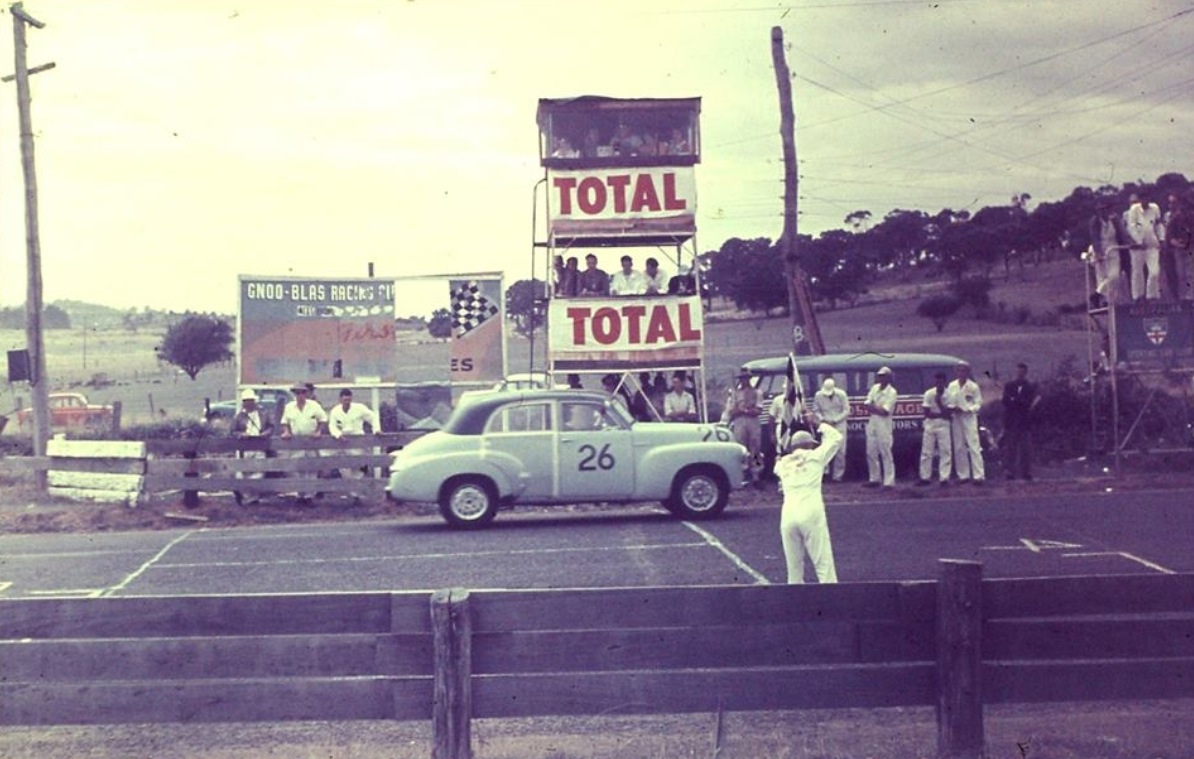
John French at Gnoo Blas, Orange circa 1960 (R Kaleda)


Chifley, Fishermans Bend, 29 November 1948 (SLSA)


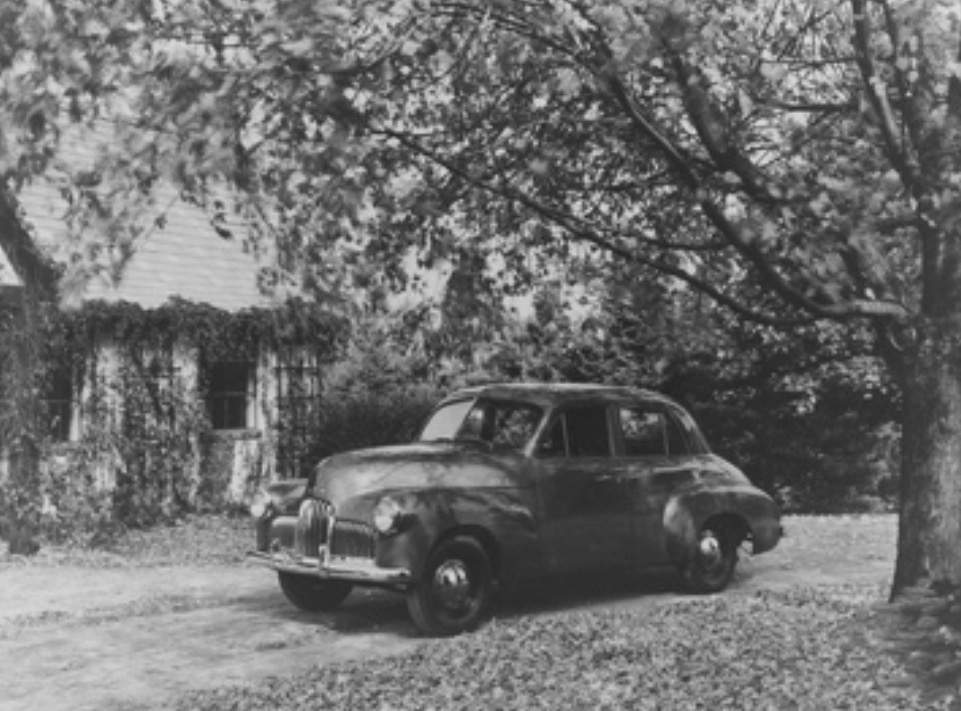
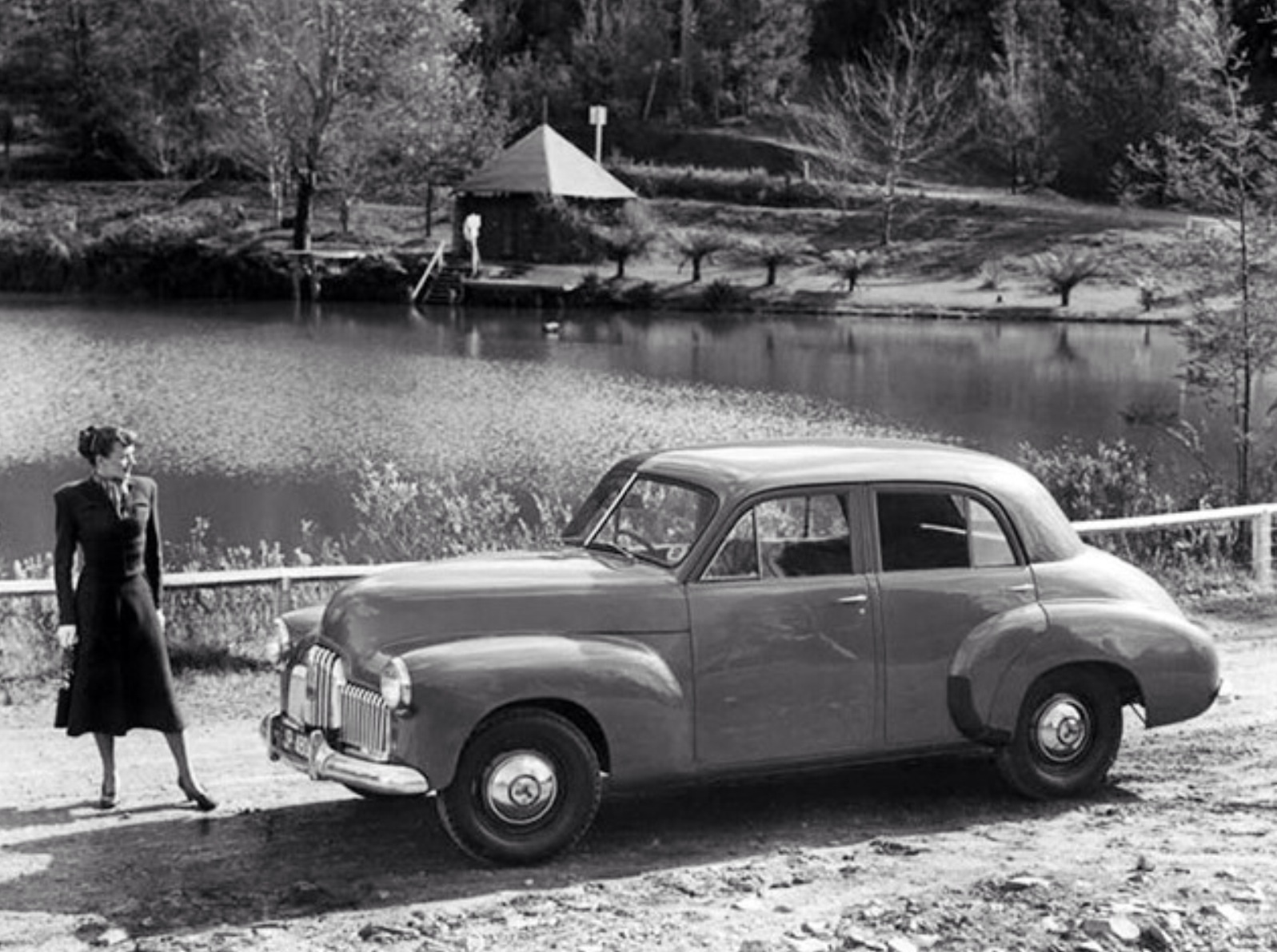
Hottie and the new 48-215. Whereizzit tho? Being lazy buggers I’m thinkin the Holden PR mob would not have travelled far to do the photo shoot so my vote is Ringwood Lake on Melbourne’s eastern outskirts?

Credits…

Sam Hood, Museums Victoria, State Library of South Australia, Ray Kaleda, Garry Woodward, General Motors Holden. australiaforeveryone.com.au, Museums Victoria, Bruce Wells

Tailpiece: ‘Told you it would be pretty painless’ Bob Menzies and Laurence Hartnett, GMH Pagewood 1940…

(S Hood)

Finito…

(M Bishop)

Bryan Thomson’s VW Chev V8 ‘Volksrolet’ at Hume Weir in 1975…

I love photographer Mark Bishop’s wit in relation to this mega-shot-‘Look closely- proof even Doctor Who went to Hume Weir Raceway to watch Bryan Thomson’. It’s the marshalls communications phone box, PMG issue at the time behind Bryan- Post Master General’s department, the precursor of Australia Post and Telstra.

Check out Thommo’s form as he tips the McLaren M10B F5000 ‘parts-bin’ Volksrolet sideways into Pit Straight with the right-front pawing the air. What an iconic, awesome and tricky beast it was, tamed so well by Shepparton’s finest.

Thommo this time hiking the front left at Calder’s ‘Tin Shed’, in front of the landlord, Bob Jane’s Holden Monaro GTS350 in December 1974 (B Keys)

Photo Credits…

Mark Bishop, Bruce Keys

Tailpiece: Thomson and Jim McKeown, Porsche 911 Turbo, Hume Weir 1975…

John Mann’s Cortina Repco Holden and Mike Stillwell’s Escort BDG in the distance (M Bishop)

Finito…
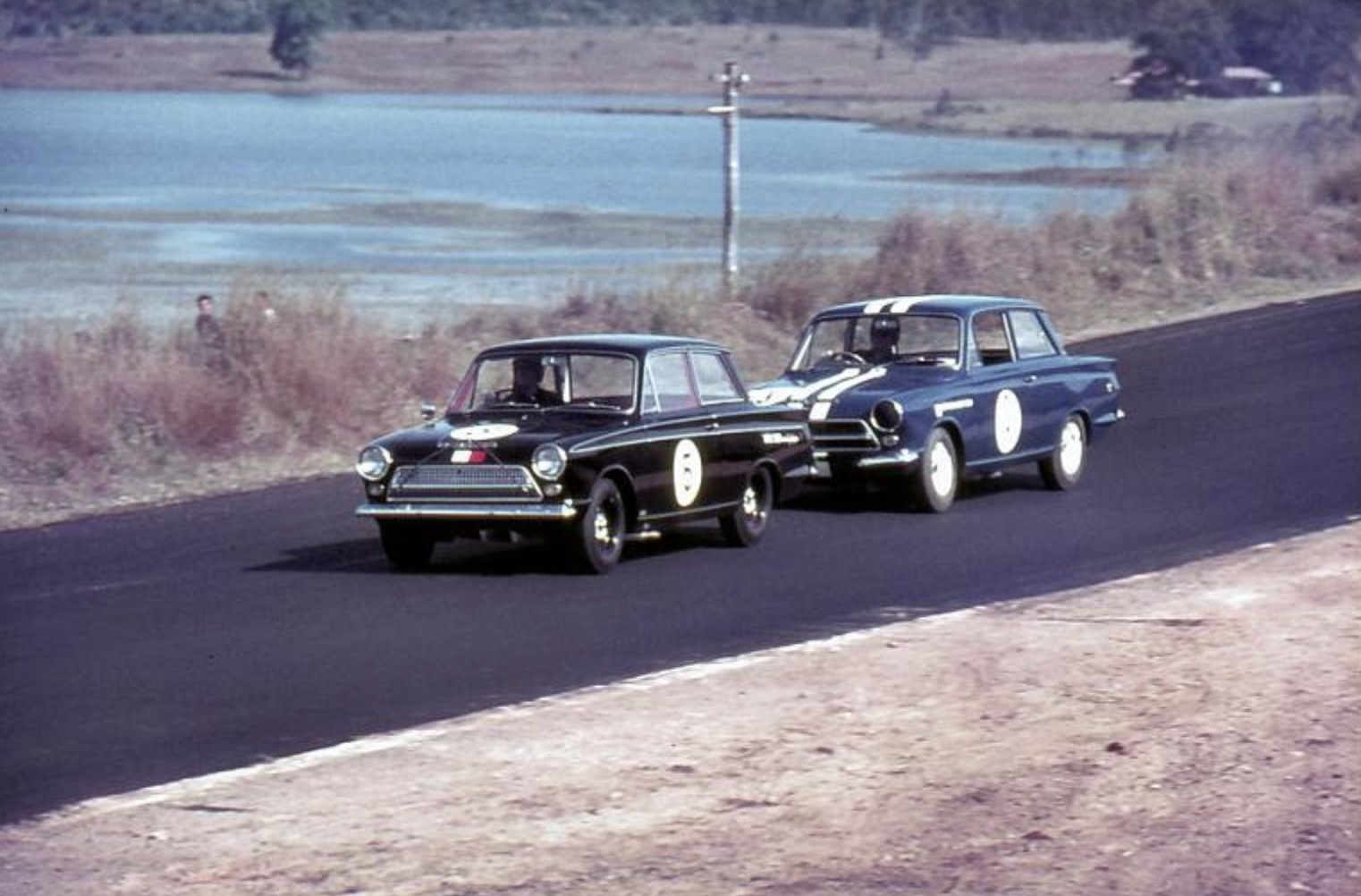
Bernie Haehnle aboard his Rennmax Mk1 Formula Vee on the front row of the grid at Warwick Farm in 1971…
Nice find of a batch of interesting photos- this one of Bernie on the front of the grid, where he typically resided, and the other two which triggered this article are Australian Department of Immigration ‘success stories of migrants in sport’ of whom Bernie was one- he hails from Stuttgart, Germany.

(DIA)


(DIA)


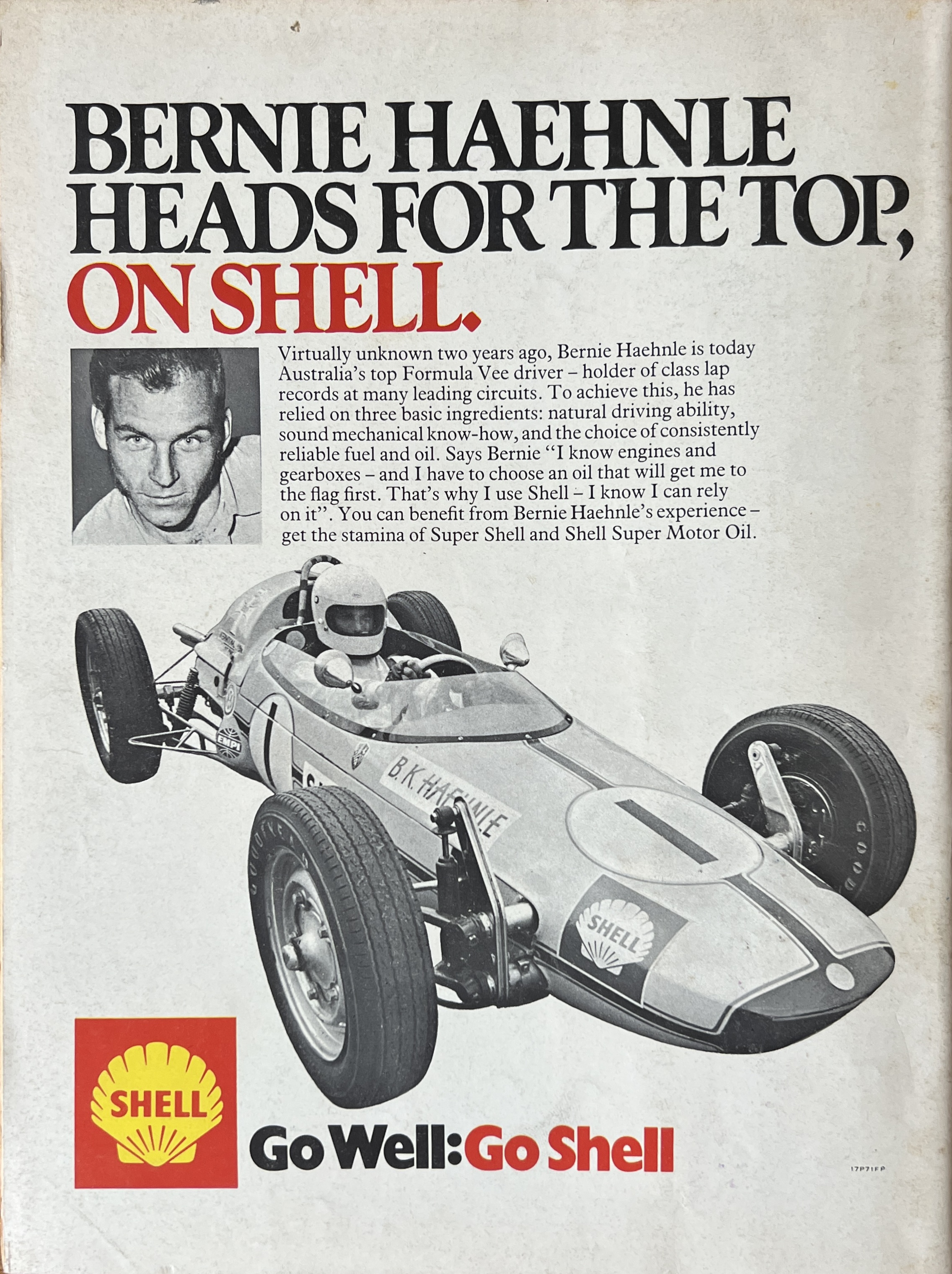
At the time of the article ( I wonder where it was published?) he had his own automotive business in Lane Cove, Sydney. Haehnle progressed from FV- these Bob Britton built Rennmax Mk1’s were the ‘ducks-guts’ to have, especially in New South Wales, to Formula Ford, racing a Bowin P6F with much elan. As was the case for top open-wheeler racers he usually saddled up in a Series Production car for the annual enduros at Bathurst, Sandown and Surfers. I wonder what he is up to these days?

Bernie, Rennmax Mk1 in the Warwick Farm Esses, November 1971 (L Hemer)

Credits…

Industrial Photography, Department of Immigration Australia, Lynton Hemer, Pictorial History of Racing Cars

What a great way for a young driver to have his profile lifted. As a sponsored driver, these Shell ads were placed in the mainstream motoring magazines of the day, not just niche ones like ‘Australian Hot Rod’.

(Pic History of Racing Cars)

Tailpiece: Just a smidge more, five more minutes…

Bernie was clearly determined and clever!

His disagreement with local real estate occurred at XL (Griffins) Bend during the running of the 1969 Bathurst 500 classic when he ran out of road heading up the mountain.

With his trusty fence post, leverage, push-and-shove and the fall of the land Bernie was able to get the little GH Whitehead entered Mazda R100 back onto its wheels and into the fray after an hour of toil. He drove down the mountain and through a farm before rejoining the blacktop.

It is one of those feats of never-say-die which has gone down in Bathurst folklore- and garnered far more TV coverage than a mid-field class car could have ever dreamed of!

Co-driver Peter Wherrett shared the car with him, the pair retired on lap 31 with PW not getting a drive but watching the drama unfold on the telly in the pits. The car was driveable, a tad second hand, but without a windscreen officialdom stepped in.

(autopics.com.au)

In an historic sidebar it was the first time a rotary engined car raced at the Mountain- in fact it was one of the R100’s first race appearances anywhere in the world.

Whilst the 982cc, twin-rotor, 100bhp cars were very quick in a straight line thanks to a combination of power and light weight.

Haehnle, R100 early in the race (autopics.com.au)

With only 805 kg to cart along, the little coupe did the standing quarter in sub 18 seconds with a top whack of 175 km/h. It wasn’t as flash through the corners though- the R100 was very narrow and tall relative to its length, resulting in lots of body roll and fearful roll oversteer at high speed caused by toe-out on the outside rear wheels due to deflection in the leaf springs. Ask Bernie.

Three R100’s started at Mount Panorama, the quickest of the two remaining finished fifth (Garry Cooke/Geoff Spence) in Class C behind the winning Cooper S, two Fiat 125s and a lone Valiant Pacer. The second R100 was seventh- the Mazdas finished two laps behind the winning Coopers with their superior handling, fuel economy and long track record of motor racing success.

What was impressive was that two standard, off the production line examples of Mazda’s new mass-produced rotary survived 500 miles flat-knacker on one of the world’s most challenging circuits without a drama. Mazda became an important force in Australian touring car racing over the ensuing decade, all of which started with the R100 and test-pilots like Bernie!

Finito…