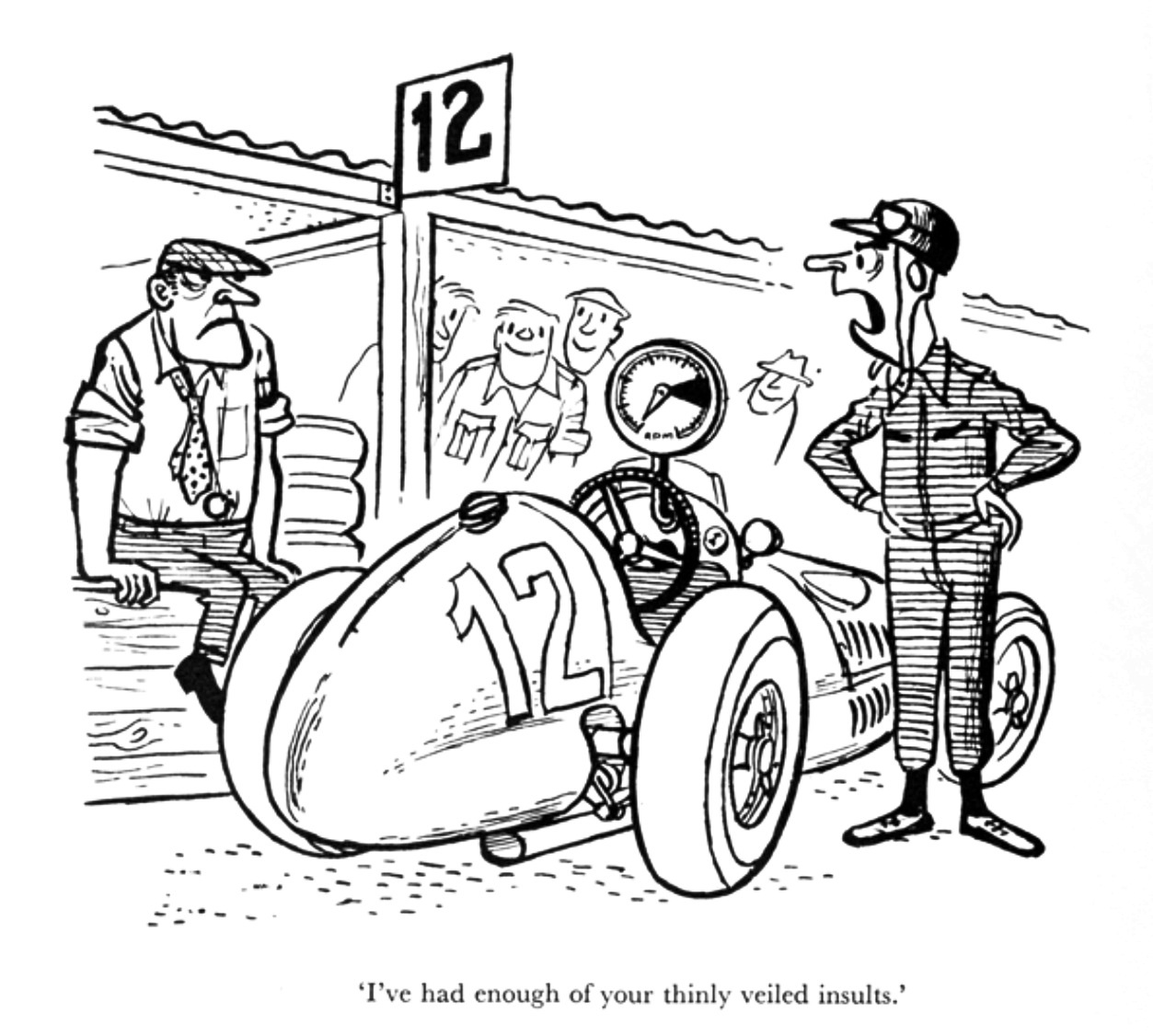
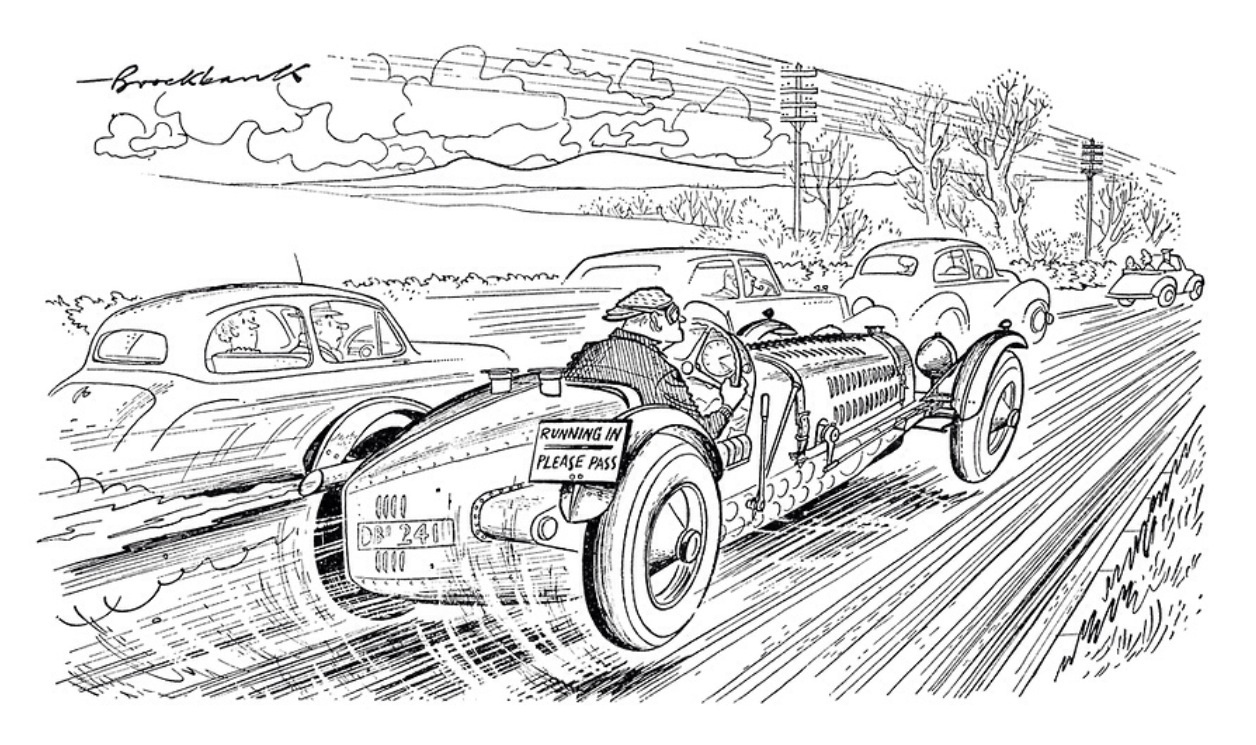
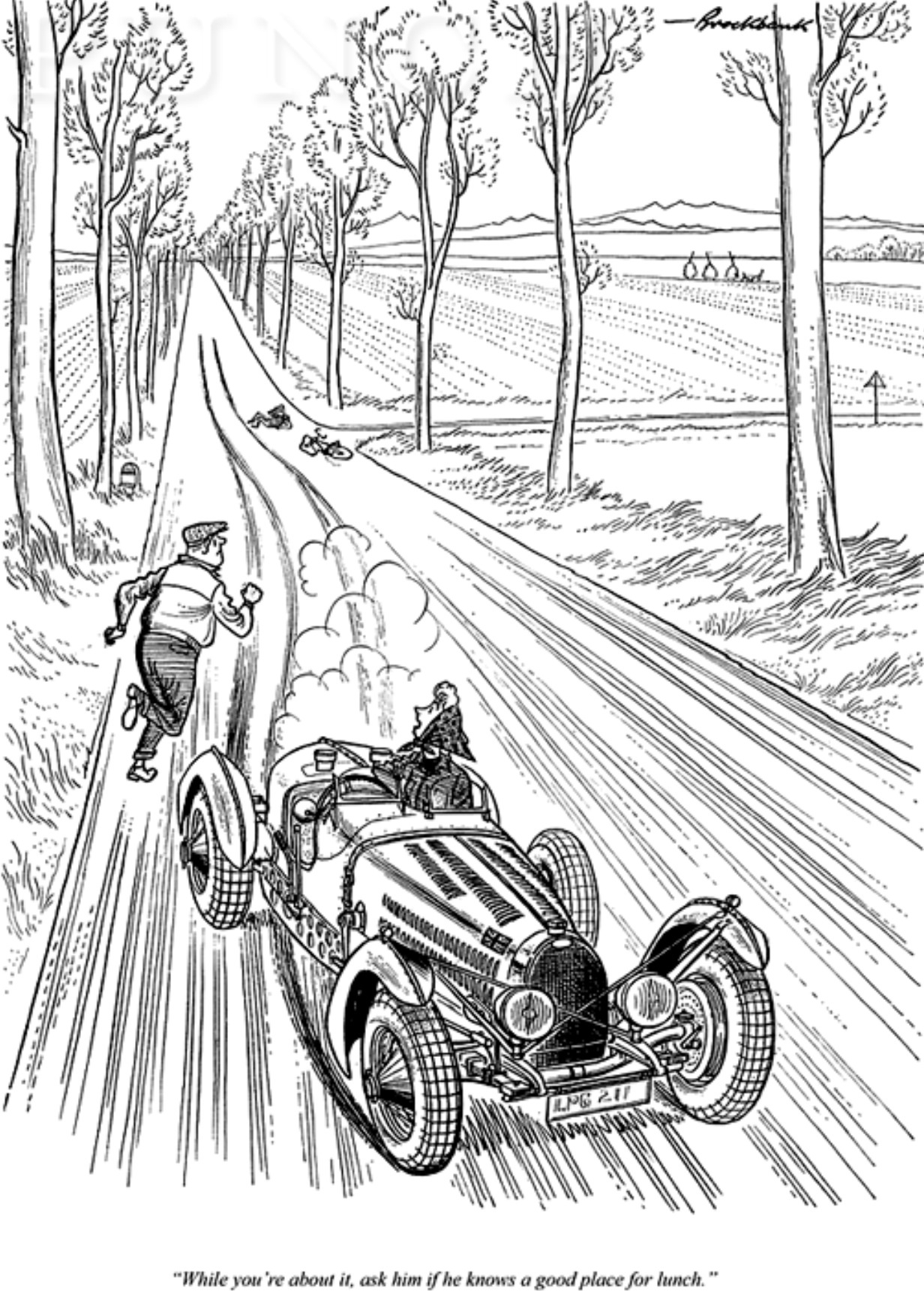
I joined a couple of much younger enthusiasts at Prahran’s ‘The Alps’ for a couple of ‘shandies’ on a warm Spring Sunday last week and was amazed to see them on their ‘duelling’ iPads cackling away to some of Brockbank’s magic…

 I shouldn’t have been surprised though as the work is timeless.

Russell Brockbank died in 1979 so has not been with us for a while. I think the first time I saw his work was in a batch of Pommie magazines my dad had been given by a mate in my early teens. A while ago.

He wasn’t born a Brit though, he was Canadian by birth, born in Niagra Falls in 1913, he was educated there and then went to Chelsea School of Art in London. He left art for industry in 1932 and then industry for art in 1936.

The 1960’s English editor of Automobile Year recalls he was a fairly well known motoring artist when Brockbank asked for his advice on how to break into the automotive business over a post Donington meeting drink. Confronted by such brilliant competition, Gordon Wilkins thought he showed sound sense in deserting art for writing.

Brockbank’s career started in the thirties as a contributor to ‘Speed’ magazine producing scraper images of the racing cars of the time.

Throughout his war service in the Royal Navy he contributed to Punch, Lilliput and The Aeroplane, his art reflecting the state of society then.

By 1949 he was the Art Editor of Punch. His passion and knowledge of cars and motor racing shines through in the technical accuracy of his work as do his characters-Major Upsett with his outmoded ‘tache and clapped out Austin 8. Not to forget the ‘Old Biddy’ haranguing her long-suffering husband, the Rolls driver and Latin racing drivers. Nothing missed his eagle eye.

In England he lived in the country and frequently gave lifts to grannies who had missed the hourly bus. He even thought of starting a ‘100 mph Club’ – ‘Bless their hearts, they chat away at a Porsche ton and don’t know it. The observant few watch the tacho, read 40 and are happy’ he quipped.

He died at the early age of 66.


Bibliography…

Automobile Year, Article by Sue Ellis

Credit…

Russell Brockbank, Brockbank Partnership

Tailpiece…


(Fistonic)

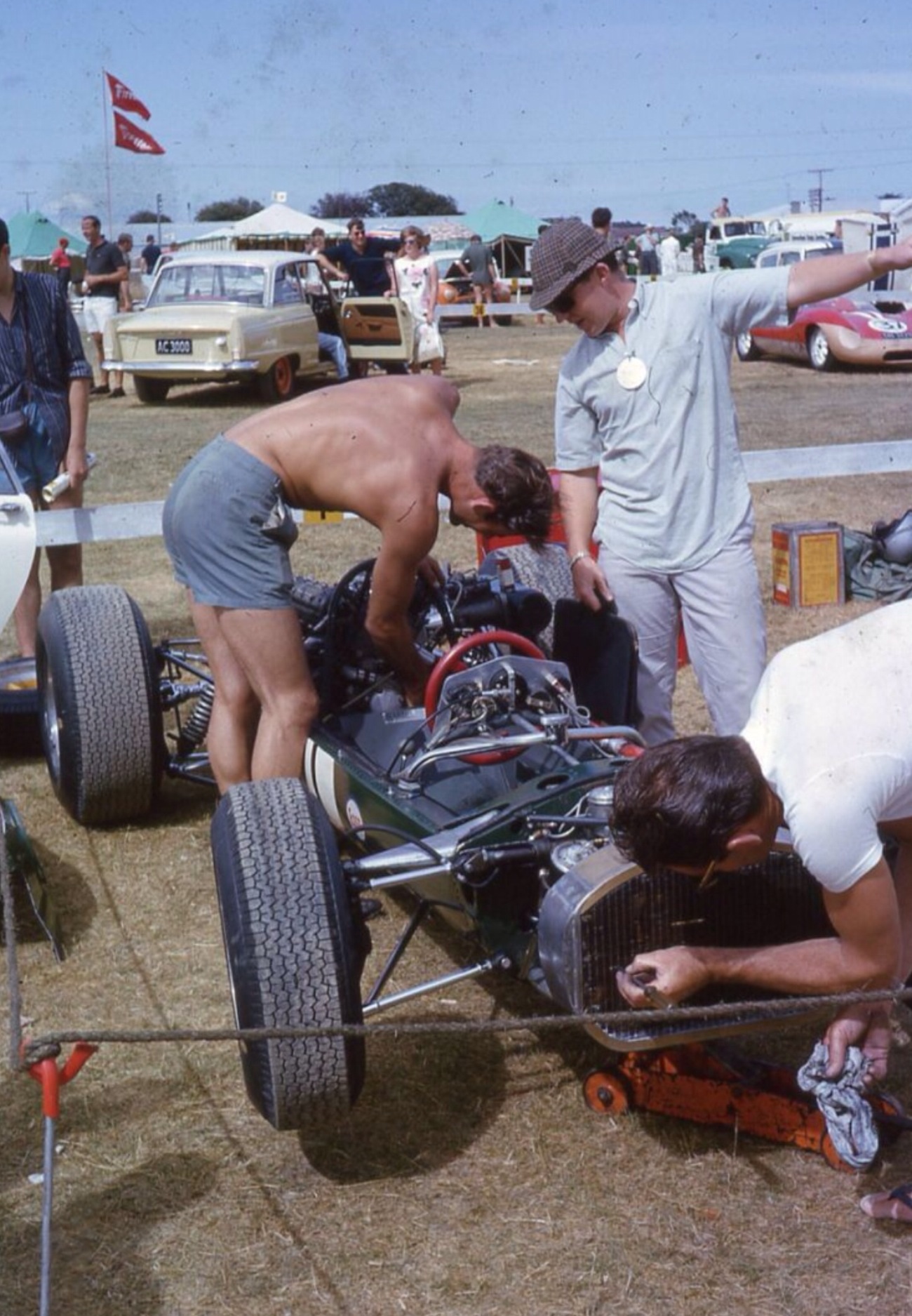
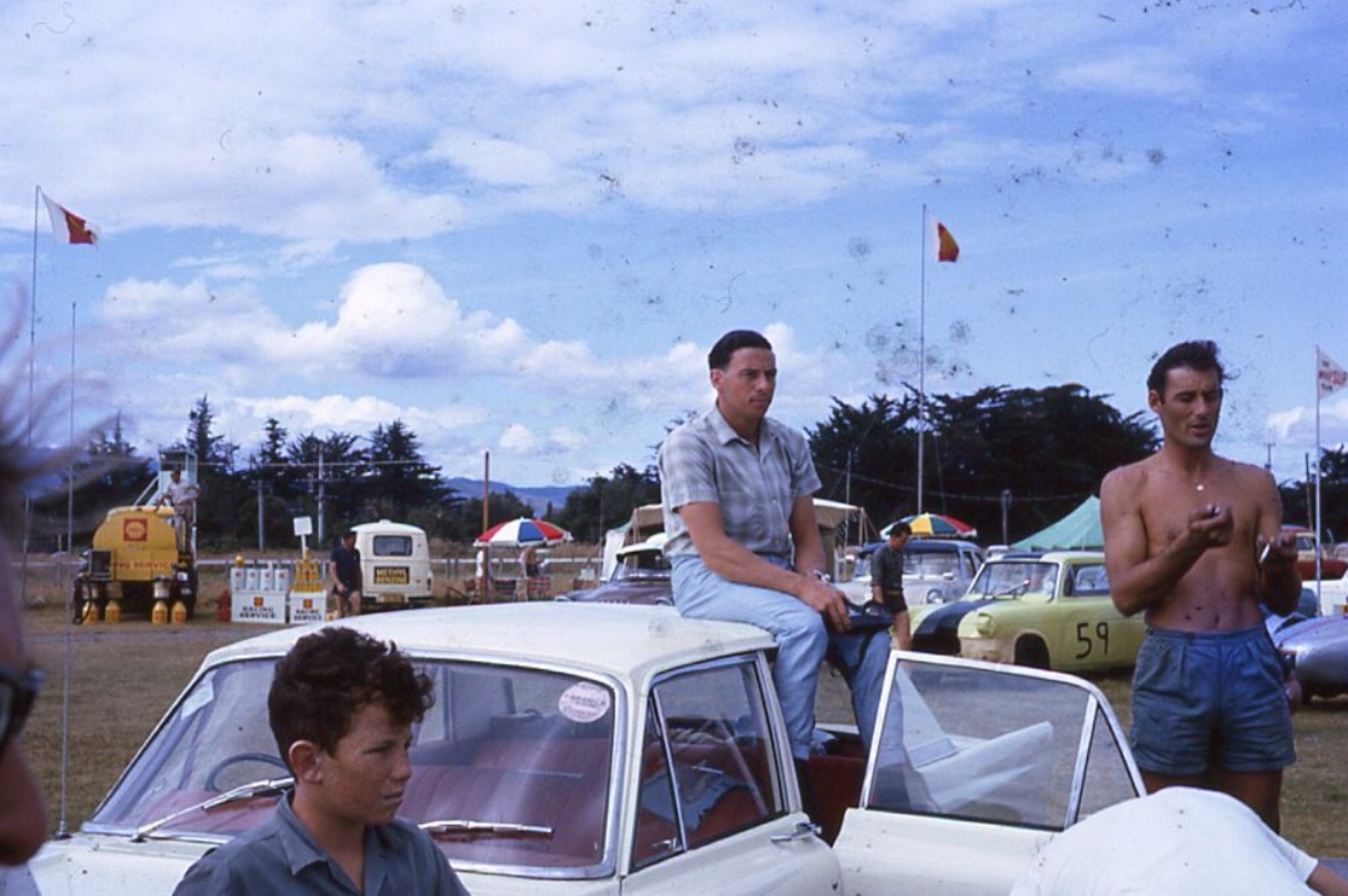
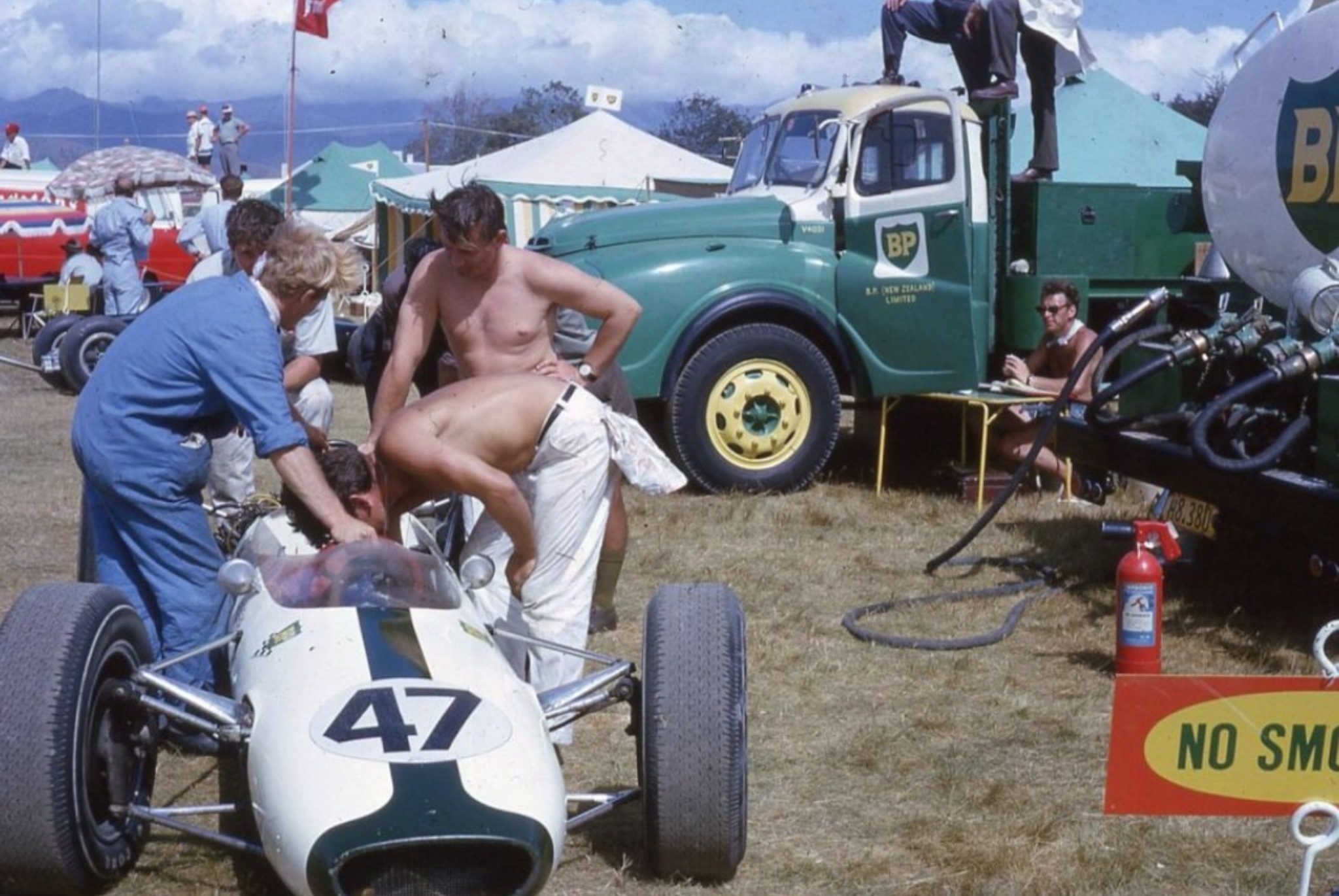
Jim Clark takes in a few rays and a touring car race from his grandstand atop a Ford Zodiac, Levin, New Zealand Tasman, January 1965. In the distance are the Tararua Ranges, alongside the Team Lotus mechanics are fettling Jim’s Lotus 32B Climax.

The champions relaxed nature and the scene itself epitomises all that was great about the Tasman Series. We had the best drivers on the planet visit us every summer and whilst the racing was ‘take no prisoners’ the atmosphere off track was relaxed- the parties, water skiing, golf and annual cricket matches at the Amon family beachhouse are stories told many times over.
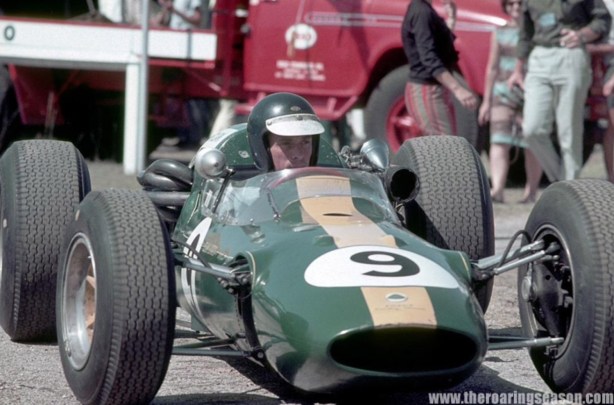
Jim Clark cruising through the Lakeside paddock during the 7 March 1965 weekend. The ‘Lakeside 99’ wasn’t a Tasman Round in 1965 but Internationals Clark, Gardner and Grant contested the event- Jim won from Gardner and Spencer Martin in the Scuderia Veloce Brabham BT11A just vacated by Graham Hill’s return to Europe (Mellor)

Few racing drivers have had a season like Jim Clark did in 1965, surely?

He started the year in Australasia and took the Tasman series with four wins in a Lotus 32B Climax FPF, won the F1 Drivers Championship in a Lotus 33 Climax with 6 wins and topped it all off with victory at Indy aboard a Lotus 38 Ford. In between times he contested the usual sprinkling of F2 events and some Touring Car races in a Lotus Cortina. Lets not forget a few longer sportscar races in the Lotus 40 Ford Group 7 car in the US. Not to mention other races as well. Amazing really.

 We were lucky enough to have the immensely likable Scot in the Southern Hemisphere at the seasons commencement though.

Colin Chapman had the Lotus Components lads build up a Tasman Special for Clark which was a mix of an F2 Lotus 32 chassis, 2.5 litre Coventry Climax 4 cylinder FPF engine and ZF gearbox. The combination was very successful taking race wins at Wigram, Teretonga, Warwick Farm and here at Levin on 16 January 1965. 

Kiwi international journalist and early member of Bruce McLaren Motor Racing, Eoin Young providing direction to the Lotus mechanics looking after Clark’s Lotus 32B. Technical specs as per text but note rocker/inboard front suspension and filler for twin tanks contained in each side of the monocoque chassis pontoons.Lola Mk1 Climax in the distance? (Fistonic)

Twelve Lotus 32 chassis were built plus Clark’s Tasman one-off car which was built around chassis or tub number 32/7. Unlike the 1 litre Cosworth SCA powered F2’s which used a full-monocoque chassis the 32B used a monocoque front section with the rear section removed and replaced by a tubular steel subframe to which the 235bhp, 2495cc, 4 cylinder Coventry Climax FPF engine was mounted. Otherwise the cars suspension, inboard at the front by top rocker and lower wishbone and outboard at the rear was the same as the F2 32. The gearbox was a ZF rather than the Hewland Mk6 of the F2 car. The car chassis plate was tagged ’32-FL-8′ where ‘FL’ was Formula Libre.

This car still exists and is owned and raced by Classic Team Lotus, a shame really as its entire racing history was in Australasia.

Clark won the Tasman in it, the car was then bought by the Palmer family, Jim raced it to NZ Gold Star victory and very competitively in the ’66 Tasman before selling it to Australian Greg Cusack. The car was also raced by South Australian Mel McEwin in period, albeit it was becoming uncompetitive amongst the multi-cylinder Repco’s and the like by then.

Eventually it passed into the very best of Lotus hands- the late John Dawson-Damer acquired it and restored it, eventually doing a part exchange with CTL to allow them to have a Clark Tasman car in their collection. John received a Lotus 79 Ford DFV as part of the deal, he already had Clark’s ’66 Tasman car in his wonderful collection, the Lotus 39 Climax, so it was a good mutual exchange.
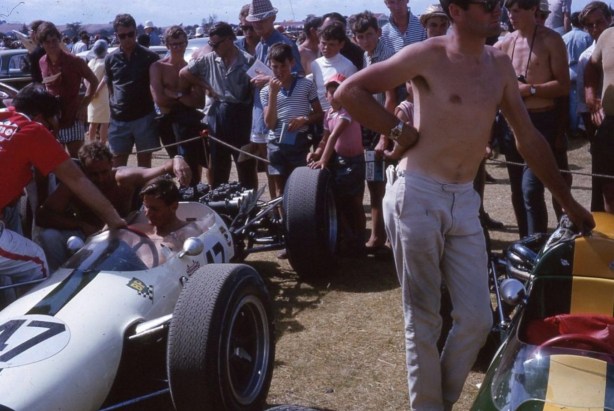
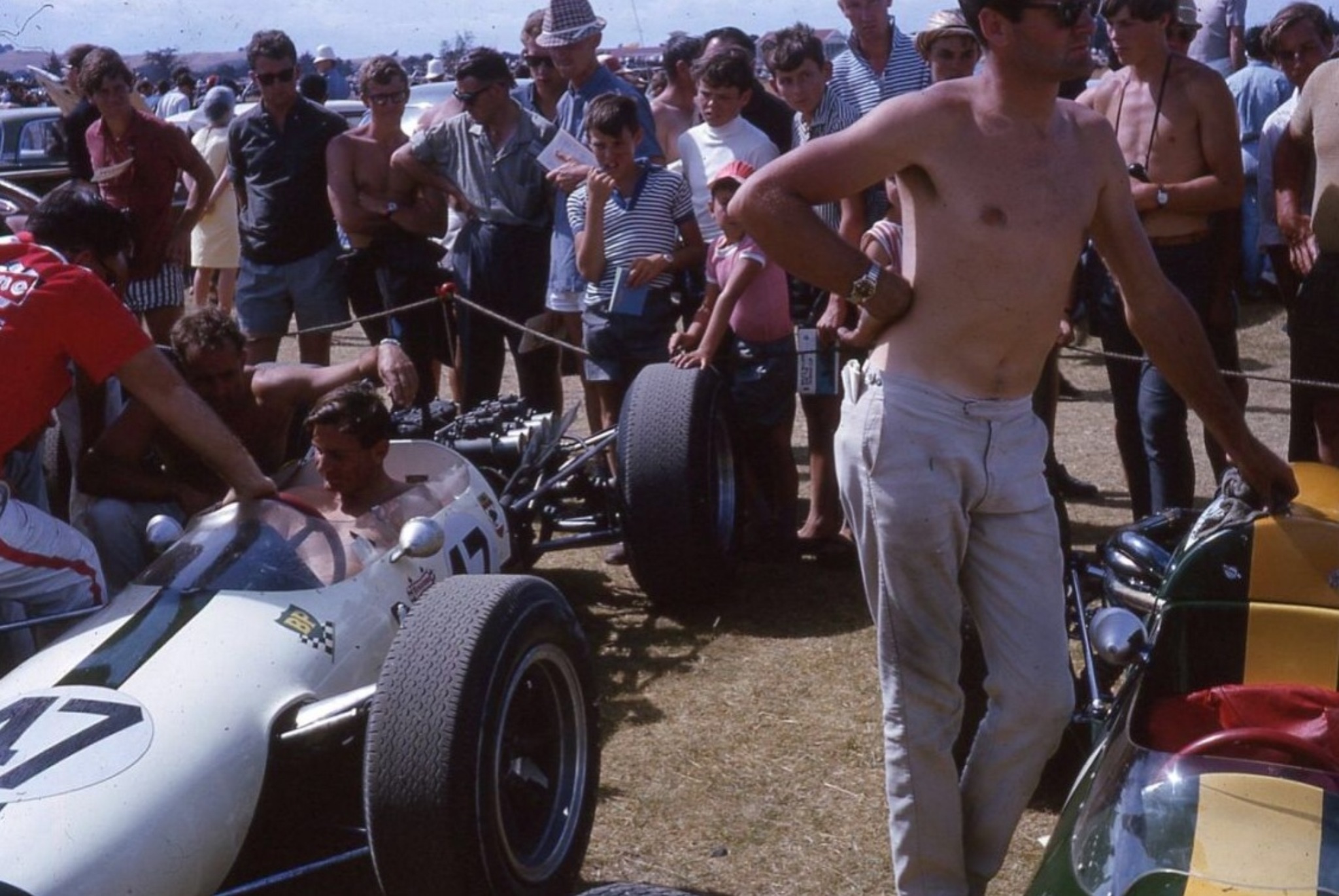
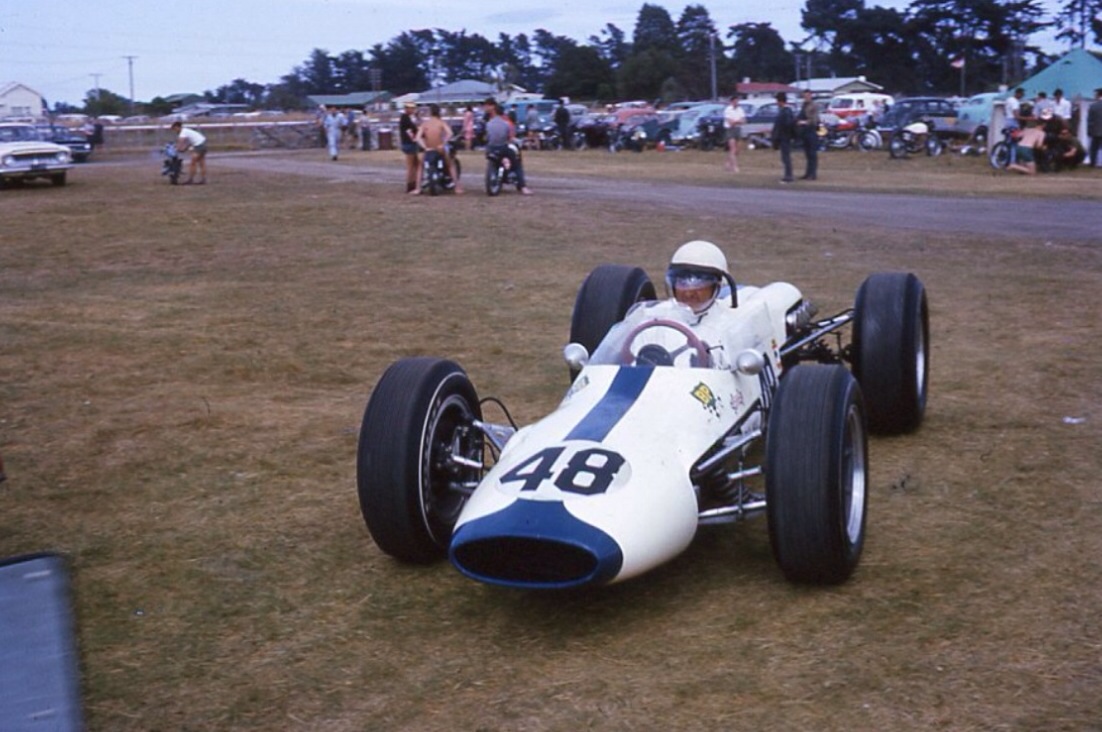
Local boy McLaren surrounded by admirers in the Levin paddock. Cooper T79, alongside is the green and yellow of Clark’s Lotus 32B (Fistonic)

Clark won the ’65 Tasman title 9 points clear of 1964 champion Bruce McLaren aboard his self constructed Cooper T79 Climax and Jack Brabham’s BT11A Climax. Given the speed of the BT11A, it was a pity Jack contested only the three Australian Tasman rounds. Frank Gardner also BT11A mounted and Phil Hill were equal fourth with Phil aboard McLarens updated ’64 Tasman car, a Cooper T70 Climax.

Graham Hill was 7th in David McKay’s Brabham BT11A Climax with other strong contenders Frank Matich Brabham BT7A Climax, Kiwi Jim Palmer similarly mounted, Bib Stillwell in a BT11A, Lex Davison in a BT4 Brabham. In addition there were a host of 1.5 litre Lotus Ford twin-cam powered cars snapping at the heels of the 2.5 FPF’s and set to pounce as the bigger cars failed.

In this article I focus on one round, the Levin event held on 14-16 January 1965.

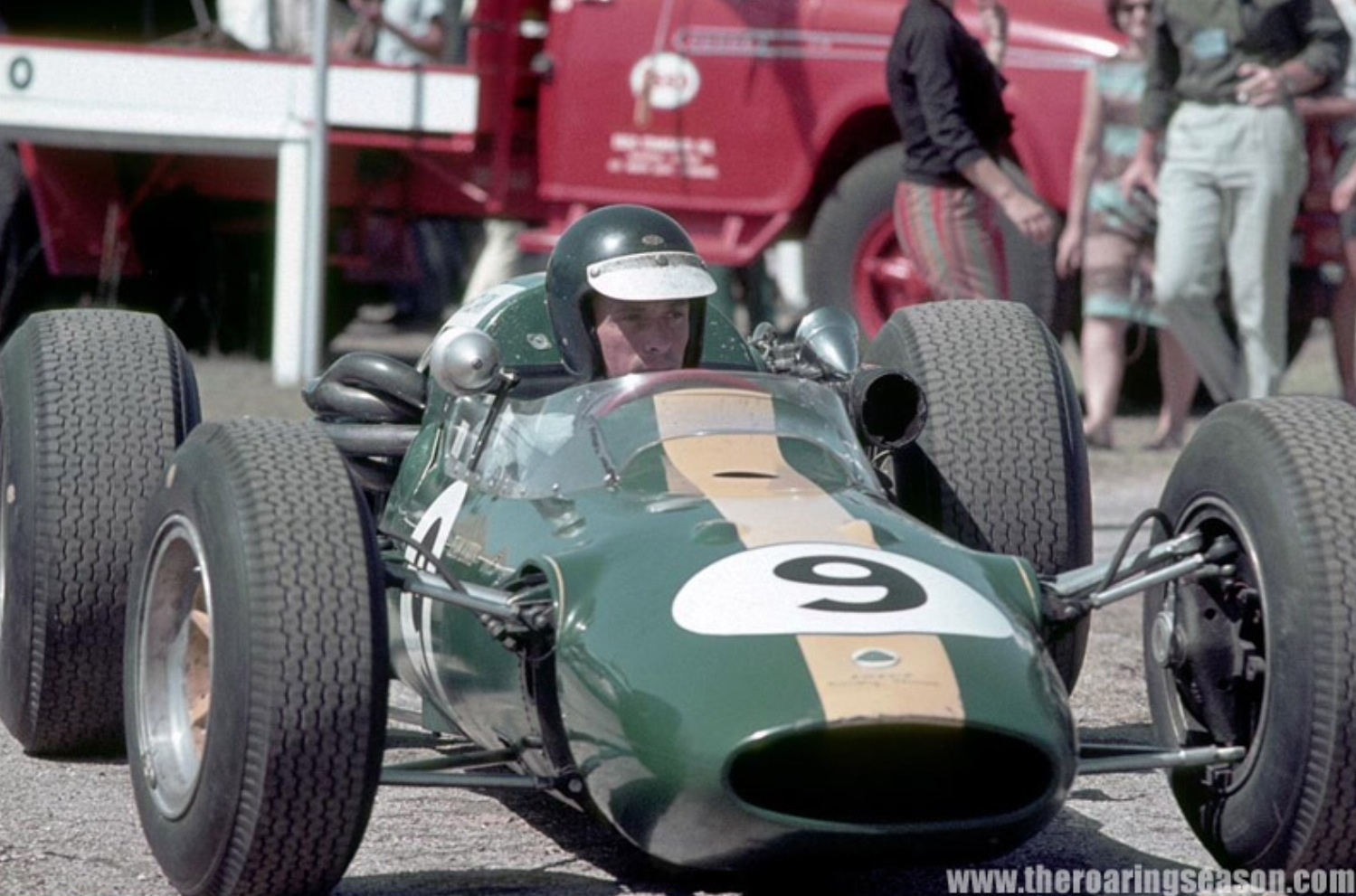
Kiwi enthusiast Milan Fistonic took some marvellous photos at the event which are posted on Steve Holmes ‘The Roaring Season’ website, check it out if you have not, it’s a favourite of mine. They are paddock shots which ooze atmosphere- Milan focuses mainly on local boy Bruce McLaren and Clark, they are magic shots which I hope you enjoy. This account of the weekend draws heavily on the sergent.com race report. It is another ripper site I always use as my Kiwi reference source.

Start of the 1965 NZ GP at Pukekohe, winner Hill on the outside, Clark in the middle and Lex Davison on the inside- Brabham BT11A, Lotus 32B and Brabham BT4 all Coventry Climax FPF powered (unattributed)

The 1965 Tasman series commenced the week before Levin with the New Zealand Grand Prix at Pukekohe. Graham Hill took a great win in David McKay’s new BT11A, straight out of the box, from the equally new Alec Mildren BT11A driven by Frank Gardner and Jim Palmer’s year old BT7A. How about that, Brabham Intercontinental cars from first to third places, with Jack not driving any of them!

Ron Tauranac’s first in a series of three very successful Coventry Climax engined cars, Tauranac tagged them as ‘IC’ for ‘Intercontinental’, was the 1962 BT4, based on that years BT3 F1 FWMV Coventry Climax 1.5 litre V8 engined car.

Jack raced the first of these in the 1962 Australian Grand Prix at Caversham, Western Australia, having a great dice with Bruce McLaren’s Cooper T62 until a back-marker took him out late in the race. This was followed by the 1964 BT7A and the 1965 BT11A.

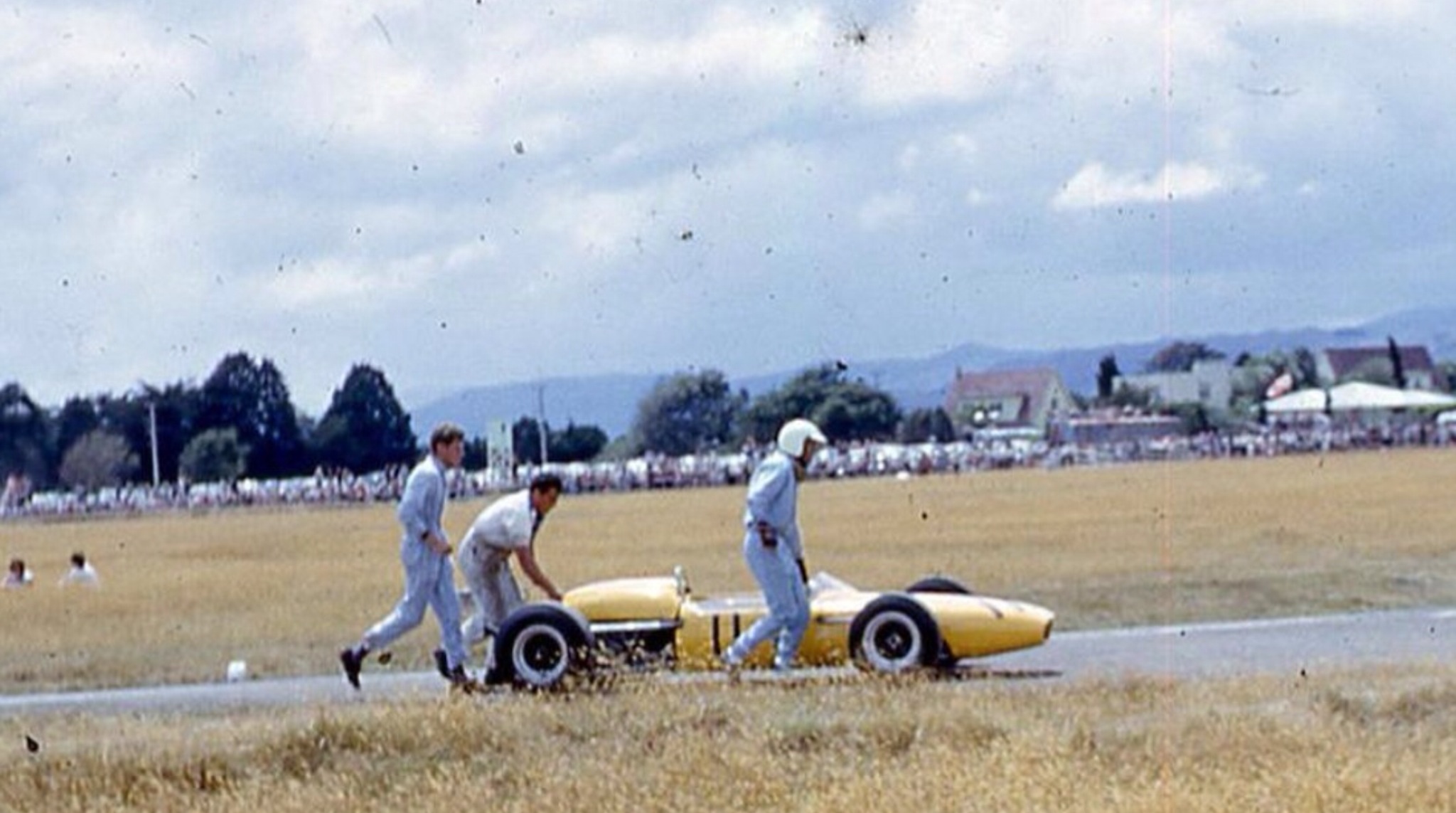
Frank Gardner’s Mildren Brabham BT11A Climax being pushed onto the grid. The lanky chap at the back is Glenn Abbey, long time Mildren and Kevin Bartlett mechanic (Fistonic)

The BT11A’s were phenomenally successful in both Australasia and South Africa, winning lots of races and championships not least the 1966/7 Australian Gold Star Championship for Spencer Martin in the very same chassis raced by Graham Hill to victory at Pukekohe.

The cars were utterly conventional, simple and oh-so-fast spaceframe chassis cars with outboard wishbone suspension out the front and outboard multi-link at the rear- single top link, inverted lower wishbone, twin radius rods and coil springs with Armstrong shocks. Like all customer Brabhams they went like the clappers straight out of the box as the base suspension setup was done on circuit by Jack’s ‘highly tuned arse’. Many championships were won by Brabham customers not straying too far from factory suspension settings!

After the NZ GP the Tasman circus upped sticks from Pukekohe and drove the 500 km from the North of New Zealand’s North Island to its South, not too far from Wellington. Levin is now a town of about 20,000 people, then it would have been less than half that, and services the local rural and light manufacturing sectors.

Bruce, Ray Stone in blue and Wally Willmott? Cooper T79 (Fistonic)

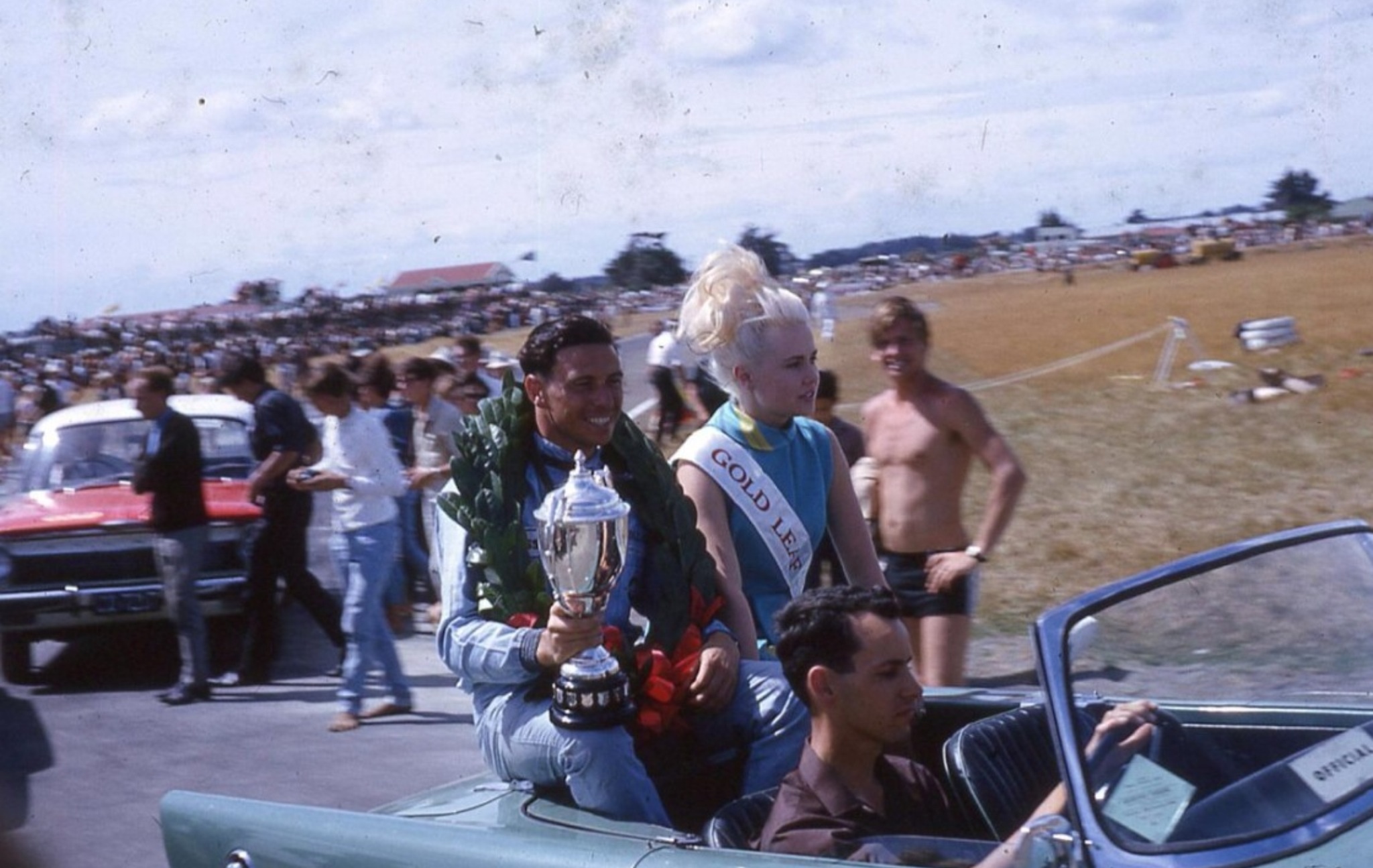
Jim Clark quickly got dialled in to his new Lotus 32B and down to business, opening his Tasman account by winning the Levin Motor Racing Club’s 30.8-mile ‘Gold Leaf International Trophy’ at fractionally more than 76.6 mph.

The Flying Scotsman cut out the twenty-eight laps in fine style in 24 min. 5.9 sec and put in his seventh lap in 49.9 sec. In 1964 Denny Hulme (2.5 Brabham-Climax) had set records of 24 min 36.8 sec and 50.3 sec in this event. Repeating their NZGP form, Brabham-Climax conductors Frank Gardner and Jim Palmer, filled second and third spots, while next in line were the Bruce McLaren Motor Racing Team 2.5 Cooper-Climaxes of Phil Hill, T70 and McLaren, T79.

Graham Hill, Lex Davison and Arnold Glass shipped their cars to Australia after the NZ Grand Prix. Wanganui driver, and later multiple Kiwi Champion, 1970 Tasman Champion and winner of many Asian Grands Prix, Graeme Lawrence had at last got hold of his Brabham BT6 which was making its first appearance at Levin. As noted above Brabham was having a Christmas break and did not join the series until the first Australian round at Sydney’s Warwick Farm in mid-February.

Levin is a tight, twisty and bumpy circuit. Newcomers Clark and Hill quickly had the 1.1-mile track sorted. Clark’s qualifying lap was a 49.4 whilst Phil Hill managed 50 sec, the same time as his team leader McLaren.
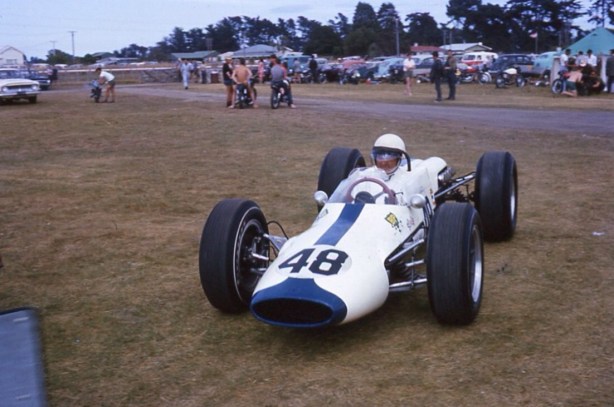
Phil Hill aboard the updated Cooper T70 Climax raced by Tim Mayer and Bruce McLaren in 1964. Compare and contrast with the ’65 model T79 below (Fistonic)

Bruce had a bitter-sweet 1964 Tasman Series. He won the championship in one of two Cooper T70’s he and his Kiwi mechanic Wally Willmott built at the Cooper Surbiton works.

These cars, raced by Bruce McLaren Motor Racing, are generally acknowledged as the first McLarens, built as they were in a corner of the Cooper factory to McLaren’s design. The second car was raced by American ‘coming man’ Tim Mayer with great speed and skill until he made a mistake on the daunting, fast, unforgiving Longford road circuit in Tasmania which took the young drivers life.

The undamaged T70 was updated during the winter to be raced by 1961 F1 World Champion Phil Hill with Bruce racing a new chassis, an evolved T70 designated T79, a spaceframe chassis was again used. The main difference between the cars were inboard front suspension on the T79 whereas the older T70 was outboard. The T79 used a nice, reliable but then new Hewland gearbox whereas the T70’s used a Colotti in one chassis and a Cooper/Citroen CS5 in the other. I wrote an article about Tim Mayer a while back, read it by following the link at the bottom of the page for details of the T70 design rather than repeat it all again here.

Hill P had a terrific Tasman which was a tonic for him as his single-seater career had stalled somewhat since his F1 title winning year. 1962 was a shocker for him with Ferrari who had failed to develop the 156,1963 in an ATS was far worse and his drives for Cooper reflected the fact that design wise, their cars were becoming outdated. If there was any doubt about Hills single-seater speed, he proved he ‘cut the mustard’ aboard a competitive year old car in the ’65 Tasman.
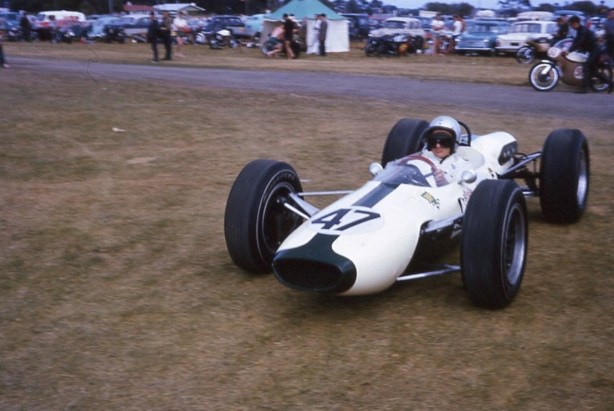
Bruce McLaren aboard his Cooper T79 Climax in the Levin paddock (Fistonic)

The Mayer/McLaren/Hill Cooper T70 Climax raced by all three drivers, originally carrying chassis plate ‘FL-1-64’, re-plated by McLaren prior to the ’65 Tasman to ‘FL-2-64’ passed through the hands of Bill Patterson for driver John McDonald, Don O’Sullivan and others before being acquired by Richard Berryman in 1974. The car was eventually beautifully restored by his son Adam in Melbourne, who retains and races it. The T79 was sold after the Tasman to John Love in South Africa who won many races in it before it later returned to the UK, it too still exists.

Back to Levin practice and qualifying…

Levis with the 1.5 Brabham BT6 Ford was in the groove with a brilliant 51.1 sec, his time put all the 2.5 drivers to shame. Palmer could only manage 51.7 sec in his Brabham BT7A, Grant 51.9 sec in his BT4, Abernethy did 52.2 in his Cooper T66 and Gardner was credited with 53.5 sec in Alec Mildren’s BT11A. Grant was a late arrival. His Brabham-Climax had undergone a major engine rebuild since the discovery of a cracked crankshaft on the eve of the Grand Prix. Second quickest 1.5 was Buchanan’s Brabham BT6 Ford with 52.0 sec. Qualifying times were academic in the sense that grid positions for the feature race were decided on heat results.

Jim Clark again chillin at Levin ’65 (Fistonic)

The eight-lap heat on raceday morning contained all overseas drivers and favoured locals.

‘Clark, sharing the front row with McLaren and Hill, jumped into the lead from the start and remained there to the finish. Hill, McLaren, Palmer and Grant settled into the next four spots after Gardner had dropped out with distributor trouble. The contest was enlivened a little by Palmer catching Grant napping on the seventh lap and assuming fourth place. Clark won in 6 min 49.8 sec and set a new lap record of 49.9 sec’ sergent.com reports.

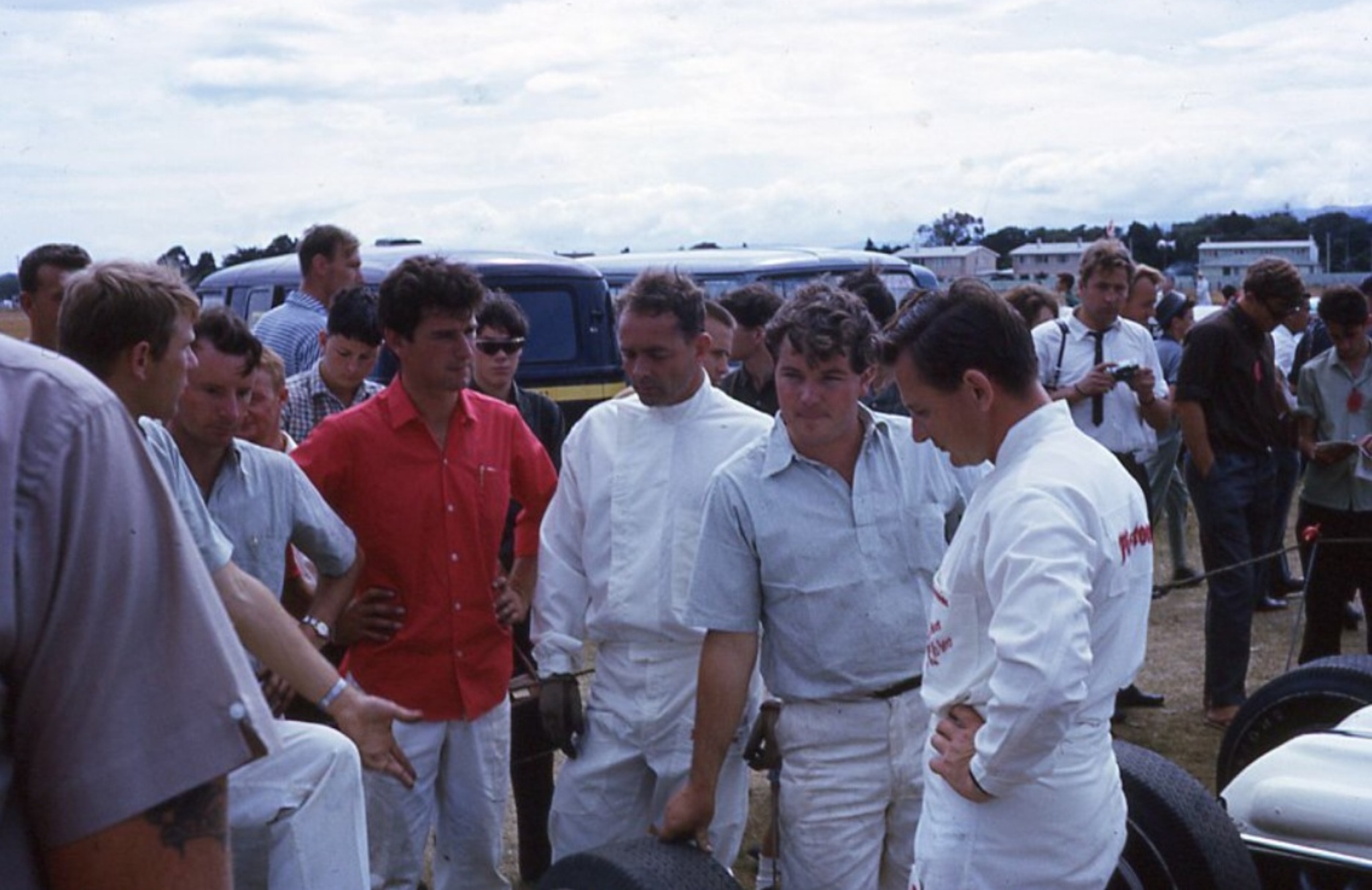
Council of war- Phil Hill in the pristine white race suit with Bruce front and centre, his allegiance to Firestone clear. Who are the other dudes? (Fistonic)

Levis had things all his own way in the second heat, winning in 7 min 13.5 sec, with Andy Buchanan, also in a 1.5 Brabham BT6 Ford, next. Third and fourth were Red Dawson Cooper T53 Climax 2.5 and John Riley in a Lotus 18/21 Climax 2.5. The situation was confused by Gardner who, anxious to make sure all was well with his car, was permitted to use the heat as a test run and took the lead in the last two laps.

Before the title race there was some feverish work in the Palmer pit to replace a cracked universal joint in his Brabham BT7A Climax. In a drama filled day for the team, an hour before the race was due to start, another close inspection revealed a hairline crack in a half-shaft. A replacement was found and fitted minutes before the cars were gridded.
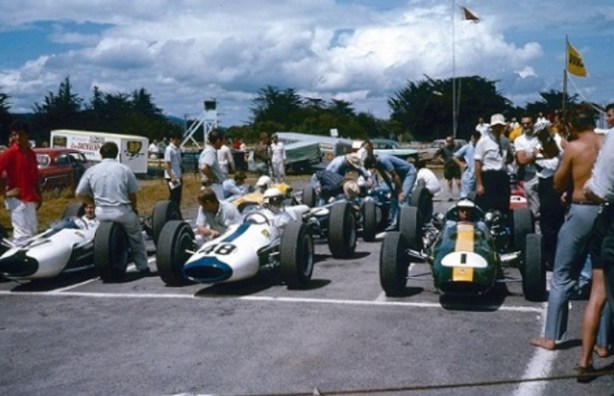
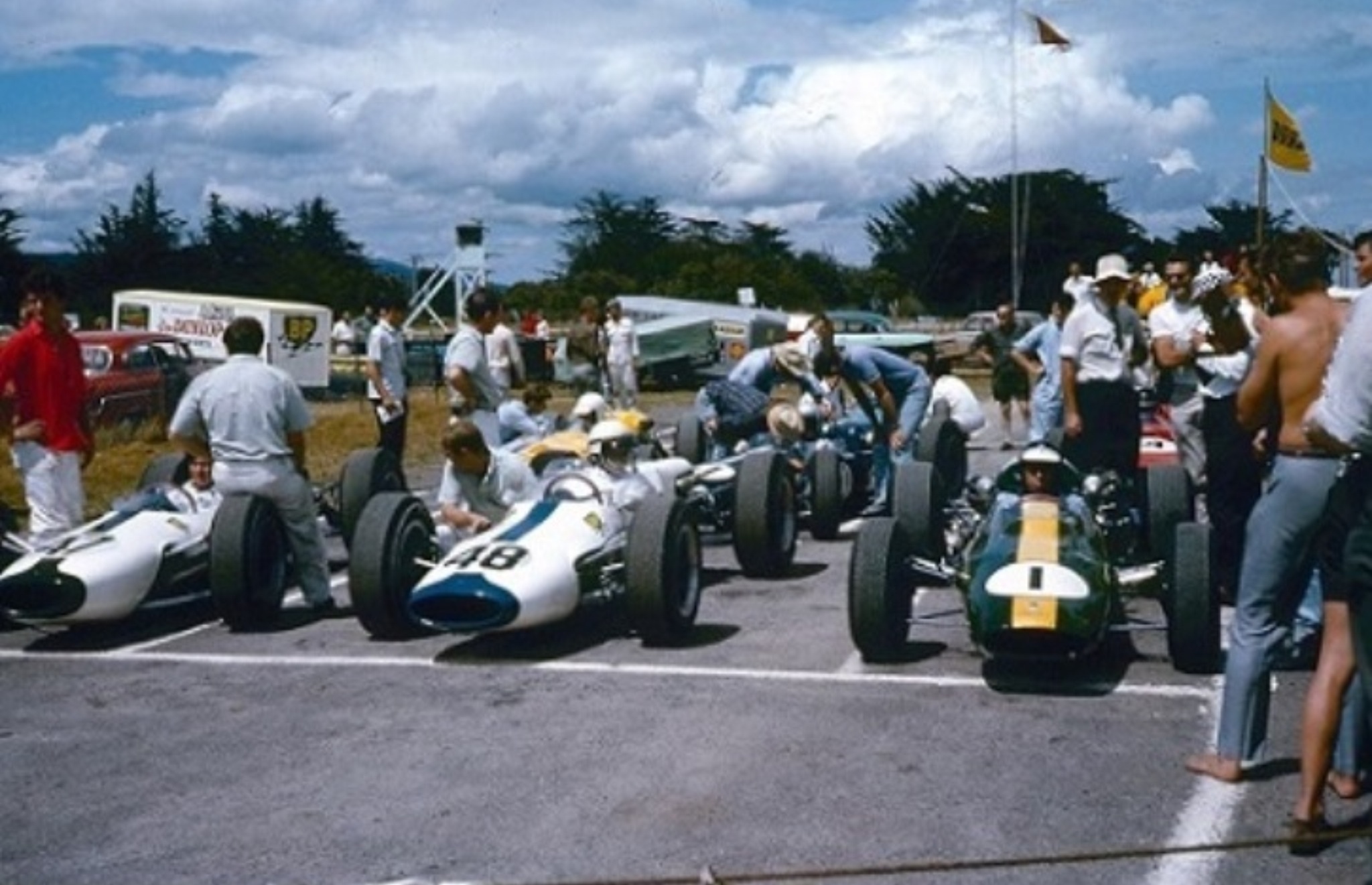
Dummy grid or form up area prior to the Levin International- Clark on pole then McLaren and Hill, the yellow of Gardner on row 2 (Fistonic)

Clark, Lotus 32B had pole position in the main event with Hill, Cooper T70 and McLaren, Cooper T79 outside him.

In rows of three, the rest of the field comprised Palmer, Brabham BT7A, Grant, Brabham BT4, Gardner, Brabham BT11A; Levis, Brabham BT6 Ford 1.5, Buchanan, Brabham BT6 Ford 1.5, Abernethy  Cooper T66; Dawson, Cooper T53, Thomasen, Brabham BT4, Brabham BT4 Riley; Flowers, Lola Mk4A, Smith, Lotus 22 Ford 1.5 Lawrence, Brabham BT6 Ford 1.5; and at the back Hollier, Lotus 20B Ford 1.5. As the cars were forming on the grid, Abernethy could not select a gear and he had to abort the start’.

‘Clark made a good start with Grant, Hill and McLaren right with him. To the elation of the partisan crowd, Grant proceeded to take McLaren and Hill on braking into the hairpin. When they came round the first time the leaders were Clark, Grant, Phil Hill, McLaren, Palmer, Gardner and Levis

A 51.6 sec second lap gave Clark a 3 sec lead over Grant. In his fourth lap Palmer took McLaren and in another two laps had moved to third place ahead of Hill. Clark held on to his lead over Grant. There was then a gap of 3 sec to Palmer, with Hill and Gardner next in line. McLaren, probably to his embarrassment, had the 1.5 drivers Levis and Buchanan looming large in his mirrors.

Clark on the way to Levin International victory 1965, Lotus 32B Climax (sergent.com)

The pattern changed dramatically during the tenth lap. Grant tried to correct a slide at Cabbage-Tree Bend, dropped a rear wheel into the rough and spun off the course to lose all chance in such a short race. Palmer took second spot, but not for long. Gardner in the next three laps bridged the gap to take over second place just 5 sec behind Clark. Next in line were Hill, McLaren and Levis. Flowers was out with transmission failure in the troublesome Lola on lap 14.

Those opening laps had been fast and furious. In their sixth lap Grant and Gardner had returned 50.6 sec in the midst of heavy traffic. A lap later Clark equaled his morning record of 49.9 sec.

As the race reached the last stages, Clark continued to circulate in a steady 51 sec. Gardner in two laps reduced Clark’s advantage from 11 sec to 9 sec while Palmer closed up to be 2 sec behind the Australian, but Clark was given the ‘hurry’ signal and moved out again with effortless ease to come home 11.3 sec ahead of Gardner with Palmer 4.7 sec further back. Thomasen retired with only a handful of laps remaining.’

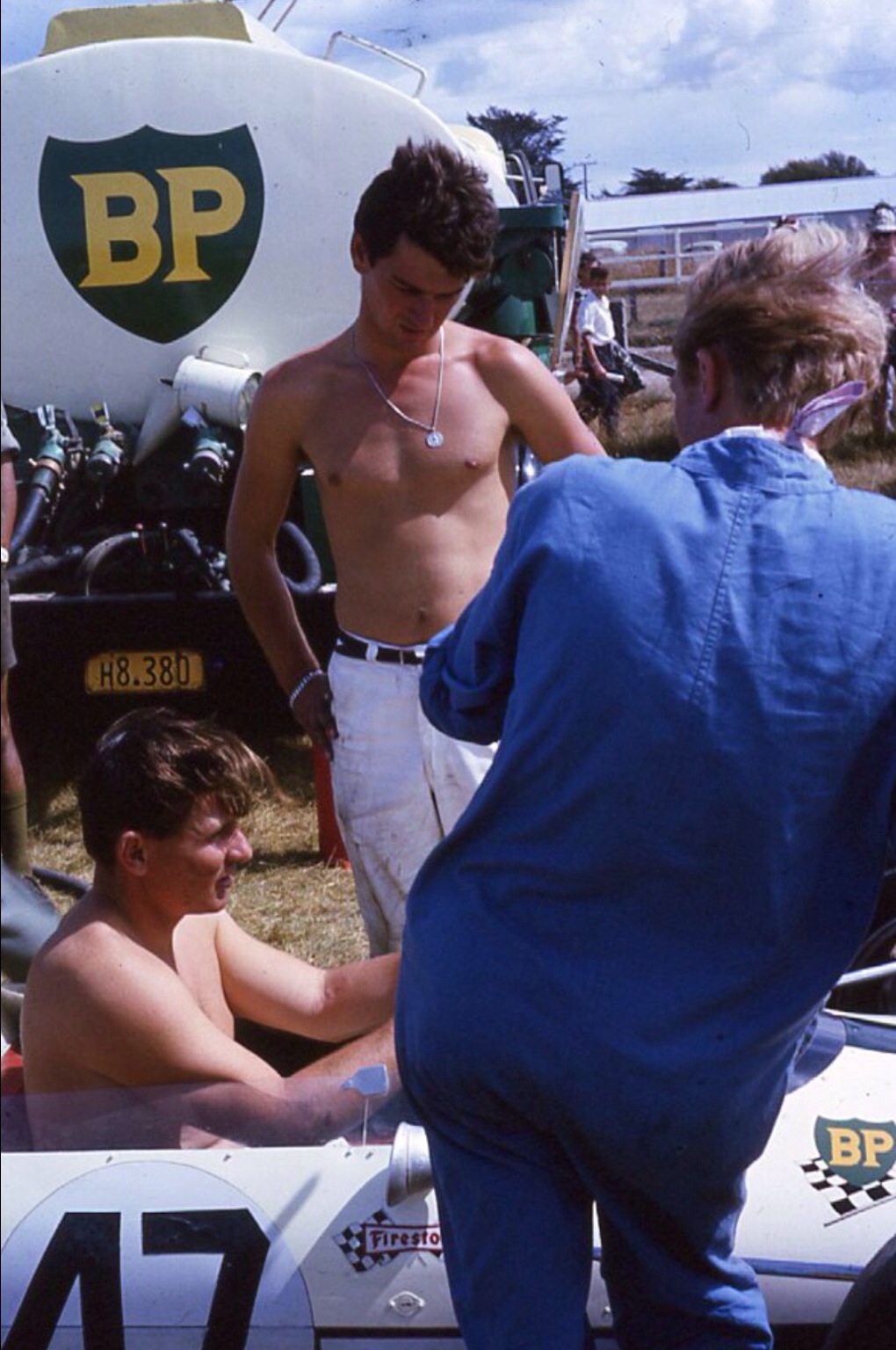
BP all the way, Bruce and Ray Stone in blue fuelling up the T79. Front on shot shows the top rocker/inboard front suspension of the car (Fistonic)

Bibliography…

sergent.com, oldracingcars.com

Cooper T70/Tim Mayer Article Link…

https://primotipo.com/?s=tim+mayer

Photo Credits…

Milan Fistonic, Peter Mellor, The Roaring Season

Tailpiece: Winners are grinners, the first of many such occasions for Jim Clark in 1965 at Levin…

(Fistonic)

Finito…


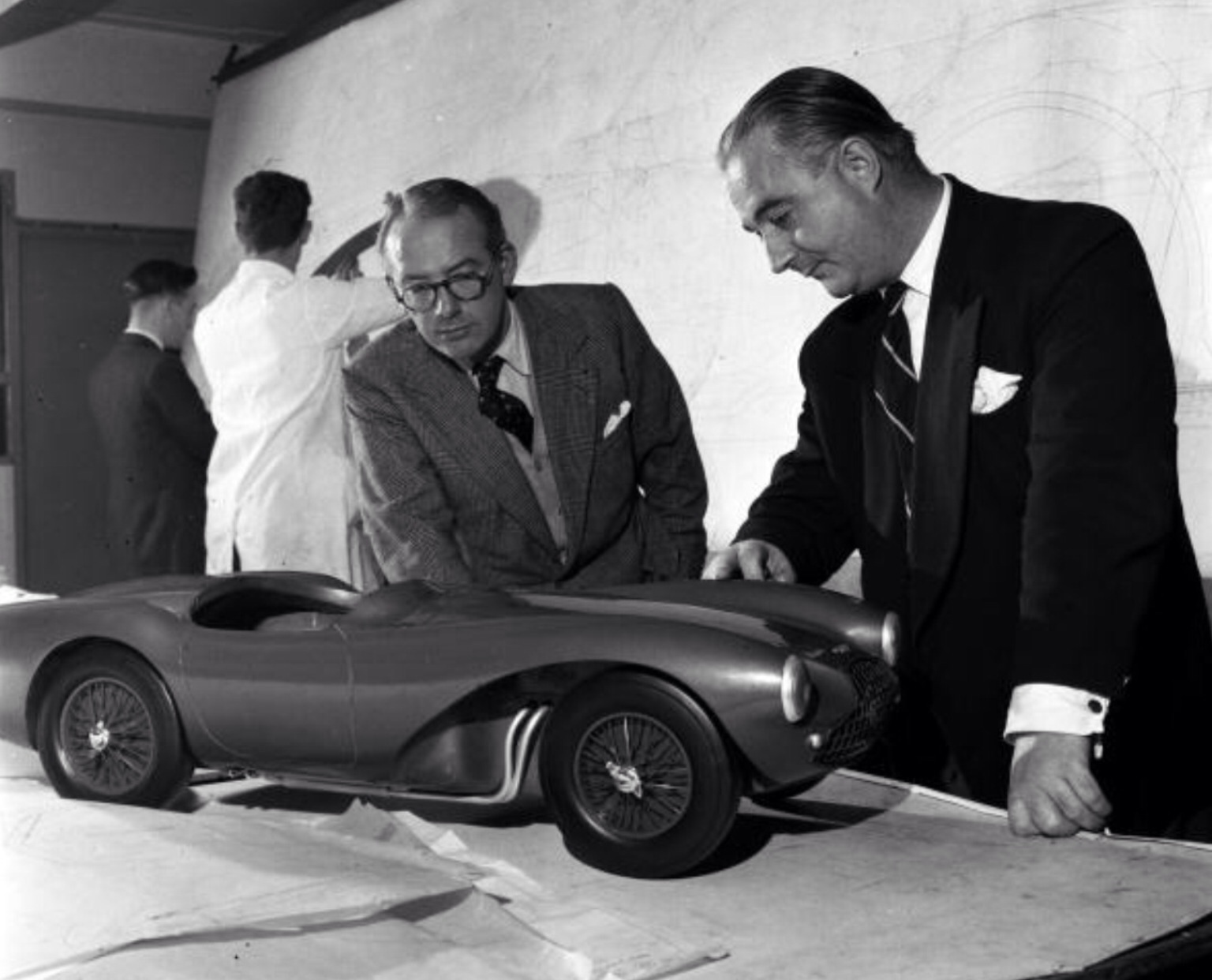
Frank Feeley, Designer (right) and Aston Martin’s owner David Brown with a clay model of Feeley’s Aston Martin DB3S in the Feltham design studio, 1954…

It would be interesting to know the occasion of this factory PR shot, the DB3S first appeared at Charterhall in May 1953 so it seems unlikely it was about that model Aston. The clay model is also notable, in comparison with the final design, for the distance behind the rear wheel arch which is shorter on the production car than the clay. The DB3 was much more slab-sider than its younger sibling too wasn’t it? The cutaway front arch, such an outstanding feature of the DB3S design is clearly shown. The rendering on the wall behind the two fellows is also intriguing, I wonder what it is?

I wrote an article about one of Aston’s sexiest models, the DB3S, not so long ago, click here to read it;

David McKay’s Aston Martin DB3S’s…

Two of Frank Feeley’s designs at Le Mans in 1949. #29 DB1 driven by Lawrie/Parker to 10th and #28 DB2 driven by Marechal/Mathieson DNF. Race won by the Chinetti/Thomson/Selsdon Ferrari 166MM (unattributed)

Feeley is said by some to be a forgotten man of Aston Martin…

 It seems odd really as he shaped all post-war Astons up to but excluding the DB4, most notably the DB3 and DB3S racers.

Feeley, whose father also worked there, joined Lagonda as a teenager at 14, initially he was the office boy under Arthur Thatcher, the assistant works manager.

By 25 he was their ‘Body Designer’, succeeding Walter Buckingham. The commercial viability of Lagonda as an independent firm was weakened when Briggs Motor Bodies exited an agreement to build Lagonda’s bodies to take on more profitable and larger deals with Jowett and Ford. Lagonda had closed their own body shop, with times being tight, Feeley and WO Bentley were shown the door.

David Brown bought Aston Martin, famously spotting a ‘For Sale’ advertisement in ‘The Times’, he paid the princely sum of twenty thousand- five hundred pounds for the business. Shortly thereafter he also bought Lagonda, creating, you guessed it, Aston Martin Lagonda. Needing a body man Brown approached Feeley who took on the role despite some misgivings.

Aston DB2 in 1949. It is the #28 car in the 1949 Le Mans photo above when first built. The car was without brakes for a long period of the race, Pierre Marechal crashed at White House on Sunday, then rolled with the unfortunate driver dying of his injuries the following day. ‘LMA/49/1’ was scrapped, the engine transferred into a DB1 (unattributed)

Feeley’s first work for the nascent AML was a roofless, rebodied Atom which ‘…was a sweeping open tourer derived from his pre-war ideas to modernise the Lagonda V12 and featured a new design of radiator grille. This had a vertically slatted centre section based on the original Aston radiator and a pair of low side grilles flanking it. Fifteen were built with the car retrospectively called the DB1’.
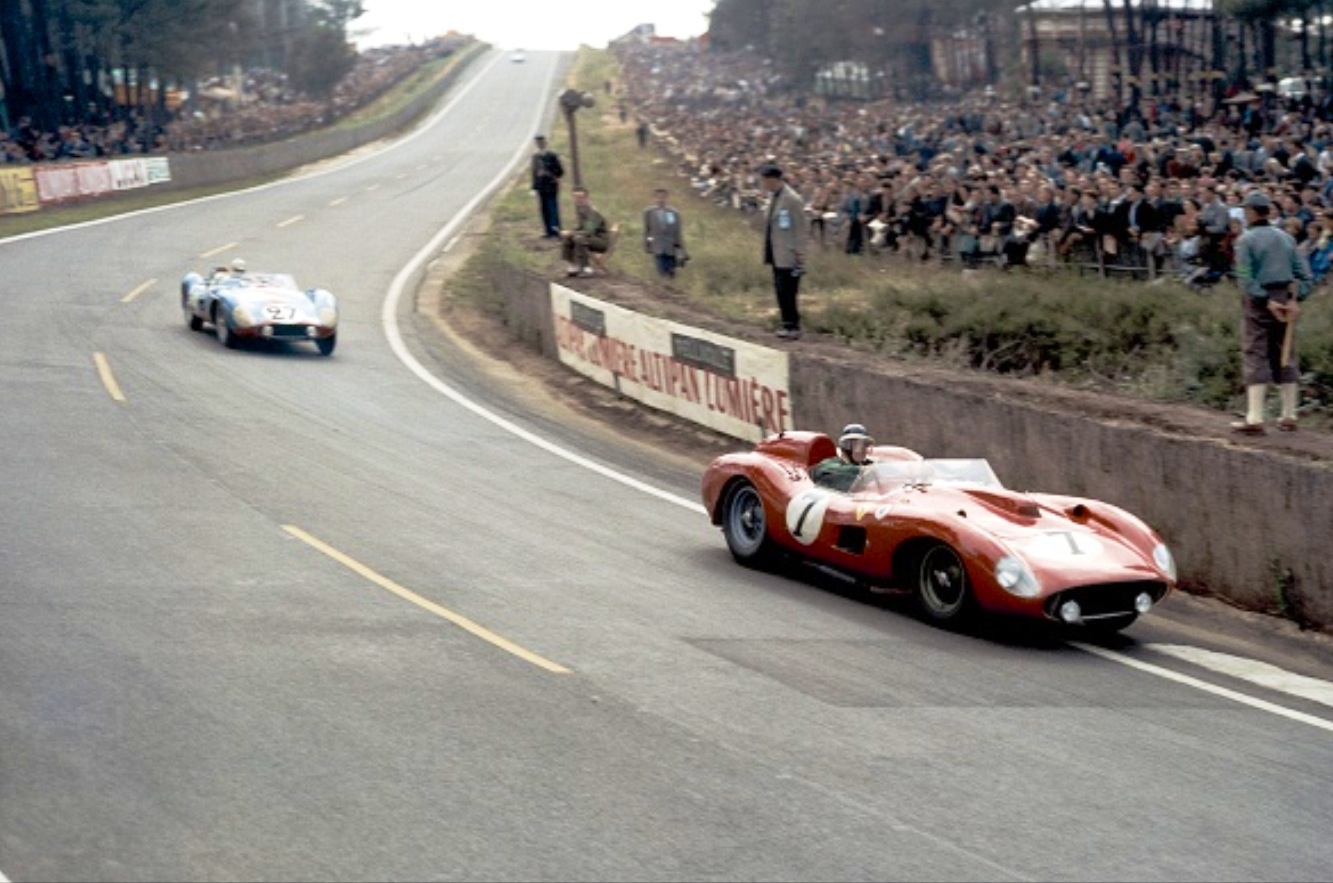
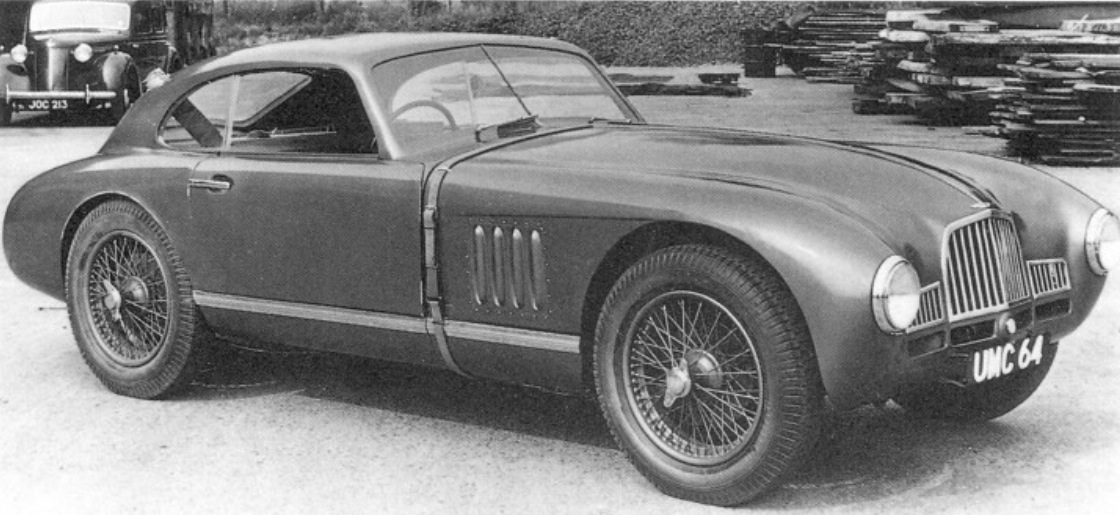
No doubt Cisitalia and Ferrari influenced the shape of the DB2 which was built on a shortened version of the Claude Hill designed ladder frame chassis- the car was created quickly to run at Le Mans in 1949. ‘We drew the chassis in and I immediately drew up the whole thing around it, the whole shape. Their was no time to change my mind once I had done it’ Feeley recalled.

The DB2 continued the DB1’s three-piece grille form, in a simplified one piece design, which set the template for the Aston grille shape which continues today.

David McKay’s first Aston DB3S ‘102’ in the leafy Sydney North Shore suburbs in the mid-fifties (pallas1970)

The DB3S is favourite car for so many of us such is its purity of curvaceous line. Cutaway front arches were its innovation, the practical element of this approach was to draw heat out of the engine bay. ‘Feeley had got fed up with the chassis engineers never knowing where they were going to put the exhaust pipes, so he decided it for them by running the pipes through the cutaways’. By this stage Frank’s duties extended to managing the body-builders, initially Mulliners of Birmingham and later Tickford in Newport Pagnell, a David Brown acquisition.

But times were changing, John Wyer was instrumental in the rejection of Feeley’s proposal for the coming DB4 in favour of Touring of Milan. This, and the concentration of activity at Newport Pagnell, where the DB4 was to be built, rather than at Feltham near Feeley’s home signalled it was time to leave. He worked in the aircraft industry and continued to live in his native Staines until his death in 1985.

In terms of contribution post-war Feeley is up there with Astons best- Claude Hill, Harold Beach, Ted Cutting, Tadek Marek, John Wyer and David Brown himself. Not a forgotten man at all me-thinks?

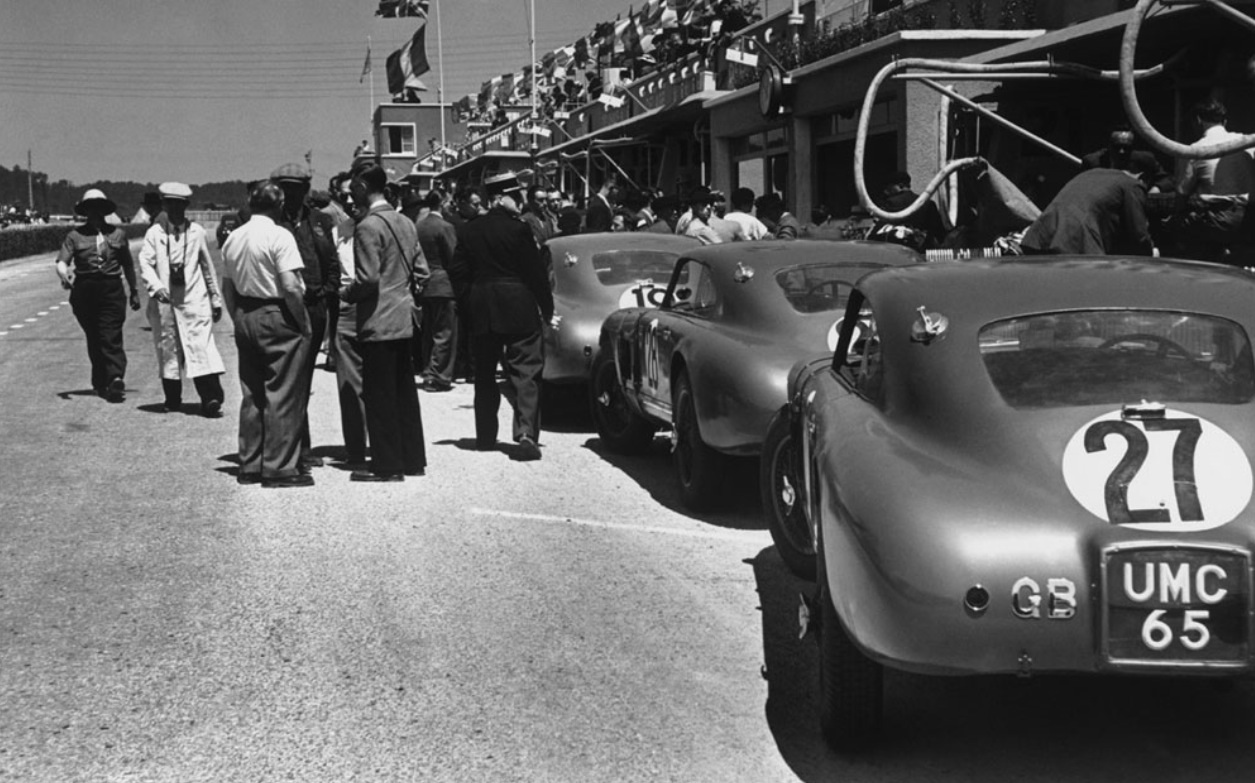
The works Aston’s before the off- Le Mans 1949: #27 is the Jones/Haines 7th placed DB2, the #28 DB2 in front of it, then the #19 Johnson/Brackenbury DB2, DNF water pump (unattributed)

Bibliography…

 Article by John Simister in ‘Vantage’ Magazine November 2014, ‘Aston Martin: The Racing Cars’ Anthony Pritchard

 Photo Credits…

 Getty Images, pallas1970

 Tailpiece: It’s a winner I think…


Graham Boulter’s race equipe completing a Bacchus Marsh pitstop enroute to Calder Raceway, Victoria, Australia circa 1968 or 1969…

Competitors can relate to this wherever you live on the planet- loading up your racer and hung-over, scaly mates and girlfriend and heading off to the track hoping the last minute fixes to your steed will last the rigours of the weekend away from home base.

Enthusiast racer Lee Nicholle identified the photograph on ‘The Nostalgia Forum’ which was taken at a ‘Golden Fleece’ servo at Bacchus Marsh, 60 kilometres from Melbourne on its western outskirts.

Oz enthusiasts of a certain age will well remember Golden Fleece as a brand of petroleum products and servo’s such as this one operated by Australian Company HC Sleigh since 1893. Caltex acquired the business in 1981.

The racer is a Holden FJ or ‘Humpy’, sports sedan. The tow car is the ‘Ducks Guts’ of General Motors Holdens range at the time- no less than an ‘HK’ Monaro GTS powered by the range-topping Chevrolet 327cid V8. One of these cars won the 1968 Bathurst 500 enduro driven by Bruce McPhee. The race was then run to ‘Series Production’ or unmodified road car rules. That the car is new is proved by the standard fitment ‘Dunlop Sovereign’ radial tyres. The other road cars in shot are a Vanguard and in the distant carpark an ‘FB’ Holden.

Finally, Lee notes that Boulter still races in ‘Historics’, has built a replica of this car as a ‘roadie’ and that the bare chested youth, now over 70 of course!, is John Reynolds who stayed close to racing as a supplier of Champion plugs into the 1990’s.

Cracker of a shot, it reminds me of my abysmal car preparation capabilities, unreliable mates, patient girlfriends and the racers breakfast of a Chico Roll and Coke on the fly, running late and being behind the eight-ball well before the meeting commenced!…

Credits…

Graham Boulter

Tailpiece: Bruce McPhee on the way to Bathurst 500 glory during the 1968 running of the Australian classic…

(unattributed)

Bruce McPhee started from pole in his HK Monaro GTS327 and won the race from the ‘works’ Holden Dealer Team similar car of Jim Palmer/Phil West and the Tony Roberts/Bob Watson HK GTS a lap adrift in 3rd

Finito…


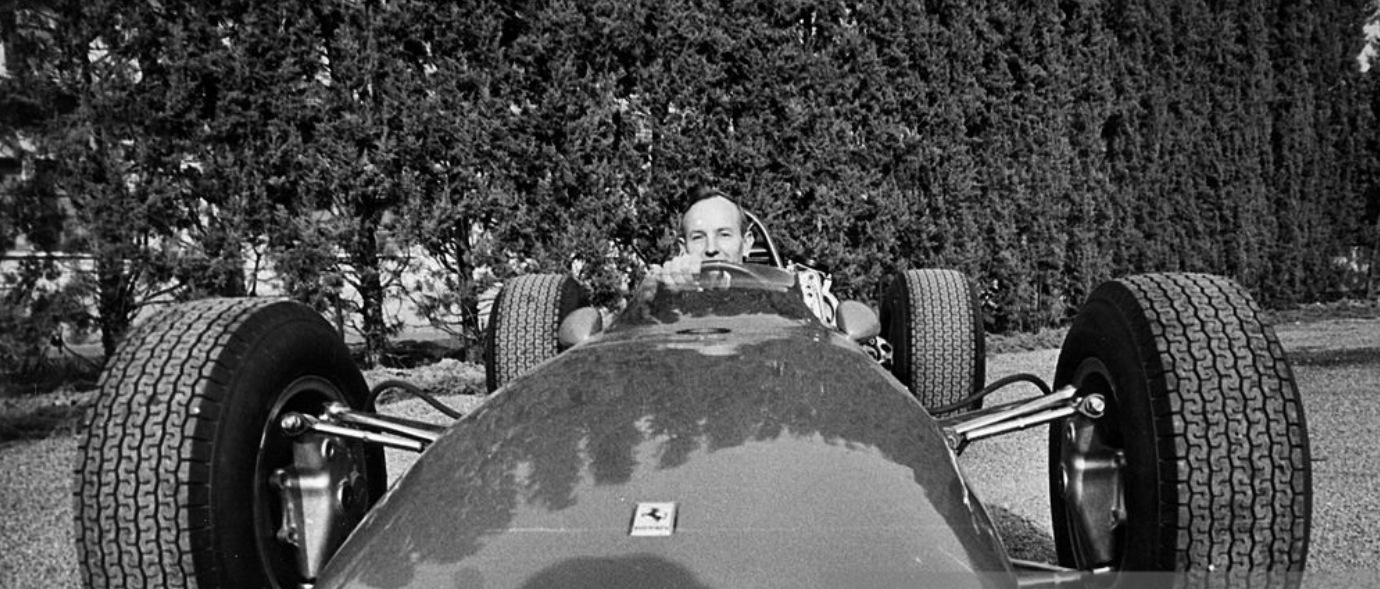
John Surtees poses with his Ferrari 312, the Scuderia’s 3 litre V12 new season and new formula contender, March 1966…

‘Big John’ is probably feeling fairly confident at this point, Ferrari seemed to be as well prepared as they had been for the last formula change from 2.5 to 1.5 litres in 1961. They took the title convincingly of course, Phil Hill won it in the Carlo Chiti designed ‘Sharknose’ 156 V6.

Coventry Climax had withdrawn as an engine provider at the end of 1965, other than some transitional support of Team Lotus with a couple of 2 litre FWMV V8’s to tide them over. Generally, 1966 was a year of transition and therefore of opportunity for those who started the season with a fast, reliable package, the Ferrari seemed just that.

Click on this link for my article on the 1966 Grand Prix season;

Winning the 1966 World F1 Championships: Brabham BT19 Repco…

surtees 2

‘Down Under’ Jack Brabham installed the first Oldsmobile F85 blocked Repco Brabham ‘RB620’ V8 into a year old Brabham chassis, BT19, built for the stillborn Coventry Climax Flat-16 engine and contested the Non-Championship South African GP at Kyalami in it on 1 January.

Repco then popped a 2.5 Tasman Formula RB620 V8 into BT19 for a couple of Tasman rounds, at Sandown Park and Longford, each time learning a little more about the engine and making it reliable.

Ferrari’s own 3 litre V12 was a trusty old warhorse which had served them well. It was a reliable Le Mans winning unit and more powerful than the Repco V8 but the car was heavy. Brabham’s BT19 was a light spaceframe and his 300 horses were stallions not geldings.

surtees 3

The first GP of the new F1, the 1966 XV Gran Premio di Siracusa was on 1 April, Surtees won it in a 312 from teammate Bandini’s Ferrari Dino 246. The only other ‘new’ F1’s were the Cooper T81 Maserati’s of Jo Siffert and Guy Ligier both of which failed to finish. So too did Brabham’s BT19 with a Repco failure.

On 14 May the teams met at Silverstone for the XVIII BRDC International Trophy which Brabham won from Surtees and Bonnier’s Cooper T81 Maser.

Game on!

Off to Monaco for the first Championship round on 22 May, Jackie Stewart’s BRM P261 took the race from Hill’s P261 both cars with 2 litre versions of the old P56 V8 1.5 litre F1 engine, and Bandini’s Dino. Surtees and Brabham were out on laps 16 and 17 respectively with transmission dramas.

Bandini’s use of the Dino which as the teams #1 Surtees should have been allowed to race, in Johns assessment the better of the two cars for the unique demands of Monaco, was one of many dramas within the team which famously resulted in the headstrong Brit telling Ferrari to ‘shove it’ costing both a title which they may well have taken.

surtess 4

Surtees joined Cooper for the balance of ’66 and made the cars sing but Jack was away and running taking the title he and Repco deserved but which perhaps should have been Maranello’s not Melbourne’s…

Click here for an interesting article on Surtees;

John Surtees: World Champion 50 Years Ago…1964

Ferrari 312 Specifications…

312 engine

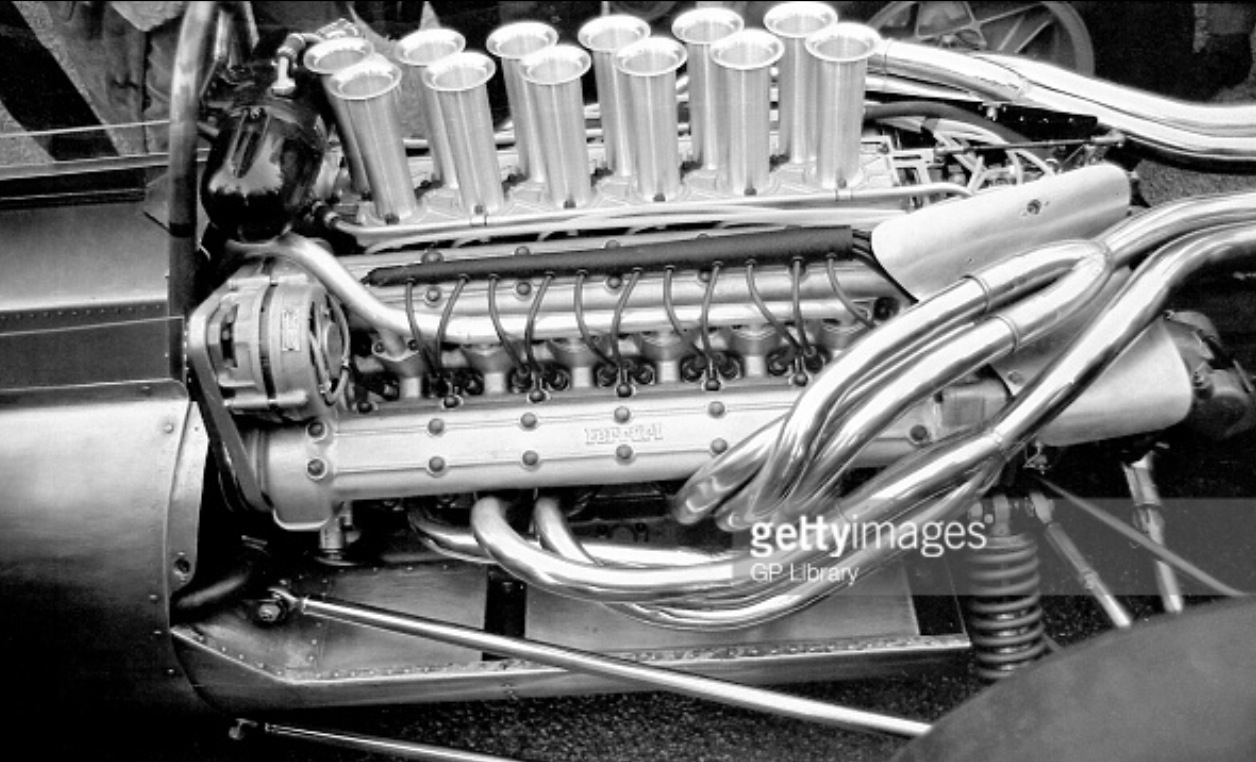
The heart of any Ferrari is its engine of course, and what a glorious thing the Tipo 218 unit was.

Cast in aluminium alloy with cast iron wet cylinder liners, the 60 degree V12 had dual chain driven overhead camshafts per bank operating 2 valves per cylinder. The compression ratio was 11.8:1, heads incorporated 2 plugs per cylinder which were fired, old school, by a battery of 4 coils. The engine was dry sumped, the cylinders fed by Lucas indirect fuel injection. Claimed output was circa 360bhp at 10,000rpm, the reality probably a little less than that.

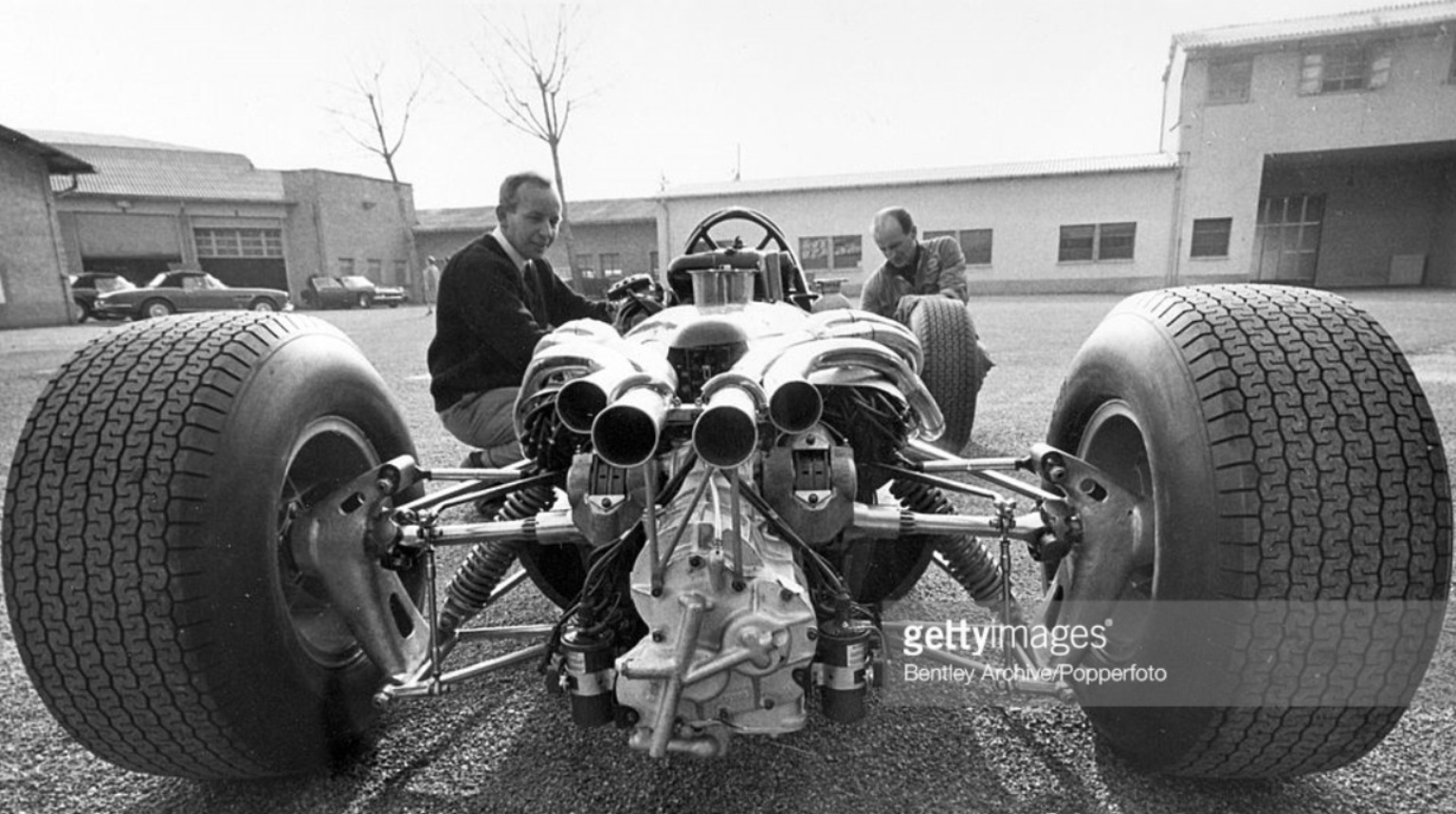
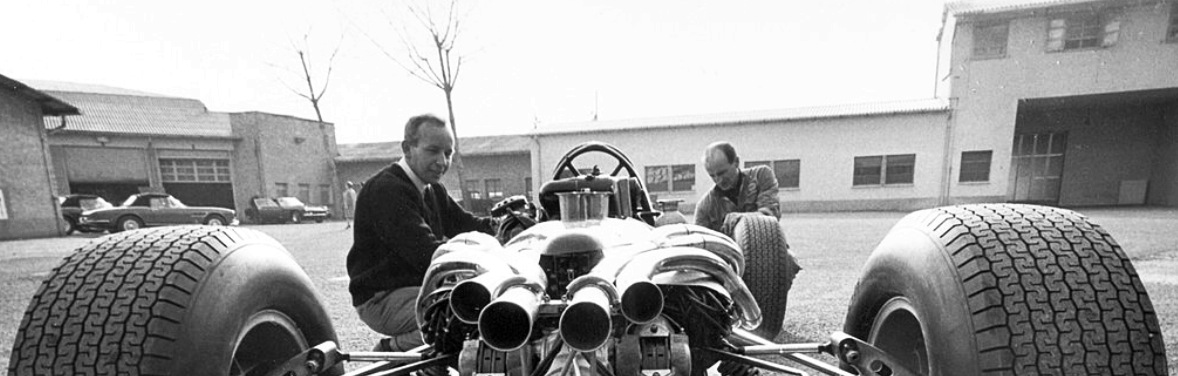
312 rear

The engine wasn’t really the cars weakness, it was probably more so the Tipo 589 chassis’s overall weight. Ferrari really didn’t get the hang of building a modern monocoque in the British idiom until they contracted John Thompson to build them one circa 1973!

Before then their tubs were sheet aluminium panels in a double wall riveted to a tubular steel structure. It was effective but heavy. The Ferrari’s suspension, as you can see is period typical; inboard at the front with a top rocker and lower wishbone and outboard at the rear with a single top link, inverted lower wishbone with forward facing radius rods for location. Uprights were cast magnesium with coil spring/shock units. Girling provided the disc brakes, which were inboard at the rear.

The Tipo 589 5 speed transaxle was sportscar derived, beefy and heavier than the DG300 Hewland box which became ‘de rigour’ in the Pommy cars of the era.

312 engine side

Shot above shows the beautiful standard of Ferrari fabrication and finish. Note the chassis, Lucas injection, twin-plug heads, alternator driven by the cams and wonderful exhausts which are fine examples of the pipe-benders art.

Credits: Popperfoto, GP Library, Reg Lancaster

Tailpiece: Why is that Simple Little Thing So Fast?…

image

Enzo Ferrari ponders the 1966 consistent speed of Jack’s BT19 Repco at Monza on September 3 1966, the ‘Wonder From Down-Under’ beating the might of the Europeans…

What is he thinking I wonder? ‘why is it so fast, its last years spaceframe chassis, engine from someone i’ve never heard of in Australia and the block is an American Oldsmobile…’

In fact the following day was a good one for the Scuderia, Ludovico Scarfiotti’s 312 V12 took the win from Mike Parkes similar car with Denny Hulme’s Brabham BT20 Repco third.


(Feisst)

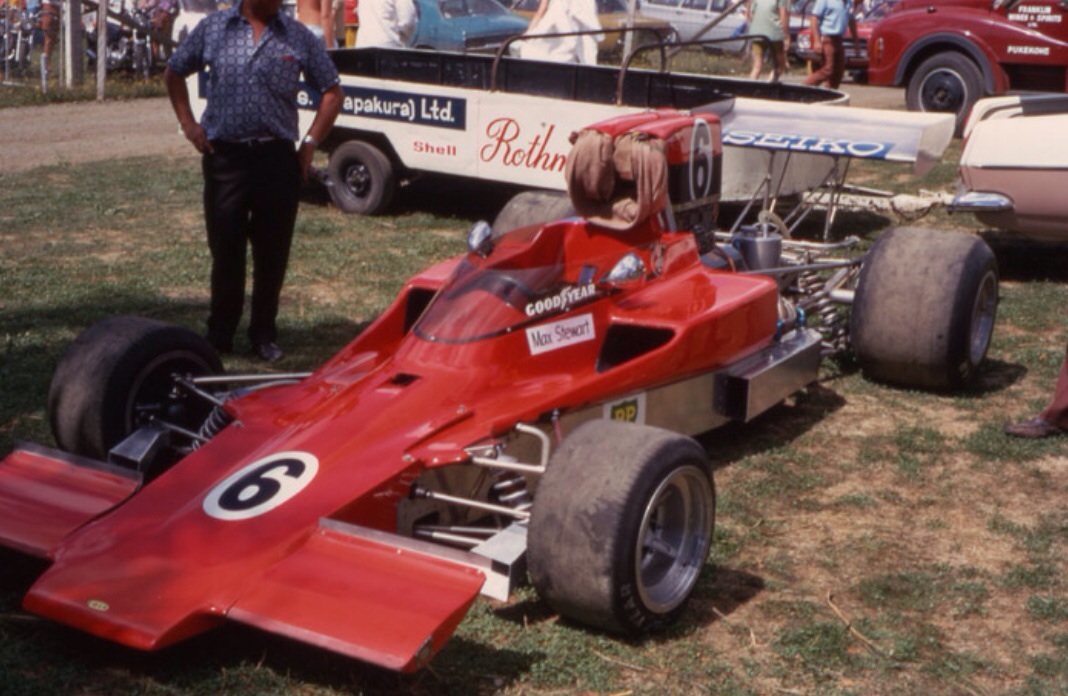
Max Stewart looks pretty happy aboard his pristine, new Elfin MR5 Repco, New Zealand Grand Prix, Pukekohe 1972…

He is talking to Elfin works mechanic Dale Koenneke, well known in Australia for his work with Elfins, John McCormack and later K&A Engineering, an enduring partnership in Adelaide he formed with Harry Aust.

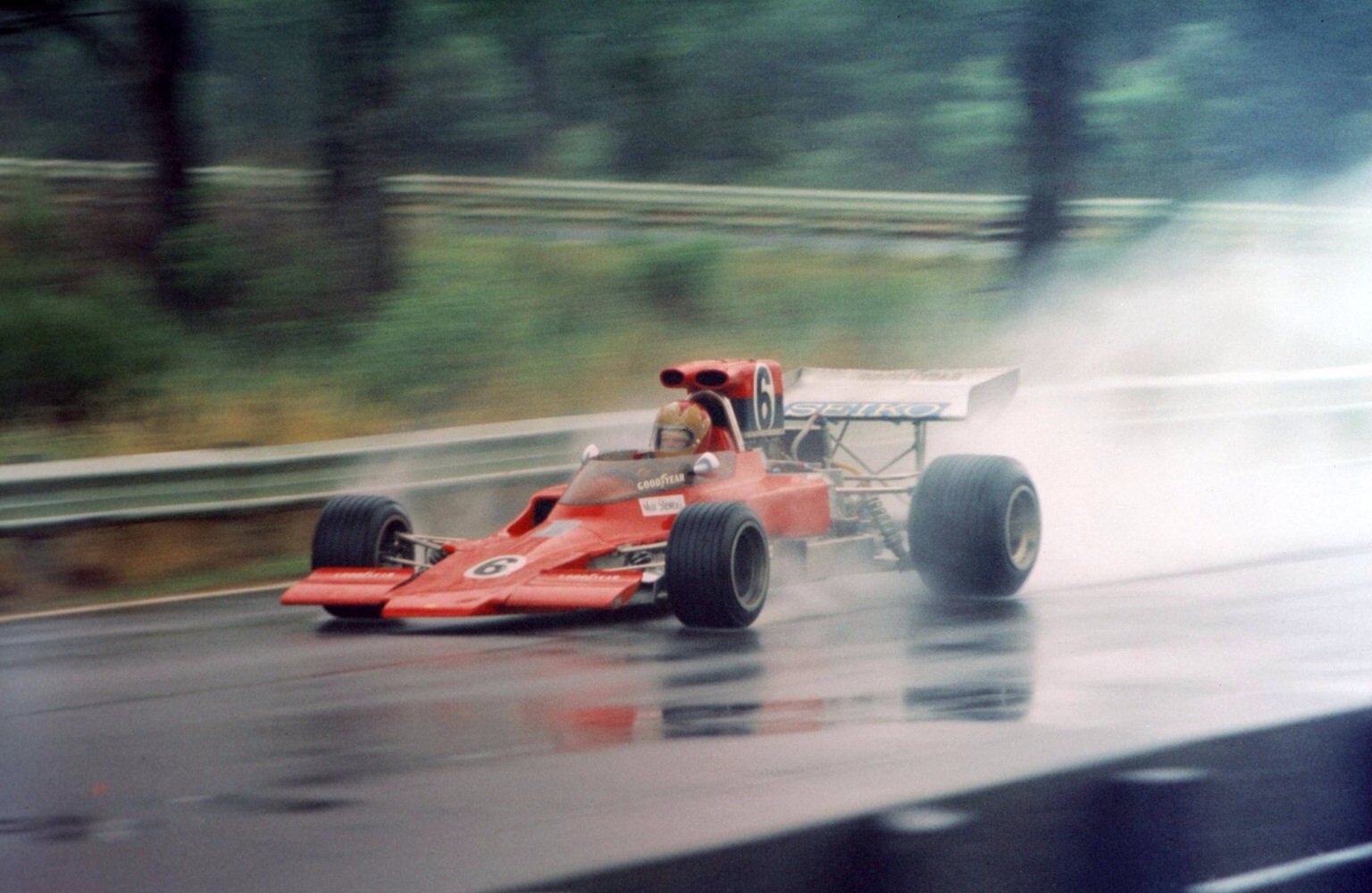
Max took to F5000 like a duck to water. His speed in 2 litre cars- he won the 1971 Australian Gold Star series in his trusty Mildren Waggott 2 litre was immediately transferred across to the more demanding 5 litre, 480bhp MR5. The Elfin wasn’t the ‘ducks guts’ of cars albeit John McCormack developed his car to a fine race, and championship winning pitch. But in 1972 Max was the fastest guy aboard an MR5- a quicker driver than Garrie Cooper, McCormack and John Walker. Very soon McCormack and Walker developed ultimate speed whereas Garrie- quick in a Tasman 2.5 car was never more than a journeyman in 5 litre single-seaters.

Stewart booting the MR5 around Warwick Farm during the 1972 ‘Hordern Trophy’ Gold Star round- 3rd behind Frank Matich’s Matich A50 Repco and Kevin Bartlett’s Lola T300 Chev (Aust Motor Racing Annual)

The MR5 looked superb. Even though Alec Mildren abandoned his race team at the end of 1970 Max kept the Mildren yellow team colour on his own cars- both the Mildren Waggott in 1971 and MR5 in 1972. He retained the Seiko and BP sponsorships too. What a sad day for Australian motor-racing it was when Alec finally pulled the pin. He was such a wonderful benefactor/entrant of Frank Gardner, Kevin Bartlett and Max Stewart and others, but those fellas in particular.

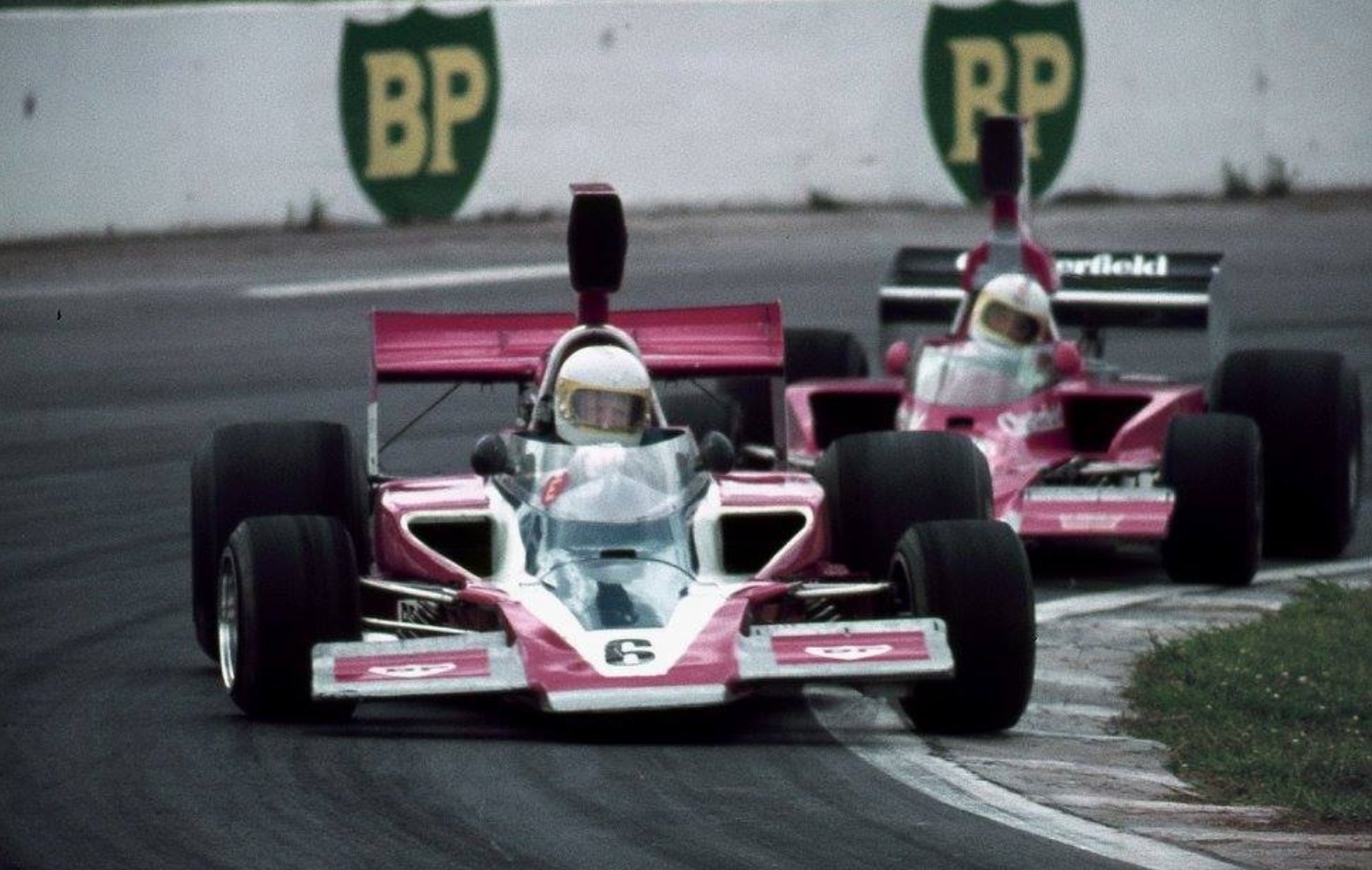
The MR5 wasn’t the ‘Silver Hammer’ at all for Max though. That car was undoubtedly the racer which followed, his ex-works Frank Gardner driven development prototype Lola T330 Chev ‘HU1’. It was the very first of that ‘category destroying’! series of dominant T330/332 Lolas. Max made HU1 sing for years and was always competitive with the T332’s. Both the T330 and MR5 ’5722’ are still in Australia, restored and exercised regularly.

Photo Credits…

Mike Feisst Collection on The Roaring Season, Neil Stratton, Australian Motor Racing Annual 1973, Tony Glenn

Tailpiece: Stewart swallowed by his Lola’s schnorkel, Pukekohe paddock 1973…

(Feisst)

Whilst Frank Gardner ‘retired’ from single-seater racing towards the end of the 1972 Tasman Series he continued to test openwheelers in his capacity as Lola’s development engineer/tester. He also raced this chassis, T330 ‘HU1’ once or twice in some end of season European F5000 Championship rounds in 1972 as he developed the production spec 1973 T330 for Eric Broadley.

HU1 was then sold to Max to run in the ’73 Tasman with Gardner on hand to advise the lanky Aussie on how to extract the best from the car, which he most certainly did. Here the car is in the Pukekohe paddock twelve months after the shot at this articles outset, both photos taken by the same photographer, Mike Feisst.

Max 5th aboard T330 HU1 during the final, sodden Warwick Farm Tasman in 1973. Steve Thompson won in a Chevron B24 Chev (Tony Glenn)

Postscript: The choice of Elfin/Repco/Lola/Chev…

Stewart didn’t have great reliability from the MR5 in either the ’72 Tasman or the Gold Star- his best results were a 5th and 4th at Pukekohe and Levin in the Tasman and two 3rd places in the Gold Star at his home NSW tracks of Oran Park and Warwick Farm.

The decision to go with Lola was an easy one. He had witnessed at first hand the speed of the T300’s driven by his mate Kevin Bartlett, Bob Muir and others and no doubt Frank Gardner was able to impress upon him the speed of the coming T330. Frank Matich was at the front of the Repco queue- FM was their works driver after all, with perhaps McCormack and Cooper getting the next best customer engines.

Lola Chev was an eminently sensible move which paid off in spades for Max albeit not initially! The story of Stewarts’ success in his Lola’s is one for another time, suffice it to say aboard T330 ‘HU1’ he won the 1974 Teretonga and Oran Park Tasman rounds, the Australian Gold Star Series winning five of the six rounds including the Australian Grand Prix at Oran Park. Quite a season for the popular boy from Orange.

Max Stewart ahead of great friend and rival Kevin Bartlett during the 1974 Gold Star round at Oran Park won by Max. Lola T330 from T332 . KB DNF, Max won from the T332’s of Warwick Brown and Graeme Lawrence (Stratton)

Finito…


hawthorn fazz

Mike Hawthorn dives his big Ferrari 335S into The Esses and past the smaller Ferrari 500TRC of Fernand Tavano and Jacques Peron early in the 1957 Le Mans 24 Hours…

Both cars failed to finish, Hawthorn shared the 335S with Luigi Musso, the cars engine cried enough on lap 56 and the 500TRC also had an engine problem withdrawing after the completion of 235 laps.

1957 was a D Type rout- the Ivor Bueb/Ron Flockhart D won from the similar cars of Lawrence/Sanderson, Lucas/Brousselet and Frere/Rouselle, all of which gave Ferrari something to think about! The best placed Ferrari was the 500 Testa Rossa driven by Lucien Bianchi and Georges Harris but it was 39 laps adrift of the winners.

Click on this link for an article about the Ferrari 335S and 1957 Mille Miglia;

Peter Collins: Mille Miglia 1957: Ferrari 335S…

Credit…

Klemantaski Collection

(Adelaide Observer)

A couple of years ago I wrote a long piece about the first car race in Australia, the article asserts that momentous event took place at Sandown Park, Melbourne on 12 March 1904. I’m in a constant search to find an earlier race

Whilst not a car race but a ‘demonstration or parade’, what seems to be the first event of this type in Australia was held at Adelaide Oval on Saturday 11 October 1902. More interesting is that the first claimed motor-cycle race in Australia took place on the same day.

The Adelaide meeting was promoted by the ‘League of Wheelmen’ a cycling organisation at no less a temple of sport than the wonderful, picturesque Adelaide Oval, not at all a venue I would have considered as one at which ‘motor racing’ took place.

Located in North Adelaide, Adelaide Oval is the best sporting venue in Australia. That my friends is a huge statement for a Melburnian member of the Melbourne Cricket Club, our ground is the Melbourne Cricket Ground. We Melburnians reckon the MCG is the best bit of sporting dirt on the planet, but good ole Adelaide Oval is better. It doesn’t win in terms of seating capacity, but the location, surroundings, vibe, the hill and scoreboard, the vista of trees towards St Peters Cathedral cannot be matched. And having seen a few stadiums around the world its ‘up there’ with the best globally in character and comfort if not capacity.

That Saturday the League of Wheelmen hosted a day of racing- cycling, motor car demonstrations and the new ‘sport of kings and millionaires’ as the Adelaide Advertiser put it- motor racing. The motor-cycle racing 5 mile event event was ‘the first motor race in Australia’ the paper reported.

The hallowed turf primarily used for cricket and football (Australian Rules) then incorporated a steeply banked track at its outer perimeter which was ideal for cycle racing and ‘admirably adapted for contests between motor cycles and for the establishment of records’ if not so great for motor car racing.

The days program was dominated by cycling events with many interstate competitors taking part. In addition there were 13 contestants of the motor-cycle races in the afternoon with ‘the final’- my god, a championship! to be held the following week, on 18 October.

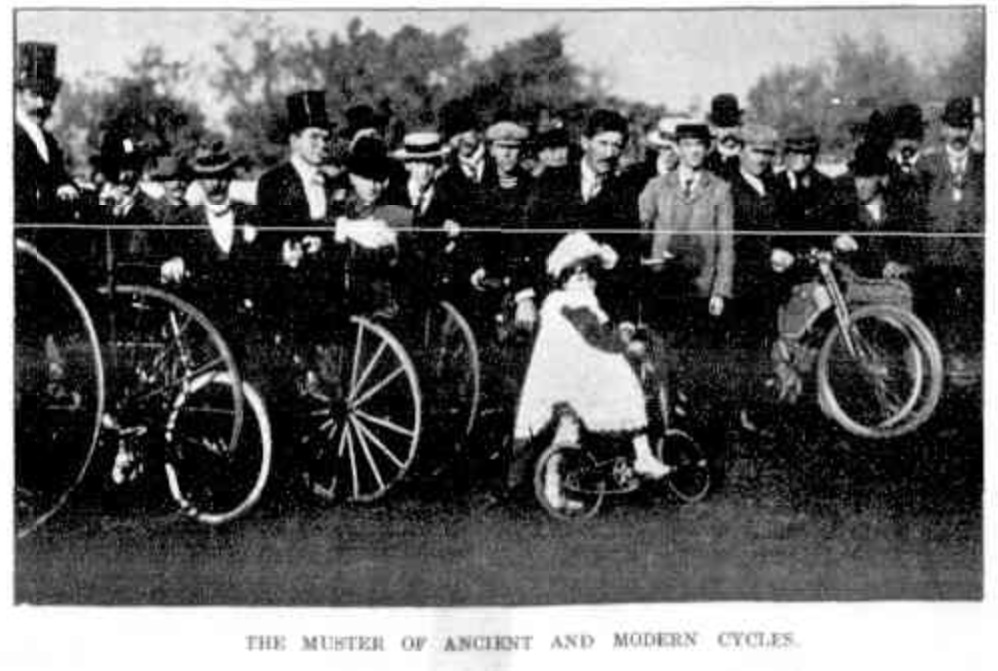
An interesting part of the program ‘to indicate the growth of the (motor) industry’ was a parade of cars, motor-cycles, quadri-cycles, cycles and velocipedes, the organisers showing a keen sense of history of transport with a focus on the previous thirty or forty years.

The Adelaide Observer reported that the display created a favourable impression. ‘The big cars whirred around the track with surprising velocity, and so easy were they to control and so graceful in their evolutions that their popularity is assured’. It seems fair to say that the success of the demonstration of cars on that October day, and the following weekend provided some type of impetus for the first car race in Australia at Sandown and the first car race in South Australia, at Morphettville two years later.

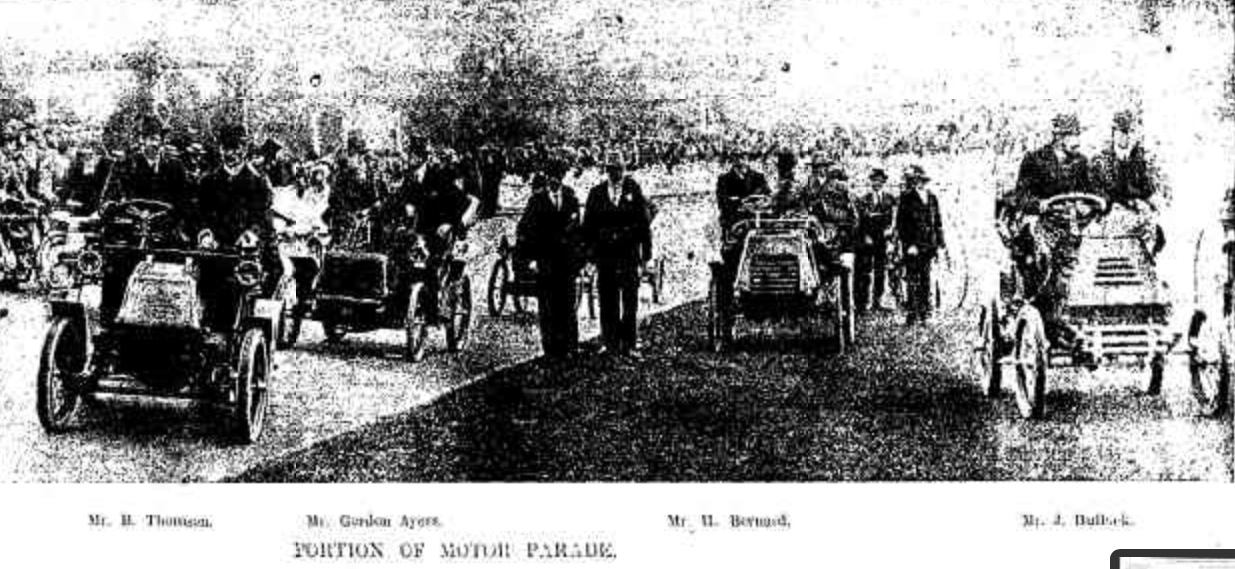
Parade of motor cars at Adelaide Oval on 11 October 1902 (Observer)

Context is Everything in History?…

We forget sometimes just how far we have come.

The Adelaide Observer of 18 October 1902, in an article entitled ‘How The World Moves’ comments upon how the dreams of Jules Verne were coming true. At the time the voyage to America from the UK had been cut to 124 hours, ‘with only 70 hours at sea’. ‘In rather less than 400 years the record of Magellan in circumnavigation of the globe has been cut from three years to between 50 and sixty days’.

The article addresses ‘The Age of the Engineer’ and notes that the cheaply constructed great Siberian railway being eventually destined to be recognised as one of the great wonders of the railway world, with ‘the Era of the Canals’ taking 1000 miles out of  global journeys. ‘Many ancient landmarks are threatened and many time honoured routes promise to become ways of the past, interesting as the grass grown coach roads of England, but no more frequented by the conveyances one so familiar.’

In addition to the above more macro view of progress, this extract from the Adelaide ‘Chronicle’ of the same day very concisely places the development of the bicycle, motorcycle and motor car in the context of the up till then omnipotent form of personal transport, the horse…

‘The opening day of the League of Wheelman’s October race meeting marked an interesting epoch in the history of cycling. One of the events on the programme was a motor cycle race- the first held in the Southern Hemisphere, and it was to be the introduction of this novelty and an exhibition of motor cars that the large attendance was due’.

The cycling world is one of rapid evolution. Forty years ago velocipedes equal to a speed of six or seven miles an hour were a favourite means of locomotion. They gradually developed into the ordinary high machine, with which it was possible on a good track to ride a mile in three minutes. It is only a little more than a decade since the ‘safety’ chain-driven machine, with pneumatic tyres, made its appearance in the streets of Adelaide, and the ‘ordinary’ disappeared before its more stylish and faster rival.’

‘From the early nineties the safety revolutionised cycle racing, and record succeeded record at a bewildering rate, until it became common for a cyclist behind pace to eclipse the times of the best racehorses the world has ever produced’.

‘The popularity of the sport developed…the League of Wheelmen…at one time promised to become a very wealthy body…but two or three years later the absence of crack riders from the other side of the world and the lack of variety in the sport, coupled with unfavourable weather conditions, resulted in unprofitable meetings’.

‘Now the motor has come to play its part in the sport, and its advent was enthusiastically welcomed on Saturday…the gate receipts…and next Saturdays takings…will all be profit.’

Mix of old and new cycles, Adelaide Oval 11 October 1902 (Observer)

‘The story of the evolution of the motor car was admirably told on Saturday in the exhibition of ancients and modern methods of locomotion…the early form of the bicycle was illustrated by old wooden velocipedes…40 years old…ridden in the old fashioned costume of top hats and black suits with flying coat-tails…Alongside of these were motorcycles ridden by Messrs TP O’Grady, A Allison, W Baulderstone, W Courtney, R Davis, HM Aunger, RW Lewis, FR Burden, EA Gowan, D Bruce and EF Wilksch were shown.’

‘Most interest was shown in the motor cars, of which four were shown. Mr Gordon Ayres brought his car, a very handsome one…but it could not be taken onto the track…with an old set of tyres one of which blew out. Mr H Thomson’s ‘Swift’, which he has just imported attracted considerable notice. The other two cars which raced around the oval were both locally manufactured. One was shown by Mr V Lewis, and driven by Mr H Bernard, and the other was exhibited and driven by Mr J Bullock. In addition to these Messrs J Bullock, H Bernard and the representative of the Massey- Harris Company had motor quadricycles on the track. With all these machines careering round the oval at their best pace the spectacle was in the highest degree interesting. The exhibition was the success of the day, and when the officials of the league saw the impression it made on the spectators they at once resolved to repeat it next Saturday. Mr Ayers car will then be shown in action with all the others.’

TP O’Grady with his ‘works’ Lewis motor-cycle- winner of the first motorbike race in Australia 11 October 1902 (Observer)

‘The other novelty of the meeting was the motor cycle race of 5 miles’. Originally their were 13 entries with the race divided into two heats, with two machines withdrawing from the first heat.

‘TP O’Grady was off scratch, W Courtney 30 seconds, A Allison 50 and W Baulderstone 1 min 5 sec. Baulderstone was away well and had almost completed a lap when O’ Grady was pushed off. Courtney retired early with a mechanical problem. O’ Grady’s machine took a while to get going, but when it did it was soon seen to be the fastest machine on the track. It lapped the others three times in the 15 laps and covered some of the circuits in 32 and 33 seconds. Its fastest pace was at the rate of 1 min 32 sec for the mile, or 30 miles per hour. O’ Grady an old time racing man, who constructed the motor himself at Mr V Lewis cycle works, was loudly cheered as he finished his five miles journey in 9 min 10 secs. Just after he crossed the line the belt of his motor broke. There was an interesting run for second place between Allison and Baulderstone. The latters machine lost the pace with which it started, and Allison was able to keep ahead’.

A story about Vivian Lewis and his nascent cycle, motor-cycle and car company is a story in itself, O’Grady was Works Manager, Works Rider/Driver! and a shareholder in Vivian Lewis Ltd.

The Adelaide Observer had this to say about O’Grady’s performance. Thomas Patrick ‘Tom’ O’Grady ‘carried off the honours’ covering the 5 miles in a time of 9 minutes 10 seconds ‘at times he travelled at the rate of 39 miles an hour’. Some of the laps of 612 yards were covered in 33.25 seconds with one mile timed at 1min 33 seconds. It was the first occasion on which the machine had been tested, it was not completed until the Saturday morning, the average of 1min 50 seconds per mile ‘must be considered gratifying, particularly as a strong wind had to be contended with’.

There were six starters in the second heat which was run at a lower pace with interest being lost when R Davis’ belt broke with 3 laps to go when he was overhauling the leaders. J Bullock won from FH Burden, RW Lewis, EF Wilksch and Davis. ‘The final between the first three in each heat will be run next Saturday’.

In a full program of bicycle racing many of the motorised racers jumped onto their normal racing cycles.

The Chronicle concluded its report by commenting favourably on the performance of ‘The Locomotive Band’, which gave a fine rendition of the march ‘Colonels Parade’, that there were no accidents during the day which ‘was well managed in every respect’.

In keeping with the mood of the week a novel race on the road was also advised, this comprised, ‘…a contest between B Thompson’s 4.5 hp car and the Broken Hill Express train ‘in a scamper to the Burra, the chauffeur and the engine driver to shake hands at the Adelaide Railway Station before starting’! Logistically this would have been easy as Adelaide Station is only several hundred metres from Adelaide Oval.

So. What do we take from all of the wonderful prose about the days activities on 11 October?…

Firstly, the claim that the first motor-cycle race in the Southern Hemisphere was run at Adelaide Oval on 11 October 1902 and won by TP O’Grady on a local Lewis machine.

It seems clear the first motor-cycle racers were graduates of bicycle racing.It makes sense doesn’t it in terms of the balance, competitiveness and the need for more speed required!

It also seems the case that the ‘League of Wheelmen’ saw motor cycle racing- and especially car competition which appears from the report to be the most popular event or motorised display on that October day, keys to future commercial success. To turn around their flagging gates.

Of course the bike and car racers would soon go their own separate ways probably when a greater number of venues became available to them both on public roads and specialist, speedway, closed circuits. But for the moment the would be motorised racers needed venues and the cyclists had them, and ‘in good nick’ too.

(Observer)

The 18 October meeting was run in splendid Adelaide spring weather with much expected from the motorised events but mechanical mayhem somewhat ruined the motor-cycle racing program…

The organisers changed the spectator amenities during the week by allowing better viewing of the cars, perhaps by allowing the punters to get closer to the action. His Excellency the Lieutenant-Governor conferred his patronage to the carnival. ‘Visiting officers of the Australian Squadron have accepted the Leagues invitation to be present’ the Evening Journal notes in an article published on the day of the race. Its interesting in these modern times to see what was regarded as relevant then but now is very much ‘who gives a rats’ stuff. Similarly the language of the day is wonderful in its eloquence, the prose of times gone by I enjoy I must admit. Long-winded sometimes but enjoyable nonetheless!

O’Grady’s ‘brilliant run’ of the week before stamped him as a certainty for the final, with many returning spectators expecting him to lap the field twice aboard his Lewis over the five mile duration of the final.

The contemporary newspapers reported upon the riders but not the machines, sadly. So, in the main, we don’t have details of the bikes ridden on that important occasion. The final was a race between five competitors with TP O’Grady off scratch, A Allison 50 seconds, VR Burden and W Baulderstone off 1 minute 5 seconds and the limit-man J Bullock on 1 minute 20 seconds.

A warm up for the bikes was provided during the cycle and motor parade which was also a feature of that days events. The competitors for the race had a trouble free run during this morning event.

During the later stages of the afternoon, just before the feature cycling event ‘The Australasian Ten Miles’, won by Victorian DJ ‘Don’ Walker, the ‘Motor Race’ commenced.

Bullock, Baulderstone, Burden and Allison completed a lap before O’Grady was pushed off from the start. There was general disappointment as the locally built Lewis bike was pulled onto the grass by its driver, the engine not firing properly. With 7 laps to go Burden passed the stationary O’ Grady, his ‘machine going splendidly’.

2 laps later Burden lapped Allison and with 4 to go caught Baulderstone again, with whom he had started. With 2 laps to run Burden passed Allison and finished an easy winner in 9 minutes 15 seconds. His time was 5 seconds slower than O’Grady’s over the same distance the week before. Bullock was 2nd in 9 mins 34 seconds and Baulderstone 3rd in 10 min 23 secs. Prize money for the race was ten, three and two pounds from first to third places.

The distance between Adelaide Oval and the fringe of Victoria Park, site of the first Formula One Australian Grand Prix in 1985 is small, 1.5 Km, but the performance difference between the cars displayed and Keke Rosberg’s victorious 900bhp Williams FW10 Honda is immense. In their wildest dreams, a spectator present on that glorious October 1902 day who also attended the AGP on a similarly wonderful, hot day in November 1985 could not have conceived of cars of such vastly different performance and sophistication within their own lifetime?

The Adelaide built Lewis car number 1, the first car built in South Australia on display/parade at Adelaide Oval on 11 October 1902, driver H Bernard. In 1902 form the car was powered by a water cooled 5HP, petrol, single-cylinder engine with ‘electric ignition’. The transmission had belt drive to a countershaft behind the rear axle from where spur gears drove the wheels. The Adelaide Oval event was one of the last public appearances of the first Lewis- motor car design was progressing rapidly and the 2 year old car was becoming dated. Lewis did build a few more cars but the future for the company was importing rather than manufacture, within a few years the business was distributing Napier, de Dion, Talbot and Star brands (unattributed)

Photo Credits…

 State Library of South Australia, Adelaide Advertiser, Adelaide Observer

 Bibliography…

Adelaide Advertiser 11, 17, 20 October 1902, The Daily Telegraph Sydney 13 October 1902, Adelaide Observer 18, 25 October 1902, The Adelaide Register 20 October 1902, earlymotor.com

Tailpiece: Be There on 18 October 1902…


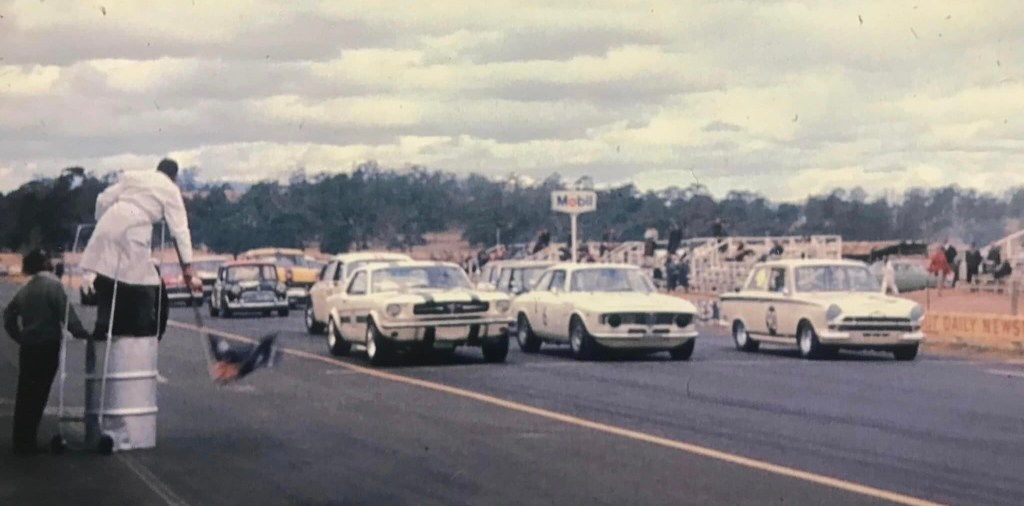
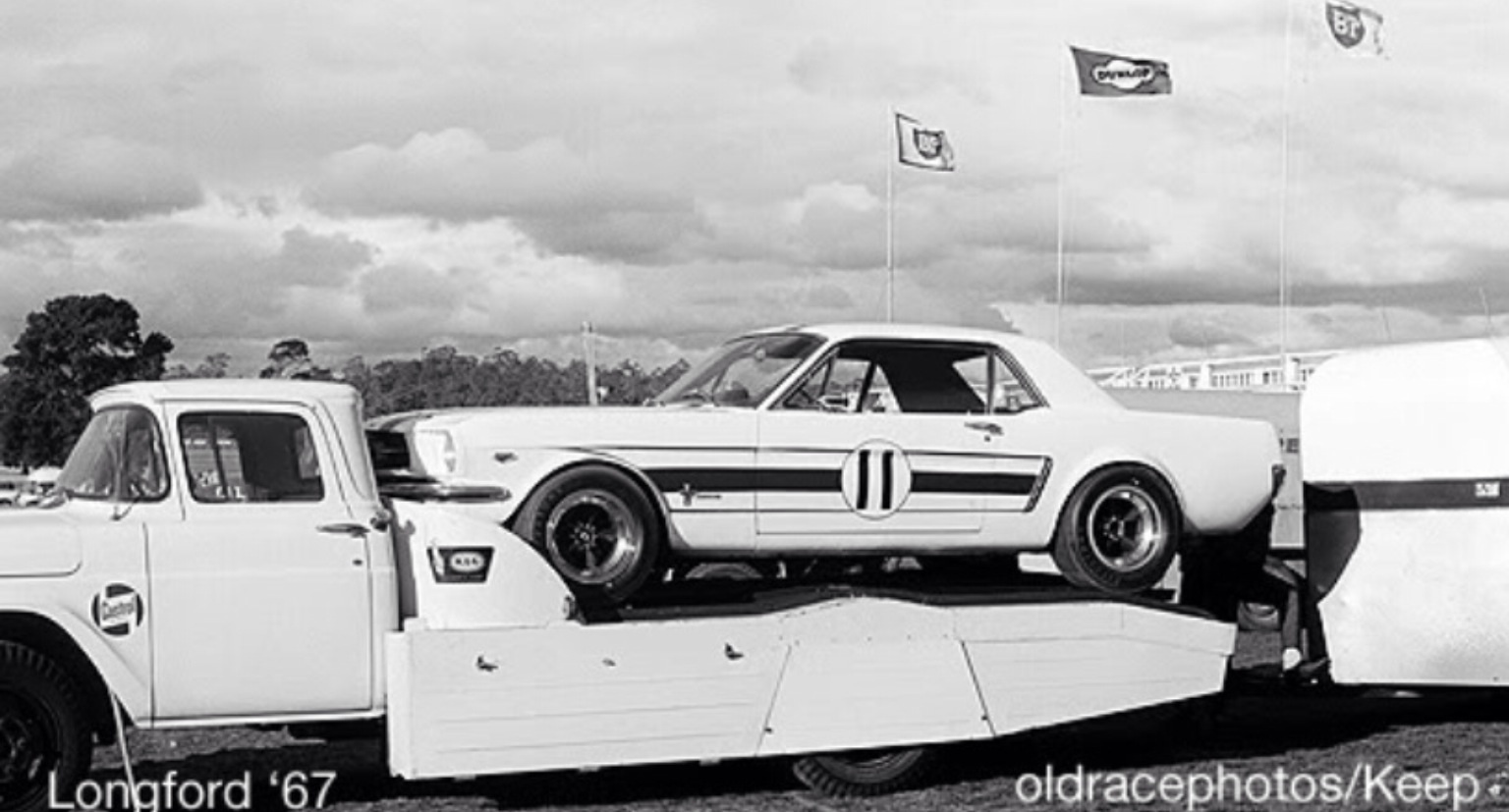
Robin Pare, Pete Geoghegan in Ford Mustangs, Bruno Carosi Jag Mk2, Frank Gardner Alfa GTA and Robin Bessant Lotus Cortina on the downhill plunge towards The Viaduct, Longford Improved Production Touring Car race 1967 (oldracephotos.com)

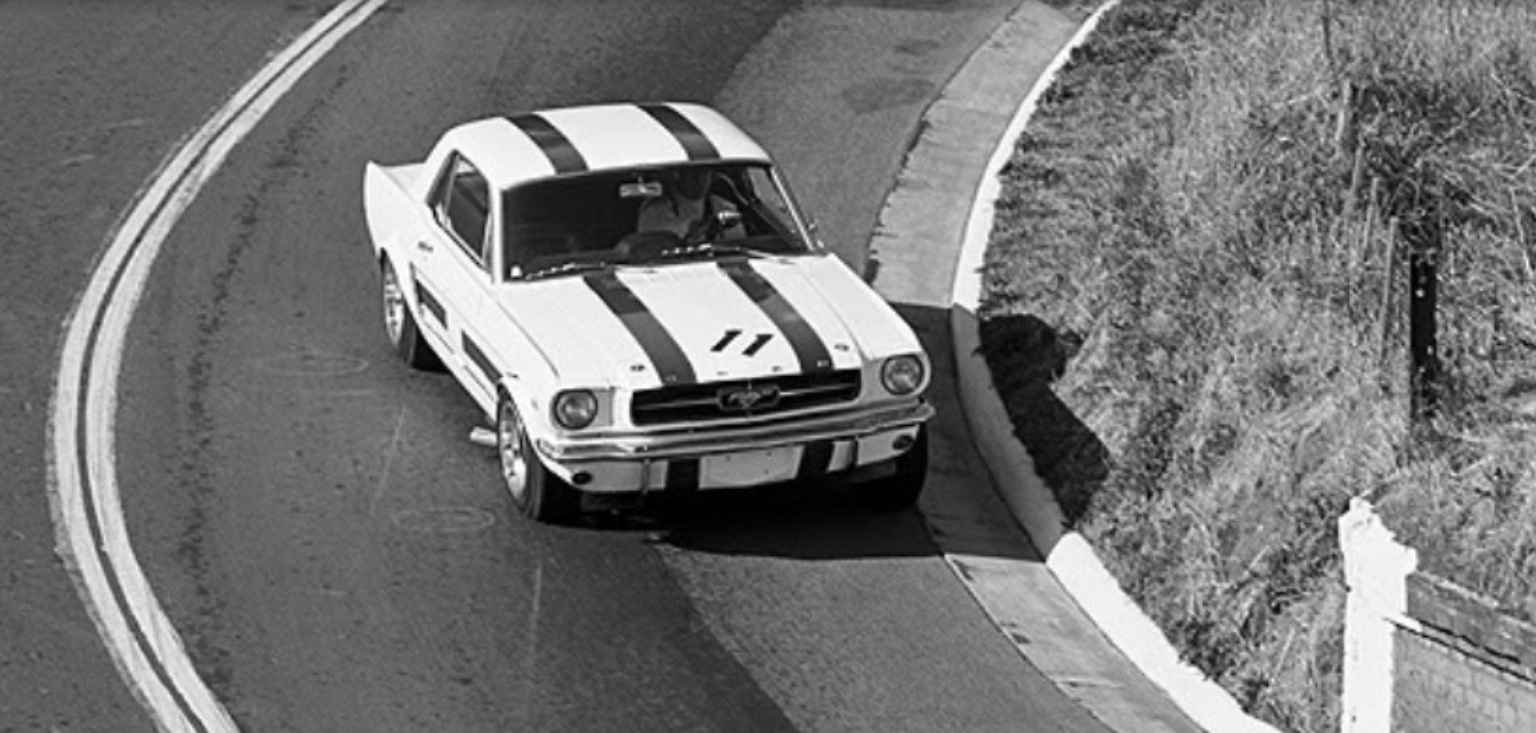
Pete Geoghegan did so many times too! The Sydneysider is here doing his stuff aboard the first of his two Ford Mustangs at Longford during the Tasman round in February 1967…

The Brothers Geoghegan, Leo and Ian or ‘Pete’ were stars of Australian Motor Racing from the late-fifties into the mid-seventies, Leo in single-seaters and Pete in ‘taxis’, touring cars of all pursuations. When he was a youth Pete was quick in a brief career in single seaters and a Lotus 23 Ford but he became a ‘big unit’ so his girth meant he was best suited to cars with a roof.

Geoghegan , Gardner and Carosi off the front row, no sign of Pare – perhaps not the same race grid as above (oldracephotos.com)

A supreme natural, Geoghegan made a car sing with flair and feel blessed to some from above. Every car he drove. His band-width extended from GT’s to Sports Cars, Production Tourers and very highly modified Sports Sedans- sedans of considerable power and performance.

His CV included some of the most iconic cars raced in Australia over the decades above including a Lotus 7 , 22, 23, the Scuderia Veloce Ferrari 250LM, Holden ‘Humpy’, Jaguar 3.4, Morris 850, the two Mustangs, Cortinas- both GT and Lotus variants, Falcon GT’s, Falcon GTHO’s, Valiant Charger E49, highly modified Porsche 911’s, his iconic, Ford factory built and later Bowin Cars modified Ford Falcon GTHO ‘Super Falcon’ and the superb John Sheppard built Holden Monaro GTS350 Sports Sedan.

That car was as conceptually clever, beautifully built and presented sedan racer as any ever constructed in Oz. Lets not forget his late career drives in Laurie O’Neill’s Porsche 935, a notoriously tricky device to master. Much earlier on he drove O’Neills Aston Martin DB4GT Zagato, every bit as exotic as the 935.

(T Watts)
Big Pete finesses the Mustang into The Viaduct (oldracephotos.com)

Geoghegan, five times Australian Touring Car Champion 1965-69 was an immensely popular racer with the fans, his bulk, manner and ‘stutter’ part of his appeal. He was not without his issues mind you. Touring Car racing is a religion in Australia, our sedan racing has been the equal of the best in the world for decades and arguably for the last 20 years our V8 Supercar category has been consistently one of the Top 5 sedan racing contests on the planet.

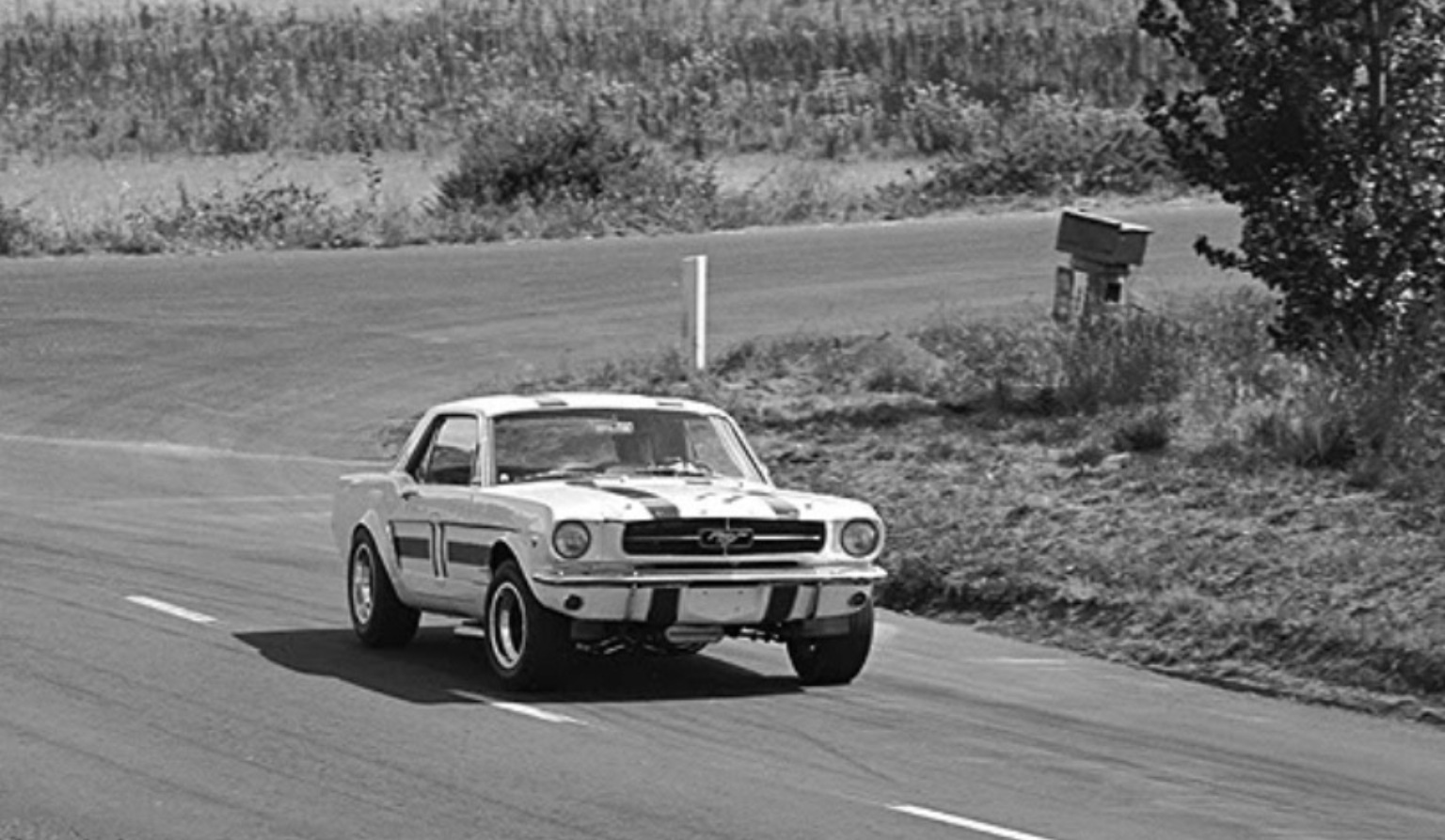
A touch of the opposites on the exit to Newry (oldracephotos.com)

So, the pantheon of talented touring car aces is large, and membership of the Top 10 a subject of much informed pub chatter, tough. Most knowledgeable touring car observers would have Geoghegan in their Top 10, if not Top 5, along with the likes of Norm Beechey, Peter Brock, Allan Moffat, Dick Johnson, Jim Richards (a Kiwi but we take him as our own) Mark Skaife, Glenn Seton, Craig Lowndes, Garth Tander, Jamie Whincup and others.

(oldracephotos.com)

Etcetera…

(unattributed)

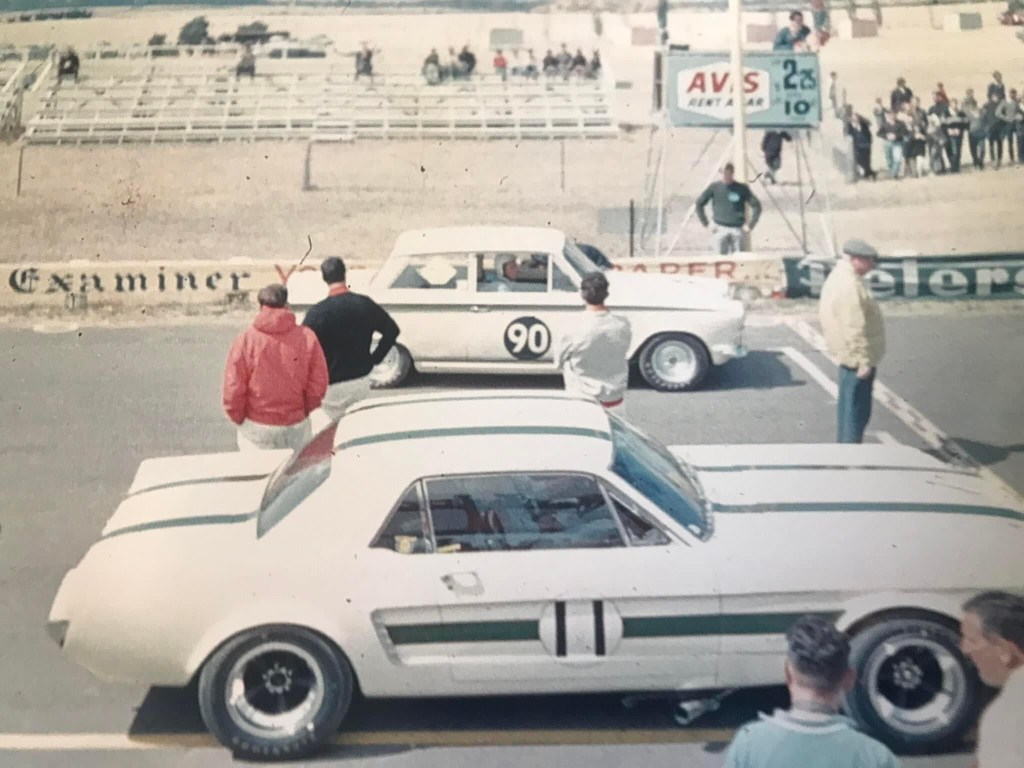
Geoghegan, Gardner and Robin Pare.

(unattributed)

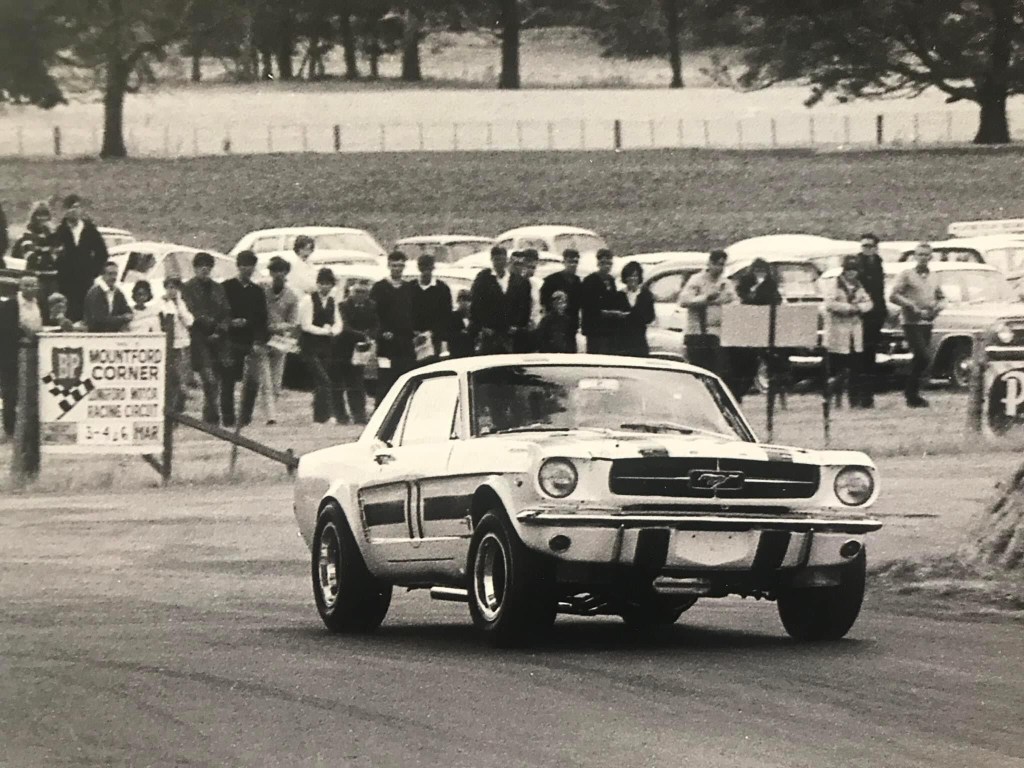
Pete booting the ‘Stang out of Mountford in typical style.

(unattributed)

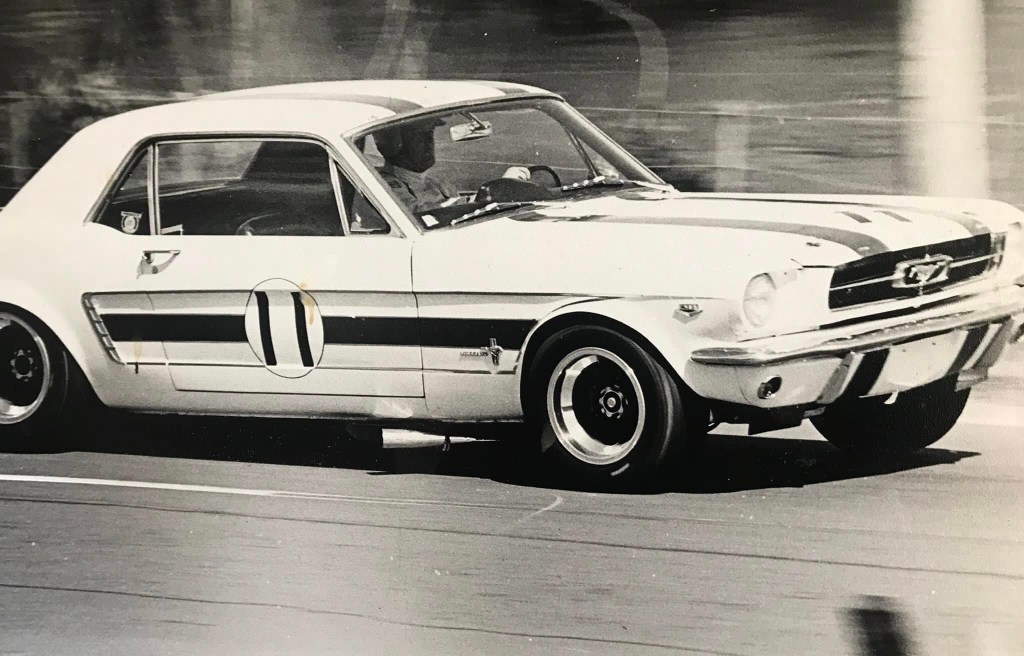
Geoghegan and Pare.

(unattributed)

Photo Credits…

Oldracephotos.com- Harrison and David Keep, Tim Watts

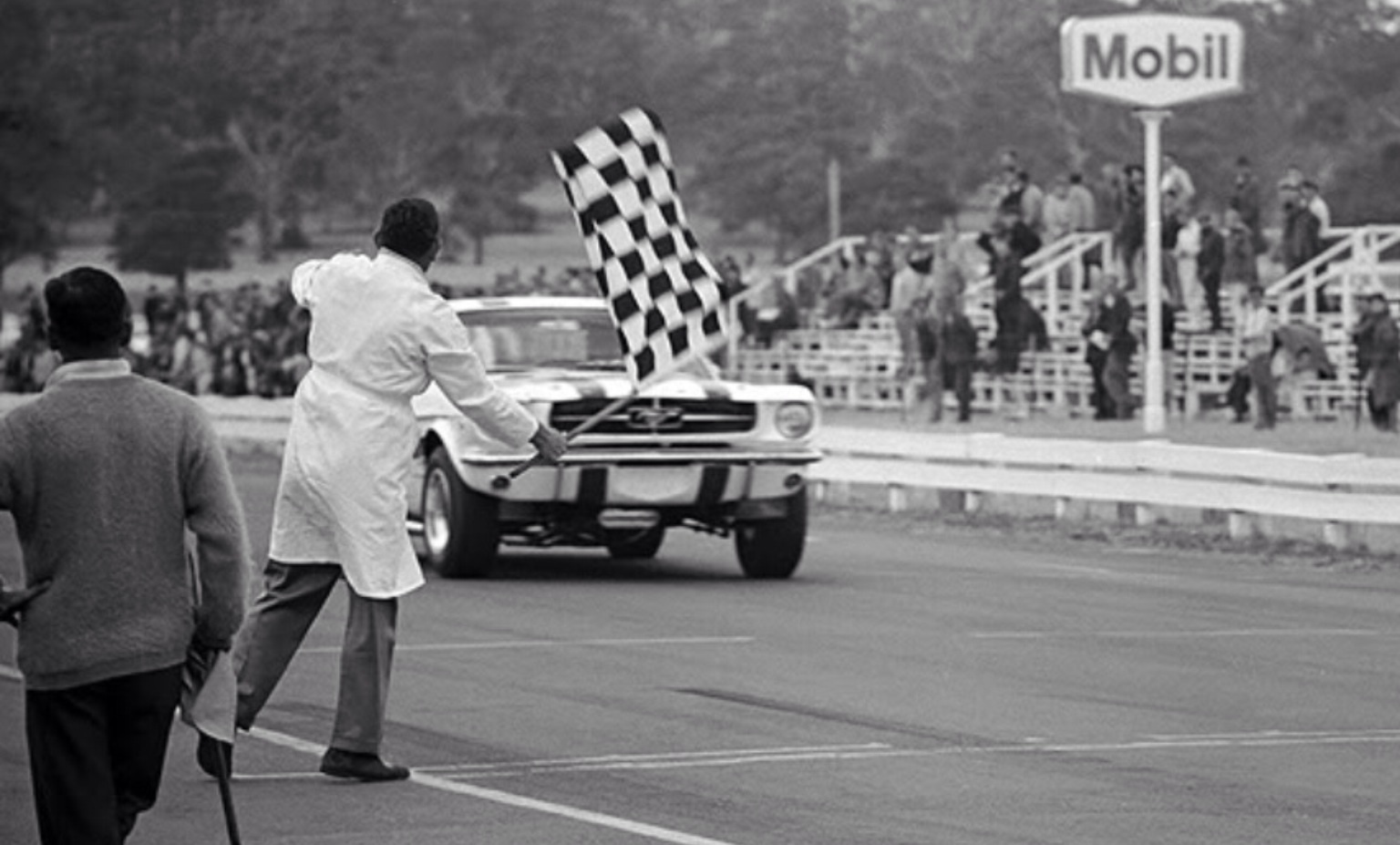
Tailpiece: Came, Saw, Conquered and then returned to Sydney…

Other Reading…

Pete Geoghegan and his Falcon GTHO ‘Super Falcon’

Pete’s 1965 Mustang notchback

http://www.bowdensown.com.au/collection/ian-pete-geoghegans-1965-mustang

Finito…

image

Glenda Foreman focusses on the Heuers whilst Pedro Rodriguez runs up-front at Le Mans 1970…

Pedro’s girlfriends powers of concentration were not tested, the Mexican’s John Wyer Porsche 917K was out of the race on lap 22 with engine failure, he and Leo Kinnunen started from grid 5. Another 917K, the Hans Hermann, Richard Attwood car won the race.

image

image

Rodriguez/Kinnunen JW Porsche 917K Le Mans 1970 (Schlegelmilch)

Credits…

Rainer Schlegelmilch

Tailpiece: Leo, Pedro, Brian and Jo. Kinnunen, Rodriguez, Redman and Siffert, the 1970 JW Automotive drivers before the off…

image